Introduction
Bovine respiratory disease (BRD) is arguably the most complicated mammalian disease that exists. The pathogenesis of BRD in newly received beef calves is influenced by the segmented infrastructure of the beef production system, social and cultural factors that influence management decisions (or lack thereof) by beef producers, marketing strategies, genetics, environment, stress-induced immunosuppression, and multiple viral and bacterial agents (Taylor et al., Reference Taylor, Fulton, Lehenbauer, Step and Confer2010). It is also difficult to accurately predict and diagnose BRD in individual beef cattle within a population; it was determined that the sensitivity and specificity of traditional BRD detection methods was 61.8 and 62.8%, respectively (White and Renter, Reference White and Renter2009). Diagnostic difficulty in the commercial setting is further demonstrated by previous research that retrospectively correlated lung lesions presented at slaughter with clinical BRD treatment during the feeding period (Wittum et al., Reference Wittum, Woollen, Perino and Littledlike1996; Thompson et al., Reference Thompson, Stone and Schultheiss2006; Tennant et al., Reference Tennant, Ives, Harper, Renter and Lawrence2014). These studies indicated cattle, with gross lung lesions present at slaughter, that were never treated for BRD during the feeding period; conversely, some cattle that were treated for BRD during the feeding period had no evidence of lung lesions at slaughter. In the feedlot, where BRD is most prevalent, disease diagnosis is dependent upon human evaluation and the basic strategy of pulling individuals for further evaluation of BRD has not changed in decades. Pen riders are professional field diagnosticians and a critical component of BRD management, but pen rider availability and expertise are limited. Furthermore, an individual pen rider may be responsible for the daily evaluation of up to 10,000 cattle in a feedlot so observation time of individual cattle or pens must be brief. Advanced technologies such as accelerometers, radio frequency identification, and global positioning systems have the potential to enhance BRD field diagnosis, but their practicality in the commercial setting requires positive cost-benefit, reliable function in harsh environments, and integration into current health management systems.
Traditional behavior assessment for BRD diagnosis
We have used visual evaluation of cattle behavior for the purposes of disease diagnosis for many decades, with questionable success. In the feedlot, the pen rider is responsible for daily monitoring and clinical determination of individual cattle health and the methods for BRD detection have remained relatively unchanged since the advent of commercial cattle feeding. Advantages and disadvantages of traditional visual monitoring for disease diagnosis exist. Perhaps the greatest advantage a pen rider has over any technology is human intuition and the ability to think. Experienced pen riders often comment that a steer or heifer ‘just doesn't look right’ as justification for BRD diagnosis. Although rudimentary, indeed this is often an effective tactic with an experienced eye, but it illustrates the disadvantage of subjectivity and potential disagreement between pen riders. Perhaps depression is the foremost behavior alteration that a pen rider uses in supporting clinical BRD diagnosis. Depression in cattle can be characterized by droopy ears, compact or extended posture, dull eyes, and general lethargy. Biologic reasons for depression in BRD-affected cattle include energy conservation for immunologic processes and indirect effects of the febrile and inflammatory response against infectious agents (Hart, Reference Hart1988). However, it is known that other diseases, including metabolic acidosis, result in similar behavioral alterations so it is likely that an unknown proportion of acidotic animals are incorrectly diagnosed as BRD cases in the feedlot (Richeson et al., Reference Richeson, Samuelson and Tomczak2019). The lack of pathognomonic behavior associated with BRD is problematic for both traditional and novel behavior assessment.
It is doubtful that feedlot pen riders will be replaced by technology. If novel behavior assessment provides early and superior sensitivity and specificity for BRD detection, the need for removal of BRD cases from their home pen to a hospital will always require pen riders unless robotic technology for animal handling advances tremendously. Understandably, pen riders may view the implementation of novel behavior assessment systems for BRD detection in the feedlot as a threat. Therefore, feedlot managers and consulting veterinarians will be required to inform pen riders of their continued importance in feedlot health management for novel behavior assessment to be successfully implemented in the production setting.
Novel behavior assessment for BRD diagnosis
Currently, there are three primary technological options to assess behavior in beef cattle, and each method has the potential to detect BRD early. The available systems include (1) three-axis accelerometers that quantify physical behaviors such as steps, standing/lying time, rumination time, or overall activity index, (2) systems that document feeding and watering behavior via RFID detection at the feed bunk and water trough, and (3) triangulation systems that continuously document spatial behavior within a pen, including the ability to locate important features in the pen, such as feed or water source, and to monitor those specific activities. Previous reviews (Theurer et al., Reference Theurer, Amrine and White2013; Wolfger et al., Reference Wolfger, Timsit, White and Orsel2015; Richeson et al., Reference Richeson, Lawrence and White2018) outlined the specific functions of each behavior assessment system and highlighted some of the research conducted. The focus of this review was to provide a general discussion on the potential benefits and challenges associated with the implementation of novel behavior assessment systems to assist in BRD detection in the commercial feedlot. The novel behavior monitoring systems previously identified offer the benefit of being remote, continuous, and objective, but they will require significant investment and adaptation to use effectively.
Remote monitoring
Monitoring the behavior of individual cattle for BRD detection via advanced technology systems offers several advantages over human observation. First, these systems are remote and do not disrupt natural behavior expressions compared to traditional visual observation by a pen rider. Most of the technologies use an ear-tag accelerometer or transponder that communicates activity or location, respectively to a central computer system for further processing of data. Although pedometer devices can better detect differential physical behaviors, they are typically attached as an ankle bracelet and may transiently alter the behavior in some cattle until they adapt to wearing the pedometer device. Poor retention and adverse scenarios such as misplacement are more likely for pedometers versus ear-tags, as many of the commercial pedometers designed for livestock are intended in dairy applications and do not appropriately fit smaller beef calves. Nevertheless, the remote advantage of behavior monitoring technologies is clear. Cattle are more likely to disguise sickness behavior in the presence of a human evaluator because of evolutionary-driven prey instincts, making early or timely BRD diagnosis more difficult for visual diagnostic approaches.
Continuous monitoring
Continuous monitoring afforded by novel behavior monitoring technologies is another advantage over visual observation and has the potential to save time and labor in the commercial feedlot if data are managed effectively through an accurate and precise algorithm and complimentary software system. Daily visual evaluation of individual animals in a large feedlot requires extensive time and labor. In production settings, it is typical to house 50 to >250 cattle in a feedlot pen. Large pen populations may overwhelm less experienced pen riders causing false-negative or false-positive BRD outcomes, but technology can overcome this challenge because each animal is monitored constantly.
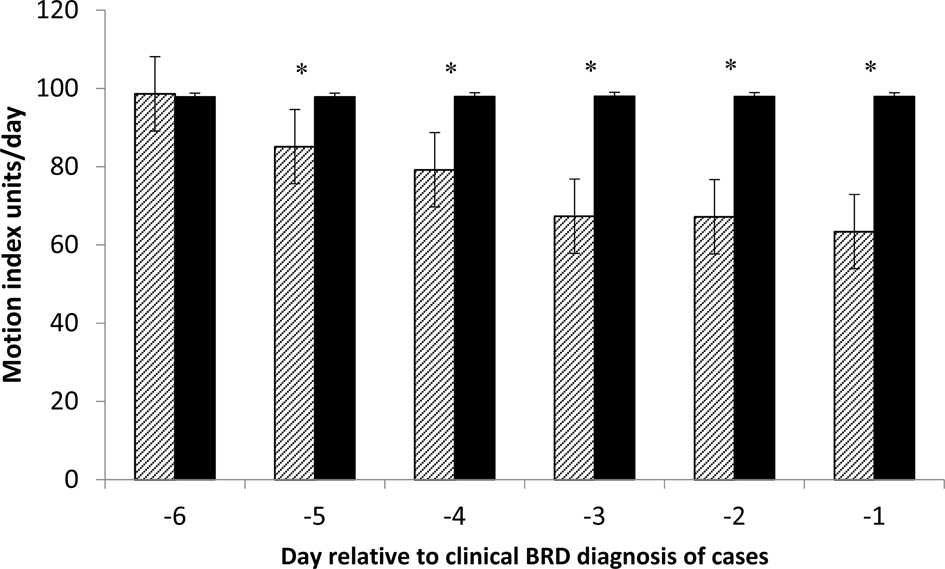
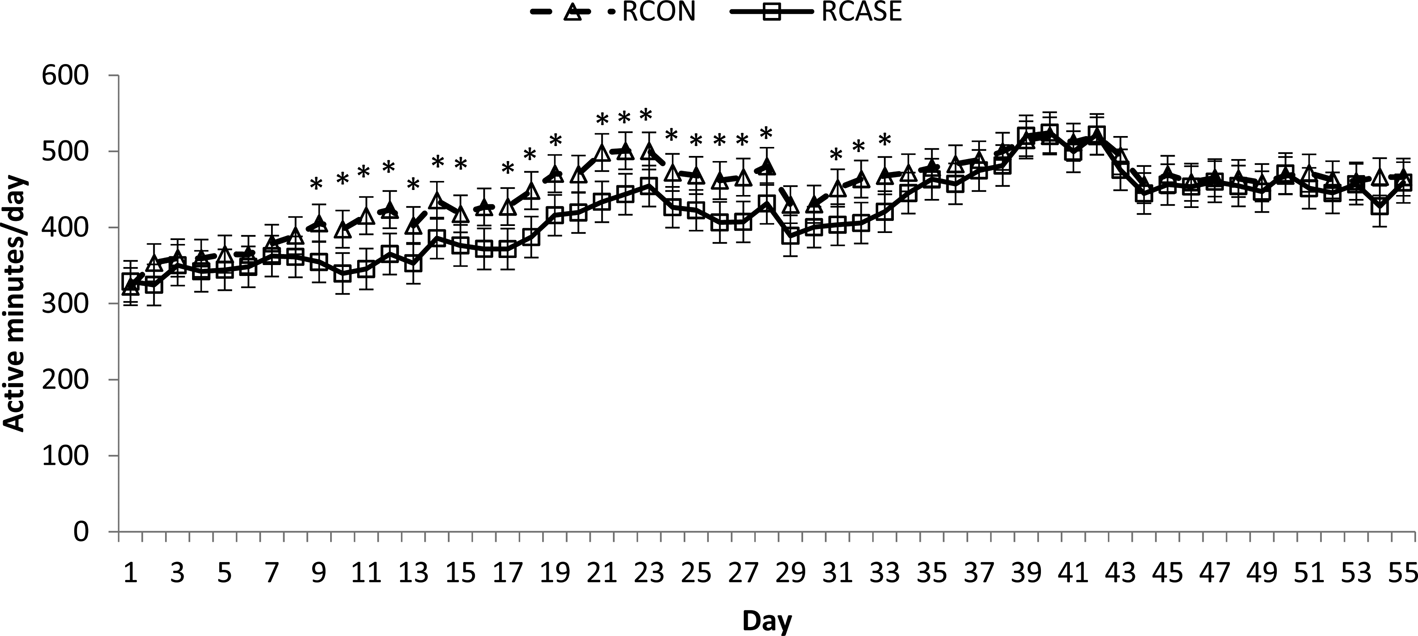
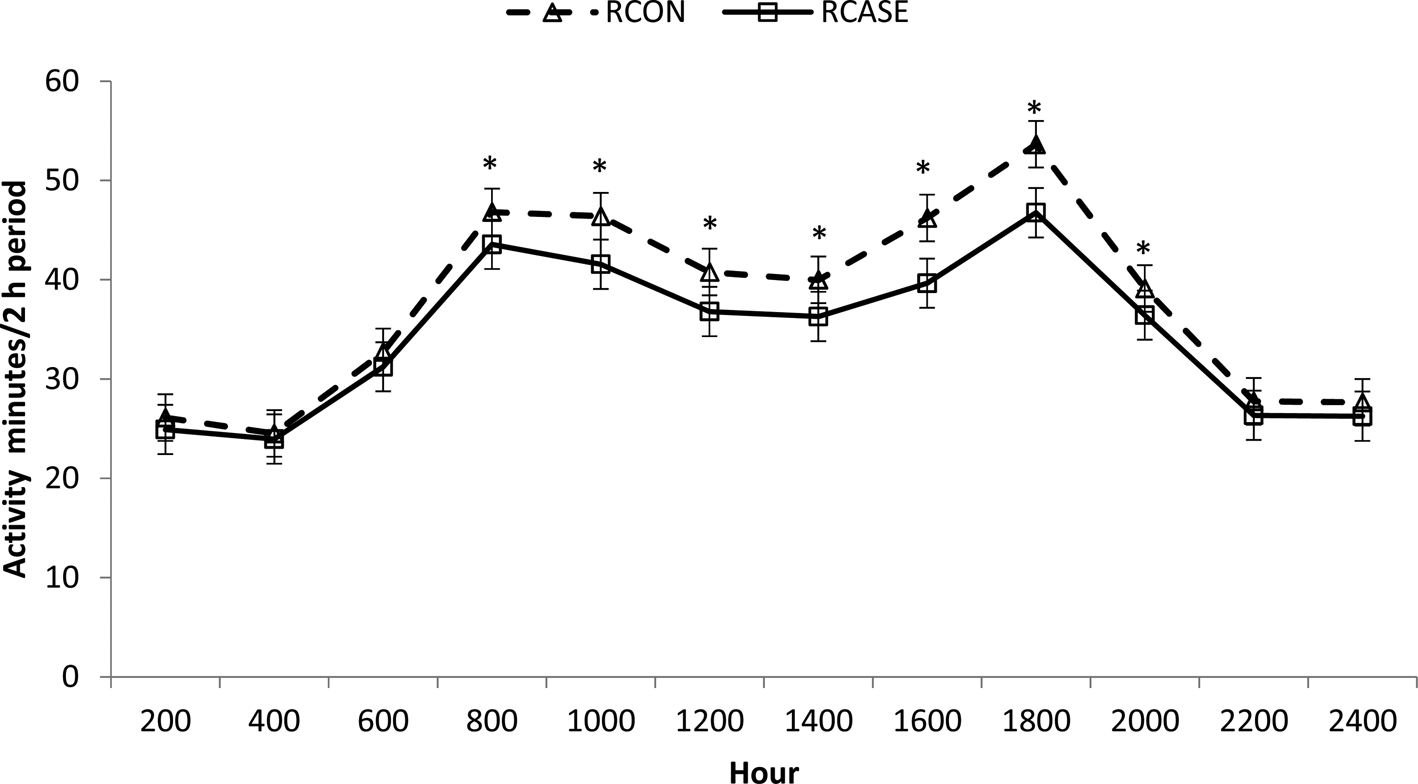
The constant logging of behavior data allows comparison of individual animals to the pen average, transient changes in behavior within a given animal, and circadian behavior patterns. Pillen et al. (Reference Pillen, Pinedo, Ives, Covey, Naikare and Richeson2016) reported changes in the activity index of naturally occurring BRD cases several days prior to clinical diagnosis by pen riders in a commercial feedlot (Fig. 1). Tomczak et al. (Reference Tomczak, Samuelson, Jennings and Richeson2019) evaluated average daily active minutes logged by an accelerometer device in high-risk, newly received feedlot calves and reported differences between BRD cases and control calves never diagnosed with BRD (Fig. 2). Similarly, circadian differences existed between BRD cases and controls (Fig. 3; Tomczak et al., Reference Tomczak, Samuelson, Jennings and Richeson2019). It is important to note that the activity differences between BRD cases and controls reported by Tomczak et al. (Reference Tomczak, Samuelson, Jennings and Richeson2019) only existed between the hours of 08:00 (morning feeding time) and 20:00 (cessation of evening activity). This suggests that future behavior monitoring applications for early BRD detection may only require data logging between these hours of increased overall activity, which could reduce the amount of data generated and simplify the application of novel behavior assessment systems.
Average motion index units/day for clinical bovine respiratory disease cases (shaded bars) and controls (solid bars) on the day relative to BRD diagnosis in a commercial feedlot. Effect of BRD (P < 0.001), day relative to BRD (P = 0.99), and their interaction (P < 0.001). Adapted from Pillen et al. (Reference Pillen, Pinedo, Ives, Covey, Naikare and Richeson2016).

Daily activity differs between calves diagnosed and treated at least once for BRD (RCASE) and those never treated (RCON). Active minutes was generated from an accelerometer collar (Allflex Livestock Intelligence, Madison, WI, USA) with daily means averaged by BRD status from 2 h data logging periods. Effect of BRD, P = 0.02; day, P < 0.01; and BRD × day, P < 0.01. *RCASE differs from RCON within day (P < 0.05). Adapted from Tomczak et al. (Reference Tomczak, Samuelson, Jennings and Richeson2019).

Circadian activity differs between calves diagnosed and treated at least once for BRD (RCASE) and those never treated (RCON). Active minutes was generated from an accelerometer collar (Allflex Livestock Intelligence) with 2 h data logging intervals averaged by BRD status across the 56th day following feedlot arrival. Effect of BRD, P = 0.71; hour, P < 0.01; and BRD × hour, P = 0.04. *RCASE differs from RCON within hour (P < 0.05). Adapted from Tomczak et al. (Reference Tomczak, Samuelson, Jennings and Richeson2019).

Objective monitoring
Fluctuations in work schedules, social dynamics, weather conditions, and the experience of horse and pen rider affect the efficiency of visual monitoring of behavioral exceptions for BRD diagnosis across feedlot pens. Technology may offer the advantage of consistent and objective monitoring that is not affected by emotion, environmental conditions, or experience. The value of novel behavior assessment for BRD diagnosis is influenced by the true sensitivity and specificity of BRD diagnosis by individual pen riders and other complicated dynamics that vary from one feedlot to another. It is possible that some of the better pen riders could perform BRD diagnoses at a similar level of sensitivity and specificity as novel behavior assessment systems. In this case, it is difficult to justify the investment cost for novel behavior assessment. However, where I see repeatable benefit with continuous monitoring, objective behavior monitoring is used in scenarios where multiple lots of high-risk calves are received over a period of several weeks, such as during the ‘fall run’ in feedlots that typically procure a large number of high-risk cattle. It is human nature and often feedlot standard operating procedure (SOP) to more closely or frequently monitor pens with new arrivals (i.e. <60 days on feed). If novel behavior monitoring is used in a group of cattle through re-implantation or beyond, technology is perhaps more likely to identify late BRD cases within a lot group after primary BRD outbreak has passed, because pen rider focus may shift to more recently received groups of cattle.
Implementation challenges
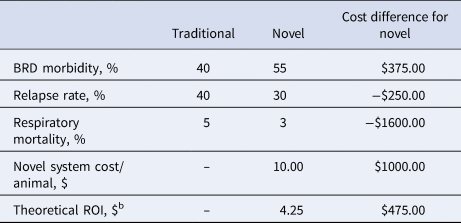
Cost-benefit is probably the primary challenge with the implementation of novel behavior assessment systems in the commercial feedlot. If BRD diagnostic sensitivity is improved with technology, the BRD morbidity rate, and thus antimicrobial treatment cost, could actually increase for novel versus traditional BRD detection methods. Therefore, the widespread adoption of novel behavior assessment systems for early BRD detection in the feedlot may hinge on cost savings from improved treatment success (i.e. reduced respiratory relapse rate), better growth performance, and less death loss. Conversely, it is possible that antimicrobial treatment cost savings could be realized for novel systems if specificity is improved. Table 1 displays a theoretical example of economically important health outcomes between novel and traditional BRD detection.
Theoretical health and economic outcomes of traditional versus novel BRD diagnostic systemsa

a Assumes sensitivity of 61.8% for traditional (White and Renter, Reference White and Renter2009) and 75% for novel in 100 head lot size with an average treatment cost of $25.00/animal and average death loss cost of $800.00/animal.
b Based on 100 animal lot size and assumes $10.00/animal total investment cost for novel implementation. Example does not consider performance or closeout differences between systems.
Another implementation challenge is the requirement for individual identification of cattle and behavior data management. To evaluate the behavior of individual animals electronically, they must be uniquely identified to effectively use the data for individual treatment decisions. Obviously, this would require feedlots using lot-level identification to convert to more intensive individual animal identification, which requires additional cost investment and management. However, an accelerometer ear-tag may be equipped with radio-frequency identification built-in as part of the cost structure.
Let us briefly visualize how invested use of novel technology for BRD diagnosis in the feedlot might affect pen rider duties. The software system generates a ‘suspect’ list of animals each morning based on behavior deviation and algorithmic (or decision tree) cutoff. The novel behavior system could be complimentary to the pen riders’ traditional duties because it can be used to enhance their diagnostic decision-making. Health management SOP for a feedlot may or may not dictate that pen riders pull every animal on the daily suspect list, or pull animals that are not identified by the novel behavior assessment system. My opinion would be to require a pen rider to pull all behavior ‘suspect’ animals for further evaluation, but allow pen riders the flexibility to make pulling decisions on their own if a particular animal appears clinically ill and eligible for BRD treatment but was not identified according to the behavior assessment technology. The ‘suspect’ list brings about another challenge; as a former cattle manager, I can imagine some of the responses I might get from a pen rider if I gave them a printed list of 200 individually identified cattle scattered across 10 or 20 different feedlot pens that they must find and sort out! Therefore, accelerometer or other devices used for behavior assessment and early BRD detection in the commercial feedlot will require a self-contained signaling mechanism such as a flashing light to facilitate timely pulling.
Conclusions
Cattle behavior is an important component of clinical BRD diagnosis, and emerging technology may greatly enhance our understanding and application of cattle behavior for animal health management in the production setting. Novel behavior assessment systems provide the benefit of being non-invasive, continuous, and objective, but further research is needed to understand their integration into existing health protocols for use as a tool for early BRD detection. The various behavior assessment systems will need to demonstrate positive cost-benefit, enhance existing health management protocols, and provide satisfactory retention and reliability in harsh conditions to gain widespread adoption in the commercial setting. Preliminary efforts suggest that continuous cattle behavior monitoring using various technology systems may allow earlier detection of BRD.