1. Introduction
In Turkey, when someone says “I took the train” instead of “I got on the train”, there is a good chance that the hearer will immediately infer that the speaker is either a foreigner or a Turk brought up abroad. It is generally believed that such people cannot speak Turkish “right”. There is nothing wrong grammatically with the utterance; what causes the foreigner treatment is simply the fact that you cannot take the train in Turkish but only get on it. Getting on a vehicle is the conventional way of relating how someone travels from one place to another. When part of that conventional wording is changed, as in this example, native speakers perceive it as unconventional. If such patterns stabilize in the speech community, the language has undergone change. This article is about such changes in Turkish as spoken by bilinguals in the Netherlands.
In example (1), there is reason to attribute the unconventionality to the influence from Dutch, the other language the bilinguals speak, if one compares the Turkish of the immigrants (NL-Turkish) with Turkish as spoken in Turkey (TR-Turkish), and with Dutch (NL).Footnote 1
(1)


The evidence suggests that NL-Turkish has borrowed the use of “take” with this meaning from Dutch, resulting in semantic extension of the verb almak “to take”. Note, however, that the Dutch expression is not copied completely (e.g. the Dutch definite marker has no equivalent in the NL-Turkish utterance). Word order and possessive marking are as in TR-Turkish. The change from dative to accusative marking, on the other hand, may have two sources: it is the regular case almak subcategorizes for, but it also mimics the direct object status of trein in the Dutch model phrase. This article will provide an account of contact-induced changes; in addition, it will explore which language elements change and which ones do not.
Language change (synchronic or diachronic) starts with the production of an utterance that violates a convention in the language spoken in a particular community. Synchronically, in producing an utterance, there are two possibilities (Croft, Reference Croft2000, p. 29): either we comply with the conventions of the speech community we belong to and thus produce a conventional utterance, or we do not, and thus produce an unconventional utterance. However, this does not mean that whenever someone says something unconventional (be it intentionally or unintentionally), the language will change since it may, for instance, just be a speech error. Change only starts when an unconventional construction (altered replication in Croft, Reference Croft2000) starts to be used by other members of the speech community (propagation, ibid.). The study of change is mostly the study of propagation (Backus, Reference Backus2005).
Yet, to fully explain change, we need to explain the original innovation. Where do these unconventional features come from? Generally, internal and external sources are distinguished (Croft, Reference Croft2000; Thomason, Reference Thomason2001). Internal change refers to the use of innovative forms within the language, and is often associated with very gradual changes (e.g. sound change and grammaticalization), whereas external change refers to the use of innovative forms borrowed from another language. In this paper, we will be concerned with external change only.
Due to language contact, people may introduce new units into one of their languages by borrowing them from the other language (Weinreich, Reference Weinreich1953; Croft, Reference Croft2000; Thomason, Reference Thomason2001; Winford, Reference Winford2003). If these new units are foreign words, they obviously do not conform to the conventions of the community, at least not initially. In the case of a foreign structure, however, unconventionality is much harder to demonstrate. Only if the supposedly unconventional structure does not occur in non-contact varieties of the same language are we on relatively safe ground (Heine and Kuteva, Reference Heine and Kuteva2005, pp. 22f.; Thomason, Reference Thomason2001, pp. 93f.).
A full description of an innovation requires not just an assessment of the source but also of the mechanism that produced it. Assuming for the moment that a given case of unconventionality has its roots in contact, we may represent the mechanism as one of copying, which is the importation of elements from another language (Johanson, Reference Johanson2002; Heine and Kuteva, Reference Heine and Kuteva2005, p. 37). It is a creative process, meaning that it is rarely exact, and the result is usually, as we will show, a hybrid, combining elements from both languages (as in example 1 above). We prefer using the term copying since it has neither negative nor more specific connotations like borrowing or transfer (cf. Johanson, Reference Johanson2002, pp. 8–10).
All copying processes depend on the establishment of equivalence between two structures in the languages that are in contact (Weinreich, Reference Weinreich1953; Muysken, Reference Muysken2000; Johanson, Reference Johanson2002; Heine and Kuteva, Reference Heine and Kuteva2005). Speakers must perceive some sort of equivalence between pattern X in language A and pattern Y in language B for any kind of substitution of Y for X to take place. If a given NL-Turkish utterance is hypothesized to be the result of copying we must establish which elements in the Turkish utterance produced are judged equivalent to which Dutch source elements. Explanation further requires that we understand why other elements in the utterance were left untouched. Perception of equivalence is subjective, and we only have recourse to this cognitive activity through the indirect evidence provided by the linguistic analysis of what speakers produce. We can only strive for plausible interpretations; direct evidence is simply not available in a corpus study. We will come back to this point in section 9.3.
Johanson (Reference Johanson2002) proposes that when speakers establish these equations some structures are more attractive than others. Attractiveness works both ways, in the sense that both the source and the recipient languages may have attractive structures. Attractive structures in the source language are copied relatively easily. At the same time, if a particular structure is not attractive in the recipient language (e.g. because of low frequency), it is a relatively good candidate for replacement by a copied structure. Attractive structures in the recipient language are, on the other hand, very stable and not easily influenced by another language. In section 6.2, we will argue that the replacement of structures can often be explained by “attractiveness”.
It is important to separate mechanisms of innovation (the initial stage of change) from mechanisms of propagation. Above, we have discussed copying as the primary mechanism of innovation. In propagation, copying plays no role since speakers make a choice between the innovated form and the old variant. Both this propagation process and its outcome (change) have generally been labeled convergence, best defined as “the enhancement of inherent structural similarities found between two linguistic systems” (Bullock and Toribio, Reference Bullock and Toribio2004, p. 91). Backus (Reference Backus2004a, p. 180) criticizes this double use of the term. Since the propagation mechanism can only be inferred from the outcome, it is understandable that the two phases are usually seen as the same. However, convergence is only one of the propagation mechanisms that lead to contact-induced change. By equating this mechanism and its result, other mechanisms are ignored. As we will show, not all innovations are copies from the other language, even if they are still induced by contact (see section 5.2). Therefore, not all contact-induced changes produce more similarity. Given these considerations, it seems more appropriate to reserve the term “convergence” for just one type of propagation mechanism in contact-induced change. We will come back to this point in section 9.3.
In this section, we have discussed how change takes place; in the next section, we will turn our attention to the question which elements are likely to undergo change.
2. What changes?
According to Thomason and Kaufman's (Reference Thomason and Kaufman1998) borrowing scale, anything can change in a language given that the necessary social conditions are in place and the contact situation lasts long enough. The authors predict that at the initial stages of contact only lexical items are borrowed, and that the borrowing of structural features will increase with growing intensity of contact. On the other hand, many researchers, most recently Montrul (Reference Montrul2004), Sánchez (Reference Sánchez2004) and Toribio (Reference Toribio2004), claim that core syntax is immune to convergence.
Our general picture is hampered somewhat because studies of synchronic data in contact situations tend to focus on lexical issues (i.e. insertional codeswitching, see Backus, Reference Backus2005), while syntactic changes have been studied primarily in a historical perspective (Haugen, Reference Haugen1972; Dorian, Reference Dorian1981; Haase, Reference Haase1992; Silva-Corvalán, Reference Silva-Corvalán1994, Reference Silva-Corvalán, Schwegler, Tranel and Uribe-Etxebarria1998; Thomason, Reference Thomason2001). Earlier studies have shown that lexical borrowings from Dutch are very common in NL-Turkish (Backus, Reference Backus1996), but there are few systematic studies of structural borrowing in this community. Although incidental observations have been made in various studies (see Backus, Reference Backus, Bhatia and Ritchie2004b, pp. 715f. for an overview) suggesting that the grammatical system is not completely stable, no quantitative comparison has been made to date of structural aspects of the language.
In an earlier paper, we investigated whether there has been a word order change in NL-Turkish from inherited SOV to Dutch influenced SVO (see example 1) and found that a change towards SOV was not taking place (Doğruöz and Backus, Reference Doğruöz and Backus2007). However, we did find that some individual expressions were changing their word order. This was interpreted as support for Owens's (1996) suggestion that pervasive syntactic change (if it happens at all) will follow the borrowing of idiomatic structure, which surfaces as loan translations. Syntactic change might just be the automatic result of change in many individual expressions. In this paper, we will try to situate NL-Turkish on this path. The main point we wish to make here is that in the early stages of contact, the syntax (e.g. word order) does not undergo much change, but that the structure of individual constructions does. Section 2.1 explains how we use this term.
2.1 The role of constructions in language change
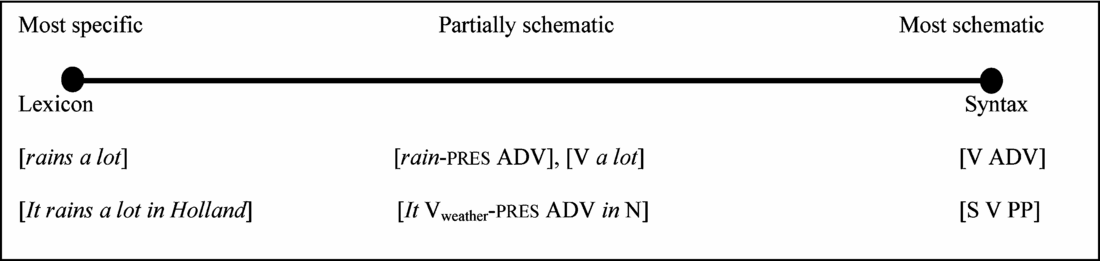
Constructions have been described as conventional multi-word units with their own meaning, which entails that they have their own syntactic, semantic and pragmatic properties that cannot be predicted from the general rules of syntax, semantics and pragmatics (Croft and Cruse, Reference Croft and Cruse2004, pp. 257–262; Goldberg, Reference Goldberg2006). If we assume that words make up the lexicon and patterns make up the syntax, constructions are somehow intermediate (see Figure 1).
Where do constructions belong?

In addition to “construction”, several other names are given to the same phenomenon, names that often reflect a focus on different aspects. Wray (2002, p. 9), for example, talks about formulaic sequences, and defines them as “a sequence, continuous or discontinuous, of words or other elements, which is, or appears to be, prefabricated: that is, stored and retrieved whole from memory at the time of use, rather than being subject to generation or analysis by the language grammar”. This echoes Langacker's (1991, pp. 15–19) definition of units, except that he includes not only fully specific but also partially schematic units. Heine and Kuteva (Reference Heine and Kuteva2005, p. 44) prefer the term use pattern, claiming that this term entails reference to discourse features (e.g. frequency of use, context) rather than to morphosyntactic ones only, which they find typical of the way constructions are treated in Construction Grammar (Fillmore, Kay and O'Connor, Reference Fillmore, Kay and O'Connor1988; Goldberg and Jackendoff, Reference Goldberg and Jackendoff2004).
Despite the differences in terminology, the following two features seem to be shared among the various approaches (Langacker, Reference Langacker1987, Reference Langacker1991, Reference Langacker1995; Fillmore et al., Reference Fillmore, Kay and O'Connor1988; Nunberg, Sag and Wasow, Reference Nunberg, Sag and Wasow1994; Croft, Reference Croft2001; Wray, Reference Wray2002; Croft and Cruse, Reference Croft and Cruse2004; Goldberg, Reference Goldberg2006), and will also be assumed in the present study:
(i) Conventionality. Constructions are perceived as a unit and used as such by most members of the speech community. As Croft (2001, p. 28) points out, “linguistic structures as embodied in utterances are not beads on a string”.
(ii) Fixedness in at least one aspect. Within a construction, there is at least one aspect that is fixed. This fixed item can be one or more words or morphemes but it can also be the order of the items in the unit or the conventionalized meaning of the construction.
The theoretical implication of these assumptions is that the strict dividing line between lexicon and syntax is abolished (Croft and Cruse, Reference Croft and Cruse2004, p. 255). Constructions represent linguistic knowledge as a whole. In this paper, we will use the term construction for all conventional units consisting of more than one morpheme, irrespective of whether the whole unit is lexically fixed (specific) or whether part of it is open and in need of lexical filling (schematic).Footnote 2 Following basic Cognitive Linguistics assumptions, we see lexicon and syntax as regions on a continuum of specificity, on which all linguistic units can be placed. The lexical end of the continuum hosts fully specific constructions while at the syntactic end we find fully schematic ones. If a construction is partially schematic, it is in between lexicon and syntax.
The enormous diversity of constructions can be illustrated with any random utterance, for example (2).
(2) It rains a lot in Holland.
Apart from the individual morphemes, this sentence contains at least the following constructions: [it V.pres.3sg], [It V-s], [It Vweather-3sg], [rains], [rains a lot], [rains temporal quantifier], [a lot], [in Holland], [in NP], [Pro V-INFL], [S V PP]. The speaker has put some of these together to form the utterance, but it is impossible to know whether s/he used only fixed specific units (e.g. “it rains a lot” and “in Holland”) or partially schematic units.
On the continuum of specificity, these constructions are scattered between the two end points (see Figure 2).
Specificity continuum: exemplification.

What we are interested in is finding out at which points on this continuum constructions are likely to undergo change (and sound unconventional to TR-Turkish speakers) in case of language contact. In other words, is structural change really to be located at the syntactic end of the continuum, or does it target the intermediate range?
To the best of our knowledge, there have been few studies that investigate this question systematically. This is no doubt because the existence of constructions and their place between lexicon and syntax on a continuum is normally not assumed outside cognitive linguistics, and cognitive linguistics has rarely been applied to contact data (see, however, Heine and Kuteva, Reference Heine and Kuteva2005 for a similar approach). Our study aims to show the usefulness of this perspective.
3. Methodology
The difference between NL-Turkish and TR-Turkish at any level of specificity is operationalized as unconventionality. Theoretically, Dutch influence could also be at work in constructions that adhere to convention, simply because Turkish and Dutch might have the same structure to begin with.Footnote 3 However, the influence may only become overtly visible where the languages differ in one or more structural aspects, as the examples in sections 5–7 will illustrate. Therefore, we concentrated on NL-Turkish constructions that would sound unconventional to TR-Turkish speakers and looked for evidence for Dutch influence. Before describing our procedure for data analysis (see section 3.2), we will first describe our NL-Turkish and TR-Turkish data.
3.1 Data
In order to carry out a systematic analysis of these issues, we analyzed an NL-Turkish spoken corpus of 23,061 words, consisting of informal conversations of seven NL-Turkish consultants with a TR-Turkish speaker. This interlocutor (the first author) did not know Dutch at the time of the recordings, so all the conversations are in Turkish. The seven NL-Turkish consultants were between the ages of 18 and 30, and were born and raised in the Netherlands. At the time of the recordings, all seven were students at a Dutch university. Their parents had emigrated from a small town in Turkey (Kirşehir) and its surroundings in central Anatolia and all came to Tilburg. Tilburg hosts many families from the Kirşehir area, a result of the chain migration that has been typical for Turkish migration to Western Europe. Although Turkish has always been the main language of communication at home and inside the Turkish community, they described themselves as native speakers of Dutch. Their Turkish does not appear to suffer from much attrition: the interviewer did not encounter any communication problems when talking with the NL-Turkish speakers.
The circumstance that the NL-Turkish speakers had to interact with a TR-Turkish speaker who did not know any Dutch had an important effect on the nature of the data. It is beyond doubt that in in-group interactions (cf. Backus, Reference Backus1996) bilinguals will often make use of Dutch, but our way of collecting data precluded them from codeswitching.Footnote 4 Normally, when an NL-Turkish speaker wishes to say something that is best expressed through a Dutch unit, three options are available. The speaker may switch to Dutch completely, s/he may produce an insertional codeswitch (i.e. a content morpheme from Dutch inserted into a Turkish morphosyntactic frame), or s/he may try to find an equivalent for the unit in Turkish. In our data, only the last option could be used. If the targeted unit is morphologically simple, this means the unconventional use of a lexical item; if the unit is multi-morphemic, some type of loan translation is the result.
Most of the research analyzing contact-induced language change investigates past diachronic changes that took place during relatively long periods of contact (e.g. Aikhenvald and Dixon, Reference Aikhenvald and Dixon2001; Thomason, Reference Thomason2001; Heine and Kuteva, Reference Heine and Kuteva2005). In many of these cases, bilingualism is not a current reality anymore. However, in relatively young contact settings the difference between the contact (e.g. NL-Turkish) and non-contact varieties (e.g. TR-Turkish) has to be conceptualized as a change in progress.
Instead of solely relying on TR-Turkish speakers' judgements about NL-Turkish, we also collected TR-Turkish data. The desirability of such a synchronic comparison has been noted in the literature (e.g. Dąbrowska, Reference Dąbrowska2004; Bullock and Toribio, Reference Bullock and Toribio2004). We analyzed a sub-corpus of 27,057 words, which consisted of informal conversations with seven speakers recorded in Kirşehir. As their NL-Turkish counterparts, the TR-Turkish speakers were between the ages of 18 and 30, and at least high school graduates. They all worked for an oil company, the only employer in town, and were monolingual. They were all born and raised in Kirşehir and had never lived outside the city, except during military service (only for males). Kirşehir was chosen because the parents of the NL-Turkish consultants immigrated from that town and its surroundings.
The comparison with native speakers from Turkey also allows us to investigate the question whether given instances of unconventionality are really unconventional in the sense that they do not occur in Turkey. If they do, the change in question is likely to be an ongoing internal change, though possibly reinforced by contact. We will see that monolingual data can sometimes be quite surprising in this respect.
3.2 Procedure
As explained above, we concentrated on unconventional constructions in NL-Turkish and looked for possible Dutch influence. Our analyses of unconventionality consisted of the following steps:
1. We identified the constructions that sound unconventional to TR-Turkish speakers.
2. We consulted a panel of five TR-Turkish judges to confirm/disconfirm the unconventionality and point out what caused unconventionality in the particular construction.Footnote 5
3. We established what the conventional version of the constructions would be in TR-Turkish.
4. We established the Dutch equivalents of the constructions, in cooperation with a panel of five Dutch judges, and assessed whether in each case the unconventionality could be the result of Dutch influence.Footnote 6
5. We checked the TR-Turkish data for the occurrence of possible unconventional constructions, and again consulted the same TR-Turkish judges.
Steps 3–5 involved the methodology outlined in the next three subsections.
What is actually unconventional? (Step 3)
Constructions are part of a taxonomic network and instantiate different levels of specificity within this network. Identifying the level of specificity at which a construction is unconventional is not always easy, since each expression combines fully specific conventional units and fully or partially schematic templates (see section 2.1). Comparison with the TR-Turkish equivalent provides us with clues in finding out whether it was a lexical item, a functional element, part of a partially schematic unit, or a syntactic pattern that caused the unconventionality.
In order to answer the question posed in section 2.1, whether diachronic structural change is the result of direct synchronic copying of syntax or is a by-product of changes in constructions (cf. Winford, Reference Winford2003), we need to have an idea about the level of specificity at which unconventionality is generally found. If specific lexical combinations are targeted, direct syntactic borrowing is unlikely. However, if unconventionality is concentrated in the more schematic domain, direct syntactic borrowing seems a distinct possibility. In order to find out at which level/s of specificity unconventionality is found in NL-Turkish, we follow the procedure outlined below.
For example, the expression “take a train” (see example 1) is a maximally specific instantiation of the schematic pattern [V OBJ] (cf. Figure 2). When an NL-Turkish speaker says [tren almak], we cannot know for sure whether s/he has translated the maximally specific Dutch unit [de trein nemen] or the partially schematic form [N nemen]. If the speaker would also say things like [araba almak] “car take” and [bisiklet almak] “bicycle take”, we would have grounds to argue that the partially schematic unit [take A VEHICLE] is the source. In the absence of such evidence, we settle for the conservative option and assume that the NL-Turkish utterance is a loan translation of the specific unit [de trein nemen].
Does the unconventionality stem from Dutch influence? (Step 4)
The null hypothesis is to attribute all unconventionality in NL-Turkish to Dutch influence. However, to confirm this for any given instance, there has to be a clear resemblance between the NL-Turkish expression and the Dutch equivalent. As it turns out, not all unconventional constructions showed such influence.
Unconventionality in TR-Turkish: Does it really not occur? (Step 5)
One might expect that these cases only include speech errors but we also came across structures that may have somehow escaped the attention of Turkish grammarians, perhaps because they only occur in informal speech. In any case, this comparison acts as an important restraint on ascribing unconventionality in NL-Turkish to Dutch.
Implications of the data for contact linguistics and linguistic theory in a wider sense will be discussed in section 9.1. In the following sections, we will assign all unconventional constructions to different levels of specificity and discuss their characteristics.
4. Formal characteristics of unconventional constructions
In presenting our analyses, we will first describe the formal characteristics of unconventional constructions and then discuss unconventionality at various regions of the specificity continuum (cf. Figure 2 above).
Irrespective of what level of specificity is involved, there are four ways in which an utterance can be unconventional: it can include a an element which is a replacement of another element; it can include a new, additional element; an element can be omitted; or an utterance can include new expression, which did not yet exist in the language. Below, we discuss these four types with examples from our data.
(i) Replacement. A morpheme in a construction may be replaced with another morphemeFootnote 7,Footnote 8
(3)

In example (3), the verb bitirmek “finish” is replaced by yapmak “do” in the construction [do primary school]. This unconventional use seems to originate from copying the conceptual structure of the Dutch construction. This copying process does not affect the grammatical structure (e.g. accusative case is used on the direct object), and Turkish morphemes are used throughout. However, the semantics of yapmak causes unconventionality since one does not do a primary school in TR-Turkish.
(ii) Addition. A morpheme may be added in the NL-Turkish construction where none exists in the TR-Turkish equivalent.
(4)

The concept [INCREDIBLY WARM] is lexicalized differently in TR-Turkish (“very warm”) and Dutch (“very bad warm”). The NL-Turkish speaker has faithfully relexicalized the Dutch construction using Turkish morphemes. The effect is that the Turkish word for “bad” is added. This causes unconventionality for TR-Turkish speakers, not just because of the unfamiliar collocation, but also because they have never seen kötü used as an intensifier.
(iii) Omission. Sometimes a morpheme is omitted in the NL-Turkish constructions. In example (5), the unconventionality in NL-Turkish originates from the omission of the accusative morpheme in dizi-ler-i “series-pl-acc”. Dutch has no accusative marking but in TR-Turkish, it is used to mark the definiteness of the direct object (see section 6.2 for more detailed discussion).
(5)

(iv) Semantic gaps. The three types of change discussed above assume a conceptual equivalence between two constructions, one in each language. However, sometimes a culturally-specific concept may not have a lexicalized equivalent in the other language (Backus, Reference Backus and Jacobson2001). If the Dutch expression is then used in Turkish guise, the result is a prototypical loan translation. For example, yazil-ma zaman-i “register-nom time-poss.3sg” sounds unconventional to TR-Turkish speakers since it is a loan translation of Dutch inschrijf.tijd “register.time”, which refers to the amount of time one has been registered with the municipal housing office while looking for housing. There is no concept like this in Turkey, so the expression does not exist in TR-Turkish either.
5. Unconventional constructions at maximally specific side of the continuum
When the changes are found in individual content morphemes, whether or not they are part of a larger construction, the unconventionality is located at the most specific end of the continuum. A lexical item, usually the literal translation of a word that is used in the Dutch equivalent construction, may either be added or replace a lexical item that would be used in TR-Turkish. Similarly, a word that is normally part of the construction in TR-Turkish may be left out because its equivalent is not used in the Dutch translation.
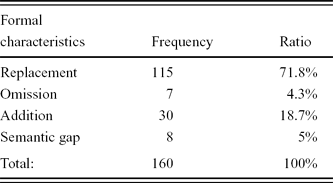
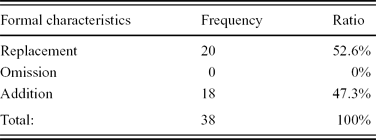
We first identified all unconventional constructions at the maximally specific side and classified them according to the formal characteristics outlined in the previous section. As can be seen in Table 1, replacement was responsible for most of the cases (71.8%) at this level of specificity.
Unconventionality at maximally specific level in NL-Turkish (classified according to formal characteristics).

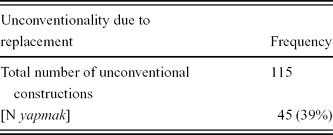
One particular construction, [N yapmak] “N do”, turned out to be involved in 39% of these replacements (see Table 2).
Unconventional [N yapmak] constructions in the ‘replacement’ category in NL-Turkish.

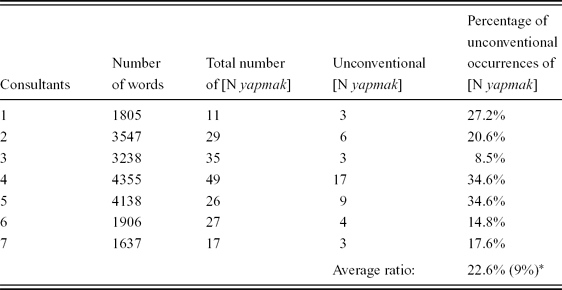
The other cases involved replacement of nouns, verbs, adverbs, and adjectives in a wide range of contexts, such as compound nouns and verb–adverb combinations. The variation is enormous and no pattern occurred more than two or three times. Based on the evidence, there is no generalization to a borrowed pattern; there are merely borrowed (and then translated) lexical elements. However, such generalization may be possible for [N yapmak]. We extracted all the occurrences of this verb in our NL-Turkish data and we computed the percentage of uses that were unconventional for each conversation. Table 3 summarizes the outcome of this exercise. In addition, it shows the average ratio of unconventionality across the conversations (22.6%).
Frequency of unconventional [N yapmak] constructions in NL-Turkish.

*We report the standard deviation of the average ratio in parentheses.
However, the category of unconventional [N yapmak] constructions is not unitary. It consists of three unrelated constructions, to be discussed in turn.
5.1 Verb–Object collocations
The thirty examples in this category involve the use of yapmak “do” as a main verb, and often betray Dutch influence. Dutch makes use of [N do] constructions for many concepts, including a sub-group of educational expressions (e.g. “do school”, “do French class”, “do an exam”). Since education is a common topic of conversation in our data, we encountered such expressions quite often. In TR-Turkish, these expressions tend to have different verbs. Unconventionality in NL-Turkish is often caused by the application of this Dutch use of “do” in Turkish resulting in an extended use of the construction [N yapmak].Footnote 9
A typical example is (6). TR-Turkish expresses the verbal element in this construction with the verb “read” (Fransizca oku-mak “French read-inf”; “do French, as a subject”), while Dutch uses “do” (Frans doen), as does NL-Turkish.
(6)

However, three of the unconventional verb–object combinations with yapmak could not be attributed to Dutch influence. For example, the combination “cook do” does not exist in Turkish or in Dutch; both languages use the copula construction “be a cook”. Therefore, it is unclear why the NL-Turkish speaker in example (7) used the verb yapmak in this expression.
(7)

5.2 Compound verbs
Yapmak is also used in compound verbs, usually with a noun or a verbal noun as the first element, e.g. ütü yapmak “to iron” (“iron make”), yariş yapmak “to race” (“race make”). In contrast to the transitive constructions discussed above, these constructions make little reference to the verb's literal meaning. The composite expression is not transitive, because the putative object (the noun or verbal noun) is not affected by the verb. Since the literal meaning does not play a role, the transparent link with its translation equivalent doen does not come into play either. Compound verbs with yapmak are especially frequent in contact settings, because it tends to be used with foreign infinitives (cf. Backus, Reference Backus1996; Türker, Reference Türker2005), and similar constructions are quite common across contact situations as the primary means to incorporate foreign verbs (Silva-Corvalán, Reference Silva-Corvalán1994, p. 47; Myers-Scotton, Reference Myers-Scotton2002, pp. 134–139). This is, in turn, probably due to the fact that it is often used with foreign verbal nouns in TR-Turkish, e.g. jogging yapmak “go jogging” (“jogging do/make”) or reklam yapmak “advertise” (“advertisement make/do”). In these combinations, yapmak competes with another verb, etmek, which historically also had the literal meaning of “do/make”, but is not used on its own anymore. It is always part of a compound verb, most of the time with an originally Arabic verbal noun, e.g. farz etmek “imagine” (“image do/make”), muhabbet etmek “have a talk” (“talk make/do”).
In NL-Turkish, yapmak seems to be replacing etmek in many compounds that use etmek in TR-Turkish. Presumably, this has nothing to do with Dutch since the Dutch translations of these examples do not use the verbs doen or maken. In example (8), the unit [hesap yapmak] “calculation do” is unconventional for TR-Turkish speakers because they would have used hesap etmek . Note that Dutch does not use a compound at all.
(8)

Though cases like these do not show Dutch influence, they are contact-induced just the same, for the simple reason that they do not occur in TR-Turkish. They are the result of a second mechanism of change, sometimes referred to as attrition or imperfect acquisition: certain elements are not well-entrenched in the grammars of immigrants due to less frequent exposure and/or opportunities for use, and are, therefore, vulnerable to replacement by more frequent forms. In addition, the frequent use in NL-Turkish of Dutch infinitives with yapmak, as in winkelen yapmak “shopping do”, might have increased the entrenchment over its rival [N etmek].Footnote 10 In any case, such examples show that not all contact-induced structural change is produced through the mechanism of borrowing (cf. sections 2 and 9.3).
5.3 Yapmak as a Proform
A third construction involving yapmak is what could be called the Proform Construction, in which yapmak replaces another verb that was mentioned a little earlier in the discourse. This use of yapmak is often unconventional for TR-Turkish speakers, who would instead repeat the more specific verb. In example (9), the NL-Turkish consultant was talking about a music course he had followed. He had tried playing a traditional Turkish instrument for a few months but found it very difficult and had stopped playing it. In Dutch, one uses “do” to refer back to the previously mentioned action, but in TR-Turkish the lexical verb (i.e. “play” in this case) is repeated.
(9)

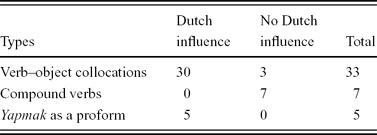
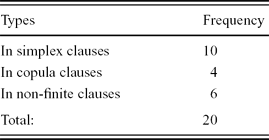
Table 4 summarizes the frequency of occurrence of unconventional [N yapmak] constructions in these three categories.
Types of unconventional [N yapmak] constructions in NL-Turkish.

In TR-Turkish data, on the other hand, only three unconventional cases occurred at the maximally specific level. All three were due to replacement and none of them involved yapmak. Instead, they were the result of confusion between two phonologically similar verbs, for example, the use of anlamak “understand” instead of anlatmak “tell”.
6. Unconventionality at partially schematic side of the continuum
As we described in section 2.1, the maximally specific side of the specificity continuum involves constructions that are totally fixed. In the middle of the continuum, we find the partially schematic region, which hosts constructions containing both fixed or “specific” items (i.e. actual lexical items or morphemes) and open or “schematic” slots (i.e. positions that host any element). For example, in [a NP ago], the indefinite article and the word “ago” are fixed, while the NP slot, which is schematic, can be filled by any time expression. Therefore, [a NPtime ago] is a partially schematic unit. We have grouped unconventionality in this area into three categories, depending on where unconventionality is located: function words, morphosyntax and clause types.
6.1 Function words
We have placed content words on the maximally specific side of the specificity continuum because they tend to be selected on their own. Function words, on the other hand, are almost always selected by virtue of being part of a larger construction. We take dependence on other elements in a construction as our reference point in determining which level of specificity a morpheme belongs to, though it must be emphasized that autonomy and dependence are gradient notions (Langacker, Reference Langacker1987, pp. 298–310).Footnote 11
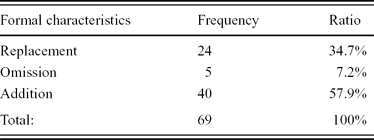
In order to get a more sophisticated picture of unconventionality at this level, we identified all the unconventional constructions in the data in which function words caused the unconventionality, and classified them according to their formal characteristics first (see Table 5). It turned out that unconventionality was caused by the addition of an unexpected functional element in 57.9% of the cases. Recall that for content words, we found an accumulation of unconventionality in the category of replacement. This suggests that NL-Turkish speakers often feel the need to use a function word where TR-Turkish does not have it, possibly driven to do this by the use of its equivalent in the Dutch translation.
Unconventionality in function words in NL-Turkish (classified according to formal characteristics).

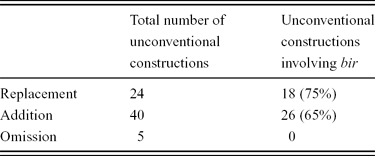
The indefinite marker bir “one” was involved in no fewer than 65% of the cases in the category of addition and 75% in the category of replacement (see Table 6). We carried out an exhaustive analysis of this marker to see whether there was any evidence of a more general change in progress. The other cases of function words involved discourse markers, a complementizer, quantifiers and two adverbials with discourse marking functions, all used in violation of TR-Turkish conventions and all as relatively clear cases of translation (i.e. they were used in contexts in which Dutch uses their translation equivalents).
Unconventional constructions in NL-Turkish.

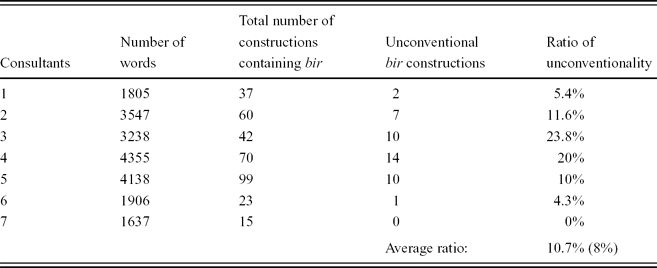
In our NL-Turkish data, we first extracted all the uses of bir as an indefinite article, ignoring complex words that contain it, such as birçok “many” (“one.many”).Footnote 12 Second, we calculated the ratio of unconventionality, which turned out to be 10.7% (see Table 7).
Frequency of unconventional bir constructions in NL-Turkish.

However, possibilities for generalization are limited, since a number of different constructions are involved (as we saw for the yapmak constructions in section 5). Unconventional constructions with bir may be broken down into three categories.
(i) Unconventionality due to semantic extension of the [ADJ bir N] construction
One difference between Dutch and Turkish is that the indefinite article is associated with non-specific referents in Turkish (Dede, Reference Dede1986; Tura, Reference Tura1986), while Dutch does not make a distinction between specific and non-specific readings of indefinite noun phrases.Footnote 13 In NL-Turkish, however, the indefinite marker was sometimes used with specific meaning. In the context of example (10), the speaker has mentioned that he had tried playing some instruments earlier in life but that he had quit. One of the things he had tried to play was the guitar, but he did not like it. The phrase [akustik bir gitar] suggests to a TR-Turkish speaker a non-specific meaning for the guitar contrasting acoustic with, for example, electric guitars. However, that is not the intended interpretation here. The speaker is referring to a specific guitar that was in the possession of his friend. TR-Turkish speakers would have used the generic construction akustik gitar “acoustic guitar”, without bir.
(10)

(ii) Unconventional placement in indefinite ADJ–N combination. In an indefinite noun phrase containing an attributive adjective, the Dutch indefinite article een always precedes the adjective. However, in Turkish the indefinite article follows the adjective, as in the previous example. Unconventionality in NL-Turkish was sometimes caused by the copying of the Dutch order, as in example (11).
(11)

(iii) Unconventionality due to redundant use in a fixed construction. Sometimes the unconventionality originated from the inclusion of bir in a partially schematic construction that happens not to contain it in TR-Turkish, while its Dutch equivalent does make use of the indefinite article. Two such constructions (as illustrated in examples (12) and (13)) were found in the data.
The structure of the Dutch unit [een stuk of N_number N.pl] is partially copied onto its Turkish equivalent. The TR-Turkish convention combines the number and the classifier tane “piece”, giving [NUMBER tane N].Footnote 14 In NL-Turkish, this complex is preceded by bir: [bir NUMBER tane] “one NUMBER piece”. Possibly, [bir tane] is the equivalent of [een stuk] “one piece”. However, note that the copying is not perfect, not only because bir and tane are not adjacent, but also because the partitive preposition of is not translated.
(12)

In example (13), the use of bir is also identified as redundant by TR-Turkish judges. However, in this case unconventionality does not seem to be related to Dutch influence, since the Dutch equivalent construction does not include an indefinite article either.
(13)

On the other hand, it is possible that öyle bir has become a fixed unit due to the association of öyle and bir in an apparent translation of zo'n (i.e. zo een “such a, such”). Due to this strong association between öyle and bir, the NL-Turkish speaker treats them as a fixed unit and always uses them together, even when the Dutch translation does not include the unit zo'n. This causes unconventionality for TR-Turkish speakers since a modifier between bir and N in the construction [öyle bir MODIFIER N] is unacceptable in TR-Turkish. The same construction would have been acceptable to TR-Turkish speakers if the modifier had been between öyle and bir (e.g. [öyle MODIFIER bir N] as in pek öyle tani-diğ-im bir kimse “much like know-nom-1sg one person”) or had not included bir in the construction at all (as in pek öyle tani-diğ-im başka kimse “much like know-nom-1sg other person”). Note also the difference in the translation of “people”. Probably due to influence from the Dutch construction [zo veel N.pl] “so many N.pl”, the NL-Turkish speaker uses the plural form kişi-ler “person-pl”, whereas the TR-Turkish version makes use of a different word in the singular form kimse “someone”.
Since we only have four cases of this type of unconventionality, all by the same speaker (with no conventional counterparts), it is possible that it merely reflects the idiolect of this one speaker rather than a convention established in NL-Turkish. Also note the occurrence of bir in example (7) (see section 5.1 above) in the NL-Turkish construction but not in the TR-Turkish equivalent.
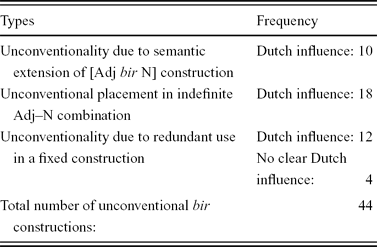
Table 8 summarizes the quantitative analysis of these unconventional constructions. All cases of unconventionality due to “semantic extension of the [Adj bir N] construction” and “unconventional placement in indefinite Adj–N combinations” seem to be copied from Dutch. In the case of redundant uses of bir in fixed constructions, the majority of the unconventionality was due to Dutch influence, but some cases were not, which may suggest an internal change. However, since we did not observe any unconventionality concerning the use of function words in the TR-Turkish data, we consider all cases of unconventionality reviewed in this section as, if not outright borrowings, contact-induced.
Types of unconventional bir constructions in NL-Turkish.

6.2 Morphosyntax
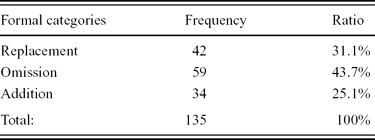
Bound grammatical markers tend to be even more dependent than function words, and, not coincidentally, have even more abstract meanings. They, too, are used in unconventional ways in NL-Turkish. Again, we first classified the unconventional constructions at this level according to their formal characteristics (see Table 9). It turned out that omission was the most frequent formal category in this domain, but all three categories occurred quite regularly. This is in sharp contrast with the content and function words discussed in the previous sections.
Unconventionality in morphosyntax in NL-Turkish (classified according to formal characteristics).

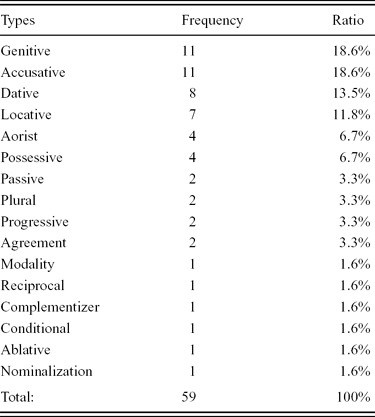
Within the omission category, the accusative and genitive case markers were omitted most frequently (see Table 10).
Types of unconventionality within the “omission” category in NL-Turkish.

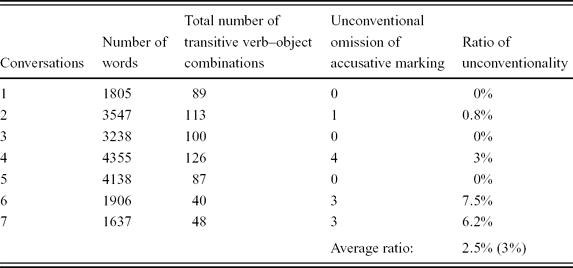
In order to explore the mechanisms of change at this level in some more detail, we will focus on accusative omission, as one of the relatively frequent types of unconventionality. We first identified all combinations of transitive verbs and definite direct objects. Within this set, we identified those cases where accusative was expected, but lacking; Table 11 gives the results. Of all the combinations of a verb and a direct object in the corpus, only 2.5% had unconventional case omission. Below, we will discuss these cases, but will also broaden the analysis to include all cases of unconventionality in which the accusative played a role (i.e. including cases of replacement).
Unconventionality in accusative marking in NL-Turkish.

(i) Omission of accusative marking. Dutch does not mark direct objects morphologically.Footnote 15 Turkish, on the other hand, marks direct objects with accusative if they are definite. In example (14), the NL-Turkish speaker was making a comparison between Dutch and Turkish music and said that he had a preference for Turkish music. Since the referent of the direct object was already mentioned earlier, it is also specific and requires accusative marking (Enç, Reference Enç1991).Footnote 16 The non-use of accusative marking is then perceived as unconventional by TR-Turkish speakers:
(14)

An important point is that Dutch influence does not target transitive structures at random. Especially vulnerable are verbs with low transitivity (see Hopper and Thompson, Reference Hopper and Thompson1980). Unconventional accusative omission was observed with the following verbs in our data: “like”, “read”, “think”, “know”, “support (a team)”, and “eat (dinner)”. All but one of these are mental activity verbs, which are typically low in transitivity. According to Hopper and Thompson's (1980, p. 252) transitivity scale, several semantic aspects of the verb and of the context together determine the degree of transitivity. The most relevant aspect for us here is the “affectedness” semantic aspect. If nothing happens to the participant (object) as a result of the action, Hopper and Thompson (ibid.) consider that verb to be low in transitivity. In our case, all of the verbs except “eat” fit this description. Since these verbs are low in transitivity, we claim that they are relatively attractive (Johanson, Reference Johanson2002, pp. 44–49) for accusative omission in case of contact with a language without case marking, such as Dutch. At the same time, the skewing in favor of contexts of low transitivity cannot itself be contact-induced. What this illustrates is that contact effects are often a combination of direct influence and language-internal or universal factors. Recall that accusative marking is only used with definite direct objects; since there are many contexts in which the object is not definite, the accusative-less construction [N V] is relatively entrenched. The result is that accusative marking is relatively unstable in this context for three conspiring reasons: discrepancy between Dutch and Turkish (a contact related factor), inherited variability in accusative marking (a language-internal factor) and little cognitive support for direct object status in cases of low transitivity (a universal factor). However, note that the unconventionality rate for accusatives is indicated to be only 2.5% in Table 11. Whether this is a high or low figure in the domain of morphosyntax is hard to say given our present knowledge about quantitative aspects of attractiveness. This is an important issue, also raised by one of the anonymous reviewers, but we will let it rest for the time being.
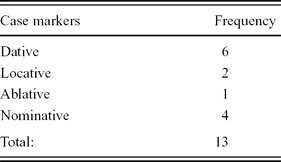
(ii) Accusative replacing other case markers. Sometimes it was the presence rather than the absence of the accusative that caused unconventionality in NL-Turkish. Table 12 indicates that the accusative sometimes replaces other case markers.
Table 12.The case markers replaced by the accusative in NL-Turkish.

Unconventional accusative marking usually means that the subcategorization pattern of a particular verb is “violated”. Four out of the six cases in which the dative was replaced involved the verb bakmak “to look”, in the context of watching programs on TV (see example (15)).
(15)

Although the Dutch verb kijken “to look” often takes the dative preposition naar, and is, therefore, similar to its TR-Turkish equivalent in its subcategorization pattern, in this particular context, it is quite natural to omit the preposition resulting in the partially schematic V–OBJ schema [kijken TV PROGRAMS] “to watch TV programs”. This may well have caused the object to be marked accusative rather than dative.
Since Dutch does not have a case marking system, attributing this type of unconventionality to Dutch influence does not seem plausible at first glance. However, the use of accusative may indicate copying from Dutch at a more abstract level. When the Dutch verb kijken “look” is used with the preposition naar “at”, the co-occurring noun is not perceived as a direct object. This is in line with Hopper and Thompson's (1980) transitivity scale, since this verb is assumed to be low in transitivity. However, in the construction [kijken TV PROGRAMS], without naar, the noun is perceived as a direct object and possibly construed with a stronger degree of affectedness. In order to convey this higher transitivity, the NL-Turkish speaker may have used the accusative rather than the dative.
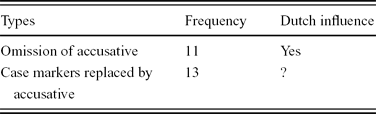
To summarize, we found that the accusative marker is undergoing some changes in NL-Turkish, but only in a tiny percentage of the relevant contexts. Dutch influence could be argued for in most but not all of these cases. More importantly, unconventionality at this level often seems to be the result of a combination of factors, Dutch influence being just one of them. Table 13 summarizes unconventionality involving the accusative marker in NL-Turkish.
Types of unconventionality related to the accusative marker in NL-Turkish.

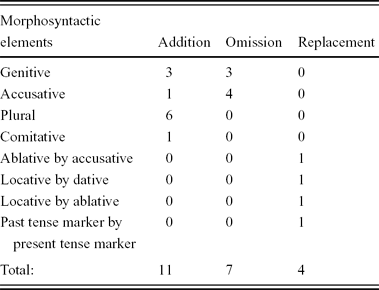
The analysis of the TR-Turkish data revealed that unconventionality at this level involves mostly additions; in particular, the redundant use of plural markers (see Table 14). This always involved combinations with quantifiers (e.g. in bütün çaba-lar-i göster “all attempt-pl-acc show”; “try your best/give it all you got”, the plural is redundant). Although accusative omission is also observed, it is rather rare. It always involved object–verb combinations in which the verb is low in transitivity (e.g. “know”). Although more research is needed, it seems that the degree of transitivity influences case assignment in TR-Turkish too, a fact not discussed before in Turcology, as far as we know.
Types of morphosyntactic unconventionality in TR-Turkish.

6.3 Clauses
Although clausal structure would be expected to be addressed at the most schematic region of the specificity continuum, we need to discuss one case in which the unconventionality occurred in a clausal construction that contains a fixed element. This involves a particular reported speech construction, with the verb demek “to say”.Footnote 17 It seems to be the case that NL-Turkish speakers at times adopt the structure of a Dutch model for reported speech, consisting of a main clause with the quotative verb and a finite subordinate clause containing the quote. The subordinate clause follows the main clause. We came across 15 unconventional instances (against 55 conventional structures). A typical example is the following:
(16)

The unconventionality in this construction is due to the change in the order of the [SUBORDINATE CLAUSE + QUOTATIVE VERB] combination. At first sight, this seems to make it an example of unconventionality at the maximally schematic end of the continuum. However, the unconventionality is limited to reported speech constructions with the verb demek “to say”. If there is a fixed item in a construction, the unit is only partially schematic. Only if this change had spread to other verbs of saying or even to all subordinate clause types, we would have placed this type at the “maximally schematic” side of the specificity continuum.
We did not encounter this type of unconventionality in TR-Turkish data. Due to length limitations, we leave a more extensive analysis of this type of unconventionality for a future study.
7. Unconventionality at maximally schematic side of the continuum: syntax
Analysis of the unconventional cases at this side gave us the findings in Table 15. Replacement and addition were the only forms of unconventionality in this category.
Unconventionality at maximally schematic level in NL-Turkish (classified according to formal characteristics).

Replacement involved cases of word order change. In example (17), the NL-Turkish consultant was explaining a move she used to make in the dance class. In the given context, this sentence receives sentence focus (Lambrecht, Reference Lambrecht1994) since all the elements in the sentence are new information for the hearer. Sentence focused sentences have a strict (S)OV order in TR-Turkish (Kiliçaslan, Reference Kiliçaslan2004). The placement of the prepositional phrase (havada “in the air”) in the postverbal area is copied from Dutch and causes unconventionality for TR-Turkish speakers (see Doğruöz and Backus, Reference Doğruöz and Backus2007).
(17)

Table 16 shows the types of clauses in which unconventionality was found, and their frequency in the category of replacement. A case study of simplex clauses shows that the proportion of word order violations (10 out of 2,109) is very small (cf. Doğruöz and Backus, Reference Doğruöz and Backus2007).
Types of unconventionality within the “replacement” category in NL-Turkish (maximally schematic side).

Addition of elements, on the other hand, involved redundant overt pronominal subjects (N = 12) and objects (N = 6). Note that Turkish is a pro-drop language, and often prefers not to use overt pronouns in subject and object functions, while Dutch normally does use them. In example (18), the NL-Turkish speaker was explaining that they do not have any family members left back in Turkey and the same is true for her husband's family. The subject pronoun is redundant in this context since both the subject NP (“my husband's family”) and the subject pronoun (o “it”) have the same referent. Note that the pronoun occurs in a Left Detachment Construction (Lambrecht, Reference Lambrecht1994), which is used quite frequently in Dutch for the purposes of topicalization. It appears that the copying of this construction has caused redundant subject pronoun use, violating TR-Turkish conventions. The ratio of redundant subject pronouns (12 out of 448) remains only 2% in the NL-Turkish data.
(18)

Overall, these findings confirm the earlier conclusion (see Doğruöz and Backus, Reference Doğruöz and Backus2007) that NL-Turkish has changed little, so far, in its basic syntax. This, in turn, confirms the claim, voiced by many, that core syntax is relatively immune to outside influence (see section 2 above).
In TR-Turkish data, unconventionality at the schematic level was detected only for the word order in two non-finite clauses and for one redundant subject pronoun.Footnote 18
8. Summary of the results
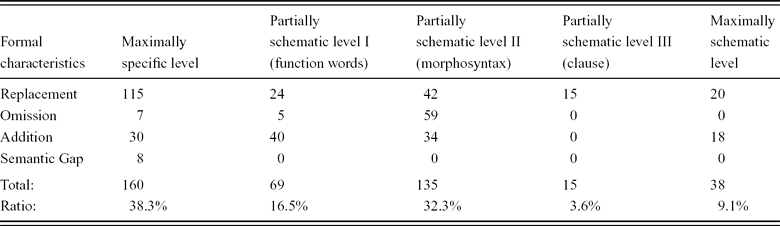
People in Turkey often recognize Almancis, Turkish immigrants in Europe, by their speech. This might suggest that their Turkish is riddled with contact phenomena. On the other hand, it is conceivable that a mere handful of salient deviations can be enough to judge someone's speech as different. In order to build an accurate sociolinguistic theory regarding these issues, we first need to know how pervasive contact effects are, objectively speaking, and whether they target particular structures of the language. This is why we have identified all unconventional constructions and classified them on the basis of two criteria: formal characteristics and position on the specificity continuum (section 4). Table 17 summarizes the distribution of these characteristics in our NL-Turkish data.
Unconventional Constructions in NL-Turkish based on formal characteristics and placement on the specificity continuum.

Our main empirical finding is this: there are unconventional constructions in NL-Turkish, quite a few in fact, but they generally do not violate Turkish syntax. The origins of unconventionality lie in particular combinations of lexical and morphosyntactic items, not in the syntax. Generally, the NL-Turkish speaker will adjust the structural characteristics of a Dutch-style construction to the rules of Turkish, although we also encounter unconventional cases where Dutch influence is not very obvious.
The second general finding is that unconventional constructions turn out to be scattered along the continuum of specificity, but with relatively dense clustering at the specific (i.e. lexical) end (38.3%). In those cases, the origin of unconventionality tends to be the literal translation of a Dutch word that is part of a Dutch collocation, a fixed combination of two or more words. Since TR-Turkish uses a different word in the equivalent construction, the NL-Turkish construction sounds unconventional to TR-Turkish speakers. (see examples (1), (3) and (4)). This is the type of contact effect known as loan translation (Weinreich, Reference Weinreich1953; Otheguy, Reference Otheguy, Roca and Lipski1993; Grzega, Reference Grzega2003).
Third, we also observe much unconventionality in various types of partially schematic constructions (16.5% for function words, 32.3% for morphosyntax, and 3.6% for the reported speech construction discussed in section 6.3) and occasionally in maximally schematic constructions (9.1%). Except for a few recurrent cases (e.g. bir, accusative marking), there are no generalized cases of unconventionality that could be said to indicate an advanced structural change. We can conclude that even structural changes, or, more precisely, cases of interference in synchronic speech that may reflect ongoing diachronic change, are for the most part lexical in nature and could be seen as a sub-category, along with loan words, of the pervasive mechanism of lexical copying. In the absence of comparative data from other contact situations, we cannot say whether this dominance of lexical changes is typical of all contact settings, or whether it is typical for contact settings similar to current Turkish–Dutch contact in the Netherlands, combining the features of shallow time depth, intense contact, and typological distance.
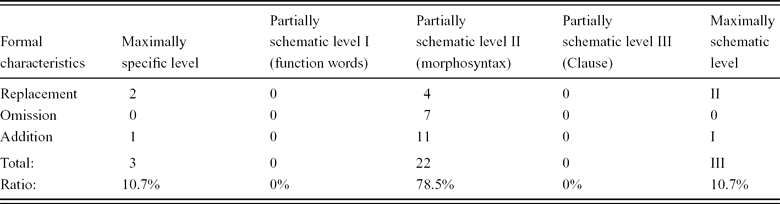
Finally, for the reasons mentioned in section 3, we also looked for “unconventionality” in the TR-Turkish data. The analyses revealed that, perhaps surprisingly, there are also unconventional constructions in these data. In comparison to NL-Turkish, however, unconventionality is not frequent (cf. Table 18 for a summary of results). Additionally, the unconventionality in TR-Turkish is also qualitatively different from the unconventionality in NL-Turkish. l
Unconventional constructions in TR-Turkish based on formal characteristics and placement on the specificity continuum.

Unconventional constructions in TR-Turkish occurred mostly with morphosyntactic elements. Addition of ele-ments (i.e. elements perceived as redundant), rather than omission and replacement, was by far the most frequent source of unconventionality in these constructions. The only types of unconventionality that were found in both NL- and TR-Turkish were omission of accusative case and redundant use of subject pronouns.
9. Discussion
9.1 General remarks on language change
Our data indicate that in current Turkish–Dutch contact, copying does not take place at the maximally schematic level, that is, in what is traditionally called syntax.
Owens (Reference Owens1996) reports something similar for Nigerian-Arabic. Most of the contact-induced changes in this language were in the idiomatic structure rather than in the syntax. Most current authors in contact linguistics agree that syntax changes rather late in contact situations (see e.g. Thomason, Reference Thomason2001; Winford, Reference Winford2003; Sánchez, Reference Sánchez2004; Toribio, Reference Toribio2004) if it ever changes. This echoes claims made in the earlier literature on structural influence in contact settings. Previous analyses of NL-Turkish also revealed that the typical syntactic feature of word order is only undergoing a very slight change (at a rate of only 1% of basic transitive clauses, cf. Doğruöz and Backus, Reference Doğruöz and Backus2007). Considering the duration of contact, it seems that the Dutch–Turkish contact situation is too young to allow changes to have spread from individual constructions to a range of related constructions (which would mean that they could be situated at the maximally schematic end of the specificity continuum), but it is intense enough to see influence in individual expressions, occasionally permitting generalizations (cf. our discussion of yapmak in section 5 and of accusative case in section 6.2.). According to Rostila (Reference Rostila2006), a change at the maximally schematic level should be expected only if several different expressions instantiating the same construction undergo similar changes and do so frequently. That is, there should be high token frequency (some fully specific unconventional units should be frequent) and high type frequency (the unconventional construction should occur in a fair amount of lexical contexts, as with the [N yapmak] construction). This is in general not the case yet in NL-Turkish, but as a result of continuing contact such spreading may take place. Further monitoring of this particular contact situation will allow added insights into this.
9.2 Mechanism of change: semantic transparency
Though, on the whole, there is not much contact-induced change in NL-Turkish, our study has uncovered enough individual cases to allow us to explore further which mechanisms lead to the outcomes we observe. We claim that a perceived degree of semantic equivalence plays a crucial role in the process of copying, in particular where speakers perceive a transparent link between translation equivalents.
Semantic transparency has been investigated in the context of morphologically complex words (such as compound nouns, see Libben, Reference Libben1998; Roelofs and Baayen, Reference Roelofs and Baayen2002; Libben, Gibson, Yoon and Sandra, Reference Libben, Gibson, Yoon and Sandra2003; and idioms, see Nunberg et al., Reference Nunberg, Sag and Wasow1994) in order to identify to what degree meaning is compositional. If the meaning of the whole can be derived from the meanings of the parts (e.g. happiness is the combination of happy and the nominalizer -ness; Roelofs and Baayen Reference Roelofs and Baayen2002, p. 132), it is identified as semantically transparent. In a bilingual context, US Spanish tends to lose the opposition between the copulas ser and estar (both translated as “be”), which are traditionally associated with different adjectives depending on factors like circumstantiality, aspect, concrete evidence, etc., when the choice between the copulas is not semantically transparent. Presumably, this ongoing change is favored by contact with English (Silva-Corvalán, Reference Silva-Corvalán1994, pp. 111f.).
In cross-linguistic cases, we are dealing with three forms of transparency: between form A and meaning P in language X, between form B and meaning Q in language Y, and between P and Q. The last relation must be perceived as one of equivalence for further transfer to take place.
We take semantic equivalence to hold if there is a clear literal Turkish translation of a Dutch element. Literal translation only starts to produce unconventionality if there is a difference between Dutch and TR-Turkish. Often, this seems to happen if the Dutch morpheme is used with a non-literal meaning, and its Turkish equivalent happens not to share this extension. This turned out to be the reason for most unconventionality at the specific level in NL-Turkish (see section 5).
Consider example (1), from section 1, where we claimed that the translation of the Dutch unit de trein nemen “train take” into NL-Turkish as tren almak “train take” was the origin of unconventionality. However, this is not all that can be said about it. The verb almak seems to have come from Dutch, conceptually speaking, since it is the transparent translation of nemen “to take”, while TR-Turkish uses the verb binmek “to get.on”. The noun tren, on the other hand, comes from Turkish, certainly phonologically. Conceptually, there is unlikely to be a difference between Turkish and Dutch regarding trains. The NL-Turkish construction is thus partially the result of a translation, made possible by the transparent link between the translation equivalents nemen and almak. What causes unconventionality for TR-Turkish speakers is the fact that the phrase “take a train” suggests getting hold of something (either getting something with your hands like taking a glass of water in English or buying something like in ev almak “house get” in TR-Turkish) so that it becomes one's possession. While TR-Turkish speakers access the literal meaning of almak, NL-Turkish speakers have extended this meaning to a figurative one, due to the translation of the Dutch verb nemen.
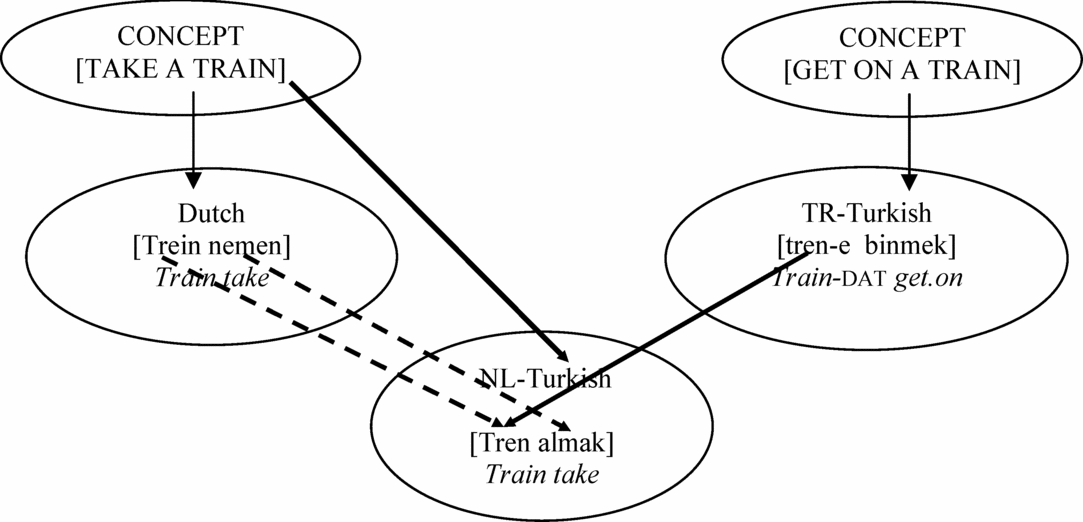
Figure 3 illustrates in detail to what extent the NL-Turkish construction is a hybrid, with characteristics from both TR-Turkish and Dutch. The concept [TAKE A TRAIN] is represented through slightly different conceptualizations in the two languages. In TR-Turkish, the use of the dative highlights the directional movement involved in boarding the train. In Dutch, the concept uses a metaphor in which the traveler takes the train into his possession for the duration of the journey. Although for both languages the ultimate meaning entails being on a train and traveling on it, the conceptualizations are different, and this is reflected in different lexicalizations.
Semantic transparency and copying.

Both the Dutch and the TR-Turkish conventions contribute to the NL-Turkish construction although reference to all components in the construction is with Turkish morphemes. Almak “take” comes semantically from Dutch (i.e. nemen) and phonologically from Turkish. This partial inheritance is indicated in Figure 3 with a broken line. The other referent, tren “train”, comes from both TR-Turkish and Dutch semantically, but from TR-Turkish phonologically, which is illustrated with a solid line. The relationship of almak with the Dutch lexical item nemen is illustrated with a broken line, since its source is Dutch only semantically but not phonologically. As in Dutch, there is no reference to a “direction” in NL-Turkish: the scene is portrayed through a transitive construction rather than through one involving motion. This relationship is indicated with a solid line emanating from the Dutch concept. Since this “direction” does not figure in the TR-Turkish expression, there is no line emanating from the TR-Turkish concept.
This mixing of source material from two languages suggests that loan translation and, by extension, all structural borrowing should receive theoretical treatment together with codeswitching. As in codeswitching, both languages are available to the NL-Turkish speaker at the time of speaking. In order to form a construction in NL-Turkish, s/he copies selected aspects of Dutch lexical units. Since the end result is a hybrid, it may be represented as copying conventions from both languages. However, copying from Turkish and copying from Dutch is not the same thing, since copying from Dutch involves the extra step of translating morphemes into their Turkish equivalents. The use of the semantically transparent equivalent of the Dutch verb nemen suggests that the conventional TR-Turkish item (-e binmek) was not readily available to the speaker at the moment of speaking. It is hard to establish the causal chain, though: whether it was the non-availability of -e binmek that triggered the search that ended in the selection of almak (which gives primacy to attrition or imperfect acquisition as the ultimate explanation), or whether the intrusion of nemen pushed out -e binmek (which gives primacy to borrowing as the explanatory factor) is impossible to say on the basis of our corpus data.
We have used a collocation between two content words to illustrate the translation process. In the case of function words and morphosyntactic structures, translation is not a very straightforward mechanism, due to the more abstract meaning, but we expect that these cases follow essentially the same path. With the more abstract meanings of grammatical morphemes and structures, transparent equivalence with a Dutch morpheme or structure is perhaps harder to establish. However, as we have illustrated in example (15) for the use of redundant accusative markers, NL-Turkish speakers do seem to establish semantic equivalence between a maximally schematic Dutch meaning–form unit (“transitive object–verb” construction) and a partially schematic Turkish morphosyntactic construction [N-acc V].
9.3 Limitations and points for further study
Generally, the tendency is to attribute unconventionality to influence from the contact language (Thomason, Reference Thomason2001; Myers-Scotton, Reference Myers-Scotton2002). Our default hypothesis was, therefore, that all unconventionality could be attributed to borrowing from Dutch. However, we came across unconventional NL-Turkish examples which did not suggest overt influence from Dutch (e.g. the replacement of etmek by yapmak in section 5.2). These examples are still due to contact since they would not have occurred if there had been no contact, and we did not find them in TR-Turkish. In some other cases, borrowing was only part of the explanation, since it worked in conjunction with other mechanisms in a process of multiple causation (see section 6.2). As has been discussed for some other contact situations, contact may accelerate inclinations for a change already going on in a language (cf. Dorian, Reference Dorian1981; Romaine, Reference Romaine1989; Silva-Corvalán, Reference Silva-Corvalán1994), and it may also involve processes not directly attributable to the other language (i.e. attrition and incomplete acquisition). For example, if two forms are in competition, the more frequent form is more likely to survive in the contact variety. In general, unconventional cases which do not reflect overt influence of the contact language are in need of further research (cf. Bolonyai, Reference Bolonyai2000).
We did not identify any constructions that had completely replaced the conventional TR-Turkish construction. This indicates that the unconventional constructions have fluctuating degrees of entrenchment, a situation referred to as the incubation period of a change (Heine and Kuteva, Reference Heine and Kuteva2005). Whether the unconventional counterpart will eventually take over from the conventional one or not is not predictable at this moment.
The unconventional cases of individual constructions suggest that NL-Turkish is on its way to becoming a new and distinct variety of Turkish. Such remarks are often made about contact varieties. However, we would like to make a methodological point regarding such claims. Corpus evidence provides some, but limited, information about the degree to which changes are entrenched in speakers’ grammars. We should seek further proof from experimental settings (e.g. grammaticality judgment tests, various pyscholinguistic tests measuring the reactions of TR-Turkish and NL-Turkish speakers to sample sentences from our corpus), in which factors involved in variation are controlled. However, this exercise would have to find ways to overcome “purist” reactions and avoid increasing sensitivity to the pivotal constructions. Such evidence could confirm whether these unconventional cases have already become conventions for the NL-Turkish community in the Netherlands. If that is the case, NL-Turkish speakers should not be able to recognize constructions as unconventional, whereas the opposite would be true for TR-Turkish speakers.
Furthermore, unconventionality in the contact variety of a language is generally identified on the assumption that the structures involved do not exist in the non-contact variety. However, we found some counter-evidence to this assumption. The analyses of our TR-Turkish data indicated that there is some surprising variability in TR-Turkish. Some unconventional cases were merely speech errors (e.g. the use of the verb anlamak “understand” instead of anlatmak “tell”), but for some others we do not know whether they may be new or hitherto unreported conventions in the TR-Turkish speech community.Footnote 19 The fact that some unconventional constructions also exist in TR-Turkish (i.e. occasional accusative omission in cases of low transitivity, see section 6.2, a redundant pronoun, and possibly a couple of cases of word order violations, see section 7 and footnote 18) makes it difficult to attribute these constructions unequivocally to Dutch influence in NL-Turkish. However, unconventionality in TR-Turkish was not frequent and, more importantly, the majority of NL-Turkish unconventional constructions did not occur in TR-Turkish (e.g. the unconventional use of bir, the reported speech construction with the verb demek, or the extended uses of the verb yapmak).
Finally, it must be kept in mind that the spoken data in this paper do not reflect NL-Turkish faithfully, because codeswitching to Dutch was not an option, without doubt a frequent phenomenon in NL-Turkish. Some of the unconventional constructions that we detected are probably not established conventions in NL-Turkish, but were created on the spot because outright codeswitching was not possible.
Our findings have an interesting parallel in acquisition data. The course of change seems to be from individual fixed constructions to low-level schemas or patterns, and from there, possibly, to maximally schematic construc-tions. This course is also found in children's acquisition of constructions. It has been suggested independently that children start learning a language on the basis of specific item-based constructions, and build these to establish the more schematic templates that ultimately show mastery of the syntax (Dąbrowska and Lieven, Reference Dąbrowska and Lieven2005; Tomasello, Reference Tomasello2003; Wilson, Reference Wilson2003). Both acquisition and change seem to start from highly specific expressions. Note that we do not claim that language change and acquisition are the same. We only indicate that they proceed through similar processes.Footnote 20
These findings may also have implications for second language learning and teaching. Nesselhauf (Reference Nesselhauf2003, p. 236) shows that German learners of English experience more difficulty with English collocations that do not have semantically transparent translations in German (e.g. make a decision and eine Entscheidung treffen). Learners apparently find it easier to produce a conventional utterance if the translation equivalent of the construction is semantically transparent. According to Nesselhauf, more attention should be paid to teaching semantically non-transparent constructions in language teaching situations.
10. Conclusion
We started this study with the very basic question of what it is that makes Turkish speakers in Turkey label Turkish as spoken in the Netherlands as different but not necessarily ungrammatical. Our analyses of spoken data revealed that NL-Turkish violates some conventions of TR-Turkish, and TR-Turkish speakers perceive these violations as unconventional. Exhaustive identification of these violations in a representative corpus was the first step in our analysis.
Secondly, we classified these unconventional cases on a specificity continuum, depending on the convention they violated. This helped us to see whether unconventionality was mostly lexical or structural in nature. It turned out that most of the violations accumulated at the maximally specific and partially schematic regions of the continuum, with very little representation at the maximally schematic level. The impact of Dutch, therefore, is mostly lexical. The violations, especially at the maximally specific level, were shown to be due to translation of transparently equivalent Dutch constructions into Turkish.
To guard against unwarranted claims of contact-induced change, we also analyzed TR-Turkish spoken data. The non-contact variety is usually assumed to be the yardstick for the contact variety, so by definition it should not contain unconventionality. Our analyses of TR-Turkish falsified this assumption in the sense that we found unconventional cases also in TR-Turkish. Although they are rather infrequent in number and somewhat different in type in comparison to NL-Turkish, apparently TR-Turkish speakers also “violate” conventions from time to time. Further studies are needed to explain whether these unconventional uses by TR-Turkish speakers would actually be judged as unconventional by these same speakers. If not, the construction in question may be reflecting an ongoing internal change in TR-Turkish.