Examining the impact of earlier maltreatment on later development can enhance our understanding of how serious deviation from the range of the expectable relational environment may affect organism–environment transactions that play important roles in the emergence and progression of psychopathology. Mounting evidence demonstrates that maltreated children are at increased risk for internalizing problems (Bolger & Patterson, Reference Bolger and Patterson2001b; Keiley, Howe, Dodge, Bates, & Pettit, Reference Keiley, Howe, Dodge, Bates and Pettit2001; Kim & Cicchetti, Reference Kim and Cicchetti2006; Widom, DuMont, & Czaja, Reference Widom, DuMont and Czaja2007) and externalizing problems (Cicchetti & Rogosch, Reference Cicchetti and Rogosch2001; Dodge, Pettit, & Bates, Reference Dodge, Pettit, Bates, Cicchetti and Toth1997; Jaffee, Caspi, Moffitt, & Taylor, Reference Jaffee, Caspi, Moffitt and Taylor2004). In addition, prior research has documented the detrimental effects of child maltreatment on the development of personality (Cicchetti & Rogosch, Reference Cicchetti and Rogosch1997; Rogosch & Cicchetti, Reference Rogosch and Cicchetti2004). We examined heterogeneous classes based on developmental trajectories of personality processes and behavioral maladjustment among maltreated and nonmaltreated high-risk children in order to investigate how parameters of maltreatment may influence the development of personality and psychopathology, and how personality trajectory classes are related to subsequent maladjustment outcomes and may contribute to potential development of personality disorders.
The current study incorporated two theoretical concepts within a developmental psychopathology perspective (Cicchetti, Reference Cicchetti1993) that can be applied to the development of personality and personality disorders. First, the development of psychopathology unfolds along different developmental pathways among different individuals. Thus, it is expected that relevant causal processes vary among individuals who show the same pattern of disorders (i.e., equifinality) and there is heterogeneity in the expression of disorders (i.e., multifinality; Cicchetti & Rogosch, Reference Cicchetti and Rogosch1996). Therefore, different psychopathological outcomes as well as multiple processes eventuating in psychopathological outcomes should be investigated simultaneously. Related to the concept of multifinality, resilience has been conceptualized as the individual's capacity for adapting successfully and functioning competently in spite of experiencing chronic stress following exposure to prolonged adversity or significant trauma (Luthar, Cicchetti, & Becker, Reference Luthar, Cicchetti and Becker2000; Masten, Reference Masten2001). Prior theory and evidence supports the contention that the maltreating environment has a substantially negative impact on the individual's capacity to negotiate the progression of developmental tasks and challenges (Cicchetti & Toth, Reference Cicchetti and Toth2009). Maltreated children, compared to nonmaltreated children, are more likely to manifest deficits in the competent resolution of the salient tasks of the life course and to develop consequent vulnerabilities for psychopathologic conditions. Some maltreated children, however, exhibit resilience, or competent outcomes, despite the severe adversity in their lives (Cicchetti & Rogosch, Reference Cicchetti and Rogosch1997; Moran & Eckenrode, Reference Moran and Eckenrode1992). Knowledge about developmental processes contributing to dysfunction and resilience is critical for understanding pathways to adaptive and maladaptive development of personality and related psychopathology.
Developing the ability to modulate one's impulses and emotional arousal and to maintain integrated yet flexible functioning relative to contextual demands is an important developmental task during childhood (Thompson, Reference Thompson1994). Particularly, the personality processes of ego resiliency and ego control represent developmentally based, integrative dispositions that underlie behavioral organization and characteristic coping styles (Block & Block, Reference Block and Block1980). Ego resiliency is defined as the relative flexibility of impulse control that enables effective regulation of affect and behavior. High ego resiliency denotes resourceful adaptation to changing circumstances and flexible use of problem-solving strategies, whereas low resiliency involves little adaptive flexibility, an inability to respond to changing circumstances, a tendency to become disorganized when dealing with change or stress (Block & Block, Reference Block and Block1980). Ego control involves the ability to monitor and modulate impulses, which includes regulating affect, delaying gratification, and anticipating consequences in a manner appropriate to one's developmental level and situational demands. Ego overcontrol is characterized by excessive inhibition of affect and impulses, whereas ego undercontrol is characterized by insufficient modulation, including noncompliance, poor frustration tolerance, and attention seeking (Block, Reference Block, Funder, Parke, Tomlinson-Keasey and Widaman1993).
A maltreating environment presents a significant threat to the optimal development of reactive approach/inhibition systems (i.e., inhibition or restraint that involve ego control) and ego resiliency. From the perspective of attachment theory, securely attached children are able to use parents effectively to help regulate their emotions and behaviors (Bowlby, 1969/Reference Bowlby1982). In maltreating families, parents are less likely to be available to their children when they are upset, and to provide support and scaffolding from which children can learn constructive strategies to regulate their internal feeling states and to guide their behaviors. In addition, maltreated children may experience overwhelming arousal that interferes with their ability to modulate and modify their level of ego control in either direction as a function of the demand characteristics of the environmental context. Indeed, existing literature points to significant impairments in the development of personality processes of ego control and ego resiliency among maltreated children (Cicchetti & Rogosch, Reference Cicchetti and Rogosch1997; Cicchetti, Rogosch, Lynch, & Holt, Reference Cicchetti, Rogosch, Lynch and Holt1993; Flores, Cicchetti, & Rogosch, Reference Flores, Cicchetti and Rogosch2005; Shonk & Cicchetti, Reference Shonk and Cicchetti2001).
One of the notable findings in the literature of resilience among maltreated children is the importance of personality characteristics. For maltreated children, who experience insecure and difficult relationships with caregivers, personality attributes of children seem to be more influential for adaptive functioning than relationship factors. Cicchetti and Rogosch (Reference Cicchetti and Rogosch1997) reported that positive self-esteem, ego resilience, and ego overcontrol predicted adaptive functioning (defined based on high levels of social competence, low levels of internalizing and externalizing symptomatology, low levels of aggression and withdrawal, and low levels of school maladaptation) among maltreated children, whereas relationship features such as emotional availability of mother and relationship quality with a camp counselor played a more prominent role in predicting adaptive functioning among nonmaltreated children. Similarly, Flores and colleagues (Reference Flores, Cicchetti and Rogosch2005) demonstrated that high ego resiliency and moderate ego overcontrol were associated with higher adaptive functioning for both maltreated and nonmaltreated Latino children; yet, relationship variables were predictive of adaptive functioning only among nonmaltreated Latino children. In addition, Cicchetti and Rogosch (Reference Cicchetti and Rogosch2007) found that the detrimental effects of maltreatment, especially physical or sexual abuse, on adaptive functioning were mediated through deficits in personality constructs: low ego resiliency and high ego undercontrol. Collectively, these findings highlight the significant contributions of personality resources to resilient adaptation among high-risk children. In particular, resilient maltreated children might have developed an adaptive coping strategy that is more likely to utilize self-reliance and self-regulation than relationship support.
Research on personality development has taken predominantly variable-centered approaches to examine how variables differ on average between groups (Shiner, Reference Shiner1998). In contrast, person-centered approaches to personality development emphasize the importance of the person as the major unit of analysis, and the study of the structure of person profiles across variables (Mervielde & Asendorpf, Reference Mervielde, Asendorpf and Hampson2000). Given the extreme failure of the average expectable environment that is associated with child maltreatment, it may be expected that maltreated children would manifest maladaptive types of personality organization. Currently, there is a dearth of research on personality organization in the child maltreatment literature. One longitudinal study of maltreated and nonmaltreated children by Rogosch and Cicchetti (Reference Rogosch and Cicchetti2004) used a person-centered approach and identified five personality clusters, including gregarious, reserved, overcontroller, undercontroller, and dysphoric clusters. Compared to the three personality configurations identified in a normal sample of adolescent boys—resilients, overcontrollers, and undercontrollers (Asendorpf, Borkenau, Ostendorf, & Van Aken, Reference Asendorpf, Borkenau, Ostendorf and Van Aken2001; Robins, John, Caspi, Moffitt, & Stouthamer-Loeber, Reference Robins, John, Caspi, Moffitt and Stouthamer-Loeber1996)—the gregarious and reserved clusters taken together closely resemble the “resilient.” A dysphoric profile, characterized by low conscientiousness, agreeableness, and openness to experience with high neuroticism, emerged predominantly among maltreated children but was rarely observed among nonmaltreated children. As expected, maltreated children were more frequently represented in the less adaptive personality clusters including overcontroller, undercontroller, and dysphoric.
Moreover, prior investigations have shown differences in adjustment outcomes among the childhood personality types both cross-sectionally (Robins et al., Reference Robins, John, Caspi, Moffitt and Stouthamer-Loeber1996) and longitudinally (Caspi & Silva, Reference Caspi and Silva1995; Hart, Hofman, Edelstein, & Keller, Reference Hart, Hofmann, Edelstein and Keller1997; Janson & Mathiesen, Reference Janson and Mathiesen2008). In general, resilient individuals show positive adaptation, indicated by high levels of academic achievement, positive social relations, and low levels of psychopathology. In contrast, overcontrolled individuals have difficulties in social interaction and problems with low self-esteem and internalizing symptomatology, whereas undercontrolled individuals have problems with aggressive behaviors, aversive social interactions, and externalizing symptomatology. Collectively, existing research suggests that maltreated children may be at multiple risks for behavioral and psychological maladjustment, because of deficits in the development of personality processes that include low ego resiliency and tendencies toward ego undercontrol.
Childhood personality and psychopathology may be important factors in identifying distinct pathways to later personality disorders. There is evidence that earlier personality disorder, disruptive disorder, and depressive symptoms are the strongest predictors of young adults' personality disorder symptoms (Cohen, Crawford, Johnson, & Kasen, Reference Cohen, Crawford, Johnson and Kasen2005). Particularly, prior research indicates clear connections between childhood internalizing disorders and avoidant personality disorders, and between childhood externalizing disorders and antisocial personality disorders (Westen, Shedler, Durrett, Glass, & Martens, Reference Westen, Shedler, Durrett, Glass and Martens2003). We believe that the investigation of long-term effects of child maltreatment on ego resiliency and ego control, along with internalizing and externalizing symptomatology, will provide valuable insights into the precursors and pathways to a variety of personality disorders. Therefore, we sought to examine developmental processes of maladaptive personality organizations and psychopathology in childhood, and the relations between them as they may contribute to the consolidation of personality disorders in late adolescence and early adulthood. Examining heterogeneity in developmental trajectories and identifying subgroup differences regarding personality processes may be critical in identifying pathways to different personality disorders.
The microsystem of child maltreatment can be conceptualized as the immediate context in which the maltreatment occurs, which is characterized by stressful, chaotic, and uncontrollable events (Cicchetti & Lynch, Reference Cicchetti and Lynch1993). The features of the maltreatment experience, such as type, multiplicity (i.e., experiencing multiple subtypes), onset, and chronicity, may have significant independent effects on child outcomes (e.g., Manly, Cicchetti, & Barnett, Reference Manly, Cicchetti and Barnett1994; Manly, Kim, Rogosch, & Cicchetti, Reference Manly, Kim, Rogosch and Cicchetti2001). A growing body of literature has established an association between childhood physical and sexual abuse and personality and psychiatric disorders (Fergusson, Boden, & Horwood, Reference Fergusson, Boden and Horwood2008; Johnson, Cohen, Brown, Smailes, & Bernstein, Reference Johnson, Cohen, Brown, Smailes and Bernstein1999; Paris, Reference Paris1997; Sachs-Ericsson, Blazer, Plant, & Arnow, Reference Sachs-Ericsson, Blazer, Plant and Arnow2005). Experiencing severe maltreatment subtypes seems to have negative effects not only on psychological functioning but also on biological processes. Cicchetti and Rogosch (Reference Cicchetti and Rogosch2001) found that maltreated children who had experienced physical and sexual abuse, as well as either neglect or emotional maltreatment, were differentiated from other maltreated children and nonmaltreated children by their cortisol regulation patterns that evidenced hypercortisolism, a maladaptive hormonal response to stress. Child maltreatment subtypes often co-occur, and coexisting forms of maltreatment may have additive effects on adjustment outcomes. Experiences of multiple maltreatment subtypes are related to higher levels of internalizing and externalizing symptomatology, posttraumatic stress symptoms, and lower levels of social competence compared to experiences of a single maltreatment type (Clemmons, Walsh, DiLillo, & Messman-Moore, Reference Clemmons, Walsh, DiLillo and Messman-Moore2007; English, Graham, Litrownik, Everson, & Bangdiwala, Reference English, Graham, Litrownik, Everson and Bangdiwala2005; Lau et al., Reference Lau, Leeb, English, Graham, Briggs, Brody and Marshall2005).
The age of onset and the chronicity of maltreatment may also be influential factors in shaping child personality and adjustment outcomes. Early maltreatment seems to signify extreme risk for later successful adaption. Prior investigations have demonstrated significant effects of early onset, suggesting that children who were maltreated earlier in life reported lower levels of perceived internal control than children whose maltreatment began later (Bolger & Patterson, Reference Bolger and Patterson2001b; Moran & Eckenrode, Reference Moran and Eckenrode1992). Several prospective studies have shown that early maltreatment was associated with later behavior problems. Specifically, Manly and colleagues (Reference Manly, Kim, Rogosch and Cicchetti2001) found that children who were maltreated during infancy–toddlerhood (whether they experienced chronic, sustained maltreatment, or the maltreatment was limited only during infancy–toddlerhood) showed significantly higher levels of externalizing symptomatology than those with a later onset. Similarly, Keiley and colleagues (Reference Keiley, Howe, Dodge, Bates and Pettit2001) reported that early physical abuse (prior to age 5 years) was related to higher levels of internalizing and externalizing behaviors. Finally, Kaplow and Widom (Reference Kaplow and Widom2007) demonstrated that earlier onset of maltreatment was predictive of depression in adulthood, while controlling for gender, race, and current age.
Prior findings also highlight the negative impact of chronicity. For example, school-aged children with a longer duration of maltreatment (whether it started during the infancy–toddlerhood or the preschool period) were more likely to show lower levels of ego resiliency, higher levels of ego undercontrol, and higher levels of internalizing and externalizing symptomatology compared to their counterparts with shorter duration of maltreatment experiences (Manly et al., Reference Manly, Kim, Rogosch and Cicchetti2001). Overall, previous findings illustrate the complexities of the construct of child maltreatment. To date, no systematic investigation compared diverse dimensions of child maltreatment relating to developmental trajectories of personality and psychopathology that may be possible childhood antecedents of personality disorders in later adolescence and adulthood. The work presented herein will examine how the parameters of heterogeneous experiences of maltreatment may differentially contribute to these personality precursors.
Hypotheses and Research Questions
This investigation was guided by the following hypotheses and research questions:
1. Among children from low-income families, maltreated children will show more maladaptive patterns in the development of personality and behavioral adjustment, compared to nonmaltreated children.
2. Consistent with the principle of resilience in developmental psychopathology, some maltreated children will exhibit gradually adaptive trajectories over time implying resilience.
3. We will explore the effects of different maltreatment parameters, including subtypes, early onset, and chronic and cumulative maltreatment, on developmental trajectories of personality and behavioral adjustment to examine individual differences among maltreated children, after controlling for gender.
4. We will examine the relations between personality trajectories and later behavioral outcomes by linking latent classes of ego resiliency and ego control with subsequent externalizing and internalizing symptomatology. Vulnerable patterns of personality development, characterized by low ego resiliency and high ego undercontrol, will be related to later maladjustment problems.
Method
Participants
The participants included 449 children (249 maltreated, 200 nonmaltreated) who attended a summer day camp research program in a Northeastern city during the years of 1986 through 2001. The research camp program was designed to provide maltreated and nonmaltreated children from economically disadvantaged families with a naturalistic setting in which children's behavior and peer interactions could be observed in an ecologically valid context. In the present sample, all children had data for at least two time points over the age range of 6 to 10 years.
Children ranged in age from 6 to 9 years (M = 6.76, SD = 1.03) when they first participated in the camp. Consistent with gender ratios in the maltreated population, there were more boys than girls in the present sample: 63% of the children were boys (283 boys, 166 girls). The sample consisted of children from diverse ethnic backgrounds: 61.2% African American, 23.2% European American, 12.7% Latino, and 2.9% other ethnic groups. The maltreated group (n = 249) and the nonmaltreated group (n = 200) were comparable with respect to demographic features including gender (159 boys and 90 girls in the maltreated group and 124 boys and 76 girls in the nonmaltreated group), χ 2 (1, n = 449) = 0.16, p = .70, and family characteristics, including parental marital status (72% of families in the maltreated group and 68% in the nonmaltreated group were headed by single parents, typically mothers), χ 2 (1, n = 449) = 0.80, p = .41, and income level (based on a total family income from all sources of $15,114 for the maltreated group and $16,304 for the maltreated group), t (445) = 1.33, p = .18. Children in the maltreated group (M = 7.08, SD = 0.93) were slightly younger than children in the nonmaltreated group (M = 7.47, SD = 1.09) when they first participated in the summer camp, t (447) = 4.08, p < .05, but the difference was merely of 4.7 months. The majority of the children were from minority racial ethnic backgrounds regardless of maltreatment status; however, there were somewhat lower numbers of ethnic minority children in the maltreated group (69% minority) compared to the nonmaltreated group (87%), χ 2 (1, n = 449) = 20.93, p < .05.
Maltreated children had been identified through the county Department of Social Services (DSS) as having experienced child maltreatment. Prior to enrolling in the study, mothers of maltreated children provided written consent for examination of any DSS records. Assessment of maltreatment history was based on multiple informants that included mothers, child protective services workers, neighbors, and other community members (e.g., teachers and daycare providers). All existing DSS records were coded by raters to specify the occurrence of sexual abuse, physical abuse, physical neglect, and emotional maltreatment according to the nosological classification system for child maltreatment developed by Barnett, Manly, and Cicchetti (Reference Barnett, Manly, Cicchetti, Cicchetti and Toth1993). Coding was conducted by trained doctoral students and by clinical and developmental psychologists. Nonmaltreated children were recruited from families receiving Aid to Families with Dependent Children or Temporary Assistance to Needy Families because the majority of maltreating families were receiving such income supplements. The demographic characteristics of these families were highly similar to those of the maltreating families and enabled us to assess the independent effects of maltreatment beyond the influences of social adversity. Parental consent was obtained to review the DSS records and Child Abuse Registry to confirm the absence of any documented maltreatment in these families. If any reports of child maltreatment or any ambiguous child maltreatment information were discovered, then the child was not included in the study. In addition, all mothers in the nonmaltreated group were interviewed regarding any incidents that might have reflected officially undetected maltreatment. This screening process resulted in a reduction in the size of the nonmaltreated group relative to the maltreated group included in the study sample.
Procedure
Parents provided informed consent to have their child attend a summer day camp and participate in research assessments. Subsequently, children were given the option to decide for themselves whether or not they wanted to participate, thus resulting in child assent for participation. In the camp, children participated in a variety of recreational activities that were appropriate to their developmental level and interests in groups of six to eight same-age and same-sex peers. Half of the children assigned to each group were maltreated. Periodically throughout the week the children took part in research assessments. Every week, five to six groups of children participated in the camp, and each camp group was led by three trained camp counselors who were unaware of the maltreatment status of the children and the research hypotheses. Camp sessions lasted 7 hr per day for 5 days, thereby providing 35 hr of interaction between children and counselors (see Cicchetti & Manly, Reference Cicchetti, Manly, Brody and Sigel1990, for detailed descriptions of camp procedures). At the end of each week, the camp counselors completed ratings of each of the children in their groups based on intensive observations and interactions with the children during their camp attendance. All counselors were trained on the measures and completed their ratings independently.
Measures
Child maltreatment
The narrative reports of the maltreatment incidents from the DSS records were coded according to the Maltreatment Classification System (Barnett et al., Reference Barnett, Manly, Cicchetti, Cicchetti and Toth1993). This system provided operational definitions and specific criteria for rating multiple subtypes of maltreatment (see Barnett et al., Reference Barnett, Manly, Cicchetti, Cicchetti and Toth1993, for a detailed description of the nosological system used to code incidents for maltreatment). The subtypes that were utilized in the analysis included emotional maltreatment, physical neglect, physical abuse, and sexual abuse. In the present sample, 65% experienced emotional maltreatment (EM), 79% were physically neglected (PN), 40% had been physically abused (PA), and 12% had been sexually abused (SA). Consistent with the high co-occurrence of subtypes that are found in the literature (cf. Manly et al., Reference Manly, Kim, Rogosch and Cicchetti2001), 64% of the maltreated children in this sample experienced two or more forms of maltreatment. To consolidate groups for comparison purposes, we differentiated children whose maltreatment experiences included physical and/or sexual abuse, with or without physical neglect and emotional maltreatment (PA/SA, 46%) from those who had not been physically or sexually abused but had been neglected and/or emotionally maltreated (PN/EM, 54%).
To incorporate the information of timing of maltreatment experience, the presence of maltreatment of any subtype was ascertained according to the developmental period(s) during which the maltreatment occurred before the children first came to the summer camp, including infancy (0 to <18 months), toddlerhood (18 to <36 months), preschool (3–5 years), and school age (>5 years). This information was relevant for examining age of onset as well as chronicity. Early onset was regarded as a higher risk compared to later onset (0 = onset during preschool period or school age period, 22% vs. 1 = onset during infancy or toddlerhood, 78%). Maltreatment in multiple developmental periods was considered more chronic (0 = one to two developmental periods, 61% vs. 1 = three to four developmental periods, 39%). In addition, we included the number of maltreatment subtypes experienced to investigate the cumulative impact of multiple subtypes of child maltreatment (0 = one to two types, 73% vs. 1 = three to four types, 27%). For 97% of the maltreated children, the child's biological mother was named as a perpetrator for some form of maltreatment. For each subtype, weighted kappa statistics were calculated to account for reliability. Interrater agreement was good, with κ values of 1.0 for sexual abuse, .94 for physical abuse, .78 for emotional maltreatment, and a range of .79–.85 for physical neglect.
Teacher Report Form (TRF) of the Child Behavior Checklist
Children's externalizing and internalizing behavior was assessed at the end of each week through completion of the TRF (Achenbach, Reference Achenbach1991). The TRF is an extensively used and well-validated assessment instrument designed to evaluate a wide range of child and adolescent symptomatology. On the TRF, camp counselors rated the frequency of occurrence of a list of 118 problem behaviors that form two broadband factors of externalizing (e.g., aggressive behaviors, delinquent behaviors) and internalizing (e.g., withdrawal, somatic complaints, anxiety–depression) symptoms. Children were rated by two camp counselors, and the scores were averaged across raters. Interrater reliabilities based on average intraclass correlations among pairs of raters ranged from .83 to .91 for externalizing behavior and from .70 to .88 for internalizing behavior.
California Child Q-Set (CCQ)
The CCQ (Block & Block, Reference Block and Block1980) consists of 100 items describing characteristics of children's personality, social, and cognitive functioning which are sorted into nine categories ranging from most to least descriptive of a particular child, according to a forced-choice format. At the end of each week, Q-Set profiles were created for each child by the child's camp counselors, based on intensive observations and interactions with the child. Correlations and standard deviations between raters were then computed for these profiles. Interrater agreement based on average intraclass correlations ranged from .80 to .87. To generate ratings of ego resiliency and ego control, the Q-Set descriptions were correlated with the criterion sorts for prototypical children demonstrating ideal levels of these constructs. Each child's correlation with the criterion was calculated, and those correlations were averaged to yield an ego resiliency and an ego control score for each child. The resulting scores represented how similar or different the individual child was to the prototypical ego resilient and ego controlled child. For example, a high positive correlation with the ego resiliency criterion sort would indicate that a child had high levels of ego resiliency, whereas a high negative correlation would indicate low ego resiliency or ego brittleness. The ego control dimension is organized such that a high score indicates high ego undercontrol; conversely, a low score indicates ego overcontrol.
Results
Data analytic strategy
Consistent with a person-centered approach to data analysis that emphasizes individual differences in development (Bergman, von Eye, & Magnusson, Reference Bergman, von Eye, Magnusson, Cicchetti and Cohen2006), we used growth mixture modeling (GMM; Muthén & Muthén, Reference Muthén and Muthén2000) using the Mplus Version 5.2 statistical software package (Muthén & Muthén, Reference Muthén and Muthén2008). The main purpose of GMM is to find the smallest number of trajectory classes that describe the repeatedly measured variables well. In GMM, latent factors of intercept and slopes are estimated based on repeated univariate outcomes at different time points to describe the shape of the developmental trajectories. GMM further tests whether the population consists of two or more distinctive classes of individuals to capture heterogeneity in the growth trajectories with the goal of determining optimal class membership for each individual. Three criteria were used to determine the optimal numbers of classes according to the suggestions by Tofighi and Enders (Reference Tofighi, Enders and Hancock2007). First, we used a sample-size adjusted Bayesian information criterion (SABIC; Sclove, Reference Sclove1987), which is a parsimony goodness of fit index based on the log-likelihood adjusted for the number of parameters. Lower SABIC values reflect a better model fit. Second, we used the adjusted Lo–Mendell–Rubin Test (Lo, Mendell, & Rubin, Reference Lo, Mendell and Rubin2001), which is a nested model likelihood ratio test and provides a significant test of whether k trajectory classes provided a better fit to the data than did the k-1 class model. Thus, a small probability value (i.e., p < .05) indicates that the k-1 class model should be rejected in favor of the model with at least k classes. Third, we also checked the usefulness of the classes based on the subjective interpretation of the developmental trajectories and the number of children in each class.
After determining the most appropriate number of trajectory classes, we then tested whether latent class differences can be described by maltreatment parameters and gender using a multinomial logistic regression approach (for the variables with more than one class) or conditional (one-class) growth curve models (for the variables with one class).Footnote 1 For these analyses, two models were estimated separately for testing effects of PA/SA and for testing the effects of other maltreatment risk factors including multiple subtypes, chronicity, and onset so that we could prevent potential multicollinearity problems (especially between PA/SA and multiple subtypes, r = .66, p < .05). Gender was included in the model as a covariate. The final step of data analysis validated the distinctiveness of the trajectory classes by testing whether the personality trajectory classes predicted later behavioral adjustment. An analysis of variance was used to examine differences in externalizing and internalizing symptomatology at ages 10 to 12 years across different classes of ego resiliency and ego control. If a significant group difference was found, pairwise multiple comparisons using Tukey (equal variances) and Dunnett C (unequal variances) post hoc tests were used to identify specific classes differing on the adjustment outcome.
Descriptive statistics
In the present data, the number of participants varied depending on age and measures because not every child participated in the camp across all years from age 6 to age 10. Out of 449 children, 254–256 children had age 6 data, 324–325 children had age 7 data, 346–350 children had age 8 data, 373–374 children had age 9 data, and 292–298 children had age 10 data. We used full information maximum likelihood estimation available in the Mplus software program, which is widely accepted as an appropriate way of handling missing data under the assumption that the data were missing at random. Full information maximum likelihood uses all information of observed data including information about the mean and variance of missing portions of a variable based on the observed portions of other variables in the covariance matrix (Arbuckle, Reference Arbuckle, Marcoulides and Schumacker1996). To investigate the impact of incomplete data (i.e., missing at random), we performed a series of regression analyses using the number of missing years for each child (range = 0–4) as a predictor and the outcome score as a dependent variable (age 6 to age 10 scores). The critical value of the Bonferroni multiple test was used to test the significance of the effect of incomplete data: the critical value for α = .05 with N > 100 was t ≥ 3.02 for the 20 tests (i.e., 5 years of data for four outcome variables). The effect of missingness was not significant: t = 0.44–2.83 for externalizing symptomatology, t = 0.08–2.14 for internalizing symptomatology, t = 0.72–2.56 for ego resiliency, and t = 0.25–2.27 for ego control. The data showed that the outcome scores were not affected by the number of missing assessments.
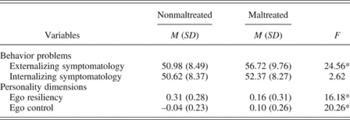
To demonstrate descriptive statistics at the initial time point, we present means and standard deviations for the main study variables at age 6 in Table 1. The differences between maltreated and nonmaltreated children were investigated by multiple analysis of covariance for behavior problems (externalizing symptomatology and internalizing symptomatology) and personality (ego resiliency and ego control). The main effects of maltreatment status (maltreated vs. nonmaltreated), gender, and the interaction effect between maltreatment and gender were tested. The main effects of maltreatment, Wilks' λ, F (7, 247) = 7.88, p < .05, and gender, Wilks' λ, F (7, 247) = 7.24, p < .05, were significant, whereas the interaction effect was not, Wilks' λ, F (7, 247) = .45, p = .77. Table 1 displays univariate F values separately for maltreated and nonmaltreated groups. Maltreated children exhibited significantly greater externalizing symptomatology than nonmaltreated children. In addition, maltreated children showed lower levels of ego resiliency and higher levels of ego undercontrol.
Comparison of maltreated and nonmaltreated children on behavioral functioning and personality measures

Note: Univariate df = 1, 253.
* p < .05.
Determining trajectories of personality and adjustment
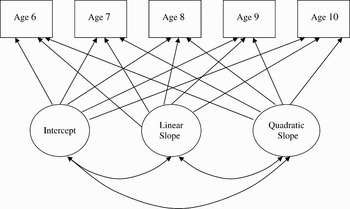
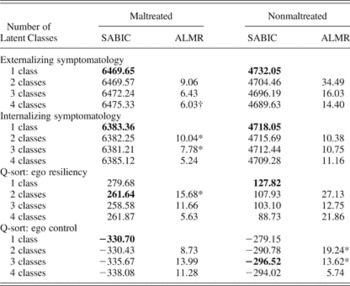
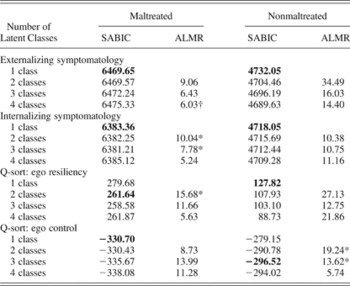
We estimated GMM in which the interindividual differences in the outcome variables were posited to result from the presence of two or more qualitatively distinct trajectory classes. The GMM was structured based on a quadratic growth model that allowed us to estimate nonlinear growth trajectories. A quadratic growth model involved both linear and quadratic slope parameters as shown in Figure 1. Following Wishart (Reference Wishart1938), power polynomials were used to estimate the curvature component of growth trajectories. The individual growth curve (consisting of t = 1, T occasions) is summarized into a small set of linear orthogonal polynomial coefficients based on a fixed power series of time (e.g., age [t], age [t]2, age [t]3, … , age [t]p) describing the general nonlinear shape of the growth curve. A linear growth model assumes a linear pattern of change over time and fixed values of slope parameters as (B[age 6] = 0, B[age 7] = 1, B[age 8] = 2, B[age 9] = 3, B[age 10] = 4). A quadratic polynomial model included an additional slope variable (acceleration) defined by a fixed basis (age [t]2). As shown in Table 2, we obtained fit indices for one-, two-, three-, and four-class models of developmental trajectories. In identifying the GMM that best delineates the data, we chose k class model over k-1 model when both the SABIC (i.e., decreased) and the adjusted Lo–Mendell–Rubin Test (i.e., p < .05) indicated a better fit for the k class model compared to the k-1 class model.
The quadratic growth curve model.

Fit indices for latent class solutions
Note: SABIC, sample-size adjusted Bayesian information criterion; ALMR, adjusted Lo–Mendell–Rubin Test. Boldface indicates the best-fitting models.
* p < .05. †p = .05.
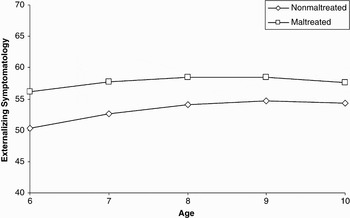
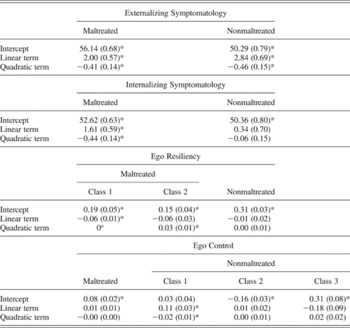
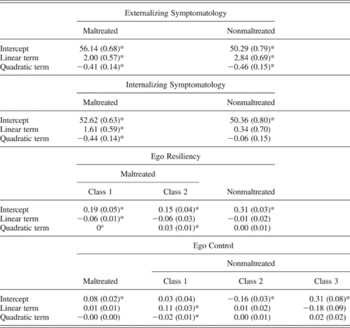
Table 2 gives an overview of the criteria used to determine the optimal number of developmental trajectories and Table 3 presents the growth parameters. A graphical depiction of the growth trajectories yielded by the best-fitting GMM is presented in Figure 2. To find the optimal number of trajectory classes, the variances and covariances of the continuous latent variables were set to zero when necessary for model estimation (Muthén, Reference Muthén and Kaplan2004). In our analyses, the variances and covariances of the linear and quadratic factors were set to zero for all four variables (externalizing and internalizing symptomatology, ego resiliency, and ego control) for maltreated children. For nonmaltreated children, the variance and covariances of the quadratic factor were set to zero for externalizing symptomatology, and the variances and covariances of the linear and quadratic factors were set to zero for internalizing symptomatology, ego resiliency, and ego control.
Estimated mean growth curves for the trajectories of externalizing symptomatology resulting from the best-fitting growth mixture model.

Estimation of growth parameters of adjustment trajectories among maltreated and nonmaltreated children
aThe parameter is fixed.
* p < .05.
Developmental trajectories of externalizing and internalizing symptomatology
Regarding behavior problems, a single-class model fitted the data best for both externalizing and internalizing symptomatology among maltreated and nonmaltreated children. As for externalizing symptomatology, maltreated and nonmaltreated children showed similar patterns of changes: (a) the linear slope mean was significant and positive suggesting an increasing trajectory from age 6 to age 10, and (b) the quadratic slope mean was significant and negative, indicating that the rate of change was decelerating (i.e., increasing trend with diminishing returns). Combined linear and quadratic slopes produced a smooth inverse U-shaped trend, suggesting that the level of externalizing symptomatology was highest around ages 8–9 and slightly decreased afterward. We performed GMM with known classes (i.e., multiple group analysis comparing maltreated vs. nonmaltreated groups) to test the equality of growth factors between the maltreated and the nonmaltreated groups. We examined whether the equality constraints degraded the model fit using the Wald chi-square test (Muthén & Muthén, Reference Muthén and Muthén2008). The results of the two-group GMM revealed that the intercepts of the externalizing symptomatology trajectories differed significantly between the maltreated and the nonmaltreated groups with χ 2 (1) = 31.13, p < .05. As indicated in Table 3 and Figure 2, maltreated children showed higher initial levels of externalizing symptomatology compared to nonmaltreated children. However, the means of linear and quadratic slope factors did not differ significantly between the maltreated and the nonmaltreated groups with χ 2 (2) = 4.78, p = .09.
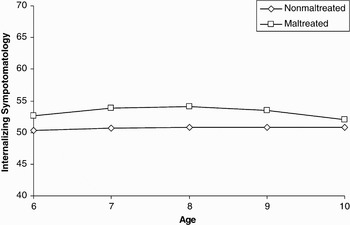
GMM analyses of internalizing symptomatology indicated that a single-class model was the best-fitting model (see Table 2). Maltreated children showed an increasing linear slope with a decelerating rate of change yielding a smooth inverse U-shaped trajectory, whereas nonmaltreated children exhibited a flat trajectory indicated by nonsignificant linear and quadratic slopes (see Table 3). We tested whether the intercept and slopes of growth trajectories differed significantly between the maltreated and the nonmaltreated groups by the multiple-group GMM. The Wald chi-square tests indicated that the intercepts of the internalizing symptomatology trajectories differed significantly between the maltreated and the nonmaltreated groups with χ 2 (1) = 4.81, p < .05; however, the means of linear and quadratic slope factors did not differ significantly between the two groups with χ 2 (2) = 4.84, p = .09. The results suggested that maltreated children showed higher initial levels of internalizing symptomatology compared to nonmaltreated children, yet the change (slope) patterns did not differ significantly between the maltreated and the nonmaltreated groups (see Table 3 and Figure 3).
Estimated mean growth curves for the trajectories of internalizing symptomatology resulting from the best-fitting growth mixture model.

Developmental trajectories of ego resiliency and ego control
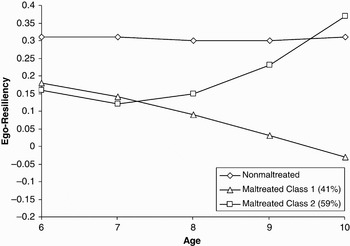
A two-class model yielded the best fit to the ego resiliency data for maltreated children (see Table 2). As shown in Figure 4, the two trajectories started at similar levels, but 59% of children (Class 2) were characterized by a U-shaped trajectory with decreasing up to age 7 and then continuously increasing afterward, whereas 41% of children (Class 1) showed significant decreases in slopes.Footnote 2 We named Class 1 the “declining” class and Class 2 the “increasing” class. There was no significant difference in terms of the number of females between the two classes with 70% girls in the declining class and 60% girls in the increasing class, χ 2 (1, N = 249) = 2.31, p = .13. The entire sample of nonmaltreated children showed a higher initial level of ego resiliency compared to maltreated children, and nonmaltreated children's trajectory was consistently high over 5 years, as indicated by the significant intercept mean and the nonsignificant means of the linear and quadratic slope factors (see Table 3).
Estimated mean growth curves for the trajectories of ego resiliency resulting from the best-fitting growth mixture model.

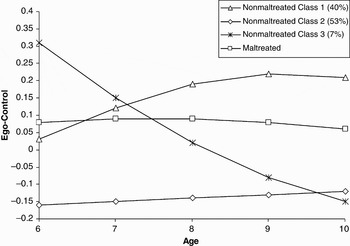
Turning to ego control, the best-fitting model of the one-class GMM indicated stable and somewhat elevated levels of ego undercontrol for the entire sample of maltreated children, as indicated by the significant intercept mean and the nonsignificant means of the linear and quadratic slopes (see Table 3). Meanwhile, GMM analyses revealed three distinctive growth trajectories for nonmaltreated children (see Table 2). About half of the nonmaltreated children (53%, Class 2 in Figure 5) showed consistently low levels of ego undercontrol (with nonsignificant means for linear and quadratic slopes) and about 40% of children (Class 1 in Figure 5) showed a U-shaped slope with significant increases. A small number of nonmaltreated children (7%, Class 3 in Figure 5) showed a higher initial level than the other two classes, and they displayed a decreasing linear trend that was marginally significant (p = .06). We named Class 1 the “increasing” class, Class 2 the “low-stable” class, and Class 3 the “declining” class. An examination of gender composition of each class revealed significant differences in the number of females across the three classes, χ 2 (2, N = 200) = 18.04, p < .05. The increasing class included three times more boys (76%) than girls (24%), and the declining class consisted of only boys (100%). The more adaptive low-stable class included 50% boys and 50% girls.
Estimated mean growth curves for the trajectories of ego control resulting from the best-fitting growth mixture model.

Predicting growth trajectories and trajectory classes based on maltreatment risk factors and gender
Next, we fitted latent growth curve models to examine the effects of maltreatment risk factors and gender on the growth factors for the outcomes that produced a single developmental trajectory (i.e., externalizing and internalizing symptomatology and ego control). For the outcome variables that yielded two distinctive classes among maltreated children (i.e., ego resiliency), we performed logistic regression analyses to predict membership in the two trajectory classes. For these analyses, two models were examined separately for the effects of maltreatment subtypes (PA/SA vs. PN/EM), and for other maltreatment risk factors of multiple subtypes, chronicity, and onset. Gender (female = 1, male = 0) was included as a covariate. Only maltreated children were included in the analyses.
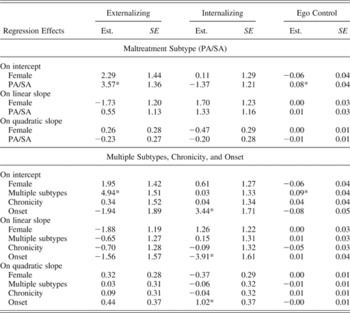
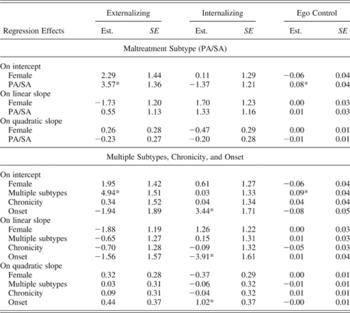
The growth curve models for externalizing symptomatology fitted the data well with χ 2 = 8.59, df = 15, and root mean square error of approximation (RMSEA) = .00 for the model involving the PA/SA predictor, and χ 2 = 17.11, df = 19, and RMSEA = .00 for the model involving multiple subtypes, chronicity, and onset. As can be seen in Table 4, experiencing physical and/or sexual abuse was related to high initial levels of externalizing symptomatology (at age 6) compared to physical neglect and/or emotional maltreatment. Significant effects of cumulative maltreatment subtypes were also found, which suggested that experiencing multiple subtypes of maltreatment was positively related to initial levels of externalizing symptomatology.
Parameter estimates and standard errors for growth curve model with maltreatment risk factors and gender
Note: Est., parameter estimate; PA/SA, physical abuse and/or sexual abuse.
* p < .05.
For the trajectory of internalizing symptomatology among maltreatment, the growth curve models testing the effects of maltreatment risk factors and gender fitted the data well with χ 2 = 17.47, df = 15, and RMSEA = .03 for the model involving the PA/SA predictor, and χ 2 = 18.34, df = 19, and RMSEA = .00 for the model involving multiple subtypes, chronicity, and onset. The results demonstrated that early onset was related to higher initial levels of internalizing symptomatology (at age 6), but late onset was related to a faster increase of internalizing symptomatology among maltreated children over time (see Table 4). However, individual differences in the growth factors of internalizing behaviors were not explained by any other maltreatment risks such as PA/SA subtype, multiple types, or chronicity beyond the “general” maltreatment experiences.
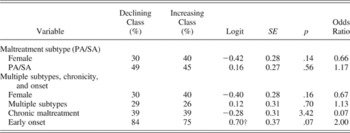
Next, for ego resiliency among maltreated children, Table 5 presents the percentages of girls, children with physical and/or sexual abuse, children with multiple subtypes, children with chronic maltreatment, and children with early onset for the two ego resiliency classes. As can be seen in Table 5, the logistic regression coefficient (or logit) predicting membership in the declining class (Class 1 in Figure 4) based on maltreatment risk factors and gender indicated that children with early onset, regardless of the maltreatment subtypes, were more likely to be in the decreasing class with a marginal significance (B = .69, SE = .37, p = .07, odds ratio = 2.00).
Maltreatment risk factors and gender predicting ego resiliency latent class membership among maltreated children

Note: PA/SA, physical abuse and/or sexual abuse; declining class, n = 90; increasing class, n = 159.
* p < .05. †p = .07.
The latent growth curve model analyses with maltreatment subtypes and gender for ego control produced reasonable fits with χ 2 = 18.69, df = 15, and RMSEA = .03 for the model involving the PA/SA predictor, and χ 2 = 23.49, df = 19, and RMSEA = .03 for the model involving multiple subtypes, chronicity, and onset. As shown in Table 4, children with PA/SA maltreatment showed higher initial levels of ego undercontrol. Similarly, experiencing multiple subtypes of maltreatment was related to higher initial levels of ego undercontrol.
Linking trajectory classes and subsequent adjustment outcomes
Our GMM results indicated two trajectory classes of ego resiliency among maltreated children and three trajectory classes of ego control among nonmaltreated children. We examined whether those trajectory classes based on personality scores during ages 6–10 years would predict adjustment outcomes (externalizing and internalizing symptomatology) observed during ages 10–12. Given the fact that not all the children in our sample had data at all three years (n = 298 at age 10, n = 231 at age 11, and n = 147 at age 12), we calculated the average scores of externalizing symptomatology and internalizing symptomatology, which were defined as the means of a given child's repeated measurements over three years (ages 10–12). About 75% of children had data on internalizing and externalizing symptomatology at ages between 10 and 12 years. Before we linked personality trajectory classes to subsequent adjustment outcomes, we performed chi-square tests to examine whether there was a systematic bias in attrition across the classes. The results indicated that there was no significant difference in rates of attrition among the three ego control classes with χ 2 = .81, df = 2, p = .67. For ego resiliency classes, there was a marginally significant difference with χ 2 = 3.80, df = 1, and p = .05. The rates of attrition indicated that there were more drop-outs in the increasing class than the declining class (31% vs. 20%). The increasing class, compared to the declining class, was bigger (60%) and involved more adaptive children. Therefore, this marginally significant difference in drop-out rates, if it influenced any, it would have made the mean comparison results more conservative.
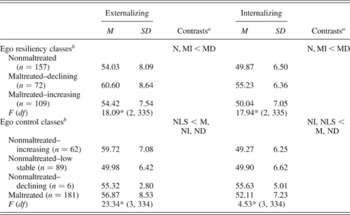
Table 6 illustrates significant group differences for both externalizing and internalizing symptomatology observed at ages 10–12. For ego resiliency, the maltreated–declining group showed higher levels of externalizing and internalizing symptomatology than the maltreated–increasing group and the nonmaltreated group (Tukey range tests, p < .05). For ego control, the nonmaltreated low-stable group differentiated from all other groups showing significantly lower levels of externalizing symptomatology (Dunnett C tests, p < .05). The nonmaltreated–increasing group (Tukey range tests, p < .05) and the nonmaltreated low-stable group (Tukey range tests, p = .06) exhibited lower levels of externalizing symptomatology compared to the maltreated group. The nonmaltreated–declining group showed the highest levels of externalizing symptomatology; however, the Tukey range tests did not detect significance of differences between this group and the other groups (probably because of the small cell size, n = 6). We used linear contrasts targeting at comparing the nonmaltreated–declining group with the other three groups and found that the mean of externalizing symptomatology for the nonmaltreated–declining group was significantly higher than the means of the nonmaltreated–increasing group (t = 2.16, p < .05) and the nonmaltreated low-stable group (t = 1.98, p < .05), but it did not significantly differ from the mean of maltreated group (t = 1.23, p = .22).
Comparison of subsequent internalizing and externalizing symptomatology based on latent class membership of ego resiliency and ego control

Note: N, nonmaltreated; M, maltreated; MD, maltreated–declining; MI, maltreated–increasing; NI, nonmaltreated–increasing; NLS, nonmaltreated–low stable; ND, nonmaltreated–declining.
aThe letters for contrasts designate groups that are significantly different at the .05 level.
bSignificant difference by latent class (p < .05).
* p < .05.
Finally, in line with the practice of previous studies using typological approaches based on both ego resiliency and eco control (e.g., Rogosch & Cicchetti, Reference Rogosch and Cicchetti2004), we compared the prospective adjustment outcomes among the five classes that were identified in the current sample, including the declining ego resiliency and the increasing ego resiliency classes among maltreated children, and the increasing ego (under)control, the low-stable ego (under)control, and the declining ego (under)control classes among nonmaltreated children. Significant group differences in externalizing symptomatology were identified by Tukey range tests and linear contrasts, indicating that (a) the maltreated declining ego resiliency class, which showed the highest levels of externalizing symptomatology, and the nonmaltreated increasing ego (under)control class had significantly higher levels of externalizing symptomatology compared to the maltreated increasing ego resiliency class and the nonmaltreated low-stable ego (under)control class; and (b) the nonmaltreated declining ego (under)control class and the maltreated increasing ego resiliency class showed higher levels of externalizing symptomatology than the nonmaltreated low-stable ego (under)control class, which showed the lowest levels of externalizing symptomatology; Tukey range tests, F (4, 333) = 26.64, p < .05; p < .05 for all comparisons, except the linear contrast for the nonmaltreated declining ego (under)control class versus the nonmaltreated low-stable ego (under)control class, t = −1.71, p = .09. Turning to internalizing symptomatology, Tukey range tests and linear contrasts revealed that the maltreated declining ego resiliency class and the nonmaltreated declining ego (under)control class showed significantly higher levels of internalizing symptomatology compared to the other three classes: Tukey range tests, F (4, 333) = 10.31, p < .05; and linear contrasts, t = −2.01 to −2.24, p < .05.
Discussion
Little empirical research has examined personality processes in maltreated children, and to our knowledge, results concerning childhood personality trajectories of ego control and ego resiliency among high-risk children have not previously been reported. The present study investigated growth trajectories as well as classification of subgroups based on trajectories of personality processes and behavioral maladjustment using a general growth mixture approach. Our findings regarding the trajectory classes for ego resiliency and ego control suggested complexity in developmental pathways that involve risk and resilience. Multifinality was observed depending on the risk status (i.e., maltreated vs. nonmaltreated) and the dimension of personality process (i.e., ego resiliency vs. ego control). For maltreated children, low ego resiliency was an influential determinant of maladjustment, as indicated by the vulnerable class that showed a decreasing trajectory of ego resiliency. In contrast, for nonmaltreated children, high levels of ego undercontrol or ego overcontrol were important predictors of maladjustment, as indicated by the vulnerable classes that exhibited increases in ego undercontrol or dramatic changes from high ego undercontrol and high ego overcontrol over time.
Our findings indicated homogenous groups for internalizing and externalizing trajectories within the maltreated group and the nonmaltreated group. Consistent with prior cross-sectional and longitudinal studies, maltreated children exhibited consistently higher levels of internalizing and externalizing symptomatology during ages 6 to 10, supporting the contention that maltreatment may place children at greater risks for behavioral maladjustment (Kim & Cicchetti, Reference Kim and Cicchetti2004; Lansford et al., Reference Lansford, Dodge, Pettit, Bates, Crozier and Kaplow2002; Manly et al., Reference Manly, Kim, Rogosch and Cicchetti2001). Maltreated children and nonmaltreated children showed similar shapes of growth trajectories indicating increasing trends in internalizing and externalizing symptomatology, with fast change rates during ages 6–8 and diminishing change rates after the peak at ages 8–9. It may be the case that the levels of maladjustment decrease from age 9. For example, Bolger and Patterson (Reference Bolger and Patterson2001b) performed growth curve analyses focusing on ages 9–12 and reported a decreasing trend in self-reported internalizing problems. More importantly, our GMM analyses with known classes (i.e., multiple group analysis) revealed that maltreated children showed significantly higher levels of externalizing and internalizing symptomatology, and the differences between the two groups were maintained between ages 6 and 10.
Our GMM analyses of personality processes identified classes differing in growth trajectories of ego resiliency and ego control as a function of maltreatment status. Maltreated children were classified into two trajectory classes based on their developmental data of ego resiliency, whereas there was only one homogenous class for nonmaltreated children. About 60% of maltreated children belonged to a subgroup that exhibited a trajectory with low initial levels of ego resiliency but notable increases especially between ages 8 and 10. At age 10, their ego resiliency level was comparable to that of nonmaltreated children. This finding is consistent with the principle of resilience in developmental psychopathology, evidencing that some maltreated children displayed increasingly adaptive trajectories of ego resiliency over time. In contrast, the other 40% of maltreated children belonged to a subgroup that exhibited a trajectory with low initial levels and stable decreases in ego resiliency. The single trajectory of nonmaltreated children's ego resiliency indicated stability and highlighted that, in general, nonmaltreated children fared better than maltreated children in terms of their ability to respond flexibly to changing situational demands. Thus, our findings extend previous findings that suggested detrimental effects of maltreatment on personality process (e.g., Cicchetti et al., Reference Cicchetti, Rogosch, Lynch and Holt1993; Cicchetti & Rogosch, Reference Cicchetti and Rogosch1997, Reference Cicchetti and Rogosch2007; Manly et al., Reference Manly, Kim, Rogosch and Cicchetti2001; Rogosch & Cicchetti, Reference Rogosch and Cicchetti2004) by providing evidence of heterogeneity among maltreated children in terms of the development of ego resiliency.
Unlike ego resiliency, longitudinal data of ego control indicated heterogeneity among nonmaltreated children only. Specifically, our GMM analyses produced three distinctive classes among nonmaltreated children and a single class among maltreated children. Maltreated children showed somewhat elevated levels of ego under-control and maintained similar levels throughout the years between ages 6 and 10. Slightly more than half (53%) of nonmaltreated children showed a trajectory with stable levels of ego overcontrol. The next prevalent class involved about 40% of nonmaltreated children that showed increases in ego undercontrol with diminishing change rates. On the contrary, a small group of nonmaltreated children (7%) revealed a notable decline in ego undercontrol, switching from high levels of ego undercontrol to high levels of ego overcontrol between ages 6 and 10. The identification of a class of children of this size is analogous to the previous findings on developmental pathways of antisocial behaviors and aggression that identified approximately 5–6% of young adolescents within an age cohort who showed serious problems of delinquency (Farrington, Barnes, & Lambert, Reference Farrington, Barnes and Lambert1996; Moffitt, Caspi, Dickson, Silva, & Stanton, Reference Moffitt, Caspi, Dickson, Silva and Stanton1996; Nagin & Tremblay, Reference Nagin and Tremblay1999; van Lier & Crijnen, Reference van Lier and Crijnen2005). Although the number of children belonging to such a class is small, the significance of its existence may well justify differentiating this type of potentially “high-risk” class. In the current analysis, as we will discuss later, some poor outcomes of internalizing and externalizing symptomatology were found for those children who showed dramatic shifts from high ego undercontrol to high ego overcontrol.
We hypothesized that maltreatment features, such as presence of physical and/or sexual abuse, early onset, and chronic and cumulative maltreatment, would have significant effects on developmental trajectories of personality and behavioral adjustment above and beyond the global maltreatment effect. Our results provide compelling information that helps enhance the existing knowledge regarding the differential effects of diverse maltreatment dimensions on personality development and psychopathology. The trajectories of ego control and externalizing symptomatology were predicted by the same maltreatment parameters. The experiences of physical and/or sexual abuse and multiple maltreatment subtypes were positively associated with high initial levels of ego undercontrol and externalizing symptomatology. Our results are congruent with previous findings of the significant effects of physical and sexual abuse on externalizing problems among children and adolescents. For example, in a prospective investigation of a community sample, Lansford and colleagues (2002) found that physically abused children were at greater risk for aggression during adolescence and for being arrested as juveniles for violent, nonviolent, and status offenses during young adulthood (Lansford et al., Reference Lansford, Miller-Johnson, Berlin, Dodge, Bates and Pettit2007). In a recent investigation of young adults, Fergusson and colleagues (Reference Fergusson, Boden and Horwood2008) reported that exposure to childhood physical and sexual abuse was associated with increased risks of later mental disorders including antisocial personality disorder and conduct disorder. Whereas prior investigations focused on comparing physically and/or sexually abused children against those who had not experienced any maltreatment, we looked beyond overall maltreatment effects and found that children who had experienced multiple subtypes of maltreatment, especially involving physical and/or sexual abuse as opposed to neglect and emotional maltreatment, showed heightened levels of externalizing symptomatology.
Experiencing maltreatment early in life, regardless of subtypes, seems to be a stronger predictor of internalizing symptomatology compared to multiplicity and chronicity of maltreatment. Children who experienced maltreatment during infancy–toddlerhood showed significantly higher initial levels of internalizing symptomatology at age 6. Interestingly, experiencing later onset of maltreatment was related to greater increases in internalizing symptomatology during the school age period. These findings converge with prior research showing detrimental effects of maltreatment occurred early in life on later behavioral and psychological adjustment (e.g., Carlson, Furby, Armstrong, & Schlaes, Reference Carlson, Furby, Armstrong and Schlaes1997; Kaplow & Widom, Reference Kaplow and Widom2007; Keiley et al., Reference Keiley, Howe, Dodge, Bates and Pettit2001; Manly et al., Reference Manly, Kim, Rogosch and Cicchetti2001) as well as brain development (e.g., Andersen et al., Reference Andersen, Tomada, Vincow, Valente, Polcari and Teicher2008; Cicchetti, Reference Cicchetti2002; De Bellis, Reference De Bellis2001). From the organizational–transactional model of child maltreatment (Cicchetti, Reference Cicchetti1993), the ecological conditions associated with early maltreatment promote the likelihood of failure on many stage-salient tasks later in life. In particular, during infancy and toddlerhood, maltreated children's unsuccessful resolution of stage-salient tasks such as formation of a secure attachment and the development of self-regulation processes may place these youngsters in pathways to behavioral maladjustment.
Children who experienced early onset of maltreatment were more likely to show low levels of ego resiliency with a decreasing trajectory over time rather than a resilient trajectory of increasing ego resiliency. Attachment theory offers insight into potential mechanisms underlying the association between early maltreatment and the development of ego resiliency. The longstanding premise is that early attachment relationships with caregivers influence children's beliefs and expectations about themselves and others, as well as their more general understanding of the world (Bowlby, 1969/Reference Bowlby1982). Indeed, research has shown that experiences of poor quality caregiving are related to the development of negative representational models of attachment figures as well as of the self (Cicchetti, Reference Cicchetti1991; Oppenheim, Emde, & Warren, Reference Oppenheim, Emde and Warren1997), which in turn, are related to negative behavioral outcomes (Sroufe, Reference Sroufe1997; van IJzendoorn, Schuengel, & Bakerman-Kranenburg, Reference van IJzendoorn, Schuengel and Bakerman-Kranenburg1999). Findings from this study further suggest that early caregiving experiences seem to have important implications for the development of internalization of the self-regulatory processes.
Prior studies have demonstrated significant associations between high ego resiliency and better adjustment, between ego overcontrol and internalizing problems, and between ego undercontrol and externalizing problems among children and adolescents (Caspi & Silva, Reference Caspi and Silva1995; Hart et al., Reference Hart, Hofmann, Edelstein and Keller1997; Janson & Mathiesen, Reference Janson and Mathiesen2008; Robins et al., Reference Robins, John, Caspi, Moffitt and Stouthamer-Loeber1996). In the present investigation, we examined whether personality trajectory classes during ages 6–10 were predictive of later adjustment outcomes assessed during ages 10–12. By doing so, we could also evaluate the validity of the classes that were identified through our GMM analyses. Consistent with previous research (e.g., Cicchetti & Rogosch, Reference Cicchetti and Rogosch1997, Reference Cicchetti and Rogosch2007), our data indicated that low ego resiliency was a risk factor for psychopathology. For ego resiliency, the maltreated declining class showed the highest levels of internalizing and externalizing symptomatology in the subsequent years compared to the maltreated increasing class or the nonmaltreated group which showed a fairly high and stable ego resiliency trajectory.
For ego control, maintaining lower levels of ego undercontrol seems to be a protective factor for externalizing symptomatology. The nonmaltreated low-stable class showed significantly lower subsequent levels of externalizing symptomatology than all other classes. However, our findings regarding the association between ego control and internalizing symptomatology suggested complexity. Specifically, keeping lower levels of ego undercontrol was related to lower levels of internalizing symptomatology. Those who showed an increasing trajectory of ego undercontrol also showed relatively lower internalizing symptomatology, although they were more vulnerable to externalizing symptomatology compared to those who showed the low-stable trajectory of ego undercontrol. Two trajectory classes were associated with higher levels of internalizing symptomatology: those nonmaltreated children who exhibited notable changes from high levels of ego undercontrol to high levels of ego overcontrol between ages 6 and 10, and the single class for maltreated children who showed stable and elevated levels of ego undercontrol.
Our examination of subsequent adjustment outcomes among the five subgroups (consisting of the two ego resiliency classes for maltreated children and the three ego control classes for nonmaltreated children) provided a clearer picture regarding joint contribution of ego resiliency and ego control to internalizing and externalizing symptomatology. Maltreated children in the declining ego resiliency group showed the worst outcomes with distinctively higher levels of both externalizing and internalizing symptomatology. In contrast, maltreated children in the increasing ego resiliency group exhibited better adjustment functioning as indicated by their relatively low levels of externalizing and internalizing symptomatology. More research is needed to better understand bidirectional effects between the development of ego control and the development ego resiliency. However, available findings from a longitudinal study of young children suggest a link between high ego undercontrol and low resiliency, and significant mediational effects of ego resiliency in the link between ego undercontrol and social competence over time (Eisenberg et al., Reference Eisenberg, Valiente, Fabes, Smith, Reiser, Shepard, Losoya, Guthrie, Murphy and Cumberland2003). Thus, it is especially for maltreated children with reduced levels of ego resiliency (or ego brittleness) that their impulsivity and inability to delay gratification (as reflected in elevated levels of ego undercontrol) may facilitate the development of a variety of personality disorders.
Although small in size, the nonmaltreated declining ego (under)control group is noteworthy. It consisted of only boys, and those boys showed the highest levels of internalizing symptomatology among the subgroups as well as high levels of externalizing symptomatology almost comparable to those of maltreated children. In light of their high levels of both internalizing and externalizing symptomatology (that were comparable to those of maltreated children), this small subgroup of nonmaltreated children may be at increased risks of later, more pervasive psychopathological and personality disorders. Both maltreated and nonmaltreated children may be vulnerable to the development of personality pathology; however, the developmental processes may vary. Unfortunately, the questions of what contributed to the dramatic changes or why such a group was not observed only nonmaltreated children are beyond the scope of this study, and await further investigations. In future work, it also will be important to replicate this finding and examine negative childhood experiences that may be causally related to this particular pathway (from high ego undercontrol to high ego overcontrol) and subsequent development of personality disorders.
Developmental trajectory patterns of childhood personality organizations such as ego resiliency and ego control may have important implications for the development of adult personality disorders. Ego brittleness and extremely high levels of ego under- or overcontrol may be the common core among later personality disorders. Indeed, previous investigations suggest that the basic structure of maladaptive traits and personality pathology is very similar between childhood/adolescence and adulthood (De Clercq, De Fruyt, van Leeuwen, & Mervielde, Reference De Clercq, De Fruyt, van Leeuwen and Mervielde2006). For example, Westen and colleagues (2003) reported that the distribution of Axis II disorders in adolescents was similar to that in adults with the exception of higher frequencies of avoidant and antisocial personality disorders (likely corresponding to childhood internalizing and externalizing disorders, respectively) among adolescents. More recently, dimensional conceptualizations of personality disorders have been advocated paralleling the developmental perspectives on adaptive personality functioning as exemplified in the Five-Factor model of personality (De Clercq & De Fruyt, Reference De Clercq and De Fruyt2007). In particular, De Clercq and colleagues (Reference De Clercq, De Fruyt, van Leeuwen and Mervielde2006) proposed the two–four hierarchical model demonstrating that the four-factor structure of personality dimensions (disagreeable disinhibition, introversion, compulsivity, and emotional instability) is conceptually similar to the structure of taxonomies representing adult personality pathology, and that the four factors can be further organized into two super factors of internalizing and externalizing traits. The impulsivity, disinhibition, and disruptive symptoms in childhood, often shown in children with ego undercontrol and ego brittleness, may be potential precursors to later personality disorders especially involving the internalizing trait. In contrast, introversion and emotional instability, often shown in children with maladaptive personality organizations of ego overcontrol and ego brittleness, may be potential precursors that foster a pathway toward later personality disorders especially involving the externalizing trait. In addition, prior studies suggest that both internalizing and externalizing symptomatology in childhood are significantly related to all three Diagnostic and Statistical Manual of Mental Disorders personality disorder clusters (Cohen et al., Reference Cohen, Crawford, Johnson and Kasen2005). Furthermore, the joint effects of childhood personality pathology and co-occurring behavior problems on the later development of personality disorders seem to be particularly detrimental (e.g., Kasen, Cohen, Skodol, Johnson, & Brook, Reference Kasen, Cohen, Skodol, Johnson and Brook1999). It would be extremely informative to conduct further longitudinal studies to ascertain how maladaptive childhood personality organizations predict different personality disorders unfolding in adolescence and adulthood.
Some limitations of this study deserve discussion. Future research efforts will be needed to replicate our GMM results to increase confidence in the validity of the subgroups. Another important avenue for future research is to examine genetic and neurobiological pathways linking early personality processes and later personality disorders. For example, Cicchetti and Rogosch (Reference Cicchetti and Rogosch2007) illustrated the benefit of using a multiple levels of analysis approach by demonstrating that personality processes of ego resiliency and ego control and biological processes of cortisol and dihydroepiandrosterone were independently predictive of resilient functioning. Incorporating multiple biological and psychological levels of analysis will advance our knowledge regarding the determinants of and the pathways to resilience (Cicchetti & Curtis, Reference Cicchetti and Curtis2007; Curtis & Cicchetti, Reference Curtis and Cicchetti2003).
Conclusion
The current study examined the longitudinal effects of child maltreatment on growth trajectories of personality and maladjustment using the variable-centered approach (e.g., conditional growth curve models) as well as the person-centered approach (e.g., growth mixture models). Findings from this study suggest that ego resiliency and ego control, which are the personality processes related to self-regulation, may be important factors in identifying distinct pathways to resilient functioning as well as pathways to psychopathology such as internalizing and externalizing symptomatology that may presage the later emergence of personality disorders. Children with maladaptive developmental patterns of personality dimensions, as shown with ego brittleness and high ego under- or overcontrol, may be particularly at risk for developing extreme manifestations of personality traits that characterize personality disorders. Further prospective longitudinal research on the associations among childhood maltreatment, personality processes of ego resiliency and ego control, and adult personality disorders is essential to the accumulation of empirical etiological evidence. Our results offer insights toward developmentally informed models of personality pathology by highlighting the identification of personality and psychopathology developmental profiles that may place children at risk for the development of a variety of personality disorders and call for elucidating the mechanisms that translate these vulnerabilities into later personality pathology.