Introduction
Cast tungsten carbide particles are widely used in composite manufacturing as a particle reinforcer due to their extremely high hardness, good performance at high temperature, great wettability with ferroalloys, and super wear resistance [Reference Lou, Hellman, Luhulima, Liimatainen and Lindroos1, Reference Sun, Yang, Jia and Xiong2, Reference Huang, Samandi and Brandt3, Reference Do Nascimento, Ocelík, Ierardi and De Hosson4, Reference Rong, Peng, Ren, Wang, Fu, Qi and Miao5, Reference Liu, Li, Li and Chen6, Reference Niu, Hojamberdiev and Xu7, Reference Li, Jiang, Zhou, Chen, Shan and Tan8]. As an extensively concerned metal matrix composite (MMC), significant efforts have been dedicated to studying the wear resistance and microstructure of cast tungsten carbide particle/steel composites [Reference Lou, Hellman, Luhulima, Liimatainen and Lindroos1, Reference Sun, Yang, Jia and Xiong2, Reference Huang, Samandi and Brandt3, Reference Do Nascimento, Ocelík, Ierardi and De Hosson4, Reference Rong, Peng, Ren, Wang, Fu, Qi and Miao5, Reference Liu, Li, Li and Chen6, Reference Niu, Hojamberdiev and Xu7]. Because of their great wettability with molten ferroalloys, tungsten carbide particles in ferroalloy matrices are rounded upon dissolution into the matrix and formation of an interface layer, indicating that the particle and matrix exhibit metallurgical bonding [Reference Lou, Hellman, Luhulima, Liimatainen and Lindroos1, Reference Do Nascimento, Ocelík, Ierardi and De Hosson4, Reference Liu, Li, Li and Chen6, Reference Li, Jiang, Zhou, Lu and Zhou9]. The resulting properties provide good technical possibilities for industrial applications.
Composite development has attracted significant attraction for the fabrication of high-performance materials [Reference Lou, Hellman, Luhulima, Liimatainen and Lindroos1, Reference Niu, Hojamberdiev and Xu7, Reference Sahin and Acılar10, Reference Sree Manu, Ajay Raag, Rajan, Gupta and Pai11, Reference Cornsweet12, Reference Dai, Sun, Sui, He, Li, Eckert, Luo and Ma13, Reference Wu, Zhang, Peker, Mao, Das and Eckert14, Reference Li, Wang, Shan, Jiang, Wei and Tan15]. The commercial availability of MMCs has been consistently increasing; therefore, information regarding their thermal properties and behavior is essential for practical applications [Reference Dash, Sukumaran and Ray16]. However, the behavior of MMCs under thermal stresses remains largely unknown, and a limited number of researchers have focused on the thermal fatigue behavior of cast tungsten carbide particle/steel substrate surface composites. Thermal fatigue is caused by cyclic temperature changes and resulting thermal deformation, which is a common damage type in engineering applications [Reference Knowles, Jiang, Galano and Audebert17]. Because of the large differences in the coefficient of thermal expansion (CTE) between the ceramic particles and metal matrix, thermal stress can be generated at the particle/matrix interface during heating and cooling cycles. Thermal cracking can easily occur at the interface between the reinforcing particles and matrix due to CTE mismatch-induced residual stress [Reference Mazahery and Shabani18, Reference Ghorbel19]. Therefore, composites with high strength and stiffness are required for harsh engineering applications [Reference Liu, Cheng, Luan and Mei20]. The thermal shock test is a common approach with which to determine the thermal fatigue resistance of composites containing ceramics [Reference Sbaizero and Pezzotti21, Reference Jin and Batra22]. Composites often exhibit poor thermal fatigue resistance due to the brittleness of ceramics, contributing to their failure at elevated temperatures [Reference Aldridge and Yeomans23, Reference Kou, Li, Zhang, Shao, Zhang, Geng, Deng and Ma24, Reference Li, Liu, Du, Li and Zhang25]. Since composites must be tested by thermal shock, and it is rational that their thermal behavior under thermal shock conditions should be investigated. Moreover, oxidation reinforcement at elevated temperatures can play a significant role in the thermal behavior of the composites, leading to crack initiation and propagation [Reference Gumula, Rudawski, Michalowski and Blazewicz26].
Tungsten carbide is widely applied in WC–Fe/Co/Ni composites and alloys as a reinforcement [Reference Huang, Samandi and Brandt3, Reference Do Nascimento, Ocelík, Ierardi and De Hosson4, Reference Rong, Peng, Ren, Wang, Fu, Qi and Miao5, Reference Basu and Sarin27, Reference Casas, Anglada, Salla and Llanes28, Reference Gu, Jeong, Kim, Kim, Son and Kim29, Reference del Campo, Pérez-Sáez, González-Fernández and Tello30, Reference Voitovich, Sverdel, Voitovich and Golovko31, Reference Bhaumik, Balasubramaniam, Upadhyaya and Vaidya32, Reference Karimi, Hadi, Ebrahimzadeh, Farhang and Sadeghi33]. The majority of the previously reported data regarding oxidation resistance have been obtained between 500 and 1000 °C under different atmospheres (air, Ar/O2 mixture, or O2), and WO3 and Fe/Co/NiWO4 Co were observed as the major oxidation products [Reference Casas, Anglada, Salla and Llanes28, Reference Voitovich, Sverdel, Voitovich and Golovko31, Reference Bhaumik, Balasubramaniam, Upadhyaya and Vaidya32, Reference Karimi, Hadi, Ebrahimzadeh, Farhang and Sadeghi33]. Cracks were commonly observed to extend from the metal–oxide interface to the other parts of the material [Reference Bhaumik, Balasubramaniam, Upadhyaya and Vaidya32]. Oxidation can result in the formation of a crumbly and porous oxide, which reduces the overall strength of the composites [Reference Casas, Anglada, Salla and Llanes28]. Mass gain test results showed that tungsten carbide can be further oxidized with increasing temperature [Reference del Campo, Pérez-Sáez, González-Fernández and Tello30]. As the primary oxidation product of tungsten carbide reinforced composites, WO3 can negatively affect their mechanical properties and thermal fatigue resistance [Reference Basu and Sarin27, Reference Casas, Anglada, Salla and Llanes28, Reference Gu, Jeong, Kim, Kim, Son and Kim29, Reference del Campo, Pérez-Sáez, González-Fernández and Tello30, Reference Voitovich, Sverdel, Voitovich and Golovko31, Reference Bhaumik, Balasubramaniam, Upadhyaya and Vaidya32, Reference Wang, Chen, Ko, Kuo, Wong, Wu, Uang, Chen and Liou34]. Therefore, understanding the oxidation of cast tungsten carbide particles is crucial for characterizing thermal fatigue behavior.
Results and discussion
Microstructure of the surface composites
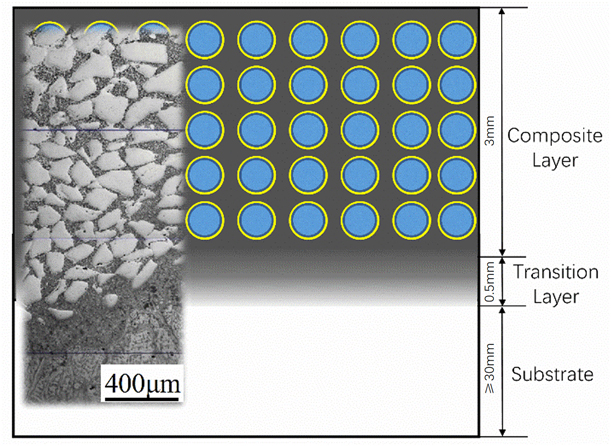
Figure 1 shows the diagrammatic cross-section microstructure of the cast tungsten carbide particle/steel substrate surface composite. The surface composite can be divided into three parts: composite layer, transition zone, and substrate. No obvious casting flaws were observed in the composite, and the transition layer was clearly formed between the composite layer and substrate. As shown in Fig. 1, the molten metal infiltrated into the preform layer and filled its pores, achieving metallurgical combination between the particles and matrix during solidification. The composite layer was composed of cast tungsten carbide particles and ferroalloy matrix infiltrated into the preform layer. Because of the interdiffusion effect between the composite and substrate, W and C from composite spread into the substrate, while Cr and Fe spread into the matrix of composite. The concentrations of W, C, Cr, and Fe near the interface between the composite and substrate varied dramatically and carbides containing W and Cr were produced, resulting in the formation of the transition layer. No obvious casting defects, such as shrinkages, blowholes, or slag inclusions, were observed, and the negative effects of casting defects were avoided.
Schematic and microstructure of the cast tungsten carbide particle/steel substrate surface composite: the surface composite was fabricated by V-EPC and molten steel was used as the substrate and was infiltrated into the preset composed of cast tungsten carbide particles under vacuum conditions. The composite layer was formed after the molten steel solidified and the transition layer was formed by mutual diffusion between the composite and substrate layers.

Thermal fatigue behavior and oxidation of the surface composites
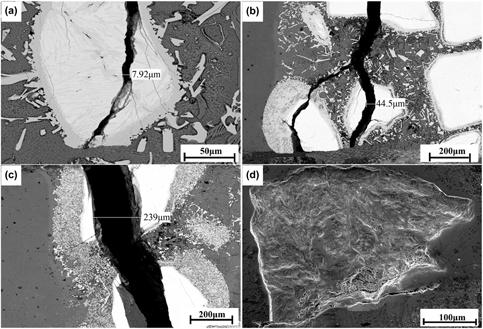
With increasing thermal shock temperature, the initiation and propagation of cracks in the composites were significantly accelerated. Due to the CTE mismatch between the composite layer and substrate, thermal stress was produced and accumulated in the composite during thermal shock cycles. The degree of stress concentration was higher than the other parts of the composite. Thermal fatigue cracking appeared easily in the transition zone because of the CTE mismatch-induced residual stress. Figure 2 shows the cracks in the transition zone, where the cracks width became dramatically wider with increasing thermal shock temperature. The width of the crack near the transition in the composite layer was 7.92 μm after 15 thermal shock cycles at 500 °C. When the thermal shock temperature was increased to 600 °C, the width of the crack in a similar spot reached 44.5 μm after the same number of thermal shock cycles (>5 times wider). At a thermal shock temperature 700 °C, the width further increased to 229 μm under the same condition and some fragments from the particle fell from the transition zone after the same number of thermal shock cycles at 800 °C.
The thermal fatigue cracks in the transition zone of the composite after 15 thermal shock cycles at different temperatures: (a) 500 °C, (b) 600 °C, (c) 700 °C, and (d) 800 °C. The cracks became dramatically wider with increasing thermal shock temperature, even when the tungsten carbide particle dropped out from the composite.

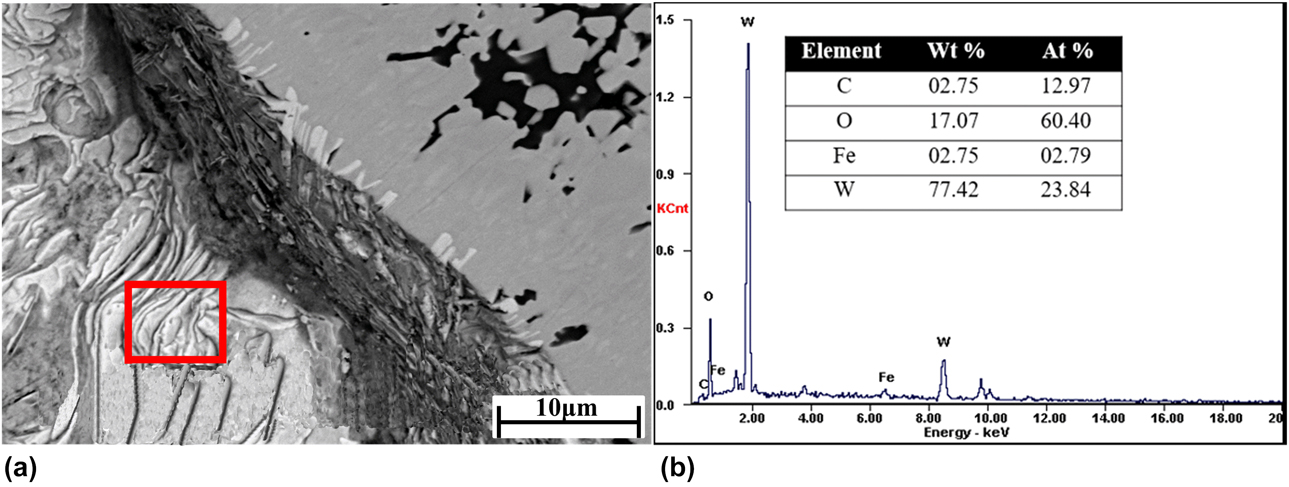
Although the CTE mismatches occurred between the particle and matrix in the composite layer, thermal fatigue cracking between the composite layer and substrate became wider after thermal shock cycles. The crack width jumped rapidly with increasing thermal shock temperature. Thus, it was inferred that other factors influenced the thermal fatigue behavior. Oxidation is a likely cause because tungsten carbide can be oxidized at elevated temperature [Reference Basu and Sarin27, Reference Casas, Anglada, Salla and Llanes28, Reference Gu, Jeong, Kim, Kim, Son and Kim29, Reference del Campo, Pérez-Sáez, González-Fernández and Tello30, Reference Voitovich, Sverdel, Voitovich and Golovko31, Reference Bhaumik, Balasubramaniam, Upadhyaya and Vaidya32]. Particle fragments fell from the composite as shown in Fig. 3(a), indicating that brittle fracturing occurred in the composite. The microstructure on the bottom of the concave pit where the particle fell showed a distinct morphology. The area marked with the red box was analyzed by energy-dispersive spectroscopy, indicating a composition of O (60.40 at.%), W (23.48 at.%), C (12.97 at.%), and Fe (2.79 at.%). This provided further evidence that the particles were oxidized. It can be inferred that the cast tungsten carbide particle was fractured, and the fragment fell, forming a concave pit with a morphology that indicated oxidative products were present on the bottom of concave pit. The atomic ratio of tungsten to oxygen was approximately one to three, which is equal to the atomic ratio of tungsten to oxygen of WO3, the primary oxide product of tungsten carbide oxidation [Reference Bhaumik, Balasubramaniam, Upadhyaya and Vaidya32].
The oxide on the bottom of the concave pit where the particle fell: (a) microstructure on the bottom of the concave pit where the red box marks the area analyzed by energy-dispersive spectroscopy (EDS). (b) The EDS analysis shows that oxygen is present in the red box area outlined in (a). Thus, it could be inferred that the cast tungsten carbide particle was oxidized.

Oxidation behavior of the cast tungsten carbide particle
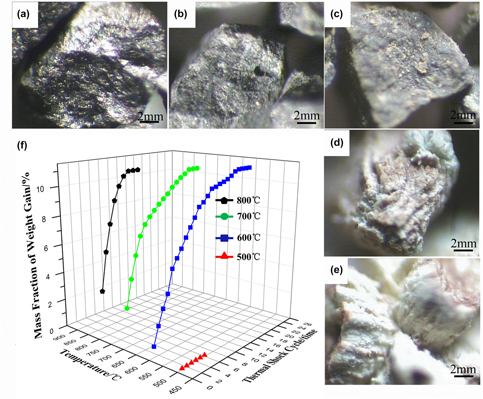
Figure 4 shows the surface topography of the cast tungsten carbide particles after the first heating and cooling cycle at different temperatures. Compared with that of the unheated particles shown in Fig. 4(a), no obvious yellow–green loose products on the surface of the particles were observed when heated at 500 °C, with the particles retaining a partial metal luster. Figures 4(c)–4(e) show that more yellow–green loose products were formed on the surface of the particles with increasing heating temperature. Figure 4(f) shows the mass gain rate as a function of time at different temperatures. When the temperature was 600 °C, the weight increase rate reached a maximum after approximately 21 cycles. At 700 °C, 15 cycles were required to stabilize the oxidation of the cast tungsten particles, whereas at 800 °C, the mass increase rate reached approximately 11% after only 7 cycles. The spots in the diagram obtained by the oxidation test show that the particles were hardly oxidized at low temperatures, e.g., <500 °C, and mass increase rate increased gradually, indicating that oxidation occurred. When the temperature reached between 500 and 600 °C, the mass gain rate finally reached a maximum value, approximately 11%, and plateaued with increasing heating time above a certain temperature.
Surface morphology and mass gain rate of the cast tungsten carbide particles after oxidation at different temperatures: (a) unheated, (b) 500 °C, (c) 600 °C, (d) 700 °C, (e) 800 °C, and (f) diagram of the mass gain rate. With increasing heating temperature, the oxide product of the cast tungsten carbide became more abundant.

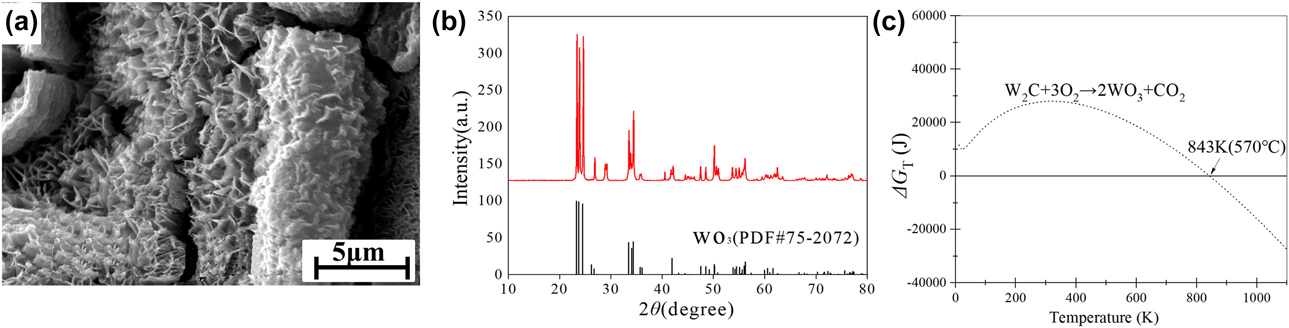
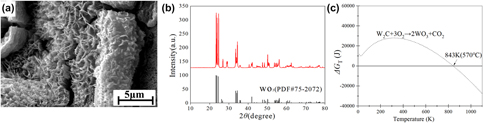
The yellow–green loose product was further investigated by scanning electron microscopy (SEM), and the results are shown in Fig. 5(a). The microphotograph shows that the microstructure of the product was representative of an oxide ore, which negatively affects thermal fatigue resistance. The yellow–green loose product was collected for X-ray diffraction (XRD) analysis, the results of which are shown in Fig. 5(b), and indicated that the product was WO3 [Reference Casas, Anglada, Salla and Llanes28, Reference Gu, Jeong, Kim, Kim, Son and Kim29, Reference Wang, Chen, Ko, Kuo, Wong, Wu, Uang, Chen and Liou34]. Due to the loose structure of WO3 in the composite, the appearance of WO3 reduced the strength and thermal fatigue resistance. WO3 acted as a thermal fatigue crack source, triggering the fragmentation and accelerating the failure of the composites.
The oxide product of the cast tungsten carbide: (a) surface topography of the WO3 oxidative product, as determined by XRD; (b) Gibbs free energy curves of W2C, the major component of the cast tungsten carbide; and (c) particles that underwent oxidation at >570 °C.

Oxidation thermodynamic analysis of the cast tungsten carbide particles
Oxidation plays a crucial role in thermal fatigue behavior at elevated temperatures. Therefore, it is essential to investigate the initial temperature of oxidation, and oxidation thermodynamic analysis of the cast tungsten carbide particles was necessary. The results offered evidence for judging whether oxidation or thermal stress played major roles at various thermal shock temperatures.
The cast tungsten carbide particles were composed of WC and W2C eutectic carbide, where W2C made up the majority of the particle [Reference Li, Wang, Shan, Jiang, Wei and Tan15, Reference Chen, Meredith, Dickey and Trice36]. W2C is the major oxidizable component under 800 °C [Reference Wang, Chen, Ko, Kuo, Wong, Wu, Uang, Chen and Liou34], and the primary oxidation reaction of the cast tungsten carbide particle was W2C + 4O2 → 2WO3 + CO2. The initial temperature of the oxide reaction is a key parameter required for understanding the oxidation behavior of the particles.
The Gibbs free energy of the reaction, W2C + 4O2 → 2WO3 + CO2, was calculated, and the curve of the Gibbs free energy was obtained for estimating the initial temperature of the oxidation reaction. The thermodynamics data are shown in Table I and were suitable for the reaction under 1100 K (827 °C) [Reference Liang and Che35]. The oxidation reaction temperature was between 500 and 600 °C because of the oxidation product occurred after the temperature was increased to 600 °C.
Thermodynamics data under 1100 K.

Under constant pressure, the Gibbs–Helmholtz equation can be expressed as follows:
 $${\left[ {{{\partial \left( {\Delta {G_T}} \right)} \over {\partial T}}} \right]_{\rm{p}}} = {{\Delta {G_T} - \Delta {H_T}} \over T}\quad ,$$
integrating Eq. (1) yields:
 $$- {{\Delta G_T^\theta } \over T} = \int {{{\Delta H_T^\theta } \over {{T^2}}}{\rm{d}}T + I\quad ,}$$
where the  $\Delta H_T^\theta$ function depended on T (temperature). Based on the Kirchhoff’s law, Eq. (2) could be transformed as follows:
 $$\Delta H_T^\theta = \Delta {H_0} + \int {\Delta {C_{\rm{p}}}{\rm{d}}T\quad .}$$
The equation of constant pressure heat capacity:
 $${C_{\rm{p}}} = a + b \times {10^{ - 3}}T + c \times {10^5}{T^{ - 2}} + d \times {10^{ - 6}}{T^2}\quad ,$$
and Eq. (4) was substituted into Eq. (3) to yield:
 $$\eqalign{\Delta H_T^\theta = \Delta {H_0} + \Delta aT + {1 \over 2}\Delta b \times {10^{ - 3}}{T^2} - {1 \over 2}\Delta c \times {10^6}{T^{ - 1}} \cr+ {1 \over 3}\Delta d \times {10^{ - 6}}{T^3}\quad .$$
Equation (5) was combined with Eq. (2) to obtain:
 $$\eqalign{\Delta G_T^\theta = \Delta {H_0} - \Delta aT\ln T - {1 \over 2}\Delta b \times {10^{ - 3}}{T^2} - {1 \over 2}\Delta c \cr\times {10^5}{T^{ - 1}} - {1 \over 6}\Delta d \times {10^{ - 6}}{T^3} + IT\quad ,$$
where I is the integral constant and the  $\Delta G_{298}^\theta$ numerical value was obtained from Eq. (7):
 $$\eqalign{I = {{\Delta G_T^\theta - \Delta {H_0}} \over T} + \Delta a\ln T + {1 \over 2}\Delta b \times {10^{ - 3}}T + {1 \over 2}\Delta c \cr\times {10^5}{T^{ - 2}} + {1 \over 6}\Delta d \times {10^{ - 6}}{T^2}\quad .$$
Based on the data from Table I, the Gibbs free energy function can be defined as follows:
 $$\eqalign{\Delta G_T^\theta = - 28865.376 - 93.02T\ln T - {1 \over 2}7.554 \times {10^{ - 3}}{T^2} \cr+ {1 \over 2}2.211 \times {10^5}{T^{ - 1}} + 633.099T\quad .$$
The Gibbs free energy calculation indicated that the W2C in the cast tungsten carbide particles is oxidized at >570 °C, as indicated by the oxidation behavior of the cast tungsten carbide particles in Fig. 4. According to the composition of the cast tungsten carbide particles, the percentage of W2C was approximately 80%. The oxidation of the particles could hinder the thermal fatigue resistance of the cast tungsten carbide particle/steel substrate surface composite. After thermal shock cycles at >570 °C, the rate of crack initiation and propagation significantly increased and the crack width increased rapidly. Both phenomena indicate that the strength of the composite was reduced due to oxidation, which weakened the cast tungsten carbide particle reinforced composite. Therefore, this composite may be not suitable for applications at temperatures of >570 °C.
Conclusions
In this study, the oxidation and thermal fatigue behavior of cast tungsten carbide particle/steel substrate surface composites were investigated at different temperatures, allowing the following conclusions to be drawn:
(1) At elevated temperatures, the fatigue behavior of composites was influenced by the CTE between the composite layer and substrate and oxidation of the cast tungsten carbide particle.
(2) The W2C in the tungsten carbide particles was oxidized to form WO3. The thermodynamic calculations showed that the initial temperature of oxidation was 570 °C.
(3) The relationship between the oxidation and thermal fatigue crack growth was investigated, suggesting that oxidation played a more important role when the thermal shock temperature was above 570 °C. The reliability of the composite was significantly reduced under thermal stress.
Experimental
Materials
Cast tungsten carbide particles as reinforcements for surface composites are commonly fabricated by arc melting. The chemical composition of the cast tungsten carbide particles is shown in Table II. The mass fractions of W and C in the particles were approximately 96% and 4%, respectively, composed of W2C, WC, and free carbon. W2C–WC eutectoids constituted the majority of the particles with a volume fraction of >74.7% [Reference Chen, Meredith, Dickey and Trice36]. In this study, the composites were used at high temperature. Thus, high Cr carbon steel, a heat-resistant steel, was selected as the substrate. The chemical composition of the high Cr carbon steel is shown in Table III. The high Cr carbon steel, a high carbon steel with carbon content of 1.0–1.2 wt%, contained 15.0–15.2 wt% Cr to maintain oxidation resistance at elevated temperatures.
Chemical component of cast tungsten carbide particle (mass fraction %).

Composition of the high Cr steel (mass fraction %).

Composites fabrication
Preparation of the surface composites was achieved using the vacuum-evaporative pattern casting (V-EPC) infiltration technique, a type of expendable mold casting, which can be summarized as follows [Reference Li, Jiang, Zhou, Lu and Zhou9]. First, the expandable polystyrene (EPS) pattern was fabricated by binding of an EPS gating system and mold cavity using an adhesion agent. The underside of the mold cavity was paved with a 95:4:1 vol% mixture of cast tungsten carbide particles (average particulate size of 0.38–0.55 mm), polyvinyl alcohol solution, and foaming agent as the preform layer, respectively. The thickness of the preform layer was 3 mm and was dried at 50 °C for 30 min after the mixture was paved flat. The entire mold was immersed into a water-base casting coating and dried at 70 °C for 6 h, which was repeated at least 3 times until the thickness was 1 mm. The second step involved the preparation of the EPC sand mold. The sand box containing the EPS pattern was filled with dry quartz sand (0.2–0.3 mm), then placed on a vibration table until the sand tightened but maintained excellent gas permeability. The last step involved the casting infiltration of the composites. The high Cr carbon steel was melted and poured into the EPS pattern under negative vacuum pressure and the molten metal infiltrated the preform to form the composite layer.
Thermal shock test
The cast tungsten carbide particle/steel matrix surface composites were placed in ceramic boats and heated in a chamber furnace. The surface composites were subsequently quenched in cold water after heating, constituting a single thermal shock cycle. The heating temperatures were 500, 600, 700, and 800 °C, and the heating time for each cycle was 5 min. The geometric dimensions of the thermal shock test specimens cut from the surface composite were 20 mm × 25 mm × 8 mm, and from the composite layer on the surface, 20 × 8 mm. The specimens were placed into chamber furnaces and heated for 5 min each time. Finally, the specimens were cooled to room temperature under an air atmosphere.
Oxidation test of the cast tungsten carbide particles
Cast tungsten carbide particles with a particulate size of 0.38–0.55 mm were placed in ceramic boats. Each sample weighed approximately 2 g and were placed into a chamber furnace and heated for 5 min. Finally, the samples were cooled to room temperature under an air atmosphere and the mass gain was determined using an electronic balance. The particles were heated and cooled repeatedly until the mass remained unchanged.
After each heating and cooling cycle, the mass gain of the samples was measured using an electronic balance with an accuracy of 0.0001 g. Oxidation of the cast tungsten carbide particles was expressed as mass gain rate, g o, which was described by the following expression:
 $${g_{\rm{o}}} = {{{m_{\rm{o}}} - {m_{\rm{s}}}} \over {{m_{\rm{s}}}}}\quad ,$$
where m o and m s represent the mass of the samples before and after oxidation, respectively. Decreasing μ indicated an increase in the oxidation rate of the cast tungsten carbide particles.
Stereomicroscopy and XRD (D/max-3B; Ricoh Co., Tokyo, Japan) analysis with Cu Kα radiation were used to analyze the influence of temperature on the oxidation behavior of the cast tungsten carbide particles. The morphology and components of the oxide surface of the specimens were evaluated by SEM (FEI QUANTA200; FEI, Eindhoven, Holland).
Acknowledgments
This work was jointly supported by the National Natural Science Foundation of China (51871116, 51501079, and 51561018). The experiments were designed by Zulai Li, Lei zhang, and Quan Shan, and performed by Yehua Jiang. The composites were fabricated by Zaifeng Zhou and Quan Shan. The oxidation tests were performed by Fan Gao. The manuscript was written by Quan Shan, Zulai Li, and Lei Zhang. Zulai Li and Lei Zhang are the corresponding authors of this research article.