Introduction
Non-suicidal self-injury (NSSI) and suicidal ideation (SI) have each been shown to confer risk for suicidal attempts (SA; Ribeiro et al., Reference Ribeiro, Franklin, Fox, Bentley, Kleiman, Chang and Nock2016). NSSI, SI and SA are also characterised by many of the same underlying risk factors e.g. depression, anxiety and substance abuse (Andover et al., Reference Andover, Morris, Wren and Bruzzese2012; Mars et al., Reference Mars, Heron, Crane, Hawton, Kidger, Lewis, Macleod, Tilling and Gunnell2014; Grandclerc et al., Reference Grandclerc, De Labrouhe, Spodenkiewicz, Lachal and Moro2016; May and Klonsky, Reference May and Klonsky2016). Moreover, these experiences seem to be temporally associated. De Leo et al. (Reference De Leo, Cerin, Spathonis and Burgis2005) for example, showed that over 99% of suicide attempters planned their attempt or experienced SI before their attempt and that over 50% of individuals who reported SI or behaviour experienced all levels of ‘less severe’ suicidal thoughts and behaviours preceding their most severe experience (e.g. life not worth living, seriously considering suicide). NSSI has also been found to prospectively predict elevated SI (Guan et al., Reference Guan, Fox and Prinstein2012). Kessler et al. (Reference Kessler, Borges and Walters1999), analysing data from the National Comorbidity Survey, showed that transition rates from ideator to planner, planner to attempter and ideator to unplanned attempter were 34, 72 and 26%, respectively. Similar transition rates have also been observed more recently in a large metropolitan Chinese sample (Lee et al., Reference Lee, Fung, Tsang, Liu, Huang, He, Zhang, Shen, Nock and Kessler2007). Cessation of self-harm (SH) (regardless of intent) has also been shown to reduce the risk for later suicidal thoughts and behaviours (Koenig et al., Reference Koenig, Brunner, Fischer-Waldschmidt, Parzer, Plener, Park, Wasserman, Carli, Hoven, Sarchiapone and Wasserman2017). Importantly, however, these phenomena can be distinct; they do not always precede or co-occur with one another. For example, SA has been shown to occur in the absence of SI or suicide planning (Bertolote et al., Reference Bertolote, Fleischmann, De Leo, Bolhari, Botega, De Silva, Thanh, Phillips, Schlebusch, Värnik and Vijayakumar2005). It has been suggested by some, therefore, that self-injurious thoughts and behaviours may exist on a continuum of ‘suicidality’, anchored at one end by less severe experiences and the other by SA (Stanley et al., Reference Stanley, Wichel, Molcho, Simeon and Stanley1992; Sveticic and De Leo, Reference Sveticic and De Leo2012). In general, a skewed distribution of related phenomena that decrease in frequency (SA occurs less frequently than SI) but increase in severity (SA behaviours are associated with more extreme outcomes than SI), has now been well established in a diverse range of samples (Scocco and De Leo, Reference Scocco and De Leo2002; Bertolote et al., Reference Bertolote, Fleischmann, De Leo, Bolhari, Botega, De Silva, Thanh, Phillips, Schlebusch, Värnik and Vijayakumar2005; Nock et al., Reference Nock, Borges, Bromet, Alonso, Angermeyer, Beautrais, Bruffaerts, Chiu, De Girolamo, Gluzman and De Graaf2008; Ghazinour et al., Reference Ghazinour, Mofidi and Richter2010).
Little known research, however, has considered a suicide continuum that extends beyond these extreme thoughts and behaviours, to incorporate a much wider array of ‘overlooked’ phenomena that may vary in severity but may constitute a risk for SH at lower levels. We suggest that a wider, more inclusive range of threatening thoughts, and beliefs, referred to here as negative self-evaluation (NSE), can be meaningfully incorporated within the extant suicidality continuum framework. Evidence would suggest that NSE can manifest in various forms such as low self-esteem, feelings of inadequacy, self-criticism, shame, submissive behaviour, self-disgust and guilt (Brown et al., Reference Brown, Dutton and Cook2001; Gilbert et al., Reference Gilbert, Clarke, Hempel, Miles and Irons2004, Reference Gilbert, McEwan, Irons, Bhundia, Christie, Broomhead and Rockliff2010; Gilbert, Reference Gilbert, Powell, Overton and Simpson2015). These self-reflective emotions and cognitions, which in turn, underpin motivation and behaviour, are commonly reflected in people's self-evaluations, particularly regarding their e.g. sense of self-worth, value, ability, and belonging, as well as their beliefs about how they are perceived by others (Leary, Reference Leary2007). More importantly, these NSE concepts are strongly related to one another (Cheung et al., Reference Cheung, Gilbert and Irons2004; Gilbert et al., Reference Gilbert, Clarke, Hempel, Miles and Irons2004, Reference Gilbert, McEwan, Irons, Bhundia, Christie, Broomhead and Rockliff2010), and are commonly identified features of many suicide-related psychiatric phenomena e.g. depression, complex posttraumatic stress disorder (CPTSD), borderline personality disorder (BPD) and psychosis (Beck et al., Reference Beck, Rush, Shaw and Emery1979; Garety et al., Reference Garety, Kuipers, Fowler, Freeman and Bebbington2001; Rüsch et al., Reference Rüsch, Lieb, Göttler, Hermann, Schramm, Richter, Jacob, Corrigan and Bohus2007; American Psychiatric Association, 2013; Maercker et al., Reference Maercker, Brewin, Bryant, Cloitre, van Ommeren, Jones, Humayan, Kagee, Llosa, Rousseau, Somasundaram, Souza, Suzuki, Weissbecker, Wessley, First and Reed2013; Zahn et al., Reference Zahn, Lythe, Gethin, Green, Deakin, Young and Moll2015; World Health Organization, 2018). They have also been shown to characterise those at greater risk for SI (Goodwin and Marusic, Reference Goodwin and Marusic2003; Creemers et al., Reference Creemers, Scholte, Engels, Prinstein and Wiers2012; Byran et al., Reference Bryan, Morrow, Etienne and Ray-Sannerud2013), and SH and SA (Fazaa and Page, Reference Fazaa and Page2003; Goodwin and Marusic, Reference Goodwin and Marusic2003; O'Connor, Reference O'Connor2007; Gilbert et al., Reference Gilbert, McEwan, Irons, Bhundia, Christie, Broomhead and Rockliff2010; Forrester et al., Reference Forrester, Slater, Jomar, Mitzman and Taylor2017).
We propose therefore that, if modelled together, NSE indicators and established suicidality continuum indicators (SI, SH) will reveal an ordered, hierarchical, dimensional structure that more accurately and broadly captures the spectrum of suicide risk that exists in the general population. We also propose that this broader dimensional representation of risk will manifest at lower or higher levels for distinct groups within the population and that the ‘level’ of suicidality expressed by these groups will, in turn, reveal variation in the proposed underlying continuum. We propose too, that a range of established suicidality risk and outcome variables will meaningfully validate this extended continuum. It is our expectation that an NSE inclusive continuum will potentially afford greater and more valuable opportunities for clinicians to identify suicide risk and intervene at the earliest possible time. To the authors’ knowledge, this is the first consideration and attempt to test an extended suicidality continuum and we believe that exploitation of existing population data coupled with sophisticated mixture modelling analysis affords a prudent framework to make an initial investigatory step.
Method
Sample
The second British Psychiatric Morbidity Survey (BPMS) was a large-scale epidemiological study conducted by the Office of National Statistics in 2000. The sample was designed to be representative of the adult population, aged 16–74, living in private households in Britain and its main aim was to estimate the prevalence and correlates of mental health problems. A multistage, stratified sampling design was adopted using the small user Postcode Address File, which yielded a total of 15 804 addresses. These addresses were visited by interviewers to identify households with at least one adult age 16–74 and one adult within each household was selected for interview using the Kish grid method.
Phase one assessment interviews were conducted which screened for the presence of mental disorders, risk factors, service use and sociodemographic variables. These interviews were successfully conducted with 8580 adults (45% male, 55% female). Mean age was 45.37 (s.d. = 15.61) years. The majority of the sample was White (94%), with small proportions of Black (2%), Indian/Pakistani/Bangladeshi (2%) and other ethnic group respondents (2%). Details of the survey method are available (Singleton et al., Reference Singleton, Bumpstead, O'Brien, Lee and Meltzer2001).
Measures
Negative self-evaluation
To examine whether a continuum of NSE existed in the general population, a pool of NSE items was generated. The BPMS was screened for appropriate items and item selection was based on whether the item was considered to have a meaningful negative self-evaluative component which could not be solely attributed to context or situation. Appropriate items were located in the sections which screened for neurotic disorders (assessed using the Clinical Interview Schedule-Revised, CIS-R; Lewis et al., Reference Lewis, Pelosi and Dunn1992), personality disorders (assessed using the self-completion version of the Structured Clinical Interview for DSM-IV Axis 2, SCID-II; First et al., Reference First, Gibbon, Spitzer, Williams and Benjamin1997) and deliberate SH. Only items which were available to the entire sample were utilised (i.e. screener linked items were not used).
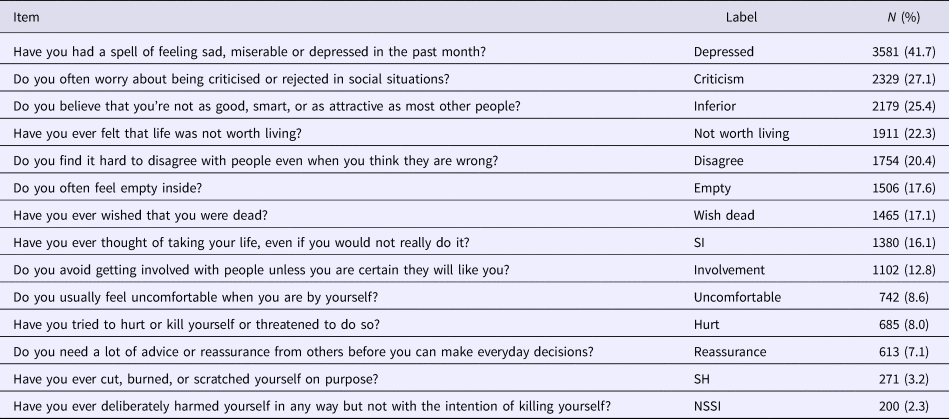
In total, 14 items were identified on the basis of the criteria (see Table 1). One item was taken from the ‘Depression’ section of the questionnaire, four from the ‘Deliberate Self-Harm’ section and nine items were included from the ‘Personality Disorder’ section. All of these items were believed to reflect aspects such as negative self-concept, low self-esteem, subordination, worthlessness, SI and SH. All items were recoded as yes (1) or no (0). Responses of ‘does not apply’ relating to the personality disorder questions were recoded and treated as missing data.
Frequency of negative self-evaluation items in the BPMS (N = 8580)

SI, Suicidal ideation; SH, Self-harm; NSSI, Non-suicidal self-injury.
Risk variables
A number of variables were used to both predict class membership and to evaluate class membership outcomes.
Sociodemographic: Age, sex (male, female), ethnicity (white, non-white), annual income (<£5199; £5200–£15 599; £15 600–£33 799; >£33 800), employment (employed, unemployed), area (semi-rural/rural, urban) and relationship status (couple, not in couple).
Substance use: Drink problem and drug dependence.
Adversities: Several adverse and traumatic events were included as risk variables. These were: experiencing serious illness, injury or assault, separation or divorce, being sacked or made redundant, looking for work unsuccessfully for more than 1 month, having a major financial crisis, having a problem with the police involving a court appearance, being bullied, experiencing violence at work, violence at home, sexual abuse, running away from home and being homeless.
Diagnostic variables: A selection of psychiatric diagnoses were used as risk and outcome variables. Presence of panic disorder, generalised anxiety disorder (GAD), obsessive-compulsive disorder (OCD), specific phobia and social phobia were determined on the basis of CIS-R responses. Individuals who screened positive for psychosis in the initial interview were invited for a follow-up clinical interview to determine the presence of a clinical psychotic disorder. The majority of these individuals took part in the follow-up interview and this information was used to generate a psychotic disorder diagnosis variable. Individuals who did not screen positive for psychosis in the initial interview were not believed to have a psychotic disorder. Details on the selection process for the follow-up interview are available (Singleton et al., Reference Singleton, Bumpstead, O'Brien, Lee and Meltzer2001). These diagnostic variables were combined to form an ‘Any Diagnosis’ variable. Diagnoses of depression and mixed depression and anxiety (MAD) were not accounted for given that a screener for depression was used as one of the NSE items.
Suicide attempt: Lifetime suicide attempt was used as an outcome variable.
Analytic plan
Latent variable modelling was conducted in four main stages. First, as there is no existing theoretical framework describing NSE in the context of the suicidality continuum, exploratory factor analysis (EFA) was first employed to explore and identify the dimensional structure of NSE using the selected items. The full BPMS dataset was randomly split into two sub-samples, each containing approximately 50% of the survey respondents. The fit of six models (a 1-factor through a 6-factor model) was assessed using EFA (oblique rotation) on one of the randomly generated subsamples. Second, confirmatory factor analysis (CFA) was used to test the validity of the best EFA generated model on the remaining subsample. A CFA model was then specified and estimated using the entire sample data to test whether the model held for the full sample. Third, after establishing the underlying dimensional structure of NSE using CFA, it was important to also test the best fitting model against a unidimensional (all items loading on one factor) and a second-order factor model (established factors loading onto a general higher-order factor), also using the full data to ensure that NSE was modelled as accurately as possible. Finally, Factor Mixture Modelling (FMM) was used to identify the fewest groups of individuals who shared the same profile of variation across the established dimensions of NSE. FMMA is a sophisticated hybrid modelling technique which combines latent class analysis with FA (Lubke and Muthén, Reference Lubke and Muthén2007). In FMMA, individuals are grouped into classes and once classified, variation within the class is able to be modelled continuously (Clark et al., Reference Clark, Muthén, Kaprio, D'Onofrio, Viken and Rose2013). This can allow for better representation of the dimensionality of a psychological structure (Clark et al., Reference Clark, Muthén, Kaprio, D'Onofrio, Viken and Rose2013). Eight models were specified and tested. All models were specified and estimated using Mplus version 7.4 (Muthén and Muthén, Reference Muthén and Muthén1998–2015) with the appropriate weighting variable. Weighted least squares means and variance adjusted estimation was employed for the FAs and robust maximum likelihood estimation (Yuan and Bentler, Reference Yuan and Bentler2000) was used for the FMMA. In order to avoid solutions based on local maxima, 100 random sets of starting values were initially used, with 10 final stage optimisations.
The goodness of fit of each model in the FAs was assessed using a series of fit statistics: the χ2 statistic, the comparative fit index (CFI; Bentler, Reference Bentler1990) the Tucker-Lewis index (TLI; Tucker and Lewis, Reference Tucker and Lewis1973) and the root mean square error of approximation (RMSEA; Steiger, Reference Steiger1990). Based on recommendations for parameters of acceptable model fit (Hoyle and Panter, Reference Hoyle, Panter and Hoyle1995; Hu and Bentler, Reference Hu and Bentler1999), a non-significant χ2, values greater than 0.95 for the CFI and TLI and a value of less than 0.05 for the RMSEA indicated good model fit. Additionally, the standardised root mean square residual (SRMR; Joreskog and Sorbom, Reference Joreskog and Sorbom1981) and the weighted root mean residual (WRMR) were estimated. It is recommended that the SRMR is close to or below 0.08 (Hu and Bentler, Reference Hu and Bentler1999) and for the WRMR, values closer to 1 indicate better fit (Yu, Reference Yu2002). The relative fit of the FMMA models was compared by using three information theory-based fit statistics: the Akaike information criterion (AIC; Akaike, Reference Akaike1987), the Bayesian information criterion (BIC; Schwarz, Reference Schwarz1978) and the sample size-adjusted Bayesian information criterion (ssa-BIC; Sclove, Reference Sclove1987). The model that produced the lowest values was judged to be the best fitting model. However, the BIC is considered to be the best of the fit indices tests in for deciding the number of classes in FMMA (Nylund et al., Reference Nylund, Asparouhov and Muthén2007). The Vuong-Lo-Mendell-Rubin likelihood ratio test (LRT; Lo et al., Reference Lo, Mendell and Rubin2001) can also be used to determine class enumeration. When the LRT becomes non-significant it suggests the model with one less class is a better fit of the data. In addition to the fit statistics, it is important to take into consideration the theoretical and conceptual relevance of the factors and latent classes when interpreting the results.
A series of regression analyses was then conducted. First, a multinomial logistic regression analysis was carried out to assess whether the sociodemographic, substance use, adversities and diagnostic risk variables could discriminate between class memberships of the best-fitting FMM. Next, multivariate logistic regression analyses were used to investigate whether class membership predicted (i) individual diagnostic outcomes and (ii) SA history.
Results
The endorsement rates for these NSE items ranged from 42% (depression item) to 2% (NSSI item; see Table 1). All inter-item correlations were significant at the 0.01 level, ranging from 0.046 to 0.721; as correlations were below +/−0.90 multicollinearity and singularity were not considered issues.
Preliminary factor analyses (EFA & CFA 50% of data)
Based on the results of the EFA (50% of the data), the 1-, 2- and 3-factor models were rejected. Both the 4- and 5-factor models were judged to have good fit, although the 5-factor model had a slightly better fit based on the fit index guidelines (Hu and Bentler, Reference Hu and Bentler1999). CFA was then performed on the remaining 50% of the data in an attempt to validate the results of the EFA and to compare the 4- and 5- factor models. The ‘Hurt’ item substantially cross-loaded in both models and was therefore removed before conducting the CFA. The 4-factor model was deemed to be marginally better than the 5-factor model in the CFA. Furthermore, the extremely high correlation between factors 4 and 5 (0.95) in the 5-factor model was a cause for concern, suggesting that these two dimensions should not be separate.
Confirmatory factor analyses (100% of data)
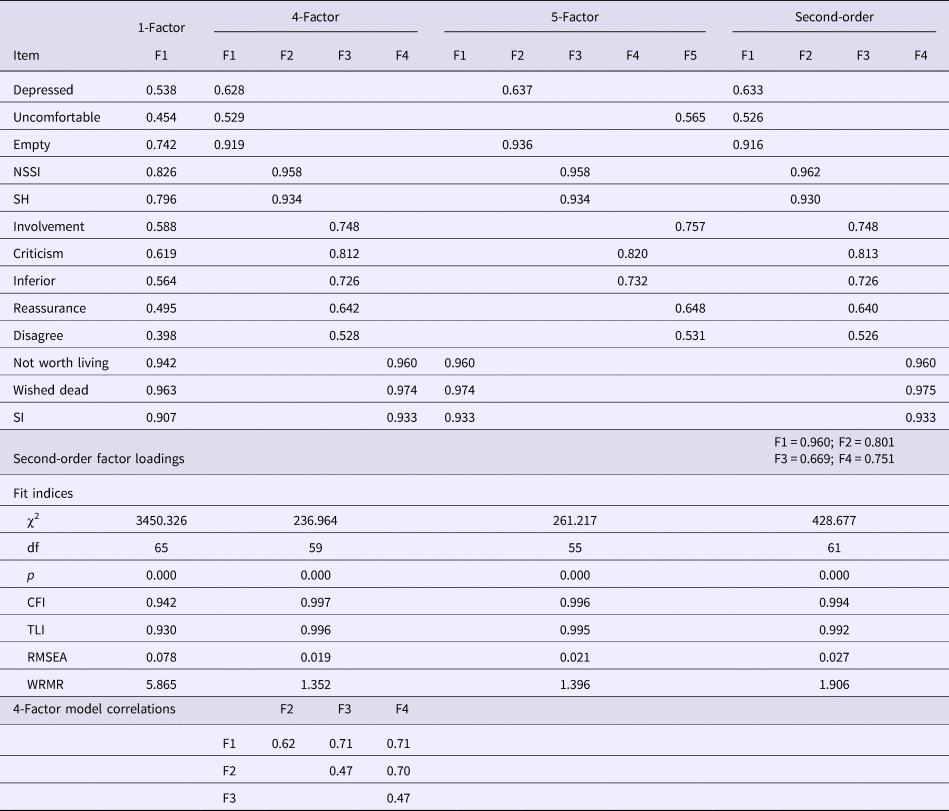
The best fitting CFA model (4-factor model) was then specified and estimated using 100% of the data. This model was tested against (i) the 5-factor model (ii) a unidimensional (all items loading on one factor) and (iii) a second-order factor model (established factors loading onto a general higher-order factor). Table 2 outlines the factor loadings and fit indices for the competing CFA models on the full data.
Factor loadings, factor correlations and fit indices for the unidimensional, 4-factor, 5-factor and second-order models in the CFA (N = 8580)

SI, Suicidal ideation; SH, Self-harm; NSSI, Non-suicidal self-injury; χ2, Likelihood ratio chi-square; CFI, Comparative fit index; TLI, Tucker-Lewis index; RMSEA, Root mean standard error of approximation; WRMR, Weighted root mean square residual.
Note: all factor loadings and factor correlations are statistically significant (p < 0.001).
Similar to the preliminary findings, the 4-factor model provided the best-fitting, most parsimonious representation of the full data. Both the factor loadings and the fit statistics indicated excellent model fit. Factor correlations ranged between 0.47 and 0.71. In this model, three items loaded onto Factor 1 (F1) which seemed to reflect a traditional depression dimension; two items loaded onto Factor 2 (F2) which reflected SH behaviour; five items loaded onto Factor 3 (F3) which was interpreted as low self-worth and feelings of subordination and the final factor (F4) contained three items relating to suicidal thoughts/SI.
FMM analyses
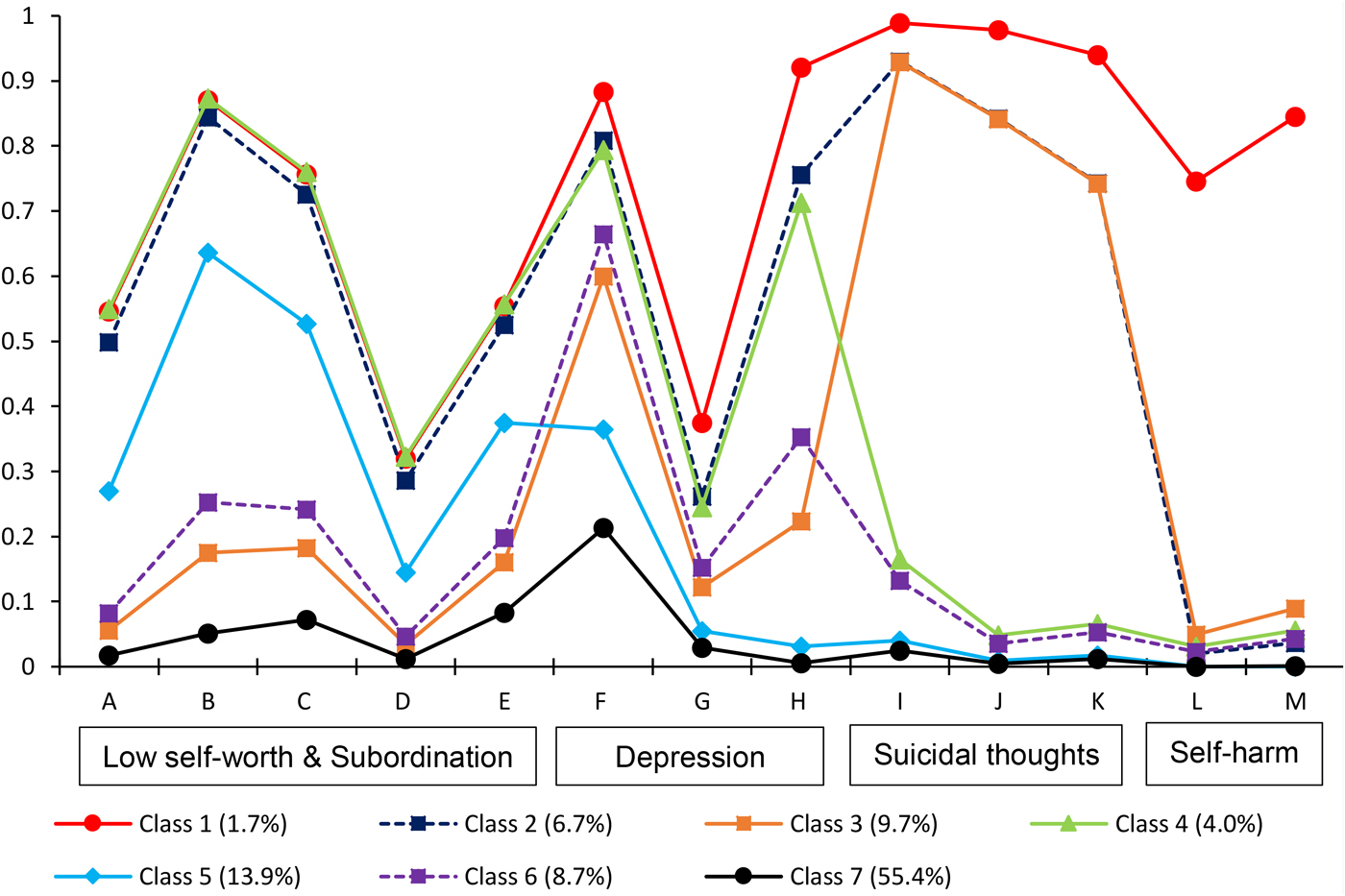
The fit indices for the FMMs are shown in the online Supplementary material (Table 1-OS). They indicated that the AIC, BIC and ssaBIC continued to decrease from the 2-Class model through to the 8-Class model. The LRT, however, became non-significant in the 8-class model, suggesting that the model with one fewer class should be accepted. Therefore, the 7-class solution, which had an acceptable entropy value (0.734) was accepted as the best fitting model (Fig. 1).
FMMA 7-class model profile plot displaying class response probabilities to NSE items. (A) Involvement; (B) Criticism; (C) Inferior; (D) Reassurance; (E) Disagree; (F) Depressed; (G) Uncomfortable; (H) Empty; (I) Not worth living; (J) Wish dead; (K) Suicidal ideation; (L) Non-suicidal self-injury; (M) Self-harm. Note: For a colour version, see this figure online.

Class 1 was the smallest class (1.7%) and had elevated probabilities across all four dimensions and was the only class to be characterised by SH; Class 2 (6.7%) had elevated probabilities on the low self-worth, depression and SI factors (F3, F1 and F4); Class 3 (9.7%) was characterised by depressed mood and SI (F1 and F4); Class 4 (4.0%) reflected a group of people high on the low self-worth and depression dimensions (F3 and F1); Class 5 (13.9%) was the second largest class characterised only by low self-worth (F3); Class 6 (8.7%) was characterised by elevated probabilities on the depression dimension only (F1); and finally, Class 7 was the largest class made up of over half of the sample which represented a baseline class which was not characterised by NSE. Across all classes that showed an elevated probability on the low self-worth dimension, this was more pronounced for the items relating to worrying about criticism and feeling inferior to others compared with the other items in this dimension.
Risk factors
Odds ratios (ORs) for the sociodemographic, substance use, adversity and diagnosis variables predicting FMM class membership are shown in the online Supplementary material (see Table 2-OS). In general, there was a tendency for the more severe classes (1, 2 and 3) to have higher ORs, although there was variability throughout. Of the sociodemographic variables, younger age had some of the strongest ORs, especially for the more severe classes (1 and 2). The trend for the substance use variables was somewhat more difficult to interpret as the more severe classes did not always necessarily seem to reflect greater risk, however, the highest ORs were associated with Class 1. Again, there was variability with the trauma and adversity variables. The highest ORs were associated with Class 1 and bullying was the only trauma variable to be consistently related to all classes. Similarly, the diagnosis variable was also significantly associated with all classes, however most notably with Class 1.
Diagnostic and suicide attempt outcomes
Multivariate logistic regression was then conducted using a range of diagnoses as outcome variables (Table 3). Significant associations emerged between all classes and diagnoses, except Class 5 with panic disorder and psychosis and Class 4 with psychosis. Again, higher ORs were evident for the more severe classes. Particularly strong ORs (>100) were observed for social phobia and Classes 1, 2 and 4; OCD and Classes 1 and 2; and Psychosis and Class 1.
Multivariate logistic regression with diagnoses as outcomes (N = 8580)

*p < 0.05, **p < 0.01, ***p < 0.001.
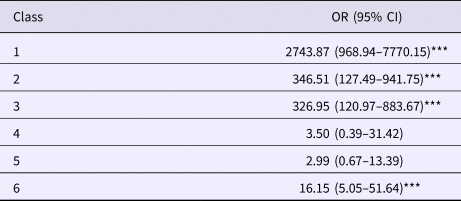
Compared with the baseline class, lifetime suicide attempt was associated with Classes 1, 2, 3 and 6. ORs were extremely elevated for Class 1 compared with the other classes. However, Classes 2 and 3, which were characterised in part by SI also had elevated ORs (Table 4).
Multivariate logistic regression with suicide attempt as an outcome (N = 8580)

***p < 0.001.
Discussion
The purpose of this study was to integrate concepts of NSE into the existing suicidality continuum and to use a series of robust analytic techniques to investigate the viability of this extended construct. A series of factor analyses indicated that a correlated 4-factor model, encapsulating feelings of low self-worth and subordination, depression, SI and SH constituted the best representation of the population data. Factor correlations in this model ranged from 0.47 to 0.71. The factors which were theorised to lie next to one another on the proposed continuum had the strongest relationships; the low self-worth factor correlated highly the depressive factor, as did the depression and SI factors, and the SI and SH factors. The results of the FMMA further supported an extended continuum framework, with 7 classes of graded severity emerging from the data. Class composition suggested the presence of distinct groups that captured variation in ‘internal threat’ from less severe NSE experiences to the most severe suicidality related beliefs and behaviours. Furthermore, almost 45% of the sample were elevated on at least one NSE dimension, meaning that this was not just relevant to a small minority. Of note, only one class emerged which was characterised by SH; this class was the smallest but was also the Class with the highest endorsement probabilities across all NSE items.
A series of recent studies have highlighted the complex relationships between suicidal thoughts and behaviours. Zhang et al. (Reference Zhang, Ren, You, Huang, Jiang, Lin and Leung2017) investigated the pathways from negative emotion (e.g. depression and anxiety) to suicidal behaviours. They found the negative emotion to be both directly linked to SI and indirectly through NSSI. Additionally, negative emotion was indirectly linked to a suicide attempt through both NSSI and SI. Similarly, NSSI has also been reported as a partial mediator between depression and suicidal risk, with depression also having a direct relationship to suicidal risk (Kang et al., Reference Kang, You, Huang, Ren, Lin and Xu2018). These studies support a ‘graduation’ hypothesis from less to more severe experiences. Although the current study cannot infer temporal ordering, it similarly suggests that individuals in the classes characterised by experiences at the lower end of the continuum have the potential to transition or ‘graduate’ to increasingly severe experiences. Nevertheless, this is not a one-size-fits-all model. Not all individuals who die by suicide will have had this consecutive chain of experiences.
The findings reported here are preliminary and replication will be needed to further substantiate the model, however, the extended continuum that we have proposed does perform well against established criteria used to evidence the existence of continua in the population (see van Os et al., Reference van Os, Linscott, Myin-Germeys, Delespaul and Krabbendam2009 seminal systematic review and meta-analysis of the psychosis continuum). Consistent with van Os’ criteria, our results suggest that an extended suicidality continuum demonstrates (i) psychopathological validity: similar patterns of comorbidity among classes; (ii) demographic and aetiological validity: shared demography and risk among classes, and (iii) distributional validity: a half-normal distribution was present. Epidemiological validity was also partially supported; this refers to the distribution of the construct relevant to the underlying theory. A logical assumption of an extended suicidality continuum would be that NSE features, at the lower end, would be more prevalent than NSSI, SI features at the higher end of the continuum; feelings of sadness/depressed mood, worry about criticism and rejection and feelings inferiority in the current analyses were endorsed most frequently (over 25% of respondents) while, as expected, the most extreme SH items were rarer (2–3%). However, notably, the SI items were endorsed more frequently than some of the low self-worth items. Importantly, beyond the use of the SA variable, predictive validity could not be inferred; further prospective research will be needed to understand class transitions over time.
Risk factors
Although not consistent across all variables, there was a general trend for risk factors to be most strongly associated with the SH class (Class 1), followed by the two classes characterised by SI (Classes 2 & 3). This incremental effect was suggestive of a continuum of experiences. Furthermore, differences between the SH class and the other classes appeared to be quantitative rather than qualitative in nature. This is similar to Nock et al. (Reference Nock, Borges, Bromet, Alonso, Angermeyer, Beautrais, Bruffaerts, Chiu, De Girolamo, Gluzman and De Graaf2008) who found that sociodemographic and mental disorder risk factors varied in magnitude rather than type among suicide ideators, planners and attempters in their international study. Sexual abuse and bullying were particularly relevant to NSE class membership in the current study. Sexual abuse and bullying have both been found to be associated with SH and SI (Holt et al., Reference Holt, Vivolo-Kantor, Polanin, Holland, DeGue, Matjasko, Wolfe and Reid2015; Mossige et al., Reference Mossige, Huang, Straiton and Roen2016) and it has been suggested that SH may be a maladaptive coping mechanism used to alleviate distress (Zlotnick et al., Reference Zlotnick, Shea, Pearlstein, Simpson, Costello and Begin1996; Klonsky, Reference Klonsky2007). Less severe NSE experiences such as feelings of worthlessness are also influential in trauma-suicidal behaviour (Jeon et al., Reference Jeon, Park, Fava, Mischoulon, Sohn, Seong, Park, Yoo and Cho2014). Moreover, consistent with the broader literature, interpersonal traumas (such as sexual abuse and bullying), compared to non-interpersonal traumas are more associated with BPD (Westphal et al., Reference Westphal, Olfson, Bravova, Gameroff, Gross, Wickramaratne, Pilowsky, Neugebauer, Shea, Lantigua and Weissman2013) and CPTSD (Cloitre et al., Reference Cloitre, Garvert, Brewin, Byrant and Maercker2013) which are both characterised by NSE and SH features.
Psychiatric diagnoses and SA
Strong associations were observed between the NSE classes and the psychiatric diagnoses. Even classes characterised by the milder manifestations of internal threat only (e.g. Class 4) presented the risk of a psychiatric disorder on par with some of the more severe classes (e.g. Class 2). These findings also support the literature showing that negative self-concepts are not specific to depression, BPD or CPTSD, where they are often central to the diagnostic formulation. Rather, they are present across a spectrum of psychopathology and are seen in a range of mental health problems including eating disorders (Cooper and Turner, Reference Cooper and Turner2000; Stein and Corte, Reference Stein and Corte2007), social anxiety (Clark, Reference Clark, Crozier and Alden2001) and psychosis (Bentall et al., Reference Bentall, Kinderman and Kaney1994; Garety et al., Reference Garety, Kuipers, Fowler, Freeman and Bebbington2001). NSE, therefore, is unlikely to be diagnostic specific but may instead be transdiagnostic, a relevant construct for psychopathology more generally.
SA acted, in part, as a validator for the proposed extended continuum as it represented the most extreme and severe outcome that could be considered for internal threat behaviour. Its association (or lack thereof), with each of the classes, indicated that while SA may be strongly associated with the most severe profiles of NSE, it is not likely to be an outcome for all who occupy positions on the proposed continuum. There seemed to be a notable risk that was specifically relevant for those who were/had actively engaged in SH behaviour. Those who entertained thoughts of suicide but who did not SH also exhibited significantly elevated risk of SA. Moreover, the significant risk was also present for Class 6 (depression only); this was an interesting finding as Class 4 (low self-worth and depression) did not exhibit risk of SA.
Limitations
Despite the large general population sample and robust analytic methodology, some limitations must be acknowledged. First and foremost, the use of cross-sectional data did not afford opportunities to test the temporal and transitional assumptions that were proposed. This study was preliminary in nature, assessing whether the existence of such a continuum was conceivable; as aforementioned, future research using prospective data will be needed to demonstrate that individuals who occupy the lower end of the proposed continuum are also at risk of transitioning through the continuum. Moreover, the current models were tested on a single sample and will require replication. Due to the constraints of working with secondary data, only NSE-related items which were available in the dataset were utilised. Therefore, incorporation of a broader selection of negative self-evaluative concepts, to more accurately model the extended continuum and understand its associated risks and outcomes over time, is also advised. The diagnoses of depression and MAD were not included as part of the combined diagnosis variable or as individual diagnostic outcomes given that the NSE items contained a screener question for depression. This meant that these relationships could not be analysed. As previously stated, the suicidality continuum model does not align with every individuals’ experiences and not all research corroborates this continuum hypothesis (e.g. De Leo et al., Reference De Leo, Cerin, Spathonis and Burgis2005; Dhingra et al., Reference Dhingra, Boduszek and Klonsky2016). Likewise, we do not posit that the extended continuum is experienced universally.
Conclusion
Low self-worth and subordination, and depression, while representative of distinct groups in the population are also highly prevalent in those who entertain suicidal thoughts and engage in SH behaviour. A suicidality continuum, therefore, may extend beyond the most extreme thoughts and behaviours and incorporate a much wider array of phenomena that may vary in severity and may constitute a broader NSE spectrum. Challenging NSE, therefore, may be a fruitful avenue for therapeutic interventions that aim to reduce psychological distress, limit SI, and prevent self-harming behaviour and death by suicide.
Supplementary material
The supplementary material for this article can be found at https://doi.org/10.1017/S0033291718003562.
Conflict of interest
None.