Since Sterling and Eyer (Reference Sterling, Eyer, Fisher and Reason1988) and McEwen and Stellar (Reference McEwen and Stellar1993) introduced the concepts of allostasis and allostatic load, respectively, to psychophysiological research, there has been increasing interest in understanding how adaptive functioning is supported by the dynamic coordination of multiple physiological regulatory systems. Allostasis refers to the process by which individuals adjust to the continually changing demands that are being put upon somatic activity, due to both predictable (e.g., diurnal fluctuations) and unpredictable (e.g., social challenges) events. Effective coping with these changing demands requires not simply reestablishing homeostasis, or a constant set point at a given level of arousal, but an ability to flexibly adjust regulatory activity to the arousal set point most advantageous for that context (Berntson & Cacioppo, Reference Berntson, Cacioppo, Cacioppo, Tassinary and Berntson2007). Under conditions of challenge, physiological regulatory systems will regulate or adapt to meet the metabolic needs of the individual. When specific chronic or repeated challenges persist over time, however, these prolonged allostatic changes might contribute to the systems losing their flexibility for responding to the myriad other challenges one might face. The adaptation to the chronic challenge might establish the activity of physiological systems at a consistent level of high or low arousal level, termed allostatic load, which leaves the individual vulnerable to pathology (Juster, McEwen, & Lupien, Reference Juster, McEwen and Lupien2010; McEwen, Reference McEwen1998) and less able to adapt their physiological functions to new or different environmental challenges.
Multiple neurobiological systems, such as the hypothalamic–pituitary–adrenal (HPA) axis and the autonomic nervous system (ANS), are responsible for producing changes in somatic activity that are necessary for responding to salient acute events. As argued by Lupien and colleagues (Reference Lupien, Ouellet-Morin, Hupbach, Tu, Buss, Walker, Cicchetti and Cohen2006), the HPA and the ANS are the primary engines of allostasis, and determine how the body instantiates environmental challenge. In a provocative article, Bauer, Boyce, and Quas (Reference Bauer, Boyce and Quas2002) applied the concepts of allostasis and allostatic load to models of the physiological underpinnings of emotional and behavioral problems in children and adolescents. They noted that although several researchers had considered how various forms of psychopathology were associated with atypical regulatory activity in two or more physiological systems, few had examined the coordination of regulation across systems. Allostatic load, they argued, might be evident in dysregulated patterns of stress reactivity across physiological systems, rather than changes in the responsivity of any one given system. Examining single indicators of physiology that reflect only one level of biological activity often yields small relations with behavior and, more fundamentally, belies the complexity of systemic regulation (Bauer et al., Reference Bauer, Boyce and Quas2002; Lupien et al., Reference Lupien, Ouellet-Morin, Hupbach, Tu, Buss, Walker, Cicchetti and Cohen2006). Similarly, others have described co- and counterregulatory processes across and within systems that influence the organization and disorganization of behavior (Cicchetti & Toth, Reference Cicchetti and Toth2009; Gottlieb, Reference Gottlieb, Cairns, Elder and Costello1996). Efforts are now needed to elucidate our understanding of how multiple and interacting physiological processes unfold across development, potentially leading to the emergence of, or shaping the course of, psychopathology (Cicchetti, Reference Cicchetti, Beauchaine and Hinshaw2008; Cicchetti & Curtis, Reference Cicchetti and Curtis2007). We undertook this study to examine how the joint effects of adrenocortical (HPA) and cardiovascular (ANS) responses to challenging events were associated with the development of adolescents' externalizing and internalizing problems over 2 years.
Physiological Regulation of Stress Reactivity
The ANS and HPA axis constitute the two main arms of stress response and regulation psychobiology, acting via direct nerve enervation and circulating hormones, respectively. The ANS is the rapid communicative system between the brain and the body, with bidirectional signals passing through its two branches, the sympathetic (SNS) and parasympathetic nervous system (PNS; Brownley, Hurwitz, & Schneiderman, Reference Brownley, Hurwitz, Schneiderman, Cacioppo, Tassinary and Bernston2000). When a challenging event occurs, the SNS stimulates the adrenal medulla to release norepinephrine and epinephrine, which drive the fight or flight responses of many tissues. This is manifested in ways that parallel many of the effects of cortisol, including release of glucose and increased heart rate (HR) and blood pressure (BP), but the effects are manifested on a much faster time scale (Berntson, Quigley, and Lozano, Reference Berntson, Quigley, Lozano, Cacioppo, Tassinary and Berntson2007). Whereas the SNS principally serves to increase somatic arousal, the PNS primarily lowers arousal, and is often characterized as curtailing SNS activation. (The SNS and PNS are not simply antagonistic, however, as they can act in a complex, synergistic fashion to exert control through coactivation or coinhibition; Berntson, Cacioppo, & Quigley, Reference Berntson, Cacioppo and Quigley1991.) Greater PNS activity lowers HR and increases digestive and recuperative activity, such that it can be seen as diminishing stress reactions or facilitating recovery from stress responses (Porges, Reference Porges2001). HR and BP are common measures of ANS activity and, although they are influenced by both branches of the ANS, SNS activity has relatively greater control over BP whereas the PNS exerts relatively greater control over HR (Berntson et al., Reference Berntson, Quigley, Lozano, Cacioppo, Tassinary and Berntson2007; Brownley et al., Reference Brownley, Hurwitz, Schneiderman, Cacioppo, Tassinary and Bernston2000).
Stress-related activity of the HPA axis begins when a challenging or threatening event occurs. Neurons in the paraventricular nuclei (PVN) of the hypothalamus release corticotropin-releasing hormone (CRH) and arginine vasopressin. CRH and arginine vasopressin stimulate the corticotrophic cells in the anterior pituitary to secrete adrenocorticotropic hormone (ACTH; Chrousos & Gold, Reference Chrousos and Gold1992; Kaltas & Chrousos, Reference Kaltas, Chrousos, Cacioppo, Tassinary and Bernston2007), which crosses the blood–brain barrier and triggers the adrenal cortex to release corticosteroids, including cortisol. These hormones are carried by the circulatory system to targets throughout the body to produce a variety of effects, including increased blood glucose levels and release of fatty acids to provide fuel for activity, and increased HR and BP. In reaction to a stressful event, especially one that is threatening because it seems unpredictable, uncontrollable, and socially evaluative (Dickerson & Kemeny, Reference Dickerson and Kemeny2004), the HPA axis initiates a response that typically peaks about 20 min after the event (Gunnar & Talge, Reference Gunnar, Talge, Schmidt and Segalowitz2008; Kudielka, Buske-Kirschbaum, Hellhammer, & Kirschbaum, Reference Kudielka, Buske-Kirschbaum, Hellhammer and Kirschbaum2004). Circulating cortisol eventually crosses the blood–brain area and signals the PVN to decrease production of CRH, such that the HPA axis is a self-regulating system through a negative feedback loop.
The ANS and HPA axis are both responsive to provocative events, although it is possible that the two systems are differentially responsive to various stressors (Lovallo & Thomas, Reference Lovallo, Thomas, Cacioppo, Tassinary and Bernston2000). Many developmental researchers have examined concurrent markers of the two systems, but most have examined them as independent measures of stress reactivity and have not considered their joint effects (e.g., Doussard-Roosevelt, Montgomery, & Porges, Reference Doussard-Roosevelt, Montgomery and Porges2003; Gump et al., Reference Gump, Reihman, Stewart, Lonky, Darvill and Granger2009; Obradovic, Bush, Stamperdahl, Adler, & Boyce, Reference Obradovic, Bush, Stamperdahl, Alder and Boyce2010; Quas, Bauer, & Boyce, Reference Quas, Bauer and Boyce2004; Rudolph, Troop-Gordon, & Granger, Reference Rudolph, Troop-Gordon and Granger2010; Snoek, Van Goozen, Mathys, Buitelaar, & Van Engeland, Reference Snoek, Van Goozen, Matthys, Buitelaar and Van Engeland2004; van Goozen, Matthys, Cohen-Kettenis, Buitelaar, & Van Engeland, Reference van Goozen, Matthys, Cohen-Kettenis, Buitelaar and van Engeland2000). It is necessary for developmental psychopathologists to broaden their vision to integrate across multiple levels of neurobiological regulation, as one physiological system can influence or constrain the activity and effects of another (Cicchetti & Curtis, Reference Cicchetti and Curtis2007; Cicchetti & Toth, Reference Cicchetti and Toth2009). There are anatomical and functional connections of the HPA and SNS systems in the brain that suggests their activity could be coordinated, including neural projections from the PVN to hindbrain regions that control sympathetic activation (Chrousos & Gold, Reference Chrousos and Gold1992), and effects of CRH on norepinephrine release (Dunn & Berridge, Reference Dunn and Berridge1990). How and when the HPA and ANS might function together to coregulate effective stress regulation remain open questions. Time course differences in activation and measurement of these systems challenges the assessment of links between them. Research to date is not conclusive as to whether indices of reactivity in the two systems are (e.g., El-Sheikh, Erath, Buckhalt, Granger, & Mize, Reference El-Sheikh, Erath, Buckhalt, Granger and Mize2008) or are not (e.g., van Goozen et al., Reference van Goozen, Matthys, Cohen-Kettenis, Gispen-de Wied, Wiegant and van Engeland1998) associated.
Stress Physiology and Developmental Psychopathology
To address the link between multilevel stress physiology patterns and psychopathology, Bauer and colleagues (Reference Bauer, Boyce and Quas2002) presented competing models showing how different patterns of coregulation of arousal might be expected to support adaptive or maladaptive stress responses. One model they presented was termed an interactive model, suggesting that asymmetrical activation across ANS and HPA axis could carry the risk for maladjustment. Drawing on evidence that glucocorticoids can serve to suppress arousal responses that are initiated by the SNS (Munck, Guyre, & Holbrook, Reference Munck, Guyre and Holbrook1984; Sapolsky, Romero, & Munck, Reference Sapolsky, Romero and Munck2000), they suggested that one role of the HPA axis might be the termination of stress reactivity that is initiated by the sympathetic branch of the ANS. If the HPA works in opposition to the SNS, optimal functioning would occur when they are balanced (symmetrical reactivity); in other words, when both systems showed either low responsivity or high responsivity to stressful events, fewer problems would be expected. Maladaptive stress reactivity and hence risk for psychopathology would be reflected in a failure to coordinate these systems resulting in high activation in one system and low activation in the other (asymmetrical reactivity).
Bauer and colleagues (Reference Bauer, Boyce and Quas2002) also presented a second model. They suggested that traditional perspectives would support an additive model, with glucocorticoids augmenting SNS-mediated peripheral activation. In this model, moderate arousal would be most adaptive, and would be reflected in either moderate arousal of both the HPA and ANS, or a pattern of high activation of one system and low activation of the other. Either symmetrically low activation or symmetrically high activation across systems could be considered maladaptive. Symmetrical low activation would carry risk for externalizing problems (e.g., Raine, Reference Raine2008; van Goozen, Fairchild, & Harold, Reference van Goozen, Fairchild and Harold2008) because individuals might be unresponsive to environmental cues that should terminate potentially dangerous activities (fearlessness) or might be driven to engage in dangerous activities in order to induce some arousal (sensation seeking). Symmetrical high activation would carry risk for internalizing problems (e.g., Kagan, Snidman, Arcus, & Reznick, Reference Kagan, Snidman, Arcus and Reznick1994; Merikangas, Avenevoli, Dierker, & Grillon, Reference Merikangas, Avenevoli, Dierker and Grillon1999) because the exaggerated arousal state would overwhelm coping resources; individuals would focus on their internal distress and avoid or withdraw from other people and situations.
At the time Bauer and colleagues (Reference Bauer, Boyce and Quas2002) contrasted these models there were no published data that could be used to evaluate their validity. There was, however, ample research on the psychobiological correlates of children's and adolescents' emotional and behavioral problems. Overall, that literature would suggest that adolescents with internalizing problems tend to show symmetrical high activation across systems, and youths with externalizing problems tend to show symmetrical low activation across systems. That is, youths with internalizing problems, and particularly anxiety, are characterized as having hyperarousal or exaggerated reactivity across systems, including cardiovascular and adrenocortical responses to stress (Granger, Weisz, McCracken, & Ikeda, Reference Granger, Weisz, McCracken and Ikeda1996; Hastings et al., Reference Hastings, Nuselovici, Klimes-Dougan, Kendziora, Usher and Ho2009; Hastings, Zahn-Waxler, & Usher, Reference Hastings, Zahn-Waxler and Usher2007; Klimes-Dougan, Hastings, Granger, Usher, & Zahn-Waxler, Reference Klimes-Dougan, Hastings, Granger, Usher and Zahn-Waxler2001; Pine et al., Reference Pine, Coplan, Papp, Klein, Martinez and Kovalenko1998; Weems, Zakem, Costa, Cannon, & Watts, Reference Weems, Zakem, Costa, Cannon and Watts2005). Although pediatric depression symptoms have not been associated with stress-reactive HR or BP (Gump et al., Reference Gump, Reihman, Stewart, Lonky, Darvill and Granger2009, personal communication; Tonhajzerova et al., Reference Tonhajzerova, Ondrejka, Javorka, Turianikova, Farsky and Javorka2010), there is some evidence that depressed youths manifest stronger SNS (Nock & Mendes, Reference Nock and Mendes2008; Shannon, Beauchaine, Brenner, Neuhaus, & Gatzke-Knopp, Reference Shannon, Beauchaine, Brenner, Neuhaus and Gatzke-Kopp2007) and weaker PNS (Gentzler, Santucci, Kovacs, & Fox, Reference Gentzler, Santucci, Kovacs and Fox2009; Shannon et al., Reference Shannon, Beauchaine, Brenner, Neuhaus and Gatzke-Kopp2007) influences on autonomic regulation, and depression in youth is associated with elevated basal and stress-reactive cortisol levels (Adam et al., Reference Adam, Doane, Zinbarg, Mineka, Craske and Griffith2010; Guerry & Hastings, Reference Guerry and Hastings2011; Lopez-Duran, Kovacs, & George, Reference Lopez-Duran, Kovacs and George2009; Mathew et al., Reference Mathew, Coplan, Goetz, Feder, Greenwald and Dahl2003; Rao, Hammen, Ortiz, Chen, & Poland, Reference Rao, Hammen, Ortiz, Chen and Poland2008). In contrast, youths with externalizing problems and disruptive behavior disorders more typically evidence hypoarousal or diminished reactivity across physiological systems (Fairchild et al., Reference Fairchild, van Goozen, Stollery, Brown, Gardiner and Herbert2008; Hastings et al., Reference Hastings, Zahn-Waxler and Usher2007, Reference Hastings, Nuselovici, Klimes-Dougan, Kendziora, Usher and Ho2009; Ortez & Raine, Reference Ortiz and Raine2004; Popma et al., Reference Popma, Jansen, Vermeiren, Steiner, Raine and Van Goozen2006; Shirtcliff, Granger, Booth, & Johnson, Reference Shirtcliff, Granger, Booth and Johnson2005). Intriguingly, studies that are inconsistent with this latter pattern, such as showing that externalizing problems are positively associated with cortisol levels, have predominantly included community samples of prepubertal children (Alink et al., Reference Alink, van IJzendoorn, Bakermans-Kranenburg, Mesman, Juffer and Koot2008). Less stress-responsive physiological systems might be most characteristic of adolescents with externalizing problems and clinical populations of pediatric antisocial problems.
To date, there are only a few studies that have attempted to directly evaluate the additive and interactive multilevel models of Bauer and colleagues (Reference Bauer, Boyce and Quas2002). Some have focused on normative emotional functioning in infants and toddlers (e.g., Lewis, Ramsay, & Sullivan, Reference Lewis, Ramsay and Sullivan2006; Buss, Davidson, Kalin, & Goldsmith, Reference Buss, Davidson, Kalin and Goldsmith2004; Fortunato, Dribin, Granger, & Buss, Reference Fortunato, Dribin, Granger and Buss2008); however, the studies that evaluate patterns of physiological responses across systems with high-risk children or adolescents are of greater relevance here. In two studies, Gordis, Granger, Susman, and Trickett (Reference Gordis, Granger, Susman and Trickett2006, Reference Gordis, Granger, Susman and Trickett2008) examined changes in salivary cortisol and alpha-amylase levels in response to challenges as measures of HPA and SNS activation, respectively. Using a modified Trier Social Stress Test with a sample of maltreated and nonmaltreated young adolescents, Gordis and colleagues (Reference Gordis, Granger, Susman and Trickett2006) found that youths with symmetrically low reactivity engaged in more aggressive behavior. Aggression was lowest among youths with asymmetrical reactivity reflecting lower SNS and higher HPA reactivity, and there was no association between salivary cortisol levels and aggressive behavior among youths with higher alpha-amylase reactivity. In a subsequent study, maltreatment status was found to moderate the association between reactive cortisol and alpha-amylase levels (Gordis et al., Reference Gordis, Granger, Susman and Trickett2008). Symmetrical reactivity was found to characterize nonmaltreated children, as their reactive cortisol and alpha-amylase levels were strongly positively correlated. However, there was no correlation between HPA and SNS reactivity in the maltreated children. This did not necessarily reflect asymmetrical reactivity per se, as there was not a negative correlation between systems; rather, it suggested that adrenocortical and sympathetic reactivity were unrelated, or uncoupled, in maltreated youths. Unfortunately, Gordis and colleagues (Reference Gordis, Granger, Susman and Trickett2008) did not report how the various patterns of association between their measures of HPA and ANS responses were associated with children's adjustment.
El-Sheikh and colleagues (Reference El-Sheikh, Erath, Buckhalt, Granger and Mize2008) examined how the interactions of basal cortisol levels with basal alpha-amylase and skin conductance levels, both of which are sympathetically mediated, were associated with internalizing and externalizing problems in a community sample of children. Children had more internalizing problems when they had symmetrically high HPA and SNS levels, and fewer internalizing problems when they had symmetrically low levels, a pattern that was consistent across the two measures of SNS. Intriguingly, the same pattern was evident when cortisol and alpha-amylase were examined in relation to children's externalizing problems. Children also manifested fewer problems of either type when they had asymmetrically low SNS and high HPA levels.
Although not entirely consistent, together these studies offer limited support for the additive model of the joint contributions of HPA and ANS activity to children's emotional and behavioral problems (Bauer et al., Reference Bauer, Boyce and Quas2002). With the exception of symmetrical reactivity being more typical of nonmaltreated children (Gordis et al., Reference Gordis, Granger, Susman and Trickett2008), in the cross-sectional literature reviewed above there was no clear support for the interactive model that would link asymmetrical reactivity with psychopathology. Several limitations of these studies should be recognized, however. First, the studies uniformly included relatively small numbers of children, with all samples totaling fewer than 90, affording limited power to detect interaction effects between physiological systems. Second, none of the studies accounted for the comorbidity of problems in their analyses, which is typically quite high in children (Nottelmann & Jensen, Reference Nottelmann and Jensen1995). Quite different patterns of association between biopsychological measures and internalizing versus externalizing problems could be expected. Third, all of the studies were cross-sectional in design, providing only a snapshot of the concurrent associations between physiology and adjustment. If patterns of association between HPA and ANS reactivity are indeed reflective of allostatic changes to meet the changing demands of life's challenges, or if they are reflective of allostatic load and a loss of the flexibility necessary for adaptation, then they should be predictive of how children's psychopathologies develop over time. Longitudinal designs would be necessary for conducting these more robust tests of the additive and interactive models (Bauer et al., Reference Bauer, Boyce and Quas2002).
Fourth, past studies have failed to consider adequately how gender might moderate associations between physiological reactivity patterns and adjustment. This might partly be attributable to the small sample size of these studies, which would afford low power to detect moderating effects of gender. There are notable patterns of gender differences in the development of psychopathology from childhood to adolescence (Nottelmann & Jensen, Reference Nottelmann and Jensen1995; Zahn-Waxler, Shirtcliff, & Marceau, Reference Zahn-Waxler, Shirtcliff and Marceau2008), with internalizing problems becoming more strongly represented in girls and externalizing problems becoming more strongly represented in boys over development from childhood through adolescence. Sex differences in adrenocortical and autonomic regulation might contribute to these differing emotional and behavioral profiles.
Although some research has found consistent patterns of association between physiology and psychopathology in males and females (e.g., Ortez & Raine, Reference Ortiz and Raine2004), there is also evidence that boys and girls with superficially similar problems might differ in their patterns of physiological reactivity and regulation. Such differences could contribute to divergent male and female trajectories of psychopathology (Zahn-Waxler et al., Reference Zahn-Waxler, Shirtcliff and Marceau2008). In this sample, boys and girls with similar externalizing or internalizing problems were found to differ in the correspondence between their autonomic and subjective emotional responses to video stimuli (Hastings et al., Reference Hastings, Nuselovici, Klimes-Dougan, Kendziora, Usher and Ho2009). Other research has shown autonomic hyporeactivity to be more characteristic of boys with conduct problems than girls with conduct problems (Beauchaine, Hong, & Marsh, Reference Beauchaine, Hong and Marsh2008). Similarly, Sylvers, Brennan, Lilienfeld, and Alden (Reference Sylvers, Brennan, Lilienfeld and Alden2010) found that antisocial personality disorder symptoms in young adult males were associated with lower sympathetic reactivity in response to an impending aversive noise, but heightened sympathetic reactivity to threatening images. In young adult females, symptoms were associated with increased parasympathetic activity in response to images of threat and distressed others.
There is reason to expect that associations between HPA response to stressors and adjustment might differ for males and females as well. Taylor and colleagues (Reference Taylor, Klein, Lewis, Gruenewald, Gurung and Updegraff2000) have argued that HPA-mediated “fight or flight” responses to stress are more typical of male than female reactivity patterns, although men and women often show similar adrenocortical responses to the Trier Social Stress Test (Kelly, Tyrka, Anderson, Price, & Carpenter, Reference Kelly, Tyrka, Anderson, Price and Carpenter2008). However, females appear more physiologically reactive to social rejection challenges, whereas males are more reactive to achievement challenges (Stroud, Salovey, & Epel, Reference Stroud, Salovey and Epel2002). In this sample, the association between cortisol reactivity to a modified Trier Social Stress Test and internalizing problems was found to be stronger for adolescent girls than boys (Natsuaki, Klimes-Dougan, Ge, Shirtcliff, Hastings, & Zahn-Waxler, Reference Natsuaki, Klimes-Dougan, Ge, Shirtcliff, Hastings and Zahn-Waxler2009). Similarly, another study found higher cortisol reactivity to a social challenge was more highly associated with internalizing problems in preschool-aged girls, and with externalizing problems in boys (Hastings et al., in press). Together, this research points to a need for further exploration of the associations between gender, physiological reactivity across systems, and development of externalizing and internalizing problems.
Goals and Hypotheses
To date, interest in allostasis and allostatic load has generated only limited empirical examination of the interactive contributions of HPA and ANS regulation to developmental psychopathology. In this study, we responded to calls for integrative multilevel models of neurobiological regulation by examining the additive and interactive contributions of cardiovascular and adrenocortical stress responses to adolescents' concurrent externalizing and internalizing problems, and to the development of their problems over the subsequent two years. We expected to replicate the research showing that adolescents' stress responses, in both the autonomic and adrenocortical systems, are negatively associated with externalizing problems and positively associated with internalizing problems. Adolescents' externalizing problems were expected to be concurrently associated with symmetrical low activation across systems; in contrast, adolescents with symmetrical high activation were expected to manifest the most internalizing problems concurrently. These associations were expected to be stronger in the interactions between cortisol and BP reactivity than those between cortisol and HR reactivity, as the former autonomic measure is a better indicator of sympathetic regulation. We tentatively expected this pattern to be maintained developmentally, with symmetrical low and high reactivity predicting more externalizing and internalizing problems, respectively, 2 years later.
Gender also was examined as a possible moderator of the associations between patterns of physiological reactivity and development of emotional and behavioral problems. Earlier symmetrical high reactivity was expected to be most strongly predictive of later internalizing problems in girls, whereas earlier symmetrical low reactivity was expected to be most strongly predictive of later externalizing problems in boys.
Method
Participants
Participants were 220 families who took part in a larger, multimethod, longitudinal investigation with two assessment waves (Time 1 [T1] and Time 2 [T2]) titled, The Role of Emotion in the Development of Psychopathology in Adolescence, conducted at the National Institute of Mental Health (Klimes-Dougan et al., Reference Klimes-Dougan, Hastings, Granger, Usher and Zahn-Waxler2001; Zahn-Waxler et al., Reference Zahn-Waxler, Klimes-Dougan, Hastings, Duggal, Gruber and Usher2001). Five youths did not provide both usable cortisol data and usable autonomic data and therefore are excluded from current analyses (N = 215). Families were recruited from the greater Washington, DC, metropolitan area. Primary inclusion criteria were youth's psychological profile and age (11 to 16 years at T1). To address the aims of the larger study, youths were screened for their levels of emotional and behavioral problems during recruitment efforts (externalizing and internalizing symptomatology, with symptom type distributed across sex and age). Additional criteria for inclusion were based on characteristics of the youth participant (e.g., IQ within the average range or higher, free from chronic medical conditions or severe psychosis) and family structure (e.g., consistent mother figure; no major structural changes, such as divorce, within the past year). When a father figure was present in the home over at least the previous year, his participation was required.
At T1, youth had a mean age of 13.67 years (SD = 1.80) and were equally divided between males (N = 109) and females (N = 106). Youths designated as “high risk” had elevated T scores (T ≥ 64) on at least one of the broadband externalizing problem (EP) and internalizing problem (IP) scales from abbreviated versions of the Youth Self-Report (YSR; Achenbach, Reference Achenbach1991b) and mother-report Child Behavior Checklist (CBCL; Achenbach, Reference Achenbach1991a) that were administered over the phone (N = 136); “low-risk” youths had all screening T scores ≤ 63 (N = 79). For the purposes of this paper, the abbreviated screening YSR and CBCL were used only to characterize the risk status of youths at recruitment and did not contribute to the analyses of relations between physiology and problem scores. Because of the approach used to recruit participants, age (M = 13.53 years and 13.73 years in the low-risk and high-risk groups, respectively) and sex (49% and 52% male in the low-risk and high-risk groups, respectively) distributions were comparable for the low-risk and high-risk groups, and males and females did not differ in screening EP and IP T scores, all |t| (213) ≤ 1.20. The youth were 71% White, 16% Black, 2% Hispanic, 3% Asian, and 7% other. Parents' ethnic composition was similar. Using the Hollingshead Four Factor Index of Social Status (Reference Hollingshead1975), there was a wide range of socioeconomic groups represented at the T1 assessment (e.g., 16.4% reported household incomes of 0 to $40,000; 35.0% reported $41,000 to $80,000; and 45.5% reported over $81,000). Most of the participants were from middle- to upper-middle class families (M = 52.93, SD = 10.84). Seventy-six percent were from two-parent families. At T2, youth ranged in age from 13.00 to 19.42, with a mean age of 16.07 (SD = 1.51) and were equally divided between males (50.6%) and females.
Recruitment and procedures
Standard recruitment procedures through announcements (e.g., newspapers advertisements, flyers, postings on community billboards) were used. Of the 480 calls received, 220 became study participants (and 6 were pilot subjects). Most who did not participate did not meet inclusion criteria, but approximately 15% of those that called declined to participate in the study or failed to complete the scheduled visits (for a full accounting of participants, see Klimes-Dougan et al., Reference Klimes-Dougan, Hastings, Granger, Usher and Zahn-Waxler2001, Reference Klimes-Dougan, Brand, Zahn-Waxler, Usher, Hastings and Kendziora2007). The larger project consisted of several steps at T1: (a) a phone screening, (b) a home visit, (c) a “homework” packet of questionnaires, and finally (d) a laboratory visit in which the questionnaires and physiological indexes of relevance to the current study were obtained.
Follow-up assessments were scheduled for 2 years after the first wave of data collection (M = 27.41 months, SD = 6.10). Of the 220 participants, 80% (N = 177) completed the T2 assessment (M = 15.98 years, SD = 1.92). There was no evidence of selective attrition based on adolescent sex or risk status. From the T2 assessment, the current analyses utilize the data from the YSR and CBCL.
The study was approved by the Human Subjects institutional review board at the National Institute of Mental Health. In compliance with APA ethical standards, parents were required to sign an informed consent and youth were required to sign an informed assent to participate in this study. Participants were monetarily compensated for their participation based on NIH guidelines.
Measures
Problem scores
Adolescents and their mothers reported on youths' broadband EP and IP problems with the use of the YSR and CBCL, respectively. Only data from the lab-administered full YSR and CBCL at T1 and T2 were used in the current analyses. For each item, the reporter was asked to rate how well the item describes the child currently or within the last 6 months: on a 3-point scale (0 = not true, 1 = somewhat or sometimes true, 2 = very often or often true). Normalized T scores in the possible range of 31 to 100 are used in analyses. The T score for IP consists of information from the syndrome scales designated as withdrawn, somatic complaints, and anxious/depressed. The T score for EP consists of information from the syndrome scales designated as delinquent behavior and aggressive behavior.
Social performance paradigm (SPP) and physiological measures
All data were collected in the late morning period. Youths and their mothers arrived at the laboratory at approximately 8:30 a.m. Two hours later, they were given a 15-min break, and then began the SPP, a modified version of the Trier Social Stress Test (e.g., Bassett, Marshall, & Spillane, Reference Basset, Marshall and Spillane1987; Kirschbaum, Pirke, & Hellhammer, Reference Kirschbaum, Pirke and Hellhammer1993). A pretask saliva sample and baseline HR and BP recordings were obtained. The SPP included two components. For the first 3 min, adolescents were asked to carry on a conversation with an unfamiliar female staff member who was described as “shy.” Youths were left alone for 1 min, and then introduced to the confederate who feigned being very shy, avoiding eye contact and not initiating any conversational turns. The task was designed to place pressure on the youths to initiate and maintain conversation. Following this conversation, youths were then instructed to give a 3-min speech in which they described themselves and what their school was like, based on an outline of relevant school topics to discuss. Adolescents were left alone for 1 min to prepare the speech, and then gave a 3-min speech to an audience of two confederates who were trained to provide only minimal feedback during the speech (for further details, see Hastings et al., Reference Hastings, Zahn-Waxler and Usher2007; Klimes-Dougan et al., Reference Klimes-Dougan, Hastings, Granger, Usher and Zahn-Waxler2001).
ANS activity
Youths' HR and BP were recorded using a Critikon Dinamap Vital Signs Monitor (1846 SX). An inflatable cuff was attached to each adolescent's upper right arm six times over the course of the procedures: twice prior to the beginning of the SPP to obtain baseline recordings, and twice immediately following each of the two components of the SPP. To obtain more stable and reliable measures of the cardiovascular indices, the averages of the two recordings at each point of measurement were computed. The SPP and the Critikon monitor have been shown to be effective for eliciting autonomic reactivity in an independent sample of adolescents (Hastings et al., Reference Hastings, Zahn-Waxler and Usher2007). Measures of ANS activity used in the current analyses included youths' HR and mean arterial pressure (MAP = [2 × diastolic pressure]/3 + systolic pressure/3; see Berntson, Bechara, Damasio, Traneh, & Cacioppo, Reference Bernston, Bechara, Damasio, Tranel and Cacioppo2007) prior to and after the SPP. For the current analyses, averaged baseline and post-SPP (after the speech component) recordings were used as the prestress and poststress measures of HR and BP.
HPA activity
Prestress saliva samples were collected after the break and just prior to the SPP. Poststress samples were collected 20 and 40 min following the end of the SPP (20-min postspeech). For each sample, youths expectorated 5 ml of saliva into a test tube. Test tubes were stored at −25°C before being shipped to Pennsylvania State University Behavioral Endocrinology Laboratory, where they were stored frozen at −86°C until assayed for cortisol. Detailed description of saliva collection, storage, and assay procedures can be found in Klimes-Dougan et al. (Reference Klimes-Dougan, Hastings, Granger, Usher and Zahn-Waxler2001). For the current analyses, HPA reactivity was measured from the prestress baseline and 20-min poststress samples, when peak secretion of stress-induced cortisol into saliva would be expected.
Analytic strategy
Preliminary analyses with correlations, t tests and analyses of variance were used to provide basic descriptive information on the data. The hypotheses were tested using structural equation modeling (SEM).
Inclusion of physiological measures and interactions as predictors of behavior problems
We were primarily interested in how physiological responses to a stressful task might be contemporaneously associated with (T1) and predictive of behavior problems 2 years later in development (T2). A series of SEM models tested these associations with all models using full information maximum likelihood to account for occasional missing data across the included variables (Shafer & Graham, Reference Schafer and Graham2002). In both contemporaneous and longitudinal models we included reactive and baseline physiological variables that quantify ANS (HR and MAP) and HPA axis (cortisol), the interactions between ANS and HPA axis (HR × Cortisol and MAP × Cortisol), and age (as a control variable). Interactions between the ANS and HPA axis were targeted because we were chiefly interested in symmetrical and asymmetrical patterns of reactivity across these stress responsive processes. Within the contemporaneous (T1) and longitudinal (T2) SEM models, MAP, and HR were correlated (only in males, r = .23 and .25, respectively, p < .01), as were age and cortisol (only in males, r = .39 and .38, respectively, p < .0001), so these bivariate correlations were included in the models to improve model fit.
Derivation of latent behavior problems using multiple informants
Because the goal of this study was to better understand development of behavior problems (both contemporaneously and longitudinally) in adolescence, we derived latent variables to best capture EP and IP. The advantage of latent factors for internalizing and externalizing problems is that the scores better represent “true” scores (Kraemer et al., Reference Kraemer, Measelle, Ablow, Essex, Boyce and Kupfer2003). In the present instance, the latent factors were based on the manifest scales for mothers' reported symptoms on the CBCL, and youths' reported symptoms on the YSR. The latent EP and IP variables represent the extent to which the mother and youth consistently reported behavior problem symptoms; as such, these latent variables represented a conservative report of EP and IP. Because we had two informants (and therefore only two items per latent factor), it was necessary that factor loadings equaled 1 across both informants.
SEM is flexible enough to allow for multiple outcomes of interest to be simultaneously modeled (Tomarken & Waller, Reference Tomarken and Waller2005). Because both IP and EP were of interest, both of these latent factors were included in the same structural model for two reasons. First, psychopathology symptoms are often comorbid within individuals (Angold, Costello, & Ekanli, Reference Angold, Costello and Erkanli1999). Correlations between IP and EP were included in both the contemporaneous and longitudinal final structural models to account for the apparent comorbidity between IP and EP symptoms (tables containing these correlations can be found in the supplementary materials). In addition, in the longitudinal model, we controlled for EP and IP at T1 by including significant correlations between the predictors and the contemporaneous outcomes. Significant correlations were modeled at the manifest item level to also control for the frequent observation that informants tend to agree with themselves across symptom types (Granger et al., Reference Granger, Shirtcliff, Zahn-Waxler, Usher, Klimes-Dougan and Hastings2003; Shirtcliff, Zahn-Waxler, Klimes-Dougan, & Slattery, Reference Shirtcliff, Zahn-Waxler, Klimes-Dougan and Slattery2007). Second, the underlying physiological correlates of EP and IP might be overlapping (Shirtcliff & Essex, Reference Shirtcliff and Essex2008); if modeled separately, it would be impossible to tell whether these symptom types were distinctly related to ANS and HPA functioning. By modeling EP and IP simultaneously, we were able to capture the extent to which physiological measures distinctly predict psychopathology symptom types (Essex, Klein, Cho, & Kraemer, Reference Essex, Klein, Cho and Kraemer2003).
Multiple group models: Establishing equivalent models for males and females
Because we were interested in understanding if males and females have different patterns of psychophysiological reactivity and behavior problems, we designed the SEM analyses to compare the entire model across males and females. The multiple group models allowed the contributions of physiological reactivity on behavior problem outcomes to be examined independently for males and females. Thereafter, we systematically tested for model equivalence in males and females so that the nature of gender differences in the entire model could be statistically examined. The use of multiple group models allowed us to infer specific information about gender differences, as opposed to simply suggesting that group differences exist.
Factorial invariance (FI; Hofer, Horn, & Eber, Reference Hofer, Horn and Eber1997) was used as a tool for establishing foremost that the male and female models were structurally equivalent enough to permit examination of gender differences in the associations of physiological activity with behavior problems. Weak FI tested that the latent variable factor loadings were equivalent across genders. Next, a strong FI model tested whether the means of the physiological variables, control variables, and behavioral factors were equivalent between males and females. Last, a strict FI model, which forced the error variance of each predictor to be equivalent between groups, was analyzed.
In the T1 model, weak FI was established because the factor loadings for the YSR and CBCL on behavior problems were already set equal to one and other variables were included as manifest variables that necessarily have weak FI. Thus, the base model for future comparisons demonstrated good practical model fit, χ2 (96) = 141.29, p = .002, comparative fit index (CFI) = 0.89, root mean square error of approximation (RMSEA) = 0.04. Strong FI constraints on the means in the contemporaneous model revealed that there were no significant differences, Δχ2 (17) = 23.09, p = .146; males and females had similar variable means. Strict FI constraints on the residual variance terms for the contemporaneous model did not reveal any significant differences in variance components between the males and females, Δχ2 (9) = 6.30, p = .709. By establishing strict factorial invariance across males and females, we can conclude that the measurement of physiological indices and behavior problem outcomes were parallel across males and females in regard to the factor loadings, means, and residual variances.
In the T2 model, weak FI was also established because the factor loadings were set equal to 1; the default longitudinal model fit indicated significant model misfit, χ2 (174) = 264.17, p < .0001, but there were no clear pathways responsible for the misfit. As with most structural equation models, the chi-square as an indicator of statistical fit was overly conservative. The indices of practical fit indicated good model fit (CFI = 0.91, RMSEA = 0.05). When strong FI constraints were added, the additional constraints indicated that strong FI was achieved, Δχ2 (9) = 12.97, p = .164. Closer inspection, however, revealed that males and females had significantly different means on the HR × Cortisol interaction, Δχ2 (1) = 4.37, p = .037. We therefore relaxed the constraint that males and females had equivalent means on the HR × Cortisol interaction, which resulted in excellent model fit for the strong FI model, Δχ2 (8) = 8.67, p = .370. Strict FI constraints for the longitudinal model did not reveal any significant differences in variance components between males and females, Δχ2 (9) = 6.70, p = .668. Because strict FI was established (with the one exception of the HR × Cortisol mean), it was possible to evaluate gender differences in the contributions of the variables of interest in predicting the longitudinal outcomes with the assumption that males and females had equivalent models verified. Gender differences in the pathways of interest (see below) are thus meaningful, and not driven by the measures being different in males and females.
To further examine gender differences in specified components of the model, the pathway of interest was set equal across males and females; gender differences were present if the model misfit (i.e., Δχ2) introduced by this constraint was significant.
Results
Preliminary and descriptive analyses
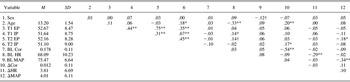
Mother and youth reports of internalizing and externalizing problems were significantly correlated at T1 (rs = .28 and .33, respectively) and T2 (rs = .35 and .35, respectively, all p < .001). Therefore, reports were aggregated at each time, using average scores for preliminary analyses (see Table 1) and latent factor scores for SEM.
Descriptive statistics and intercorrelations of variables

Note: Sex, 1 = male, 2 = female; T1, Time 1; IP, internalizing problems, EP, externalizing problems; T2, Time 2; BL, baseline; Cor, cortisol (untransformed values shown); HR, heart rate; MAP, mean arterial pressure.
†p < .10. *p < .05. **p < .01.
A 2 × 2 × 2 (Sex × Problem Type × Time) mixed-design analysis of covariance, controlling for age and with problem type and time treated as within-subjects factors, was used to examine the mean reported problem scores. There was a significant Problem Type × Time interaction, F (1, 171) = 12.12, p < .01, but post hoc analyses did not identify any significant pairwise comparisons. There were no significant effects involving sex.
Paired t tests demonstrated that there was significant physiological reactivity to the SPP on all measures: cortisol, t (214) = −2.21, p < .05; HR t (214) = −8.37, p < .001; MAP, t (214) = −9.61, p < .001. All indices of arousal increased from pre-SPP to post-SPP assessments; baseline and change scores are presented in Table 1. Simple arithmetic differences scores (post-SPP – pre-SPP) were used to index change, with baseline physiology scores included in all SEM analyses.
The zero-order correlations among the key variables are presented in Table 1. Problem scores were highly stable over time. Older children had lower HRs but higher HPA reactivity (ΔCor) to the SPP. There were few significant associations between physiology and problem scores. Youths with higher baseline HR at T1 had more IP at T1. Youths with higher HPA reactivity at T1 had more IP at T2. Youths with higher MAP reactivity (ΔMAP) at T1 had fewer EP at T2.
Were ANS and HPA activity contemporaneously associated with EP and IP?
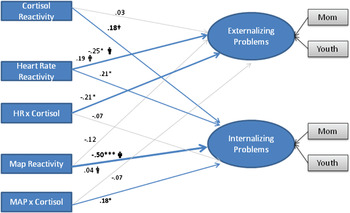
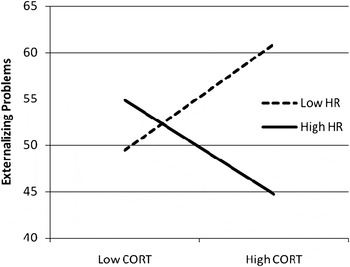
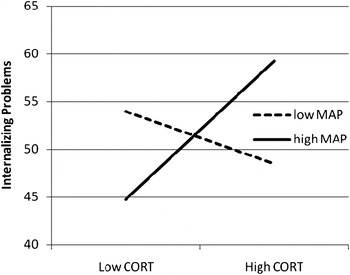
Figure 1 illustrates how patterns of ANS and HPA reactivity were contemporaneously associated with EP and IP. As is typical with studies with large sample sizes, the chi-square for the final contemporaneous model, χ2 (136) = 184.77, p < .003, indicated significant model misfit, yet the model fit was good according to the indices of practical fit (CFI = 0.89, RMSEA = 0.04). Several model parameters were similar in males and females because the model fit was not compromised when the beta weights were constrained to be identical between males and females (i.e., Δχ2). Across all youths, there was a trend toward a positive association between cortisol reactivity and IP (β = 0.18, t = 1.77, p = .07), as well as a significant positive association between HR and IP (β = 21, t = 2.40, p = .02). More directly relevant to the current hypotheses, there were two significant interactions between HPA and ANS reactivity in relation to youths' problems. The interaction of HR × Cortisol Reactivity was associated with EP (β = −0.21, t = −2.28, p = .02). Consistent with expectations, youths with fewer EP had symmetrical high reactivity across these systems (see Figure 2), whereas youths with the most EP showed an asymmetrical pattern of low HR reactivity but high HPA reactivity. The interaction of MAP × Cortisol Reactivity was associated with IP (β = 0.18, t = 2.11, p = .04). As expected, youths with the most IP showed symmetrical high reactivity across these systems (see Figure 3), whereas youths with fewer IP had asymmetrical activation, with high MAP reactivity but low HPA reactivity.
Concurrent associations between hypothalamic–pituitary–adrenal and autonomic nervous system reactivity and adolescents' externalizing and internalizing problems. HR, heart rate; MAP, mean arterial pressure. [A color version of this figure can be viewed online at journals.cambridge.org/dpp]

Heart Rate × Hypothalamic–Pituitary–Adrenal Reactivity associated with concurrent externalizing problems in adolescents. HR, heart rate; CORT, cortisol.

MAP × cortisol reactivity associated with concurrent internalizing problems in adolescents. MAP, mean arterial pressure; CORT, cortisol.

Whereas the preceding findings did not vary between male and female youth, there were two associations between physiological measures and contemporaneous behavior problems that differed significantly. The association between HR reactivity and EP was significantly different across males and females, Δχ2 (1) = 5.34, p = .021; the inverse association of higher HR reactivity and fewer EP approached significance for girls only (β = −0.25, t = −1.83, p = .06). The association between MAP reactivity and IP also differed across gender, Δχ2 (1) = 4.97, p = .03, with higher MAP reactivity being associated with fewer IP problems only in males (β = −0.50, t = −4.04, p < .0001).
Did HPA and ANS activity predict the development of behavior problems?
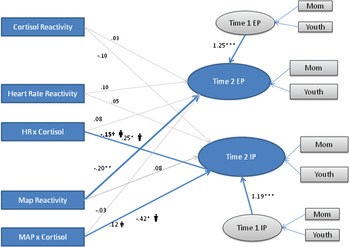
Figure 4 illustrates how patterns of ANS and HPA reactivity longitudinally predicted the change in EP and IP from T1 to T2. Again, the chi-square, which is an overly conservative indicator of model fit, was significant, χ2 (220) = 314.62, p < .0001, but the indices of practical fit indicated that the model fit was good (CFI = 0.90, RMSEA = 0.04). After controlling for the high stability of EP and IP from T1 to T2, the T2 behavior problems latent variables captured the change in youths' EP and IP over time.
Prediction of later externalizing and internalizing problems from earlier hypothalamic–pituitary–adrenal and autonomic nervous system reactivity. HR, heart rate; MAP, mean arterial pressure; EP, externalizing problem; IP, internalizing problem. [A color version of this figure can be viewed online at journals.cambridge.org/dpp]

There was only one association between T1 physiological reactivity and T2 problems that did not differ significantly between male and female youths. There was an inverse association between earlier MAP reactivity and later EP (β = −0.20, t = −3.22, p = .001), such that youths who responded to the SPP with larger increases in BP had decreases (or smaller increases) in EP over the subsequent 2 years. The interactive contributions of ANS and HPA to the development of IP over time, however, differed between boys and girls.
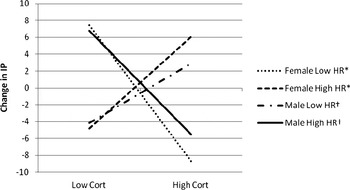
The prediction of T2 IP from T1 HR × Cortisol Reactivity was significant for girls (β = −0.25, t = 2.49, p = .013) and approached significance for boys (β = −0.15, t = −1.83, p = .067), but in the opposite direction, Δχ2 (1) = 8.55, p = .003. As shown in Figure 5, girls had the greatest increases in IP when they had symmetrically low or symmetrically high HR and HPA reactivity. Conversely, boys had the greatest increases in IP when they had an asymmetrical pattern of high HR reactivity but low HPA reactivity.
Heart Rate × Cortisol predicting longitudinal change in internalizing problems in male and female adolescents. IP, internalizing problem; HR, heart rate; Cort, cortisol.

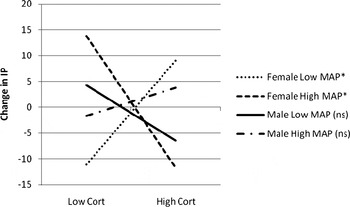
Male and female youth also differed in the prediction of T2 IP from MAP × Cortisol Reactivity, Δχ2 (1) = 4.13, p = .042; the association was significant for girls only (β = −0.42, t = −3.08, p = .002). As shown in Figure 6, girls had the greatest increases in IP over time when they had responded to the SPP with patterns of asymmetrical reactivity, either higher MAP reactivity and lower HPA reactivity, or lower MAP reactivity and higher HPA reactivity.
MAP × Cortisol predicting longitudinal change in internalizing problems in male and female adolescents. IP, internalizing problem; MAP, mean arterial pressure; Cort, cortisol.

Discussion
We conducted this prospective longitudinal investigation of the contributions of ANS and HPA regulation to the development of adolescents' emotional and behavioral problems in order to test the additive and interactive models of allostasis and adjustment proposed by Bauer and colleagues (Reference Bauer, Boyce and Quas2002). Allostasis is an integral theory for advancing our understanding of how a person maintains stability through change. In a developmental context, the importance of understanding change is further accentuated because the person is not only trying to maintain stability, but is simultaneously promoting development and maturation across these systems. To our knowledge, this is the first study to apply this perspective within a longitudinal design, and as such, it has the potential to inform the design of new multilevel models of developmental psychopathology (Cicchetti, Reference Cicchetti, Beauchaine and Hinshaw2008). Interactions between adrenocortical reactivity to a modified Trier Social Stress Test and both HR reactivity and BP reactivity, which are indicative of the activity of different branches of the ANS, were found to be associated with adolescents' concurrent internalizing and externalizing problems, and the development of their problems over the subsequent 2 years. With several significant HPA and ANS interaction effects in our analyses, we found support for both the additive and the interactive models, but intriguingly, the nature of that support changed over time. These findings have implications for our understanding of allostasis and the dynamic nature of the relations between multiple physiological regulatory systems and adolescent psychopathology.
The majority of research to date has considered how individual physiological measures are associated with children's and adolescents' problems contemporaneously and, less frequently, over time. Several of our findings replicate the predominant patterns. For example, in the contemporaneous analyses, adolescents with more internalizing problems had higher resting HRs and tended to have higher cortisol reactivity, whereas girls with more externalizing problems had lower HR reactivity. In the predictive analyses, higher HPA reactivity was associated with having more internalizing problems 2 years later, although this was not sustained in the more rigorous SEM analysis, whereas higher BP reactivity was associated with greater decreases in externalizing problems 2 years later. These findings conform to models of psychopathology that associate externalizing problems with hyporeactivity (Hastings et al., Reference Hastings, Zahn-Waxler and Usher2007; Ortez & Raine, Reference Ortiz and Raine2004; Rogeness, Cepeda, Macedo, Fischer, & Harris, Reference Rogeness, Cepeda, Macedo, Fischer and Harris1990), and internalizing problems with physiological hyperreactivity (Dietrich et al., Reference Dietrich, Riese, Sondeijker, Greaves-Lord, van Roon and Ormel2007; Granger et al., Reference Granger, Weisz, McCracken and Ikeda1996; Granger, Weisz, & Kaauneckis, 1994; Olsson, Kenardy, De Young, & Spence, Reference Olsson, Kenardy, De Young and Spence2008; Rao et al., Reference Rao, Hammen, Ortiz, Chen and Poland2008), although we found one discrepancy in that boys with higher BP reactivity had fewer internalizing problems.
Although these findings generally replicated many past studies, there is an inherent limitation in the single physiological system approach to developmental psychopathology research. Simply put, the effects of distinct physiological regulatory systems do not function independently of each other. When single systems are examined in isolation, a given neurobiological characteristic such as blunted HPA reactivity can appear to be a shared feature of such distinct psychopathologies as posttraumatic stress disorder (Weems & Carrion, Reference Weems and Carrion2007) and conduct disorder (Snoek et al., Reference Snoek, Van Goozen, Matthys, Buitelaar and Van Engeland2004), despite their markedly different etiologies, symptom profiles, and developmental sequelae. In accord with calls for more integrative multilevel models of neurobiological regulation (Cicchetti & Curtis, Reference Cicchetti and Curtis2007; Miskovic & Schmidt, in press), examining patterns of arousal across systems might be a more effective way of understanding allostasis and adjustment. A few studies have followed the recommendations of Bauer et al. (Reference Bauer, Boyce and Quas2002) and examined how youths' problems are associated with multilevel patterns of HPA and ANS reactivity. Our contemporaneous analyses were consistent with these reports. El-Sheikh and colleagues (Reference El-Sheikh, Erath, Buckhalt, Granger and Mize2008) found clear support for the additive model in their examination of internalizing problems, which were associated with symmetrical SNS and HPA reactivity. They found that children with symmetrically high activity had the most internalizing problems, but those with symmetrically low activity also had more internalizing problems than children with asymmetrical reactivity. Closely paralleling this, we found that youths with more internalizing problems showed symmetrically high BP and cortisol reactivity, and those with symmetrically low reactivity had the next highest level of internalizing problems. As BP is primarily controlled by sympathetic innervation (Charkoudian & Rabbitts, Reference Charkoudian and Rabbitts2009), our finding the predicted pattern of high symmetrical reactivity was consistent with arguments that the HPA and SNS work in conjunction to generate physiological stress responses (Sapolsky et al., Reference Sapolsky, Romero and Munck2000). Potentially, the slower but longer lasting influence of HPA arousal could be prolonging or exacerbating the initial somatic activation triggered by the SNS, such that youths could be experiencing stronger and longer responses to stressors, or an exaggerated “flight” response.
With regard to the contemporaneous association between reactivity and externalizing problems, we noted that the fewest externalizing problems were evident in youths with symmetrical high cortisol and HR reactivity. This somewhat mirrors the association between symmetrical low reactivity and higher aggression identified by Gordis and colleagues (Reference Gordis, Granger, Susman and Trickett2006), and clearly is concordant with fearlessness, disinhibition, and sensation-seeking models of disruptive behavior problems (Raine, Reference Raine2008; van Goozen et al., Reference van Goozen, Fairchild and Harold2008). Youths who are symmetrically highly reactive clearly are responding to threat cues with ample arousal to curtail their engagement with dangerous activities. Curiously, though, the most externalizing problems were evident not in youths with symmetrical low reactivity, but in those with an asymmetrical pattern of low HR reactivity and high adrenocortical activity. HR reactivity is multiply determined, but relatively greater control is exerted by the parasympathetic than sympathetic branch of the ANS (Berntson et al., Reference Berntson, Quigley, Lozano, Cacioppo, Tassinary and Berntson2007). Low HR reactivity suggests that youths did not respond to our social challenge with the normatively expected pattern of withdrawal of vagal downregulation of cardiac activity that would support active coping (Porges, Reference Porges2007), and such poor parasympathetic regulation is characteristic of youths with disruptive behavior problems (Beauchaine, in press). Yet their “slow road” to arousal, vis-à-vis HPA reactivity, was evident. This suggests that some youths with externalizing problems might lack an immediate somatic signal to amend their actions in the face of a challenge or potential threat, but then experience a delayed arousal response. If that reactivity pattern is cognitively associated with the eliciting event, and if stimulation seeking is one of the motivations for externalizing youths' engagement in risky activities, then the combination of lower arousal during the event and higher arousal following it might be experienced as rewarding.
Although the preceding patterns of contemporaneous associations between regulation and adjustment are of interest, the most novel part of this investigation was the examination of how symmetrical or asymmetrical reactivity predicted the subsequent development of youths' internalizing and externalizing problems 2 years further into adolescence. It is striking that the patterns substantively reversed themselves. Whereas symmetrical BP and adrenocortical reactivity were associated with more internalizing problems initially, their asymmetrical reactivity predicted increasing problems in girls 2 years later. It is analogous that, whereas symmetrical HR and HPA reactivity was associated with fewer externalizing problems initially, symmetrical high or low HR and HPA reactivity predicted greater increases in internalizing problems in girls. What could account for this dramatic shift in the relations between profiles of physiological reactivity and youths' emotional and behavioral problems?
Note that this pattern is far from unprecedented. As Kraemer has argued (Kraemer, Yesavage, Taylor, & Kupfer, Reference Kraemer, Yesavage, Taylor and Kupfer2000), there are inherent risks in extrapolating findings from cross-sectional studies into predictions about developmental processes for psychopathology. Cross-sectional investigations can even lead one to exactly the opposite conclusions of longitudinal studies depending on how researchers attempt to correct for development within cross sectional studies. Evidence for divergent conclusions stemming from cross-sectional versus longitudinal analyses comes not only from mathematical models, but from empirical research as well. Developmental psychopathology research has shown that associations between physiology and problems often are not maintained, and sometimes are reversed, across different developmental periods (e.g., Lorber, Reference Lorber2004), such as the relation between cortisol levels and externalizing problems shifting from positive in early childhood to negative in adolescence (Alink et al., Reference Alink, van IJzendoorn, Bakermans-Kranenburg, Mesman, Juffer and Koot2008). Further, within samples in longitudinal studies, contemporaneous associations between physiology and problems can be reversed over time (Ruttle, Shirtcliff, Serbin, Ben-Dat Fisher, & Schwartzman, Reference Ruttle, Shirtcliff, Serbin, Fisher and Schwartzman2011; Shirtcliff & Essex, Reference Shirtcliff and Essex2008). Studies of HPA axis functioning in relation to traumatic and chronic stress have shown that children can initially manifest HPA hyperarousal to severe stressors, but then have blunted stress hormone reactivity after the trauma has become more distal or if the stress exposure becomes chronic (Miller, Chen, & Zhou, Reference Miller, Chen and Zhou2007; Weems & Carrion, Reference Weems and Carrion2007). Our understanding of such developmental changes in the relations between neurobiological regulation and problems is beginning to be incorporated into our models of developmental psychopathology.
Allostasis, as a concept, is about maintaining stability through change (McEwen, Reference McEwen1998), and that stability is maintained, depending on the nature of the stressor, by several systems each with different thresholds of activation, duration of effects, and target actions, and potentially with the capacity to affect the activity of other systems (Cicchetti & Toth, Reference Cicchetti and Toth2009). When attempting to assess this through measures of allostatic load, it is difficult to account for how change or regulation across systems is dynamically interacting within the individual across different time courses. Common approaches to allostatic load may capture the additive models, but not the interactive ones; many studies of the effects of environmental stressors on allostatic load adopt the additive model to index the cumulative effects across physiological systems (Evans, Kim, Ting, Tesher, & Shannis, Reference Evans, Kim, Ting, Tesher and Shannis2007; Worthman & Panter-Brick, Reference Worthman and Panter-Brick2008). We found that the interactive models were especially important in the longitudinal predictions of the development of problems. Clearly, our predictive model was more reflective of the developmental implications of allostasis. Thus, our findings strongly suggest that more understanding of the measurement and development of allostasis is needed before broad conclusions can be drawn about whether high versus low reactivity in any given physiological system should be considered adaptive or maladaptive.
As expected, and concordant with models of gender differences in developmental psychopathology (Zahn-Waxler et al., Reference Zahn-Waxler, Shirtcliff and Marceau2008), the interactions of ANS and HPA reactivity predicted the development of internalizing problems most strongly in adolescent girls. Profiles of asymmetric reactivity across BP and cortisol were strongly associated with girls' increasing internalizing problems. This is striking for at least two reasons. First, it is the opposite of the symmetrical reactivity pattern that was noted for contemporaneous internalizing problems. Second, it is reflective of patterns that have been noted in studies of adult psychopathology. An asymmetrical pattern of higher sympathetic reactivity and lower adrenocortical reactivity has been found in dysphoric women (Girdler et al., Reference Girdler, Pedersen, Straneva, Lesermen, Stanwyck and Benjamin1998), alexythmic men (Henry et al., Reference Henry, Haviland, Cummings, Anderson, Nelson and MacMurray1992), and adults with posttraumatic stress disorder (Mason, Giller, Kosten, & Harkness, Reference Mason, Giller, Kosten and Harkness1988), compared to adults with fewer problems. As BP is under greater sympathetic than parasympathetic control (Berntson et al., Reference Berntson, Quigley, Lozano, Cacioppo, Tassinary and Berntson2007), our findings suggest that adolescent girls' asymmetric reactivity of the SNS and HPA systems might precede the kinds of neurobiological underpinnings of internalizing pathologies that are evident in adulthood.
Within the allostasis framework, adolescent girls who responded to the social challenge paradigm with reduced HPA but increased BP reactivity did so as an adaptive response to the event in order to establish stability and cope with the demands of the task. Our expectation is that it was reflective of their characteristic response tendencies, which would have developed in the context of how these kinds of challenges were experienced in their lives up to that time. If those challenges were pervasive or enduring, however, then their profile of physiological reactivity might have been reflective of an accumulating allostatic load. As they proceeded through their adolescent development and likely experienced the increasing social challenges that adolescent girls normatively face (Hankel, Mermelstein, & Roesch, Reference Hankin, Mermelstein and Roesch2007; Robins, Trzesniewski, Tracey, Gosling, & Potter, Reference Robins, Trzesniewski, Tracy, Gosling and Potter2002), that physiological profile might not have served them effectively, or continued to be adaptive as their social expectations and contexts continued to change across adolescent development. If their response profile of asymmetric SNS and HPA reactivity was stable or inflexible, it might have made them vulnerable to the development of increasing internalizing problems (Bauer et al., Reference Bauer, Boyce and Quas2002).
Conversely, symmetric profiles of high HR and cortisol reactivity, or of low HR and cortisol reactivity, also were associated with increasing internalizing problems over time for girls. Given divergent trajectories of problem development in girls and boys (Nottelmann & Jensen, Reference Nottelmann and Jensen1995), it is intriguing that these same profiles of symmetric HR and cortisol reactivity initially were associated with fewer externalizing problems contemporaneously, then predicted increasing internalizing problems only for girls. Despite the prevalence of comorbidity in child and adolescent psychopathology, one implication of these findings is that a relative absence of externalizing problems in girls is not necessarily protective against the emergence of problems on the internalizing spectrum, depending on the girls' multilevel profiles of neurobiological regulation. The association of symmetrical high reactivity with increasing internalizing problems is compatible with the dominant perspectives on the development of anxiety-based difficulties (Kagan et al., Reference Kagan, Snidman, Arcus and Reznick1994; Merikangas et al., Reference Merikangas, Avenevoli, Dierker and Grillon1999). As suggested previously, girls who react to social challenges with rapid ANS-mediated arousal that is prolonged by HPA-mediated arousal might become overwhelmed and unable to mount an effective coping response, leading to withdrawal, greater focus on their own distress than the challenge itself, and feelings of helplessness. The association of symmetrically low arousal with increasing internalizing problems is more puzzling, although it parallels the contemporaneous patterns noted in previous research (El-Sheikh et al., Reference El-Sheikh, Erath, Buckhalt, Granger and Mize2008). It might reflect a pattern of blunted reactivity, as has been observed with HPA functioning in traumatized youths (Cicchetti & Rogosch, in press), which could represent a divergent pathway toward internalizing difficulties.
There are a number of potentially important implications of the approach used here to examine multiple levels of neurobiological indices across development. As well as informing our understanding of the etiology of emotional and behavioral problems, an integrative perspective that generates profiles of neurobiological regulation also will be fundamental to using biological measures to enhance multilevel prevention and intervention programs (Cicchetti & Gunnar, Reference Cicchetti and Gunnar2008). Such efforts might include the use of multiple biomarkers or endophenotypes to identify youths at greatest risk for the maintenance or exacerbation of internalizing or externalizing problems over development, and the identification of the kinds of treatment procedures, both behavioral and pharmacological, to which youths of varying ages with specific biopsychosocial profiles are likely to be most responsive (Beauchaine et al., Reference Beauchaine, Hong and Marsh2008). The present investigation illustrates that co- or counterregulatory processes across components of the stress response system yield an integrated profile of such endophenotypes. Examining change in a single system would not have clearly indicated which biological profile was indicative of greatest risk. Building on new multilevel models that incorporate environmental measures, such as the biological sensitivity to context model (Boyce & Ellis, Reference Boyce and Ellis2005; del Guidice, Ellis, & Shirtcliff, Reference Del Guidice, Ellis and Shirtcliff2011), this work might lead to the identification of unique interactions between neurobiological profiles and social–contextual factors that explain pathways toward or away from disorder beyond main effects models. In turn, recognizing that neurobiological regulation is itself sensitive to and shaped by environmental influences (Cicchetti & Rogosch, in press; Maheu et al., Reference Maheu, Dozier, Guyer, Mandell, Peloso and Poeth2010; Strang, Hanson, & Pollak, in press), interventions might be aimed at the level of family, peer, school, or neighborhood in order to alleviate the chronicity of stressors that drive adolescents' regulation toward maladaptive and rigid patterns of allostatic load.
Limitations
Despite several strengths of this investigation, including the large sample size, the assessment of multiple physiological measures, the use of multi-informant problem scores, and the prospective longitudinal design, there were limitations that should be noted. Primarily, this was not a clinical sample, but rather a targeted community sample with a modest overrepresentation of youths with clinically significant problems. It is very possible that processes of allostasis, allostatic load, and the development of psychopathology function differently in children and adolescents with diagnosed disorders. Ideally, were it feasible, obtaining repeated assessments of physiological reactivity on a large subset of these youths would have allowed us to examine whether contemporaneous relations between physiology and problems change across development. Nor were we able to obtain serum from these youths, which would have increased the range of biomarkers of allostasis that could have been considered. However, our emphasis on allostatic mediators, including HPA and ANS functioning, was appropriate within a young population in which the full panel of allostatic load or metabolic syndrome is not yet likely to be manifest (Lupien et al., Reference Lupien, Ouellet-Morin, Hupbach, Tu, Buss, Walker, Cicchetti and Cohen2006). Future efforts to more clearly understand the pathophysiology of emotional and behavioral problems might be enhanced if the global ANS measures of HR and BP are supplemented with more precise measures of the sympathetic and parasympathetic systems. Finally, given the impact of environmental stressors on allostasis, it would also be useful for future studies to incorporate measures of youths' stressful life experiences into prospective longitudinal examinations of the neurobiological correlates and determinants of emotional and behavioral problems.
Conclusion
Allostasis reflects a process of establishing adaptation to fluctuating demands through dynamic change, and when considered in a developmental framework, it must be recognized that development itself generates some of those fluctuating demands. As children progress through the maturational changes of puberty and adolescence, their hormonally driven physical growth, their changing cognitive, emotional, and behavioral competencies, and their social roles, experiences, and expectations all place new demands on their regulatory systems. What were effective patterns of dynamic regulation at one point of development, whether reflected in symmetrical or asymmetrical reactivity across systems, might not continue to be adaptive under the new demands of a later stage. As allostasis helps the developing youth to adapt to their circumstances over time, either symmetrical or asymmetrical reactivity could prove to be the more adaptive profile, depending on where the individual has started from and to where she or he is headed. Thus, as a field, developmental psychopathology is sorely in need of more prospective longitudinal studies that include repeated assessments of multiple physiological response systems, indices of behavioral adjustment, and measures of contextual stressors and supports. What will be learned from such endeavors might not be predictable from our current knowledge based on cross-sectional studies. As a field, we are starting to develop a good idea of how things function at a given point in time, yet this does not mean that we know how they will unfold over time.