INTRODUCTION: LANGUAGE, GENDER, AND THE TRANSFORMATION OF WORK
When the organizational sociologist Joan Acker (Reference Acker1990) formulated her thesis on ‘gendered organizations’ in 1990, she was operating under the assumption that normative masculinity pervaded most workplaces. This assumption has also permeated the field of language and gender in the workplace, a now well-established sociolinguistic field of inquiry, where it is reflected in a predominant focus on high-status, male-dominant workplaces (Holmes & Stubbe Reference Holmes, Stubbe, Holmes and Meyerhoff2003; Baxter Reference Baxter2006; Holmes Reference Holmes2006; Mullany Reference Mullany2010; Angouri Reference Angouri2011; Holmes & Marra Reference Holmes and Marra2011). Holmes has pointed to the expectation in such workplaces of a speech style that signals ‘autonomous’, ‘task/outcome’, and ‘referentially oriented’ stances, and that in turn has been said to index normative masculinity (2006:6; see also Tannen Reference Tannen2001). One oft-explored question in this body of work has been how female managers discursively navigate the double bind of being in a position of authority without coming across as abrasive, aggressive, or unfeminine (Mullany Reference Mullany2010; Angouri Reference Angouri2011; Holmes & Marra Reference Holmes and Marra2011; Ladegaard Reference Ladegaard2011).
The shift to a globalized service economy, however, has transformed the world of work. The globalized service economy is here understood as comprising workplaces that have existed for less than thirty years, whose institutional culture incorporates globalized capitalism, and whose primary objective is to sell services rather than goods (Cameron Reference Cameron2000). In workplaces in the globalized service economy, the assumptions underlying Acker's theory of gendered organizations no longer apply, in that it is typically not normative masculinity, but normative femininity that prevails (Belt Reference Belt, Holtgrewe, Kerst and Shire2002; Russell Reference Russell2008; Scholarios & Taylor Reference Scholarios and Taylor2011). Call centres, the focus of this study, are emblematic of the globalized service economy. The link between call centre work and women is well-documented (Cameron Reference Cameron2000; Belt Reference Belt, Holtgrewe, Kerst and Shire2002; Russell Reference Russell2008; Scholarios & Taylor Reference Scholarios and Taylor2011). Dubbed ‘female ghetto[s]’ (Belt Reference Belt, Holtgrewe, Kerst and Shire2002) or, more positively, ‘female-friendly workplaces’ (Russell Reference Russell2008), 71% of workers in the global call centre industry are female (Holman et al. Reference Holman, Batt and Holtgrewe2007). From a sociolinguistic point of view, Cameron (Reference Cameron2000) has observed that the speech style prescribed to call centre agents in training and other institutional guidance indexes normative femininity in that it encourages rapport building, empathy, and other relational work, values that are crucial to convey when organizations compete on service (Hochschild Reference Hochschild2012).
In gender terms, the effects of the shift to service-based economies are double-edged, creating both new work opportunities for women across the world as well as new gender segregations and glass ceilings (Cameron Reference Cameron2000; Freeman Reference Freeman2000; Belt Reference Belt, Holtgrewe, Kerst and Shire2002; Mirchandani Reference Mirchandani2005; Durbin Reference Durbin, Burgess and Connell2006; Russell Reference Russell2008; Forey Reference Forey2013). Call centre jobs are notorious worldwide for their high levels of turnover, absenteeism, employee burnout, and emotional exhaustion (Holman, Batt, & Holtgrewe Reference Holman, Batt and Holtgrewe2007; Russell Reference Russell2008; Rod & Ashill Reference Rod and Ashill2013), and agents are at constant risk of angry outbursts from customers, sexual harassment, and outright abuse (Sczesny & Stahlberg Reference Sczesny and Stahlberg2000; Cameron Reference Cameron2008; Archer & Jagodziński Reference Archer and Jagodziński2015). Yet, having been enabled by advances in information technology, plummeting costs of data transmission and political and economic deregulation, call centres are here to stay, and they are one of the most significant employers in the globalized service economy (Holman et al. Reference Holman, Batt and Holtgrewe2007). In Europe, the location of the two call centres in focus in this study, the industry grows by 10% per year (Russell Reference Russell2008). It seems, then, that it is timely to put these increasingly widespread types of workplaces under scrutiny. In particular, given the paramount status and ‘commodification of language’ in the globalized service economy (Heller Reference Heller2010), it seems pertinent to explore the extent to which the linguistic policies and practices within call centres might serve to reinforce occupational gender segregation in the call centre industry. This study seeks to do that by comparing the compliance of male and female call centre agents with the speech style that is valued and actively prescribed by the institution.
In what follows, I first describe the theoretical and methodological approach adopted in this study and state the research questions. After describing the two call centres from which data was collected, I give an account of the data and research methods before presenting the findings. Finally, I discuss the significance of the findings for language and gender as a field of inquiry as well as for the real world.
THEORETICAL AND METHODOLOGICAL APPROACH
The study is inspired by, but also significantly extends, Cameron's (Reference Cameron2000) work by investigating not only ideological representations of gender—that is, how call centre agents ought to speak—but also how they actually speak in naturally occurring call centre service interactions. As Cameron (Reference Cameron2000) points out, there is no reason to assume that the gendered indexicality observed at the level of ideology will necessarily manifest itself in gendered ways of speaking at the level of practice. Indeed, the well-documented reliance on technology to direct, monitor, and control the work practices, including the linguistic practices, of call centre agents (Fernie & Metcalf Reference Fernie and Metcalf1998; Cameron Reference Cameron2000; Cameron Reference Cameron2008; Hultgren Reference Hultgren2008) may limit the potential for customer service—and the normative femininity that it indirectly indexes (Ochs Reference Ochs, Duranti and Goodwin1992)—to be enacted (Belt Reference Belt, Holtgrewe, Kerst and Shire2002). In other words, what holds in ideology may not hold in practice. By examining call centre service interactions, and specifically the extent to which male and female call centre agents comply with the speech style that is valued and prescribed by the institution, this study offers a new perspective on language and gender in call centres specifically and the globalized service economy more generally.
Studies relying on naturally occurring call centre service interactions are few and far between, due to well-documented restrictions on access stemming primarily from commercial sensitivities and data protection acts (Cameron Reference Cameron2000; Cowie Reference Cowie2007; Heller Reference Heller2007, Reference Heller2010; Alarcón & Heyman Reference Alarcón and McC. Heyman2013; Woydack & Rampton Reference Woydack and Rampton2016). Given that 69.8% of an agent's workday is spent in interaction with customers (Dimension Data 2015), a key aspect of call centre work—the linguistic interaction with customers – has therefore been obscured from such accounts. In the few cases where call centre service interactions have constituted part of the data set (Forey & Lockwood Reference Forey and Lockwood2007, Reference Forey and Lockwood2010; Friginal Reference Friginal2009; Bolton Reference Bolton and Kirkpatrick2010), gender has not usually been foregrounded. As far as is known, no study to date has compared the ways in which male and female call centre agents talk to customers in actual call centre service interactions.
By comparing quantitatively and qualitatively the linguistic behaviour of male and female call centre agents, this study departs from currently favoured approaches in language and gender. Since the 1990s, language and gender studies have taken a well-motivated turn away from generalizations about the ways in which males and females speak. Instead, the preference has been for qualitative, social constructionist approaches in which agency and (gendered) indexicality are foregrounded (Ochs Reference Ochs, Duranti and Goodwin1992; Silverstein Reference Silverstein2003; Eckert Reference Eckert and Coupland2016). Such approaches highlight the ways in which speakers actively (though not necessarily consciously) construct a range of context-dependent social meanings, and how they sometimes break with normatively gendered ways of speaking. In workplace contexts, for example, it has been shown that female leaders draw on a range of ‘masculinities’ and ‘femininities’ to enact their professional identity (Holmes & Stubbe Reference Holmes, Stubbe, Holmes and Meyerhoff2003; Baxter Reference Baxter2006; Holmes Reference Holmes2006; Mullany Reference Mullany2010; Angouri Reference Angouri2011; Holmes & Marra Reference Holmes and Marra2011; Ladegaard Reference Ladegaard2011). Similarly, in female-dominated workplace contexts, such as nursing, the discursive behaviour of male nurses has been described as ‘feminine’; however, this does not mean that they are ‘being a woman’, but simply that they are conducting a professional role of ‘being a nurse’ (McDowell Reference McDowell2015).
Whilst the knowledge generated from such research is clearly important, particularly in showing that discursive behaviour is not consistently gender-congruent, nor necessarily gendered at all, qualitative social constructionist methodologies are less suited to uncover systematic patterns of gender differences, and hence of gender inequalities (Cameron Reference Cameron, Bergvall, Bing and Freed1996; Bergvall Reference Bergvall1999; Eckert & McConnell-Ginet Reference Eckert and McConnell-Ginet1999). In comparing the communicative behaviour of male and female call centre agents quantitatively and qualitatively, this study takes as its starting point both a material as well as a socially constructed conceptualization of gender. It recognizes not only that gender resides in discourse, but also that discourse itself is produced by gendered bodies, in this case, male and female call centre agents. In recognizing both constructionism and materiality, I find it useful to use both gender and male/female as terms of reference. I want to avoid the term sex as this might give the impression that any male/female differences are the effect of biological sex, an argument that is beyond the scope of this article. At the same time, the nonbinary constructionism that is implied in the term gender does not seem to sufficiently capture the materiality and, as we shall see, the linguistic effects, of being male and female. The theoretical and methodological approach adopted in this study might be said to revert back to a pre-1990s era of gender and language research in which scholars deliberately set out to compare the speech styles of men and women. From the 1990s onwards, such approaches came to be deliberately avoided, partly because they were seen as perpetuating gender stereotypes (Sunderland & Litosseliti Reference Sunderland, Litosseliti, Litosseliti and Sunderland2002; Mills Reference Mills2003).
However, when, in this study, an approach comparing the discursive behaviour of male and female speakers is adopted, it should be seen against the possibility that the ‘new economy’ might have brought with it new forms of systematic gender inequality (Williams, Muller, & Kilanski Reference Williams, Muller; and Kilanski2012), which might be obscured by an exclusively qualitative approach. Some of the reluctance towards quantifying male/female differences might also stem from well-known challenges of studying discursive variation quantitatively because choices are infinitely variable (Pichler Reference Pichler2010). Call centres, however, bypass such challenges because, in contrast to discourse in most other types of workplaces, call centre service interactions are highly standardized and routinized.
Specifically, the study seeks to address three questions: First, given the possibility that complying with the institutionally prescribed speech style might reinforce the gendered nature of call centres and potentially even lead to over-recruitment of women to the industry, the study asks: (i) Is there any evidence that female call centre agents comply more than their male colleagues with the institutionally prescribed speech style? Moreover, given the potentially conflicting demands of providing an excellent customer care and meeting the company's targets, the second question posed is: (ii) To what extent are any male/female differences in rule compliance attributable to the prescribed speech style indexing normative femininity? A final question relates to whether agents and managers themselves are aware of any male/female differences in suitability for call centre work, which may have impacted on their career choice and recruitment practices: (iii) To what extent do call centre agents and managers believe that there are differences in the ways in which male and female call centre agents speak with customers?
In the next section, I describe the two call centres from which data was collected. The description seeks to convey a sense of the extraordinarily regimented nature of call centre work.
CALL CENTRES AND THE REGIMENTED NATURE OF WORK
The study relies on data collected from two large, onshore, monolingual call centres in two counties, Denmark and Scotland, with the pseudonyms ‘Mermaid Mobile’ (Mermaid) and ‘Thistle Finance’ (Thistle). The rationale for the cross-national comparison is to explore whether any male/female differences observed in one country are replicated in the other, which might strengthen any findings about gender inequalities. Both call centres are inbound in the sense that they mainly receive calls on the topic of a wide range of customer-initiated queries. The Danish call centre is in the telecommunications industry, and the Scottish one is in the financial services sector. On a spectrum ranging from complex to routine calls (Taylor, Hyman, Mulvey, & Bain Reference Philip, Hyman, Mulvey and Bain2002), both call centres receive a combination, with some calls dealing with technically complex pension funds or mobile-phone issues and others with routine matters such as updating customer details. The proportion of female agents at Thistle is close to the industry average of 61%. At Mermaid, the proportion is 85%. The overall higher proportion of females in the Danish call centre should be seen in the context of the overall higher female labour force participation in Scandinavian countries.
In both call centres, and in accordance with call centres in general (Taylor et al. Reference Philip, Hyman, Mulvey and Bain2002), targets exist for both ‘hard’ and ‘soft’ aspects of the work, the attainment of which is consequential for bonuses and career advancement, so there is clearly an incentive to try to meet the targets. Hard targets relate to how many calls an agent should take during a workday, how quickly calls should be answered, and their maximum duration. A record of attainment against targets is handed out to agents at the end of each workday, and agents and managers also have them at their fingertips in the IT systems so that they can continually monitor performance against targets and speed up call processing when needed. The system will also record any deviation from set work times, such as whether agents log out before their lunch break. Targets such as these—referred to as ‘stats’ by agents at Thistle—permeate the work culture to a considerable extent, and virtually all agents in both countries mentioned them in their interviews, often disclosing that it was what they disliked most about their jobs. A female agent at Mermaid put it like this: “It's like having a joystick up one's arse”.
Soft targets relate to the way in which the service interaction is conducted. These can be further divided into accuracy and quality. Accuracy involves following the correct procedure for the security check, adhering to the Data Protection Act, getting technical details right on premiums and policies, bluetooth, and data transmission. Quality, in turn, relates to customer service and communication skills, including the conversational moves and utterances that the agent should use with the customer. These skills are encoded in institutional documents of various kinds, such as call assessment scorecards, customer service manuals, and communication training material (print and online); they are reinforced in communication training, call assessments, and performance reviews. Call centres vary in the degree to which they prespecify the service interaction (Taylor et al. Reference Philip, Hyman, Mulvey and Bain2002). The material at Mermaid and Thistle, which is remarkably similar across national contexts (see Hultgren Reference Hultgren2011), is less specific than a ‘script’ in that it does not specify every word, but more specific than a series of ‘prompts’ in that it does give examples of utterances and words that agents should (and should not) use (see Cameron Reference Cameron2000).
In their call assessments, agents are assessed against a scorecard, which is a two-page document at Mermaid and one two-page and another three-page document at Thistle. The assessor must perform a set of checks in call assessments, for example:
Checks customer accepts the solution or now understands the action they/the advisor will take, e.g. ‘Does that make sense now Mr/Mrs Customer?’, ‘How do you feel about that now?’, ‘Would you like me to go over any of those details again for you?’, ‘What else do you think you'll need to explain this to your partner?’. (Customer Service Manual, Thistle)
Each check is accompanied by a potential score against which calls are marked in monthly call assessments. At Thistle, agents are assessed once a month in ninety-minute sessions, as is the practice of most call centres in developed economies (Holman et al. Reference Holman, Batt and Holtgrewe2007). Five or ten calls are randomly sampled from the preceding month's calls; the better the agent's performance, the fewer calls are assessed. Unlike Thistle, Mermaid does not record every single call. Instead, the company outsources the assessment to consultant ‘mystery callers’. In addition to this, calls can be, and are, listened into surreptitiously at any time; at Thistle this is done daily by coaches and weekly by managers. As agents never know which of their calls will be listened to or assessed, agents treat every call as one that is potentially monitored. As one female agent put it, ‘the supervisor can be aware of what the agent is doing at any moment of the working day’ (Richardson, Belt, & Marshall Reference Richardson, Belt and Marshall2000:363). At Thistle, another female agent put it like this:
You cannot have an off day here—what if your call is assessed on that day? It's tough luck! I can go down a level. Being on the top level certainly does not mean that you can relax!
These quotes suggest that call centre agents are attentive to the rules and know how important rule compliance is.
DATA AND METHODS
Data
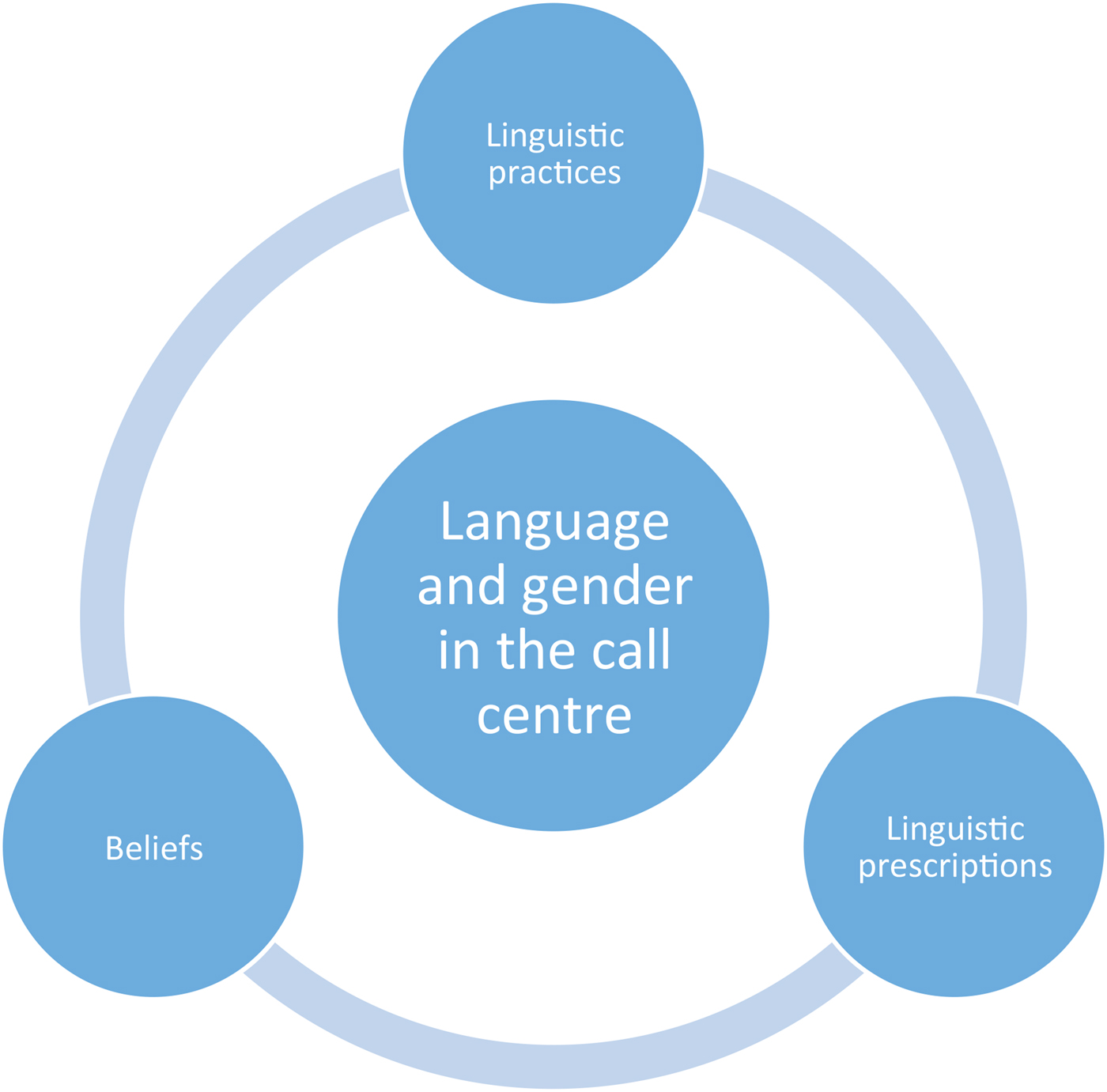
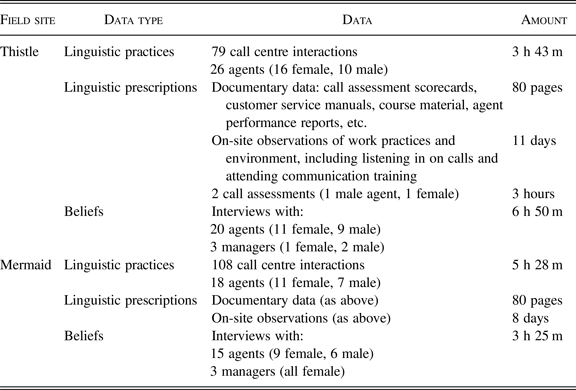
To explore male/female differences in rule compliance, three types of data were collected: (i) data on the linguistic prescriptions, (ii) data on the linguistic practices engaged in by male and female agents in their interactions with customers, and (iii) data on the gender-specific beliefs of managers and agents (see Figure 1). The specifics of each data set are given in Table 1.
Overview of data types.

Detail of data.

The University of Oxford's ethics guidelines were adhered to. Participants were made aware of the broad aims of the research and its focus on gender (see Discussion section for ways in which this may have affected the findings). Calls in the Thistle corpus were recorded as part of standard operating procedures and callers are informed of this. Calls in the Mermaid corpus were recorded for the purpose of this study, following explicit consent from the callers. All calls were anonymized. Half of the calls in the Thistle corpus were collected and transcribed by me and last between one and five minutes; the other half were collected by my gatekeeper, that is, the person who granted me access to the research site, and transcribed by the company. Calls in the Mermaid corpus range in length from just under a minute to thirteen minutes. As they are in Danish, extracts in this article were transcribed and translated into English by me. Calls in the Thistle corpus are in English.
Analytic methods
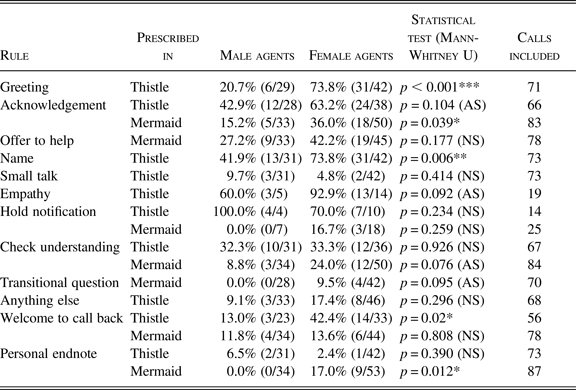
The linguistic rules to be analysed were identified as follows: An initial screening of the documentary data yielded thirty rules in total from Thistle and Mermaid combined. From observations of call assessments and interviews with agents and managers, it quickly became clear that some rules were key in the sense that call assessments consistently focused on them whereas other rules were never enforced. So for instance, while coaches would always look out for whether the agents asked if they could help with anything else, once the main query had been resolved, the rule about thanking the customer for calling was never enforced or even picked up on. Through this process, a total of seventeen key rules were identified: ten at Thistle and seven at Mermaid (see Table 2 below).
Mean rule adherence by male and female agents at Thistle and Mermaid (Asterisks denote levels of statistical significance: *** = less than one in a thousand chance of being wrong; ** = less than one in a hundred chance of being wrong, and * = less than one in twenty chance of being wrong; NS = nonsignificant; AS = approaching significance).

Once relevant rules had been identified, agents were scored on a binary categorical division according to whether or not they complied with the linguistic prescription in question, and their compliance was quantified. Compliance was operationalized as functional equivalence, so formal deviations from the rules were accepted if they were functionally equivalent, for instance if the agent said “Is that all for you today, Mr./Mrs. Customer?” rather than the prescribed “Is there anything else I can help you with, Mr./Mrs. Customer?”. This was in accordance with the norm in the call centres. The only exceptions to functional coding occurred when institutional prescriptions had made it very clear that the form must be rendered verbatim, such as the Thistle prescription that agents must greet the customer with a “Good morning/good afternoon, Thistle, how may I help you?” (I discuss the greeting in greater detail below). Coding decisions and rationales were meticulously documented and revisited in an iterative fashion to ensure consistent coding. Mean rule adherence by female and male agents in both Thistle and Mermaid was calculated, and as no assumptions were made about normal distribution, the nonparametric (Mann-Whitney U) test was carried out to verify statistical significance.
The quantitative approach was supplemented with a qualitative approach, which sought to identify (i) any contextual factors contributing to instances of noncompliance, and (ii) any gendered meaning of the rules with which agents complied. Interviews were transcribed and analysed quantitatively and qualitatively with a view to understanding what participants themselves believed about gender.
FINDINGS
Presence and absence of male/female differences
In this section, rule compliance by male and female agents in both national contexts is considered. Table 2 lists each rule prescribed at Thistle and Mermaid and shows the number and percentage of times male and female agents complied with it. Percentages are calculated by dividing the number of times a rule is complied with by the number of times it would have been possible to comply with it. Absolute numbers are given in brackets. In the fifth column, the statistical test is shown, and in the sixth column the total number of calls included is given.
As can be seen in Table 2, there was no statistically significant male/female difference in rule compliance for just under half of the rules (nine out of seventeen): five out of ten at Thistle, and four out of seven at Mermaid. For the other half of the rules, five exhibited a male/female difference in rule compliance that was statistically significant at p < 0.05, and four exhibited a degree of male/female difference that approached statistical significance. Approaching statistical significance is here defined as having a p-value above the threshold of conventional quantitative research (p < 0.05) but around what most social-scientist researchers would refer to as a nonsignificant trend.
Which agents comply more, male or female ones?
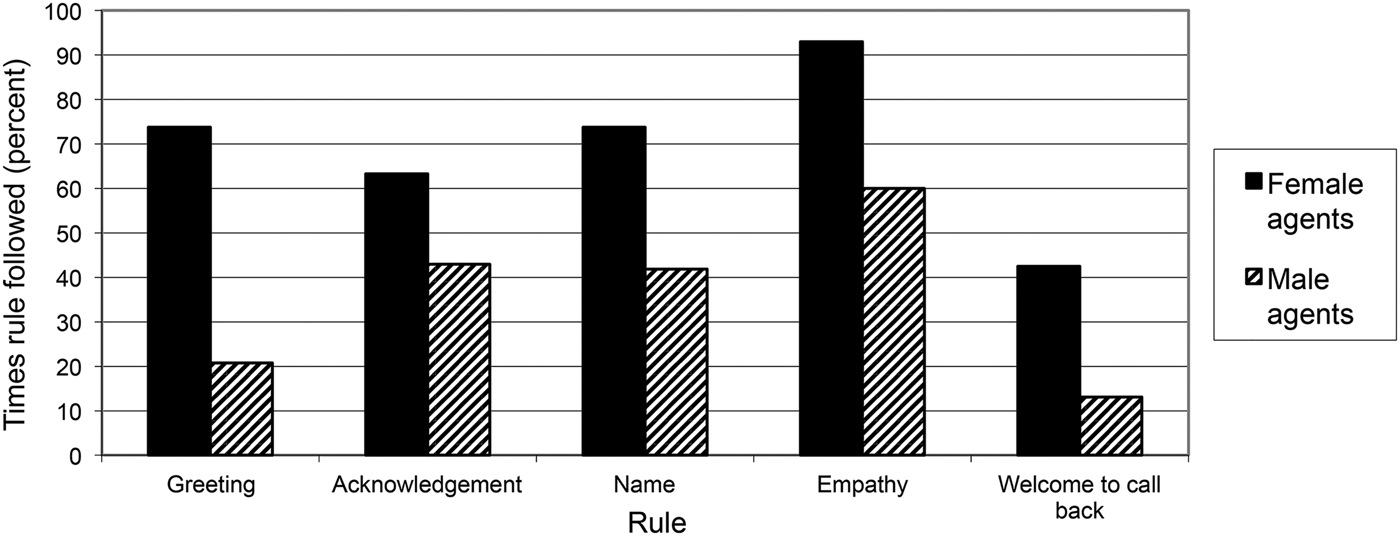
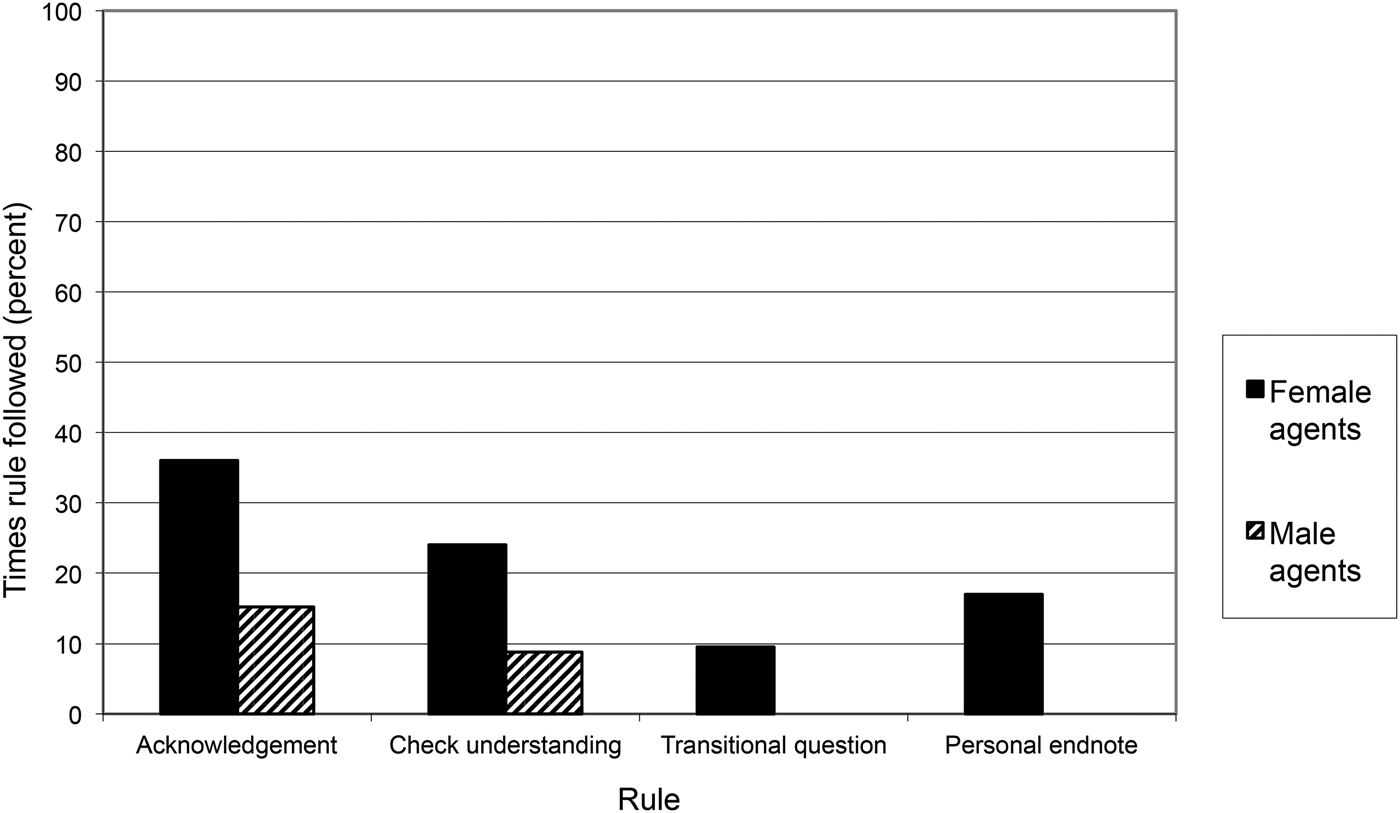
In all cases where a statistically significant male/female difference emerges, it is the female call centre agents who comply more with the linguistic prescriptions. This is backed up by the four male/female differences that approach statistical significance, all of which point in the same direction as the statistically significant ones. In other words, in every case where male/female differences emerge that are statistically significant or approach statistical significance, the female call centre agents invariably comply more with the linguistic prescriptions than their male colleagues do, and this is the case in both national contexts (see Figures 2 and 3). (As can be seen when comparing Figures 2 and 3, there are also differences in rule compliance between the two national contexts, with Thistle agents being more rule compliant than Mermaid agents. For a more in-depth discussion of this finding, see Hultgren Reference Hultgren2011.)
Gender differences in rule compliance at Thistle that are statistically significant or approach statistical significance.

Gender differences in rule compliance at Mermaid that are statistically significant or approach statistical significance.

As to the first question asked, then—whether female agents comply more with the institutionally prescribed speech style than their male colleagues—the answer is both yes and no. For just over half of the rules, they did; for the other half, male/female differences were absent. It is noteworthy that in each and every case where a statistically significant (or approaching statistically significant) male/female difference emerges, it is invariably the female agents—in both national contexts—who comply more. There are clearly cases in which no male/female differences emerge but, importantly, there is no case in which male agents comply more. Female agents’ greater rule compliance is examined in more detail below, supported by evidence from the qualitative analysis. We begin, however, by having a closer look at the cases where male/female differences were absent.
Factors accounting for the absence of male/female differences
The rules for which no male/female differences emerge fall into three broad categories: (i) The nature of the call prevents the rule from being complied with; (ii) The rule could have been complied with, but neither male nor female agents comply with it to any great extent; and (iii) Both male and female agents do comply with the rule, but no pattern of male/female differences emerges. We consider each category in turn.
As for the first category (the nature of the call prevents the rule from being complied with), one example of this is the hold notification rule. As can be seen in Table 2, the hold notification rule could potentially have been complied with in only fourteen out of seventy-nine calls at Thistle and in twenty-five out of 108 calls at Mermaid as it is only applicable in calls where the caller is put on hold. Out of these fourteen cases at Thistle, male agents comply with this rule in all possible cases, and female agents in seven out of ten possible cases. At Mermaid, the male agent complies with it in zero out of a possible seven cases, and the female agents in three out of eighteen. These numbers are too low for a statistically significant male/female difference to emerge. And, indeed, there is no way of knowing whether a larger sample size would have caused a statistically significant male/female difference to emerge.
As for the second category (cases in which the rule could have been complied with, but neither male nor female agents comply to any great extent), this seems to apply to the ‘welcome to call back’ rule at Mermaid and the ‘small talk’ and ‘personal endnote’ at Thistle (see Table 2). These were only complied with in 2.4% to 13.6% of the cases. It may be that creating small talk, offering a personal endnote, and inviting the caller to call back are perceived as time-consuming luxuries that must be dispensed with in order to meet the efficiency targets (for a more in-depth discussion of these particular rules, see Hultgren Reference Hultgren2017). Again, there is of course no way of knowing whether greater compliance would have led to male/female differences.
As for the third category (both male and female agents do comply with the rule, but no pattern of male/female differences emerges), this applies to ‘anything else’ and ‘check understanding’ at Thistle and ‘offer to help’ at Mermaid, all of which agents did comply with to some extent (see Table 2). One possible reason for the absence of male/female differences for these rules may be that agents sometimes make individual adaptations to the script so that it works for them (Woydack & Rampton Reference Woydack and Rampton2016), something that was also confirmed in interviews. In some cases, this may lead to individual males complying more and individual females complying less. Indeed, one male agent at Thistle was hailed by managers as a star employee, and I was often encouraged to listen in on his calls to witness a model of how the work should be done.
The absence of male/female differences in linguistic behaviour evidenced in the study corroborates the accumulation of evidence in language and gender studies that differences among females or males are often greater than they are between females and males (Cameron, McAlinden, & O'Leary Reference Cameron, McAlinden, O'Leary, Coates and Cameron1988; Freed & Greenwood Reference Freed and Greenwood1996.) The strength of statistical testing, however, lies in its capabilities of detecting group behaviour that may have gone unnoticed when focusing only on individuals. In the next section, we consider these patterns of male/female differences in greater detail.
Differences between male and female agents
In this section, I consider the rules for which a male/female difference in compliance emerged that was statistically significant or approached statistical significance. This pattern is the same in both national contexts (see Figures 2 and 3). As shown in Table 2, these constitute just over the majority of cases, four out of seven, at Mermaid and half of the cases, five out of ten, at Thistle. At Thistle, male/female differences emerged for the following rules: ‘greeting’, ‘acknowledgement’, ‘name’, ‘empathy’, and the ‘welcome to call back’ rules. At Mermaid these differences emerged for the following: ‘acknowledgement’, ‘check understanding’, ‘transitional question’, and ‘personal endnote’ rules.
To illustrate how this plays out in actual calls, two representative cases of male/female differences in rule compliance are examined in more detail below, one from Thistle and one from Mermaid. Calls in Mermaid are in Danish and have been translated by me.Footnote 1
Greeting, Thistle
For the ‘greeting rule’ prescribed at Thistle, male agents complied with this on only six out of twenty-nine occasions (29.7%). Female agents, in contrast, complied in thirty-one out of forty-two possible calls, or 73.8% of the time. With seventy-one calls included in the group examined for this rule, this finding comes out as strongly statistically significant (p < 0.001***). The greeting is the only prescribed rule that must be rendered verbatim as “Good morning/good afternoon Thistle Finance how may I help you”; agents are potentially marked down if they do not reproduce it verbatim.
-
(1) Prescribed greeting at Thistle:
Good morning/good afternoon Thistle Finance how may I help you? (Thistle scorecard)
Actual greeting at Thistle:


In example (1a) the male agent deviates from the script by adding the word ‘Group’ to the company name, a remnant from a now dissolved business arrangement where Thistle was one of a group of collaborating companies. The male agent in example (1c), an individual different from the one in (1a), adds the phrase ‘you're through to Ivan’ in addition to ‘Group’ and also fails to employ the pronoun ‘you’ in ‘how may I help you’. (The false start, in which the agent is about to say ‘good afternoon’ instead of the temporally appropriate ‘good morning’, has not been analysed as a violation of the rule because the agent interrupts and corrects himself.) There is not much to say about the female agents’ linguistic behaviour since, in both examples, they reproduce the greeting verbatim as prescribed. As with the males, the female agents are two different individuals.
While the male agents’ deviance from the prescriptions might seem slight, replicating the greeting exactly as prescribed is a key performance indicator at Thistle. This was especially the case since the organization had recently outsourced part of its call centre operation to India in addition to having one at another location in the UK. The fact that there were now three sites globally meant that it was even more important to have one standard greeting so that customers would have a consistent brand experience irrespective of whether they happened to be put through to India, Scotland, or another location. (Note, however, that data was collected only from the Scottish site, so the corpus is not confounded by Indian calls.) As was pointed out in interviews, the motto was ‘one Thistle’, and managers had hung posters with the new, standardized greeting around the room and in individual agents’ workspaces as reminders. In the call assessments I attended, the female agent, who got the greeting spot on, was complimented whereas the male agent, who deviated from prescriptions by adding ‘Group’, was reprimanded.
Acknowledgement, Mermaid
A Mermaid rule for which a statistically significant male/female difference was found was the acknowledgement rule. This rule requires the caller to explicitly acknowledge the caller's problem before entering the resolution stage. Whereas male agents complied with this rule in only five out of the thirty-three cases (15.2%) where conversational preconditions would allow it, female agents complied comparatively more often, in eighteen out of fifty applicable calls (36.0%). With a sample of eighty-three eligible calls, the difference is statistically significant at p = 0.039*. Considered below are four examples: two in which male agents do not comply and two in which female agents do comply. The two males and females are different individuals.
-
(2) Prescribed acknowledgement at Mermaid:
[The agent must] acknowledge the caller's problem, e.g. ‘I understand your problem’, ‘I will help you with the case/problem’. (Mermaid Scorecard, translated from Danish)
Actual acknowledgement at Mermaid:

The male agents do not follow the prescribed procedure of signalling their willingness to help the callers. Instead, they launch into their attempts to resolve the callers’ query straight away by seeking to elicit (through a question and an imperative, respectively) the relevant information (i.e. customer number and mobile phone number) that they need to look into the callers’ issues. This performance stands in contrast to that of female agents, who offer acknowledgements in accordance with the prescriptions.
While two examples of female agents’ greater rule compliance have been shown above, any one of the nine examples could have been chosen. The statistical tests show that the effect of agent gender is highly significant. In this regard, it is important to note that other factors that might be thought to influence rule compliance (be it length or complexity of call; caller gender, age and perceived friendliness; agent age, experience, qualification, socioeconomic status, career ambitions, etc.) are assumed to be spread evenly across the corpus. As calls in both call centres are distributed randomly to agents via Automatic Call Distribution software, it is highly unlikely that any one gender has systematically received more of any particular type of call that might have affected rule compliance. There may be factors, however, that co-vary systematically with gender, as which is discussed in a later section.
DISCUSSION: FEMININE INDEXICALITY OR FEMALE RULE COMPLIANCE?
At the outset of this article, I reviewed research suggesting that the speech style prescribed to call centre agents indexed normative femininity by encouraging rapport building, empathy, and other relational work. In this section, I revisit this issue and consider whether the propensity of female agents to comply more with the linguistic prescriptions than their male colleagues has to do with the speech style indexing normative femininity.
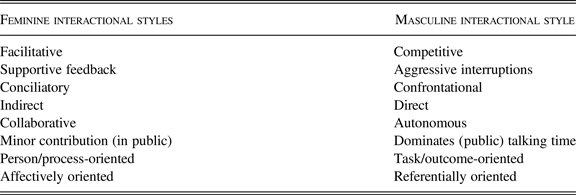
Some of the most widely cited features of normatively gendered interactional styles are summarized by Holmes (Reference Holmes2006:6) and shown in Table 3 below. As can be seen, there is a certain degree of overlap between these styles and the rules with which female agents complied more. Thus, some of the rules may well be interpreted as being person- and affective-oriented: the Thistle ‘name’, ‘empathy’, and ‘welcome to call back’ rules and the Mermaid ‘check understanding’ and ‘personal endnote’ rules. However, there is no obvious affective- or person-oriented aspect to getting the greeting exactly right (Thistle) or asking a ‘transitional question’ (Mermaid). Asking a transitional question requires that agents elicit the customers’ consent for Mermaid to get in touch whenever new products are released that they may be interested in buying. This rule, which effectively recasts the interaction from a customer-initiated service inquiry to a company-initiated sales inquiry, is widely regarded by agents as a highly face-threatening act, evidenced by interview data in which agents express a deep dislike of them as well as a clear reluctance to use them. Yet the management was intent on agents asking this question as it maximized their potential for profit generation; and their importance was reflected in interviews and in the multitude of posters around the room reminding agents to ask it. Despite the fact that the transitional question is arguably the opposite of affective and person-oriented talk, female agents complied with it to a greater extent than male agents, with the males in the sample not using it at all.
Normatively feminine and masculine interactional styles (Holmes Reference Holmes2006).

A similar situation applies to compliance with the acknowledgement rule. Prescribed in both Thistle and Mermaid, this rule requires the agent to verbalize an intention to help the customer by saying ‘I understand your problem’, ‘I will help you with the case/problem’, and it can therefore be seen as not exclusively person-oriented but also task-oriented (in that by deploying it, the agents signal that they are efficiently taking charge of the call). There is plenty of evidence from the Thistle call assessments that agents were complimented for taking charge of a call by using lots of ‘I-statements’. The ‘check understanding’ rule, the final one of the nine rules for which male/female differences emerged, could also be analysed in terms of both person-oriented and task-oriented utterances. This rule asks agents to check that the customer is happy with the solution offered, in effect signalling attentiveness to the caller as well as a focus on completion of the task. In sum, then, there is no conclusive evidence to support the theory that the rules associated with higher female agent compliance are ones that index normative femininity. It seems more likely, I would argue, that the greater female rule compliance is to do with rule compliance per se rather than with any particular social meaning ascribed to the rules in question.
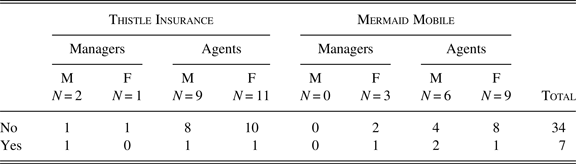
Interview data contrasts with the findings above in that gender is rarely mentioned as a factor influencing agents’ ability to perform on the job. When asked, “What sort of people do you think make the best call centre agents?”, neither agents nor managers mentioned gender. Instead the agents and managers cited such virtues as patience, professionalism, and enthusiasm. When asked more directly whether agent gender makes a difference, the overwhelming majority of respondents (thirty-four out of forty-one) across both sites replied in the negative (see Table 4).
Response to the interview question ‘Does gender matter?’.

Many respondents were quite emphatic in their views that gender did not matter, as shown by some representative responses below.
No, it doesn't matter—not at all. The majority of call centre workers are female, but it doesn't make a difference. The guys are just as good as the girls. (Male agent, Thistle)
No, there is no gender difference. Absolutely not. (Female agent, Thistle)
You see very slight differences between men and women but one is not necessarily better than the other—it depends on the individual. (Female agent, Thistle)
There is no difference between men and women. I've seen good examples of both genders. (Female agent, Mermaid)
When pushed, some interview respondents suggested that women were more person-focused, but these were in the clear minority, and in addition, they tended to distance themselves somewhat from these claims.
I think that as a sweeping generalization women can probably empathize and sympathize better than the guys can, but if the person has the right skills, male or female will not come into it. (Male manager, Thistle)
Man or woman doesn't matter. My experience and perception is that men are a bit more business-like than the women. Women are a bit more chatty and have more rapport. I could be wrong, though. (Female agent, Thistle)
Overall, then, interview data from this study did not provide evidence that women are thought to be more suited for call centre work than men, a finding confirmed by Mirchandani (Reference Mirchandani2005).
In contrast, studies by organizational sociologists have found evidence that women are preferred for call centre jobs. Interestingly, this preference appears to stem not only from an assumption that women have superior ‘communication’ and ‘people’ skills, but also because of their assumed ‘ability to deal with repetitive and highly pressurised work’ (Belt, Richardson, & Webster Reference Belt, Richardson and Webster2002:29). Managers in thirteen call centres in three countries (Ireland, the Netherlands, and the UK) explained (Belt, Richardson, & Webster Reference Belt, Richardson and Webster2002:30).
‘I find that the girls do the work better, they stay on-line and like what they are meant to do… whereas I think the men are constantly coming off-line to try and do other things. (Female Team Leader, Computer Services Sector)
You do find that the men are more likely to be doing things that they shouldn't be doing, whereas women stick to the procedure and the way it should be done. (Male Manager, Financial Services Call Centre)
The people I've employed before, hundreds and hundreds and hundreds of people that I've literally recruited and trained myself, a very, very small percentage—probably less than ten per cent—have been males. And that's not because I haven't given them the opportunities, because I have. In actual fact, in a short space of time it's the males that tend to come to me saying that they just can't hack it at the end of the day. (Female Manager, Outsourced Call Centre)
It is unclear why some studies have found overtly expressed preferences for call centre agents of a particular gender, and others not. One possible explanation may be the focus of the interviews, which in Belt and colleagues’ study was explicitly on recruitment practices whereas in mine it was language and gender. Or, put differently, where the sociological interview focused on material conditions, the sociolinguistic one focused, perhaps too narrowly, on social meaning (an argument to which I return below). Another explanation may be that discourses on gender are inherently multifaceted and sometimes contradictory. For instance, research exploring discourses on gender and career progression in the speech and language therapy profession, in which men make up only 2.5% of therapists, found that discourses of women as ‘carers/nurturers’ and as ‘superior communicators’ were sometimes taken as given and reinforced by research participants, while at other times they were contested (Litosseliti & Leadbeater Reference Litosseliti and Leadbeater2011).
Taken together, there does appear to be evidence to suggest that the male/female differences identified in this study are less to do with gendered indexicality, that is, female call centre agents finding it easier than their male colleagues to discursively construct the femininity that is valued, and more to do with them acting in a more rule-compliant, target-attentive way. In other words, it is not all about social meaning and indexicality; it is also about speakers and about the material environment in which they operate. Production metrics from a US banking call centre support this interpretation in showing that female agents complete calls on average twenty-four seconds faster than their male colleagues, amounting to a nine percent difference in all-over productivity (Waber Reference Waber2014). An interpretation in terms of greater female rule compliance also finds support in the literature on child development and schooling, which claims that girls are rewarded for compliance and sanctioned more severely than boys for the same kinds of noncompliance (e.g. joking around, calling out, or failing to stay on task; see Maccoby Reference Maccoby1998, Jones & Myhilla Reference Jones and Myhilla2004, Paechter Reference Paechter2007). It is conceivable that this socialized difference carries over into the workplace and shows up particularly in regimented workplaces, where following instructions and meeting targets is a performance indicator.Footnote 2 It also finds support in variationist sociolinguistics, where female speakers have been found to orient to a greater extent than their male counterparts to the way of speaking that is valued in the community of practice to which they belong (Eckert Reference Eckert2000; see Cheshire Reference Cheshire, Chambers, Trudgill and Schilling-Estes2002 for an overview).
CONCLUSION: NEW PERSPECTIVES ON LANGUAGE AND GENDER
This study has offered a new perspective on language and gender by focusing on male/female differences in rule compliance in call centres, a highly regimented, female-dominated workplace in the globalized service economy. While greater female rule compliance has been shown to happen in male-dominated workplaces, such as the British House of Commons (Shaw Reference Shaw and Baxter2006), this study shows that it happens also in female-dominated workplaces, and perhaps particularly in highly regimented workplaces such as call centres. Meeting targets is what counts in these workplaces, and it would appear that female workers, on the whole, do more to comply with the call centre rules. Strikingly, the pattern of greater female rule compliance emerges in both national contexts surveyed here. The new finding in both national contexts is not that ‘men speak like this’ and ‘women speak like that’, but rather that there are structures of inequity and entitlement, which cross-cut national cultures, and which may make female call centre agents, and possibly women in general, more prone to follow the rules. Because women have overall lower status in society, following the rules may be a way of proving that they belong—a way of gaining ‘symbolic capital’ (Bourdieu Reference Bourdieu1984; see also Eckert Reference Eckert2000). Breaking the rules, by contrast, is the prerogative of those in power.
The real-world implications of women's greater rule compliance is a possible reinforcement of the gendering—both numerical and ideological—of call centre work and a sustained occupational segregation. Of course, language is only one among many individual, cultural, and structural factors influencing career choice and recruitment practices (Evetts Reference Evetts2000; Russell Reference Russell2008; Scholarios & Taylor Reference Scholarios and Taylor2011), but given the centrality of language and regimentation in these workplaces, it is not inconceivable that greater female rule compliance may contribute—whether unwittingly or not—to an over-recruitment of women to the industry (Russell Reference Russell2008). While in the short run, over-recruitment may benefit individual women (Forey Reference Forey2013), on a more structural level, it may herd women into these low-paid and stressful jobs where they have little influence and low status. Insofar as the findings from this study are generalizable to contexts other than call centres, they may shed light on the conundrum of why females continue to be paid less and be underrepresented in high-status professional domains despite consistently outperforming boys throughout formal schooling (Eden Reference Eden2017). Greater female rule compliance would explain both these phenomena. While rule compliance is valued and rewarded in schools, by the time young women enter the professional arena it may start to work against them, keeping them at bay in highly regimented jobs with low prestige and little influence. Shaw's (Reference Shaw and Baxter2006) study suggests that rule compliance may work against women even in powerful professions. By deliberately not breaking the turn-taking rules as much as their male counterparts, female politicians in the British parliament get less talk time and, hence, potentially, less influence (Shaw Reference Shaw and Baxter2006).
In terms of the field of language and gender, the study raises the question of whether qualitative discourse analytic approaches, with their foregrounding of agency and indexicality, are equipped to capture systematic patterns of gendered behaviour and resultant occupational segregation and inequality. It could be argued that the differences in rule compliance that have emerged in this study might have gone unnoticed if an exclusively qualitative approach had been adopted. It is not my contention that language and gender scholars should therefore revert back to an earlier era of simplistic gender binarisms and over-generalizations of essentialized gendered behaviour. Rather, what I am arguing is that in call centres, and possibly in other workplaces in the globalized economy as well, there is a lot less scope for professional and linguistic agency, and a lot greater emphasis on regimentation, targets, and rule compliance. This, as we have seen, may affect male and female workers differently and perpetuate gender inequalities. Consequently, future research in language and gender could investigate a wider range of research sites, adopt a wider range of methodologies, not shy away from combining quantitative and qualitative approaches, and pay heed to a sociolinguistics in which people and material conditions matter as much as social meaning. The study, in sum, echoes calls to ‘reinvigorate the political basis of earlier work on language and gender’ (Ehrlich & Meyerhoff Reference Ehrlich, Meyerhoff, Ehrlich, Meyerhoff and Holmes2014:14; see also Swann Reference Swann, Litosseliti and Sunderland2002; McElhinny Reference McElhinny2007).
This study has raised issues that must be addressed in further research. First of all, future studies will need to explore how gender intersects with other variables. The workforce composition in both call centres studied here was such that although there were many young workers, both male and female, who worked there for a short time while taking a degree, the longest serving employees tended to be women. If women, on average, have served longer in the organization than their male colleagues, their greater-than-average rule compliance may be a sign of greater commitment to the job and/or of a better understanding of what is valued by the system. In other words, gender may mediate other more salient variables such as length of service, job commitment, and experience. This is a topic worthy of further exploration (see Goodwin & Kyratzis Reference Goodwin, Kyratzis, Ehrlich, Meyerhoff and Holmes2014 and contributors to Pichler & Eppler Reference Pichler and Eppler2009 for how gender interacts with other variables). Future studies could also consider a wider range of national contexts than the two included in this study to explore whether the pattern of greater female rule compliance is replicated elsewhere, as the shift to service-based economies is a truly global phenomenon. On its own, though, this study, the first of its kind, serves to open up some important questions about language and gender in recent twenty-first-century workplaces.
APPENDIX: TRANSCRIPTION CONVENTIONS
- C
-
caller
- A
-
agent
- […]
-
omitted passage
- //
-
overlapping speech
- I- I-
-
false start
- italics
-
emphasis
- (2)
-
pause with approximate duration in seconds
- bold
-
place where the rule is/is not complied with