Social anxiety disorder (SAD) is characterised by intense fear or anxiety about social situations where a person may be observed by others, and where the person fears that their behaviour or anxiety symptoms will attract negative evaluation (American Psychiatric Association, 2013). Estimates of lifetime prevalence are up to 12% for SAD (Kessler et al., Reference Kessler, Berglund, Demler, Olga, Merikangas and Walters2005), and SAD is associated with limitations in social and occupational function, and educational attainment (Acarturk, de Graaf, van Straten, ten Have, & Cuijers, Reference Acarturk, de Graaf, van Straten, ten Have and Cuijpers2008; Acarturk et al., Reference Acarturk, Smit, de Graaf, van Straten, ten Have and Cuijpers2009). As many as 80% of those with SAD do not seek treatment, or seek treatment after more than 10 years from symptom onset (Grant et al., Reference Grant, Hasin, Blanco, Stinson, Chou, Goldstein and Huang2005). This is concerning, as effective cognitive behaviour therapy (CBT) interventions for SAD are available (Butler, Chapman, Forman, & Beck, Reference Butler, Chapman, Forman and Beck2006; Goldin et al., Reference Goldin, Ziv, Jazaieri, Werner, Kraemer, Heimberg and Gross2012; McEvoy, Reference McEvoy2007).
Fear of negative evaluation (FNE) refers to distress due to expectation of unfavourable evaluations from others about one's appearance or social performance (Watson & Friend, Reference Watson and Friend1969), and FNE has long been understood to characterise social anxiety (Fergus et al., Reference Fergus, Valentiner, McGrath, Stephenson, Gier and Jencius2009; Heimberg et al., Reference Heimberg, Fresco, Hart, Turk, Schneier and Liebowitz2005; Kocovski & Endler, Reference Kocovski and Endler2000; Rodebaugh, Weeks, Gordon, Langer, & Heimberg, Reference Rodebaugh, Weeks, Gordon, Langer and Heimberg2012). Cognitive models of social anxiety highlight the central role of FNE in the development, maintenance, and effective treatment of SAD (Clark & Wells, Reference Clark, Wells, Heimberg, Liebowitz, Hope and Schneier1995; Rapee & Heimberg, Reference Rapee and Heimberg1997; Kocovski & Endler, Reference Kocovski and Endler2000).
Fear of positive evaluation (FPE) refers to anxiety associated with favourable evaluation in social and public situations (Weeks, Heimberg, & Rodebaugh, Reference Weeks, Heimberg and Rodebaugh2008; Weeks, Heimberg, Rodebaugh, & Norton, Reference Weeks, Heimberg, Rodebaugh and Norton2008). Gilbert (Reference Gilbert2001) argued that FPE may confer an evolutionary advantage by reducing conflict within a social group, thus increasing the safety of all group members. Weeks, Heimberg, and Rodebaugh (Reference Weeks, Heimberg and Rodebaugh2008) developed the Fear of Positive Evaluation Scale (FPES), which has been shown to be positively associated with the Social Interaction Anxiety Scale (SIAS; Mattick & Clarke, Reference Mattick and Clarke1998) in a mixed clinical sample with a range of anxiety disorders (Fergus et al., Reference Fergus, Valentiner, McGrath, Stephenson, Gier and Jencius2009), and with the SIAS and the Social Phobia Scale (SPS; Mattick & Clarke, Reference Mattick and Clarke1998) in non-clinical student samples (Weeks, Heimberg, & Rodebaugh, Reference Weeks, Heimberg and Rodebaugh2008) and a clinical sample with SAD (Weeks, Heimberg, Rodebaugh, Goldin, & Gross, Reference Weeks, Heimberg, Rodebaugh, Goldin and Gross2012). Weeks, Heimberg, and Rodebaugh (2012), using hierarchical regression, also showed that FPES and the Brief FNE-Straightforward scale (BFNE-S) accounted for unique variance in measures of social anxiety. Heimberg, Brozovich, and Rapee (Reference Heimberg, Brozovich, Rapee, Hofmann and DiBartolo2010) presented a revision of Rapee and Heimberg's (Reference Rapee and Heimberg1997) model of SAD, in which they proposed that SAD may be better understood as reflecting fear of evaluation generally, both positive and negative, rather than FNE only.
Fergus et al. (Reference Fergus, Valentiner, McGrath, Stephenson, Gier and Jencius2009) examined the responsiveness of the FPES to Group CBT (GCBT) in a clinical sample with SAD (n = 37) using a non-experimental single group pre-post design. The GCBT intervention was modified to include components directly targeting FNE and FPE. Outcome measures included the FPES, the Brief Fear of Negative Evaluation (BFNE; Leary, Reference Leary1983), the SIAS, the Beck Depression Inventory (BDI; Beck, Ward, Mendelsohn, Mock, & Erbaugh, Reference Beck, Ward, Mendelson, Mock and Erbaugh1961), and the Penn State Worry Questionnaire (PSWQ; Meyer, Miller, Metzger, & Borkovec, Reference Meyer, Miller, Metzger and Borkovec1990). The findings indicated significant changes on all outcome measures after treatment, suggesting that CBT was impacting a component common to the constructs assessed by these measures, such as negative affect. More recently, Weeks et al. (Reference Weeks, Heimberg, Rodebaugh, Goldin and Gross2012) reported significantly higher change scores on measures of both FPE and FNE among people with SAD receiving standard individual CBT for SAD compared to a waitlisted comparison group.
Further to the question of what may underlie the responsiveness of both measures of depression and measures of anxiety to interventions aimed at targeting anxiety, Wang, Hsu, Chiu, and Liang (Reference Wang, Hsu, Chiu and Liang2012) investigated factors influencing reported high levels of comorbidity between social interaction anxiety and depression using a non-clinical sample of Taiwanese students. Using hierarchical regression, these authors showed that the FPES was an independent predictor of variability in two measures of social anxiety, the SIAS and the Liebowitz Social Anxiety Scale — Self Report — Social Interaction Subscale, in addition to positive affect, negative affect, and FNE. However, the FPE was not a significant, independent predictor of variability in either of two measures of depression, the BDI-II (Beck, Steer, & Brown, Reference Beck, Steer and Brown1996) and the Depression subscale of the Depression Anxiety Stress Scale (DASS; Lovibond & Lovibond, Reference Lovibond and Lovibond1995), after positive affect, negative affect, and FNE were entered. Wang et al. concluded that FPE and FNE are independent predictors of social interaction anxiety, but that FPE is not an independent predictor of depression. However, as Weeks and Howell (Reference Weeks, Howell and Weeks2014) argue, it is possible that Wang et al.'s findings reflect culturally specific factors and thus require replication.
The present study examined the relationships between measures of FPE and FNE and measures of social anxiety and depression in a sample assessed as suitable for group CBT for social anxiety (n = 35). The responsiveness of measures of FPE and FNE to standard group CBT for social anxiety was also evaluated in a subset of this group (n = 20) using a quasi-experimental pre-post waitlist control design. Based on Fergus et al.'s (Reference Fergus, Valentiner, McGrath, Stephenson, Gier and Jencius2009) findings from a mixed sample with anxiety disorders, it was predicted that FPES scores would correlate significantly and positively with scores on the BFNE-S (Rodebaugh et al., Reference Rodebaugh, Woods, Thissen, Heimberg, Chambless and Rapee2004) and that both FPE and BFNE-S would be positively correlated with measures of SAD (SIAS, SPS; Mattick & Clarke, Reference Mattick and Clarke1998) and of depression (BDI-II; Beck et al., Reference Beck, Steer and Brown1996). If Wang et al.'s (Reference Wang, Hsu, Chiu and Liang2012) conceptualisation in which FPE is understood to be a unique predictor of social interaction anxiety independent of FNE, but where FPE would not be expected to be related to measures of constructs other than social interaction anxiety, such as the SPS and the BDI-II, independently of FNE, then it would be expected that statistically controlling for BFNE-S in hierarchical regression would reduce or eliminate the relationship between FPES and both SPS and BDI-II, but that a unique relationship between FPES and SIAS would remain significant after BFNE-S was statistically controlled. Finally, if FPES scores are responsive to standard GCBT then it would be expected that there would be a significant reduction in FPES scores after standard GCBT for SAD compared to a waitlist.
Method
Participants
The sample comprised self-referred people who contacted a psychology training clinic in Sydney that provided outpatient group treatment for social anxiety after finding out about the program from material available on the clinic website. All participants were interviewed concerning SAD symptomatology and all interviews were conducted or supervised by a clinical psychologist experienced with CBT for social anxiety (the second author). Inclusion criteria were: (a) met criteria for SAD and offered a place in a free CBT group for social anxiety; (b) minimum age 18 years. Exclusion criteria were: (a) untreated, current psychotic symptoms; (b) problematic alcohol or substance use such that the individual was unable to meet a sobriety attendance requirement; (c) history of significant brain injury or neurological disorder. Participants did not receive any remuneration or incentive to participate in the study.
A total of 35 people (21 females), mean age 32.20 years (SD = 9.46 years; range = 19–56 years) completed initial assessment and were considered appropriate for group CBT for social anxiety. A further three people were assessed but were not included as their primary concerns were not related to social anxiety. About 70% (n = 24) had achieved a post-secondary certificate, diploma or degree; more than half were working full time or part time (n = 20, 57.1%); about one third were studying (n = 11, 31.4%); and the remainder were unemployed (n = 4, 11.4%). Slightly less than half (n = 16, 45.7%) reported being in a current relationship. Approximately half the group (n = 18, 51.4%) reported they had previously received psychological interventions for social anxiety and about half (n = 17, 48.6%) reported previous psychological interventions for other psychological concerns. Sixteen people (45.7%) reported current use of psychoactive medication.
A subset of 20 participants undertook and completed group CBT for social anxiety and, based on availability to attend and availability of places, were non-randomly allocated to treatment (GCBT; n = 10) or waitlist (WL; n = 10) groups. The GCBT group was assessed immediately before and after an 8-week group CBT intervention, and the WL group was assessed twice at a similar interval to the GCBT group and commenced the group CBT after the second measurement occasion. The time between assessments was not significantly different for the two groups (M = 47.7 days and M = 47.6 days for WL and GCBT respectively), t(9.94) = .02, p = .99, and there were no significant differences between the groups in mean age in years (M = 32.9 and M = 33.6 for WL and GCBT respectively), t(18) = .16, p = .88, number who had received treatment for social anxiety previously (n = 6 and n = 4 for WL and GCBT respectively), χ2(1) = .200, p = .66, or number currently taking psychoactive medication (n = 7 and n = 3 for WL and GCBT respectively), χ2(1) = 1.80, p = .18.
Materials
Fear of Positive Evaluation Scale (FPES; Weeks et al., Reference Weeks, Heimberg, Rodebaugh and Norton2008)
The FPES is a 10-item self-report inventory assessing fear and distress related to positive evaluation from others. Participants rate statements such as ‘I feel uneasy when I receive praise from authority figures’ on a 10-point Likert-type scale ranging from 0 (not at all true) to 9 (very true) where higher scores represent greater FPE. The convergent and discriminant validity of the FPES has been reported to be good, and the scale has good reliability (Cronbach's α = .80; Weeks, Heimberg, & Rodebaugh, Reference Weeks, Heimberg and Rodebaugh2008), consistent with that found in the present study (Cronbach's α = .85).
Brief Fear of Negative Evaluation-Straightforward (BFNE-S; Rodebaugh et al., Reference Rodebaugh, Woods, Thissen, Heimberg, Chambless and Rapee2004)
The BFNE-S comprises the eight non-reversed items from the twelve-item BFNE (Leary, Reference Leary1983). The BFNE is a self-report inventory assessing worry and concern related to negative evaluation from others in which participants rate statements such as ‘I am frequently afraid of other people noticing my shortcomings’ on a 5-point Likert-type rating scale from 1 (not at all characteristic of me) to 5 (extremely characteristic of me). Higher scores represent greater FNE. The BFNE-S has superior psychometric properties than the BFNE and is recommended for use in clinical populations (Rodebaugh et al., Reference Rodebaugh, Woods, Thissen, Heimberg, Chambless and Rapee2004; Weeks et al., 2005). Weeks et al. (2005) reported that the reliability of the BFNE-S in clinical samples was high (Cronbach's α = .92), consistent with the obtained value in the current sample (Cronbach's α = .89).
Social Interaction Anxiety Scale (SIAS; Mattick & Clarke, Reference Mattick and Clarke1998)
The SIAS is a 20-item self-report inventory assessing anxiety during interpersonal interactions. Participants rate statements such as ‘When mixing in a group, I find myself worrying I will be ignored’ on a 5-point Likert-type rating scale from 0 (not at all characteristic of me) to 4 (extremely characteristic of me), where higher scores indicate greater anxiety. The SIAS has good reliability in clinical samples (Cronbach's α = .93; Mattick & Clarke, Reference Mattick and Clarke1998), and in the present study the Cronbach's α was.90.
Social Phobia Scale (SPS; Mattick & Clarke, Reference Mattick and Clarke1998)
The SPS is a 20-item self-report inventory assessing anxiety experienced while being observed performing daily activities. Participants are asked to rate statements such as ‘I become anxious if I have to write in front of others’ on a 5-point Likert-style rating scale from 0 (not at all characteristic of me) to 4 (extremely characteristic of me), where higher scores indicate higher anxiety. The SPS is reliable, with Cronbach's α in clinical samples .89 (Mattick & Clarke, Reference Mattick and Clarke1998), consistent with the current study (Cronbach's α = .89).
Beck Depression Inventory-II (BDI-II; Beck et al., Reference Beck, Steer and Brown1996)
The BDI-II is a 21-item self-report inventory assessing depression. Participants are asked to rate the intensity of symptoms and behaviours on a 4-point Likert-style rating scale from 0 (e.g., I do not feel sad) to 3 (e.g., I am so sad or unhappy that I can't stand it). The reliability of the BDI-II in clinical samples is good (Cronbach's α > .92; Beck et al., Reference Beck, Steer and Brown1996). In the present sample the Cronbach's α was .91.
Group CBT
The standard GCBT intervention was based on Hofmann and Otto (Reference Hofmann and Otto2008) and was offered free of charge to treatment-seeking individuals. The intervention comprised eight weekly sessions of 2 hours each and was structured as follows:
Session 1: Overview of the program; psychoeducation about anxiety and social anxiety; introduction to the CBT model of social anxiety and how the work of the group will relate to the model; essential role of between-session work; between-session work: thought and mood monitoring.
Session 2: Review of between-session work and of the CBT model; identifying and changing unhelpful thinking; developing rational responses; between-session work: thought monitoring with rational responses.
Session 3: Review of between-session work and of cognitive restructuring, how to get more evidence to challenge automatic thoughts; between-session work: thought monitoring with rational responses and additional evidence to challenge thoughts
Session 4: Review of between-session work; graded exposure and rationale; in-session exposure exercises with practice in recording and monitoring anxiety; focus on identifying and replacing safety behaviours; between-session work: continue thought challenging and graded exposure.
Session 5: Review of between-session work; in-session videotaped presentations with feedback and review; between-session work: continue thought challenging and graded exposure.
Session 6: Review of between-session work; anticipatory anxiety, post-event processing and memory biases; between-session work: continue thought challenging and graded exposure; finding evidence to challenge memory bias.
Session 7: Review of between-session work; progress to date and identifying areas that need further work; relapse prevention; between-session work: continue thought challenging and graded exposure.
Session 8: Review of between-session work; review of program; dealing with lapses.
The intervention was conducted with groups of six to eight participants and was facilitated by registered and provisionally registered psychologists under the supervision of a clinical psychologist.
Procedure
The study was approved by the Australian College of Applied Psychology Human Research Ethics Committee. Treatment-seeking individuals were invited to participate in the study when they attended an appointment where they completed a structured clinical interview with a clinical psychologist or a provisionally registered psychologist under supervision and completed series of questionnaires to determine eligibility to join a group CBT program for social anxiety. All potential participants were informed that access to the program was not contingent on participating in the research and all participants provided written consent for their de-indentified data to be used for research purposes. Following interview, participants completed five psychometric measures (FPES, BFNE-S, SIAS, SPS and BDI-II). Only responses provided by participants who met criteria for SAD based on the structured clinical interview with a clinical psychologist or psychologist trainee and who were considered appropriate for treatment were included.
Results
Where less than 10% of items from a questionnaire have not been completed, Shrive, Stuart, Quan, and Ghali (Reference Shrive, Stuart, Quan and Ghali2006) recommend replacing the missing item responses with an imputed mean calculated from the total mean of an individual's completed responses on that measure. This simple method performs well psychometrically compared to more complex options (Shrive et al., Reference Shrive, Stuart, Quan and Ghali2006). There were eight missing responses to items across the five psychometric measures initially completed by each of the 35 participants and a further four missing responses to items across the five psychometric measures completed by 20 participants a second time. Each of these was replaced with the imputed mean using the method described above (Shrive et al., Reference Shrive, Stuart, Quan and Ghali2006).
Relationship of FPES to Measures of Social Anxiety and Depression
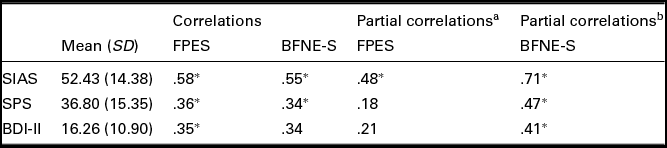
The mean FPES in the present sample was 38.29 (SD = 15.53) and the mean BFNE-S was 31.63 (SD = 6.6). The FPES was positively and significantly correlated with the BFNE-S (r = .38, p = .025). Both the FPES and BFNE-S were positively correlated with the SIAS, r = .58, p < .001 and r = .55, p = .001 for FPES and BFNE-S respectively, the SPS, r = .36, p = .038 and r = .34, p = .044 for FPES and BFNE-S respectively, and the BDI-II, r = .35, p = .047 and r = .34, p = .052 for FPES and BFNE-S respectively, and all correlations were significant except for that between the BFNE-S and BDI-II (see Table 1). As indicated in Table 1, the partial correlations between BFNE-S and SIAS, r = .72, p < .001, SPS, r = .47, p = .007, and BDI-II, r = .41, p = .02, were all positive and significant when FPES was controlled. However, only the partial correlation between FPES and SIAS, r = .48, p = .005, was significant when BFNE-S was controlled.
SIAS, SPS and BDI-II: Means and Standard Deviations; Correlations and Partial Correlations with FPES and BFNE-S
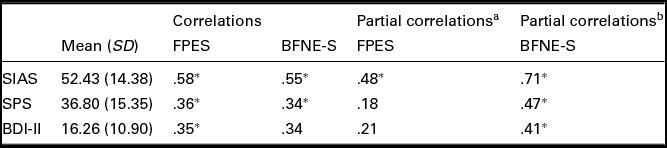
Note: *p < .05; FPES = Fear of Positive Evaluation Scale; BFNE-S = Brief Fear of Negative Evaluation Scale — Straightforward; SIAS = Social Interaction Anxiety Scale, SPS = Social Phobia Scale; BDI-II = Beck Depression Inventory; acontrolling BFNE-S; bcontrolling FPES.
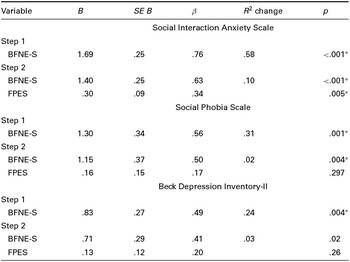
To evaluate the extent to which the BFNE-S and the FPES were independently related to measures of social interaction anxiety (SIAS), general social anxiety concerns (SPS), and depression (BDI-II), a series of hierarchical regression analyses were conducted. In each case, the BFNE-S score was entered in the first step and FPES scores were added in the second step. To adjust for the repeated analyses, a Bonferroni adjustment was applied to the type 1 error rate, which was set at p = .017 (.05/3).
For the hierarchical regression predicting SIAS, at Step 1, R 2 = .58, adjusted R 2 = .57, F(1, 32) = 44.29, p < .001. At Step 2, R 2 = .68, adjusted R 2 = .66, F(1, 31) = 9.36, p = .005. After Step 2, adjusted R 2 indicates that almost two thirds of the variability in SIAS was accounted for by BFNE-S and FPES. As is evident in Table 2, BFNE-S was a significant predictor of SIAS at Step 1 (β = .76), and both BFNE-S and FPES were significant predictors of SIAS at Step 2 (β = .63 and β = .34 for BFNE-S and FPES respectively; ps < .017).
Regression Weights From Hierarchical Regression Analyses of the Unique Variance in SIAS and BDI-II Accounted for by FPES and BFNE-S

Note: *p < .05/3 = .017with Bonferroni adjustment for repeated regression equations; BFNE-S = Brief Fear of Negative Evaluation Scale-Straightforward; FPES = Fear of Positive Evaluation Scale.
With regard to SPS, at Step 1 R 2 = .56, adjusted R 2 = .29, F(1, 32) = 14.60, p = .001. At Step 2 R 2 = .58, adjusted R 2 = .30, F(1, 32) = 1.12, p = .30. After Step 2, adjusted R2 indicates that about one third of the variability in SPS was accounted for by BFNE-S and FPES. From Table 2 it is clear that BFNE-S was a significant predictor of SPS at Step 1 (β = .56) and Step 2 (β = .50; ps < .017), but FPES was not a significant predictor of SPS at Step 2 (β = .17; see Table 2).
For BDI-II, at Step 1 R 2 = .49, adjusted R 2 = .21, F(1, 32) = 9.59, p = .004. At Step 2, R 2 = .52, adjusted R 2 = .27, F(1, 31) = 1.35, p = .255. After Step 2, adjusted R 2 indicates that about one fifth of the variability in BDI-II was accounted for by BFNE-S and FPES. BFNE-S was a significant predictor of BDI-II at Step 1 (β = .49; p = .004), but at Step 2 neither BFNE-II nor FPES were significant (β = .41 and β = .20 for BFNE-S and FPES respectively; ps > .017), suggesting that FPES may be acting as a suppressor variable (see Table 2).
GCBT Compared to WL
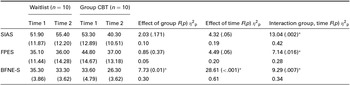
There were no significant differences between the groups at initial assessment on FPES, t(18) = 1.65, p = .117, d = 0.78, BFNE-S, t(18) = .87, p = .394, d = 0.41, SIAS, t(18) = .25, p = .803, d = 0.12, SPS, t(18) = .10, p = .922, d = 0.05, or BDI-II, t(18) = .718, p = .48 d = 0.34 (see Table 3).
Mean Time 1 and Time 2 Scores for SIAS, FPES, and BFNE-S for the Waitlist and Group CBT Groups (SD in Brackets)

Note: FPES = Fear of Positive Evaluation Scale; BFNE-S = Brief Fear of Negative Evaluation Scale — Straightforward; SIAS = Social Interaction Anxiety Scale, SPS = Social Phobia Scale; BDI-II = Beck Depression Inventory.
Analysis of variance (ANOVA) with one between-group factor (Group: WL; GCBT) and one within-group factor (Time: Time 1; Time 2) was used to compare the GCBT and WL groups on measures of social interaction anxiety, FNE and FPE taken before and after group CBT for social anxiety (GCBT) or before and after an equivalent period without GCBT (WL). To control the type 1 error rate, a Bonferroni adjustment was applied and the decision rule was set at p = .017 (.05/3). On BFNE-S there were significant main effects for Group, F(1, 18) = 7.73, p = .01, η2 p = .30, and Time, F(1, 18) = 28.61, p < .001, η2 p = .61, where the average BFNE-S scores were lower for the GCBT group compared to the WL group, and the average Time 1 scores were higher than the Time 2 scores (see Table 3). No other main effects were significant (ps > .017). There were significant interactions between Group and Time for all variables, SIAS, F(1,18) = 13.04, p = .002, η2 p = .42, BFNE-S, F(1,18) = 9.29, p = .007, η2 p = .34, and FPES, F(1,18) = 7.14, p = .016, η2 p = .28. Means indicate that for all variables there was little change between Time 1 and Time 2 for the WL group and a decrease between Time 1 and Time 2 for the GCBT group (see Table 3).
Discussion
This study examined the relationships between measures of FPE and FNE and measures of social anxiety and depression in a sample assessed as suitable for group CBT for social anxiety and considered the responsiveness of measures of FPE and FNE to standard group CBT for social anxiety in a subset of this group. It was predicted that FPES and BFNE-S scores would be significantly correlated and that each would be significantly correlated with SIAS, SPS, and BDI-II. The findings were largely consistent with these predictions and with the findings of Fergus et al. (Reference Fergus, Valentiner, McGrath, Stephenson, Gier and Jencius2009) from a mixed sample with anxiety disorders, and Weeks et al. (Reference Weeks, Heimberg, Rodebaugh, Goldin and Gross2012) from a sample with SAD.
FNE has been understood as a core feature of both depression and social anxiety (Collins, Westra, Dozois, & Stewart, Reference Collins, Westra, Dozois and Stewart2005; Duke, Krishnan, Faith, & Storch, Reference Duke, Krishnan, Faith and Storch2006; Fergus et al., Reference Fergus, Valentiner, McGrath, Stephenson, Gier and Jencius2009; Weeks, Heimberg, & Rodebaugh, Reference Weeks, Heimberg and Rodebaugh2008), and the hierarchical regression analyses suggest that the relationship between BFNE-S scores and measures of both social anxiety and depression is independent of FPE, and that FPE is a unique predictor of social interaction anxiety but not performance anxiety or depression, replicating the findings of Wang et al. (Reference Wang, Hsu, Chiu and Liang2012) with their Taiwanese student sample in a clinical sample from Australia, and previous work concerning the relationship between FPE and FNE (Fergus et al., Reference Fergus, Valentiner, McGrath, Stephenson, Gier and Jencius2009; Weeks, Heimberg, & Rodebaugh, Reference Weeks, Heimberg and Rodebaugh2008; Weeks, Heimberg, Rodebaugh, & Norton, Reference Weeks, Heimberg, Rodebaugh and Norton2008). These findings also provide empirical support for Wang et al.'s contention that FPES is uniquely associated with social interaction anxiety rather than broader social anxiety concerns assessed by the SPS, although this finding needs to be replicated in a larger sample.
The study also adds to findings reported by Fergus et al. (Reference Fergus, Valentiner, McGrath, Stephenson, Gier and Jencius2009), with a modified GCBT intervention for social anxiety, and Weeks et al. (Reference Weeks, Heimberg, Rodebaugh, Goldin and Gross2012), with standard individual CBT for social anxiety. Here, scores on the FPES appeared to be sensitive to standard GCBT for social anxiety. In terms of comparability of the sample to those reported elsewhere, the means and standard deviations for FPES and BFNE-S in the sample reported here were very similar to those reported by Weeks et al. (Reference Weeks, Heimberg, Rodebaugh, Goldin and Gross2012): 39.6 (14.92) and 32.43 (5.57) for FPES and BFNE-S respectively. The mean scores for SIAS, BFNE-S and FPES at Time 1 for the GCBT and WL groups, and at Time 2 for the GCBT group, were somewhat higher than those reported by Fergus et al. (Reference Fergus, Valentiner, McGrath, Stephenson, Gier and Jencius2009). However, the means of the key outcome variable, the SIAS, before and after GCBT were comparable to those reported in several other studies looking at the impact of group CBT on social anxiety in community samples (c.f. McEvoy, Reference McEvoy2007; McEvoy, Nathan, Rapee, & Campbell, Reference McEvoy, Nathan, Rapee and Campbell2012; McEvoy, Erceg-Hurn, Saulsman, & Thibodeau, Reference McEvoy, Erceg-Hurn, Saulsman and Thibodeau2015). This suggests that despite the small sample size reported here, the effectiveness of the intervention was similar to that found in other studies. In general, the findings reported here add to earlier work using a modified GCBT intervention (Fergus et al., Reference Fergus, Valentiner, McGrath, Stephenson, Gier and Jencius2009) and individual CBT (Weeks et al., Reference Weeks, Heimberg, Rodebaugh, Goldin and Gross2012) and suggest that the FPES is sensitive to standard GCBT for SAD that does not include a component focused specifically on FPE.
Several limitations of the present study should be noted. The sample size was relatively small, limiting the power to detect effects. This, along with Bonferroni corrections for multiple analyses, may account for the finding of a non-significant association between BFNE-S score and BDI-II score at Step 2 of the regression model. Despite this, the pattern of findings was largely consistent with predictions suggesting that the effects observed are robust. Participants were not randomly assigned to conditions, so that there may be important differences between the groups that were not controlled. Social anxiety symptomatology was assessed through structured clinical interviews rather than structured diagnostic interviews at Time 1 only and detailed information about comorbidity was not collected. However, as noted above, the means on self-report measures before and after treatment for the group reported here are largely comparable with McEvoy's (Reference McEvoy2007) effectiveness study.
Extending from previous work, the findings indicated that standard GCBT for social anxiety without a component focused directly on FPE was effective in reducing self-reported FPE. This may imply that modifications to standard GCBT are not necessary to improve the effectiveness of treatment; however, further research comparing standard GCBT to GCBT, including a focused FPE component, is needed to address this directly. The importance of FPE as a predictor of long-term outcomes for SAD is also yet to be established. To date, FPE has been measured using self-report, and it is important to establish a valid behavioural measure for FPE to improve the interpretability of findings such as those reported here. These findings add to the literature concerning the sensitivity of FPE to treatment, and the specificity of the relationship between FPE and social interaction anxiety.