

Age discrimination in the Australian workplace has been more apparent since the 2004 introduction of the Age Discrimination Act. The position of Age Discrimination Commissioner (Australian Human Rights Commission, 2010a; Heffernan, Reference Heffernan2011) was established in the context of increasing numbers of older adults in the population. The Australian Bureau of Statistics (2013) has projected that the aged population will rise substantially, with the population of Australians aged from 65 to 85 years old expected to almost double between 2012 and 2061, in line with the population increases of older adults evident in many countries (Watkins, Reference Watkins2005). If proposals for retirement at later ages are effective in keeping older adults employed longer, then an increased number of complaints of age discrimination both within and outside of the workplace is likely. The Australian Human Rights Commission claims that the majority of age discrimination reports (65%) in Australia refer to incidents at work and that the majority of these complaints (66%) arise from people over the age of 45 years (Australian Human Rights Commission, 2010a). The prediction of increased numbers of incidents of age discrimination suggests that this is an issue that warrants more attention by Australian researchers.
Work is an important meaningful activity for older adults (Mor-Barak, Reference Mor-Barak1995). While continuing good health is one of the determinants of continuing to work, the transition to retirement is complex (Hansson, DeKoekkoek, Neece, & Patterson, Reference Hansson, DeKoekkoek, Neece and Patterson1997; Mariappanadar, Reference Mariappanadar2013; Moen, Reference Moen, Hedge and Borman2012; Sterns & McQueen, Reference Sterns, McQueen, Lichtenberg and Mast2015). One cause of retirement is job loss in about 25% of those who left work before planned retirement (Kim & Moen, Reference Kim, Moen and Lachman2001). Such cases may involve ageist attitudes on the part of employers. This study explores attitudes toward older workers and the factors associated with those attitudes, such as knowledge of ageing.
The term ‘ageism’ was coined by Butler (Reference Butler1975) as ‘a process of systematic stereotyping and discrimination against people because they are old’ (p. 12). One example is provided in a British survey of attitudes towards older adults. It asked respondents to rate younger and older adults on a variety of traits (Age Concern England, 2005). While older adults were viewed as moral and friendly, they were also seen as being incompetent. There are many factors involved in the analysis of ageism (Kite & Johnson, Reference Kite and Johnson1988). Among these, social support provided outside the work setting helped buffer age discrimination among police officers (Redman & Snape, Reference Redman and Snape2006). The influence of respondent age upon measures of ageism has been reported to be both negative (Berg & Sternberg, Reference Berg and Sternberg1992; Guo, Erber, & Szuchman, Reference Guo, Erber and Szuchman1999) and positive (Rothbaum, Reference Rothbaum1983).
Overt discrimination is the most obvious form of ageism. Between 2006 and 2007, 106 complaints of age discrimination in Australia were recorded, but by 2010 the number of complaints yearly had increased to 174 (Australian Human Rights Commission, 2007; 2010b). Increasing evidence of age discrimination has been reported internationally, with workplace age discrimination cases involving older adults increasing in the United States since 2007 (Levitz & Shishkin, Reference Levitz and Shishkin2009). Jones (Reference Jones2009) suggested that the economic strain resulting from the 2008 global financial crisis has led to increased age discrimination. Age discrimination carries its own costs, both financial and psychological, not only to the employees who are discriminated against, but also to the employers who discriminate. Loss of productivity, interruptions in the workplace caused by dismissals, and the costs associated with replacing employees are all significant. Cases of wage discrimination frequently result in significant financial costs to the employer (Lieber, Reference Lieber2007).
Knowledge of older adults and the ageing process has also been explored, with the general hypothesis of ageism suggesting that younger adults have less knowledge of older adults, making them more likely to hold stereotypes and negative attitudes. Interventions aimed at countering stereotypes of ageing and older adults, particularly those aimed at younger adults, have been proposed (Ragan & Bowen, Reference Ragan and Bowen2001). While such studies were found to affect attitudes in the short term, long-term change was less evident. Age discrimination is frequently justified by claims of reduced productivity with advancing age. Current research however, indicates that ageing does not have a negative effect on productivity (Bowen, Noack, & Staudinger, Reference Bowen, Noack, Staudinger and Schaie2011; Feyrer, Reference Feyrer2007; Hedge, Borman, & Lammlein, Reference Hedge, Borman and Lammlein2006; Kryger, Reference Kryger2005). Nonetheless, an ageing workforce has been found to influence perceptions of age discrimination, which may in turn lead to decreased workplace productivity (Garstka, Schmidt, Branscombe, & Hummert, Reference Garstka, Schmidt, Brancombe and Hummert2004).
Through better knowledge of how the workforce is influenced by the ageing of Australia's population, policies can be implemented to reduce the incidence of age discrimination, which is likely to increase otherwise (Beatty & Visser, Reference Beatty and Visser2004). Research in this area is limited. Past research has associated social development and attitudes towards older adults (Löckenhoff et al., Reference Löckenhoff, De Fruyt, Terracciano, McCrae, De Bolle, Costa and Yik2009). Ageism and economic development may be related, with workplace ageism being a secondary outcome of intergenerational conflict over resources (Silverstein, Parrott, Angelelli, & Cook, Reference Silverstein, Parrott, Angelelli and Cook2000). Consistent with this prediction, Kornadt and Rothermund (Reference Kornadt and Rothermund2011) report that the domain of work and employment was rated as having the youngest age at which someone can be regarded as ‘old’. At the same time, they report that the same domain was rated as one of the most positively disposed towards older adults, along with the domains of family and partnership, and of religion and spirituality. It may thus be plausible that those who were working would have more positive attitudes towards older workers than those who are not working.
Little research has examined the attitudes towards older workers in the general population. Changes in workplace practices and dynamics caused by the economic strains of the second half of the past decade may have consequences for working populations and attitudes towards older workers. This study explores the current state of Australia's workforce age relations through an analysis of present attitudes towards older workers. We predicted: (1) that those working would hold largely more positive attitudes towards older workers; (2) that age, employment status and hours worked per week would each be associated with the two dependent variables: the two scales assessing respondents’ attitudes towards older workers; and (3) that knowledge of older adults in general would increase the level of predictability.
Methods
Participants
The sample comprised 64 males (M = 43.9 years) and 89 females (M = 41.7 years). A total of 136 (88.9%) reported themselves working, with the remaining 17 unemployed. Of those employed, 71 reported full-time work, 15 reported part-time work, and 14 reported casual work. Of those employed, 129 reported a mean of 21.3 years employed. Secondary level education was completed by 37.8% of participants, post-secondary training by 30.8%, and postgraduate education by 31.5%.
Participants were recruited through first- and second-year undergraduate psychology classes at the Townsville campus of James Cook University and through flyers displayed on bulletin boards across the campus. Introductory psychology students were rewarded for their participation with credit points towards their course. Participants were also recruited through a local branch of the Lions Club, as well as through the personal networks of participants and investigators.
Measures
The Hassell and Perrewe (Reference Hassell and Perrewe1995) Beliefs about Older Workers Questionnaire (BOW) comprises 36 items regarding ageing adults in the workplace. Participants respond on a 5-point Likert scale from strongly disagree to strongly agree. High scores on the BOW indicate positive attitudes towards older workers. The original study reported internal consistency reliability of .83; the equivalent figure for the present Australian sample was .66.
The Attitudes toward Older Workers Scale (AOWS; Gringart, Helmes, & Speelman, Reference Gringart, Helmes and Speelman2013) is composed of 28 items in which older workers are defined as those aged 55 to 70 and younger workers as 25 to 40. Items are rated on a 7-point Likert scale. As with the BOW, the AOWS scores reflect positive attitudes towards older workers with high scores and low scores are associated with negative attitudes. Gringart et al. (Reference Gringart, Helmes and Speelman2013) report coefficients alpha of .92 to .95 with the value for the present sample at .87.
Knowledge of older adults was assessed through Palmore's second Facts on Ageing Quiz (FAQ-2; Palmore, Reference Palmore1999), as adapted to Australian use (Pachana, Helmes, & Gudgeon, Reference Pachana, Helmes and Gudgeon2013). Because of its heterogeneous content, internal consistency has not been reported for the FAQ-2 (Anastasi & Urbina, Reference Anastasi and Urbina1999).
Procedure
The questionnaire package included a demographic information sheet, followed by the BOW, AOWS, and FAQ-2 in that order. Ethical approval was obtained from the University Human Research Ethics Committee. Implied consent was obtained through completion of the questionnaires in order to reduce demand and expectation effects beyond those raised by the study's information sheet. Recruitment talks were given at first- and second-year lectures.
The hypotheses were evaluated using independent groups t tests to evaluate whether those respondents who were working had different attitudes from those who were not. Two multiple regression analyses evaluated the relative contribution of age, education and hours worked per week in predicting attitudes. One analysis was conducted using the BOW as the dependent variable, with the AOWS used in the same manner in the second analysis. Age, education and hours worked per week were used for each analysis, as well as including the measure of knowledge, the FAQ-2. With four predictor variables and 153 cases, each analysis satisfies the recommendations of Tabachnick and Fidell (Reference Tabachnick and Fidell2007).
Results
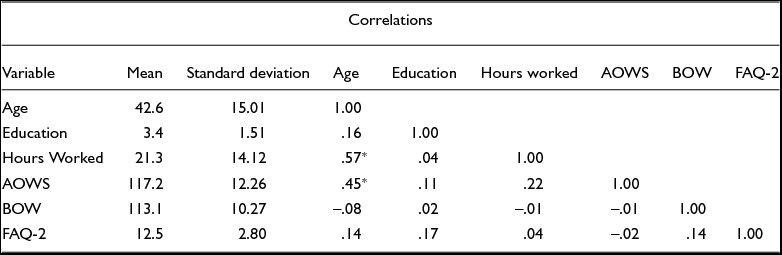
Both attitude measures showed more favourable attitudes toward older workers by those respondents who were working from those who were unemployed. Only the difference in AOWS scores was significant (M = 123.7 vs. 116.2; t = 6.32, 151 df, p = .016, 95% confidence interval [CI] = 1.22 to 11.82) and not that for the BOW (114.5 vs. 112.8, t = 0.75, 151 df, p = .47; 95% CI = −2.81 to 6.23). Table 1 reports descriptive statistics and correlations among the various measures.
Descriptive Statistics and Intercorrelations of Measures
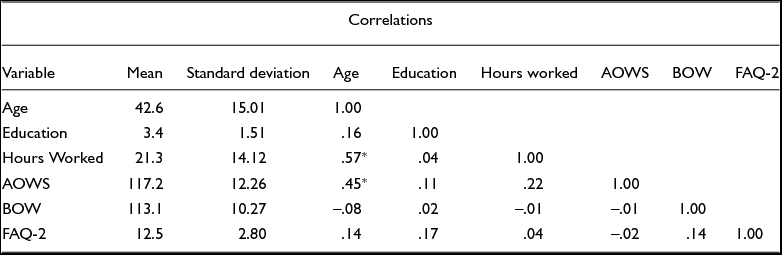
Note: AOWS = Attitudes toward Older Workers; BOW = Beliefs about Older Workers; FAQ-2 = Facts on Ageing Quiz — Multiple Choice; *p < .05.
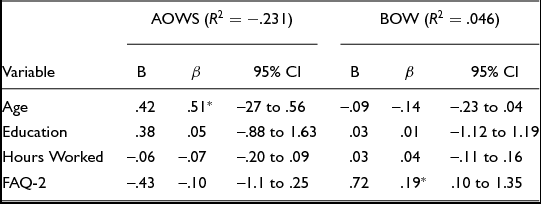
Table 2 reports the outcome of the two regression analyses, with the values of R 2, unstandardised and standardised regression beta weights, and 95% confidence intervals for the standardised coefficients for the analyses. The regression equation was significant for the AOWS (F = 10.4, 4, 138 df, p < .001) with age as a statistically significant predictor. In contrast, the regression equation for the BOW scale was not significant (F = 1.62, 4, 138 df, p = .16).
Results of Regression Analyses to Predict Attitudes Toward Older Workers
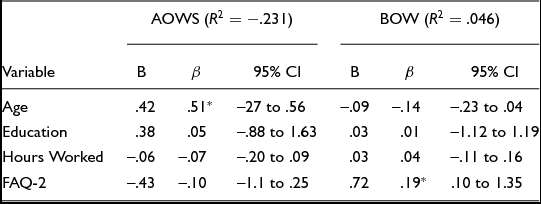
Note: AOWS = Attitudes toward Older Workers; BOW = Beliefs about Older Workers; FAQ-2 = Facts on Ageing Quiz — Multiple Choice; CI = confidence interval; *p < .05.
Discussion
The results were broadly as predicted for the first hypothesis. The comparison of those who were working with those who were unemployed showed more positive attitudes towards older workers on both attitude scales. However, only the AOWS scale showed a significant difference. The correlations among the various measures were generally low and nonsignificant, and the regression equations showed few significant associations of the attitude scales. Indeed, the regression equation for the BOW scale was not statistically significant, and while the regression for the AOWS was significant, only age was a significant predictor. Our findings thus did not support either our second or third hypotheses. It may be that contact with older workers may shift attitudes due to personal relationships with older workers, but the three factors other than age failed to be associated with the attitude measures.
While many researchers claim that negative attitudes towards workers are the norm (Hess, Reference Hedge, Borman and Lammlein2006; Walker Reference Walker1999), others have noted that wide-ranging statements of attitudes generalised simply as positive or negative conceal the true complexity (Hummert, Mazloff, & Henry, Reference Hummert, Mazloff and Henry1999; Kite & Wagner, Reference Kite, Wagner and Nelson2002). One aspect that can improve assessment is the careful development of the AOWS in terms of promoting the reliability of the AOWS (Gringart et al., Reference Gringart, Helmes and Speelman2013). This was not done in the case of the BOW scale, which might account for both its lower internal consistency reliability and absence of significant effects in the study.
The average age of the present sample was in the early 40s, notably older than the typical university undergraduate sample, and which reflects the broad range of participants who were recruited for the study. It is thus not surprising that age correlates with both dependent measures, although only the association with the AOWS was significant. This finding is consistent with the common finding of increasing age having a positive impact upon attitudes towards ageing (Guo et al., Reference Guo, Erber and Szuchman1999).
The role of knowledge of ageing and attitudes towards ageing remains an issue (Hinrichsen, Reference Hinrichsen, Lichtenberg and Mast2015). The correlations of the FAQ-2 with the attitude scales were low and not statistically significant, and did not account for a significant amount of the regression of knowledge of ageing with either attitude scale, contrary to the initial prediction. Abrams, Vauclair, and Swift (Reference Abrams, Vauclair and Swift2011) document the social factors such as changing family structures that affect attitudes across European countries. Nevertheless, the importance of stereotypes of older adults should not be underestimated (Lamont, Swift, & Abrams, Reference Lamont, Swift and Abrams2015)
The amount of time worked during the week was correlated with the AOWS score but not with the BOW score. Hours worked proved not to be a significant predictor of either attitude measure, with age likely taking the bulk of the reliable predictable variance. Older individuals are more likely to be working full time than younger ones. This may also be a function of the present sample, in which approximately half the sample was working full time, with part-time or casual work each accounting for less than a quarter of the employed respondents. This area should be one addressed by future research.
The present sample was a mix of university undergraduates, many of whom were working as well as studying, and employed adults. As such, while it may generalise to a larger group, some effects are blurred by the mix of demographic factors. At the same time, a larger sample that includes middle-aged people has benefits as well. Other weaknesses included the use of the Hassell and Perrewe (Reference Hassell and Perrewe1995) scale, which proved to be comparatively insensitive. A strength was that the form of the knowledge measure, the FAQ-2, was a form that had been adapted to Australian use (Pachana et al., Reference Pachana, Helmes and Gudgeon2013). The FAQ-2 remains a very heterogeneous measure, and it is possible that a more internally consistent measure would have given different results.
In conclusion, this study suggests that attitude scales do differ in their sensitivity to attitudes towards ageing workers, and that robust findings are more likely with newer measures, such as the AOWS. Most of the study's other findings supported results of past research, and future research should further explore the role of education and employment experience on the attitudes towards older workers. Managers should be aware of the age structure of their workforce and of the attitudes of both the worker and management towards older workers.
Acknowledgments
I thank L. Batts, T. Bosworth, K. Essimount, L. Maley, and A. Whybird for their efforts in collecting data. The manuscript was prepared while the author was Visiting Chair in Gerontology, St. Thomas University, Fredericton, NB, Canada.