For many students of global governance who explore the myriad institutions, rules, norms, and coordinating arrangements that transcend individual states and societies, what really marks the contemporary era is not the absence of such governance but its “astonishing diversity.”Footnote 1 In addition to “long-standing universal-membership bodies,” such as the United Nations, writes Stewart Patrick, “there are various regional institutions, multilateral alliances and security groups, standing consultative mechanisms, self-selecting clubs, ad hoc coalitions, issue-specific arrangements, transnational professional networks, technical standard-setting bodies, global action networks, and more.”Footnote 2 The proliferation and diversification of governance mechanisms—yielding a jumble of formal and informal arrangements—has supplanted the simpler image of state representatives gathering at official assemblies. Many scholars believe this pluralism opens important new avenues for tackling a growing array of complex transnational problems, particularly at a time when the responsiveness of traditional multilateral institutions is being called into question.
Global governance has indeed become more diversified in recent decades, and informal arrangements do sometimes provide opportunities for action when traditional multilateral bodies are stymied. But there is something important missing from this picture. The fundamental challenge of global governance today is not a shortage of cooperative mechanisms but the rapid shift in power away from the United States and the West toward emerging countries in the erstwhile periphery of the international system—countries that do not necessarily share Western assumptions about the purposes and methods of global governance. No amount of institutional proliferation or innovation can ultimately substitute for a lack of consensus among incumbent or rising powers on the fundamental “rules of the game” in world affairs, including basic norms of political legitimacy, war and peace, and commerce. These are the foundations upon which any workable global governance system must be built.
It was easier to disregard these foundations when they seemed more secure. The global governance literature emerged in a particular historical context—the immediate post–cold war period—when America's predominance was largely unchallenged, and when the willingness of the United States to continue underwriting the institutional arrangements of international security and commerce was widely taken for granted. Early contributors to this literature focused on emerging forms of governance beyond the nation-state, or “governance without government.”Footnote 3 The overriding image emerging from this scholarship was that of a world inhabited by “countless actors of many different types” that combined in diverse arrangements to address transnational problems, regulate international activity, and provide public goods.Footnote 4 Global governance, according to this view, was “less state-centric and more the sum of crazy-quilt patterns among unalike, dispersed, overlapping, and contradictory” political actors.Footnote 5 Material power—and state power, in particular—seemed to fade into the background.Footnote 6
Today, the conditions that defined the post–cold war period are fading into the past, yet the global governance literature continues to reflect the circumstances of its birth: too often, it takes the foundations of global governance for granted.Footnote 7 In this essay I argue that the study of global governance needs to bring material power—and power politics—back into focus. Otherwise, it will have little to say about the most important governance challenge of our time: how to adapt and strengthen the rules-based international order, and thus preserve cooperation, in the midst of a historic global power transition.
The remainder of this essay is divided into three parts. First, I make the case that the study of global governance has enhanced our understanding of world affairs by drawing attention to the pluralization of global governance actors and mechanisms, a trend that is likely to continue in the coming years. Second, I contend that the literature has nevertheless tended to neglect the material foundations of global governance, as well as the imperative of consensus among the world's most powerful states on core norms as a basis for global stability and cooperation. Third, I argue that remedying this shortcoming does not mean abandoning research on informal and innovative forms of cooperation or regulation. On the contrary, it is a combination of both perspectives—the enduring importance of major-power consensus, and the growing pluralization of governance arrangements—that offers the strongest basis for analyzing today's most pressing global governance challenges.
The Rise of Plurilateralism
With the end of the cold war, the collapse of the Soviet Union, and the decline of great-power rivalry, many policymakers and scholars turned their attention to other aspects of international affairs, including the globalization of capital, production, information, ideas, crime, pathogens, and environmental damage.Footnote 8 The intensification of linkages across states and societies also highlighted the need for improved methods of managing problems that transcended state borders, which in turn fueled the growth of the academic literature examining new forms of global cooperation and regulation. The study of global governance, which gained prominence during this time, reflected these preoccupations.Footnote 9
Philip Cerny was one of the scholars writing on this subject in the early 1990s, and his work encapsulated many of the themes of this emerging scholarship.Footnote 10 He described the rise of a variegated patchwork of governance arrangements, which, he believed, would ultimately coexist with, cut across, and rival the post–World War II architecture of formal multilateral organizations. Cerny called this complex system “plurilateralism” to reflect its diversity and fluidity. Although he acknowledged that a plurilateral world would “not be an easy world to live in, much less to manage,” he was optimistic about its potential to produce a stable, resilient, and adaptable international system—partly because he expected it to be more flexible and responsive than traditional multilateralism, and partly because shifting coalitions of “individuals, groups, states, firms, and other agents” working on different issues would create new, overlapping ties of interdependence. Stability, he posited, would not necessarily depend on a broad agreement about “the rules of the game,” or a consensus on the fundamental norms of international affairs, but instead could arise from “the very cross-cutting nature” of these new forms of cooperation. Put differently, the apparent disorder of plurilateralism might, paradoxically, produce order.
Interest in plurilateral global governance was not limited to the academy. The concept gained traction in policy discussions, too, including in the 1995 report of the Commission on Global Governance, a blue-ribbon panel created after the cold war to map out an agenda for international cooperation.Footnote 11 Previously, the report explained, governance had been “viewed primarily as intergovernmental relationships,” but now “a multitude of new actors . . . are increasingly active in advancing various political, economic, social, cultural, and environmental objectives that have considerable global impact.” As a result, global governance had become “a broad, dynamic, complex process of interactive decision-making that is constantly evolving and responding to changing circumstances.” Like Cerny, the report's authors highlighted the diversity of actors and mechanisms involved in global governance and the fluidity and adaptability of the resulting system, as well as its problem-solving orientation. They set out what some observers have called a “post-internationalist” orientation, focusing on governance arrangements and actors other than states and traditional intergovernmental organizations.Footnote 12
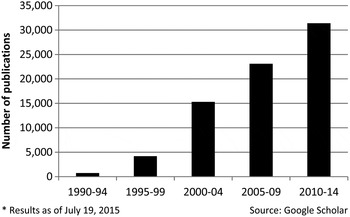
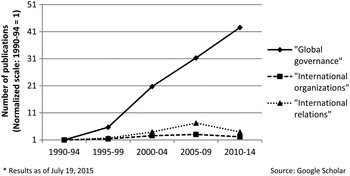
In the ensuing two decades the study of global governance burgeoned, as figure 1 indicates. A total of 738 academic publications referred to “global governance” between 1990 and 1994, but by 2000–2014 that number had jumped to 31,400. Figure 2 places this growth in perspective, by scaling these numbers and comparing them to two other key terms: “international organizations” and “international relations.” While scholarly references to “global governance” increased more than forty-two-fold from the early 1990s to the early 2010s, mentions of “international organizations” and “international relations” grew by factors of only 2.2 and 4.0, respectively. These figures may help to explain why by 2005 scholars were already observing that global governance had attained “near-celebrity status” in the political science discipline.Footnote 13 But this was just a start. We now know that academic interest in the subject would continue to grow rapidly for another decade, both in absolute terms and relative to other key concepts. By all appearances, it is growing still.
Number of Academic Publications Referring to “Global Governance”

Number of Academic Publications Referring to “Global Governance” vs. Other Terms (Normalized)

One of the drivers of this increased attention was almost certainly the propagation of new governance mechanisms themselves, along with a belief that “the hierarchical old governance model” of formal treaties and universal-membership bodies has only “limited utility in dealing with many of today's most significant global challenges.”Footnote 14 Echoing Cerny's description of plurilateralism, many more recent analyses have traced the growth of nonstate, private, semiprivate, transnational, and subnational entities in global governance, as well as the diversification of regulatory and cooperative arrangements addressing an array of issues.Footnote 15 On climate change, for example, Matthew Hoffmann provides a fascinating description of fifty-eight “innovative initiatives” that have been pursued by “cities, counties, provinces, regions, civil society, and corporations” working outside the formal treaty process, the United Nations Framework Convention on Climate Change (UNFCCC).Footnote 16 Some of these initiatives catalogue greenhouse gas emissions; others set certification standards or supervise emissions trading schemes, or perform other functions. The result, he notes, is “something less familiar, messier, more diffuse and dynamic” than the top-down UNFCCC process, which has been all but paralyzed by interstate disagreements. Hoffmann suggests that this “experimental system” of patchwork governance may be able “to provide the impetus for the global response” to climate change “in a way that multilateral treaty-making simply cannot.” Similar analyses have been performed in other “global policy spaces,” including trade, finance, health, labor, security, migration, and development.Footnote 17
Issue-specific investigations have also spawned more theoretical studies of “regime complexity,” defined as the “presence of nested, partially overlapping, and parallel international regimes that are not hierarchically organized.”Footnote 18 In contrast to prior research on regimes, which tended to view international governance and regulatory systems as relatively centralized and integrated, the newer scholarship emphasizes both the fragmentation of these systems and the absence of top-down direction.Footnote 19 Some observers argue that international organizations play important and constructive roles within these regime complexes, including that of mobilizing and working with private actors and institutions to achieve regulatory goals.Footnote 20 Others, however, point to apparent disadvantages: Julia Morse and Robert Keohane, for example, believe that regime complexity allows multilateral institutions to be used to undermine other institutions and to weaken existing international rules and cooperation—a practice they describe as “contested multilateralism.”Footnote 21
All told, such debates and investigations have shed new light on an important phenomenon: the growth of complex networks of diverse governance mechanisms in world politics, which now overlap with, and sometimes rival, the traditional multilateral structures of the post–World War II era. Plurilateralism has become a reality. Further, these trends are likely to continue, particularly as the digital revolution and other “disruptive” technologies enable more nonstate groups and individuals to become transnational actors in their own right.Footnote 22 By detailing the rise of this plurilateral system, and showing how informal mechanisms can sometimes facilitate cooperation when more formal multilateral organizations are unable or unwilling to act, the global governance literature has made an important contribution to our understanding of international affairs.
But the World Was Changing in Other Ways, Too
During the same period, however, other changes were taking place in the world—changes that have revealed something of a blind spot in the study of global governance. Whereas during the immediate post–cold war years the predominance of the United States was largely unchallenged, by the 2010s few doubted the diffusion of power away from the Western core of the international system and toward emerging countries elsewhere, particularly in Asia. China's economic output, for instance, was just a tenth of the U.S. figure in 1980, but it is reportedly on track to be 20 percent larger by 2020.Footnote 23 Meanwhile, the fatigue and expense of long wars in Iraq and Afghanistan, along with the effects of the 2007–2008 financial crisis and subsequent economic recession, seemed to have diminished the appetite of the U.S. leadership and public for expensive foreign engagements. As U.S. ambitions have contracted, China, Russia, and smaller regional powers in the Persian Gulf and elsewhere have grown more assertive, leading observers to proclaim the “return of geopolitics,” or a period of more aggressive competition among powerful states.Footnote 24 For all these reasons, a quarter century after the end of the cold war many question whether the United States still has the material power, or the political will, to continue underwriting and upholding the institutional foundations of international security and the global economy.
These developments have placed the study of global governance in an awkward position. The rise of plurilateralism has been real and important, but so is the need for consensus among the world's most powerful states on the core norms of international relations. Such a consensus can no longer be taken for granted. Not only is power shifting toward emerging states, thus complicating the task of reaching consensus because it multiplies the number of influential actors who must agree. More fundamentally, there is no guarantee that new powers will subscribe to Western ideas about how, and to what ends, global governance should be organized. Some scholars argue that such rising states as China, India, Turkey, and Brazil already hold different views than that of industrialized Western nations about “the foundations of political legitimacy, the rules of international trade, and the relationship between the state and society.”Footnote 25 Others are more sanguine, arguing that “the overarching trend in the preference of China, India, and Brazil on existing global governance regimes has been one of convergence on the status quo.”Footnote 26 This debate will be resolved in time: we will eventually learn whether emerging powers accept, seek to revise, or attempt to overthrow existing governance arrangements. At present, however, greater ideological pluralization and increased geopolitical competition seem all but inevitable, which in turn raises questions about the future of global governance.
These questions are of particular concern to policy practitioners, who face the daunting but vital task of adapting the rules-based international order and maintaining cooperation in the midst of a global power transition. But these developments also pose an analytical challenge to students of global governance. As noted above, no amount of institutional proliferation or innovation in global governance can ultimately substitute for the absence of a consensus among the world's most powerful states on the rules of the game in international affairs. Yet much of the global governance literature continues to reflect the preoccupations of the immediate post–cold war era, when managing the effects of globalization—rather than ensuring the foundations of world order—was top-of-mind. Although contributors to this literature have regularly acknowledged the continued importance of states and of material power in world affairs, many have in practice relegated power—and state power, in particular—to the background, focusing instead on post-internationalist forms of global cooperation and regulation. Indeed, the literature as a whole has tended to define itself in contradistinction to traditional conceptions of interstate diplomacy and multilateral organizations. At a time when the material and ideological foundations of world order seem to be shifting, studies of global governance that have little to say about power and geopolitics are at risk of missing the forest for the trees—or worse, of being rendered obsolete.
Back to Basics
For all these reasons, the study of global governance needs to rediscover power. I say “rediscover” because many international relations scholars have explored the relationship between power politics and institutionalized cooperation in depth, and their work might provide some guidance for students of global governance today. One notable example is Robert Gilpin, whose eclectic brand of realist analysis came quickly to be overshadowed by Kenneth Waltz's “neorealism,” which has dominated the discipline for decades.Footnote 27 In contrast to Waltz's static and unremittingly materialist view of world politics, Gilpin examined the dynamics of change and the interconnections among material power, norms, and institutions. He conceived of the international system as a set of “social arrangements,” which include “rights and rules that govern or at least influence the interactions among states.” These arrangements, he argued, “tend to reflect the relative powers of the actors involved,” but they are not simply reducible to the distribution of material power. Ideas and institutions, in other words, have an independent causal role in world affairs, serving as a “form of control” that “regulates behavior and may range from informal rules of the system to formal institutions.” They are not mere artifacts of power politics.
However, Gilpin maintained that these social arrangements cannot be dissociated from material power. Global governance structures may, for example, persist after the disappearance of the power conditions that gave rise to them, but not indefinitely. At some point, a “disjuncture” emerges between these structures “and the capacity of the dominant state, or states, to maintain the system.” If rising powers—those gaining the capacity to maintain, or to topple, the system—view the current governance arrangements as reflecting their own interests, needs, and values, they may opt to replace the declining powers as guarantors of these arrangements. According to Gilpin, such states have historically sought to change existing governance structures, either through incremental adjustment or, more often, by undermining or overthrowing them.
Contemporary scholars and policy experts, including many in the United States, are aware of this risk. Charles Kupchan, for instance, an academic who has held staff positions at the National Security Council, warns that if the West and the “rising rest” fail to “forge a consensus on the ordering rules that define legitimacy and govern matters of commerce, war, and peace,” we may be entering a period of “considerable potential for geopolitical peril.”Footnote 28 John Ikenberry similarly argues that the United States “will need to renegotiate its relationship with the rest of the world, and this will inevitably mean giving up some of the rights and privileges that it has had in the earlier hegemonic era.”Footnote 29 Stephen Brooks and William Wolhforth, for their part, contend that the decline in American power should not be overestimated, but also note that the existing architecture of international institutions is “a relic of the preoccupations and power relationships of the middle of the last century,” and maintain that there are good reasons for the United States “to spearhead the foundation of a new institutional order.”Footnote 30 Former U.S. National Security Advisor Zbigniew Brzezinski asserts that any new institutional order must be based on a new understanding between the United States and China.Footnote 31 Such a compact, he argues, is a necessary condition for the development of new global governance arrangements, because if the U.S.-China relationship “is not stable and is not guided by a genuine recognition by both sides of our respective interests in working together, then no multilateral institution created in that context is going to work.”
The challenge for students of global governance is to blend such insights with the concurrent reality of institutional proliferation and diversification in global governance. Returning to the example of climate change provides a small but telling illustration of why this is important. In spite of the plethora of governance instruments and experiments aimed at reducing emissions, the net results have been less than satisfactory. The authoritative Intergovernmental Panel on Climate Change has reported that global emissions of greenhouse gases grew more quickly between 2000 and 2010 than in each of the three previous decades—arguably the clearest measure of governance effectiveness on this issue.Footnote 32 If anything, the most hopeful recent development in this field was not the appearance of a variety of new governance mechanisms, but rather the November 2014 agreement between the United States and China that set “new targets for carbon emissions reductions by the United States and a first-ever commitment by China to stop its emissions from growing by 2030.”Footnote 33 Perhaps this agreement, or another like it, will serve as a basis for a renegotiated approach to climate change that could be broadened to include more countries and eventually institutionalized in new governance structures. Indeed, beyond the issue of climate change, achieving a new modus vivendi between these two countries—the preeminent incumbent and rising powers, respectively—on critical and contentious matters of international economics, security, and environmental sustainability may be the single most important requirement to adapt the system of global governance to new power realities. Brzezinski probably gets this right.Footnote 34
At the same time, the sheer complexity of today's transnational problems may defy the capacity of even the strongest states, acting in concert, to manage. This is why research on the growing role of nonstate actors in global governance and the emergence of informal cooperative and regulatory mechanisms will remain relevant and important. Too often, however, these two perspectives—one emphasizing the enduring importance of major-power consensus as a basis for world order, the other highlighting the remarkable proliferation of global governance actors and arrangements—have been treated as rival approaches to the study of international affairs. In fact, each is incomplete without the other. A synthesis of both perspectives would offer the strongest basis for analyzing the most pressing problems of order and governance facing the world today.
Taking the study of global governance “back to basics,” in other words, does not mean returning to the past. Power is diffusing not only toward the emerging economies but also toward transnational and nonstate actors. Realists who fail to acknowledge this trend, or who paint a picture of international relations that depicts little more than interstate politics, will almost certainly face greater difficulty explaining world affairs. Similarly, as the number and variety of participants in global politics multiplies, the most strategically minded international actors, be they governmental or nongovernmental, will be those that comprehend that getting things done on a more crowded world stage requires mobilizing diverse coalitions of like-minded actors. The global governance literature, with its insights into the pluralization of cooperative mechanisms, is already well-positioned to understand and to explain this tactic.
Yet, for all this transformation, states remain the most influential actors in world affairs, and material power continues to be the primary source of influence. It is one thing to acknowledge these facts in words, but another to build them into analyses of international relations. The study of global governance should start from the recognition that complex new patterns of cooperation ultimately depend on whether or not the foundations of global cooperation are maintained. Those foundations, as Gilpin observed, are made up of mutual understandings among the world's most powerful actors. What is most needed today, therefore, is more research and analysis not only about the actual or potential renegotiation of these foundations but also, and more specifically, about the ways in which the proliferation and diversification of global governance actors and mechanisms might advance this most fundamental goal. In this sense, going “back to basics” is about moving the field forward.
Conclusion
In their essay for this forum, Thomas G. Weiss and Rorden Wilkinson call on global governance scholars to consider “bigger questions that deal with where we have come from and where we are going.” I agree. Navigating the current period of global power transition is a generational challenge that will require enlightened political leadership informed by an understanding of how power, norms, and institutions can interact to produce systemic stability. The contributions of global governance scholars will be essential, but answering such “bigger questions” will require a broader view of governance, one that blends the literature's new insights about the rise of plurilateralism with older truths about the foundational importance of consensus among the world's most powerful states on “the rules of the game.”