Introduction
Temperature is a key environmental factor that significantly affects the ecology of poikilothermic organisms, especially insects, which are highly sensitive to temperature fluctuations (Skendžić et al. Reference Skendžić, Zovko, Živković, Lešić and Lemić2021). Insects are adapted to thrive in specific habitats, making their optimal performance dependent on a relatively narrow range of abiotic conditions. Under these optimal conditions, insects complete their development efficiently, they reproduce at the highest rates, and they achieve the maximum survival over time (Deal Reference Deal1941; Davidson Reference Davidson1944). However, when exposed to temperatures outside their optimal range, insects must either endure or escape stress, which can negatively impact their performance and overall fitness, thereby increasing the likelihood of mortality (Johns et al. Reference Johns, Boone, Leggo, Smith, Carleton and Quiring2012). Studies have shown that suboptimal temperature stress induces a range of physiological and biochemical changes in insects, which can detrimentally affect their reproduction, morphology, and biochemistry (González-Tokman et al. Reference González-Tokman, Córdoba-Aguilar, Dáttilo, Lira-Noriega, Sánchez-Guillén and Villalobos2020). Exposure to cold stress, for example, can impair reproduction, development, morphology, survival, and other life processes (Sarmad et al. Reference Sarmad, Ishfaq, Arif and Zaka2020). Similarly, heat stress can disrupt foraging behaviour, digestion and nutrient absorption, reproductive abilities, growth, development, and geographical distribution.
Although suboptimal temperature stress is often detrimental to insect physiology, some studies suggest that exposure to such stress can unexpectedly enhance an insect’s tolerance to heat (Terblanche et al. Reference Terblanche, Hoffmann, Mitchell, Rako, le Roux and Chown2011) and increase its resistance to cold (Kelty and Lee Reference Kelty and Lee1999; Worland and Convey Reference Worland and Convey2001). For instance, although repeated short-duration suboptimal temperature stress has been linked to reduced fecundity and longevity in Parthenium beetles, Zygogramma bicolorata Pallister (Coleoptera: Chrysomelidae), such temperature stress has also been shown to enhance daily oviposition in females, with peak oviposition occurring early in their adult life, as well as increasing egg viability (Patel et al. Reference Patel, Yadav and Kumar2024). Short-duration thermal stress has also been found to stimulate protective enzyme activity in Parthenium beetles, aiding their adaptation to suboptimal temperatures (Yadav et al. Reference Yadav, Patel, Singh, Verma, Chowdhury and Kumar2024a). Such findings highlight the significant impact that cold and heat stress can have on an insect’s well-being (Denlinger and Yocum Reference Denlinger, Yocum, Hallman and Denlinger1999; Zhu et al. Reference Zhu, Wang and Ma2019), with the effects varying depending on factors such as the exposure duration, the species, and the insect’s developmental stage (Hoffmann et al. Reference Hoffmann, Sørensen and Loeschcke2003; Marshall and Sinclair Reference Marshall and Sinclair2012).
Exposure to suboptimal temperatures can also result in oxidative damage and increased levels of reactive oxygen species in insects (Cui et al. Reference Cui, Du, Lu and Qiang2011; Farahani et al. Reference Farahani, Bandani, Alizadeh, Goldansaz and Whyard2020). Factors such as protein denaturation, toxic product accumulation, DNA damage, membrane dysfunction, nutrient deprivation, and desiccation further contribute to the increased reactive oxygen species levels (Chown and Nicolson Reference Chown and Nicolson2004; King and MacRae Reference King and MacRae2015). Over evolutionary time, most insect species are believed to have developed various survival mechanisms at the behavioural, physiological, and genetic levels to cope with suboptimal temperature stress (Colinet et al. Reference Colinet, Sinclair, Vernon and Renault2015). Short-duration heat stress, for example, is thought to trigger alterations in protein synthesis (Zeng et al. Reference Zeng, Zhu, Fu and Zhou2019), leading to increased lipid peroxidation levels with increased antioxidant enzyme activity in insects (Zhu et al. Reference Zhu, Xue, Luo, Ji, Liu, Zhao and Sun2017). The primary antioxidant enzymes involved include superoxide dismutase, catalase, and glutathione-S-transferases (Felton and Summers Reference Felton and Summers1995). In response to heat stress, insects also exhibit an enhanced synthesis of heat shock proteins (Kang et al. Reference Kang, Chen, Wei and Liu2009). During cold stress, in addition to heat-shock proteins and antioxidants, insects produce specific chemicals, such as antifreeze proteins and polyol cryoprotectants, to survive (Clark and Worland Reference Clark and Worland2008).
In their natural environments, insects experience daily temperature fluctuations associated with thermal stochasticity (Helmuth et al. Reference Helmuth, Broitman, Yamane, Gilman, Mach, Mislan and Denny2010) and must therefore be pre-adapted to frequent and unpredictable temperature changes (Colinet et al. Reference Colinet, Rinehart, Yocum and Greenlee2018). In the present study, we examined the effects of a fluctuating thermal regime (i.e., optimal temperature intermittently disrupted by repeated short-duration heat or repeated short-duration cold; Colinet et al. Reference Colinet, Rinehart, Yocum and Greenlee2018) on the activity of antioxidant enzymes (catalase and superoxide dismutase), on lipid peroxidation, and on the assimilation of glucose and triglycerides in the Parthenium beetle, Z. bicolorata. Based on previous research, we hypothesised that a daily exposure to a fluctuating thermal regime would increase antioxidant enzyme activity and nutrient assimilation in beetles (see Lalouette et al. Reference Lalouette, Williams, Hervant, Sinclair and Renault2011; Ismail et al. Reference Ismail, Van Baaren, Hance, Pierre and Vernon2013; Torson et al. Reference Torson, Yocum and Bowsher2024; Yadav et al. Reference Yadav, Patel, Singh, Verma, Chowdhury and Kumar2024a). We also predicted that once thermal stress is removed, the beetles would exhibit reduced antioxidant enzyme activity and lower nutrient assimilation compared to the levels they exhibited during thermal stress exposure. We anticipate that our findings will provide insight into insects’ short- and long-term adaptive responses under fluctuating thermal regimes and help us understand how insects might survive in a changing global climate.
Materials and methods
Insect species
In our study, we used Z. bicolorata as the experimental model. This beetle is a highly effective biocontrol agent for Parthenium hysterophorus Linnaeus (Asteraceae), an invasive herbaceous weed with a pantropical distribution. The weed negatively impacts grazing land productivity and native biodiversity and can cause naso-branchial allergies in humans. The beetle was first introduced to Australia from Mexico in 1980 (McFadyen and McClay Reference McFadyen and McClay1981), although efforts to control the weed in India using this beetle began in 1983 (Jayanth and Nagarkatti Reference Jayanth and Nagarkatti1987). Feeding by Z. bicolorata has been shown to negatively affect the weed under field conditions (Dhileepan et al. Reference Dhileepan, Setter and McFadyen2000), which has sparked considerable interest in using this beetle for biological control of the weed (Patel et al. Reference Patel, Bhusal, Kumar and Kumar2020).
Insect rearing
Adult males and females (n = 50; ♀ = 22; ♂ = 28) of Z. bicolorata were collected from agricultural fields of Banaras Hindu University and other nearby areas of Varanasi, India (25° 20′ N, 83° 0′ E) during October and November 2022. The adults were paired and reared for a generation in plastic Petri dishes (dimensions: 9.0 × 1.5 cm2) under constant optimal conditions (27 ± 2 °C; 65 ± 5% humidity; 14:10–hour white-light:dark photoperiod) in biological oxygen demand incubators (NSW-152; Narang Scientific Works Pvt. Ltd., Delhi, India). The insects were provided with a daily replenished supply of fresh P. hysterophorus twigs (containing fresh young leaves with two to three branches; biomass 750 mg) collected from the agricultural fields. Wild beetles from the fields were frequently added to the established stock to prevent inbreeding. The eggs laid were collected every 24 hours, kept in biological oxygen demand incubators (n = 3000 eggs) and were observed for hatching, and the requisite stages obtained were used for further experiments during March–April 2023.
Fluctuating thermal regimes: heat and cold treatments, followed by recovery phases
To induce heat or cold stress in Z. bicolorata adults, it is important to expose them to a range of temperatures that allows their survival while also causing a certain level of stress. When working with brief exposures to extreme temperatures, it is important to consider the variability in the insect’s response and to adjust the temperature accordingly (see Goller and Esch Reference Goller and Esch1990). In Indian agroecosystems, a temperature range of 25–30 °C is considered optimal for Z. bicolorata (Bhusal et al. Reference Bhusal, Ghimire, Patel, Bista, Upadhyay and Kumar2020). We therefore selected 27 ± 2 °C as the optimal temperature for our experiments. Larvae of Z. bicolorata fail to complete their development at temperatures below 15 °C (Patel et al. Reference Patel, Bhusal, Kumar and Kumar2020), whereas temperatures above 40 °C result in frequent mortality in both larvae and adults (Chidawanyika et al. Reference Chidawanyika, Nyamukondiwa, Strathie and Fischer2017; Patel et al. Reference Patel, Bhusal, Kumar and Kumar2020). Based on this, we chose 10 ± 2 °C as the cold stress temperature and 42 ± 2 °C as the heat stress temperature for the present study (see Patel et al. Reference Patel, Yadav and Kumar2024). A temperature variation of ± 2 °C was necessary to ensure optimal humidity levels (65 ± 5%) under both heat and cold stress conditions.
We divided the newly emerged Z. bicolorata adults (n = 2300; ♀ = 1150; ♂ = 1150) reared at 27 ± 2 °C (control/optimal temperature) into three groups. During every 24 hours, each adult of group A (n = 1000; ♀ = 500; ♂ = 500) was kept at 42 ± 2 °C (heat stress) and each adult of group B (n = 1000; ♀ = 500; ♂ = 500) was kept at 10 ± 2 °C (cold stress) in biological oxygen demand incubators for 1 hour. Thereafter, for the next 23 hours, each adult in both groups were kept at the optimal temperature of 27 ± 2 °C and were provided with fresh P. hysterophorus twigs, replenished daily. Humidity and photoperiod were kept at the optimal 65 ± 5% and 14:10–hour white-light:dark levels, respectively, throughout the experiments. The process was repeated daily for successive 10 days. However, from the eleventh day until the twentieth day, the adults were reared individually under the control/optimal abiotic conditions (temperature: 27 ± 2 °C; humidity: 65 ± 5%; photoperiod: 14:10–hours light:dark) to allow recovery from the thermal stress. Each adult in the control group (group C; n = 300; ♀ = 150, ♂ = 150) was kept individually under optimal conditions of 27 ± 2 °C, 65 ± 5% humidity, and 14:10–hour light:dark photoperiod for 20 consecutive days without exposure to any thermal stress. Total mortality (%) in each of the three groups was quantified (Fig. 1).
Study design to assess the effects of fluctuating thermal regimes on antioxidant enzyme activities and nutrient assimilation by Zygogramma bicolorata.

Biochemical and enzyme activity assays
On day 11 and day 21, 10 males and 10 females from each of the two treatment groups and the control group were taken out and used for the biochemical and enzyme activity assays. To estimate glucose concentrations and each of superoxide dismutase, catalase, and lipid peroxidation activity, the males and females (fresh and anaesthetised) were homogenised individually using a homogeniser in 0.1 M phosphate buffer saline, pH 7.0. To estimate triglycerides levels, the samples were prepared in phosphate buffer saline + 0.05% Tween 20 (PBST). The crude homogenates were centrifuged at 10 000 g for 10 minutes to estimate glucose and the superoxide dismutase and catalase activities, at 3000 g for the lipid peroxidation assay, and at 7000 g for the triglycerides estimates at 4 °C for each assay and estimate. Soon after centrifugation, the supernatant for triglyceride estimation was placed in a water bath for 10 minutes at 70 °C and thereafter was kept in a deep freezer at –4 °C for subsequent analyses.
The concentrations of glucose and triglycerides and the activity of each of catalase and superoxide dismutase, and the lipid peroxidation products (i.e., thiobarbituric acid reactive substances) were determined by spectrophotometry. All spectrophotometric analyses were conducted in a UV-visible spectrophotometer (UV–VIS Spectrophotometer 119; Systronics India Ltd., Ahmedabad, India) or by using a microplate spectrophotometer (ELX 800, Biotek Instruments Inc., Winooski, Vermont, United States of America). Each experiment was conducted on 10 males and 10 females per treatment group or control, and the readings were taken in triplicates.
Estimation of triglycerides
Triglycerides were estimated using a liquizyme triglyceride reagent kit (LS027H; Beacon, Mumbai, India), which contained the triglyceride reagents and the standards. From each sample, 2 µL of supernatant, standard, and PBST (as a blank) were transferred to a flat-bottomed, 96-welled microplate (941 196; Tarsons, Calcutta, India) by micropipette (Transferpette® S 0.5–10 μL; Brand GMBH and Co., Wertheim, Germany). Two hundred microlitres of triacylglycerol enzyme reagent were added to each well containing the sample, standard solution, or PBST. The microplate was sealed immediately with paraffin tape to prevent contamination and was then incubated at 37 °C for 10 minutes. Using a microplate reader, absorbance was measured at 490 nm. The concentration of triglycerides was determined using the following formula:
 $$\rm Concentration\ of\ triglycerides\ (mg/dL) = {{{{\rm{Absorbance\;of\;sample}}}} \over {{{\rm{Absorbance\;of\;standard}}}}} \times 200$$
Estimation of glucose
Glucose was estimated using an Autospan glucose kit (93DP100–74; Arkray, Mumbai, India), which contains the reagents and the standards. For glucose quantification, from each sample, 2 µL of the supernatant, the standard, and phosphate buffer saline (as a blank) were transferred to a flat-bottomed, 96-well microplate (941 196; Tarsons) by micropipette (Transferpette S 0.5–10 μL; Brand GMBH and Co.). Two hundred microlitres of glucose reagent were added to each of the wells containing the sample, standard solution, or phosphate buffer saline. The microplate was sealed with paraffin tape and was then incubated at 25 °C for 10 minutes. A microplate reader set at 490 nm was used to record the absorbance. The following formula was used to calculate the glucose content:
 $$\rm Concentration\ of\ glucose\ (mg/dL) ={{{{\rm{Absorbance\;of\;sample}}}} \over {{{\rm{Absorbance\;of\;standard}}}}} \times 100$$
Determination of enzymatic antioxidants
Catalase was estimated using Aebi’s (Reference Aebi1984) protocol. The fresh and anaesthetised males and females were homogenised separately (one individual at a time) in 1.5-mL centrifuge tubes in ice-cold phosphate buffer saline (pH 7.0; Sisco Research Laboratories Pvt. Ltd., Mumbai, India) at 10% (w/v) ratio using a tissue homogeniser (Precision Scientific, Varanasi, India) for 30 seconds at 4 ºC. Homogenates were centrifuged at 10 000 g for 10 minutes at 4 ºC in a centrifuge (NEYA 16R refrigerated centrifuge, high speed, 4 × 175 mL, 16 000 rpm; Remi Lab World, Mumbai, India). The supernatants containing the enzyme extracts were collected in new centrifuge tubes and used for enzymatic assay. Ten microlitres of the enzyme extract diluted with phosphate buffer saline (690 µL) were added to a centrifuge tube containing 300 µL of 30 mM H2O2 (Avantor Performance Materials, Gurugram, India), and the tube was placed immediately in a UV-visible spectrophotometer (UV–VIS Spectrophotometer 119; Systronics India Ltd.) and kept at 240 nm to record the absorbance with a recorder at 30-second intervals for 3 minutes. The readings were recorded in triplicate, and the average of the three readings was considered as a single value for further statistical analysis.
Calculations of catalase activity were done with the help of the following formula: catalase activity (U/mg) = (A0 – A180) × Vt/Ɛ240 × d × versus × Ct × 0.001; where (A0 – A180) is the difference between the initial and final absorbance; Vt is the total volume of the reaction (1 mL); Ɛ240 is the molar extinction coefficient for H2O2 at OD240 (34.9 mol–1 cm–1); d is the optical path length of the cuvette (1 cm); versus is the volume of the sample (10 µL); Ct is the total protein concentration in the sample; and 0.001 is the absorbance change caused by 1 U of enzyme per minute at 240 nm optical density. The protein concentration was calculated by Bradford’s (Reference Bradford1976) method using bovine serum albumin (Sisco Research Laboratories Pvt. Ltd.) as the standard, and the total protein concentration in each sample was determined by comparing the unknown samples to the prepared standard curve (see section ‘Protein quantification’).
The superoxide dismutase activity assay was done using the protocol provided by Das et al. (Reference Das, Samanta and Chainy2000). To determine the superoxide dismutase activity, the enzyme was extracted as per the protocol described in the catalase assay above. The supernatant collected was used as an enzyme source. In a fresh centrifuge tube, 700 µL of the reaction buffer was prepared using 550 µL phosphate buffer saline, 40 µL (20 mM) L-methionine (Sisco Research Laboratories Pvt. Ltd.), 20 µL (1%) Triton X-100 (Sisco Research Laboratories Pvt. Ltd.), 40 µL (10 mM hydroxylamine-hydrochloride (Sisco Research Laboratories Pvt. Ltd.), and 50 µL (50 mM) ethylenediaminetetraacetic acid (Sisco Research Laboratories Pvt. Ltd.). Within the reaction buffer, 50 µL of the sample was added, whereas in the reference and the blank solutions, 50 µL of phosphate buffer saline was added. The above tubes were transferred to an incubator for pre-incubation at 37 ºC for 5 minutes. Thereafter, 40 µL (50 µM) of riboflavin (Sisco Research Laboratories Pvt. Ltd.) was added to both the sample and the reference solutions, then the reaction mixture tubes containing the samples were exposed to 15-W CFL light (Philips, Delhi, India) for 10 minutes, and subsequently 500 µL of freshly prepared Greiss reagent was added to all of the tubes. The UV-visible spectrophotometer was set up at 543 nm and calibrated with the blank solution, and the absorbance of the sample and reference were recorded.
The superoxide dismutase activity calculation was done using the formula: superoxide dismutase (U/mg) = {(Vo/V) – 1/mg of protein}, where Vo is the absorbance of the reference solution, and V is the absorbance of the sample solution. The enzyme activity was expressed as units of enzyme activity per microgram of protein (U/mg). One unit of superoxide dismutase activity was defined as the amount of enzyme capable of inhibiting 50% of nitrite formation under assay conditions (Das et al. Reference Das, Samanta and Chainy2000). The protein concentration of the enzyme was calculated using Bradford’s (Reference Bradford1976) method, using bovine serum albumin as the standard, and the total protein concentration in each sample was determined by comparing the unknown samples with the prepared standard curve (see the section ‘Protein quantification’). All readings were recorded in triplicate, and the average of three readings was considered as a single value for statistical analysis.
Extraction and estimation of thiobarbituric acid-reactive substances content
The thiobarbituric acid reactive substances assay is a common method used to measure lipid peroxidation, which is an indicator of oxidative stress. The amount of these substances is determined by the method proposed by Ohkawa et al. (Reference Ohkawa, Ohishi and Yagi1979). The assay quantifies the amount of malondialdehyde, a byproduct of lipid peroxidation (Meng et al. Reference Meng, Zhang, Zhu, Wang and Lei2009), present in the sample. The thiobarbituric acid reacts with malondialdehyde, forming a pink-coloured complex.
The fresh and anaesthetised males and females were homogenised individually in phosphate buffer saline (10% w/v), followed by centrifugation at 3000 g for 10 minutes at 4 °C, and the supernatant was collected in a fresh centrifuge tube. Fifty microlitres of the supernatant from each sample was added to 825 µL of thiobarbituric acid reagent (Sigma Aldrich, Germany) prepared using 50 µL (8%) of sodium dodecyl sulfate (Sisco Research Laboratories Pvt. Ltd.), 375 µL (20%) of acetic acid (Merck), 375 µL (0.8%) of an aqueous solution of thiobarbituric acid, and 25 µL (0.8%) of butylated hydroxy toluene (Sisco Research Laboratories Pvt. Ltd.). The reaction mixture containing the sample was incubated at 95 °C in a water bath, which resulted in the appearance of a pinkish colour. After 1 hour, the tubes were taken out, cooled, and centrifuged at 3000 g for 10 minutes to remove debris. The supernatant (800 µL) was collected, and the absorbance was measured at 532 nm in the UV-visible spectrophotometer. The amount of thiobarbituric acid reactive substances present was calculated using the extinction coefficient 1.56 × 10⁵ M–1 cm–1, which is a constant that relates the absorbance of the coloured complex to the concentration of malondialdehyde.
The lipid peroxidation activity was expressed as nanomoles of thiobarbituric acid reactive substances produced per milligram of protein. The protein concentration of the enzyme was calculated by Bradford’s (Reference Bradford1976) method, using bovine serum albumin as the standard; the total protein concentration in each sample was determined by comparing the unknown samples with the prepared standard curve (see section ‘Protein quantification’).
Protein quantification
Protein quantification in Z. bicolorata was performed using the Bradford (Reference Bradford1976) protein assay method. The Bradford reagent, made with Coomassie Brilliant Blue G-250 (Sisco Research Laboratories Pvt. Ltd.) and orthophosphoric acid (Merck, Rahway, New Jersey, United States of America), was used. The protein standard was prepared by serially diluting 1 mg/mL bovine serum albumin (Sisco Research Laboratories Pvt. Ltd.). One microlitre of diluted standard then was mixed with 200 µL of the Bradford reagent, transferred to a flat-bottomed, 96-well microplate (Tarsons), and incubated for 10 minutes at 25 °C. The sample was then covered with aluminum foil to prevent evaporation. Absorbance at 595 nm was measured using a microplate reader (ELX 800; Biotek Instruments Inc.). The standard curve was plotted (R 2 = 0.9818) using absorbance and concentration.
The biological samples of adult males and females (fresh and anaesthetised) from each treatment group were taken separately. Thereafter, they were homogenised in 10% (w/v) ratio individually at 4 °C, then centrifuged at 10 000 g for 10 minutes. The resulting supernatant was collected and stored at –20 °C. Following this, 1 µL of each respective supernatant was mixed with 9 µL of distilled water and transferred to a flat-bottomed, 96-well microplate (Tarsons). We used 10 µL of triple-distilled water as a blank. Thereafter, 200 µL of Bradford reagent was added to each sample- or blank-containing well. The samples then were each covered with aluminum foil to prevent evaporation and were incubated for 10 minutes at 25 °C. Each sample reading was taken in triplicate. The total absorbance at 595 nm was measured using a microplate reader (ELX 800; Biotek Instruments Inc.). The standard curves prepared earlier were used for the determination of protein concentration in the unknown samples.
Statistical analysis
We evaluated the experimental data for homogeneity of group variances using Levene’s test and assessed normality with the Kolmogorov–Smirnov test. To analyse data on glucose and triglyceride assimilation, as well as the superoxide dismutase, catalase, and lipid peroxidation activity (dependent variables), we applied a three-way repeated-measures analysis of variance, followed by Tukey’s post hoc comparison of means. The independent variables considered in the analysis included rearing conditions (either optimal conditions throughout as the control, or repeated short-duration heat or cold stress), exposure duration (10 or 20 days), sex (male or female beetles), and their interactions. Total mortality (%) in each of the three groups was analysed using the Chi-square (χ 2) test. All statistical analyses were conducted using MINITAB 18 software (MINITAB Inc.; Pennsylvania State University, University Park, Pennsylvania) on a personal computer.
Results
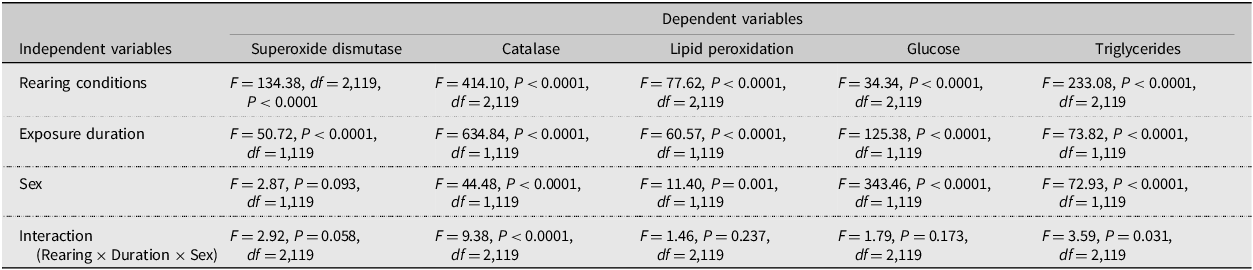
Repeated-measures analysis of variance revealed significant effects of rearing conditions and exposure duration on activity of each of superoxide dismutase and of catalase and on lipid peroxidation products. The assimilation of glucose and triglycerides also differed significantly, based on both rearing conditions and exposure duration. Although the sex of the adults had no significant impact on superoxide dismutase activity, it did significantly affect the activity of catalase and of the lipid peroxidation products, as well as the assimilation of glucose and triglycerides. Catalase activity and triglyceride assimilation were significantly influenced by the interaction of the rearing conditions, exposure duration, and sex, but the superoxide dismutase activity, lipid peroxidation products, and glucose assimilation did not vary significantly due to the interaction of those three factors (Table 1).
Repeated measures analysis of variance (three-way) table showing the effects of rearing conditions, exposure duration, sex, and their interaction on the activity of superoxide dismutase and of catalase, on lipid peroxidation products, and on the assimilation of glucose and triglycerides by Zygogramma bicolorata adults (F-values significant at P < 0.05)

Tukey’s post hoc comparison of means revealed that, in males, the highest superoxide dismutase and catalase activity and increased lipid peroxidation products were observed under repeated short-duration heat stress. In contrast, the lowest superoxide dismutase and catalase activity were recorded under repeated short-duration cold stress, with reduced lipid peroxidation products observed under optimal temperature conditions. In females, the highest superoxide dismutase activity and increased lipid peroxidation products were found under repeated short-duration heat stress, whereas catalase activity peaked under both optimal and repeated short-duration heat stress conditions. The lowest levels of superoxide dismutase and catalase activity were recorded under repeated short-duration cold stress, and the lowest lipid peroxidation levels were observed under optimal conditions (Fig. 2).
Effect of fluctuating thermal regimes on the activity of superoxide dismutase (SOD), catalase (CAT), and lipid peroxidation (LPO) products within adult males (A, C, E) and females (B, D, F) of Parthenium beetle. Values are mean ± standard error; upper-case letters represent comparison of means between pre- and post-stress conditions, lowercase letters compare the means amongst the three temperatures per stress condition, and Greek letters (α, β) compare the parameters between males and females; STC, repeated short-duration cold stress; STH, repeated short-duration heat stress; TBARS, thiobarbituric acid reactive substances; Tukey’s post hoc comparisons significant at P < 0.05.

Following the removal of thermal stress and the rearing of the insects under optimal temperature, adults of both sexes previously maintained at optimal conditions exhibited higher superoxide dismutase and catalase activity and lower lipid peroxidation levels than did the adults previously exposed to repeated short-duration heat or cold stress. In males, continuous exposure to short-duration heat stress for 10 days, followed by optimal temperature for another 10 days, resulted in no significant change in superoxide dismutase (P = 0.345) or catalase (P = 0.177) activity, or lipid peroxidation levels (P = 0.057) after 20 days. In females, superoxide dismutase activity (P = 0.495) and lipid peroxidation levels (P = 0.083) remained unchanged, whereas catalase activity (P = 0.006) increased. Similarly, adults continuously exposed to repeated short-duration cold stress for 10 days and then to optimal conditions for another 10 days showed no change in superoxide dismutase (P Male = 0.554; P Female = 0.423) activity. However, both catalase activity (P Male < 0.0001; P Female < 0.0001) and lipid peroxidation levels (P Male = 0.001; P Female < 0.0001) increased in these individuals.
Regardless of rearing conditions, males exhibited significantly higher catalase activity under repeated short-duration heat stress (P < 0.0001) and greater levels of lipid peroxidation products under both repeated short-duration cold (P = 0.002) and optimal (P < 0.0001) conditions than females did. Even after the removal of thermal stress, males previously exposed to both repeated short-duration cold (P = 0.016) and heat (P < 0.0001) stress conditions continued to show elevated catalase activity, whereas those previously exposed to only repeated short-duration cold stress (P < 0.0001) exhibited higher superoxide dismutase activity than females did (Fig. 2).
The results further revealed that glucose concentrations were highest in adults exposed to repeated short-duration cold stress and lowest in those exposed to repeated short-duration heat stress. Conversely, males exposed to repeated short-duration cold stress and females exposed to either repeated short-duration cold or heat stress showed reduced triglyceride concentrations compared to beetles maintained under optimal temperatures. Upon return to optimal conditions, males reared under optimal or previously exposed to short-duration heat stress showed increased glucose assimilation compared to those previously exposed to repeated short-duration cold stress. However, females previously exposed to repeated short-duration cold or heat stress did not show significant changes in glucose assimilation relative to those reared under optimal conditions. Moreover, triglyceride assimilation was highest in adults (both sexes) reared under optimal temperatures compared to those that had previously been subjected to thermal stress (Fig. 3).
Effect of fluctuating thermal regimes on the assimilation of glucose and triglycerides within adult males (A, C) and females (B, D) of Parthenium beetle. Values are mean ± standard error; upper-case letters represent comparison of means between pre- and post-stress conditions, lowercase letters compare the means amongst the three temperatures per stress condition, and Greek letters (α, β) compare the parameters between males and females; STC, repeated short-duration cold stress; STH, repeated short-duration heat stress; Tukey’s post hoc comparisons significant at P < 0.05.

In males exposed to short-duration heat stress for 10 days, followed by optimal temperature for another 10 days, glucose assimilation (P < 0.0001) increased but triglyceride assimilation (P = 0.174) remained unchanged after 20 days. In contrast, females exhibited decreased glucose assimilation (P = 0.021), with no change in triglyceride assimilation (P = 0.216). Adults subjected to repeated short-duration cold stress for 10 days and then reared under optimal conditions for 10 days showed decreased glucose assimilation (P male < 0.0001; P female < 0.0001); however, triglyceride assimilation increased in males (P = 0.002) and remained unchanged (P = 0.116) in females after 20 days. Across all rearing conditions, females exhibited significantly higher glucose assimilation than did males during and after thermal stress (P < 0.0001 for each condition). In addition, females assimilated significantly more triglycerides than did males under both short-duration cold stress and optimal temperature conditions (P < 0.0001 for each; Fig. 3).
Total mortality (%) was highest among adults exposed to short-duration heat stress conditions and lowest in those maintained at the optimal temperature. However, males exhibited higher mortality rates than did females across all three thermal regimes. Chi-square analysis revealed a statistically significant difference in mortality rates among the groups (χ² = 53.88; df = 5; P < 0.0001; Fig. 4).
Effect of fluctuating thermal regimes on adult mortality in Parthenium beetle. Values are mean ± standard error; χ 2-value significant at P < 0.05; STC, repeated short-duration cold stress; STH, repeated short-duration heat stress.

Discussion
Insects are often subjected to a variety of biotic and abiotic challenges, with temperature being a key abiotic factor that induces physiological changes and influences life history traits (Jia et al. Reference Jia, Dou, Hu and Wang2011). In the present study, short-duration heat stress conditions induced upregulation of both superoxide dismutase and catalase activity in Z. bicolorata males, whereas females exhibited elevated superoxide dismutase activity, indicating an increase in pro-oxidant production. This response may be attributed to elevated metabolic rates at higher temperatures, which result in increased oxygen consumption and the subsequent production of reactive oxygen species, such as superoxide anion, hydrogen peroxide, and hydroxyl radical. These reactive oxygen species may cause oxidative damage to lipids, proteins, and nucleic acids (Jena et al. Reference Jena, Kar, Kausar and Babu2013), triggering a compensatory increase in antioxidant enzyme activities. The findings of the present study align with those observed in other insect species (Zhang et al. Reference Zhang, Chang, Hoffmann, Zhang and Ma2015; Kang et al. Reference Kang, Liu, Liu, Yu, Tan and Zhang2017; Das et al. Reference Das, Malik and Barik2018; Wang et al. Reference Wang, Germinara, Feng, Luo, Yang and Xu2022), underscoring the crucial role of antioxidant enzymes in mitigating oxidative stress induced by temperature fluctuations. However, in the present study, females reared under short-duration heat stress conditions did not exhibit significant changes in catalase activity compared to those that had been maintained at optimal temperature. This could be due to sex-specific differences in antioxidant responses or to a compensatory mechanism that limits catalase activation in females. Further research is needed to explore this possibility.
Contrary to the results of the repeated short-duration heat stress conditions, repeated short-duration cold stress conditions resulted in a down-regulation of both superoxide dismutase and catalase activity in the beetles. This may be due to the insect’s adaptive response to cold stress, which includes rearranging lipid membranes, accumulating carbohydrate cryoprotectants, and synthesising antifreeze proteins (Lee Reference Lee2010). As a result, the insects exhibited reduced antioxidant enzyme activity under cold stress. Our results are consistent with the findings of Lubawy et al. (Reference Lubawy, Chowański, Colinet and Słocińska2023), who reported a decrease in antioxidant activities in cockroaches exposed to repeated short-term cold stress, followed by an increase in antioxidant activity after thermal shock.
The increased levels of lipid peroxidation products observed under both repeated short-duration heat and cold stress conditions, compared to maintenance under the optimal temperature, further suggest the activation of Parthenium beetles’ stress response mechanisms that protect cell membranes from oxidative damage. These findings align with those of Jia et al. (Reference Jia, Dou, Hu and Wang2011), who reported that malondialdehyde concentration was highest in the fruit fly, Bactrocera dorsalis (Diptera: Tephritidae), when subjected to thermal stress as opposed to maintenance under optimal temperature conditions. This suggests that any deviation from the optimal temperature, whether higher or lower, leads to an increase in malondialdehyde concentration, thereby elevating lipid peroxidation products. The rise in lipid peroxidation activity thus reflects a physiological response aimed at counteracting thermal stress and maintaining cellular integrity (Yadav et al. Reference Yadav, Patel, Singh, Verma, Chowdhury and Kumar2024a).
Moreover, the elevated metabolic rate during heat stress and the reduced effectiveness of antioxidant enzymes during cold stress can result in the accumulation of reactive oxygen species (Joanisse and Storey Reference Joanisse and Storey1996, Reference Joanisse and Storey1998). This oxidative stress may cause an increase in catalase activity and lipid peroxidation products upon returning to warmer temperatures, as we observed in the present study. Both sexes previously maintained under repeated short-duration cold stress conditions showed this response, as did females from the repeated short-duration heat stress group, which exhibited enhanced catalase activity. Our findings are consistent with those previously reported in houseflies, Musca domestica (Diptera: Muscidae), by Rojas and Leopold (Reference Rojas and Leopold1996). The impact of fluctuating thermal regimes on oxidative stress therefore could reflect a trade-off between repairing damage caused by heat or cold exposure and the heightened reactive oxygen species production required to facilitate such repair. As a result, antioxidant capacity rapidly increases to counteract the harmful effects of heat injury or cold chilling and to match the increased reactive oxygen species production during rewarming (Lalouette et al. Reference Lalouette, Williams, Hervant, Sinclair and Renault2011). In this way, thermal stress induces oxidative damage in Parthenium beetles, and a recovery period activates the antioxidant system, promoting repair of heat- or cold-induced damage, which ultimately enhances the beetles’ survival.
Compared to adults reared continuously at the optimal temperature, those previously exposed to either repeated short-duration heat or cold stress conditions and subsequently returned to the optimal temperature exhibited reduced superoxide dismutase and catalase activity. This suggests that, whereas thermal stress elevates antioxidant enzyme activity, recovery under optimal temperatures may suppress these activities to help restore physiological homeostasis. Our findings also suggest that the physiological response to thermal stress and the subsequent recovery are influenced by both the type of stress and the sex of adults. Although males appeared to maintain stable antioxidant enzymes following heat exposure, females demonstrated a selective upregulation of catalase activity, indicating a potentially increased antioxidant response. In the case of cold stress, the increase in catalase and lipid peroxidation activity in both sexes implies a persistent effect of cold exposure on oxidative balance, even after the beetles return to optimal conditions.
In the present study, glucose levels were highest in adults exposed to repeated short-duration cold stress conditions. The mobilisation of cryoprotectants, such as glucose, is a well-documented response to cold stress in a number of insect species (Colinet et al. Reference Colinet, Hance, Vernon, Bouchereau and Renault2007; Lalouette et al. Reference Lalouette, Koštál, Colinet, Gagneul and Renault2007). This increase in glucose has been linked to improved chill tolerance. Our results suggest that elevated glucose levels may arise from glycogen catabolism during cold stress. These findings are consistent with those of Chowanski et al. (Reference Chowanski, Lubawy, Spochacz, Ewelina, Grzegorz, Rosinski and Slocinska2015), who observed elevated glucose levels in the Madagascar cockroach, Gromphadorhina coquereliana (Blattodea: Blaberidae), under short-duration cold stress. In contrast, in the present study, Parthenium beetle adults maintained under short-duration heat stress conditions exhibited the lowest glucose levels, likely due to glucose conversion into glycogen to mitigate heat damage (Chen et al. Reference Chen, Solangi, Zhao, Yang, Guo, Wan and Zhou2019). Previous studies have shown that glycogen serves as an oxidative energy source during physiological stress, helping to protect against heat injury (Gray and Bradley Reference Gray and Bradley2005). In contrast to our results, Ghaedi and Andrew (Reference Ghaedi and Andrew2016) reported an increase in glucose levels in response to heat stress in the green peach aphid, Myzus persicae (Hemiptera: Aphididae).
Unlike the changes in glucose levels revealed in the present study, we found that triglyceride concentrations were higher in males kept under repeated short-duration heat stress or optimal conditions and in females maintained at the optimal temperature. In both sexes, the lower triglyceride levels were observed under repeated short-duration cold stress conditions. Possibly, the synthesis of cryoprotectants in response to thermal stress is expected to deplete other energy reserves, particularly triglycerides (Teets et al. Reference Teets, Kawarasaki, Lee and Denlinger2011), which likely contributed to the reduced triglyceride concentrations observed in Z. bicolorata under cold stress. Under heat stress, vital energy reserves, particularly triglycerides, are consumed to protect cells from hyperthermic damage. Furthermore, the energy-intensive repair and recovery processes under thermal stress require sufficient adenosine triphosphate supply (Colinet et al. Reference Colinet, Sinclair, Vernon and Renault2015), which may also deplete triglycerides as an energy source. Our results are further supported by those of Ghaedi and Andrew (Reference Ghaedi and Andrew2016) and Chen et al. (Reference Chen, Solangi, Zhao, Yang, Guo, Wan and Zhou2019), who respectively reported reduced triglyceride content in adults of green peach aphids, Myzus persicae (Hemiptera: Aphididae) and ragweed leaf beetles, Ophraella communa (Coleoptera: Chrysomelidae), under thermal stress conditions. These findings suggest that triglycerides play a crucial role in behavioural thermoregulation and in the repair processes during thermal stress (Chen et al. Reference Chen, Solangi, Zhao, Yang, Guo, Wan and Zhou2019). Our results also suggest that thermal stress induces sex-specific metabolic adjustments that persist beyond the stress period. Males may prioritise carbohydrate metabolism following heat exposure, whereas females exhibit a suppression of glucose use. Cold exposure, on the other hand, appears to stimulate lipid assimilation in males, possibly as an energy reserve strategy, whereas females maintain a more stable lipid metabolism under the same conditions.
Under certain rearing conditions, antioxidant enzyme activity was higher in males than in females, suggesting that females may be more resilient to thermal stress. The smaller size of males results in a higher surface area–volume ratio compared to that of females, causing males to lose or gain heat more rapidly and making them more susceptible to thermal stress. Moreover, the higher assimilation of glucose and triglycerides by females compared to males, both before and after thermal stress, further indicates the distinct physiological and reproductive needs of females for these nutrients. The higher triglyceride levels in females suggest a tendency to accumulate lipids in the ovaries, serving as the primary energy source for embryo development (Ziegler and Ibrahim Reference Ziegler and Ibrahim2001; Muntzer et al. Reference Muntzer, Montagne, Ellse and Wall2015). However, the higher glucose levels further imply that females require more nutrients and energy reserves to maintain their larger body size and to meet the increased metabolic demands of reproduction and oviposition. Numerous studies have also reported sex-specific responses to heat stress in insects, with females often exhibiting higher antioxidative enzyme activity and greater stress resistance (Esperk et al. Reference Esperk, Kjaersgaard, Walters, Berger and Blanckenhorn2016; Schou et al. Reference Schou, Kristensen, Pedersen, Karlsson, Loeschcke and Malmendal2017; Chen et al. Reference Chen, Solangi, Guo, Wan and Zhou2018a, Reference Chen, Zheng, Luo, Guo, Solangi, Wan and Zhou2018b, Reference Chen, Solangi, Zhao, Yang, Guo, Wan and Zhou2019; Yadav et al. Reference Yadav, Patel, Singh, Verma, Chowdhury and Kumar2024a).
The highest mortality of adults under the short-duration heat stress conditions observed in the present study is likely due to heat injury caused by the elevated temperatures. Under heat stress, maintaining water balance is a significant challenge for insects. Dehydration can lead to severe physiological damage, including protein denaturation, nucleic acid damage, and lipid peroxidation, ultimately resulting in insect death (Lopez-Martinez et al. Reference Lopez-Martinez, Benoit, Rinehart, Elnitsky, Lee and Denlinger2009). The mortality of beetle adults under repeated short-duration cold stress conditions is likely due to chilling injuries, which in insects are caused in part by damage to mitochondrial membranes and the electron transport chain (Koštál et al. Reference Koštál, Renault, Mehrabianová and Bastl2007). Moreover, the reduced effectiveness of antioxidant enzymes (Rojas and Leopold Reference Rojas and Leopold1996) and the loss of spiracular function, both linked to chill coma (Sinclair et al. Reference Sinclair, Klok and Chown2004; Stevens et al. Reference Stevens, Jackson, Bester, Terblanche and Chown2010), may also contribute to insect mortality. Moreover, males exhibited higher mortality rates than females did across all three thermal regimes, which further suggests that males may be more physiologically vulnerable to thermal stress, possibly due to their small size, and that the sex-specific differences exist in stress tolerance, energy allocation, or antioxidant defence mechanisms (Yadav et al. Reference Yadav, Patel, Singh, Verma, Chowdhury and Kumar2024a, Reference Yadav, Patel, Patel, Chowdhury, Upadhyay, Kumar and Kumar2024b).
In summary, insects exposed to fluctuating thermal conditions must rely on antioxidant defences, which, in conjunction with the physiological stress response, help mitigate cellular damage (Jena et al. Reference Jena, Kar, Kausar and Babu2013). Although repeated heat stress elevated the activity of antioxidant enzymes, repeated cold stress increased glucose assimilation. Moreover, males displayed higher antioxidant enzyme activity, whereas females accumulated more glucose and triglycerides, suggesting greater thermal stress tolerance in females. These findings indicate that females of Z. bicolorata are more resilient to thermal stress, potentially enhancing their effectiveness in Parthenium biocontrol. In addition, although the transgenerational effects of fluctuating thermal conditions on the biochemical and enzymatic defences of Z. bicolorata adults remain poorly documented, similarly limited information is available on this topic for other insect species. Further research involving a broad range of insect models could provide further insights into the mechanisms by which insects adapt to thermal stress and ensure their survival.
Acknowledgements
The authors thank UGC-CAS– and DST-FIST–funded Department of Zoology, Banaras Hindu University, Varanasi (India) for laboratory facilities. A.K.P. thanks CSIR, New Delhi, India, for JRF and SRF fellowships. B.K. thanks IoE and SRICC, Banaras Hindu University, for their partial financial assistance in the form of incentive and trans-disciplinary grants, and professional development funds.
Competing interests
The authors declare that they have no competing interests.