More than a decade since emerging from colonialism and apartheid, South Africa continues to face big challenges relating to poverty and racial inequality. After coming to power in 1994 the post-apartheid government formulated a number of policies and laws, the purpose of which was to redress the imbalances of the past while at the same time improving the welfare of all South Africans. Over half of South Africa's 44 million people live in poverty, with almost 70 per cent of the poor living in rural areas (Aliber Reference Aliber2003). These rural areas therefore became key targets of the new policies and legislation.
It is common knowledge that colonialism and apartheid resulted in Africans being dispossessed of land on a large scale and confined to overcrowded reserves or Bantustans. Beginning in 1994, and later enshrined in Section 25 of the Constitution of the Republic of South Africa (Act 108 of 1996), land reform became one of the key tools to fight poverty and other injustices in the new South Africa. Through its three components, land reform aims to return land or to offer alternative redress to people who unfairly lost their land after a cut-off date in 1913 (restitution), reverse skewed land ownership caused by colonialism and apartheid by making land available for productive and residential purposes (redistribution), and to provide secure land tenure rights where they did not exist (tenure reform).
Namaqualand is a semi-arid geographical region in the Northern Cape Province comprising about 48,000 square kilometres and 70,000 inhabitants. The population consists of people of Nama identity, people of mixed descent,Footnote 1 and a minority of European origin constituting about 20 per cent of the population. Following the settlement of Europeans during the early part of the eighteenth century, Namaqualand was annexed to the Cape Colony between 1798 and 1847 (Wisborg and Rohde Reference Kepe, Wynberg and Ellis2005). The resulting land dispossession, diseases and economic exploitation largely compromised the livelihoods of non-whites and confined them to mission stations, which acted as places of refuge. Much like the other ‘native reserves’ in other parts of South Africa, the government maintained ‘coloured reserves’ in Namaqualand as reservoirs of labour for mining and farming in the area. These reserves, which today are labelled ‘communal areas’, constituted about 23 per cent of Namaqualand's area prior to land reform, while about 400–450 white commercial farmers owned almost 52 per cent of the land. The rest of the area was mining land (7 per cent), conservation areas (4 per cent), state land (7 per cent), and municipal land (7 per cent). Before and after 1994 Namaqualand communities, assisted by the Surplus People Project (SPP), a land-based non-government organization, and the Legal Resources Centre (LRC), a public interest law non-government organization, vigorously campaigned for more land and secure land rights. Researchers have documented the significant progressFootnote 2 of land reform in Namaqualand, including the purchase of farms by the state to use for redistribution to disadvantaged communities (Wisborg and Rohde Reference Kepe, Wynberg and Ellis2005; Benjaminsen et al. 2006; Lebert and Rohde Reference Desmet2007; May and Lahiff Reference May and Lahiff2007). However, people of Namaqualand, one third of whom engage in small stock farming, continue to feel strongly about the loss of their ancestral land, and are keen to increase their land base (Wisborg and Rohde Reference Kepe, Wynberg and Ellis2005). Since the advent of democracy, Namaqualand communities have begun to rediscover, or reassert, their Nama identities at the expense of their ‘coloured’ identity. ‘For the first time in years it (is) possible to express a genuine pride in an aboriginal identity which had either been unacknowledged or subsumed under the derogatory appellations “bushman”, “hottentot” and “coloured”’ (Penn Reference Penn2004: 159). The revival of Nama culture and language is closely linked to the land issue.
However, land reform and the sustainability of farming in Namaqualand are hotly debated issues amongst researchers, conservationists, and practitioners interested in this area. This contestation involves issues of biodiversity conservation versus livelihood needs and ‘modern’ private ‘commercial’ farming versus ‘traditional’ ‘communal’ farming, as well as questions about what a ‘degraded’ landscape really means. Natural scientists point out that Namaqualand, which is part of the Succulent Karoo biome, contains more than 3,500 plant species, 25 per cent of which are endemic to this area, and that it is one of only two internationally recognized dryland biodiversity hotspots in the world (Desmet Reference Desmet2007; Hoffman et al. 2007). Eager to protect this biodiversity against indigenous use, scientists and conservationists have for a long time maintained that livestock farming, as historically and currently carried out by the people in communal areas, is a threat to this biologically important environment (see, for example, Todd and Hoffman 1999; Desmet Reference Desmet2007; Hoffman et al. 2007). Describing ‘overgrazing’ and ‘desertification’ in Namaqualand, Cowling and Pierce (1999: 138) state for instance that ‘the amount of land under communal use can be expanded – as is, indeed, happening today. Ultimately, however, this land will also be desertified unless some way can be found to manage it within the limits imposed by its production potential.’ However, in view of Namaqualand's history of racial and social injustice Benjaminsen et al. 2006 argue that it is ethically problematic to privilege conservation of a maximum level of biodiversity and one particular perception of the ideal landscape at the expense of livelihood security and poverty alleviation. It is also problematic because it presents the private ranch system as an ideal one, without considering disparate production goals and unequal economic opportunities and constraints. Benjaminsen et al. 2006 also present historical evidence demonstrating that rangelands in the area are capable of sustaining livestock densities far greater than those recommended by the Department of Agriculture, which uses ‘commercial’ ranches as a reference model and refers to maximum meat production as the farming objective. A related critique has been put forward by Allsopp et al. 2007, who describe the indigenous knowledge of communal livestock keepers in Namaqualand and how the idea of adhering to a fixed carrying capacity remains irrelevant for a system with multiple production objectives in a variable environment.
In fact, for most farmers in communal areas, livestock keeping is but one of several livelihood sources, which often will encompass wage labour, remittances, pensions, and social security grants. Some of these sources are insecure, and livestock keeping represents a safety net against fluctuations in other incomes – as a ‘bank account’ that they can dip into to make up for regular seasonal shortages or when other sources fail (Benjaminsen et al. 2006). Namaqualand's communal livestock farming sector thus has multiple production objectives: milk and meat are important elements in household food security; sheep and goats provide capital storage, insurance, and cash income; and donkeys provide draft power for transport and crop operations (Anseeuw et al. 2001; Rohde et al. 2003).
The widespread perception of communal farming in southern Africa as ecologically destructive and economically inefficient is rooted in colonial views of ‘native’ African farming (Maddox Reference Maddox, Dovers, Edgecombe and Guest2002). This perception is part of a broader dominating discourse in southern Africa on range management, environmental conservation and agricultural development, which is shared by an influential network of actors (Hongslo and Benjaminsen Reference Hongslo and Benjaminsen2002; Benjaminsen et al. 2006). Such actor-networks (Callon and Latour Reference Callon, Latour, Knorr-Cetina and Cicourel1981; Keeley and Scoones Reference Keeley and Scoones2003) tend to establish, promote and reproduce a particular discourse through the use of language and actions. This discourse on communal farming holds a strong position in South Africa, including within the Department of Agriculture, the ‘white farming sector’, ‘emergent black commercial farmers’, the South African National Parks (SANParks), various non-governmental organizations working for nature conservation, whether international or national, and South African natural scientists at large; as we shall see, it also includes the mining sector in the case study area.Footnote 3
In line with conservationist conclusions about the value and potential threats to Namaqualand's biodiversity, environmentalists during the last ten years have been ‘mobilizing resources for protected area expansion as well as a range of other conservation and ecotourism initiatives’ (Hoffman et al. 2007: 3). But the problem for local communities is that within the framework of market-based reform, these initiatives tend to compete with redistribution of land to these communities (May and Lahiff Reference May and Lahiff2007). This tension or trade-off between Western-style conservation and support to the livelihoods of marginalized communities is the focus of this article. In Namaqualand, the creation and expansion of the Namaqua National Park has implied the purchase of private farms. With the land redistribution programme also targeting nearby private farms to meet its goal, the two government programmes of environmental protection and land reform have been set on a collision course.
Given that the struggles against colonialism and apartheid in South Africa focused on loss of land as a form and symbol of conquest and injustice, one might have expected land reform to emerge as a more pressing post-apartheid policy goal than, say, the creation of protected areas. While land reform and the goal of poverty alleviation may hold a priority position in political rhetoric, studies have shown that when conservation and land reform goals are in conflict, as in the case of land claims in protected areas, conservation has generally emerged as the winner (Magome and Murombedzi Reference Magome, Murombedzi, Adams and Mulligan2003; Kepe Reference Kepe2004; Kepe et al. 2005). As we shall see, this is also the case in Namaqualand.
The power of the global biodiversity conservation discourse may partly explain this situation. This discourse is mainly directed against perceived threats to global biodiversity (Leach and Mearns Reference Leach, Mearns, Leach and Mearns1996; Adger et al. 2001). Furthermore, the discourse is thought to be strengthened by claims from scientists and conservation advocates, who argue that very little is done to prevent the erosion of biodiversity. Du Toit et al. (2004: 12), for example, contend that ‘(t)ropical biodiversity continues to erode unabated’. Along similar lines, Sanderson and Redford (2003: 389) lament the fact that ‘biodiversity has all but disappeared from the global dialogue on sustainable development’ and Sanderson Reference Sanderson2005 complains that plans to meet the Millennium Development Goals have paid insufficient attention to the environmental costs of rural development.
Chapin 2004 provides perhaps the most concise rebuttal of the conservation advocates' argument about the neglect of biodiversity conservation. In tracing the history of the world's three most powerful conservation agencies – Worldwide Fund for Nature (WWF), Conservation International (CI) and The Nature Conservancy (TNC) – he shows how funding made to the large conservation NGOs has increased tremendously since 1990. Chapin reveals that the multi-billion dollar combined revenues of these NGOs is mainly due to their ability to sell their message to the wealthy individuals, private sectors and governments of wealthy countries. He attributes the success in fundraising of these three environmental NGOs to the reformulation of their mission statements to focus on large-scale conservation, which many see as the only way to tackle global threats to ecosystems. Investment in conservation in the developing world by these NGOs is increasing dramatically, with about $490 million invested in 2002 compared to $240 million in 1998.
With this background in mind, we present the case of the creation and expansion of the Namaqua National Park to highlight the contradictions between global interests in biodiversity conservation and local land needs. The article also highlights the role played by powerful environmentalists supporting conservation financially and thereby influencing the land reform–conservation dynamics in Namaqualand. Primary data for this study were collected in Namaqualand in September and December 2002, as well as in October–December 2003. Informal conversations with the personnel of the Park, people working with conservation NGOs, key informants from local communities neighbouring the Park, as well as local government officials, provided us with an overview of issues. These conversations were later followed up by semi-structured interviews. Two settlements directly affected by the establishment and expansion of the Namaqua National Park – Soebatsfontein and Hondeklipbaai – were selected for these interviews. In addition, a small household survey was carried out in the two localities. Both communities are relatively poor, with limited options for gaining sustainable livelihoods. They have both sought to acquire additional land through the land reform programme. Soebatsfontein borders the Park directly and has a relatively conflictual relationship with the Park. Hondeklipbaai is situated on the coast and is hemmed in by the sea, mining areas, a fishing company, and private commercial farmers. While the Hondeklipbaai community had hoped to get out of landlessness through land reform, people have observed that mining land and commercial farm land have been sold to the Park instead.
NAMAQUA NATIONAL PARK, LAND REFORM AND LOCAL LIVELIHOODS
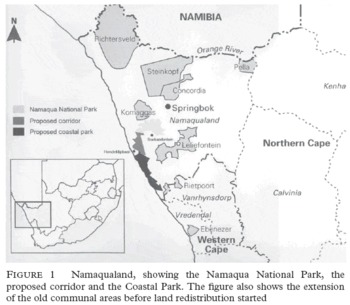
The Namaqua National Park is situated some 500 km north of Cape Town (Figure 1). It is one of twenty National Parks managed by SANParks to conserve representative areas of the country's rich biodiversity.
The Park is one of the most recently established conservation areas in South Africa. It was officially proclaimed on 25 January 2002. As of October 2006, the size of the Park was 93,000 hectares (SANParks 2006), and it is said to be one of the world's fastest-expanding parks.Footnote 4 Land acquisitions are planned to gain an additional 41,000 hectares, with the possibility of including another 35,100 hectares in the future (SANParks 2006). The Succulent Karoo biome, in which Namaqualand and the Park are located, has been described as having the richest succulent flora in the world, containing about a third of the world's 1,000 succulent plant species (Low and Rebelo Reference Low and Rebelo1996). A proposed Coastal Park is also planned, along with a plan to establish a corridor to link the two parks. The area will eventually be managed as one single protected area, the Greater Namaqua National Park. This greater park is expected to double the size of the current Park.5
While the main tourist attraction of Namaqualand is the spectacular display of spring flowers in August and September, the Park management is hoping to attract more tourists by reintroducing wildlife to the area. Thus far, animals such as springbok, red hartebeest and gemsbok have been bought (30 of each species) and reintroduced into the Park.Footnote 6 The management is also planning to buy black rhinos on wildlife auctions and bring them into the Park.7
The Namaqua National Park is managed as a Category I protected area, following IUCN's Protected Areas Categories. This implies that it is a ‘strict nature reserve and wilderness area’.Footnote 8 Despite this category, however, SANParks also tends to present the Park within the framework of community-based conservation, focusing on local empowerment and local benefits of the Park. For example, a ‘rhino-proof’ fence has been erected around the Park, and local people have been employed to carry out this work as part of the Park's ‘Empowerment Project’. Furthermore, in an open response to earlier critique from us, SANParks writes:
The park's contribution to the empowerment of local people and institutions has been enormous … the People and Conservation Unit of the park continues to actively interact with 16 rural communities, 19 primary schools, three communal farmers associations, two commercial farmers unions, two municipalities and 5 high schools, as well as a wide range of stakeholder and constituency groups. To date well over 30,000 local people have benefited from environmental education over the past few years. As a result there is increasing support for the park among local communities as evidenced by demonstrable improvements in the attitudes of local communities towards conservation as a justifiable form of land use…. The Namaqua National Park has a well established and representative stakeholder Park Forum through which all matters pertaining to park development are discussed.9
One of the Park's objectives is also to ‘realize opportunities for, and equitable distribution of, benefits to surrounding communities in line with the SANParks resource use policy’ (SANParks 2006). However, the park manager stresses in an interview with us that the Park Forum is only an advisory body and that the Park management decides, given the Park's Category I status.
Key players behind the establishment of the Park
The Park owes its birth to a South African businessman and billionaire, Anton Rupert, an avid nature lover, who in June 1988 purchased the first property, the Skilpad farm, which was thereafter transformed into Skilpad Wildflower Reserve. Rupert, who in 1968 had founded the Southern African Nature Foundation, which later became WWF–South Africa, gave WWF the responsibility of managing the Reserve. Rupert also became President of WWF–South Africa. According to Ramutsindela and Tsheola 2002, the white right wing has had a significant influence on the affairs of WWF in South Africa through the Afrikaner Broederbond, an Afrikaner nationalist secret society of which Anton Rupert was also a member. But Rupert has also been able to influence WWF–International more directly by serving 22 years as a member of its Board of Trustees and Executive Committee (Bonner Reference Bonner1993).
The Skilpad farm covered an area of 960 hectares and had been known for its beautiful spring flower displays, which mostly occur on old fields and other ‘disturbed’ sites such as heavily grazed land or along roads (van Rooyen Reference van Rooyen2002).Footnote 10 There were still some remaining grazing contracts on the property and, when these had run out, WWF–South Africa operated the property as a private nature reserve until 1997. The Skilpad Wildflower Reserve was open to tourists for two months of the year during the flower season.11
In 1996, WWF–South Africa started to look for a suitable agency to take over the management of the reserve. It was decided that SANParks should take over, since there were already recommendations that the reserve should develop into a national park. In 1999 another successful businessman and philanthropist, Leslie Hill, bought an additional 45,000 hectares of property from De Beers Diamond Mining Company, which, together with another 2,500 hectares bought by SANParks, were combined with the Skilpad Wildflower Reserve to form the Namaqua National Park. Because of this donation, WWF–International honoured Leslie Hill as the first individual to be recognized as having made ‘A Gift to the Earth’ in line with its global ‘Living Planet Campaign’.Footnote 12 According to WWF–International,
a gift to the earth is a public celebration by the WWF, of a conservation action by a government, a company, an organization, or an individual, which is both a demonstration of environmental leadership and a globally significant contribution to the protection of the living world. The Gift is symbolic, and is WWF's highest accolade for applauding conservation work. It is a form of recognition which enables WWF to publicly recognize an important conservation achievement, which also can serve as an example, helping encourage similar actions by others elsewhere. In addition, this enables WWF to draw worldwide attention to the conservation achievement including the international media, funding agencies and other organizations. (WWF's website 〈www.panda.org〉, accessed 23 September 2005)
As of September 2005, WWF has recognized more than 90 ‘Gifts to the Earth’ since this initiative was launched in 1996. Anton Rupert was recognized as having made ‘A Gift to the Earth’ in 2000 when he personally initiated transboundary conservation throughout Southern Africa.
Since 1999, the Park has used either SANParks' development fund, set up to buy properties, or the Leslie Hill Succulent Karoo Trust Fund to purchase more land. The latter fund is administered by WWF–South Africa and has contributed to the purchase of nearly 100,000 hectares of land to be used for conservation since its establishment in 1995. As well as land added to the Namaqua National Park, this includes land added to the Addo Elephant National Park, the Anysberg Nature Reserve and several other areas in the Little Karoo (WWF–South Africa 2003).
Donor funding from conservation organizations such as the WWF, the Global Environmental Facility, the RARE Centre for Tropical Conservation, and the Wilderness Foundation, as well as from private wealthy South Africans, has played a vital role in the establishment and development of the Park. To date, donor funds have been used for land consolidation, infrastructure development, environmental education campaigns, staff capacity building and training of communities.
In addition, Namaqualand is well researched by the biological sciences. Funding for ecological research in the area appears relatively abundant. The Leslie Hill Institute for Plant Conservation at the University of Cape Town has in recent years played a leading role in providing the scientific research and advice that has been used by the conservation lobby in Namaqualand. In addition, the Institute's Director is one of three trustees of the Leslie Hill Succulent Karoo Trust Fund, a major source of funding for the establishment and extension of the Park.
The establishment of Namaqua National Park affects several communities in the area, most of which lack employment opportunities. According to a study carried out by the Surplus People Project 1999 in relation to the planning and implementation of land reform in the District, Namaqualand communities expressed concerns with regard to the establishment of more conservation areas. There was a view amongst the locals that the need for conservation was given more significance than the land needs of local communities, who seek to use the land for productive purposes. Soebatsfontein and Hondeklipbaai are two neighbouring communities directly affected by the establishment and planned expansion of the Namaqua National Park.
In general, these two communities are characterized by high unemployment, poverty and landlessness. Many residents rely on state grants and pensions. Most people are struggling to support themselves and their families. In the survey we carried out in Soebatsfontein, we found that 40 per cent of the respondents were unemployed, 24 per cent were contractual workers, 17 per cent were pensioners, and 7 per cent were still mine workers.
Both the Soebatsfontein and Hondeklipbaai communities have sought to acquire land in order to secure their livelihoods by combining several sources of income in the same way as farmers in communal areas. But this would require the acquisition of land through the land redistribution programme, of particular importance as the mines are closing down and laying off people. Whilst the community of Soebatsfontein has acquired some land through this programme, the community of Hondeklipbaai is still attempting to access land after lodging a land restitution claim that was rejected. Below, we present a more detailed background account of one of these two communities – Soebatsfontein.
Access to land
The small settlement of what became known as the kleurling lokasie (‘coloured settlement’) of Soebatsfontein is the Park's direct neighbour on the southern side. It is situated 80 km south-west of the town of Springbok and 48 km north-west of Kamieskroon (Figure 1). The settlement originated in 1954 when a piece of land was bought by the United Reformed Church (Verenigde Gereformeerde Kerk) from one of the seven farms in the area, to establish a church, a school, houses for teachers and houses for local ‘coloured’ pensioners. The inclusion of pensioners in this land arrangement was a result of the fact that ‘coloureds’ were only allowed to remain on the white-owned farms as long as they could work as labourers (Wellman and Murray 2000). Once they became too old, they had to leave the farm. This small piece of land was squeezed between white-owned farms and the farms of the De Beers Diamond Mining Company.
Today, the 250–300 residents of Soebatsfontein continue to live on this church land. Until the mines recently started to close down, people in the community found work in the mines or on the farms run by De Beers to feed its workers. But in May 2002, De Beers closed down its Farms Department, and all farming operations were ceased. Most of the people from Soebatsfontein working as labourers on the farms lost their jobs. When they were being laid off by De Beers they had asked: ‘What are we going to live off now?’ They observed that the mining company was selling a lot of land to SANParks, while they did not get much land.13
As early as November 1995, the Soebatsfontein community had approached De Beers about the availability of land for purchase through the land redistribution programme. De Beers agreed to inform the Department of Land Affairs (DLA) when land was made available, and duly did so in October 1996, when a number of farms near Soebatsfontein were coming up for sale. People in Soebatsfontein expressed their interest in the properties and asked the DLA to proceed in the matter. According to the Soebatsfontein community, proceedings were far advanced when they were notified that SANParks and WWF–South Africa were interested in the same properties. In July 1997 the Surplus People Project (SPP), De Beers and SANParks had a meeting about the establishment of a possible new national park. After subsequent meetings, De Beers assured the Soebatsfontein community that it would make available alternative properties on condition that the community approved the development of the national park. SANParks bought the contested properties and eventually, after many more meetings and delays, approximately 15,000 hectares were made available for purchase, and handed over from the Department of Land Affairs to the Kamisberg municipality for the benefit of the Soebatsfontein community. Hence, the municipality formally owns the new land received. However, people in Soebatsfontein argue that the land area received is too small. ‘This is a small community, we don't need a lot of land, just a little bit more', they say.Footnote 14 Wellman and Murray, who carried out a study for the DLA in Soebatsfontein in Reference Wellman and Murray2000, talked to a number of local people who expressed gratitude to the government for the land received. But they also stressed that this land was not enough. The authors quote from a group interview with five men: ‘With this land the government is giving us back human dignity. We are very grateful for that.’ However, ‘fifteen thousand hectares is not enough, but it is better than nothing. We hope that we perhaps can obtain one or two more farms. Then we can take much better care of the land and there will be something left for our children and grandchildren.’ ‘Now, I can die quietly. That feels good.’ (Wellman and Murray 2000: 24).
Among the residents, 29 families have indicated that they would like to use the land for livestock farming. However, the land has been heavily used by De Beers and local people have been told by the Department of Agriculture that the carrying capacity of the 15,000 hectares received is only 1,200 SSU,Footnote 15 which, if equally distributed, would give a quota of only 41 SSU per household. However, in order to make a living from sheep farming, people in Soebatsfontein who were interviewed consider 150–200 sheep per household to be a minimum. In comparison, white commercial farmers in Namaqualand keep from 500 up to several thousand sheep.
One of the key local players in Soebatsfontein has previously worked for the Park and has been involved in running a Landcare project in Soebatsfontein. This is a conservation project with a total budget of R300,000 over three years, aimed at improving local livestock management by decreasing trampling and overgrazing, and improving the local environment by planting trees of local varieties. The measures used to improve stock farming are fencing of the area into camps, the promotion of rotational grazing between the camps and the development of water supply. The position of the local Landcare agent has been to adhere strictly to the recommendation from the Department of Agriculture and therefore to set a maximum stocking density at 1,200 SSU. Because of this conservative stance, he has been ejected from the local commonage committee, which is responsible for managing the redistributed land. His opponents insist that to make a living as a sheep farmer, it is not possible to follow the recommendation from the Department of Agriculture. However, following an intervention by the Department of Agriculture, the community was later persuaded that it is necessary to respect the defined carrying capacity. As of September 2003, this was not a problem, as the 29 households had only 280 SSU and 13 LSU in total. But as herd sizes continue to build up, the community's acceptance of the stipulated carrying capacity will be put to test.
Most people in Soebatsfontein feel that there is unfair competition for land from the Park. They argue that some of the farms bought by the Park should have been distributed to the community, because they feel they have legitimate claims to this land. Many people in Soebatsfontein worked on these farms, some were born there, and some of their parents and grandparents were buried there. However, it should also be noted that the Soebatsfontein community has received a school from the Park worth R500,000.16
As respondents pointed out during household interviews,Footnote 17 the acquisition of land is regarded as critical and central to the survival and the improvement of livelihoods of communities. Access to land would therefore hold a central position in local livelihood strategies, especially given the fact that the mines are closing down and other employment options in the area are lacking. Both the communities of Soebatsfontein and Hondeklipbaai have aspired and struggled to get more land through the government's land reform programme.
However, the existence of and the planned expansion of the Park has tended to raise expectations of the price that private landowners might receive from selling their land to the Park. Furthermore, according to a case study carried out by Surplus People Project 2003, SANParks are viewed as playing a major role in determining land prices as they have more purchasing power than the Department of Land Affairs, which assists disadvantaged communities in purchasing land.
According to Surplus People Project 2003, an estate agent in the area indicated that it is not uncommon for SANParks to pay 50 per cent above what is considered the market value to get land in order to establish new parks or extend existing ones. An example is the SANParks' purchase of land in the Garies area in order to extend the Namaqua National Park. Whilst the average price of land in the area in 2003 was between R150 to R170 per hectare, SANParks paid R250 per hectare. In addition, a summary of proposed land acquisitions by the Park in 2002 indicates a property price as high as R430 per hectare (Namaqua National Park 2002). The preparedness of the Park to purchase land at any cost serves to destabilize the land market and has an adverse impact on those who wish to buy land, but who cannot compete with the offers made by the Park.
In fact, the Park's management also shares this view. Responding to the question whether the existence and the planned expansion of the Park have raised the market price on land in the area, the park manager replied that it certainly had and he continued:
Land prices are always a controversial thing. It is a free market, supply and demand, and by us arriving in the market and maybe having some funding available, we have been able to buy land for more than a local person next door. All the properties that we have bought possibly doubled the real agricultural value of the land. When we look at the conservational value, we are more than satisfied with what we have paid. We would not be able to pay unrealistic amounts because we also follow formal processes and even more so with donor funding. They want to know how they are spending their money. They do not want to waste money.18
In terms of access to land, people in Soebatsfontein have not only experienced that the establishment of the Park has made it more difficult to acquire land through the government's land redistribution programme. Some of the respondents in the household interviews had also lost access they formerly enjoyed to certain areas. Approximately 50 per cent of the respondents from Soebatsfontein, and 20 per cent of those from Hondeklipbaai, used to have access to parts of the land that presently belong to the Namaqua National Park. This difference can be explained by the fact that people from Soebatsfontein used to work on De Beers farms. As employees, De Beers gave them grazing rights. However, there were limitations on the number of stock that could be kept there by each farmer (Surplus People Project 1997).
Perceptions of communal farming
Another controversial issue that emerged through the interviews with the different stakeholders is the attitude amongst the Park management, commercial farmers and mining companies towards communal farming in the area. The Park management does not acknowledge communal farming as a viable source of income. Besides claiming that communal farmers do not have the appropriate knowledge and capacity to manage the land sustainably, the Park management argues that the vulnerable habitats in the area are not suitable for farming.19
An interview with a former manager for De Beers' farming operations also revealed lack of trust in communal farmers' ability to sustain land quality on the farms formerly owned by De Beers.Footnote 20 He referred to communal management as inherently ‘tragic’, saying that communal farmers ‘should really be helped to understand the basic problems inherent to what they are doing’. In Soebatsfontein, the redistribution project had gone all wrong, because the DLA conceded to demands from too many people, he claimed. It would have been much better to allocate land to only a few capable individuals. Furthermore, he said that De Beers were forced into selling land to Soebatsfontein, because the community and DLA had been so vocal when land was being sold to the Leslie Hill Succulent Karoo Trust Fund. The redistributed land should have been part of the Park, because of its conservation value, he continued. In fact, there had been a ‘gentleman's agreement' between De Beers and SANParks that the land of the former should be taken over by the latter. ‘We are friends,’ he added.
There is no doubt that both De Beers and white farmers prefer the land to go to the Park rather than to communal farmers, who are widely believed to have a destructive relationship to land. While the Soebatsfontein and Hondeklipbaai communities complain that land is inaccessible to them, the Park management confirms that for them ‘land acquisition is not a problem, there are lots of willing sellers’.21
Visually powerful fence-line contrasts found between private farms and communal areas are often used to support claims of environmental degradation and associated ideas of what a well-managed veld ought to look like. These differences in landscape quality and vegetation composition are obviously caused by different livestock densities and distribution of land resulting from the colonial and apartheid history of South Africa. Differences in vegetation cover and species composition would be expected between different grazing systems, but such differences do not ‘prove’ any land degradation (Benjaminsen et al. 2006). As Beinart (2003: 390) argues, ‘Measuring change in terms of movement away from a pristine environment, and calling all change degradation, is of limited analytical value.’
Claims of economic inefficiency also ignore the multiple objectives of livestock farmers in communal areas and the harsh economic realities that constrain their options. It would be rational for people with poor investment options to maintain higher stocking densities than those with better options. Hence, the management system and stocking densities found in the Namaqualand commons appear to be rational adaptations to particular local objectives, constraints and needs (Benjaminsen et al. 2006; Allsopp et al. 2007).
Employment and the Park
Unemployment was identified as another major economic constraint in the two communities. Thus employment can be perceived as one way to improve local livelihoods. Given the lack of employment options, there are high expectations that Namaqua National Park will create jobs, whether it is directly by employing staff or indirectly by attracting tourists and thereby stimulating businesses in the area. Both the Soebatsfontein and Hondeklipbaai communities have high hopes for future employment opportunities in connection with the Namaqua National Park.
Through the Department of Environmental Affairs and Tourism's ‘Parks Empowering People’ development project, the Park received R13.4 million in 2002 from the Global Environmental Facility.Footnote 22 This fund is earmarked to empower local communities through the creation of jobs. In total, through this programme, the Park has created approximately 200 casual jobs. However, these are short-term and can therefore not be regarded as a sustainable future income source. In addition, many of these jobs were actually about erecting the fence around the Park.
On the other hand, the Park management stresses that their mandate and priority is to conserve biodiversity, and that they ‘are not rural developers’.Footnote 23 They rather see their role as a catalyst trying to create opportunities for the communities. An example put forward by the management is to teach the communities how to benefit from the tourism that the Park attracts. The Park, for instance, has hosted a community-based capacity-building programme on tourism and one on basic financial life skills. The Social Ecology Unit is further engaged in environmental awareness training aimed at children in surrounding schools.
According to the Park's annual report for the financial year 2002–3 it employed between 70 and 80 people from surrounding communities on short-term contracts that year. Apart from these short-term agreements, people from the communities have also been staffing three permanent positions: two social ecologists and one park ranger. In addition, one other park ranger was employed on a project contract. The contracts of two of these four employees were later terminated, so as of December 2003 the Park only employed two persons from local communities in full-time positions.24
In the interviews with people from Soebatsfontein, they often expressed disappointment at what the Park had achieved when it came to creating jobs. ‘The Park does very little in terms of job creation,’ said one leading member of the commonage committee. ‘They only do small and short-term things’. Other community members say that the Park has not delivered what SANParks' National Park Board promised during the initial negotiation between SANParks, De Beers and the Soebatsfontein community.Footnote 25 The Park management actually supports this statement and puts the responsibility for this situation on the directors of SANParks who were responsible for the negotiations about the establishment of the Park. Their ‘unrealistic’ promises are remembered by the community and create problems for the current management as they have not been able to meet these expectations.
As of December 2003, the Park was losing money.Footnote 26 This is due to the short tourist season and the rather limited potential for tourism in the area. The park manager thinks there is potential to break even in the long term, after the Coastal Park has been established, but he does not believe that the Park will be able to make any profits in the foreseeable future.
When the respondents in the survey we carried out were asked what they thought should be prioritized between the establishment of more conservation areas (the Coastal Park) and redistribution of land, an overwhelming majority said that redistribution of land should be prioritized. While people in Soebatsfontein initially expressed a positive attitude to conservation as practised by the Park, this may largely be explained by their hopes for jobs created by the Park. In general, however, people see livestock farming as a more viable or secure source for improvement of their livelihoods. But it should also be noted that local people in general recognize the necessity of maintaining the natural resources on which farming activities depend, not only for themselves, but also for future generations. Thus it can be argued that there are potential synergies between conservation and local livelihoods if people are involved and are able to benefit from conservation.
Integration of local livelihood needs
There seems to have been little involvement of the surrounding communities when it comes to the planning and implementation of the Park. In Soebatsfontein, the community did not know about the plans to establish a national park in the area until they realized that SANParks were interested in buying the same property from De Beers that they were interested in acquiring. One of our colleagues happened to arrive in Soebatsfontein just after the call for tender had been put up for the erection of the fence around the Park. Looking at the notice, some locals remarked: ‘This is the first time we hear about a park, and now they are going to fence us out.’Footnote 27 Recognizing what was happening, the Soebatsfontein community invited representatives from SANParks to a meeting to explain the proposed development of the Park to the community.
There seems to be a general lack of willingness within the Namaqua National Park authority to involve the communities in the planning and implementation of conservation in the area. The communities are simply on the receiving end of the Park's plans and ‘good will’. This is mainly a result of the fact that the Park is a Category I area with the strictest form of conservation, which means that the Park management does not feel any obligation to involve local communities in the planning process. Previously, consultation seems to have been forced by calls from the affected communities and has taken the unambitious form of information sharing. When asked if they had heard about the proposed Coastal Park, 60 per cent from Soebatsfontein replied that they had, compared to 50 per cent from Hondeklipbaai. In fact, in conservation projects in South Africa people tend to be ‘viewed as little more than an inconvenient irritation’ (May Reference May2006: 27).
The Namaqua National Park, in collaboration with De Beers, uses financial power to make decisions on future use without seriously taking the views and needs of the local communities into account. The benefits communities might receive from the existence of the Park are basically ‘add-ons’ or ‘spin-offs’, as the Park management puts it.28
CONCLUSIONS
There are two competing discourses on people–nature interaction in Southern Africa. First, there is a hegemonic conservationist discourse that is shared by a network of powerful actors, and which is also influenced by the global biodiversity conservation discourse. The focus of this discourse is on imminent threats to and the importance of biodiversity conservation. In the case of Namaqualand, which is a biodiversity hotspot region with a high number of endemic species, farming by poor people who live in communal areas represents one of the main threats to this biodiversity, according to the discourse. Thus, a network of actors working together or as individuals play their part in attempting to stop or reverse the negative impact of farming by poor people in communal areas on Namaqualand's important biodiversity. These actors include environmental NGOs from within or outside South Africa, individual conservation advocates (natural science researchers and conservation sponsors) and government departments (SANParks, the Department of Agriculture).
The alternative discourse, which is on the margins with regard to policy influence on people–nature interactions, is shared, or partly shared, by a number of social science researchers and advocates of human rights and poverty alleviation. This discourse is critical of the privileging of conservation goals at the expense of other elements of sustainable development (economic and equity aspects). It is argued within this discourse that a hard-line ecocentric view of people–nature interaction, as advocated by conservationists, is not only encouraging the infringement of poor people's rights to livelihoods, but is possibly also counter-productive to conservation (Kepe et al. 2005). Research has shown that as a way of asserting their rights, or fighting against what they perceive as unfair domination by powerful groups, poor people have been known to engage in ‘unruly’ social practices, including those that have negative effects on biodiversity (Magome and Murombedzi Reference Magome, Murombedzi, Adams and Mulligan2003; Kepe and Cousins Reference Kepe and Cousins2002).
Despite the policy shift in the conservation literature from ‘fortress’ to community-based conservation, we argue that, while some countries such as South Africa have attempted to reconcile the need for biodiversity conservation and the need to secure rights and livelihoods of the poor, conservation continues to dominate when there is a trade-off between the two sides. This in turn can be explained by the power of the hegemonic conservation discourse. In South Africa, rural poverty and land rights have emerged as the greatest challenge to the conservation agenda. But, using the case of Namaqua National Park, we argue that conservation has managed to draw on financial, scientific and discursive resources to out-compete land and poverty reduction needs in Namaqualand. The study shows that both scientific knowledge and finances held by powerful conservationists, organizations and individuals aided the creation and expansion of the Park. Advocates for conservation succeeded in raising funds for the expansion of the Park, while advocates for human and land rights remain on the margins in terms of political influence. We argue that this difference can be traced to the involvement of powerful conservation interests.
ACKNOWLEDGMENTS
We are grateful to Nuchey van Neel and to the late Francois Jansen for invaluable assistance during field work, to Michael Sheridan for his comments and encouragement, and to Espen Sjaastad, Hanne Svarstad, Poul Wisborg and two anonymous referees for insightful suggestions that helped to improve the manuscript. This study was part of a research collaboration between the Programme for Land and Agrarian Studies (PLAAS) at the University of the Western Cape and the Department of International Environment and Development Studies (Noragric) at the Norwegian University of Life Sciences. The collaboration has benefited from two sources of funding: the Norwegian Embassy in Pretoria (20005) and joint funding from the Norwegian Research Council and the National Research Foundation in South Africa (2002–5).
Namaqualand, showing the Namaqua National Park, the proposed corridor and the Coastal Park. The figure also shows the extension of the old communal areas before land redistribution started