I. INTRODUCTION
There has been considerable interest in controlling/enhancing catalytic behavior by applying elastic strain on to the catalyst surfaces based on the “volcano plot” theory. Reference Nørskov, Bligaard, Rossmeisl and Christensen1 In essence, an imposition of an elastic strain on the surface of a catalyst is expected to move the electro-chemical reaction condition either closer to or further away from the optimal condition, thereby increasing or decreasing the total reaction rate; prior research has demonstrated this correlation between elastic strain and electro-catalytic behavior. For example, Pt has been alloyed with other transition metals to generate elastic strain at the catalyst surface to increase the activity of Pt for ORR. Reference Stamenkovic, Mun, Mayrhofer, Ross, Markovic, Rossmeisl, Greeley and Nørskov2–Reference Stephens, Bondarenko, Gronbjerg, Rossmeisl and Chorkendorff5 Likewise, epitaxial deposition of mono-layers of Pd on various metals Reference Kibler, El-Aziz, Hoyer and Kolb6 has shown a lattice-strain-induced d-band shift during H desorption. Core–shell bimetallic nanoparticle structures have been obtained by deposition or de-alloying process where elastic strains on the “shell” structure are manifested through lattice mismatch. Reference Strasser, Koh, Anniyev, Greeley, More, Yu, Liu, Kaya, Nordlund, Ogasawara, Toney and Nilsson3,Reference Mani, Srivastava and Strasser7–Reference Sun, Li, Ding, Zhu, Guo, Wang and Sun10 The de-alloying process has also been used to achieve strain on noble-metal thin film surfaces Reference Yang, Leisch, Strasser and Toney11,Reference Liu, He, Li and Li12 and the observed increase in the catalytic response of the film during electrochemical reactions was attributed to elastic strain. Enhancement in catalytic activity from elastic strain has been related to changes in the electronic structure and more specifically, the d-band center shift Reference Hammer and Nørskov13,Reference Greeley, Nørskov and Mavrikakis14 arising from the misfit lattice strain at the noble-metal-rich surfaces.
The observed change in the catalytic activity of such de-alloyed nano-particles, thin films and mono-layers can arise from a combined effect of (i) surface area change, (ii) chemical “ligand” effects resulting from the substrate materials, Reference Maark and Peterson15 and (iii) the effect of d-band center shift of the surface layer. Additionally, it is also difficult to quantitatively and systematically study the effect of strain on catalytic response in such systems. Studies over the past decade Reference Strasser, Koh, Anniyev, Greeley, More, Yu, Liu, Kaya, Nordlund, Ogasawara, Toney and Nilsson3,Reference Yang, Maark, Peterson and Kumar16–Reference Deng, Smetanin and Weismuller20 have utilized various approaches to isolate the strain effect from the “ligand effect” in electro-catalysis and include core/shell nanoparticles, Reference Strasser, Koh, Anniyev, Greeley, More, Yu, Liu, Kaya, Nordlund, Ogasawara, Toney and Nilsson3 direct mechanical loading of a thin film deposited on a substrate, Reference Yang, Maark, Peterson and Kumar16 utilizing a mechanically tunable shape memory alloy substrate, Reference Du, Cui, Cao and Bard17 and near-surface/sub-surface alloying. Reference Stephens, Bondarenko, Perez-Alonso, Calle-Vallejo, Bech, Johansson, Jepsen, Frydendal, Knudsen, Rossmeisl and Chorkendorff18 Recently, Wang et al. Reference Wang, Xu, Tsai, Li, Liu, Zhao, Liu, Yuan, Abild-Pedersen, Prinz, Nørskov and Cui19 have used a novel approach whereby they induced lattice compression and tensile strains in Pt nanoparticles by using Li ion battery material (lithium cobalt oxide) as a substrate for Pt nanoparticles, thereby avoiding the ligand effect as well as surface area changes associated with previous approaches; they took advantage of the volume change associated with controlled charging and discharging to induce the strain and examine its effect on ORR activity. The strain in the Pt nanoparticles could be observed and measured in an aberration-corrected transmission electron microscope. Deng et al. Reference Deng, Smetanin and Weismuller20 used a piezo-actuator to impose a cyclic elastic strain on the working electrode (in this case, 50 nm thick films of Au or Pt deposited on a polyimide substrate with a intermediate Ti layer to promote adhesion) and measured the resulting modulation in the Faraday current for a hydrogen evolution reaction (HER) in H2SO4 and found that tensile strain enhanced the exchange current density and the reactivity at low overpotential whereas the trend is reversed and the reactivity diminished at higher overpotential.
We previously demonstrated experimentally that an externally applied elastic strain has a clear effect on the catalytic behavior of PdCuSi metallic glass thin films during oxygen reduction reaction (ORR) in an acid environment. Reference Yang, Maark, Peterson and Kumar16 We showed that a compressive strain enhances the catalytic response, while a tensile strain suppresses it. The significance to using a metallic glass is that such films with their high yield strengths and relatively lower elastic moduli than their crystalline counterparts are capable of sustaining relatively “large” elastic strains (about 1.5–2%) that enables the strain effect to be demonstrated unambiguously. A drawback with the Pd-based glass thin film, however, is that the presence of Si which stabilizes the glass structure, poisons the catalytic behavior of the film in ORR, Reference Chen, Yang, Kumar and Lu21 making the film an inferior catalyst compared to pure crystalline Pd films that are, however, incapable of supporting such large elastic strains by themselves. Thus, the pertinent question is whether there are ways to use Pd-based metallic glass to take advantage of the “large elastic strain capability”, while retaining at a minimum, a catalytic response as good as that of pure Pd in the strain-free state?
In this study, we explore this aspect by examining the catalytic response as well as the consequences of imposed strain of a newly-designed bilayer thin film system. This bilayer film is fabricated by depositing a thin crystalline film (10 nm) of Pd or Pt on top of a binary Pd70Zr30 20-nm thick metallic glass layer that was previously deposited on a polymethylmethacrylate (PMMA) substrate. The Pd70Zr30 glass film is key to enabling the surface crystalline layer (Pd or Pt) survive significant elastic strains without detectable rupture. The results confirm that this bilayer system can capture the catalytic activity of Pd and Pt in the strain-free state, while at the same time, demonstrate an ability to be repeatedly and successfully cycled through large elastic strains (up to 2%) both in uniaxial tension and in uniaxial compression. The experimental results also successfully demonstrate that compressive elastic strain can enhance the catalytic activity of Pd and Pt during ORR, while tensile elastic strain suppresses it; these findings are in line with the theoretical prediction on the effect of strain on catalytic response using the d-band theory.
II. EXPERIMENTAL DETAILS
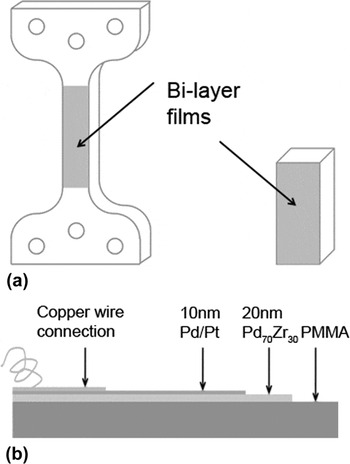
Polymethyl methacrylate (PMMA) tension and compression specimen geometry that serve as substrates for thin film deposition were first machined. A 20-nm thick Pd70Zr30 film was then deposited on the polymer substrate by co-sputtering on one face of each of these PMMA specimens using Pd (99.95% pure) and Zr (Grade 702) targets as sources. Then, two additional sets of bilayer specimens were produced by sputtering 10 nm thick Pd or Pt films on top of the 20-nm thick Pd70Zr30 layer. The thickness of 10 nm for Pd and Pt films was chosen to allow smooth and continuous coverage, to separate the “ligand effect” from the metallic glass underneath, while still retaining the ability to effectively transfer the applied strain elastically to the surface film. Schematic illustrations of the tensile and compression specimen geometry as well as a cross-section schematic of the bilayer film on the PMMA substrate are shown in Figs. 1(a) and 1(b). Good adhesion between the Pd–Zr metallic glass film and the PMMA substrate is expected based on our previous experience with the deposition of the Pd–Cu–Si glass on a similar substrate Reference Yang, Maark, Peterson and Kumar16 as well a published report of good adhesion between a Zr-based glass and a PMMA substrate. Reference Soinila, Sharma, Heino, Pischow, Inoue and Hanninen22 For comparison purposes and for establishing a baseline, single-layer specimens of both 20 nm-thick glassy Pd70Zr30 film and 10-nm thick pure crystalline Pd film were also directly deposited on to similar PMMA substrates by sputtering.
(a) Schematic illustrations of the tension and compression specimen geometry and (b) cross-sectional schematic of the bilayer film on the PMMA substrate.

X-ray diffraction (XRD) using Cu Kα radiation was used to examine the structure of the as-deposited Pd70Zr30 film as well as the bilayer Pd/Pd70Zr30 film. The surface quality of the specimens before and after deformation was examined using scanning electron microscopy (SEM) with careful attention being paid to evidence of specimen plastic failure/cracking following deformation. The composition of the as-deposited Pd70Zr30 film layer was measured using energy dispersive spectroscopy (EDS) by point scans at randomly chosen locations on the film.
The electrochemical measurements were conducted in a home-made three-electrode PVC cylindrical cell installed in an Instron 4505 tensile/compression test frame [Instron, Norwood, Massachusetts; see Figs. 1(a) and 1(b) in Ref. Reference Yang, Maark, Peterson and Kumar16 for further details]. This setup allows in situ measurements of electrochemical response while the specimen is subjected to uniaxial tension or uniaxial compression. All the electrochemical measurements during ORR were performed using an Autolab potentiostat (Metrohm USA Inc., Riverview, Florida) system. A Pt wire (Pine Research Instrumentation, Durham, North Carolina) served as the counter electrode, and a Ag/AgCl reference electrode (Pine Research Instrumentation) was used. All the electrochemical tests were performed at room temperature, with a scan rate of 50 mV/s.
Electrochemical stability of the (i) as-deposited single-layer Pd70Zr30 film, (ii) the bilayer Pd/Pd70Zr30 film, and (iii) the bilayer Pt/Pd70Zr30 film in the strain-free state was confirmed by cyclic voltammetry (CV) in O2-saturated 0.1 M NaOH for a duration of 100 cycles. Then, the ORR activity of all three films at four tensile strains (+0.5, +1, +1.5, and +2%) and four compression strains (−0.5, −1, −1.5, and −2%) was measured in O2-saturated 0.1 M NaOH by monitoring the CV curves and obtaining shifts in the potential as a function of strain at specified values of ORR current density. In such tests, the tensile or compressive specimen is mechanically loaded uniaxially to a given strain level, and held at that particular strain for the test duration which included 5 CV scan cycles. Four tension and four compression specimens for each of the three films were tested to ensure reproducibility.
To impose a pre-determined elastic strain on the thin film (single or bi-layer film), the approach adopted in this study is as follows. A PMMA specimen with no deposited film on it is first loaded either in tension or in compression as the case may be, and a load versus crosshead displacement curve is obtained and it is verified that the curve is linear for the range of displacement imposed. Based on the gauge section geometry, the load and displacement are converted to engineering stress and engineering strain. This calibration curve is then used for subsequent experiments where the thin films have been deposited on the PMMA substrate. Specifically, it is assumed that strain transfer is efficient, and the “composite” specimens are loaded to prescribed load values corresponding to the tensile or compression strains identified above by using the PMMA calibration curve.
The mean absolute surface roughness, R a, of the electrochemically tested film specimens was then measured using atomic force microscopy (AFM) and compared to the R a value of the as-deposited films to track any change in the surface roughness that may have occurred during the electrochemical-mechanical test. In addition, the surface roughness of the PMMA substrate and the surface roughness of the PMMA substrate with the PdZr glass layer deposited on it were also measured to provide a baseline for the measured absolute roughness.
III. RESULTS AND DISCUSSION
A. As-deposited thin film characterization
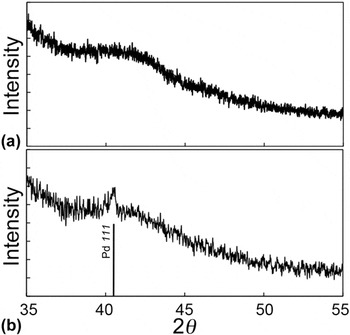
A single broad peak at 2θ ≈ 40° in the X-ray diffraction pattern obtained using monochromatic Cu Kα radiation confirmed the amorphous structure of the 20 nm Pd70Zr30 layer [Fig. 2(a)]. The composition of the as-deposited Pd70Zr30 layer varied within five atomic percent for the different specimens as confirmed by EDS. In contrast, for the bilayer Pd/Pd70Zr30 film, superimposed on the broad background peak was the characteristic highest intensity {111} peak of crystalline Pd [Fig. 2(b)], confirming that the 10 nm Pd is crystalline, while the Pd70Zr30 underneath is still amorphous. A similar X-ray diffraction pattern was also obtained for the bilayer film consisting of Pt/Pd70Zr30.
X-ray diffraction scans of (a) the as-deposited Pd70Zr30 metallic glass film and (b) the bilayer Pd/Pd70Zr30 film.

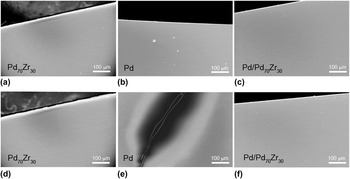
As-deposited films of Pd70Zr30, pure Pd, and bilayer Pd/Pd70Zr30 (each deposited on the PMMA substrate) were examined in the SEM. All three films were found to be continuous and smooth without any microcracks or microvoids [Figs. 3(a)–3(c)]. Furthermore, no evidence for microcracks or “shear bands” (a common deformation mode in metallic glasses) was found in the 20 nm Pd70Zr30 [Fig. 3(d)] or in the Pd/Pd70Zr30 bilayer [Fig. 3(f)] films after being deformed to 2% uniaxial tensile strain and unloaded, confirming that these specimens did not sustain visible permanent damage but deformed within the elastic regime. In contrast, significant cracking was noted in the 10 nm single-layer Pd directly deposited on the PMMA substrate when similarly deformed to 2% strain and unloaded [Fig. 3(e)]. This result indicates that the metallic glass Pd70Zr30 layer is necessary for the crystalline Pd top layer to sustain large elastic strain. Higher elastic strains cannot be achieved as the PMMA substrate could only be elastically deformed to about 2% strain as was previously determined by uniaxial tension tests. Reference Yang, Maark, Peterson and Kumar16 A similar response was also obtained for the Pt/Pd70Zr30 bilayer films when loaded in uniaxial tension.
SEM images of the as-deposited (on a PMMA substrate) films: (a) Pd70Zr30, (b) pure Pd, and (c) Pd/Pd70Zr30. SEM images of these films after extending to 2% strain and unloading to the strain-free state: (d) Pd70Zr30, (e) Pd, and (f) Pd/Pd70Zr30.

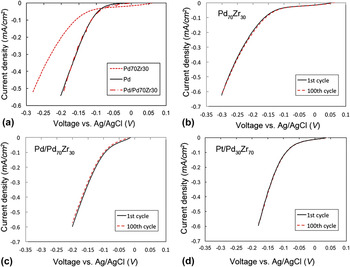
The ORR activity of the as-deposited, unstrained Pd70Zr30 film, Pd film, and the bilayer Pd/Pd70Zr30 films was measured in O2-saturated 0.1 M NaOH. As shown in Fig. 4(a), the catalytic activity of the 20 nm Pd70Zr30 film is much lower than that of the 10 nm Pd film during ORR, this likely being caused by the Zr. A similar behavior was also previously observed in PdCuSi metallic glass films. Reference Yang, Maark, Peterson and Kumar16 However, when the Pd70Zr30 film is coated with a 10 nm Pd film, the CV curve shifts back and overlays the CV curve of pure Pd (as might be expected), indicating that the 10-nm thick coating is enough to eliminate the influence of Zr in the metallic glass layer. A similar behavior was also observed for the Pt/Pd70Zr30 bilayer films.
(a) A comparison of the reduction sweep of CV scans for Pd70Zr30, Pd, and the Pd/Pd70Zr30 bilayer films during ORR, indicating that the 10-nm thick pure Pd coating is enough to eliminate the adverse influence of Zr in the metallic glass layer on catalytic response; (b–d) reduction sweep of CV curves that confirm that the as-deposited (b) Pd70Zr30, (c) Pd/Pd70Zr30, and (d) Pt/Pd70Zr30, films are all stable in the first 100 scan cycles.

The stability of the Pd70Zr30, Pd/Pd70Zr30 and the Pt/Pd70Zr30 films was examined to ensure that surface degradation and/or damage would not pose a problem during the straining tests and obscure interpretation of the results. The stability test results in Figs. 4(b)–4(d) show that after one hundred CV scan cycles in O2-saturated 0.1 M NaOH, all the films are stable, and there is no observable electrochemical behavior change. The number of cycles selected (100 cycles) exceeds the total number of cycles each film would experience through the entire strain history experiment (5 cycles at each of 5 different strains during loading, strain free state after unloading, and a maximum strain state during a second cycle re-loading—i.e. 5 cycles at each of 0 → 0.5 → 1 → 1.5 → 2 → 0 → 2% strain, adding up to 35 cycles).
B. Strain effects on the films
To evaluate the effect of elastic strain on the catalytic response of Pd70Zr30, Pd/Pd70Zr30 and the Pt/Pd70Zr30 films, all three types of films were tested as described in the experimental procedure section. As a baseline, 5 cycles of CV scans of the as-deposited specimens were first conducted immediately after the tensile/compression specimen was clamped in the electrochemical cell mounted in the Instron load frame. The PMMA tensile/compression specimens were then progressively mechanically deformed within the electrochemical cell to elastic strains of 0.5, 1.0, 1.5, and 2%. At each of these strain levels, 5 cycles of CV scan were obtained. The specimens were subsequently unloaded to 0% strain and another 5 cycles of CV scan were obtained; lastly, the specimens were again directly loaded to 2% strain and another 5 cycles of CV scans were obtained. These last two steps were designed to verify reproducibility of the initial strain-free response as well as in the 2% strained condition and to confirm that only elastic deformation took place in the film. In summary, each of the specimens experienced a total of 7 strain levels (i.e., 0 → 0.5 → 1 → 1.5 → 2 → 0 → 2%, either in uniaxial tension or in uniaxial compression, depending on the specimen geometry). Note that the strain changes the surface area by changing the bond lengths between atoms; however, it has been previously shown Reference Kai, Maark, Khorshidi, Sethuraman, Peterson and Guduru23 that it is valid to normalize all geometric current densities by the unstrained surface area (assuming that the number of active sites did not change with strain) for small strains in a similar experimental setup. Thus, in this study, we report all current density based on unstrained surface area. Also, to lucidly demonstrate the strain effect (potential shift, etc.) on the CV curves at multiple strain levels, only the reduction portion of the third CV scan (of the 5 scans conducted at each strain step) is presented.
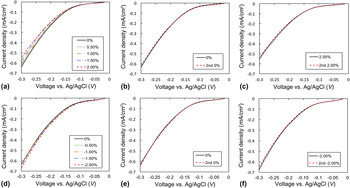
The ORR activity of the Pd70Zr30 metallic glass films as tracked by the reduction portion of the CV scan at different tensile strain levels [Fig. 5(a)] and compressive strain levels [Fig. 5(d)] illustrate a systematic shift in potential for a given current density. The curves collected at different tensile strain levels showed a continuous negative shift in potential with an increase in magnitude of the tensile strain, indicating that tensile strain suppresses the catalytic activity of the metallic glass films. In contrast, the curves revealed a continuous positive shift with an increase in magnitude of the compressive elastic strain, implying that compressive strain enhances the catalytic activity of the films during ORR although the change per unit strain does not appear to be as large as in tension. These trends are consistent with our previous results on the PdCuSi glass films. Reference Yang, Maark, Peterson and Kumar16
Reduction portion of the CV scans for Pd70Zr30 metallic glass films during ORR in the presence of uniaxial tensile (a–c) and uniaxial compressive (d–f) strain. (a and d) show the shift with increasing (magnitude) tensile/compressive strain. (b, c, e and f) confirm the reproducibility and reversibility of the strain effect on the films. At each strain level, 5 scan cycles were performed and the 3rd cycle is shown.

Figures 5(b) and 5(e) compare the response of the metallic glass film in the strain-free state before deformation with that obtained after fully unloading the specimen from 2% strain and it is seen that the two curves almost completely overlap; the curves compared in Figs. 5(c) and 5(f) were collected at the first excursion to 2% strain, and after unloading and reloading for the second time to 2% strain to further demonstrate reproducibility. These four sets of ORR curves [Figs. 5(b), 5(c), 5(e) and 5(f)] also provide indirect evidence for the film surface condition not deteriorating during these straining tests. In addition, they confirm that the elastic strain effect on the catalyst is almost fully reversible. We note that the dashed curves and the solid curves in Figs. 5(b), 5(c), 5(e) and 5(f) do not completely overlap (particularly at larger negative voltages) but the shift trends are not consistent (tension versus compression) to attribute the small differences to strain effects; the origin of this minor difference could be related to measurement inaccuracies or minor surface deterioration, but at this stage, this is only a speculation. In summary, the observed shifts of the reduction portion of the CV curves shown in Figs. 5(a) and 5(d) can therefore be considered a direct consequence of mechanically imposed elastic tensile/compressive strain. However, as mentioned previously, the initial catalytic activity of the single-layer Pd70Zr30 metallic glass films is inferior to that of pure Pd and Pt during ORR, likely due to the presence of Zr atoms on the film surface.
Thus, we next examine if the bilayer film can show similar strain effect up to ∼2% elastic strains, while simultaneously maintaining the superior catalytic activity characteristic of pure Pd or Pt during ORR. Analogous to the strain tests conducted on the single layer Pd70Zr30 metallic glass films, the bilayer specimens consisting of 10 nm Pd or Pt deposited on Pd70Zr30 films were also subjected to a two-cycle strain excursion (i.e., 0 → 0.5 → 1 → 1.5 → 2 → 0 → 2%) within the electrochemical cell, and as previously stated, at each strain, 5 CV scans were collected.
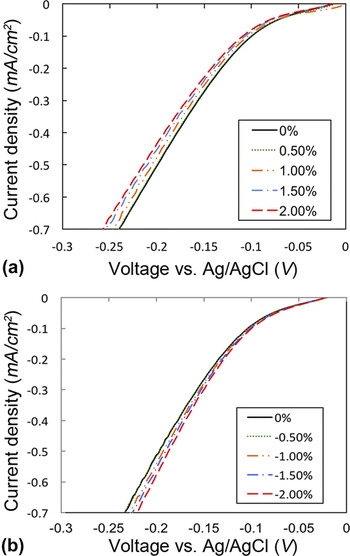
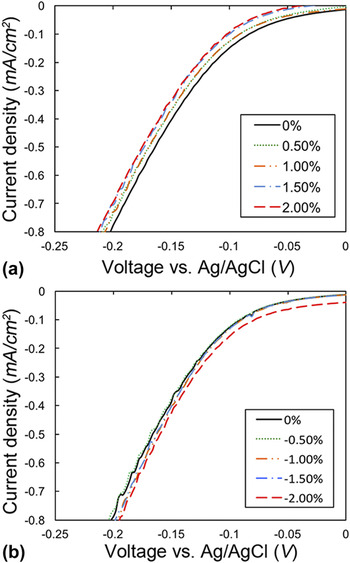
The electrocatalytic response of the Pd/Pd70Zr30 bilayer films at different tensile strain levels [Fig. 6(a)] and compressive strain levels [Fig. 6(b)] shows a systematic effect of strain similar to that previously observed for the Pd70Zr30 metallic glass films, but with a superior overall catalytic activity. The ORR activity continuously decreases with an increase in magnitude of the tensile strain, while the presence of a compressive elastic strain results in a corresponding increase in activity. To confirm the general applicability of strain effects on ORR response, the catalytic behavior of Pt/Pd70Zr30 [Figs. 7(a) and 7(b)] bilayer films in different tension and compression strain states was also examined. As seen in Fig. 7(a), in the presence of tensile strain, the curves for the Pt/Pd70Zr30 film show a systematic decrease in magnitude in ORR catalytic activity. In contrast, when a compressive strain is imposed, the ORR activity of the film increases [Fig. 7(b)] with increase in the magnitude of imposed compressive strain.
Reduction portion of the CV scans for Pd/Pd70Zr30 bi-layer films in the presence of uniaxial (a) tensile and (b) compressive strains showing the shift with increasing (magnitude) tensile/compressive strain.

Reduction portion of the CV scans for Pt/Pd70Zr30 bilayer films in the presence of uniaxial (a) tensile and (b) compressive strains showing the shift with increasing (magnitude) tensile/compressive strain.

Similar to the curves shown in Figs. 5(b), 5(c), 5(e) and 5(f), we also confirmed the reversible nature of the elastic strain effect on the Pd/Pd70Zr30 and Pt/Pd70Zr30 bilayer films. The ORR responses before deformation and after unloading from 2% strain overlap. Likewise, the catalytic activity of the film at 2% strain in the 1st cycle and in the 2nd cycle overlap, these experiments once again demonstrating reproducibility and the absence of film deterioration during the course of these experiments.
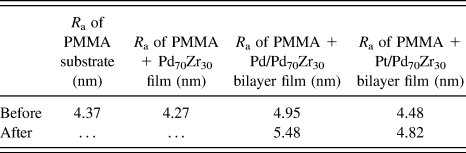
To assess physical changes to the film surfaces, the surface roughness of the Pd/Pd70Zr30 and Pt/Pd70Zr30 bilayer specimens was measured before and after the CV tests using an AFM in the tapping mode. For each of these bilayer films, two specimens were examined, and three areas (30 × 30 μm each) were randomly selected within each specimen to yield a total of six measurements. In addition, similar measurements were also made on the PMMA substrate, and after the PdZr glass film was deposited on it. This enables understanding the origin of the measured roughness on the bilayer film. The surface roughness is described by a mean absolute surface roughness, R a in Table I. The results show that the absolute value of surface roughness of the films of around 4–5 nm is primarily a consequence of the surface roughness of the PMMA substrate that is carried through on the film surface. The change in the R a value for the Pd/Pd70Zr30 bilayer film after the electrochemical tests is 0.53 nm, and the corresponding change for the Pt/Pd70Zr30 bilayer film is even less at 0.34 nm. These results indicate that the geometric current density is an appropriate measure in this study, and the number of the catalytic sites is not expected to be significantly affected.
Average surface roughness (R a) a of the PMMA substrate, the PMMA substrate with the Pd70Zr30 film deposited on it and of the PMMA + the bilayer films before and after electrochemical tests.

a A total of 6 AFM scans were performed on 2 different specimens (2 × 3 scans) in each case; individual measurements encompassed a 30 × 30 μm area.
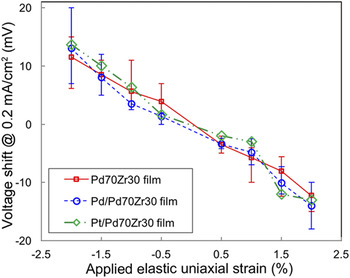
The effect of applied elastic strain on voltage change relative to the strain-free state for Pd70Zr30, Pd/Pd70Zr30, and Pt/Pd70Zr30, is compared in Fig. 8. The data in Fig. 8 were obtained from the reduction portion of the CV scans in Figs. 5–7 at a fixed current density (0.2 mA/cm2). The error bars in Fig. 8 show the scatter in data for multiple specimens at the same strain level for each of the three types of films. All these thin films show the same trend in voltage change due to elastic strain during ORR. Compressive strain enhances the catalytic activity while tensile strain suppresses it. Furthermore, we note that the magnitude of “the strain effect” is marginally different in these three different materials at the same current density, but generally fall in the range of ∼10 mV shift per one percent strain increase.
The influence of an externally applied uniaxial tensile and uniaxial compression strain on the voltage shift at a fixed current density of 0.2 mA/cm2 (during ORR and extracted from the reduction portion of the CV curves in Figs. 5–7) is shown relative to the voltage at the same current density at zero strain for the Pd70Zr30, Pd/Pd70Zr30, and Pt/Pd70Zr30 films deposited on a PMMA substrate.

As shown in Figs. 4(b)–4(d), in Figs. 5(b), 5(c), 5(e) and 5(f) and in Table I, the surface of all the Pd70Zr30, Pd/Pd70Zr30, Pt/Pd70Zr30 films were proven to be stable during these strain tests through stability tests for 100 cycles, through reproducibility tests and from surface roughness measurements by AFM. Further, the ORR response for all these films was collected under the same chemical environment. Therefore, the chemical “ligand effect” if any is present, is negligible and observations can be attributed to the “strain effect” on ORR activity in this study.
A similar strain effect was observed experimentally previously Reference Yang, Maark, Peterson and Kumar16 in a PdCuSi metallic glass film and DFT simulations showed that an elastic compressive strain can down-shift the Pd d-band center. This down-shift weakens the bonding between the Pd surface and adsorbates, thereby increasing the catalytic activity of Pd (and Pt) in ORR. The relationship between the electronic structure of the catalyst and adsorption properties has also been examined previously using the d-band model by Nørskov et al. Reference Hammer and Nørskov24,Reference Nilsson, Pettersson, Hammer, Bligaard, Christensen and Nørskov25 A similar description can be used to explain the strain effect that we measured in Pd70Zr30, Pd/Pd70Zr30, and Pt/Pd70Zr30 films in this study.
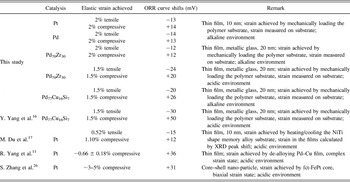
In Table II, the ORR curve-shifts due to elastic strain that were measured in this study are compared to those previously reported in literature. Reference Yang, Leisch, Strasser and Toney11,Reference Yang, Maark, Peterson and Kumar16,Reference Du, Cui, Cao and Bard17,Reference Zhang, Zhang, Jiang, Zhu, Guo, Su, Lu and Sun26 The general observation is that the magnitude of change is consistent across the different studies and that tensile strain suppresses the ORR activity while compressive strain enhances it. Care however must be exercised in these comparisons with regards to (i) the state of strain which depends on the way it is imposed, (ii) the way the strain is measured, (iii) the specific catalyst being compared, and (iv) the environment in which the catalyst was strained. Whereas the results in this study (as well as those in Ref. Reference Yang, Maark, Peterson and Kumar16) are from uniaxial tension and compression tests (where a lateral Poisson contraction (in tension) or extension (in compression) is present), the state of strain on the surface of a film generated by heating and cooling the substrate Reference Du, Cui, Cao and Bard17 is biaxial (tension or compression) as would be the case in a core–shell particle Reference Zhang, Zhang, Jiang, Zhu, Guo, Su, Lu and Sun26 or more complicated in de-alloying Reference Yang, Leisch, Strasser and Toney11 and therefore can account for some differences. Another point to note is the accuracy/validity of the reported magnitude of strain which is often indirect, Reference Yang, Leisch, Strasser and Toney11,Reference Zhang, Zhang, Jiang, Zhu, Guo, Su, Lu and Sun26 whereas in this study, the strain is obtained by external application of a mechanical load. Lattice parameter-based differences that result in a single reported strain value may not necessarily completely reflect the biaxial strain state present on the film surface and its consequence on catalytic response, particularly if it is not equi-biaxial tension or equi-biaxial compression due to crystallographic stiffness anisotropy. Lastly, we note that while this study predominantly focused on using an alkaline environment, our previous study on PdCuSi glass Reference Yang, Maark, Peterson and Kumar16 was performed in an acidic environment. To determine whether the environment (acidic versus alkaline) influences the magnitude of shift due to strain, in Table II, we have compared our results for the PdCuSi glass film and the PdZr glass film in both environments. We note that the response in the acidic environment is larger in both instances as compared to the alkaline environment.
Quantitative comparison of results from this study with previously published studies on strain effects on metal catalysis in ORR.

A limitation of the methodology adopted in this study (and in Ref. Reference Yang, Maark, Peterson and Kumar16) is that a home-designed electrochemical cell directly installed onto an Instron machine is used, with the catalytic films being deposited on dog-bone or cuboidal shaped substrate geometries; this prevents cathode rotation during the in situ electrochemical tests and so, the performance recorded is likely to be limited by oxygen diffusion. Nevertheless, if we assume that the diffusive conditions are equivalent for a group of samples, the trends evidenced should be valid on a comparative basis. Importantly however, the approach enables to clearly and systematically demonstrate the influence of different amounts of mechanically imposed tensile and compressive strains on catalytic response on a single specimen.
IV. CONCLUSIONS
In this study, we provide direct experimental evidence for the strain effect on the ORR catalytic activity of Pd and Pt thin films using a bilayer film system. A quantitative relationship between the level of imposed elastic strain and the change in ORR activity is documented. An intermediate 20 nm-layer of a Pd70Zr30 metallic glass film appears necessary to enable a significant level (2%) of mechanically applied elastic strain (both uniaxial tension and compression) to be sustained by these 10 nm-thick crystalline metal films of Pd and Pt. Since during the whole process, the morphology and composition of the films remain the same, the “strain effect” is successfully isolated from the effect of surface area change and “ligand effect”. Our experimental results confirm the general trend that compressive elastic strain enhances the catalytic activity of Pd and Pt during ORR, while tensile elastic strain suppresses it. These results are in agreement with predictions of the d-band theory, as well as our previous study on PdCuSi metallic glass, Reference Yang, Maark, Peterson and Kumar16 confirming the generality of these experiments and interpretations. They suggest the possibility of improving and controlling electrochemical reaction rates by actively controlling the strain on the catalyst surface, with potential implications in areas such as fuel cells and energy storage applications.
ACKNOWLEDGMENT
This material is based upon work supported by the U.S. Army Research Laboratory and the U.S. Army Research Office under the Multidisciplinary University Research Initiative (MURI) grant number W911NF-11-1-0353 at Brown University.