Introduction
Major depressive disorder (MDD) has frequently been associated with structural brain differences (Macqueen & Frodl, Reference Macqueen and Frodl2010; Kempton et al. Reference Kempton, Salvador, Munafo, Geddes, Simmons, Frangou and Williams2011). One of the often proposed underlying mechanisms is that chronic or severe stress, including childhood maltreatment (CM), stressful life events and stress hormones (e.g. cortisol), moderates the associations (McEwen, Reference McEwen2008). One brain structure that is thought to be particularly vulnerable for the detrimental effects of stress is the hippocampus (Sapolsky et al. Reference Sapolsky, Krey and McEwen1986; McEwen, Reference McEwen2001). This structure is highly sensitive to neurotoxic effects of increased glucocorticoid levels (Knoops et al. Reference Knoops, Gerritsen, van der Graaf, Mali and Geerlings2010). Experimental animal studies have shown that chronic stress can cause atrophy or remodelling of the apical dendrites of the pyramidal neurons in the CA3 region of the hippocampus (Sapolsky et al. Reference Sapolsky, Krey and McEwen1986; McEwen, Reference McEwen2001). In humans, smaller hippocampal volume is a frequently observed finding in patients with MDD (Kempton et al. Reference Kempton, Salvador, Munafo, Geddes, Simmons, Frangou and Williams2011; Price & Drevets, Reference Price and Drevets2012) and is also a consistent finding in individuals reporting a history of CM (Frodl & O'Keane, Reference Frodl and O'Keane2013; Chaney et al. Reference Chaney, Carballedo, Amico, Fagan, Skokauskas, Meaney and Frodl2014). The hippocampus plays an important role in regulating stress responses and is a major feedback site for glucocorticoids (McEwen & Magarinos, Reference McEwen and Magarinos1997). A smaller hippocampus may result in less inhibition of the hypothalamus-pituitary-adrenal axis (Sapolsky et al. Reference Sapolsky, Krey and McEwen1986) making an individual more prone to develop stress-related disorders. It has also been shown that a smaller hippocampal volume in patients with MDD is related to poorer prognosis (Frodl et al. Reference Frodl, Koutsouleris, Bottlender, Born, Jager, Scupin, Reiser, Moller and Meisenzahl2008). Because the hippocampus is the major brain structure for spatial learning a smaller hippocampus is also related to memory deficits (Squire & Zola-Morgan, Reference Squire and Zola-Morgan1991).
In the current study we are primarily interested in the possible moderating effects of CM on the association between MDD and hippocampal volume, because CM is a major risk factor for the onset of MDD (Kessler et al. Reference Kessler, Davis and Kendler1997) and because two earlier studies showed that hippocampal volume loss is more pronounced in persons with MDD who also have a history of CM (Vythilingam et al. Reference Vythilingam, Heim, Newport, Miller, Anderson, Bronen, Brummer, Staib, Vermetten, Charney, Nemeroff and Bremner2002; Frodl et al. Reference Frodl, Reinhold, Koutsouleris, Reiser and Meisenzahl2010). It has even been suggested that a smaller hippocampal volume due to CM may render individuals more susceptible for the onset of MDD (Rao et al. Reference Rao, Chen, Bidesi, Shad, Thomas and Hammen2010).
We therefore sought to investigate the relationship of MDD with hippocampal volume reduction in persons with and without a history of CM in two large independent cohort studies: a sample of 636 middle-aged and older persons with manifest arterial disease from the Second Manifestations of ARTerial disease-Memory, depression and ageing (SMART-Medea) study, and a sample of 262 adults with and without MDD from the Netherlands Study of Depression and Anxiety (NESDA). In both cohort studies we also examined the influence of several clinical characteristics, including remission of MDD and age of onset of MDD. By using data from two independent cohort studies we are able to replicate our findings, decreasing the chance of false-positive results.
Method
Study populations
SMART-Medea study
Data were used from the SMART-Medea study (Geerlings et al. Reference Geerlings, Appelman, Vincken, Mali and van der2009; Gerritsen et al. Reference Gerritsen, Comijs, van der Graaf, Knoops, Penninx and Geerlings2011), a prospective cohort study in patients with a history of arterial disease with the aim of investigating how brain changes are associated with depression and psychosocial vulnerability and stress factors. The SMART-Medea study is an ancillary study to the SMART-MR study, which has been described in more detail elsewhere (Geerlings et al. Reference Geerlings, Appelman, Vincken, Mali and van der2009). In brief, between May 2001 and December 2005, 1309 patients newly referred to the University Medical Center Utrecht with coronary artery disease, cerebrovascular disease, peripheral arterial disease or abdominal aortic aneurysm, and without magnetic resonance imaging (MRI) contraindications were enrolled in the SMART-MR study. Between April 2006 and May 2009, 710 participants participated in the follow-up when measurements of stress factors and depression were added as part of the SMART-Medea study. In the current study data from this first follow-up measurement are used.
The SMART-MR study and SMART-Medea study were approved by the ethics committee of our institution, and written informed consent was obtained from all participants. From this section onwards we will refer to the SMART-Medea study as the ‘SMART study’.
For the 636 patients for whom manual segmentation of the hippocampus was available, missing covariates were imputed using multiple imputation. Missing data rarely occur at random, and a complete case analysis (deletion of all participants with one or more missing values) leads to loss of statistical power and to biased results. We therefore used multiple imputation (10 datasets) to address the missing values (Donders et al. Reference Donders, van der Heijden, Stijnen and Moons2006) using the AregImpute package of the statistical program R (version 2.10.0, R Foundation, Austria).
NESDA study
The NESDA study is a large cohort study on the course of depressive and anxiety disorders, including a total of 2981 respondents that were recruited from the community, general practice care, and specialized mental healthcare. The study sample included persons with depressive or anxiety disorders as well as control subjects without lifetime psychiatric diagnosis. For objectives and methods of the NESDA, see Penninx et al. (Reference Penninx, Beekman, Smit, Zitman, Nolen, Spinhoven, Cuijpers, De Jong, Van Marwijk, Assendelft, Van Der Meer, Verhaak, Wensing, de Graaf, Hoogendijk, Ormel and Van Dyck2008). A subset of the NESDA participants (both patients and controls) was selected to undergo MRI scanning for the NESDA-MRI study (N = 301). Inclusion criteria for patients in the NESDA-MRI study were current MDD and/or anxiety disorder (panic disorder and/or social anxiety disorder and/or generalized anxiety disorder in the past 6 months according to DSM-IV criteria). Exclusion criteria for both patients and controls were the presence or history of major internal or neurological disorder, dependency or recent abuse (past year) of alcohol or drugs; hypertension (⩾180/130 mmHg), heavy smoker (⩾5 cigarettes/day), and general MRI contraindications. High-resolution anatomical images were obtained from 289 participants (imaging data from 12 participants were excluded because of poor image quality).
The research protocol was approved by the ethics committee of the participating universities and all participants provided written informed consent.
For these 289 participants missing data on covariates was imputed by applying multiple imputation for 10 datasets, using the mi package in R (version 3.1.1). In the current study we were solely interested in the effect of MDD and abuse and therefore participants with a pure anxiety disorder (e.g. without co-morbid MDD) were excluded from analysis (N = 27), leaving 262 participants for the analysis.
CM
In both cohorts, CM was assessed with the Nemesis Trauma Interview (Spijker et al. Reference Spijker, de, Bijl, Beekman, Ormel and Nolen2002). Participants were asked whether they had experienced emotional neglect, psychological abuse, physical abuse, and/or sexual abuse before age 16 years. Emotional neglect was described as ‘people at home didn't listen to you, your problems were ignored, and you felt unable to find (receive/obtain) any attention or support from the people in your house’. Psychological abuse was described as ‘you were cursed at, unjustly punished, your brothers and sisters were favoured – but no bodily harm was done’. Physical abuse was described as ‘Were you being abused physically, meaning being hit, kicked, beaten up or other types of physical abuse?’ and sexual abuse was described as ‘Were you sexually abused, meaning being touched or having to touch someone in a sexual way against your will?’ When participants answered yes to one or more of the above questions we classified them as having a history of CM.
Diagnosis of MDD
In both cohorts, the presence of MDD in the preceding 12 months was assessed according to DSM-IV criteria using the Composite International Depression Interview (CIDI, version 2.1; Robins et al. Reference Robins, Wing, Wittchen, Helzer, Babor, Burke, Farmer, Jablenski, Pickens and Regier1988), which was administered by extensively trained research staff members. Participants were asked at which age they had first experienced a MDD episode. The age ranges in NESDA and SMART are rather dissimilar. Therefore, to make results more comparable among these two cohort studies we chose to define early-onset of MDD as a first episode of MDD reported at age ⩽40 years and late-onset of MDD as a first episode reported at age >40 years.
Participants were defined as having remitted MDD if they did not fulfil the criteria for MDD in the previous 12 months, but did report one or more episodes prior to the previous 12 months.
MRI protocol and brain parameters
SMART-Medea
Imaging data were acquired using a Philips 1.5-T system (Philips, The Netherlands). For hippocampal measurements a sagittal T1-weighted 3D fast field echo sequence was conducted (repetition time 7.0, echo time 3.2 ms, matrix size 240 × 256, voxel size 1 mm3, 170 slices). The sagittal T1-weighted images were tilted to the coronal plane and orientated perpendicular to the long axis of the left hippocampus.
Manual outlining of hippocampal volumes was performed by two trained investigators blinded to all clinical information. The hippocampus was outlined on an average of 40 slices and included the hippocampus proper, subiculum, fimbria, alveus, and dentate gyrus. We started at the first slice where the hippocampus was visible as the anterior boundary. More posterior, the dorsal boundary was defined by CSF and choroid plexus, which was not included in the measurements. The posterior border was defined as the slice before the total length of the fornix was visible. For more details on protocol see Knoops et al. (Reference Knoops, Gerritsen, van der Graaf, Mali and Geerlings2010).
Intracranial volume was measured by adding up grey matter, white matter, white-matter lesions (WML), and CSF volumes obtained with automated segmentation (Anbeek et al. Reference Anbeek, Vincken, van Bochove, van Osch and van der Grond2005). Periventricular WML were defined as adjacent to or within 1 cm of the lateral ventricles. Deep lesions were located in deep white-matter tracts with or without adjoining periventricular lesions. These two types of WML were summed and because the variable had a skewed distribution, we applied natural logarithm transformation.
NESDA
Imaging data were acquired using Philips 3-T MR systems (Philips, The Netherlands) located at the participating centres, equipped with a SENSE-8 (Leiden University Medical Center and University Medical Center Groningen) and a SENSE-6 (Amsterdam Medical Center) channel head coil. At every site the same MRI protocol was applied. For each subject, an anatomical image was obtained using a sagittal 3D gradient-echo T1-weighted sequence (repetition time 9 ms, echo time 3.5 ms, matrix 256 × 256, voxel size 1 mm3, 170 slices).
Intracranial volume was assessed using FreeSurfer image analysis suite (v. 5.0.1, Martinos Center for Biomedical Imaging, Harvard-MIT, USA), which is documented and freely available for download (http://surfer.nmr.mgh.harvard.edu/). Coronal MRI results were reformatted to axial images without interpolation, and then the Analyze format was converted to the FreeSurfer mgz format. FreeSurfer analyses were performed at one site using all available NESDA MR images. The process of FreeSurfer's intracranial volume estimation has been described previously in detail in a developers’ publication (Buckner et al. Reference Buckner, Head, Parker, Fotenos, Marcus, Morris and Snyder2004).
Hippocampal volumes were assessed using automatic subcortical volumetric segmentation with the FreeSurfer software as well. The technical details of these procedures have been described previously (Fischl et al. Reference Fischl, Salat, Busa, Albert, Dieterich, Haselgrove, van der Kouwe, Killiany, Kennedy, Klaveness, Montillo, Makris, Rosen and Dale2002). Briefly, this fully automated process includes motion correction, removal of non-brain tissue, automated Talairach transformation, segmentation of the subcortical white-matter and deep gray-matter volumetric structures (including hippocampus, amygdala, caudate, putamen, ventricles), intensity normalization, and cortical reconstruction. This segmentation procedure assigns a neuroanatomical label to every voxel in the MR image volume. The method is based on probabilistic information estimated from a manually labelled training set.
Covariates
As a first step we selected possible confounders based on the literature (Raz et al. Reference Raz, Rodrigue, Kennedy and Acker2007; Knoops et al. Reference Knoops, Gerritsen, van der Graaf, Mali and Geerlings2010; McEwen & Gianaros, Reference McEwen and Gianaros2010) and then tested each possible confounder in our data by adding it to linear regression models with hippocampal volume as outcome and MDD and CM as independent variables. If the association between the independent variables and hippocampal volume changed by ⩾10% then it was considered to be a confounder and added as a covariate to the analysis of covariance. The following variables were considered as covariates: age, sex, educational level in years of education in NESDA and in grades of education in SMART-Medea, systolic and diastolic blood pressures (mmHg), smoking status (current smoker v. current non-smoker), alcohol intake (no alcohol, regular alcohol, excessive alcohol intake) diabetes mellitus and antidepressant use (any current use of SSRIs, SNRIs, TCAs or MOA inhibitors) (Penninx et al. Reference Penninx, Beekman, Smit, Zitman, Nolen, Spinhoven, Cuijpers, De Jong, Van Marwijk, Assendelft, Van Der Meer, Verhaak, Wensing, de Graaf, Hoogendijk, Ormel and Van Dyck2008; Gerritsen et al. Reference Gerritsen, Comijs, van der Graaf, Knoops, Penninx and Geerlings2011). Additionally, in SMART-Medea general cognitive abilities were tested using the Mini Mental State Examination (MMSE; Folstein et al. Reference Folstein, Folstein and McHugh1975).
In NESDA MR images were conducted at three different locations, to overcome a possible effect of scanning site the location of scanning was added as a covariate.
Data analysis
We first estimated the main effects of CM and MDD on hippocampal volume in separate linear regression models. Second, we examined whether there was an interaction between MDD and CM by adding both independent variables and an interaction term (MDD × CM) to one linear regression model. Third, in case of significant interaction, the data were stratified on the basis of having a history of CM. In these two groups (CM− and CM+) we used analysis of covariance, to examine the associations between a current 1-year diagnosis of MDD and total hippocampal volume.
All analyses were adjusted for possible confounding by adding age, gender, highest attained educational level, intracranial volume, body mass index, blood pressure, diabetes mellitus, alcohol use, smoking habit and antidepressant use as covariates to the models. To control for possible cognitive ageing and cerebrovascular effects in the SMART study, the analyses were additionally adjusted for MMSE score and WML volume. All these analyses were conducted in SPSS (IBM SPSS Statistics 2013, version 22).
In explorative analyses we also looked at possible lateralization (left v. right hemisphere) effects. We repeated the analysis of the last model with left and right hippocampal volumes as outcome in two separate models. Furthermore, we conducted additional analysis to explore the effect of clinical characteristics of MDD using separate linear regression models for acuteness (current 1-year diagnosis of MDD v. remitted MDD) and age of onset of MDD (early-onset v. late-onset). Last, we explored potential gender differences by adding interactions between CM × gender, MDD × gender and CM × MDD × gender to the original CM × MDD interaction model.
As a fourth step we conducted pooled analyses, first by pooling the estimates from data analysis steps 1 and 2 and second by pooling the fully adjusted means from data analysis step 3, by using the ‘meta’ package (version 3.6.0) in R (version 3.0.1). For pooling the estimates we used the ‘metagen’ function and for pooling the adjusted means we used the ‘metacont’ function. These analyses were performed using random effects to overcome the heterogeneity among the two studies and as outcome Hedges’ g was used, which is comparable to Cohen's effect size with a correction for bias from sample sizes (Hedges & Olkin, Reference Hedges and Olkin1985). Additionally, the percentage difference effect size is also provided to aid neurobiological interpretation of the data.
Results
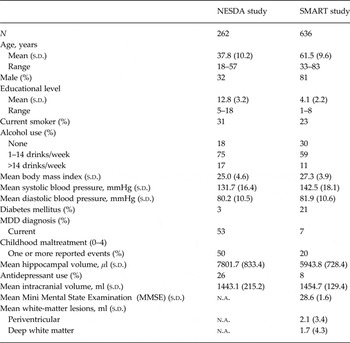
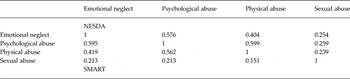
Table 1 shows the characteristics for the two study populations. As can be seen, participants from SMART were older and more often male, had diabetes more often than the NESDA participants. Because the NESDA study was purposefully designed to investigate MDD and anxiety, the participants in NESDA more often had an MDD diagnosis and reported more CM events than the SMART participants. The most often reported type of CM in both studies was emotional neglect and the separate traumata were moderately to highly correlated (Table 2), as can be seen the correlations were very comparable among the two cohort studies.
Sample characteristics

Missing data occurred in the following variables for the SMART study: smoking status (3.5%), alcohol use (3%), MMSE (2.2%), Diabetes mellitus (1.5%), MDD diagnosis (6%), childhood maltreatment (4%) and antidepressant use (3%).
Missing data occurred in the following variables for the NESDA study: smoking status (2%) and alcohol use (1.5%), diabetes mellitus (3%) and systolic blood pressure (<1%).
Pearson correlations between reported childhood maltreatment events

In the upper-right part of table correlations within NESDA study are presented; in the lower-left part of table the correlations for the SMART study are presented.
All correlations are significant p < 0.05.
Main effects of CM and MDD
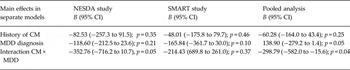
In both studies, a history of CM was not significantly related to hippocampal volume, see Table 3 (all p > 0.05). A diagnosis of MDD within the year prior to the study was not related to hippocampal volume either; however, after pooling the estimates of the two studies the effect of MDD became significant (−138.90 mm3, 95% CI −279.2 to 1.4, p = 0.05).
Main effects of CM and MDD on hippocampal volume (mm3)

CM, Childhood maltreatment; MDD, major depressive disorder.
Adjusted for age, gender, highest attained educational level, intracranial volume, body mass index, blood pressure, diabetes mellitus, alcohol use, smoking habit and antidepressant use (and in SMART additionally for white-matter lesions and cognitive functioning).
CM × MDD
The interaction term between CM and MDD reached borderline significance in the NESDA study (p for interaction term = 0.052), but not in the SMART study (p for interaction term = 0.37). After pooling the interaction terms of the two studies it became significant (−298.79, 95% CI −582.0 to −15.6, p = 0.04).
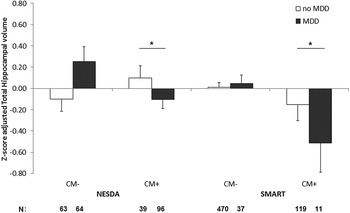
After stratifying the data on having a history of CM we found that in NESDA, participants without a history of CM showed no significant relationship between MDD and hippocampal volume (B = 167.9 mm3, 95% CI −119.2 to 455.1, p = 0.25), but in participants with a history of CM, MDD was associated with smaller hippocampal volume (B = −316.8 mm3, 95% CI −589.8 to −43.8, p = 0.023), which corresponded to a 3% smaller volume.
In SMART, participants without a history of CM showed no significant relationship between MDD and hippocampal volume (B = −120.52 mm3, 95% CI −345.7 to 194.9, p = 0.24), but in participants with a history of CM, MDD was associated with smaller hippocampal volume (B = −407.56 mm3, 95% CI −811.4 to −3.4, p = 0.046), which corresponded to a 6% smaller volume.
To compare the results of both studies, we computed Z scores of hippocampal volume (Fig. 1).
Association of childhood maltreatment (CM), major depressive disorder (MDD) and hippocampal volume; *p < 0.05. Adjusted for age, gender, highest attained educational level, intracranial volume, body mass index, blood pressure, diabetes mellitus, alcohol use, smoking habit and antidepressant use (and in SMART additionally for white-matter lesions and cognitive functioning).

Pooling results from the two studies
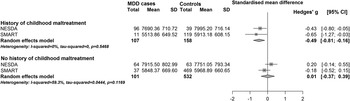
Fig. 2 shows the pooled estimates for the two studies. The heterogeneity statistics did not reach significance, meaning that the pooled estimate is reliable. Overall, there was no significant association between MDD and hippocampal volume in participants without CM (Hedges’ g 0.01, 95% CI −0.38 to 0.39), whereas in participants with a history of CM, MDD was associated with smaller hippocampal volume (Hedges’ g −0.47, 95% CI −0.78 to −0.16).
Pooled results of effects of childhood maltreatment and major depressive disorder (MDD) on hippocampal volume. Means are adjusted for age, gender, highest attained educational level, intracranial volume, body mass index, blood pressure, diabetes mellitus, alcohol use, smoking habit and antidepressant use (and in SMART additionally for white-matter lesions and cognitive functioning).

Exploratory analysis
Supplementary Table S1 shows the results of the exploratory analyses in which we looked at possible lateralization effects. None of the findings were significantly different between left- and right-sided hippocampal volume (all Z scores for difference <1.96, p > 0.05) (Altman & Bland, Reference Altman and Bland2003). Supplementary Table S2 shows the results of the analysis on clinical characteristics of MDD (acuteness of MDD: current 1-year diagnosis of MDD v. remitted MDD, and age of onset of MDD: early- v. late-onset). For total hippocampal volume we found no significant effects of acuteness of MDD or age of onset of MDD (all p > 0.05).
Discussion
In this study we show that a diagnosis of MDD in the last year is associated with smaller hippocampal volume and that this is specifically seen in those participants who also had experienced a history of CM.
Smaller hippocampal volume is one of the most frequently reported structural brain findings in MDD (Macqueen & Frodl, Reference Macqueen and Frodl2010; Price & Drevets, Reference Price and Drevets2012). In line with our findings, a study among women with MDD also found that smaller hippocampal volume was found in women with a history of childhood abuse but not in women without a history of childhood abuse (Vythilingam et al. Reference Vythilingam, Heim, Newport, Miller, Anderson, Bronen, Brummer, Staib, Vermetten, Charney, Nemeroff and Bremner2002). Particularly stress early in life is thought to affect structural brain measures, as the maturation of particular the medial temporal lobe and prefrontal cortex continues into adolescence (Lupien et al. Reference Lupien, McEwen, Gunnar and Heim2009). Consequently these brain areas may be more vulnerable to environmental adversities during childhood and adolescence (Andersen & Teicher, Reference Andersen and Teicher2008).
In the current study we found a main effect of MDD on hippocampal volume, but found no additional effects of age of onset or acuteness of disease (current v. remitted MDD). Several meta-analyses have shown that MDD is related to smaller hippocampal volume (Macqueen & Frodl, Reference Macqueen and Frodl2010; Kempton et al. Reference Kempton, Salvador, Munafo, Geddes, Simmons, Frangou and Williams2011) and other studies have suggested that in remitted MDD the hippocampus is less affected than in current MDD (Frodl et al. Reference Frodl, Koutsouleris, Bottlender, Born, Jager, Scupin, Reiser, Moller and Meisenzahl2008). Moreover, age of onset of MDD is thought to impact the effect of MDD on hippocampal volume, but both stronger effects in early-onset and late-onset MDD have been reported (Janssen et al. Reference Janssen, Hulshoff Pol, de Leeuw, Schnack, Lampe, Kok, Kahn and Heeren2007; Ballmaier et al. Reference Ballmaier, Narr, Toga, Elderkin-Thompson, Thompson, Hamilton, Haroon, Pham, Heinz and Kumar2008). We found no effect of age of onset or acuteness probably because the design of the two studies were not ideal to look into these clinical features; in the NESDA study all participants were aged <50 years making it impossible to investigate late-onset MDD and in the SMART study we did not have detailed information on course of MDD nor of previous episodes of MDD. However, previously, within the SMART study we did show that early-onset depression was related to smaller hippocampal volume, whereas late-onset depression was not (Gerritsen et al. Reference Gerritsen, Comijs, van der Graaf, Knoops, Penninx and Geerlings2011).
It has long been assumed that the decrease in hippocampal volume is a result of MDD, as some studies found that hippocampal volume increased after remission and because animal studies showed that chronic stress leads to decreased hippocampal volume as well (Sapolsky et al. Reference Sapolsky, Krey and McEwen1986; Joels, Reference Joels2008). However, a debate has been started recently on whether smaller hippocampal volume could also be a risk factor for the development of MDD as some studies suggest that smaller hippocampal volume antedates the onset of depression (Rao et al. Reference Rao, Chen, Bidesi, Shad, Thomas and Hammen2010; Amico et al. Reference Amico, Meisenzahl, Koutsouleris, Reiser, Moller and Frodl2011). For instance, one study found that healthy offspring of patients with MDD showed significantly smaller hippocampal volumes than persons with no family history of MDD (Amico et al. Reference Amico, Meisenzahl, Koutsouleris, Reiser, Moller and Frodl2011), while another study found that particularly individuals who show a smaller hippocampal volume after having experienced childhood adversity are susceptible for the onset of MDD (Rao et al. Reference Rao, Chen, Bidesi, Shad, Thomas and Hammen2010). It may thus well be that only individuals who carry a certain predisposition are vulnerable for the detrimental effects of stress early in life and may thus show hippocampal volume loss and eventually may develop a psychiatric disorder.
There is, however, a complex relationship between parental psychopathology, CM and genetics; children of parents with psychopathology are at greater risk for developing psychopathology, not only because of the shared genetic make-up but also because they are more likely to have grown up in a less favourable environment, including possible CM (Nanni et al. Reference Nanni, Uher and Danese2012). This means that in our study we are not able to disentangle whether persons with MDD and CM have smaller hippocampal volume due to the experience of CM or due to shared disadvantageous genetic make-up.
Even though it is possible that CM causes hippocampal volume loss that may eventually lead to a larger risk to develop MDD, it is impossible to discern cause from consequence in our cross-sectional design. Patients with MDD do not only more often have a history of CM, but due to their negative mood they may also report more CM, compared to non-depressed individuals. However, findings from a follow-up measurement within the NESDA study when childhood trauma was assessed 4 years later suggest that CM at the baseline measurement (current study) was assessed reliably and, moreover, was not dependent on current mood state (Spinhoven et al. Reference Spinhoven, Penninx, Hickendorff, van Hemert, Bernstein and Elzinga2014). An explanation may be that in our study the smaller hippocampal volume in individuals with a history of CM and MDD represent the effect of a more severe depression; however, the observed relationship could not be explained by severity of depressive symptoms on hippocampal volume in either study (data not shown).
The main strength of this study is that we investigated the exact same association in two completely independent populations, which differed on many variables. MDD and CM were assessed in comparable ways, and also the heterogenic statistics showed that the estimates of the studies could be pooled together. Despite large differences in study participants and MRI protocols we found similar associations. MRI protocols differed on field strength (1.5 T v. 3 T) and hippocampal volume assessment (manual v. automatic). By pooling the data using random effects we accounted for the heterogeneity of the combined data and at the same time the differences among the two studies make the external validity of our findings stronger.
A limitation of the CM assessment is that it was done retrospectively, which may have led to underreporting of events. Moreover, in the SMART study CM was assessed using a written questionnaire, whereas in the NESDA study, participants were interviewed personally (using the exact same questions as in the SMART study). The difference in presentation of the CM questions may partly explain why the participants in NESDA reported a much higher frequency of CM than the SMART participants. However, it should be noted that the correlation structure among the four subtypes of maltreatment was highly comparable in the two studies, suggesting that we indeed measured the same kind of CM.
To conclude, our study shows in two independent cohorts, particularly in individuals with a history of CM, that a diagnosis of MDD is related to smaller hippocampal volume. Prospective studies are needed to further investigate whether hippocampal volume is a cause or a consequence of MDD and through what mechanisms CM moderates this relationship.
Supplementary material
For supplementary material accompanying this paper visit http://dx.doi.org/10.1017/S0033291715001415.
Acknowledgements
The infrastructure for the NESDA study (www.nesda.nl) is funded through the Geestkracht program of the Netherlands Organization for Health Research and Development (Zon-Mw, grant number 10-000-1002) and is supported by participating universities and mental health care organizations [VU University Medical Center, GGZ inGeest, Arkin, Leiden University Medical Center, GGZ Rivierduinen, University Medical Center Groningen, Lentis, GGZ Friesland, GGZ Drenthe, Institute for Quality of Health Care (IQ Healthcare), Netherlands Institute for Health Services Research (NIVEL) and Netherlands Institute of Mental Health and Addiction (Trimbos)]. L.G. is supported by a Netherlands Organisation for Scientific Research VENI grant (ZonMW 916-14-016).