Introduction
The factors that influence health services utilisation by older people have received considerable attention. Health status, sex, age, level of education and health coverage have all been seen as influences on utilisation (Andersen Reference Andersen1995; Evashwick et al. Reference Evashwick, Rowe, Diehr and Branch1984). It is well known that as people grow older, their use of health services increases. Nevertheless, few research projects have investigated the conditions of service use particular to different sub-groups of older people, and specifically those with disabilities. Many in this group receive care and support from other people in their social networks. In this regard, it is important to understand in what ways formal and informal care influence the receiver's use of health services. These relationships have not been sufficiently studied. In this paper, we analyse the role of types of care on the utilisation of health services by old people with disabilities in Spain.
People need to maintain their basic activities in order to remain autonomous and live independently. These basic or essential actions have come to be known as the Activities of Daily Living (ADLs). ‘Such activities are typically divided into three categories: physical ADL, which refers to the most basic personal care tasks; instrumental ADL, which is concerned with more complex activities needed for independent living; and mobility (ability to get around), items which may be included in the first two categories’ (Fillenbaum Reference Fillenbaum and Maddox1995: 7–9).Footnote 1 When older adults have difficulties with ADLs, there are four possible combinations of help: (1) from informal care, (2) from formal care, (3) from informal and formal care, and (4) none. Informal care has been defined as the support provided by a member of the social network (Walker, Pratt and Eddy Reference Walker, Pratt and Eddy1995). Some researchers have pointed out that informal care has an altruistic motivation (Instituto de Mayores y Servicios Sociales [Institute for Older People and Social Services] (IMSERSO) 2004). Informal care involves physical, emotional and informational support (Harlton, Fast and Keating Reference Harlton, Fast and Keating1998; IMSERSO 2004; Rodríguez Reference Rodríguez Rodríguez2006), and informal care-givers undertake many different tasks, such as administering medication, helping to bathe or dress, cooking and negotiating with health and social services. The kinds of tasks performed depend most on the type and severity of the care-receiver's disabilities. Some care needs are met by formal care, the defining characteristics of which are that it is provided: (1) in exchange for money (salary or wage); (2) by a trained professional; or (3) by a formal organisation (e.g. private companies, public services, or non-profit organisations).
There is evidence that informal and formal care helps older people to maintain their health, psychological wellbeing and social status, and that its level is related to income and the level of education (Durán Reference Durán2003). It has been argued that both types of care contribute to increase older people's autonomy (Harlton, Fast and Keating Reference Harlton, Fast and Keating1998). Much domiciliary care is designed to prevent people having to move into institutional settings. It has also been shown that informal and formal care have different outcomes for care receivers, because of their different efficacy in delivering various care tasks and providing emotional support (Willmot Reference Willmot1986). Although there are more and more studies of care delivery to older people, and the effect of social networks on the utilisation of health services has been examined (Wolinsky, Mosely II and Coe Reference Wolinsky, Mosely and Coe1986; Litwin Reference Litwin1997; Linden et al. Reference Linden, Horgas, Gilberg and Steinhagen-Thiessen1997; Kouzis and Eaton Reference Kouzis and Eaton1998), the influence of informal and formal care on older people's health services use is not well understood. Andersen (Reference Andersen1995) recognised the social network as an important factor in the use of health services, and Wan (Reference Wan1987) suggested that social support promotes access to health and social services. More closely related to the present analysis, a study in the United States by Van Houtven and Norton (Reference Van Houtven and Norton2004) found that informal care for older adults by their adult children reduced health-services utilisation.
This paper has five sections. The first discusses the theory related to formal and informal care for older adults, the second describes the main characteristics of the Spanish public system of health and social care for older adults, and the third describes the data and methods used in the analysis. The results are reported in the fourth section, which is followed by a discussion of their implications for the understanding of older people who are disabled and who receive formal and informal care.
Formal and informal care for older adults
Many researchers have tried to disentangle which factors distinguish the use of formal as opposed to informal care and of both. Previous research has shown that age, gender, availability of informal care, and level of disability probably have most influence on the kind of care received by older adults who need help with daily activities. People living alone are less likely to receive informal care (Herlitz Reference Herlitz1997), so the availability of potential care-givers is crucial. Men are more likely to receive informal care than women, and women are more likely to receive formal care and both types of care. Previous research has suggested that the reasons for these gender differentials are: (1) that availability of informal carers is higher for men (essentially because men are more likely to have wives than women are to have husbands); and (2) that women live longer and on average have lower health status (Puime Reference Puime2004), and so need higher levels of care. Demographic and cultural factors have also been used to explain the gender differences in the availability of informal care (Bazo and Domínguez-Alcón Reference Bazo and Domínguez-Alcón1996; Ungerson Reference Ungerson1987).
The age of the care receiver is another crucial variable. The greater an older person's age, the greater the likelihood that she or he has limitations in carrying out daily activities. Age is also related to the size and composition of people's family and social networks. With increasing age, the number of potential care-givers declines, which is one reason why women on average receive less informal care than men. Given that chronic diseases are the main generator of difficulties in daily activities for older adults, the health status of individuals is strongly related to the need for care and support. Formal care is mainly used when the levels of disability and health-care needs are high (Blandford and Chappell Reference Blandford and Chappell1991). Its utilisation depends on factors such as the level of development of public services and the income of the receiver and her or his family. The boundary between formal personal care and health care is unclear, for some tasks provided by professional health-care providers (e.g. licensed nurses) extend to personal care.
Previous research has suggested that the relationship between formal and informal care is complex. Several studies have shown that usually the time given by informal carers is greater than the time spent by formal carers, and that the two groups deliver different types of care (Durán Reference Durán2002; Wimo et al. Reference Wimo, Strauss, Nordberg, Sassi and Johansson2002). Davey and Patsios (Reference Davey and Patsios1999) found that in the United States and Great Britain, the receiving of formal care was positively associated with that of informal care, and that only a small percentage of people received only formal services. The type of care has important consequences for receivers and their social networks. It is well known that being an informal carer has a substantial impact on the everyday lives of care-givers and their families (for a comprehensive review see Fast, Williamson and Keating Reference Fast, Williamson and Keating1999). There is some evidence that delivering informal care has a negative impact on care-givers’ finances (Montoro Reference Montoro1999; Dosman, Keating and Fast Reference Dosman, Keating and Fast1998; Andersson, Levin and Emtinger Reference Andersson, Levin and Emtinger2002), psychological well-being (Dwyer, Lee and Jankowski Reference Dwyer, Lee and Jankowski1994; Starrels et al. Reference Starrels, Ingersoll-Dayton, Dowler and Neal1997; Eales, Keating and Fast Reference Eales, Keating and Fast2001), and time use (Nissel and Bonnerjea Reference Nissel and Bonnerjea1982; Folbre and Bittman Reference Folbre and Bittman2004).
The negative impacts of informal care have been conceived as various kinds of losses or costs: employment-related, out-of-pocket expenses, of unpaid labour, physical strain, negative effects on social life, and emotional strain (Fast, Williamson and Keating Reference Fast, Williamson and Keating1999). Positive consequences of informal care, as perceived by both care-givers and care-receivers, have also been found (Brouwer et al. Reference Brouwer, Van Exel, Van den Berg, Van den Bos and Koopmanschap2005). It has been shown that many men caring for their spouses experience senses of competence and control, and that adult children who are carers commonly feel that they are returning the care that they received when they were young (Raschick and Ingersoll-Dayton Reference Raschick and Ingersoll-Dayton2004). Despite the vast literature on informal and formal care and the consequences for the receivers and their social networks, the connection between type of care and the receivers' use of health services has received little attention.
The Spanish public system of health and social care
Access to health services is an important determinant of health (Wilson and Rosenberg Reference Wilson and Rosenberg2002; Raphael Reference Raphael2004). The Spanish Constitution of 1978 established the right of all citizens to health protection and health care, and to put this into effect the government established the National Health System with public financing and the requirement to provide universal and equitable coverage (Ministerio de Sanidad y Consumo 2006).Footnote 2 Medical consultations, emergency services, and hospitalisation are non-discretionary services, while some limitations to universal coverage exist in mental, pharmacological and dental services (Fernández-Mayoralas, Rodríguez and Rojo Reference Fernández-Mayoralas, Rodríguez and Rojo2000). Older people are the principal adult users of the health services (IMSERSO 2002). Correspondingly, hospital service use has increased in the last few years as a result of population growth and the rising average age along with other factors (Gènova Maleras, Álvarez Martín and Morant Ginestar Reference Gènova Maleras, Álvarez Martín, Morant Ginestar, Puyol Antolín and Abellán García2006). It has been argued that in health-care systems that provide equitable access to services, demographic characteristics and health status are more likely to explain variations in health services utilisation than socio-economic status, income and education (Andersen Reference Andersen1995). Previous research in Spain supports this general proposition, since the health-care system is universal, although there are exceptions (as with dental services) in which income has a greater influence on utilisation (Fernández-Mayoralas, Rodríguez and Rojo Reference Fernández-Mayoralas, Rodríguez and Rojo2000).
Alongside the health services, personal social services for long-term care, especially to provide assistance with the instrumental and personal activities of daily living, are a crucial support system for older people, particularly those with disabilities. It is recognised that their care needs should be met through both health and social care services (Sancho Castiello and Díaz Martín Reference Sancho Castiello, Díaz Martín, Puyol Antolín and Abellán García2006). Social services for long-term care in Spain are less well developed than in most developed countries (Defensor del Pueblo Reference Defensor2000). Access to social care is not universal, but the government assists people with low incomes and high levels of dependency (Sancho Castiello and Díaz Martín Reference Sancho Castiello, Díaz Martín, Puyol Antolín and Abellán García2006). Nevertheless, the Spanish social care system will probably change during the next decade as a result of the Ley de Promoción de la Autonomía Personal y Atención a las Personas en Situación de Dependencia [Law to Promote the Personal Autonomy and Care of Dependent People], which was approved by the Spanish Congress in November 2006.Footnote 3 Among the public care services for disabled older people in Spain, the most important are home-care services, day-care centres, telecare at home, and rest homes for seniors. All these formal care services have increased in recent years, but there are important differences in levels of provision across the country. The highest demand is for home-care services, but their development has been restricted by a severe lack of resources (Sancho Castiello and Díaz Martín Reference Sancho Castiello, Díaz Martín, Puyol Antolín and Abellán García2006).
In 2003 in Spain, about 20 per cent of those aged 65 or more years reported that they required support from other people to maintain ADLs (Abellán García and Esparza Catalán Reference Abellán García, Esparza Catalán, Puyol Antolín and Abellán García2006). It has been estimated that in 2004, 1.23 million older adults received informal care and 109,700 received formal care (IMSERSO 2005). The number of Spanish older adults who have unmet or under-met needs is not well established. Different sources suggest that women constitute between 71 and 84 per cent of all informal care-givers (INE 2002; IMSERSO 2005). Most informal carers are very close relatives of the people in need. In 1999, about 80 per cent of the main care-givers of people aged 65 or more years were family, friends or neighbours (INE 2002); hence people who were emotionally attached to receivers by kinship or friendship ties. The family is the greatest source of informal care of older Spanish adults, with friends and neighbours playing a much smaller role.
Several sources have provided systematic and representative data on formal and informal care in Spain (including the Balearic and Canary Islands). The Encuesta sobre Discapacidades, Deficiencias y Estado de Salud [Survey on Disabilities, Impairment and Health Status] carried out in 1999 had a sample of about 220,000 individuals, and provides detailed information about receivers and some characteristics of formal and informal care-givers (Instituto Nacional de Estadística 2002). The Encuesta de Condiciones de Vida de los Mayores [Survey on Life Conditions of Older People] carried out by the IMSERSO in 2004 had a sample of 2,007 persons aged 65 or more years, among who 531 reported that they needed help with ADLs and they identified their care-givers. The Survey on Informal Support to Older Adults in Spain 2004, carried out by the IMSERSO was the only representative survey specifically on informal care-givers in Spain over the last decade. It has information from 1,504 care-givers of people aged 60 or more years, and data on both main and secondary care-givers. Given that the sample was only of informal care-givers, it did not represent all types of care received by older adults in Spain. In this sense, the most recent survey that is representative of different types of care received by Spanish older people and with the largest sample is the Spanish Health Survey of 2003.
Data and methods
The main data source for the analysis was the Encuesta Nacional de Salud de España (ENSE) [National Health Survey of Spain] of 2003, carried out by the Ministry of Health and Consumption and the National Institute of Statistics (Instituto Nacional de Estadística 2003). The most important objectives of this survey were to provide information on the health status and problems of the population. It featured questions on chronic diseases, pain, limitations in activities, support and accidents. ENSE 2003 had a stratified sample that was representative of the national population and each of the autonomous communities. Three different questionnaires for those living in non-institutional settings were administered: a household questionnaire, a questionnaire for adults, and a questionnaire for children. A total of 21,650 adults (aged 16 or more years) and 6,463 children were interviewed, and socio-demographic information for every household member was collected. The information was normally gathered through face-to-face interviews (only in exceptional cases by telephone interviews). For people who had difficulties responding to the questions, proxies living in the same home were authorised to answer. A total of 6,134 people aged 65 or more years were interviewed. From this sample we selected those who reported needing help with ADLs and who identified their care provider and those who reported that they did not receive care. To focus on those who needed long-term care, respondents who indicated that their problems had lasted (or would last) less than one year were eliminated from the sample. The final sample for analysis had 1,148 cases.
The measures
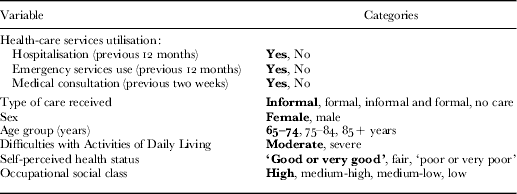
Table 1 shows the principal variables used in the analysis and their categories. Three health services utilisation variables were chosen: hospitalisation, emergency service use, and medical consultations.Footnote 4 Hospitalisations and emergency services use were measured as presentations during the previous 12 months. Medical consultations were measured in terms of people who had consulted any medical doctor during the previous two weeks. The response categories were either ‘yes’ or ‘no’ for all three measures.
Variables and categories in the analysis
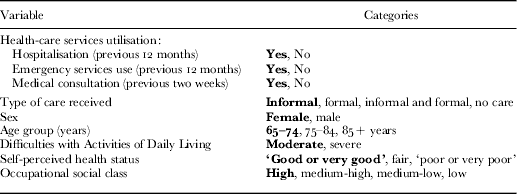
Note: Reference categories are indicated by bold font.
The independent variables were: sex, age, level of difficulty in daily activities, type of care received, self-perceived health status, and social class. The level of difficulties with ADLs had four self-assessed categories: ‘none’, ‘moderate’, ‘severe’, and ‘absolute’. To have sufficient cases for useful statistical analyses, the ‘severe’ and ‘absolute’ categories were merged. The ages of the care receivers were represented by three age groups: 65–74, 75–84, and 85 or more years. Three categories of self-perceived health status were used: ‘very good’, ‘good or fair’, and ‘poor or very poor’. The social class variable was that developed by the Spanish Epidemiology Society (Regidor Reference Regidor2001) and is based on level of education and occupation. It has four categories: ‘high’ (higher grade professionals, managers or administrators in public or private organisations in occupations normally requiring university degrees), ‘medium-high’ (routine non-manual employees), ‘medium-low’ (qualified and semi-qualified manual workers), and ‘low’ (unskilled workers).
The dependent variable was the care provided in four categories: ‘informal’, ‘formal’, ‘informal and formal’, and ‘none’. ‘Informal’ was defined as the care provided: (1) from the kin or friendship network of the care receiver, (2) by a person who did not receive a salary or wage for this work, and (3) by a person without any affiliation to a care-providing organisation. By contrast, ‘formal’ carers: (1) received money or (2) worked for any kind of care-provider organisation. Note that the variable did not distinguish the number of different providers.
Results
Care and health services use among older people with disabilities
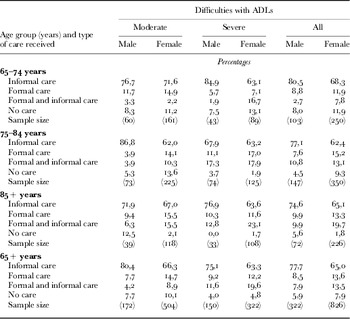
The type of care received by the 1,148 older people with disabilities varied by sex, age and level of disability (Table 2). A higher proportion of men (78%) received informal care than women (65%), whereas the opposite applied to formal care (9% and 14% respectively) and to the receipt of both forms of care (8% and 14%). These differences are thought to arise from the greater availability of informal care among men, the higher life expectancy of women and their greater levels of disability. Among the oldest age groups, the need for care was relatively great and formal provision was comparatively important. Approximately 73 per cent of older adults aged 65–74 years received only informal care, while 17 per cent received formal care or both types together. In contrast, the percentage of people aged 85 years old and over who received informal care was lower (67%), and the percentage receiving formal or both types of care rose to 30 per cent. In a similar way, those without any care varied from 11 per cent in the youngest age group to three per cent among the oldest. Turning to the measures of health-care services utilisation, 28 per cent indicated they had been hospitalised during the previous year, 46.5 per cent that they had used emergency services, and 59.9 per cent that they had consulted a medical practitioner.
Profile of the sample by age, gender, source of care, and level of difficulty with the activities of daily living, Spain 2003

Notes: The percentages were calculated for the standardised sample. Authors' calculations.
Source: Encuesta Nacional de Salud de España (ENSE) [National Health Survey of Spain] 2003.
The relationships between type of care and health-services use
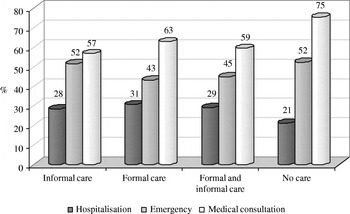
The analysis of the relationships of interest began with cross-tabulations of the dependent and independent variables and continued with the estimation of a binomial logistic regression model for each type of use. The forward stepwise estimation method was used (Garson Reference Garson2006). The descriptive findings are similar to those from previous studies of hospitalisation, emergency-services utilisation and medical consultations. As expected, utilisation increased with age and the level of difficulty with daily activities, and was high among people with poor self-perceived health status; and there were the expected gender differences. Men had higher levels of hospitalisation than women (33% compared to 26%), but men were less likely to contact physicians than women (55% versus 61%). In spite of the higher mortality and hospital morbidity of older men (IMSERSO 2005), older women revealed greater levels of difficulties in daily activities and chronic diseases, and were more likely to rate their health as poor (Redondo-Sendino et al. Reference Redondo-Sendino, Guallar-Castillón, Ramón Banegas and Rodríguez-Artalejo1999; Schellhorn et al. Reference Schellhorn, Stuck, Minder and Beck2000). A lower proportion (21%) of those who received no help were hospitalised than those who received either or both formal or informal care (Figure 1). A lower proportion of formal care receivers used the emergency services than those who did not receive such care. Finally, a higher proportion (75%) of those who did not receive any type of care consulted physicians.
Health services users by type of care received, Spanish population with disabilities aged 65 or more years, 2003.

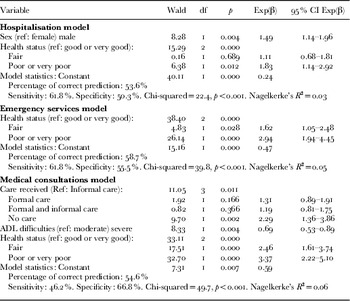
The first regression model examined the determinants of hospitalisation (Table 3). Sex and health status were statistically significant. Relative to women, the odds ratio for men shows that they were 49 per cent more likely to have been hospitalised during the previous year. The likelihood of being hospitalised was 83 per cent higher among those with ‘poor’ or ‘very poor’ health than among those with ‘good’ or ‘very good’ health. Age, level of difficulties with ADLs, social class, and type of care were not significantly associated with having been hospitalised (p>0.05). It is possible that the influence of age and level of difficulty were neutralised by the health status effect. This model correctly classified 53.6 per cent of the respondents, and was statistically significant (p<0.001).
Logistic regression models of influences on health services utilisation, people aged 65 or more years with chronic ADL disabilities, Spain 2003

Notes: The sample size for all three models was 1,148. ref: reference case. Exp(β) is the exponential of the beta coefficient or odds ratio. CI: confidence interval. ‘Sensitivity’ refers to the percentage of correct predictions in the reference category of the dependent variable (1 for binary logistic regression), and ‘Specificity’ refers to the percentage of correct predictions in the given category of the dependent variable (0 for binary logistic regression).
The second model examined the determinants of emergency services use (Table 3). The only statistically significant selected variable was health status: compared to those with ‘good’ or ‘very good’ health, those whose health was ‘fair’ were 62 per cent more likely to use the emergency services, and those with ‘poor’ or ‘very poor’ health status were almost three times more likely to use these services. The model correctly classified 58.7 per cent of respondents.
The third model examined the variables that influence medical consultations (Table 3). The statistically significant variables were health status, level of difficulty with ADLs, and type of care received, while sex, social class and age did not enter the model. Comparing people with ‘good’ or ‘very good’ health, people with ‘fair’ health were 2.5 times more likely to consult a practitioner, and people with ‘poor’ or ‘very poor’ health more than three times more likely. People with severe difficulties were significantly less likely to consult a practitioner than people with moderate difficulty. The odds ratios indicate that the probability of consulting a practitioner within the last two weeks varied significantly by the type of care received. Relative to those who received informal care, those who received no care were twice as likely to consult a practitioner. The model correctly classified 54.6 per cent of the cases. The medical consultation model revealed a significant difference between those who received informal care and those who had no care, but no other significant differences were found among the groups receiving different types of care. The low explained variance (R 2) of the regression models could reflect limitations in the measures used in the analysis. It is possible that more refined measurements would produce higher variance. Three other models (not reported in this paper) that explored different relationships between groups of people by type of care were tested, but no significant relationships were found.
Discussion
The main objective of this paper was to examine the relationships between the type of care received by older people with disabilities and their health services use with models that controlled for sex, age, level of difficulty in daily activities, self-perceived health status and the social class of the care receivers. The results confirm some previous findings, such as that older people's self-perceived health status is a strong predictor of service utilisation. As the Andersen behavioural model (Reference Andersen1995) suggests, the level of need was a strong predictor of utilisation. The role of this factor is especially significant for universal health-care systems, as in Spain, where access is not mediated by income (Fernández-Mayoralas, Rodríguez and Rojo Reference Fernández-Mayoralas, Rodríguez and Rojo2000). We also found that gender influenced the level of hospitalisation and corroborated earlier findings from Spain, that men are more likely to be hospitalised than women (Fernández et al. Reference Fernández, Schiaffino, Badia, Rajmil and Segura1999; Guallar-Castillón et al. Reference Guallar-Castillón, Redondo Sendino, Banegas, Lopez-Garcia and Rodriguez-Artalejo2005). Regarding the level of difficulties in daily activities, the results indicate that those with severe difficulties were less likely to contact a physician than those with moderate difficulties. This can be explained by the type and level of care being received, for those with a high level of disabilities received more care than those with moderate disabilities. Another possible interpretation is that it is more difficult for people with severe disabilities to travel, and they are therefore less likely to consult physicians.
The findings draw attention to the influence of the type of care on health services use. Previous work showed that in the United States, the provision of informal care to older people by adult children reduces health-care services use, particularly that of home health care and nursing homes (Van Houtven and Norton Reference Van Houtven and Norton2004). We observed that informal care reduced the likelihood of consulting physicians, but contrary to Van Houtven and Norton's results, found that the probability of having been hospitalised was not associated with receiving informal care. Wan's (Reference Wan1987) study of functionally disabled older people in Virginia indicated that social support, in terms of the provision of instrumental support and a relatively strong social interaction network, had a direct and positive influence on the use of health and social services, the effects being slightly greater on the use of social services than on that of physician services. Noro, Hakinnen and Laitinen (Reference Noro, Hakinnen and Laitinen1999) examined the determinants of health services use in a sample of 60–79 year-olds in Finland; they found similar results to ours on the role of perceived health and the sex of the care receiver, but no association between informal help and health services utilisation.
The findings support the proposition that social support substitutes for some tasks that are usually done by health professionals, since the results indicated that older people with disabilities who received no care were more likely to contact physicians than those who received informal care. No statistically significant relationships were found, however, between formal home care and health services use. On the one hand, it can be argued that family or friends undertake tasks that otherwise would be performed by physicians, such as giving advice, providing medication and even making provisional diagnoses, although it is impossible to know to what extent informal care-givers contribute to more positive or negative health outcomes. On the other hand, the findings are consistent with the notion that physicians not only provide medical care to older people, but also psychological and emotional support (Rabinowitz et al. Reference Rabinowitz, Feldman, Gross and Boerma1998; Curtis et al. Reference Curtis, Wenrich, Carline, Shannon, Ambrozy and Ramsey2001). For older people with slender social networks, this function might be particularly important, and might explain why the respondents who received no care contacted physicians more often. Since we were unable to control for psychological and emotional support in the analysis, this explanation is hypothetical and requires further research.
Limitations of the analysis
Several limitations of the presented research should be considered when interpreting the findings and in future research. Only individuals who reported a ‘permanent’ health problem that caused difficulties with ADLs were included in the analyses. It is possible that relationships between the described variables might change if people without difficulties had been included. Secondly, the analysis was cross-sectional. Longitudinal data are required to examine the outcomes of different types of care on the health of older people, and would throw more light on the dynamic relationships among care receiver, informal care-givers and health services utilisation. Larger samples are also needed to explore specific situations (e.g. different types of difficulties, different types of informal and formal care, and different reasons for using health care services) and to confirm these findings. Longitudinal data would also provide a clearer understanding of why the older people with disabilities who did not receive any form of informal or formal care saw physicians more often. It might be that this finding is an artefact of the question asked, in that variations in contact with physicians might be sensitive to the 14-day enumeration period – we know that over 12 months almost every respondent had contact with a physician.Footnote 5 Lastly, even though access to the Spanish health care system is supposed to be independent of wealth and geographic factors, because the direct and indirect costs of travel to clinics are not covered by the state health system or private health insurance, it would be interesting to explore whether income and ‘distance to health centre’ are associated with health-services utilisation.
Conclusions
The findings of this study suggest that in contemporary Spain, there is an interaction between the provision of informal care to older people with disabilities and their health-services utilisation. Informal care provides not only personal care and social support but also health care, hence it reduces the demands for medical consultations. While the Spanish public health service achieves near universal access according to need, the public system of personal social services is not well developed. The resulting lack of social services reflects (and requires) the predominant role of the family in caring for older people with disabilities. The relationship between informal care and medical consultations implies that family care relieves not only the public social care system but also public health care. Families, especially women, are making a substantial contribution to both types of care in maintaining the health and quality of life of older people in Spain. Our findings indicate that informal care-givers, the public health care system and the public system in social care are inter-connected, and that a change in one implies change in the others. The current development of the Spanish public social care system by the Law of Personal Autonomy Promotion and Care for Dependent People demands accurate data about the potential consequences of these changes. In this sense, it is expected that a better delimitation of the respective functions of health-care and social-care systems would increase the quality of these services.
The second implication concerns whether the health-care and social-support needs of older people with disabilities are appropriately and adequately met by informal care-givers. On the one hand, some people who receive informal care do not go to the doctor when maybe they should. There is no information about whether those who defer seeing a physician might have more or more severe health problems in the future. The possibility that important health-care needs which are not being met lead to a greater quantity or severity of health problems has important implications for policy makers, and emphasises the importance of identifying which people are not receiving appropriate and timely health care and of finding ways to address this issue. Greater effort should be directed to identifying cases of unmet health-care needs and particularly of serious cases of ‘shut-ins’ or exclusion from medical care. A third implication follows from the tentative evidence that health-care professionals contribute to meeting the psychological and emotional needs of older people with disabilities. It is that an improvement in personal social-services care that meets these needs would reduce the requirement for medical consultations for non-medical reasons.
Finally, the fourth implication is linked to informal care-givers. Our findings indicate that informal care-givers perform tasks that imply significant levels of responsibility and risk regarding the health of care receivers. It is unclear to what extent these responsibilities contribute to increased stress and strain among informal care-givers. A better understanding of families' care roles among public health and social care professionals would help in the development of appropriate complementary support. In this sense, care-givers and receivers should be properly informed about the range of formal care services on which they can call. Specifically, care-givers' training programmes may help them to know whether they should provide informal care to their disabled kin or seek advice from health professionals. In spite of this study's limitations, it has provided new information about the consequences of the different types of care that older people with disabilities receive for their utilisation of health-care services. The findings should make a useful contribution to planning and developing co-ordinated health care and long-term formal and informal personal and social care. Further research is required to deepen our understanding of the influence of the different types of care on health services use by older people and of the specific role of informal care-givers in promoting the health of elderly people.
Acknowledgements
This work was supported through grants from the Spanish Council for Scientific Research – CSIC – (I3P-BPD2003-1, reference project SEC2002-00504) and the Spanish Ministry of Education and Science (BES-2004-6170, reference project BSO2003-00401). The authors would like to thank the anonymous referees and especially the editor for their helpful suggestions.