In the 1980s and 1990s, Amartya Sen drew our attention to the “missing women” of the developing world. Given sex ratios at birth, he suggested, about one hundred million women were absent from the population as a result of excess female mortality.Footnote 1 Scholars have since fine-tuned the estimated number and examined the social and demographic consequences of both “missing women” and “surplus men.”Footnote 2 Some have argued that sex imbalance stems primarily from cultural preferences for sons, resulting in abortions of female fetuses and infanticide or neglect of unwanted daughters. Others have attempted to find biological explanations for “missing women,” such as the possibility that mothers infected with hepatitis B may be more likely to produce sons. For the most part, the “cultural” school seems to be in ascendancy, and both governments and the United Nations have tried to reduce excess female mortality by treating it as a cultural problem.Footnote 3 The response to Sen's analysis has thus shaped the ways that scholars think about economy, demography, and society in the developing world.
This article asks whether women were similarly “missing” from the population of late medieval England and reflects on what it might mean if indeed they were. I propose that late medieval English men may have outnumbered women by a significant margin, perhaps as high as 110 to 115 men for every 100 women. My data suggest that fewer females survived to adulthood and that those who did may have died younger than their husbands and brothers. Historians of medieval England have said little about the possibility of a skewed sex ratio, yet if women were indeed “missing” from the population as a whole in a significant and sustained way, the consequences for our understanding of English history are important. At a minimum, the data suggest that we cannot safely assume parity of sexes nor, as some have suggested, that there were fewer men than women in postplague England.
In what follows I first survey briefly the existing historiography on sex ratios in late medieval England and the sparse evidence available from documentary sources. I then discuss the ways in which historians might use evidence from skeletal remains. These findings are drawn from reports of fifteen parish and local cemeteries, and suggest not only excess female mortality in childhood but also earlier mortality among adult women. I speculate briefly about the causes of this pattern: if indeed a skewed sex ratio existed, it probably resulted from a combination of causes. Nutritional, environmental, and/or metabolic differences between males and females seem particularly likely culprits, although I also consider whether the gap might be explained partly by infanticide and/or maternal mortality. I conclude with some tentative suggestions about the demographic, social and economic, and cultural consequences if women were indeed fewer and sicklier than men.
Worldwide today, about 107 boys are born for every 100 girls. This ratio at birth is remarkably consistent, despite small variations in sex ratios at conception and during pregnancy.Footnote 4 Because girls tend to be healthier than boys as infants and young children, the ratio almost balances out by maturity. According to 2012 worldwide estimates, men outnumber women by about 102 to 100 among those aged 15–64. For those over 64, the ratio is lowered once again: about 80 men survive for every 100 women. While total population sex ratios vary among different regions of the world, they seldom fall below 95 or above 105 males to every 100 females without some readily explicable circumstance such as gendered migration, warfare, sex-selective abortions, or consistently poor treatment of girls and women.Footnote 5 These numbers thus provide a benchmark for examining medieval ratios. As Josiah Cox Russell expressed in his survey of British medieval population in the 1940s, “[A]ny marked divergence [from a sex ratio of 100 men for every 100 women] causes suspicion that some tampering with human life has occurred.”Footnote 6 Thus even small disparities in the sex ratio may reflect significant and ingrained patterns in the everyday lives and general health of medieval women and men.
The Historiography of Sex Ratios
Medieval sex ratios have been mentioned, at least in passing, for many decades, but only a few individuals have addressed the issue directly. Russell, for instance, suggested that male and female sex ratios were approximately even in the mid-thirteenth century but that the proportion of women then began to decline. Although the mid-fourteenth-century plague temporarily equalized ratios, he argued, men again started to outnumber women during the fifteenth century. Russell derived these ratios mostly from inquisitions postmortem, documents recording the deaths of the wealthiest members of medieval English society. But based on a survey from 1390, he also noted “an unmistakable deficiency in the number of female children” of medieval serfs. In addition, Russell examined the proportions of women and men in poll tax returns (discussed below), concluding that women were more likely to be found in larger towns. Russell did not quite claim that the English practiced infanticide in this period, although he did raise the possibility.Footnote 7 Barbara Hanawalt expressed similar concerns, given that more boys than girls appeared before orphans' courts in late medieval London. Hanawalt noted that the disparity between the numbers of boys and girls entering wardship fluctuated over time and argued that fewer girls may represent early female mortality. She also suggested that women's lower survival rate was worthy of further analysis by historians, a suggestion that seems largely to have been ignored.Footnote 8 Indeed, Jim Bolton has argued tentatively that there may have been more women than men after the plague and that the plague itself was more likely to single out men.Footnote 9
Sex ratios have also been considered in passing by historians seeking to situate medieval England within broader demographic regimes such as the “Northwest European marriage pattern.” This model is characterized by a late average age of marriage, a high proportion of individuals who never marry, and a period of life cycle service in another household. John Hajnal, one of the most important early proponents of the pattern, believed that societies fitting this marriage regime had sex ratios that were either roughly equal or low (i.e., more women than men). Although mostly interested in the Continent in the early modern and modern periods, Hajnal believed that some aspects of a Northwest European household system may have been present in England as early as 1200.Footnote 10 Certainly, documentary evidence is more secure for the early modern era, particularly owing to the use of parish registers noting baptisms, burials, and marriages; the overall sex ratio in England between 1574 and 1821 is believed, on the basis of 70 community reconstructions, to have been about 91.3 men for every 100 women.Footnote 11 Indeed, Katherine Lynch has recently reframed the question about early modern sex ratios by asking why more women were not missing in the sixteenth and seventeenth centuries, especially considering that excess female mortality recurred in nineteenth-century Europe.Footnote 12 But we lack detailed sources such as parish registers for the Middle Ages, so when medievalists such as Richard M. Smith, Maryanne Kowaleski, P. J. P. Goldberg, John Hatcher, and L. R. Poos have considered the early evidence for England's inclusion in the Northwest European marriage pattern, they have focused more closely on marital age, rates of marriage, life cycle service, household size, and public provision for the poor and elderly.Footnote 13 Recent work has highlighted the role of disease, too, as a driving factor in England's demographic history. Some demographers, notably Hatcher, Ole Benedictow, and Richard M. Smith, have recently suggested that disease was especially rampant in England from the mid-fifteenth to the early sixteenth centuries. This “mortality cycle,” evident in well-documented monastic populations, resulted in lower life expectancies.Footnote 14 If these findings represent those of the population at large, they suggest a starker demographic transition between the medieval and early modern periods—with changes in total population, age of death, marriage patterns, and public responses to disease—than previously assumed. In short, much attention has been paid to demographic changes and continuities between the late medieval and early modern eras, and the debate is far from over, but sex ratios have perhaps received the least sustained attention.
Historians of continental Europe have considered sex ratios more directly, though they are far from reaching a consensus. Emily Coleman's suggestion, based on a ninth-century polyptych, that female infanticide in the early Middle Ages resulted in a skewed sex ratio met with profound skepticism, although subsequent scholars have found similar results elsewhere.Footnote 15 David Herlihy's chronology of changing sex ratios was initially taken more seriously.Footnote 16 Herlihy proposed that the early Middle Ages were a time of “spirited competition for scarce women,” because girls were more likely to die in childhood. But, he argued, women's life expectancy drew even with, and then surpassed, that of men by the late Middle Ages. Vern Bullough and Cameron Campbell built on Herlihy's claims, suggesting that improvements in diet and the increased use of iron cooking pots from about 1200 improved women's iron levels and hence their general health.Footnote 17 Bullough later expanded on this argument by calculating iron requirements for men and women, and contended that the reduction of iron-deficiency anemia accounted for increased female longevity and an equalization of sex ratios by the late Middle Ages.Footnote 18 The arguments of Herlihy, Bullough, and Campbell are bold and interesting, but in order to make them, these historians inevitably are forced to juggle many different types of sources from different places, each with their own idiosyncrasies, in their efforts to establish sex ratios over time. Peter Biller has critiqued Herlihy for failing to take sufficient account of regional differences, and he is skeptical about the spread of iron pots (citing Christopher Dyer's observation that most pots were made of copper).Footnote 19 Herlihy's argument has encouraged historians to examine changes over time in sex ratios, but his overall picture is drawn in rather broad strokes.
Indeed, some of Herlihy's own work on Tuscany casts doubt on his argument that sex ratios had evened up by the late Middle Ages. As he and Christiane Klapisch-Zuber explained, the Florentine catasto, or tax records, document 110 males for every 100 females within Tuscany as a whole and 117 males for every 100 females in Pisa and Florence. These gaps they attributed to the frequent failure to record girls and women (especially nuns and older women), and frequent scribal error.Footnote 20 Others have suggested, however, that the Florentine catasto may not have been so inaccurate. Maristella Botticini's work on Florence in the thirteenth to fifteenth centuries found a remarkably consistent ratio of around 120 males for every 100 females among children of testators.Footnote 21 Anthony Molho's examination of the 1480 catasto from Florence identified an overall sex ratio of 117 men for every 100 women, identical to that of the 1427 catasto.Footnote 22 In addition, Ann Carmichael's study of mortality in death registers from fourteenth- and fifteenth-century Florence found sex ratios varying between 103 and 126 men for every 100 women.Footnote 23 Despite the skepticism of Herlihy and Klapisch-Zuber, therefore, multiple sources suggest that men may still have outnumbered women significantly in Florence throughout the fifteenth century and that the reversal of sex ratios was yet to happen.
Thus even for Florence, one of the best-documented localities of the late Middle Ages, historians do not agree about sex ratios. It is perhaps little surprise that most historians of medieval England have been reluctant to examine sex ratios directly on the basis of even less demographic data. Although suggestions of skewed sex ratios have been raised, they have not been pursued and have had little impact on the historiography of late medieval demography, economy, and society.
Documentary Sources on Sex Ratios
Disinclination to examine sex ratios can perhaps be justified on the grounds that most documentary sources tell us remarkably little about sex ratios one way or the other. Indeed, examination of sex ratios requires setting aside the most often-used sources of social and economic historians, such as wills, account rolls, and court rolls, because these either probably or certainly underrepresent women. Perhaps the most helpful of the limited array of sources are those of the poll taxes, levied on all lay adults, male and female, except the genuinely poor. Three poll taxes were levied between 1377 and 1381, but the only one to give us even semireliable data on sex ratios is that of 1377, and unfortunately this is also the tax for which fewest detailed records survive. If adjusted for rural/urban variations in sex ratios and the omission of the clergy, surviving returns suggest considerably more men than women in the population as a whole.
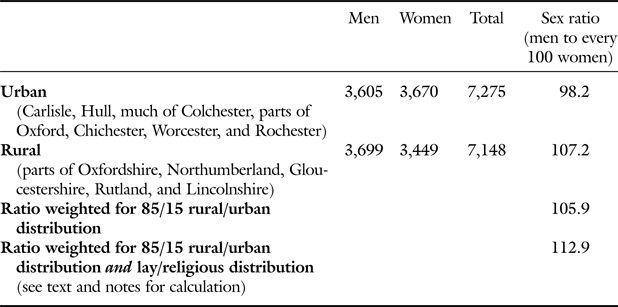
Poll tax returns from 1377 have survived better for urban than for rural areas, a discrepancy that has perhaps masked the overall evidence they provide about sex ratios. As table 1 shows, urban areas contained more women than men. Many returns cannot be considered because they do not give the names—and hence conceal the sexes—of servants. Among the surviving comparable returns for urban areas, ratios varied widely, from 88 men for every 100 women in Carlisle to 194 men for every 100 women in the small sample of 47 taxpayers from the Oxford parish of St. Cross. Altogether, the returns for more than 7,000 urban laypeople give a cumulative sex ratio of 98.2 men for every 100 women.Footnote 24 But towns held only a small portion of the population as a whole, and any urban imbalance was more than matched by an excess of men in rural areas. Rural sex ratios varied too (especially between inland and maritime regions), but overall they were clearly higher: of just over 7,000 lay taxpayers in rural parts of Oxfordshire, Northumberland, Rutland, Gloucestershire, and Lincolnshire, the ratio is 107.2 men for every 100 women.Footnote 25 Because at least 85 percent of the population lived in the countryside, the sex ratio for the total population, weighted for urban/rural distribution, was thus 105.9 laymen for every 100 laywomen.
Sex Ratios in the Poll Tax of 1377

The sex ratio climbs higher still when one factors in the professional religious. Clergy were taxed separately, and surviving clerical poll tax returns show that their numbers were significant: about 33,500 male clerics in England in the late 1370s, plus about 3,000 friars who were exempt from the tax. Thus the estimate that one adult male in every fifteen was a member of the church is probably a fair one. In contrast, nuns in late fourteenth-century England numbered only about 2,000. When the weighted urban/rural sex ratio is further adjusted to take account of the professional religious, both male and female, the sex ratio for the population as a whole climbs to around 112.9 men for every 100 women.Footnote 26
Although it is possible that high sex ratios in 1377 poll tax records result from the overrepresentation of women among the genuine poor (exempted from tax), this is hard to substantiate. In Brockworth (Glos.), Richard Thressher was excused from the tax on the grounds of his extreme poverty, but other returns did not routinely record those exempted.Footnote 27 Certainly the number of single women in poll tax returns for 1379 and 1381 dipped dramatically by comparison with the 1377 records, seriously compromising the value of the later records for demographic analysis.Footnote 28 Indeed, the omission of single women in 1379 and 1381 may reflect deliberate evasion by peasants who resented paying frequent taxes, especially for unmarried daughters, but for 1377, the extent of their absence is uncertain.Footnote 29 Moreover, the returns reflect the clustering of single women in the towns, a phenomenon long suspected by historians, suggesting that at least some single women were taxed. Of course, gendered exemption on the grounds of poverty may have inflated ratios in both rural and urban areas, but no direct evidence of such a practice exists. The most reliable of the scant documentary sources, therefore, when adjusted for population distribution and the exclusion of the clergy, suggests a total adult sex ratio of more than 110 men for every 100 women. In Russell's words, such a ratio leads to “suspicion that some tampering with human life has occurred.”
Registers and lists of serfs occasionally provide additional information, although they must be treated with even greater caution. Among 859 adult and child descendants of serfs from thirteenth-century Spalding priory manors, H. E. Hallam found an overall sex ratio of 119.7 males for 100 females. For the manors of Moulton and Weston specifically, whose documents distinguished between families with adult children and those with young children, boys outnumbered girls by a ratio of 114.5 to 100, whereas adult sons were fewer than adult daughters (a ratio of 95.4 to 100). Considerable variation existed between manors, which Hallam attributed to differences in inheritance customs and consequent migration.Footnote 30 A later document on Spalding manors, the so-called Myntling Register of the 1470s, has also yielded data on sex ratios: E. D. Jones found a ratio of 111 males for 100 females among “hundreds” of families. It should be noted, however, that the Myntling Register families may not be representative, and scholarly consensus is that one should be cautious of relying on it for demographic data.Footnote 31 An even more imbalanced ratio was found by Russell in a list of serfs from the manors of John of Hastings in the 1390s: 78 sons and 46 daughters, or a ratio of 170 males to 100 females.Footnote 32 Each of these lists of serfs points to an excess of males over females, yet not enough is known about the reasons for creating these documents to be sure that females were not systematically undercounted, so we might take them with many grains of salt.
Evidence from contemporary observers adds little to our understanding of sex ratios. Although one might be tempted to argue from silence that no comments about shortages of women mean that no shortages existed, this conclusion seems unfounded. As Peter Biller has shown, medieval scholars did not seem to have conceptualized the idea of sex ratios until about the thirteenth century, and even then it tended to be theoretical rather than the result of observing their own populations. Bonaventure may have been the first medieval scholar to ponder sex ratios in his mid-thirteenth-century commentaries on Peter the Lombard's Sentences, in which he considered the theoretical possibility that there could be more men than women. But it took longer for commentators to note imbalanced ratios in real situations: one fourteenth-century chronicler, for instance, claimed that a parish priest in Florence regularly baptized 300 to 500 more male than female babies among the 5,000 to 6,000 he baptized every year.Footnote 33 In England, the first commentaries are later and less useful. John of Reading, Thomas Walsingham, the Chronicler of Louth Park Abbey, and the continuer of Higden's Polychronicon each commented not on the overall sex ratio but rather on their perception that the plague of 1361 killed more men than women.Footnote 34 We should probably be cautious about such evidence, partly because monastic chroniclers were less likely to observe the deaths of women and partly because of the circulation of discourses by those trying to understand the plague (John, for instance, also repeats a French chronicler of the 1350s who claimed that children born after the plague would have fewer teeth).Footnote 35 Even if these commentators were right that more men than women died in 1361, their evidence is confined to a specific epidemic and says nothing about sex ratios in the population that survived. The comments of contemporary observers on their own populations certainly hold an appeal for historians, seeming as they do to answer our questions most directly, but it can be easy to forget the context in which these observers wrote and the limited amount of information they had available. We might, therefore, be skeptical about the evidentiary value of both the silence of pre-fourteenth-century commentators and the specific remarks of commentators on the 1361 epidemic.
Documentary sources are thus suggestive but hardly conclusive in assessments of sex ratios. Poll tax returns from 1377, the best of a meager bunch of sources, suggest a significant excess of men, but on their own they cannot bear the weight of a broader argument. However, Robin Fleming has recently urged historians to make better use of the rich data available from archaeological sources.Footnote 36 Archaeological data allow us to move beyond one of the major problems of documentary sources—that of contemporary writers' failure to notice women or record female names because of a sense that women were less important to their purpose, whether that purpose be taxation, the maintenance of law and order, or efforts to understand the world more generally.
Archaeological Sources and the Historian
Of course, archaeological evidence has issues of its own and requires careful interpretation. In using archaeological material for the bulk of this article, I do not mean to privilege it over documentary sources, nor to suggest that it represents some objective truth that is otherwise inaccessible to historians. Archaeological evidence is neither necessarily better than documentary evidence nor necessarily worse: like wills, literature, or tax records, it lends itself better to some topics and questions than others. Archaeologists make subjective decisions and interpretations as they choose a dig site (or have a site foisted upon them) and as they analyze finds. As Roberta Gilchrist and others have shown, archaeologists—like historians—have allowed their work to be influenced by the patriarchal constraints of the present.Footnote 37 Archaeological work is, however, conducted quite differently from that of historians: archaeologists typically work in teams made up of both experts and contributors with varying degrees of specialized training and experience.Footnote 38 Much of the work of archaeology takes what historians call a case study approach, focusing on one site. Site reports often include discussion, however, of the ways in which findings compare with those of digs from a similar place and period.
Only a small minority of medieval documents has survived to the present. So, too, the skeletons about which we know are a small minority of the total number of humans who lived in late medieval England. Many cemeteries were discovered only accidentally in the course of excavation for development. The large cemetery of St. Peter's in Leicester, for instance, was excavated in 2004–05 to make way for a new John Lewis store, while the smaller parish cemetery at Ormesby St. Margaret was uncovered by excavations for a new road.Footnote 39 Other cemeteries may be known or suspected but cannot be excavated because currently used buildings or cemeteries lie on top of them. The West Smithfield Black Death cemetery, for instance, lies beneath modern London businesses, Charterhouse Square, and part of Charterhouse Street.Footnote 40 Similarly, parish churches constructed in the medieval era very likely have medieval cemeteries alongside them and medieval tombs beneath their floors, but these cannot be excavated because doing so would disturb more recent burials on top. Many cemeteries have been excavated only in part, and more medieval skeletons certainly lie still buried in inaccessible areas.Footnote 41
The preservation of skeletons and cemeteries further limits their evidentiary value. Medieval cemeteries often experienced intercutting of graves as early modern and modern burials were placed on top of medieval skeletons. Sometimes old bones were collected and stored in a charnel house, although this was not the norm in Britain.Footnote 42 In other cases, bones uncovered in subsequent burials might have been gathered and reburied in charnel pits. Detached from their skeletons and contexts, individual bones tell us far less about the age and sex of a population. Soil acidity can affect bone survival too: the best areas for preservation are alkaline soils, such as the chalk regions in parts of southern and eastern England, which have sometimes preserved even small ear bones, gallstones, and bladder stones. Bodies are best preserved in sealed lead coffins, although these are seldom found in parish cemeteries.Footnote 43 Archaeologists have paid considerable attention to the ways in which age and sex might affect bone preservation. Children's bones seem to have been particularly vulnerable to rot, and one study has suggested that the bones of girls aged four years or younger may have rotted more quickly than those of young boys.Footnote 44 At any rate, archaeologists usually regard the number of juvenile skeletons in a cemetery as a bare minimum and assume that more children died than surviving remnants of their bones suggest. Although the bones of young girls may not have survived as well as those of young boys, women's bones seem to have been preserved as well as men's, so that among adult skeletons, the sex ratio ought not to be affected by differences in decomposition. One study has suggested that postmenopausal female skeletons may disintegrate faster or develop more “masculine” features in the skull, but this has not been confirmed by research elsewhere.Footnote 45
Techniques for attributing sex to adult skeletons have been refined over time, and most are considered remarkably accurate.Footnote 46 Archaeologists usually divide adult populations into five sex categories: females, possible females, indeterminate or intermediate sex, possible males, and males. When calculating sex ratios, however, they typically merge the possible females and possible males with the female and male categories, respectively, and I have followed this practice in the discussion of parish and local cemeteries that follows. On the rare occasion that skeletal remains can be compared with documentary records, the accuracy of standard criteria for sex attribution has been found to be extremely high among adult skeletons.Footnote 47 Of 623 adult skeletons from the eighteenth and nineteenth centuries interred in the crypt at Christ Church, Spitalfields, only two were sexed inaccurately. Skeletons were sexed by archaeologists using visual criteria alone and then compared with names on the coffin plates. As Molleson and Cox conclude, “Although not all could be verified in this way, it is clear that evaluation of visual criteria is a reliable means of determining sex of skeletal material when a substantial sample is under examination by competent operators.”Footnote 48 The criteria for visual sexing are also used for medieval skeletons, and scholars seem comfortable with estimates that sex can be attributed with 97 percent accuracy if both skull and pelvis are present, 96 percent accuracy with pelvis alone, and 92 percent with skull alone.Footnote 49 Although the sexing of adult skeletons is quite accurate, attribution of sex to children's skeletons is very difficult, and few routinely attempt it. The best way to assess sex in skeletons of children below the age of eighteen is through the use of DNA testing, but this is expensive, time-consuming, and not always conclusive.Footnote 50 Some efforts have been made to estimate sex using cheaper and quicker methods, but none is especially reliable.Footnote 51 In short, while we can be confident that sex attribution is reasonably accurate for adults, even without DNA testing, we cannot reliably use non-DNA sexing of children. For this reason, skeletons of children below eighteen have been omitted from the discussion of parish and local cemeteries that follows.
Like historians, archaeologists have often noted a dearth of women, although usually in the context of specific archaeological sites. In a report published in 1980, for instance, the esteemed paleopathologist Calvin Wells noted his suspicions that the distorted sex ratio among tenth- to twelfth-century skeletons from North Elmham Park might be explained by excess female mortality in early childhood.Footnote 52 Juliet Rogers reached similar conclusions in her analysis of skeletons from the lay cemetery at Taunton Priory, in which manorial tenants were routinely buried. In noting the gap between the average age of death of women (twenty-nine years) and men (thirty-six years), Rogers argued that pregnancy and childbirth cannot account for all of the excess female mortality: as she remarked, “[A]n important contributory factor is likely to have been the poor status, nutritional or otherwise of women in general.”Footnote 53 However, other archeologists have been skeptical about gender-related differences in health and mortality. In their overview of archaeological data on health, Charlotte Roberts and Margaret Cox cited the author of a British dissertation who argued that dental health was the only area in which women consistently fared worse than men. The dissertation was, however, based primarily on samples from monastic populations, and women included were thus mostly of higher socioeconomic status.Footnote 54 Like historians, then, archaeologists have been cautious in extrapolating from specific sites or sources to a more general pattern of skewed sex ratios. Yet when one draws all the evidence together, the overall pattern looks remarkably uniform. In my discussion of parish and local cemeteries below, I have combined data from multiple sites, though I have tried to do so judiciously. Merging data risks decontextualization, but dealing with each cemetery separately would be not only tedious but also potentially misleading, because some sites contain many more skeletons than others.
Sex Ratios from Parish and Local Cemeteries
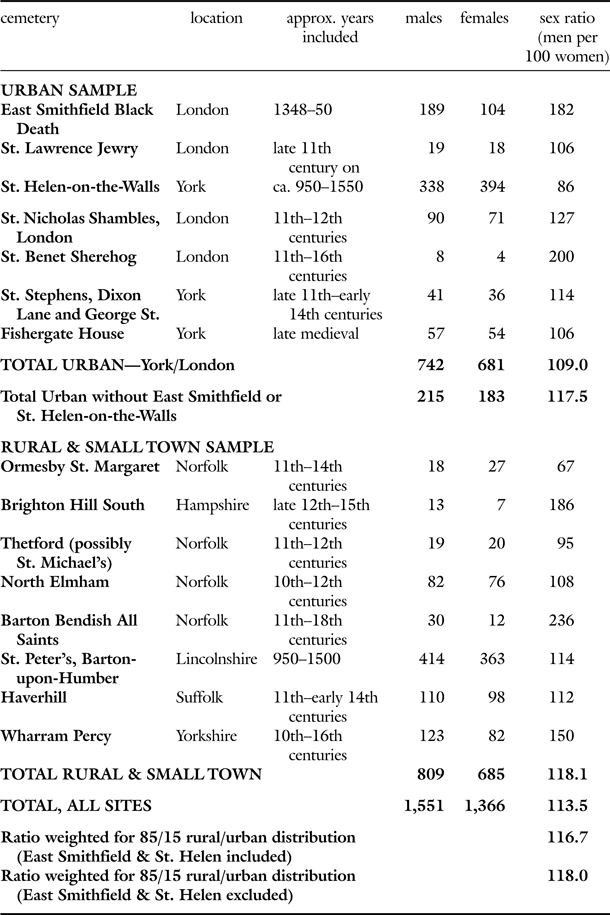
Most excavations of parish and local cemeteries find more male than female skeletons. In the discussion that follows, I draw primarily on data from fifteen cemeteries, listed in table 2 below.Footnote 55 Of the fifteen, only three had more women than men among their surviving, sexable adult skeletons: St. Helen-on-the-Walls, Ormesby St. Margaret, and Thetford, and in the latter two, women outnumbered men by fewer than ten skeletons.
Late Medieval English Parish and Local Cemeteries with Sex Ratios from Archaeological Data
Note:—All sources are listed in the appendix. In some cases (e.g., Wharram Percy and Barton-upon-Humber), skeletons were excavated from early medieval or postmedieval periods, but they were omitted from these calculations.
Urban cemeteries seem to have contained higher proportions of women than cemeteries from rural areas and small towns, and certainly this result might be predicted based on poll tax data.Footnote 56 Yet it might also be explained in part by the low sex ratio in the largest urban cemetery, that of St. Helen-on-the-Walls, which somewhat swamps the urban data. St. Helen's, the only urban parish cemetery here with more women than men, is known from documentary sources to have been poorer than most urban parishes, and cottages on the nearby corner of Aldwark and St. Andrewgate were occupied by more women than men in the early fifteenth century. Indeed, these cheap rentals owned by the York Vicars Choral were notorious for housing a number of prostitutes.Footnote 57 Although St. Helen's was not taxed independently in the poll tax of 1377, the adjacent parish of St. Saviour contained the highest proportion of female-headed households (36.4 percent) in the city of York.Footnote 58 The parish of St. Helen-on-the-Walls, therefore, may well have been a locus of “spinster clustering,” with a preponderance of poor single women. The experiences of women buried at St. Helen's are important to understanding urban sex ratios, and by bracketing them I do not wish to exclude them from consideration altogether. In fact, the importance of “spinster clusters” for women within medieval towns may be highlighted by temporarily removing the St. Helen's data, because the remaining urban cemeteries have ratios much closer to those of rural and small-town cemeteries.
The Black Death cemetery of East Smithfield is an outlier in the opposite direction, with significantly more men than women. It was one of two emergency cemeteries established to cope with the enormous number of plague victims and was set up in late 1348 or early 1349, when space in smaller churchyards and hospitals started to run out.Footnote 59 Because it does not include those from the first months of plague and includes fewer children than one would expect, Sharon DeWitte has suggested that its population may not represent a cross-section of the plague stricken. The first wave of plague killed off the most vulnerable—the very old, the very young, and the sick—and the second wave (represented at East Smithfield) was more likely to include previously healthy adults.Footnote 60 If women's general health in fourteenth-century London was poorer than that of men, then women, too, may have died in higher numbers in the first wave of plague. Samuel Cohn has found that women accounted for 55 percent of deaths when the plague first hit Florence in May 1348 but only 46 percent of burials in June and July, and 40 percent of burials in August and September. The same patterns of early female mortality and later male mortality were found in Arezzo and among lay burials at the Dominican cemetery of Camporeggio in Siena.Footnote 61 The particularly high sex ratio at East Smithfield (182 men to every 100 women) suggests that vulnerability to plague in London may have been similarly gendered and that the sex ratio of this cemetery should be considered with caution.
Because rural cemeteries are generally smaller, I have not attempted to eliminate outliers. Particular mention should be made, though, of Wharram Percy, because a high sex ratio persists there even with a large sample size. As Simon Mays has explained, the cemetery was not subject to zoning by sex, so the high sex ratio is unlikely to be explained by a missing cluster of women. Mays has suggested that Wharram Percy's proximity to York (twenty miles) may have attracted girls to the city in disproportionate numbers, helping to explain the lower sex ratio at poor urban cemeteries such as St. Helen-on-the-Walls.Footnote 62 Wharram Percy, a deserted medieval village, has been the focus of an intensive and long-standing archaeological dig, and because these skeletons have been used in many studies by respected archaeologists, any discrepancies in sex attribution would have been noticed. While Wharram Percy's cemetery housed more men than women, women outnumbered men at Ormesby St. Margaret, and it has been suggested that young men may have died elsewhere, perhaps as sailors or soldiers, given Ormesby's proximity to the coast.Footnote 63 Among rural cemeteries, that of St. Peter at Barton-upon-Humber is worthy of particular note: more than 750 skeletons survive for the medieval phases of the site, and analysis was performed by well-regarded scholars who were candid about any areas of concern.Footnote 64
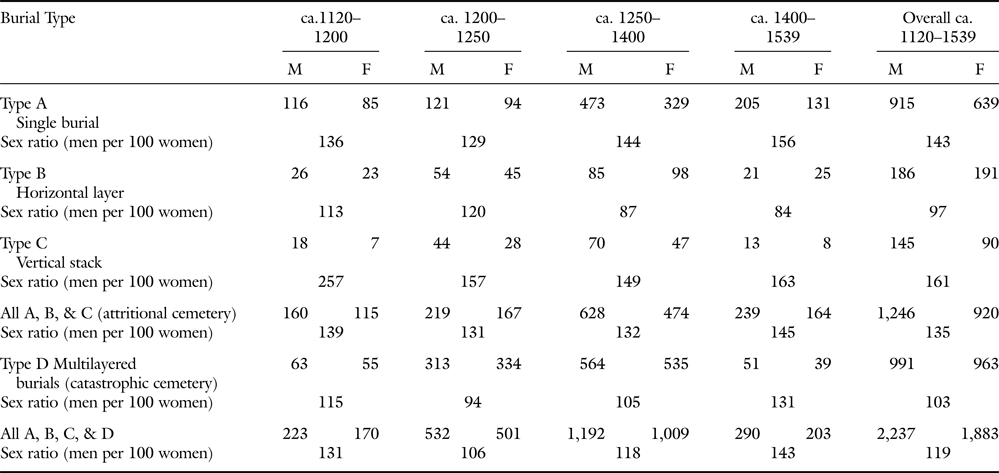
Newly published data from St. Mary Spital, a priory and hospital on the outskirts of medieval London, strongly support the gendered patterns noted from parish and local cemeteries above. Because its population was slightly different from that of parish cemeteries—mixing monks, lay sisters, patrons, hospital inmates, and members of the broader London community—sex ratio data from St. Mary Spital has not been merged with that of table 2 above. As table 3 below shows, however, the data from St. Mary Spital warrant careful attention, both because of the significant numbers of skeletons and because of archeologists' careful analysis of differences among types of burials. Archaeologists have noted that the number of skeletons found in the cemetery exceeds the hospital's capacity, suggesting that the cemetery incorporates many burials from the London population at large. Thus, despite its status as a religious house, “this cemetery population must be considered principally a secular one.”Footnote 65
Burials at St. Mary Spital, c. 1120–1539
Source:—Brian Connell, Amy Gray Jones, Rebecca Redfern, and Don Walker, A Bioarchaeological Study of Medieval Burials on the Site of St. Mary Spital: Excavations at Spitalfields Market, London E1, 1991–2007 (London: Museum of London Archaeological Service, 2012), 25–35.
Sex ratios for St. Mary Spital between ca. 1120 and 1539 vary significantly according to the type of burial, and these variations are revealing. Although the overall sex ratio for the cemetery is high (119 men for every 100 women), it is especially so in parts of the cemetery that reflect “attritional” burials over time and closer to equal in the “catastrophic” type of burials that correlate with famine and its associated diseases. The sex ratio of bodies buried alone (burial type A in table 3 below) is especially high, and the large number of these burials (1,554 of the 4,120 sexable adults) may disproportionately affect the overall data. The number of single burials is perhaps swelled by the fact that monks and wealthy male patrons would most likely have been buried alone under normal circumstances, although those of highest status would have been buried within the church itself and are not included among the cemetery data cited here. Women's skeletons are found in higher proportions among type B internments, those buried in horizontal layers, usually of two to seven bodies. Women are underrepresented, however, among type C internments, those buried in vertical stacks usually consisting of two to eleven bodies. These smaller multiple burials—types B and C—may contain bodies of people who died on the same day.Footnote 66 Archaeologists analyzing the St. Mary Spital data have grouped burial types A to C together as collectively comprising an “attritional cemetery.” The burial ground also, however, contains a number of multilayered burial pits (type D burials), each containing as many as 45 skeletons. These “catastrophic” type burials are thought to result from instances of sudden disease or famine and contain more children's skeletons than the attritional burials. Although men's skeletons still outnumber women's, the mass burial sex ratios are much lower: 103 men for every 100 women. Between 1200 and 1250, in fact, women's skeletons outnumber men's. Most of the St. Mary Spital mass burials come from the period prior to the Black Death; indeed, the dates of mass burials correlate more closely with famine and nonplague epidemics in the 1250s than with visitations of the bubonic plague beginning a century later.Footnote 67 Certainly, the lower sex ratio of the catastrophic burials at St. Mary Spital does not resemble the very high sex ratio (182 male skeletons for every 100 female skeletons) of the Black Death cemetery at East Smithfield, and might seem to add weight to DeWitte's argument that East Smithfield represents a “second wave” catastrophic cemetery established after the most vulnerable (especially women) had already been interred in overflowing parish and local cemeteries.Footnote 68 If the St. Mary Spital catastrophic cemetery does indeed reflect famine and associated nonplague diseases, as seems likely, then it may help show why women were initially carried off by plague in higher numbers than men: women's health was probably disproportionately compromised by famine and poor nutrition of the preplague era.
Whether parish or hospital, urban or rural, late medieval cemeteries seem to have contained significantly more men than women. Might these skewed sex ratios be explained by a practice of excluding more women than men from burial in parish and local cemeteries? This seems highly unlikely. Although some corpses were indeed denied cemetery burial on the grounds of their impure souls, this was probably a small minority, and there is no reason to suspect that women were overrepresented. As Christopher Daniell has commented, “The horror of a non-cemetery or non-Church burial was such that in practice few people were exempted.”Footnote 69 Unbaptized infants were, in theory at least, among those excluded; John Mirk repeated earlier church statutes when he noted in the late fourteenth century that a woman who died in childbirth should have her fetus cut from her and buried beyond consecrated ground. The mother herself, he said, should be buried in the churchyard, not the church.Footnote 70 Archaeologists have, however, found at least ten late medieval British examples of women with full-term fetuses lodged in their pelvises, suggesting that they may have died in childbirth and that the rule about removal of fetuses was not always followed.Footnote 71 At St. Mary Spital alone, a further thirteen instances of women buried with fetuses in utero have been uncovered.Footnote 72 However, the injunction against the unbaptized may have been followed in at least some areas, because digs have found clusters of infant burials, suggesting that areas of unconsecrated ground adjacent to the cemetery were reserved for them. But even if fetuses and stillborn and unbaptized infants were sometimes excluded from parish cemeteries, their mothers were not. Women underwent a ritual of purification, or “churching,” several weeks after the birth of each child, but church doctrine was clear that unpurified mothers were not to be excluded from sacraments and there is no evidence that they were routinely denied burial in cemeteries.Footnote 73 Heretics, excommunicates, suicides, and those who died without a chance to confess mortal sins were also theoretically excluded from both church and cemetery, but there is no reason to suspect that women were overrepresented among these groups, nor that the groups were sufficiently large to skew the cemetery data by their absence.Footnote 74 While some individuals may well have been excluded from parish cemetery burials on the grounds of their alleged sin, character, or impurity, women seem no more likely than men to have been rejected.Footnote 75
It is also possible that social class excluded some from parish cemeteries, although again it seems unlikely that women were excluded more often than men. Fees were charged by gravediggers (over and above the funeral payment), although it is not clear what happened to bodies if families were too poor to pay. Burying the dead was one of the seven corporeal acts of mercy, and wills occasionally left money to pay for the burial of paupers. As Daniell has pointed out, though, it is curious that this was the least popular of the seven works of mercy receiving bequests.Footnote 76 Its omission might suggest that corpses were seldom denied burial on the grounds of poverty and that parishes or gravediggers accepted the possibility of unpaid debts. Certainly hospitals and almshouses, many of which included the destitute among their inmates, often had cemeteries of their own, like that of St. Mary Spital. Because death was a daily occurrence, these institutions presumably had some arrangement with gravediggers. As with parish cemeteries, more male than female skeletons are usually found in hospital graveyards.Footnote 77 At the other end of the social spectrum, members of the nobility and gentry often chose burial either within the parish church or in a monastic church or burial ground. Laymen were far more likely than their sisters and wives to choose monastic burials: wills and charters show that almost three times as many laymen as laywomen were buried in monastic houses, and excavations of monasteries find far more men than women, even in areas thought to have been reserved for the laity.Footnote 78 If anything, then, the availability of alternative sites for elite burial should have decreased the proportion of men in parish cemeteries.
Because women were no more likely than men to be excluded from parish cemetery burial, adult sex ratios in these cemeteries are probably a reasonable approximation of ratios among the living population. If, as with the poll taxes, we weight the rural data more heavily than the urban data to match the distribution of the population as a whole, approximately 85 percent rural, the overall sex ratio increases to 116.7 men for every 100 women (if East Smithfield and St. Helen-on-the Walls are excluded too, the ratio is 118 to 100). These findings are supported by data from St. Mary Spital, where the sex ratio in the attritional cemetery is 119 men for every 100 women, while the ratio in the catastrophic cemetery linked to periods of famine is 103 men for every 100 women. Throughout England, significantly fewer women than men seem to have survived to adulthood, suggesting that girls are disproportionately represented among the unsexed and unpreserved skeletons of those who died in childhood. While these ratios are a little higher than those found in weighted poll tax data (112.9 to 100 as calculated above), they point very much in the same direction: adult men seem to have outnumbered women significantly in late medieval England.
Age at Death
Not only do fewer women seem to have survived to adulthood, but those who did appear to have died younger than men. Paradoxically, while women are outnumbered by men in the world today, their life expectancy is still, on average, about four years longer. The reasons for greater female longevity are largely biological: male infants are weaker at birth, and women on the whole have stronger immune systems than men. Many infectious diseases—syphilis, tuberculosis, leprosy, and brucellosis, for instance—are more prevalent among men than women.Footnote 79 So from a purely biological standpoint, one might expect that medieval women, too, would live longer than medieval men. But life expectancies, then and now, are related to excess female mortality. In the world's poorest countries with lowest overall life expectancies, the gap between male and female longevity is typically less than three years; in wealthier countries, women outlive men by about five to seven years.Footnote 80 Demographers have known for half a century about this relationship between low overall life expectancy and excess female mortality. In the United Nations survey of world mortality patterns in the early 1960s, researchers found that when a country's overall life expectancy at birth was lower than thirty, girls from that country died in significantly higher numbers beginning at about age five.Footnote 81 When resources are scarce, in other words, girls and women suffer disproportionately.
Medieval England seems to fit this model of low overall life expectancy and excess female mortality—at least, it probably did so some of the time. John Hatcher's work on the monks of Christ Church, Canterbury, and of Durham Priory, and Barbara Harvey's study of the monks of Westminster suggest that life expectancy at birth in the fourteenth to fifteenth centuries for this relatively privileged male population may have been as low as twenty-one to twenty-three years.Footnote 82 Tenants-in-chief, the wealthiest—and presumably healthiest—men in medieval England, had similarly low life expectancies.Footnote 83 For peasants and townspeople, life expectancies were possibly lower still. For this population, we know more about age of death (a different, albeit related, measure) than about life expectancy at birth. Most historians have focused on men's age of death only. However, Hallam's work on Lincolnshire peasants, while hamstrung by the limited availability of comparable data, suggested that men lived several years longer than women.Footnote 84 Historians have sometimes registered surprise that women did not make up a larger population of those admitted to almshouses or granted corrodies at monasteries in old age. While the underrepresentation of women in these institutions may indeed reflect the prejudices of a patriarchal society that took care of men first, it may also stem from fewer older women surviving.Footnote 85 Piecemeal data from documentary sources on life expectancy and age of death thus predict the skeletal evidence suggesting that medieval women surviving to adulthood died younger than men.
Archaeological evidence is arguably better than documentary evidence for age of death, but it is still far from objective and fraught with interpretational issues. First, a profile of age-assessed skeletons does not directly correlate with a risk of death at any given age unless one knows the total living population in a given community (and we do not). A preponderance of remains indicating that people died at a given age is highly suggestive of an increased risk at that age, but life tables show that increased mortality and increased risk of mortality are not identical. Second, age assessment adds another layer of subjectivity on top of gender assessment: subjective observers must place skeletons into age brackets depending on a variety of criteria (such as the length of bone and state of teeth), which vary from one site to another. Other subjective scholars must decide how to interpret and organize the age assessments.Footnote 86 Many incomplete skeletons are unable to be assessed for age at all, and other more complete skeletons are nonetheless ambiguous. In short, fewer skeletons can provide reliable information about both age and gender than about gender alone. The sample of 2,917 skeletons from table 2 shrinks to 1,838 when the age variable is added, and we should interpret the results even more cautiously. Yet even with this caution, the evidence is important because, when women and men are compared directly, we find that women's skeletons were usually younger than those of men. Two patterns emerge: women seem, on the whole, to have been particularly vulnerable between the ages of 26 and 35, and they were less likely than men to survive past the age of 45.
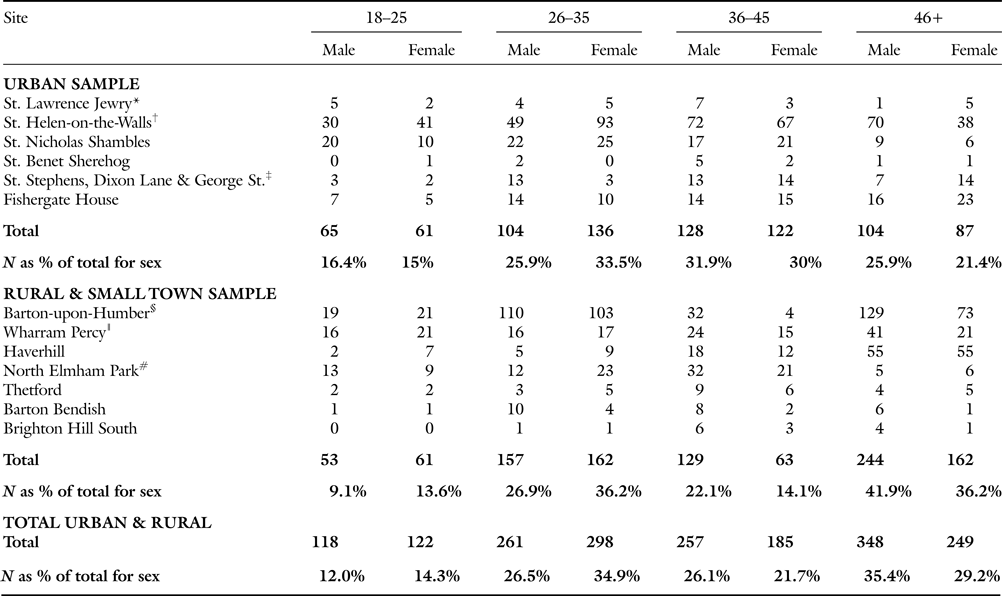
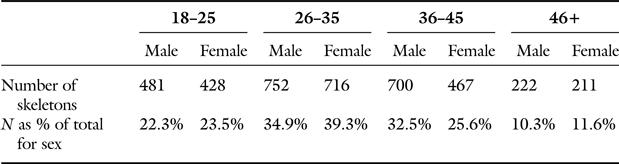
While the age of death distributions are different for urban and rural cemeteries, it seems that women in both town and countryside were especially vulnerable between the ages of 26 and 35. As table 4 shows, the deaths of over one third of women buried in the parish and local cemetery sample, but just over one quarter of men, took place between these years.Footnote 87 Urban women were also at considerable risk in the 36 to 45 cohort, whereas rural women were perhaps less so (the undernumeration of both women and men in the 36 to 45 cohort from Barton-upon-Humber may partly account for this).Footnote 88 Data from the hospital at St. Mary Spital show a similar pattern.Footnote 89 The average age at death for both male and female skeletons at St. Mary Spital (see table 5 below) was younger than that of their counterparts in the parish and local samples, presumably reflecting the disproportionate numbers of unhealthy people admitted to the infirmary. But even within this pattern of earlier mortality, the age of death for female skeletons was lower. As with the urban and rural parish, and local cemetery samples, women's deaths were especially high between 26 and 35—in fact, since almost 40 percent of 1,822 ageable female deaths occurred in this age range, the proportion of 26- to 35-year-olds buried at St. Mary Spital was higher still. This may partly reflect a disproportionate number of women dying in childbirth at the hospital, although men aged between 26 and 35 were also buried at St. Mary Spital in higher proportions (34.9 percent of 2,155 ageable male skeletons) than in the parish samples.Footnote 90 As in the parish and local samples, men outnumbered women among those dying between 36 and 45: almost one third of men and just over one quarter of women belonged to this age range at the time of their burial.
Adult Age of Skeletons from Thirteen Parish and Local Cemeteries
Sources:—See appendix.
Notes:
* The printed publication of material for St. Lawrence Jewry (Bowsher et al., The London Guildhall, 498; CD tables 56 and 57) breaks down adult ages into three cohorts: 17–25, 26–45, and 46+. Therefore, for the purposes of age comparisons, I have used data from the Museum of London's website, which employs four age cohorts. For the sake of consistency, I have not updated in this table the numbers in the 18–25 or 46+ cohorts from the printed publications, but I include them here: males 17–25: 9; females 17–25: 5; males 26–45: 7; females 26–45: 10; males 46+: 2; females 46+: 2. In fact, these numbers seem more in keeping with the overall pattern whereby women were more likely to die in midadulthood.
†The St. Helen-on-the-Walls data actually sliced the years slightly differently with a year of overlap in between (thus, the first age category was 17–25, the second 25–35, the third 35–45, and the fourth 45+). I do not know whether an individual who was aged at about 25 would have been put in the 17–25 or the 25–35 category (although he/she would not have been double-counted).
‡The first age category started at 19, not 18.
§Very few skeletons (32 male, 4 female) in the Barton-upon-Humber assemblage were placed in the 35- to 44-year-old category, while a higher than expected number of skeletons (110 male, 103 female) was placed in the 25- to 34-year-old category. Scholars suspect that age may often have been underestimated on this dig (St. Peter's, Barton-upon-Humber, 35–36).
‖The catalog of skeletons notes several different age ranges in addition to the standard grouping by decades. Skeletons dated “21–30” or “22–30” have been grouped here with the 18–25 year cohort, “30–40” with the 26–35 year cohort, and “40–50” with the 36–45 year cohort. In addition, “40+” and “50+” have both been included with the “46+ group” here. The 8 medieval-era skeletons with age ranges of more than 10 years have been omitted from this table.
#Actual age profiles reported were 18–27, 28–37, 38–47, 48+; nonetheless, I have included these among the 18–25, 26–35, 36–45, and 46+ cohorts, respectively.
Adult Age of Skeletons from St. Mary Spital, ca. 1120–1539
Source:—Connell et al., A Bioarchaeological Study, 28, table 9.
The likely brevity of women's lives relative to men's is even more obvious if one compares the proportions of those dying past the age of 45. As table 4 shows, older women certainly outnumbered men in a few parish and local cemeteries, the most significant (in terms of numbers) being the two York sites of St. Stephen's and Fishergate House. But the overall pattern suggested by the parish and local cemetery data is that men were more likely than women to reach the oldest age bracket. In urban cemeteries, 26 percent of ageable adult male skeletons were those of men over 45, while 21 percent of female skeletons were those of older women. In rural cemeteries, skeletons of both men and women were likely to be older, but men still outnumbered women in the oldest age bracket: 42 percent of male and 36 percent of female skeletons came from the 46+ age cohort. Most data from nonparish cemeteries show a similar mortality pattern. The database of mostly monastic cemeteries compiled by Gilchrist and Barney Sloane shows a smaller gap between proportions of men and women dying over the age of 45, but the gap persists nonetheless: of 1,093 ageable women's skeletons, 24.6 percent were of those over 45, compared with 27.9 percent of 271 ageable men's skeletons.Footnote 91 Most of these men and women would have been of higher socioeconomic status (monks, nuns, and wealthy laypeople) than people buried in parish cemeteries. In contrast, women slightly outnumbered men among those dying after age 46 at St. Mary Spital, although the small proportion of those over 45 (10.3 percent of male skeletons and 11.6 percent of female skeletons) makes it hard to compare these data directly. The overall pattern suggested by cemetery data is that women were less likely than men to survive past the age of 45.
Early female mortality in late medieval English cemetery data matches both documentary sources for Hallam's Lincolnshire peasants and lower age of female skeletons found among cemetery evidence for medieval Scandinavia.Footnote 92 Although skeletal data is not directly equivalent to life expectancy, parish and local cemetery data also resemble the model identified by demographers for the modern world, whereby low life expectancy in the population as a whole correlates with excess female mortality and a particularly low life expectancy for women. Skeletal data relating to age of death thus suggests that whatever was killing more girls than boys in childhood may also have shortened the lives of those women who did survive to adulthood.
Causes of Excess Female Mortality in Late Medieval England
If late medieval English girls were less likely to survive to adulthood, and if those who did died younger than their brothers and husbands, what may have been the causes? Cemetery evidence available to date cannot completely answer this question, although it can steer us toward some explanations and away from others. Tempting though it is to seek a simple cause, I suspect that excess female mortality resulted from a combination of causes, both cultural and biological.
Female infanticide could certainly explain women's underrepresentation in cemeteries, but we lack sufficient evidence either for or against the practice. As historians have noted, the English legal records include remarkably few prosecutions for infanticide, and deaths of girls seem no more common in prosecuted cases than those of boys.Footnote 93 Moreover, archaeological excavations of late medieval cemeteries do not find unexpected numbers of neonates. Simon Mays has contrasted the mortality profiles of fetal and neonatal births from Romano-British sites with those of medieval Wharram Percy. He found a significant peak in the proportion of Roman-era infants buried at 38 to 40 weeks of gestation, suggesting infanticide soon after birth. In Wharram Percy's churchyard, by contrast, the mortality profile is more consistent with stillbirths and infant mortality from natural causes.Footnote 94 It is certainly possible that victims of infanticide were neither brought to the attention of authorities nor buried in cemeteries. With the tacit complicity of a community sympathetic to the burden of more mouths to feed, a midwife may, for instance, have chosen not to clear the airways of an unbaptized newborn girl who would then have been buried outside consecrated ground. We lack solid data, however, to suggest that this happened routinely, and unless more evidence is found, the possibility of widespread female infanticide must remain an unknown.
Nor does death in childbirth seem a sufficient explanation for excess female mortality. It almost certainly explains some deaths in early adulthood, but not all, and it does not account for the difference between the numbers of men and women reaching maturity. Moreover, the difference in mortality between women and men in their reproductive years (which we might expect to be covered mostly by the 18–25 and 26–35 cohorts) was already higher than would be expected from maternal mortality. Among the ageable and sexable skeletons in the parish and local sample, 38.5 percent of men died between 18 and 35, compared with 49.2 percent of women.Footnote 95 If maternal mortality accounted for the difference, then approximately 1 in 10 women must have died in childbirth or from childbirth-related causes. A maternal mortality rate of 1 in 10 would be much higher than that in the developing world today (where the lifetime risk is about 1 in 120) or in fifteenth-century Florence (where the risk was about 1 in 69 per pregnancy).Footnote 96 It is also curious that the peak in female deaths by age corresponds only partly with the years in which we would expect to see women bearing children: if maternal mortality rates were especially high, we might expect to see a higher number of deaths in the 18–25 cohort and fewer in the 36–45 cohort. Another reason why the maternal mortality explanation seems insufficient is that nuns were vulnerable at a similar age to laywomen. Data on age of death of 122 female skeletons from three late medieval English nunneries finds that 64 percent of women died between the ages of 26 and 45, compared with 50 percent of 600 male skeletons from monasteries.Footnote 97 Nuns, in theory at least, were not having children—at least, not while they were nuns (although some may have entered nunneries as widows having already had children). Thus nuns, like women buried in parish and local cemeteries, seem to have been especially vulnerable in the middle years of adulthood, even without the risk of frequent childbirth, suggesting that factors other than maternity played a role. Childbirth was doubtless a time of great risk for women, and it is no surprise that women's death rates were high during their childbearing years, but the excess female mortality during these decades does not sufficiently explain women's absence from the cemeteries nor their greater vulnerability to early death.
Infanticide and maternal mortality do not seem adequate to explain fully the pattern of excess female mortality, so we must look to other factors—particularly nutritional, metabolic, and environmental—to examine their contributing role. Different nutritional needs of men and women may certainly have resulted in varying susceptibility to diseases and thus different mortality rates. Bullough and others have drawn our attention to the iron requirements of menstruating women and the lack of iron in medieval diets. However, it is worth noting that premodern women probably had far fewer menstrual periods (one estimate suggests about 50 menstrual cycles throughout a woman's lifetime, as opposed to about 450 for modern women in the West) as a result of poorer diets, more pregnancies, and routine breastfeeding, so iron depletion among women was likely not as drastic as has been suggested.Footnote 98 Not that pregnancy and lactation made women any healthier than menstruation: both pregnancy and lactation require extra calories and nutrients, and as recent polemical debates on the “fetus as parasite” have highlighted, a fetus can access and deplete nutrients stored in a mother's body. Kathy Pearson has pointed out that the excessive fiber consumption in the early medieval diet may have blocked nutrient absorption and proven a particular problem for pregnant and lactating women, and it is possible that the late medieval diet (especially prior to the Black Death) was equally problematic.Footnote 99 Better nutrition in the postplague period could thus have contributed to the end of excess female mortality in the early modern era, although more work needs to be done to substantiate this.
It is also possible that women ate less food (in relation to their nutritional needs) and that the food they ate was of a lower quality. As Mavis Mate put it in 1998, “Historians can calculate the amount of food that a family of five needed in order to survive but cannot tell how this food was divided among family members. When a family ate meat, for example, did husband and wife share equally, or was a larger portion taken by the primary wage-earner, the male head of household?”Footnote 100 Indeed, medieval women may have apportioned scarce food resources to their husbands and children before themselves, a practice documented in later populations. Given the illiteracy of peasant women, a practice of maternal forbearance would be unlikely to show up in written sources. Hints of gendered food portioning can be found in account rolls from St. Leonard's hospital in York, which show that female corrodians received a slightly lower fish allowance than their male counterparts.Footnote 101 Archaeological investigations also suggest gendered differences in diet at some sites. By examining specific carbon and nitrogen isotopes found in bone collagen, archaeologists can assess consumption of plant and animal protein, particularly protein from marine fish. Because bone grows very slowly, the rates of carbon and nitrogen reflect an average of diet over the ten to thirty years prior to death (thus reaching back into childhood). Gundula Müldner and Michael P. Richards have discovered that bone collagen of women buried at the Gilbertine priory of St. Andrew at Fishergate in York was significantly lower in marine proteins than that of men. They have concluded that women ate far less marine fish, a sign of “profound social differentiation expressed by ways of food consumption.”Footnote 102 Less distinction was found in bone collagen from the rural site of Wharram Percy, although little marine fish was consumed by either sex and only twenty-eight adults were tested.Footnote 103 Future archaeological investigations may yield more data on gendered dietary practices among late medieval adults.
Yet cemetery data also indicate that much of the disproportionate female mortality occurred prior to adulthood, which might suggest different dietary practices for girls and boys. Some European commentators, such as Konrad of Megenberg and Paolo of Certaldo, believed that girls required less food than boys because they were allegedly less physically active (a self-fulfilling prophecy, one suspects), but it is hard to know how closely this advice was followed, especially in England.Footnote 104 If boys and girls were weaned at different ages, that, too, might help explain differences in their health. Although isotope data can be used to establish the approximate age of weaning, the current imprecision in determining the sex of children's skeletons makes it difficult to detect any difference between the weaning age of girls and boys. Some medieval commentators recommended weaning girls at age one and boys at age two, and wet nursing contracts from Florence show that boys were routinely nursed longer than their sisters, but little is known about practices in late medieval England.Footnote 105 Given how close many medieval people lived to the margin of starvation, a widespread practice of weaning girls before boys or feeding girls less than boys may be sufficient to explain gaps in the adult sex ratio. Certainly resource allocation within the household is thought to be one of the major contributors to the “missing women” problem in modern Asia.Footnote 106
A final possibility in explaining disproportionate female mortality relates to the environments in which medieval boys and girls spent their time. We know from Barbara Hanawalt's work on coroners' rolls that boys' and girls' places of work resembled that of their parents from an early age. Boys were more likely to suffer accidental death while helping in the fields or tending animals, whereas girls suffered accidents while minding younger children, tending the fire, drawing water, or doing laundry.Footnote 107 But household chores might have contributed to mortality in less dramatic ways too, hidden from coroners' rolls because they manifested as chronic illness, fragility, and susceptibility to other diseases. For instance, cooking fires likely increased the risk of chronic sinusitis and bronchitis, and women seem to have suffered more often than men. While some archaeologists have begun to seek out and record signs of chronic sinusitis etched in the bone, this practice is not yet routine. The 2.5 percent of women and 1.6 percent of men thought to be suffering from chronic sinusitis at St. Mary Spital, for instance, is acknowledged as a “gross under-representation of the number of individuals affected.”Footnote 108 Elsewhere, too, women seem to have been prone than men to sinusitis, although it is possible that more fragile facial bones in women make the signs of sinusitis more obvious.Footnote 109 Of more direct relevance, perhaps, is the fact that some children's bones also show symptoms of chronic sinusitis: for example, the skull of an unsexed adolescent from St. Mary Spital shows changes in the frontal bones that may have resulted from persistent and chronic sinus infections.Footnote 110 Chronic infections such as sinusitis may not have caused death on their own, but they certainly made people more susceptible to diseases such as tuberculosis (which affected perhaps as much of 30 percent of the population and which, in some instances, at least, affected women more than men).Footnote 111 If, as a result of their work in the smoky houses of late medieval England, girls suffered sinus infections more frequently than boys, they may have been less likely to survive other diseases. Increasing use of chimneys in the early modern era may have improved the health of boys and girls disproportionately. Women and girls presumably spent more time around the sick and dying, too, and may thus have been more susceptible to catching diseases.
A second way in which environment may have affected health was through malabsorption of vitamin D, a topic of burgeoning concern among doctors in the modern West. Vitamin D can be acquired through certain foods (such as fatty fish, fish oils, and beef liver), but it is absorbed far more readily through exposure to natural sunlight.Footnote 112 Women may be more prone than men to vitamin D deficiency; the long clothing worn by medieval women and girls, and the fact that much of their work was conducted indoors, could further have inhibited their absorption of ultraviolet rays. Polluted skies, particularly in towns, may also have hindered vitamin D absorption. In children, an extreme vitamin D deficit can produce rickets, and certainly some cases of rickets have been found among bones of unsexed infants and young children.Footnote 113 In adults, in contrast, vitamin D deficiency can produce osteomalacia, a weakening and deformity of the bones that is harder to detect in long-buried skeletons and has not routinely been sought by archaeologists. Although vitamin D deficiency is not fatal in and of itself, it is associated with heightened risk of cancer, diabetes, kidney failure, and hypertension.Footnote 114 More attention to symptoms of rickets and osteomalacia in future digs may thus yield useful evidence, especially if we can also learn about its prevalence over time and by gender. However, given that clothing for girls and women did not change significantly between the medieval and early modern eras, and that the skies of medieval England were likely no more polluted than those of early modern England, it is hard to see vitamin D absorption as any more than a minor contributor to excess female mortality in the late Middle Ages.
Causes of excess female mortality in late medieval England, therefore, have yet to be pinned down. Infant mortality can neither be proven nor conclusively disproven, and the number and timing of deaths cannot be explained fully by maternal mortality. A combination of nutritional, metabolic, and environmental factors seems the most likely, but more research—archaeological and documentary—must be done to pinpoint differences in male and female health and the ways in which these changed over time.
Conclusions
If indeed there were more males than females in England between 1000 and 1500, and if those females were indeed sicklier than their brothers, some of our assumptions about late medieval England must undergo revision. Given the need for further research into sex ratios and gendered differences in health, my suggestions here are speculative at best. Nonetheless, an imbalanced sex ratio would surely have had important demographic, economic, social, and cultural consequences that merit further investigation.
If women were fewer and sicklier, this would certainly affect estimates of both fertility and mortality in the late Middle Ages. Historians of England have long debated whether to understand the population's failure to recover quickly from the Black Death in terms of decreased fertility or increased mortality. Cemetery data might seem to add weight to the argument for decreased fertility, because fewer women mean fewer children, although the imprecision of burial dating may conceal changes in the sex ratio over time. Yet if girls and women were more vulnerable to disease, the data might also support the argument for increased mortality. Certainly something had changed by the early modern era, because population reconstructions from parish registers suggest that sex ratios had swung significantly toward a majority of women. Russell and Hanawalt both suggested that sex ratios were lower in the immediate postplague era but increased again in the fifteenth century, around the same time in which Hatcher, Harvey, and others have identified a marked dip in life expectancy of monks.Footnote 115 Yet if excess female mortality in the preplague era was due to general malnutrition and susceptibility to disease, one might expect more women to survive (and fertility to increase) in the postplague era of more and better food. If problems resulted from specific dietary inadequacies and differences in men's and women's ability to metabolize the medieval diet, however, these may not have been eliminated by more plentiful food. The change in sex ratios between the medieval and early modern eras may instead have resulted from some as-yet unidentified shift in diet and/or patterns of daily life. As dating techniques become more precise, future excavations of parish cemeteries may enable us to pinpoint changes in the sex ratio over time and, in doing so, help address the riddle of how and why England's population changed between the late medieval and early modern periods. Demographic historians of late medieval and early modern England need to include sex ratios as part of this debate.
Economic and social historians may wish to consider the consequences of a possible imbalanced sex ratio too. For instance, while we have explored the economic and social effects of an excess of women in towns, we have paid far less attention to a potential shortage of women in the countryside. Because, as historians have argued convincingly, women's role in the peasant household economy was vital, we might explore further the functioning of households that lacked women. Much work has focused on the experiences of widows, identifiable by the ways in which their names were recorded, as “vidua” (widow) or “relicta” (relict) or “qui fuit uxor” (who was the wife) of their deceased husbands. But perhaps the more common experience was that of widowers, largely invisible to historians because their names did not change.
We might also consider the cultural consequences if women, and hence potential wives, were in short supply. In medieval England, the church obviously absorbed some of the shortfall in female marriage partners, providing careers for theoretically celibate priests and monks. Work-related migration (especially for soldiers or sailors) diverted others. But sex ratio data suggest that other men lacked wives or outlived them. Some anthropologists have suggested that societies in which men significantly outnumber women tend to be more violent and competitive; others have argued that such cultures are more peaceful because women have more power within their households and communities.Footnote 116 We might also consider the cultural consequences of a paucity of senior women. While noble and urban bourgeois families appreciated representations of St. Anne with her daughter and grandson, real grandmothers may have been thin on the ground.
Conceptualizing discrepancies between women and men by means of the number of “missing women” has helped Sen and others draw attention to the conditions of modern women in developing countries. So, too, we might think about the population of medieval England and extrapolate living conditions for girls and women by attempting to assess the number of “missing women” between 1000 and 1500. English population estimates are far from precise, but if we take population calculations by demographers, assume about four generations per century, and estimate the “missing” women if the adult sex ratio was 110 to 115 men for every 100 women, we find somewhere between 2.6 and 3.9 million unaccounted for.Footnote 117 I certainly do not claim precision for these figures, especially because sex ratios probably varied over time; I mention them to emphasize the scale of the gap between numbers of men and women and the lack of attention this discrepancy has received from scholars. By contrast, the much-studied witch craze of the early modern period resulted in fewer than 1,000 deaths in England.Footnote 118 If England's missing women indeed accounted for 4 to 7 percent of the total population, then they numbered three times as many as the men employed by the church as priests, monks, and other religious professionals. Their numbers were similar to the adult populations of England's thirty largest towns combined.Footnote 119 Their experiences—or absences—are ghosts within the historical record.
Appendix: Sources for Data on the Parish and Local Sample
East Smithfield Black Death, London: Ian Grainger et al., The Black Death Cemetery, East Smithfield, London (London, 2008).
Excavated 1986–88
St. Lawrence Jewry, London: David Bowsher et al., The London Guildhall: An Archaeological History of a Neighbourhood from Early Medieval to Modern Times, Part II (London, 2007) and http://archive.museumoflondon.org.uk/Centre-for-Human-Bioarchaeology/Database/Medieval+cemeteries/GuildhallYard.htm.
Excavated 1992–97
St. Helen-on-the-Walls, York: Jean D. Dawes and J. R. Magilton, The Cemetery of St. Helen-on-the-Walls, Aldwark (York, 1980).
Excavated 1973–76
St. Nicholas Shambles, London: William J. White, Skeletal Remains from the Cemetery of St. Nicholas Shambles, City of London (London, 1988).
Excavated 1975–77
St. Benet Sherehog, London: Adrian Miles, William White, with Danae Tankard, Burial at the Site of the Parish Church of St Benet Sherehog Before and After the Great Fire: Excavations at 1 Poultry, City of London (London, 2008) and http://archive.museumoflondon.org.uk/Centre-for-Human-Bioarchaeology/Database/Medieval+cemeteries/St+Benet+Sherehog.htm.
Excavated 1994–96
St. Stephens, Dixon Lane and George St., York: J. McComish et al., Roman, Anglian and Anglo-Scandinavian Activity and a Medieval Cemetery on Land at the Junction of Dixon Lane and George Street, York, Archaeology of York Web Series 9 (2007), http://www.iadb.co.uk/yat/publish.htm?PUB=47, last accessed 14 October 2009.
Excavated 2005–06
Fishergate House, York: C. A. Spall and N. J. Toop, eds., Blue Bridge Lane and Fishergate House, York. Report on Excavations: July 2000 to July 2002, 2005. © Archaeological Planning Consultancy Ltd 2003–2006. Consulted online at http://www.archaeologicalplanningconsultancy.co.uk/mono/001/index.html, last accessed 16 December 2009.
Excavated 2000–02
Ormesby St. Margaret: Heather Wallis with Sue Anderson, A Medieval Cemetery at Mill Lane, Ormesby St. Margaret, Norfolk (Dereham, 2009).
Excavated 1995–96
Brighton Hill South: P. J. Fasham and G. Keevil with D. Coe, Brighton Hill South (Hatch Warren): An Iron Age Farmstead and Deserted Medieval Village in Hampshire (Salisbury, 1995).
Excavated 1987
Thetford (possibly St. Michael's): Carolyn Dallas, Excavations in Thetford by B. K. Davison between 1964 and 1970 (Dereham, 1993).
Excavated 1964–70
North Elmham: Peter Wade-Martins, ed., Excavations in North Elmham Park, 1967–1972, 2 vols. (Gressenhall, 1980).
Excavated 1967–72
Barton Bendish All Saints: Andrew Rogerson et al., Three Norman Churches in Norfolk (Norfolk, 1987).
Excavated 1980–81
St. Peter's, Barton-upon-Humber:St. Peter's, Barton-upon-Humber, Lincolnshire: A Parish Church and Its Community, 2 vols., ed. Tony Waldron (Oxford 2007–11).
Excavated 1978–84
Haverhill: Jon Murray et al., “Excavation of a Medieval Cemetery at Crowland Road, Haverhill,” Proceedings of the Suffolk Institute of Archaeology and History 41, part 1 (2005): 5–42.
Excavated 1997
Wharram Percy:The Churchyard, Wharram: A Study of Settlement on the Yorkshire Wolds, vol. 11, ed. S. Mays, C. Harding, and C. Heighway (York, 2007).
Excavated 1962–73. Despite the early date of initial investigation, this site has been reanalyzed carefully in recent years by Simon Mays, among others.