The first secretion produced after parturition is named colostrum, and is composed of immune, growth and antimicrobial factors, besides other proteins, fat, minerals and vitamins. Growth factors such as insulin-like growth factor type I (IGF-I) and epidermal growth factor (EGF) are known to increase intestinal cell proliferation and differentiation, influencing the absorptive capacity of electrolytes and nutrients for newborns (Pandey et al., Reference Pandey, Dar and Mondal2011). The antimicrobial factors present in colostrum, such as lactoferrin, lactoperoxidase and lysozyme, in turn, are responsible for inhibiting bacterial growth and activity as well as attacking bacterial cell walls and promoting subsequent bacterial lysis. The antioxidant protection of colostrum to newborns has been reviewed (Przybylska et al., Reference Przybylska, Albera and Kankofer2007; Pandey et al., Reference Pandey, Dar and Mondal2011).
Differences between the intrauterine and extrauterine environment results in exposure of the neonate to oxidative stress conditions (Przybylska et al., Reference Przybylska, Albera and Kankofer2007). Lactoperoxidase is responsible for catalyzing the oxidation of specific molecules using H2O2 to generate reactive products with high antibacterial activity. The consequent decomposition of H2O2 to H2O results in cell protection against peroxidative effects of oxygen peroxide (Przybylska et al., Reference Przybylska, Albera and Kankofer2007). Lactoferrin, in turn, acts as a non-enzymatic antioxidant by binding to the iron generated during the destruction process, or cellular inflammation, reducing the synthesis of hydroxyl radical (Vasconcelos et al., Reference Vasconcelos, Goulart, Moura, Benfato and Kubota2007). Colostrum also has vitamins (A, C and E) that are considered very effective non-enzymatic antioxidants since they have a high ability to scavenge free radicals in the body (Pandey et al., Reference Pandey, Dar and Mondal2011). Some minerals, such as selenium, zinc, manganese and copper, act as antioxidants since they are indispensable constituents of enzymes that prevent the formation of ROS (Jan et al., Reference Jan, Azam, Siddiqui, Ali, Choi and Haq2015).
Beyond various nutraceutical properties, the quality of colostrum is characterized by immunoglobulin concentration and depends on age, breed, and parity. With increasing age, the animal becomes more experienced and provides further development of the immune system, reaching the highest concentration of colostrum IgG. This is observed when colostrum of primiparous and multiparous cows is compared. Colostrum from multiparous cows has greater accumulation of antigens to which the cow was exposed throughout its life (Machado Neto et al., Reference Machado Neto, Packer, Menten and Lavorenti2001). The relationship of antioxidant potential of colostrum with age, breed, and parity is not well defined. The hypothesis of this study was that the colostrum antioxidant potential of primiparous and multiparous dairy cows would be different. Thus, our objective was to determine the antioxidant potential of colostrum produced by primiparous and multiparous (second and third lactation) Holstein cows.
Materials and methods
The project was approved by the Ethics Committee on Animal Use ESALQ/USP, No. 2015-16, and conducted in accordance with the rules of Waste Management of ESALQ/USP. Colostrum was collected from eight primiparous and eight multiparous (second and third lactation) healthy Holstein cows from Fazenda Santo Antonio, Piracicaba, São Paulo, Brazil. Primiparous and multiparous cows received the same diet during pregnancy, 3 kg of concentrate per cow per day divided into two meals daily and composed of corn meal (91.5 kg per cow per day), soybean meal (1.2 kg per cow per day), hill (colipearl, 0.021 kg per cow per day), adsorbent (Taxfin™, 0.009 kg per cow per day), Bovigold beta pré-parto (0.27 kg per cow per day). Furthermore, the animals were supplied 30 kg of roughage per cow per day, in both groups, composed of sorghum or maize silage (19 kg per cow per day), hay (1 kg per cow per day) and humid barley (10 kg per cow per day). The cows sampled in this study were vaccinated during pregnancy in order to improve colostrum quality. Details of this and other additional methodological details are given in the online Supplementary File. Shortly after birth, calves were separated to collect 300 ml of first milking colostrum. These samples were stored in labeled vials at −80°C for subsequent laboratory tests.
Quantification of IgG in colostrum was performed by radial immunodiffusion assay and concentrations were expressed in mg ml−1. Colostrum whey was obtained after precipitation using renin and total protein concentration was determined by the biuret method. The SDS-PAGE was performed in a separation polyacrylamide gel (12%) and a stacking polyacrylamide gel (4%), applying 40 mA to the stacking gel and 50 mA to the separating gel. After stained, the gels were scanned and analyzed in the GelAnalyser software. To quantify protein fractions, bands of each sample were compared with a standard running on the gel. The results were expressed as mg ml−1 of serum.
The ceruloplasmin and lactoperoxidase activity were determined in colostrum whey according to Rice et al. (Reference Rice, Wagman, Takenaka and Seligson1963) and Mansson-Rahemtulla et al. (Reference Mansson-Rahemtulla, Baldone, Pruitt and Rahemtulla1986), respectively. Enzyme activity was expressed in IU (international unit), which refers to the amount of enzyme degrading 1 μmol of substrate per min at 37°C. The lysozyme activity was performed in colostrum whey by turbidimetric assay using 0.75 mg ml−1 of lyophilized cells of Micrococcus lysodeikticus Gram-positive bacteria as substrate. The results are presented as U ml−1, where 1.0 U of lysozyme corresponds to the number of enzymes that reduces the optical density by 0.0001 per min.
To determine antioxidant activity, colostrum whey samples were analyzed for oxygen radical absorbance capacity (ORAC), according to Melo et al. (Reference Melo, Massarioli, Denny, dos Santos, Franchin and Pereira2015). The values are expressed as μmol of equivalent Trolox ml−1. The values of glutathione peroxidase activity, expressed as unit U ml−1, was determined according to Wendel (Reference Wendel1981). The catalase (CAT) activity was determined according to the methodology described by Iwase et al. (Reference Iwase, Tajima, Sugimoto, Okuda, Hironaka, Kamata, Takada and MizunoeIwase2013). The values of catalase activity are expressed as units of U ml−1. One unit of catalases is responsible for the consumption of 1 mol of H2O2 per min. The variables iron (μg dl−1), latent iron binding capacity (LIBC, μg dl−1), total iron binding capacity (TIBC, μg dl−1), transferrin (mg ml−1) and transferrin saturation index (TSI%) were determined by commercial kits (Labtest Diagnóstica SA, Lagoa Santa, MG, Brazil).
The statistical analyses were performed using PROC MIXED procedure of SAS statistical program. The experimental design was completely randomized and after confirming the normal data distribution with the Shapiro–Wilk test, the analysis of variance and Pearson correlation analysis were performed. The probability of 5% (P < 0.05) was considered, except where specified.
Results
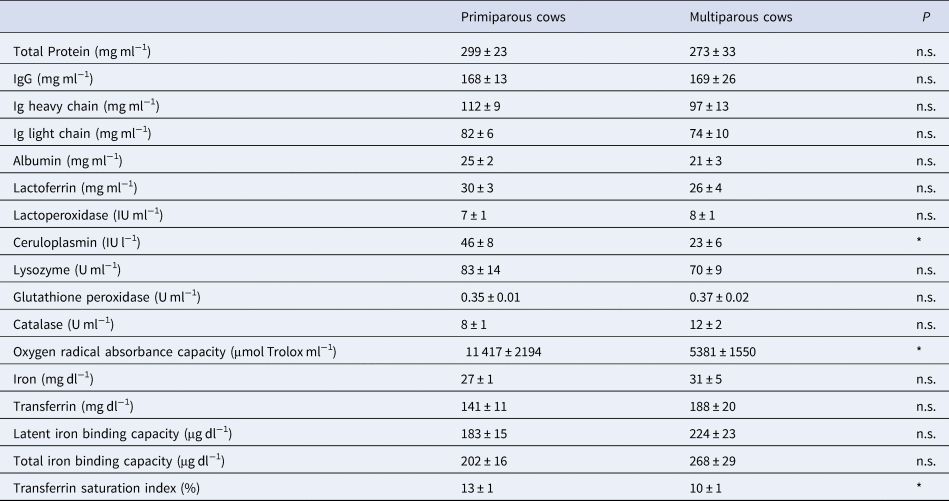
Colostrum from primiparous cows showed higher values of ceruloplasmin activity, oxygen radical absorbance capacity (ORAC) and transferrin saturation index (TSI) than colostrum from multiparous cows (P < 0.05) (Table 1). The total iron binding capacity (TIBC) and transferrin concentration in the colostrum of primiparous cows showed a non-significant numerical decrease (P = 0.06) in relation to the value in the colostrum of multiparous cows. The Pearson correlation between the variables are presented in Supplementary Table 1.
Components of colostrum from primiparous and multiparous (second and third lactations) Holstein cows

*P < 0.05; n.s.: non-significant.
Note: Non-significant numerical difference in total iron binding capacity and transferrin concentrations (P = 0.06).
Discussion
In mammals, antioxidant factors in colostrum are important in the perinatal period. In these species, birth is associated with oxidative stress, mainly due to the environment being much richer in oxygen than the intrauterine environment and poorly developed antioxidant defense mechanism in the neonate (Przybylska et al., Reference Przybylska, Albera and Kankofer2007). In this work, colostrum from first-lactation cows showed greater capacity to fight peroxyl radicals than colostrum from second and third-lactation cows did, suggesting that newborns from primiparous cows have higher antioxidant protection then newborn from multiparous ones do. Higher antioxidant capacity of colostrum can be effective to prevent newborns from exposure to an oxygen- rich environment after birth. Navarro-Ruiz et al. (Reference Navarro-Ruiz, Hernández-Aguilar, Rodríguez-Castellano, López-Jaén, Valls-Bellés and Codoñer-Franch2013) states that maternal diet, mainly in its micronutrient content, is a fundamental factor to ensure the antioxidant capacity of breast milk that can be protective to infants. However, in the present work, cows received the same diet and differences in antioxidant capacity were due to the number of lactations. It is known that primiparous and multiparous cows differ in the control of tissue mobilization, which may promote nutrient partitioning into growth as well as milk during the first lactation (Wathes et al., Reference Wathes, Cheng, Bourne, Taylor, Coffey and Brotherstone2007). The present work shows that these metabolic differences between cows in the first and second or third-lactations affected the antioxidative status of colostrum, since colostrum of primiparous cows showed more than double the oxygen radical absorptive capacity than that of colostrum from multiparous cows.
In colostrum of primiparous cows, lower values of transferrin, iron binding capacity and higher transferrin saturation index were observed. Lactoferrin and transferrin are involved in the regulation of iron metabolism and iron concentration, and their direct antimicrobial activity has been well characterized as an activity exerted against a wide range of bacteria as well as viruses (Wheeler et al., Reference Wheeler, Hodgkinson, Prosser and Davis2007). Sacerdote et al. (Reference Sacerdote, Mussano, Franchi, Panerai, Bussolati, Carossa, Bartorelli and Bussolati2013) evaluated the most representative agents (lactoferrin, transferrin, IL-2, IFN-γ, tumor necrosis factor, IgG, and IgA) in mammary secretions of Holstein cows and observed that a significant decrease in active components occurs after the first few hours, indicating the need for greater protection in the first hours of life of the newborn. In the present study, the lowest iron stock may be directly related to the higher antioxidant activity of the colostrum from primiparous cows, since iron is the metal with the greatest capacity to catalyze oxidation reactions, besides being present in larger quantities in the organism (Jan et al., Reference Jan, Azam, Siddiqui, Ali, Choi and Haq2015). The toxicity of H2O2, for example, can be indiscriminately increased in the presence of iron, given rise to the reactive and toxic hydroxyl radical (HO&) by Fenton chemistry (Jan et al., Reference Jan, Azam, Siddiqui, Ali, Choi and Haq2015). Hanušovský et al. (Reference Hanušovský, Bíro, Gálik, Rolinec, Šimko, Juráček and Rušinová2014) describe higher iron values in colostrum compared to the subsequent mature milk of pigs, indicating the importance of this mineral for newborns and agreeing with the decrease in antioxidant activity throughout lactation. In colostrum of primiparous cows, greater activity of ceruloplasmin was also detected. Ceruloplasmin is a blue glycoprotein conferred by the presence of copper, which is involved in the metabolism (oxidation) of iron, avoiding the formation of free radicals (Vasconcelos et al., Reference Vasconcelos, Goulart, Moura, Benfato and Kubota2007). These results indicate a direct relation of iron metabolism with a greater capacity to inhibit peroxyl radicals generated by the colostrum of primiparous cows. In agreement with this hypothesis, a negative correlation of 51, 59 and 59% between the oxygen radical absorbance capacity and LIBC, TIBC and transferrin, respectively, was observed.
According to Machado Neto et al. (Reference Machado Neto, Packer, Menten and Lavorenti2011), the higher the number of parities, the higher the concentration of IgG in colostrum. However, in this study, colostrum of primiparous and multiparous cows had the same concentration of IgG, indicating that immunization during pregnancy improves concentration of IgG in the colostrum of primiparous cows, as already verified in recent studies (Denholm et al., Reference Denholm, Hunnam, Cuttance and McDougall2017; Reppert et al., Reference Reppert, Chamorro, Robinson, Cernicchiaro, Wick, Weaber and Haines2019). Still, colostrum of multiparous cows is possibly of better quality because the animals are exposed to a greater variety of antigens during their lifetime, that is, they have greater immunological experience. All of the cows sampled in this study were vaccinated during pregnancy in order to improve colostrum quality. Therefore, their colostrum may have presented a high concentration of IgG, regardless of the natural immune experience. This interference in the concentration of colostrum IgG may have led to a lack of correlation between the immune potential, represented by the IgG concentration, and the antioxidant potential in colostrum. Furthermore, the result indicate that antioxidant potential of colostrum is independent of immunoglobulin mobilization to the lacteal secretion.
In conclusion, the higher antioxidant potential of colostrum from primiparous cows in relation to multiparous ones indicates an important role of the antioxidant potential of colostrum for neonates of first-lactation cows. Additionally, the iron stock may be directly related to the higher oxygen radical absorbance capacity of the colostrum from primiparous cows, and further investigations are required.
Supplementary material
The supplementary material for this article can be found at https://doi.org/10.1017/S0022029920000813.
Acknowledgments
Authors are indebted to Fundação de Amparo à Pesquisa do Estado de São Paulo (FAPESP), Process 2014/14937-2; 2015/07255-0; and 2015/06583-3. We are also grateful to Fazenda Santo Antônio, Piracicaba, São Paulo, Brazil for their willingness to provide samples and information to carry out the work.