Milk harvesting on pastoral dairy farms accounts for a significant portion of labour input, 33–57% annually (O'Brien et al. Reference O'Brien, Gleeson and O'Donovan2004; O'Donovan et al. Reference O'Donnell, Shalloo, Butler and Horan2008; Taylor et al. Reference Taylor, van der Sande and Douglas2009). Furthermore, herd sizes on pastoral dairy farms are increasing and are likely to continue to expand in the future (O'Donnell et al. Reference O'Donnell, Shalloo, Butler and Horan2008; Dairy & LIC, Reference Dairy2011), exerting pressure on scarce labour resources.
To minimise the effect of increasing herd size on labour resources, larger dairies with more units that are capable of greater throughput (Edwards et al. Reference Edwards, Lopez-Villalobos and Jago2012; O'Brien et al. Reference O'Brien, Jago, Edwards, Lopez-Villalobos and McCoy2012) are being installed in an attempt to maintain total herd milking times. However, this can increase the number of clusters handled per operator, often resulting in an increase in row (herringbone parlour) or rotation (rotary parlour) time owing to the inability to reduce per unit work routine times appreciably (O'Brien et al. Reference O'Brien, Jago, Edwards, Lopez-Villalobos and McCoy2012). Thus, cluster-on time could increase in dairies not fitted with automatic cluster removers (ACR), estimated to represent 95% of swingover parlours in Ireland (Kelly, Reference Kelly2009) and 91% of swingover and 46% of rotary parlours in New Zealand (Cuthbert, Reference Cuthbert2008), potentially resulting in clusters remaining attached after the cessation of milk flow, resulting in overmilking.
Most pasture-based production systems involve a seasonal calving pattern, which results in a lactation curve where herd yield declines as the season progresses. The decline in yield results in shorter milking durations for cows whilst per unit work routine times for the operator remain constant, resulting in greater potential for overmilking in late lactation (O'Brien et al. Reference O'Brien, Jago, Edwards, Lopez-Villalobos and McCoy2012).
Reported effects of overmilking on udder health are variable. Overmilking has been linked with an increased incidence of infected quarters, incidence of clinical mastitis and higher somatic cell count (SCC) in some studies (Natzke et al. Reference Natzke, Everett and Bray1982; Osteras & Lund, Reference Osteras and Lund1988), although other studies have reported no such relationship (Neave et al. Reference Neave, Oliver and Dodd1962; Natzke et al. Reference Natzke, Oltenacu and Schmidt1978; Olney & Mitchell, Reference Olney and Mitchell1983). Similarly, some studies have reported an effect of overmilking on teat condition (Peterson, Reference Peterson1964; Hillerton et al. Reference Hillerton, Pankey and Pankey2002) whilst others have not (Natzke et al. Reference Natzke, Everett and Bray1982; O'Callaghan et al. Reference O'Brien, Jago, Edwards, Lopez-Villalobos and McCoy1998; Gleeson et al. Reference Gleeson, O'Callaghan and Rath2003b). These conflicting results could be in part due to the varying lengths of treatments, clusters and liners, degrees of overmilking applied and the scale of the experiments. Additionally, Natzke et al. (Reference Natzke, Everett and Bray1982) concluded that overmilking is likely to be associated with the transfer of organisms to non-infected quarters during the time of little or no milk flow, so an increase in the incidence of mastitis may only be seen in herds with a reservoir of bacteria.
Within the industry it is generally acknowledged that 2 min of overmilking is acceptable, a level supported by O'Callaghan et al. (Reference O'Callaghan, Gleeson and Neijenhuis1998), Hillerton et al. (Reference Hillerton, Pankey and Pankey2002) and Gleeson et al. (Reference Gleeson, O'Callaghan and Rath2003b). However, few studies have compared more than one level of overmilking in the same experiment, with the exception of Hillerton et al. (Reference Hillerton, Pankey and Pankey2002) who noted the limited number of cows used in their study (n=6), short time period (12 d out of three weeks) and uncertainty about the practical implications of the induced changes. Overmilking of greater than 2 min is regularly occurring on commercial farms without ACR (Hillerton et al. Reference Hillerton, Ohnstad, Baines and Leach2000; Jago et al. Reference Jago, McCoy and Edwards2012). Thus, the objective of the experiment was to examine the effect of four different levels of overmilking on the teat-end hyperkeratosis score, milking characteristics and indicators of udder health of dairy cows in late lactation.
Materials and methods
Animals
The study was conducted on 181 spring-calving mixed-age Friesian cows on two research farms (Curtins Research Farm, n=92, Moorepark Research Farm, n=89; Fermoy, Co. Cork, Ireland), from October to November 2011. Average lactation number was 2·5±1·5 and cows were 217±24 d in milk. The use of animals was approved by the Moorepark Animal Ethics Committee. Treatments for the present experiment were balanced across each of the existing management herds on each farm. The herds were milked in the morning between 7·00 and 8·30 and in the afternoon between 15·00 and 16·30, ensuring a consistent milking interval. At Curtins Research Farm, cows were milked through a 14-unit high level swingover side by side parlour (DairyMaster, Causeway, Ireland) fitted with ACR and DairyMaster 916S liners using 4×0 pulsation. Plant vacuum was set at 48 kPa. Post milking, a commercially available teat sanitizer (Teatcare Plus AG206, Deosan, Northampton, UK) was applied manually to each cow by pressurised spray. At Moorepark Research Farm, cows were milked through a 30-unit high level swingover side by side parlour (DairyMaster, Causeway, Ireland) fitted with ACR and DairyMaster 916S liners using 4×0 pulsation. Plant vacuum was set at 50 kPa. Post milking, a commercially available teat sanitizer (Super Iodip AG205, Deosan, Northampton, UK) was applied manually to each cow by pressurised spray.
Experimental design
The experiment used a randomised design with repeated measures. Four treatments were selected to assess the impact of overmilking on teat-end condition, milking characteristics and indicators of udder health. All treatments were balanced for pre-trial teat-end hyperkeratosis score, herd, lactation number, milking duration, yield and SCC. Clusters were attached to cows in all treatment groups without pre-milking preparation. Clusters were removed automatically by ACR 5 s after milk flow rate reached 0·2 kg/min; this treatment was considered the control (Ovr0). The remaining three treatments (Ovr2, Ovr5 and Ovr9) had identical pre-milking procedures to the control, whilst clusters were removed at 120, 300 and 540 s after milk flow rate reached 0·2 kg/min. Cows remained on their allocated treatment for the duration of the 6-week experiment. Following the experimental period ACR threshold was returned to 0·2 kg/min+5 s and cows were dried off an average of 3 weeks later.
Measurements
Weighall individual milk meters (DairyMaster, Causeway, Ireland) were used to record individual cow milk yield, milking duration (cluster-on to cluster-off), maximum milk flow rate, overmilking time (time cluster was attached after milk flow rate reached 0·2 kg/min), milk flow rate at cluster removal, and the number of times the cluster was re-attached at each milking (an indicator of the number of times clusters were kicked off). Individual cow milk samples were collected weekly and analysed for composition using a Milko Scan 203 Analyzer (Foss Electric, Hillerød, Denmark) and SCC (AM sample only) using a flow-cytometer (Bentley 3000, Bentley Instruments Incorporated, Chaska MN, USA).
Teat-end hyperkeratosis score was assessed using the field evaluation method described by Mein et al. (Reference Mein, Neijenhuis, Morgan, Reinemann, Hillerton, Baines, Ohnstad, Rasmussen, Timms, Britt, Farnsworth, Cook and Hemling2001), using a 1–4 scale, whereby teats classed as normal (N), smooth (S), rough (R) and very rough (VR) were assigned the scores 1, 2, 3 and 4, respectively. Measurements were taken at four time points, at weeks 0, 3, 5 and 6. On each occasion all four teats were scored twice by the same assessor, at an AM and PM milking, after cluster removal (within 60 s) and prior to the application of teat sanitizer. The AM and PM scores were then averaged. Overmilking treatments were not marked visually. Cows with clinical mastitis were identified and recorded by farm staff and treated according to farm guidelines. The foremilk of suspect cows was inspected and clinical mastitis was defined as one quarter displaying any of the following signs: flakes or clots in the milk, watery or discoloured milk, or hot or swollen mammary tissue. Following the detection of clinical mastitis, treatments were stopped and further data were not collected.
Statistical analysis
Somatic cell count data were normalised using a log10 transformation. The milking data were analysed using mixed models, including the fixed effects of farm, session (AM/PM), overmilking treatment, the interaction of session with overmilking treatment and initial milking characteristics as covariables plus cow within farm, session and week within cow as random effects. Teat-end condition data were analysed using mixed models including the fixed effects of farm, overmilking treatment, the interaction of week and overmilking treatment and initial teat-end score as a covariable plus cow as a random effect. The residuals provided no evidence that a transformation was required. Percentages of score 4 teats were analysed for treatment differences at each measurement week using generalised linear models with logit link and binomial error distribution. All analyses were undertaken using GenStat 14.1 (VSN International, Hemel Hampstead, UK).
Results
Teat condition
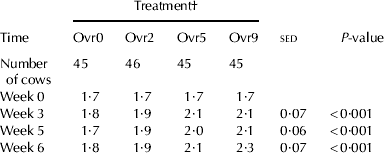
Teat-end hyperkeratosis score increased with increasing duration of overmilking at each measurement week (Table 1). The greatest change occurred from weeks 0 to 3 (P<0·001), changes from weeks 3 to 5 and from weeks 5 to 6 were not significant (P>0·05). However, there was an interaction between overmilking treatment and week (P<0·05). Mean teat score of the Ovr2 treatment was significantly higher than Ovr0 only at week 5 (Table 1). In comparison, mean teat score of the Ovr5 and Ovr9 treatments were greater than the Ovr0 treatment at weeks 3, 5 and 6 (P<0·001). However, mean teat score of the Ovr9 treatment only increased significantly beyond the Ovr5 treatment at week 6 (P<0·001). At week 6 mean teat scores were 0·1, 0·2, 0·4 and 0·6 units higher than week 0 for the Ovr0, Ovr2, Ovr5 and Ovr9 treatments, respectively. The percentage of score 4 (VR) teats increased with level of overmilking (Table 3).
Effect of four overmilking treatments (Ovr0, Ovr2, Ovr5 and Ovr9) on mean teat-end hyperkeratosis score (1–4 scale)

† Treatment: cluster was removed 5 s (Ovr0), 120 s (Ovr2), 300 s (Ovr5) and 540 s (Ovr9) after milk flow rate reached 0·2 kg/min
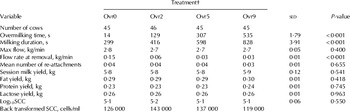
Effect of four overmilking treatments (Ovr0, Ovr2, Ovr5 and Ovr9) on milking characteristics, yield and somatic cell count (SCC)

† Treatment: Cluster was removed 5 s (Ovr0), 120 s (Ovr2), 300 s (Ovr5) and 540 s (Ovr9) after milk flow rate reached 0·2 kg/min
Effect of four overmilking treatments (Ovr0, Ovr2, Ovr5 and Ovr9) on the percentage of teats with score 4

† Treatment: Cluster was removed 5 s (Ovr0), 120 s (Ovr2), 300 s (Ovr5) and 540 s (Ovr9) after milk flow rate reached 0·2 kg/min
‡ Average standard error of the difference
Milking performance
Overmilking time recorded by the milking parlour confirmed that treatments had been applied correctly and cluster-on time increased accordingly (P<0·001; Table 2). Milk production variables (milk yield, fat yield, protein yield and lactose yield) were unaffected by overmilking treatment. Furthermore, the number of cluster re-attachments and maximum milk flow rate were not different between treatments. However, milk flow rate at cluster removal declined from Ovr0 to Ovr5. Log10-transformed SCC did not differ between treatments and no interaction was detected between overmilking treatment and measurement week (P=0·6). During the experiment, one cow on the Ovr5 treatment developed clinical mastitis.
Discussion
The average teat-end hyperkeratosis score for cows on the Ovr2 treatment was not significantly higher than those receiving no overmilking in all weeks, except week 5. In comparison, cows on the Ovr5 treatment had a greater teat-end hyperkeratosis score during each of the three measurement weeks. The degradation in teat health is consistent with Gleeson et al. (Reference Gleeson, Kilroy, O'Callaghan, Fitzpatrick and Rath2003a) who reported increased teat sinus injury after 5 min of overmilking and Hillerton et al. (Reference Hillerton, Pankey and Pankey2002) who reported differences in teat ringing at 5 min but not 2 min of overmilking. Similarly, O'Callaghan et al. (Reference O'Callaghan, Gleeson and Neijenhuis1998) and Gleeson et al. (Reference Gleeson, O'Callaghan and Rath2003b) reported no difference in teat-end hyperkeratosis score with 2 min of overmilking. Thus, farmers should seek to limit overmilking to 2 min to minimise changes in teat-end condition.
An interaction between overmilking treatment and measurement week was detected for teat-end score indicating that the rate of increase in teat score was not uniform between overmilking levels. The mean teat score of the Ovr2 and Ovr5 treatments had increased from 1·7 to 1·9 and 2·1 units by week 3 and remained at this level for the remainder of the experiment, and thus appeared to have reached an upper limit. Similarly, the mean teat score of the Ovr9 treatment had increased from 1·7 to 2·1 units by week 3, and remained at this level for week 5 before increasing to 2·3 units in week 6. Thus there was no difference between overmilking by 5 or 9 min until week 6, indicating that the maximum rate of teat-end degradation may have been reached. Additionally, the stepped increase in mean teat-end score of the Ovr9 treatment may be a reflection of requiring several weeks for the teat-end score to move from one classification band to the next. It is unclear whether presence of an apparent maximum rate of teat-end degradation and upper limit to teat-end hyperkeratosis score (Ovr5) reported in this short-term experiment could apply long-term or whether teat-end condition score would continue to increase to its maximum value if these levels of overmilking had been imposed for a full lactation.
Indicators of udder health were not compromised despite the increase in teat-end condition score over the 6-week experiment. The absence of an effect on SCC despite higher teat-end hyperkeratosis is consistent with the results of Shearn & Hillerton (Reference Shearn and Hillerton1996), Gleeson et al. (Reference Gleeson, Meaney, O'Callaghan and Rath2004) and Breen et al. (Reference Breen, Bradley and Green2009a) who reported no association between increased teat-end hyperkeratosis score and SCC on commercial farms. Mild teat-end hyperkeratosis has been reported to reduce the chances of invasion by bacteria through entrapment in the keratin, which is subsequently flushed from the teat canal during milking (Mein et al. Reference Mein, Brown and Williams1986). Furthermore, using another indicator of udder health, Sieber & Farnsworth (Reference Sieber and Farnsworth1981) reported no association between teat-end condition and the prevalence of clinical mastitis in 22 commercial herds. However, several studies have reported relationships between udder health and teat-end condition. Neijenhuis et al. (Reference Neijenhuis, Barkema, Hogeveen and Noordhuizen2001) reported clinical mastitis was associated with higher teat-end callosity up to 3 months prior to the mastitis occurring. Similarly, Breen et al. (Reference Breen, Green and Bradley2009b) reported quarters with moderate to severe hyperkeratosis, which were more prevalent in the longer overmilking treatments of this study, were more likely to develop clinical mastitis in the same herds where no association between teat-end hyperkeratosis score and SCC had been detected (Breen et al. Reference Breen, Bradley and Green2009a). Thus changes in udder health caused by overmilking may not be apparent in the short term; however, they may develop over a period of time after an increase in teat-end callosity or when teat-end hyperkeratosis becomes severe.
Cows did not appear in discomfort despite the longer cluster attachment time. Clusters remained attached for nearly twice the normal amount of time for Ovr5 cows, and more than 2·5-times for Ovr9 cows, resulting in a period of milking with low milk flow as evidenced by the lower milk flow rate at cluster removal (Table 2). Milking during a period of low milk flow causes the cluster to climb, collapsing teats (Bruckmaier, Reference Bruckmaier2001). However, despite this there was no recorded increase in the number of times clusters required re-attachment (after being kicked off by cows), which is an indicator of discomfort and source of potential frustration to the operator should it occur often. The absence of a difference in cluster re-attachment supports the conclusion of Natzke et al. (Reference Natzke, Everett and Bray1982) that extended milking has little or no traumatising effect on the mammary gland. Thus, owing to the lack of interruption to the routine of the milking operator, through having to re-attach clusters, manage SCC or treat clinical mastitis, many operators may be unaware of overmilking until teat condition reaches a critical point.
The results of this overmilking study have implications for milking management in dairy parlours. The effect of overmilking on teat-end hyperkeratosis can be rapid, with changes detected in 3 weeks, although it may take a period of time for hyperkeratosis to reach a severe level. Overmilking of greater than 2 min is likely to occur in single operator swingover parlours (14–30 units) utilising a full pre-milking routine (spray, strip, wipe and cluster attachment) without the use of ACR, during any stage of lactation (O'Brien et al. Reference O'Brien, Jago, Edwards, Lopez-Villalobos and McCoy2012). Additionally, greater than 2 min of overmilking is likely to occur in single operator parlours without ACR when applying no pre-milking routine (i.e. immediate cluster attachment) if parlour size is greater than 26 units and 22 units at peak and late lactation, respectively (O'Brien et al. Reference O'Brien, Jago, Edwards, Lopez-Villalobos and McCoy2012). Thus, to minimise changes in teat-end condition, care is required when sizing milking parlours. When constructing a new swingover parlour the ideal number of units should be determined based on the anticipated cow milking duration and operator work routine time to ensure maximum utilisation of clusters and minimal operator idle time. In existing parlours, if overmilking is likely to occur then either the work routine may be streamlined by removal of components such as pre-spray and wipe, an additional operator employed in the parlour, ACR installed, or an appropriate number of units deactivated.
In conclusion, overmilking of greater than 2 min resulted in an increase in teat-end hyperkeratosis score of dairy cows in late lactation. However, overmilking did not affect indicators of udder health in this 6-week experiment or appear to cause cow discomfort and overmilking may therefore go unidentified by operators until hyperkeratosis reaches a critical point. To limit overmilking to 2 min in parlours not fitted with ACR the row time in swingover parlours should be appropriately matched to cow milking duration by manipulating operator work routine time through streamlining pre-milking routines, adding an additional operator, installing ACR or deactivating an appropriate number of clusters.
This study was part of a programme of research funded by Teagasc (RMIS 5897). The authors would like to acknowledge the Curtins and Moorepark Farm staff for animal and milking management and Barbara Dow (DairyNZ) for assistance with the data analysis.