Introduction
The genus Pertusaria DC. has a worldwide distribution with over 350 species and is particularly common in subtropical and temperate regions (Lumbsch & Nash Reference Lumbsch, Nash, Nash, Ryan, Gries and Bungartz2002). The genus is characterized by a crustose thallus, hemiangiocarpous apothecia often sunken in verrucae, the presence of a cupulate exciple, primary paraphysoids present in the hamathecium of mature ascomata, thick-walled asci with bivalve dehiscence, and one-celled, often thick-walled, hyaline to brownish ascospores (Lumbsch & Schmitt Reference Lumbsch and Schmitt2001). Nevertheless, the morphological characters show a remarkable variability and, in addition, the chemistry is very complex.
The genus has received considerable attention in recent decades. This has resulted in numerous revisions and the description of many new species (Dibben Reference Dibben1980; Hanko Reference Hanko1983; Kantvilas Reference Kantvilas1990; Archer Reference Archer1997, Reference Archer2004; Lumbsch et al. Reference Lumbsch, Nash and Messuti1999; Zhao et al. Reference Zhao, Ren and Aptroot2004; Messuti Reference Messuti2005; Sipman Reference Sipman2006; Archer et al. Reference Archer, Elix, Fischer, Killmann and Serusiaux2009, Archer & Elix Reference Archer and Elix2011). Molecular studies have shown that Pertusaria is a polyphyletic genus which can be separated into three monophyletic groups (Lumbsch & Schmitt Reference Lumbsch and Schmitt2001; Schmitt & Lumbsch Reference Schmitt and Lumbsch2004).
The Canary Islands are part of Macaronesia, one of the 25 World Biodiversity hotspots (Myers et al. Reference Myers, Mittermeier, Mittermeier, da Fonseca and Kent2000), and play a key role within this region (Médail & Quézel Reference Médail and Quézel1997, Reference Médail and Quézel1999). The lichen biota of the Canary Islands is rich, with more than 1600 species listed for an area of just 7447 km2 (Hernández Padrón & Pérez-Vargas Reference Hernández Padrón, Pérez-Vargas, Arechavaleta, Rodríguez, Zurita and García2009). Nevertheless, new records arise and new species continue to be described from this region with some frequency (Giralt et al. Reference Giralt, Etayo and van den Boom2002; Elix & Schumm Reference Elix and Schumm2003; Etayo & Marbach Reference Etayo and Marbach2003; Pérez-Vargas et al. Reference Pérez-Vargas, Hernández-Padrón and Elix2007, Reference Pérez-Vargas, Hernández-Padrón, Pérez de Paz and Elix2010a, Reference Pérez-Vargas, Hernández-Padrón, Pérez de Paz and Elix2011; Giralt & van den Boom Reference Giralt and van den Boom2009, Reference Giralt and van den Boom2011; Pérez-Vargas & Pérez de Paz Reference Pérez-Vargas and Pérez de Paz2009), including Pertusaria (Pérez-Vargas et al. Reference Pérez-Vargas, Hernández-Padrón, Etayo, Pérez de Paz and Elix2010b), confirming that the lichen biota in this region, with its many ecosystems, is still insufficiently known. In the present work we describe a new species of Pertusaria from this Archipelago.
Material and Methods
The specimens were collected on lava flows in Timanfaya National Park (Lanzarote) and in Fuerteventura. Specimens are deposited in TFC herbarium. The morphology of the lichen specimens was examined using a Leica ZOOM 2000 or a Zeiss Stemi 2000C stereo-microscope. Sections for anatomical examination were cut by hand and were studied with an Olympus CH compound microscope. Spore measurements were made on material mounted in water at ×1000 magnification, and only well-developed ascospores lying outside the asci were measured. Colour reactions (spot tests) were made using standard methods (Orange et al. Reference Orange, James and White2001). Chemical constituents were identified by thin-layer chromatography (TLC) using standard methods (Culberson Reference Culberson1972; Culberson et al. Reference Culberson, Culberson and Johnson1981; Elix & Ernst-Russell Reference Elix and Ernst-Russell1993).
The New Species
Pertusaria etayoi Pérez-Vargas & C. Hern.-Padr. sp. nov.
MycoBank No.: 563523
Fungus saxicolous. Thallus crustaceus, flavido-olivaceus, rimoso-areolatus; soredia vel isidia nulla. Verrucae fertiles thallo concolores, numerosae, conspicua. Hymenium hyalinum, epithecium brunneum K-. Asci cylindrici, 2-spori. Ascosporae hyalinae, non-septatae, ellipsoideae, 115–140×55–70 µm. Paries 11–14(18) µm crassus. Conidia filiformia, 12–16×1 µm. Thallus acidum thiophanicum, acidum sticticum, acidum norsticticum et acidum menegazziaicum continens.
Typus: Spain, Lanzarote Island, Timanfaya National Park, “Entre Montañas Miradero y Señalo”, UTM: 624172/3209083, 395 m alt., on basaltic rocks, March 2010, C. Hernández & P. L. Pérez de Paz, TFC Lich: 9642 (TFC Lich.—holotypus; TFMC, MACB—isotypi).
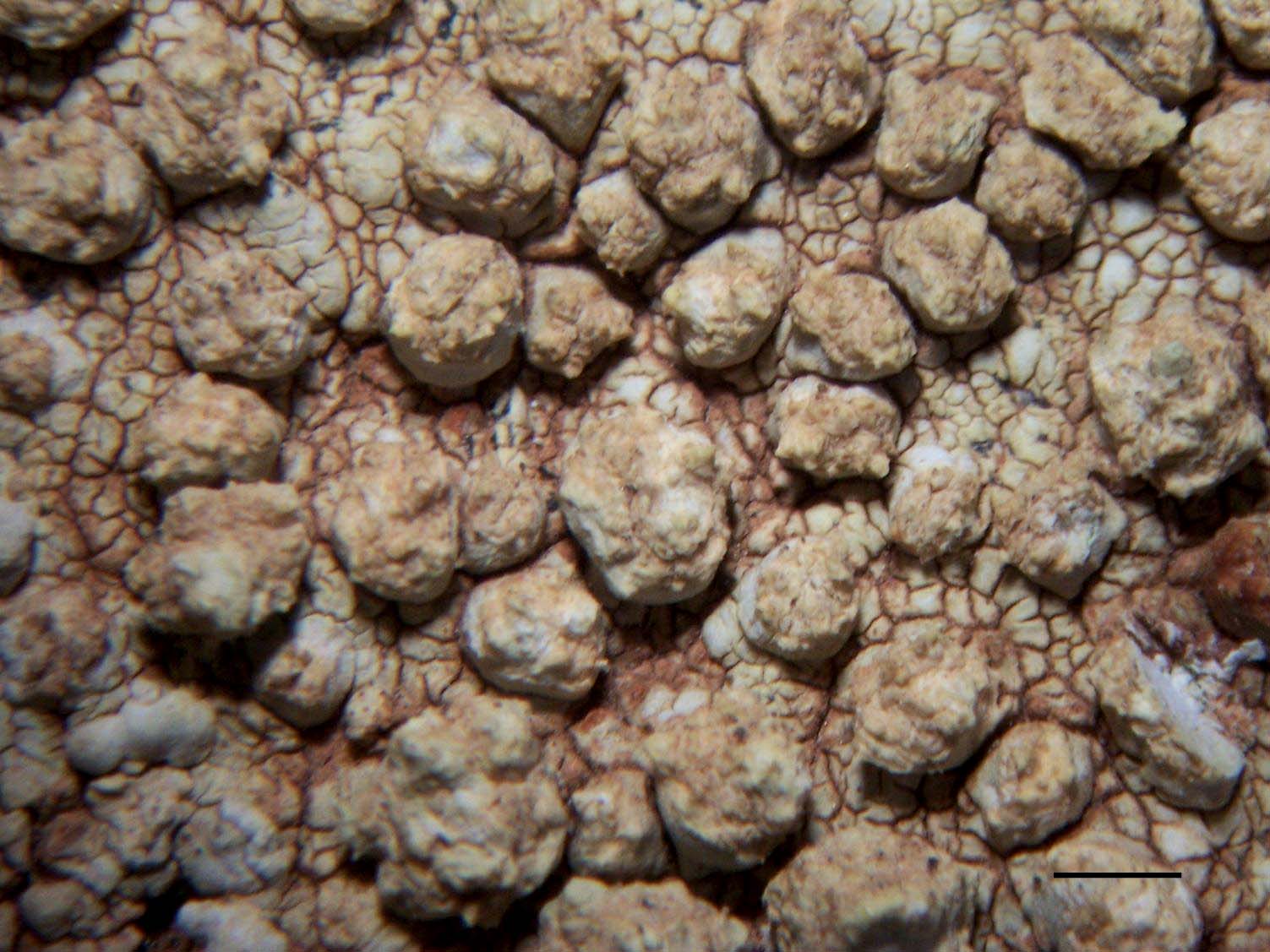
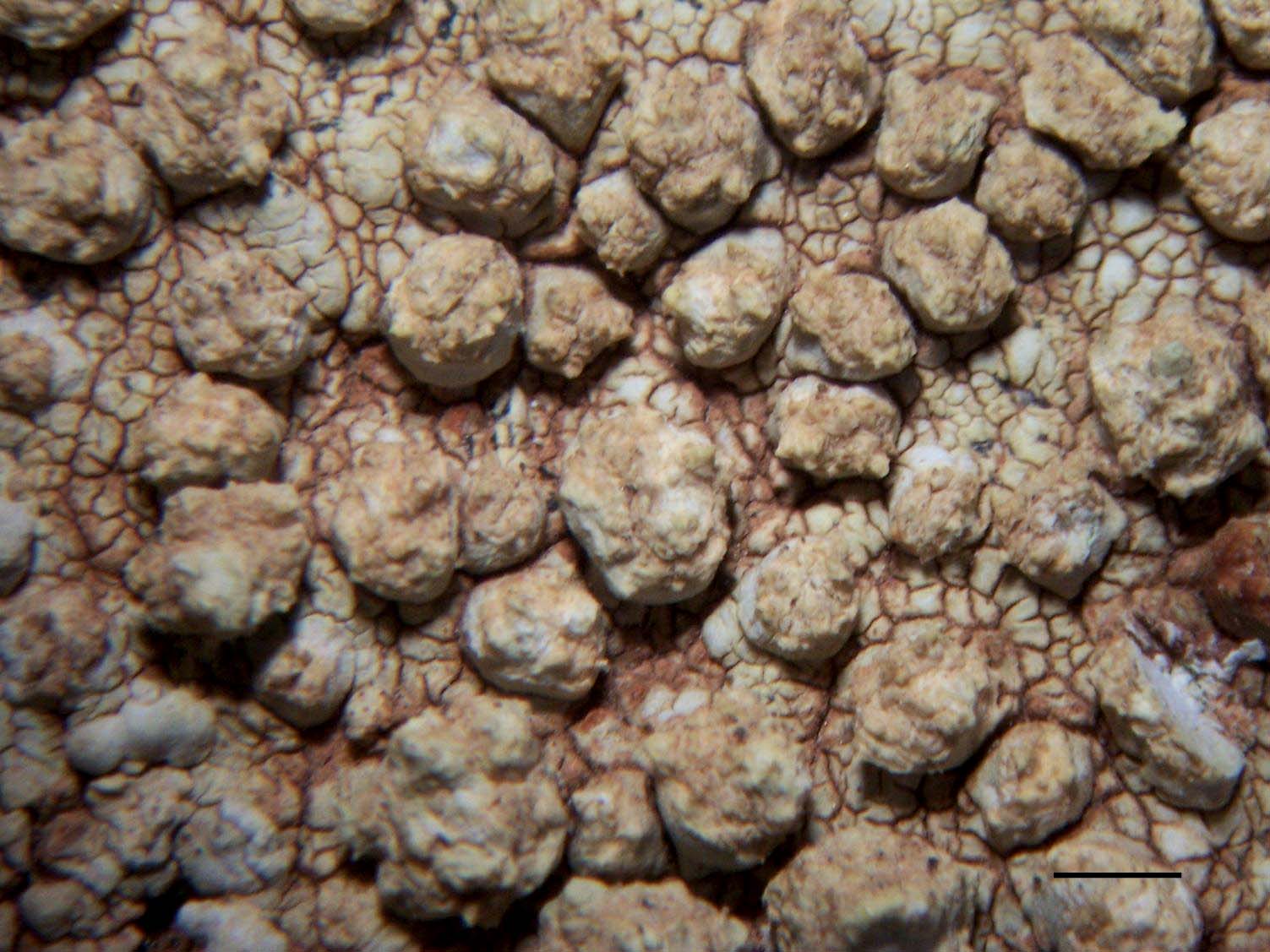
Pertusaria etayoi, habit showing thallus and apothecia (part of holotype TFC Lich: 9642) Scale=2 mm. In colour online.
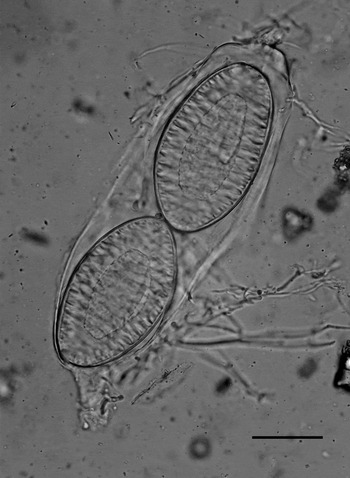
Pertusaria etayoi, ascus with spores. Scale=50 µm.

Thallus crustose, saxicolous, cracked-areolate, moderately thick, yellowish grey (creamy) to greenish yellow, slightly whitish pruinose, lacking isidia and soredia.
Apothecia numerous, verruciform, verrucae conspicuous, concolorous with the thallus, hemispherical to subglobose, disc finally exposed, often deformed and resembling soralia, up to 2·5 mm diam. Epithecium olivaceous, K−. Hymenium colourless, 320–400 µm thick. Paraphyses sparingly branched, anastomosed, up to 3 µm thick. Asci cylindrical, 270–300×70–90 µm. Ascospores 2 per ascus, hyaline, ellipsoid, 115–140×55–70 µm; spore walls thick, double, 11–14(18) µm, striate.
Pycnidia rare; conidia straight, acicular, 12–16×1 µm.
Chemistry. K+ yellow-orange, C+, KC+ and UV+ vivid orange, Pd+ orange; thiophaninic, stictic, norstictic and menegazziaic acids.
Etymology. This new species is named in honour of the Spanish lichenologist Dr J. Etayo, in recognition of his many contributions to Canarian lichenology and for his friendship.
Habitat and distribution. Pertusaria etayoi occurs on basaltic rocks and lava flows between 50 and 650 m a.s.l. in Lanzarote and Fuerteventura, the most eastern islands of the Canarian Archipelago. These areas are characterized by a xerophytic shrub-like community (e.g. Kleinio-Asparagetum pastoriani, Euphorbietum balsamiferae) with low density and harsh climatic conditions due to the low precipitation and high solar radiation. It is better developed on pahoehoe lavas where it occurs together with crustaceous species of Acarospora A. Massal., Aspicilia A. Massal., Caloplaca Th. Fr. and Ochrolechia A. Massal., and fruticose species of Ramalina Ach.
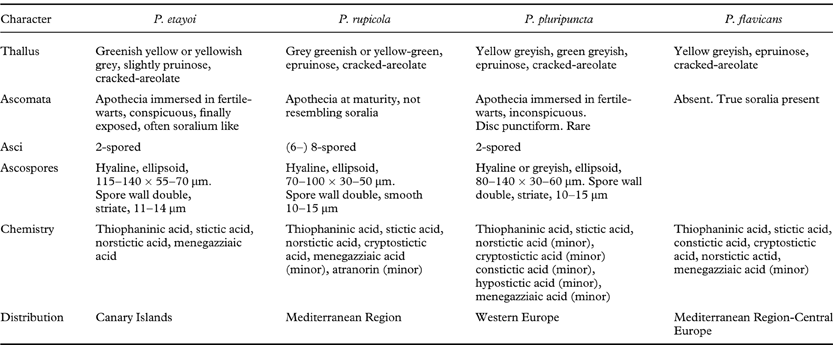
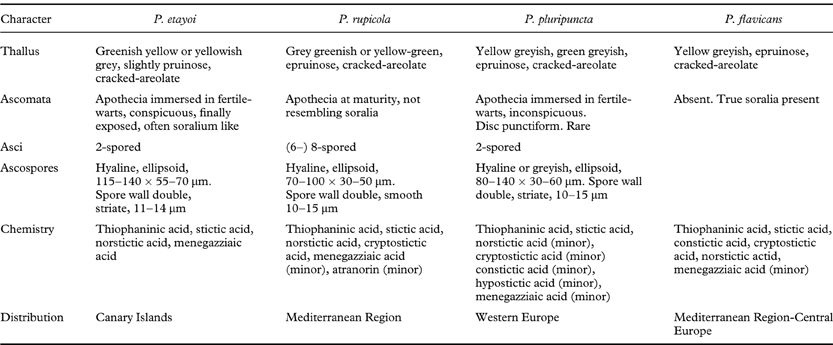
Notes. This new species is characterized by its saxicolous habit with verruciform, subglobose and finally exposed apothecia, asci with 2 ascospores with thick and striate walls and the presence of thiophaninic, stictic, norstictic and menegazziaic acids. Superficially it can resemble the Mediterranean saxicolous Pertusaria rupicola (Fr.) Harm. That species, however, has an epruinose thallus, the apothecia never resemble soralia, the epithecium is K+ violet and when it is fertile has asci with (6–)8 spores with smooth walls (Boqueras & Llimona Reference Boqueras and Llimona2003).
Other saxicolous species of Pertusaria with a similar chemistry and morphology include P. pluripuncta Nyl. and P. flavicans Lamy. The first has an epruinose thallus, the apothecia are rare and consistently punctiform, inconspicuous and immersed in the thallus (Chambers et al. Reference Chambers, Gilbert, James, Aptroot, Purvis, Smith, Aptroot, Coppins, Fletcher, Gilbert, James and Wolseley2009). The latter is a sterile species with true soralia and epruinose thallus (Table 1).
Main differences between Pertusaria etayoi and related species.
Selected specimens examined. Spain: Lanzarote Island: Timanfaya National Park, “Montaña Pedro Perico”, UTM: 616445/ 3207695, 170 m alt., on lava flows, v 2010, C. Hernández, I. Pérez-Vargas & P. L. Pérez de Paz (TFC Lich: 10187); “Montaña de Timanfaya”, UTM: 622249/ 3208156, 458 m alt., basaltic rocks, v 2010, C. Hernández, I. Pérez-Vargas & P. L. Pérez de Paz, (TFC Lich: 9987); “Malpaíses del Bco. del Fuego”, UTM: 620369/ 3207975, 270 m alt., on lava flows, v 2010, C. Hernández, I. Pérez-Vargas & P. L. Pérez de Paz, (TFC Lich: 9380). Fuerteventura Island: “Montaña La Muda”, 650 m alt., on basaltic rocks, iii 1992, P. L. Pérez de Paz, (TFC Lich: 2130).
This work was supported by Organismo Autónomo de Parques Nacionales (Spanish Ministerio de Medio Ambiente), project: TEC 00002173. We thank two anonymous reviewers for their helpful suggestions which improved the manuscript.