Introduction
In recent years, with the improvement of life conditions and the decline in the birth rate, ageing has become an important social issue. According to The 2019 Revision of World Population Prospects (United Nations, 2019), the percentage of the population aged 65 and above rose globally from 5.1 per cent in 1950 to 8.2 per cent in 2015, and it will increase to 17.8 per cent in 2060. Many countries worldwide are now facing the challenge of a rapidly ageing population, leading to a shrinking number of workers and a growing social security solvency problem. Therefore, research on social security and employment for older adults has become more important than ever.
This paper is related to the extensive literature addressing governments’ supply-side labour interventions with respect to the employment of older adults (Krueger and Pischke, Reference Krueger and Pischke1992; Gustman and Steinmeier, Reference Gustman and Steinmeier2005; Mastrobuoni, Reference Mastrobuoni2009; Behaghel and Blau, Reference Behaghel and Blau2012; Hanel and Riphahn, Reference Hanel and Riphahn2012; Staubli and Zweimüller, Reference Staubli and Zweimüller2013; Atalay and Barrett Reference Atalay and Barrett2015; Engels et al., Reference Engels, Geyer and Haan2017). Most of these studies find that reductions in social security benefits or increases in the retirement age have significant positive effects on the labour supply of older workers.
There are also extensive studies on the effect of governments’ demand-side labour interventions, but with mixed results. The broader literature documents positive labour demand effects from anti-age discrimination laws in the United States of America (USA). Neumark and Stock (Reference Neumark and Stock1999) document positive employment effects of anti-age discrimination legislation on workers in the covered age ranges. Ashenfelter and Card (Reference Ashenfelter and Card2002) find that the abolition of mandatory retirement for college faculty reduced retirement after an amendment to the anti-age discrimination law. Adams (Reference Adams2004) suggests that anti-age discrimination leads to a decrease in retirement among protected workers. Neumark et al. (Reference Neumark, Burn, Button and Chehras2019) conclude that there is less discrimination against older men and women in those states where the anti-age discrimination laws are stricter. Conversely, some studies find that anti-age discrimination laws have limited and even negative effects on employment. Shannon and Grierson (Reference Shannon and Grierson2004) suggest that making mandatory retirement illegal has little effect on the size of the older workforce. Lahey (Reference Lahey2008) reports that white male workers over the age of 50 in states with strict anti-age discrimination laws are more likely to retire and less likely to be hired than workers in states with lax ones. These findings suggest that such legislation has the unintended consequence of firms seeking to avoid litigation by not employing older workers in the first place or trying to remove older workers through retirement incentives.
While there is an extensive literature examining the effects of demand- and supply-side effects, the literature on the complementarity of demand- and supply-side interventions is relatively scarce. For example, using Health and Retirement Study data from the USA and a triple difference method, Neumark and Song (Reference Neumark and Song2013) examine the complementarity of demand- and supply-side interventions, such as anti-age discrimination laws and social security reforms, finding that in the USA, an increase in employment due to reduced pension benefits and a rise in the full retirement age is more significant in states with strict anti-age discrimination protection. The authors argue that strong laws reduce the demand-side barriers.
In Japan, the government has implemented many social policies to solve the problems of an ageing society.Footnote 1 Of these, the pension revision and Elderly Employment Stabilization Law (EESL) revision,Footnote 2 linked to each other, were two of the most significant amendments and attracted widespread attention. Under the 2000 pension revision, Japan gradually increased the remuneration-based proportional part of the pension eligibility age from 60 to 65 from 2013.Footnote 3 Moreover, the EESL revision, aimed at companies, was also implemented in 2013. There were two important changes. The first was the abolition of the selection mechanism by which companies could select continued employment for older employees according to selection criteria. Whereas before the 2013 EESL revision, companies could refuse older employees who wished to continue working for the same company after mandatory retirement age by setting selection criteria, after the 2013 revision they had to employ them all. The second change meant that companies could transfer older adults to their subsidiaries or affiliated companies, regardless of whether they were willing or not. The government made this transitional measure to avoid putting too much pressure on companies. However, this may have offered a new potential strategy for companies to exclude older adults.
In Japan, many empirical studies have examined the effects of the 2006 revision of the EESL. Regardless of the data source and method, all studies indicate that this law has been effective in increasing the employment rate of older workers (Yamamoto, Reference Yamamoto, Higuchi and Seko2008; Kondo and Shigeoka, Reference Kondo and Shigeoka2013; Kondo and Shigeoka, Reference Kondo and Shigeoka2017). Kondo and Shigeoka (Reference Kondo and Shigeoka2017), using Labour Force Survey, estimated the impact by comparing cohorts affected by the 2006 revision (such as those born in 1946) with those unaffected (those born in 1945). Their results indicate that the 2006 revision had increased the employment rate of men in their early sixties, with the impact of supply-side labour enforcement being slightly larger when combined with demand-side enforcement. Yamada (Reference Yamada2017) analyses the combined effects of the 2013 EESL and pension revisions by using individual data from the Longitudinal Survey of Middle-aged and Elderly Persons and employing a difference-in-difference (DD) model, with his results indicating that the employment rate among men rose due to these revisions. However, the paper used ‘whether he is engaged in a paid job’ as the dependent variable, which may have led to some bias in the results. According to the definition, self-employed workers are also in paid jobs. However, it should be noted that they are not the target of the 2013 EESL and pension revisions, which are applied to salaried workers who are employed by companies. Thus, inclusion of this non-target group may have led to some bias in the results.
In 2013, the EESL abolished the selection mechanism, enhancing the obligation of companies to employ older adults. In the same year, the pension revision raised the eligibility age for retirement. These modifications aimed to increase the continued employment of older adults. However, the 2013 EESL did not prohibit companies from transferring older adults to their subsidiaries or affiliated companies. Therefore, the revision might impact the continued employment of older adults; that is, companies might be more likely to use the measure of job transfer or company transfer.
This study examines the effects of a demand-side labour revision, namely the 2013 EESL revision, and a supply-side labour revision, namely the 2000 pension revision on employment of older adults. By doing so, this study extends the literature in three ways. First, while there have been several studies of the effects of the 2006 EESL revisions, this study examines the effects of the 2013 EESL and pension revisions. It is related to an extensive literature on the effects of the 2006 revisions on employment of older adults (Yamamoto, Reference Yamamoto, Higuchi and Seko2008; Kondo and Shigeoka, Reference Kondo and Shigeoka2013; Kondo and Shigeoka, Reference Kondo and Shigeoka2017). These previous studies have typically found that the employment percentage of people in their sixties has increased. However, there have been few studies on the effect of the 2013 revision (Yamada, Reference Yamada2017). Second, this study investigates the labour supply and demand responses to the revisions. Specifically, this study explores whether the revisions actually led to older adults receiving their pension later and whether they have been employed in subsidiaries, affiliated companies or the like. To the best of our knowledge, no prior studies have investigated the 2013 revision's effects on job transfers, which is a key point. Third, this study uses Keio Household Panel Survey data to control for individual fixed effects.
The situation in Japan is different to that in Western countries. While legislation in Japan obliges companies to employ older adults, to avoid imposing stress on the companies it also gives companies the right to choose the form that such employment takes. Through the 2013 EESL revision in particular, the restriction on companies transferring older adults has been relaxed. What, then, might the effect of such a moderate policy reform be? The 2013 EESL and pension revisions can serve as typical examples and provide more policy implications for other countries.
The primary results of this study are as follows. First, this study found no significant increase in the employment rate or receipt of pensions for men aged 60 and older. Second, this study found that the revisions of 2013 raised the job transfer rate of men aged 61 by 7.3 per cent and those aged 62 by 5.1 per cent.
Background
The 2013 EESL and pension revisions
According to the White Paper on the Aged Society,Footnote 4 in the 1980s, Japan's population ageing rate was lower than that of the other main developed countries and regions. However, after 1990, the ageing rate accelerated, and Japan transformed from an ‘ageing society’ (over 7% in 1970) to an ‘aged society’ (over 14% in 1994) in the space of 24 years. Against this background, the Japanese government implemented the revisions in relation to pensions and employment of older adults.
Since the revisions implemented in 2013 were based on the ones in 2006, this study will first briefly introduce the 2006 EESL and 1994 pension revision. The Pension Reform Act, reversed in 1994, had gradually raised the eligibility age from 60 to 65 for the fixed rate part of the ‘specially provided pension’ for men by one year every two years from 2001.Footnote 5 The revision for women applied five years later than for men, starting from 2006.
However, at this time, the mandatory retirement age was still 60, and there was a gap between the pension eligibility age and the mandatory retirement age. To close the gap, the EESL revision was implemented in 2006. According to this revision, companies were required to take at least one of the following measures: (a) increase the mandatory retirement age to the pension eligibility age; (b) set up a formal rule for employment extension (kinmu enchō) or re-employment (saikoyō); or (c) abolish the mandatory retirement age. In practice, however, the transitional measures are as follows. First, companies do not need to employ older adults up to age 65, but they must employ them at least until they reach the age at which they can receive the fixed rate part of their pension. Second, the employment selection criteria can be set by employers through labour-management agreements or employment provisions to select the continued employment of old employees.
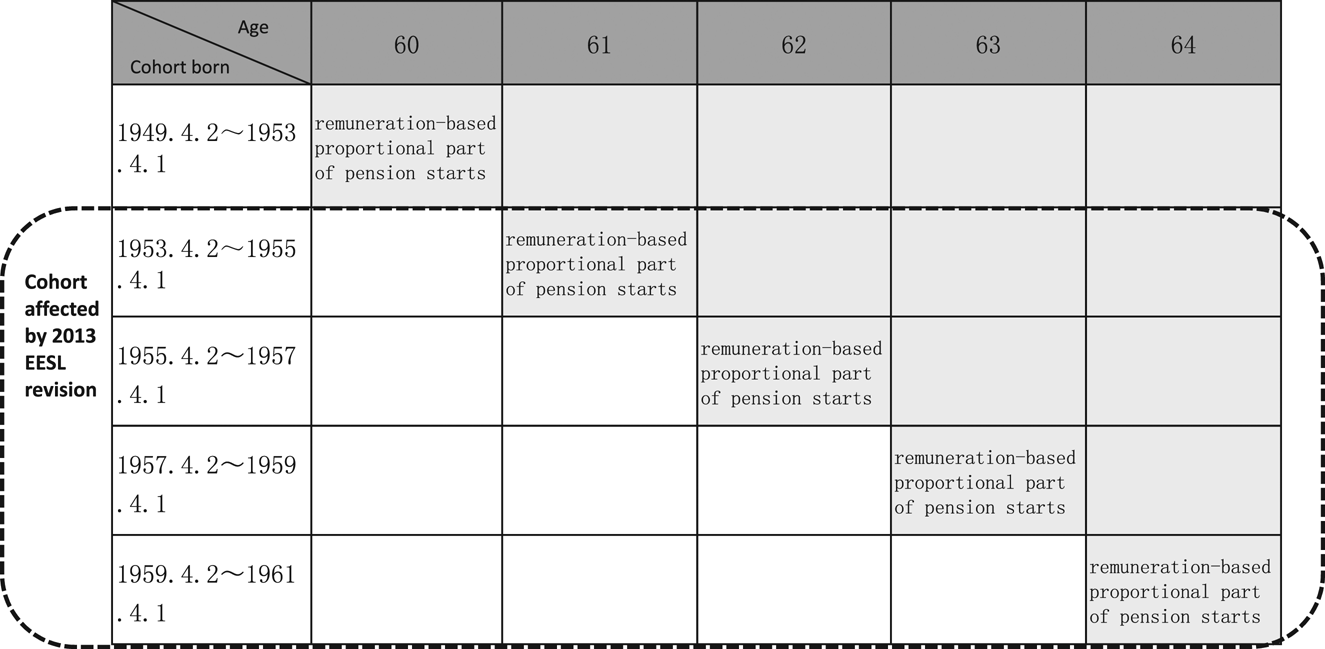
Since the 20th century, the ageing rate in Japan has deepened further, increasing to 28.4 per cent in 2019, the highest in the world.Footnote 6 The Pension Reform Act was revised again in 2000, this time gradually raising the eligibility age from 60 to 65 for the remuneration-based proportional part of the ‘specially provided pension’ for men, again by one year every two years, from 2013, until it reaches 65 for the cohort born in 1961. More specifically, if a man was born in 1953 or 1954, he can start receiving the remuneration-based proportional part of pension when he is 61 years old, in 2014 or 2015, respectively, and so on for those born after that. The revision for women again came into effect five years later than for men, starting from 2018.
Following the pension revision, the EESL was amended again in 2013 to strengthen companies’ obligations further. According to the 2013 EESL revision, in principle, companies were obliged to employ older adults up to 65 without establishing any selection criteria. In practice, as a transitional measure, companies must employ them until they reach the age at which they can receive the remuneration-based proportional part of their pension. Then, companies are obliged to make an effort to employ older adults without criterion from the age of eligibility to 65.
Figure 1 summarises how each revision applies to each cohort. The figure shows the timing of each cohort's eligibility age for the remuneration-based proportional part of their pension (under the pension revision). The parts within the dotted line are the cohort affected by 2013 EESL, under which companies are obliged to employ or make an effort to employ older adults without selection criteria. We can see that the eligibility age for receiving the remuneration-based proportional part of the pension gradually increased for the cohort born after 1953, and that they are also affected by the 2013 EESL revision. Thus, older men born after 1953 have a financial incentive to work because they will not receive a pension at the age of 60. Simultaneously, they are protected by the 2013 EESL revision, which obliges companies to employ them.
Age limits for older adults to receive the remuneration-based proportional part of the specially provided pension and the 2013 Elderly Employment Stabilization Law (EESL) revision (for men).
Note: 1949.4.2 represents 2 April 1949.

The 2013 EESL revision also included the following: (a) abolition of the selection mechanism that could set standards for the selection of older employees; (b) expansion of the categories of companies hiring older employees; (c) introduction of disclosure rules for companies that breach the law; and (d) the setting of guidelines concerning the implementation and operation of employment for older adults. When compared to the previous legal situation, this revision has two main features.
The first feature is the abolition of the selection mechanism that allowed companies to select the continued employment of older adults according to certain selection standards. In other words, companies were prohibited from establishing standards, with all candidates being eligible for continued employment. Before the 2013 EESL revision, companies had the right to reject continued employment for older workers under certain criteria. Consequently, it is unclear whether older workers were excluded before 2013 on the basis of some subjective and ambiguous selection criteria established by companies. If so, then the 2013 EESL revision will be effective. If not, then it could have less of an impact on employment promotion.
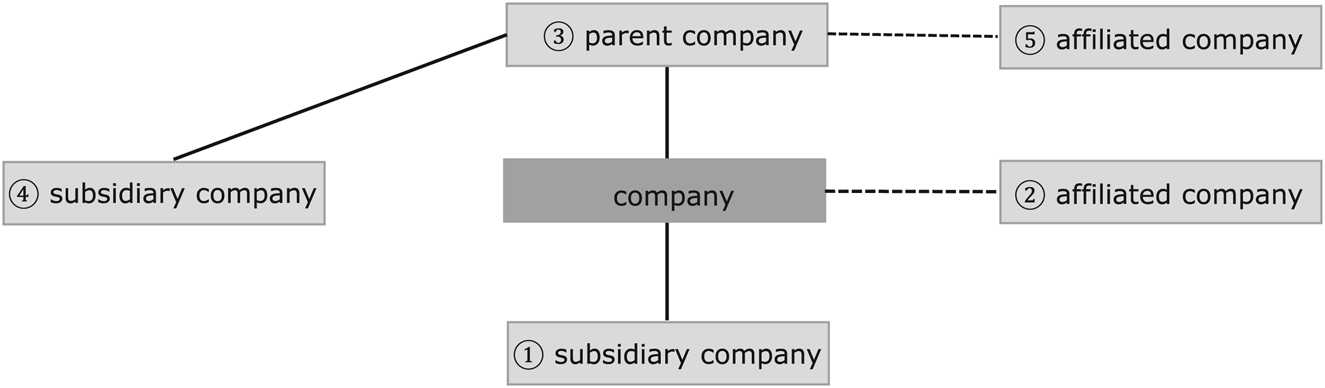
The second is the expansion of the categories of companies. This was a transitional measure to avoid putting too much pressure on companies from employing older adults. Before the 2013 EESL revision, companies were obliged to employ older adults at the same workplace from which they were retiring. However, after the 2013 EESL revision, companies were allowed to transfer the older employees to group companies, such as subsidiaries (see Figure 2 ①) or affiliated companies (Figure 2 ②) of the company where they had worked before retirement, or to the parent company (③) or its subsidiaries (④) or affiliated companies (⑤). Put differently, older employees could be assigned to a range of companies whether they liked it or not.
Expansion of the categories of companies (a major point of the 2013 Elderly Employment Stabilization Law revision).

In summary, the pension revision gradually raises the eligibility age from 60 to 65 for the remuneration-based proportional part of the pension benefit from 2013. At the same time, the 2013 EESL revision was also implemented to strengthen the obligation of continued employment for older adults. The revised 2013 EESL mandated companies to employ older adults without setting any selection criteria. However, as a transitional measure, the revision allowed companies to transfer older adults to any affiliated or associated companies.
Abolition of the selection mechanism in the 2013 EESL
The abolishment of the selection mechanism has introduced the following nature of the changes. We interpret these selection criteria as either hiring or redundancy criteria. Companies use the criteria to re-employ some older people while rejecting others. This study prefers to think of it as hiring criteria. In Japan, the selection criteria are used when companies re-employ older people after the mandatory retirement age; thus, it is appropriately referred to as hiring criteria. However, regardless of the interpretations, abolishing the selection criteria should essentially mean that companies could no longer select few older people but have to re-employ all older people who wish to continue working after the mandatory retirement age.
This study will then give more details about the abolition of the selection mechanism. To deepen understanding of the precise changes that the revision made, we need to know the situation before the 2013 EESL revision. Here, this study will give an introduction to the pre-reform rules (selection criteria regulations in the 2006 EESL) and the practices of companies.
First, the specific provisions of the selection criteria that were stipulated in the 2006 EESL. According to the 2006 EESL, when formulating the criteria, business owners had to conduct detailed negotiations with labour unions and set the criteria according to each company's situation, with the contents of the criteria depending, in principle, on labour and management agreements. Even if the criteria were stipulated after adequate consultation between the labour force and management, if the criteria were not in line with the standards or were contrary to other labour laws or public order and morals, they were considered illegal (i.e. the criteria had to be specific and objective). The 2006 EESL revision had only basic requirements for employers with respect to the hiring criteria, rather than detailed rules. This meant that until the 2013 EESL abolished the selection mechanism, it was possible for companies to select older workers by setting unreasonable selection criteria.
In practice, the top criteria used by the companies before the 2013 EESL revision were ‘willingness to work’, ‘absence due to health problems’, ‘attendance rate’, ‘work attitude’ and ‘being able to agree with the job content asked by the company’ (see Yamada, Reference Yamada2009). Arguably, ‘willingness to work’ and ‘work attitude’ could be considered subjective and ambiguous criteria. Therefore, even if we consider the statistics on the actual criteria, it is not clear whether older workers were selected on the basis of the criteria established by corporations before the 2013 revision. In other words, it is not clear whether the 2013 revision was effective.
Macro-economic background
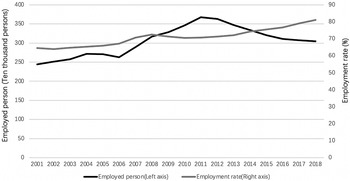
Below, this study gives background information on Japan's macro-economic situation before the EESL was revised in 2013. Trends in the employment numbers and rates of older workers from 2001 to 2018 are shown in Figure 3. The employment rate is more appropriate than the number to confirm the impact of the EESL revision. The employment rate increased sharply after the 2006 EESL revision and then fell due to the 2008 financial crisis. However, employment began to rise again beginning in 2012, reaching 72.2 per cent in 2013. Therefore, when the employment rate of older workers rose to a high level, and the labour market for older workers was saturated, even if social policy was reformed, the effect was unlikely to be noticeable. Thus, one might wonder whether the 2013 EESL revision and pension revision were effective.
The employment number and rate for older men aged 60–64.
Source: Data from the Labour Force Survey (long-term time-series data; Ministry of Internal Affairs and Communications).

Data and descriptive statistics
Data
To examine the impact of the 2013 revision of the EESL and the pension revision on labour market behaviour, this study used individual-level data from the Keio Household Panel Survey for the period from 2008 to 2018. The data provide very detailed information on individual characteristics, employment and living conditions. The data of interest to us include employment, job transfer and receipt of pension.
This study will focus on the effect on males and will ignore the female sample. The reason for doing so is that the 2013 EESL and the pension revisions are more likely to affect men than women. In practice, the EESL is mainly applied to regular workers on a full-time contract. However, in Japan, women often retire from full-time employment during the childbirth and child-rearing period, and few women remain in full-time employment until they reach the mandatory retirement age.
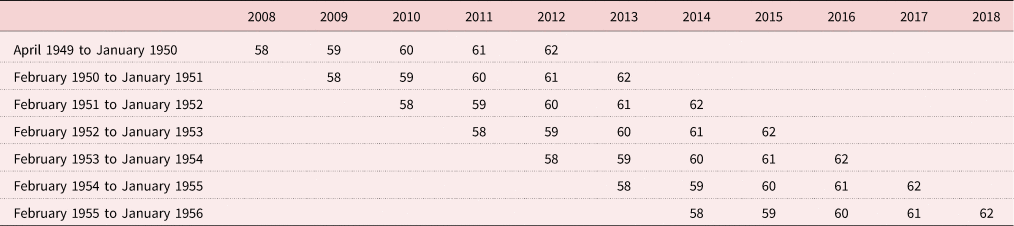
Given that our interest is in the effects of the 2013 revision of the EESL and the pension revision, this study used samples of men born between April 1949 and January 1956. As shown in Table 1, since the survey was carried out in January each year, this study calculated the age of older adults on the basis of their month of birth in the questionnaire. The sample consisted of individuals aged from 58 to 62 years.
Sample consisting of cohorts and questionnaire waves

Note: The values in the table are the ages of the individuals. Since the survey was carried out in January each year, this study calculated the age of the older adults on the basis of their month of birth in the questionnaire. For example, people born in February 1950 were 58 years old in January 2009. The same applies to the other calculations.
The estimation sample consisted of two sub-samples for people who started to receive pensions at different ages. The treatment groups (post-reform cohorts) consisted of individuals born between April 1953 and January 1956, while the control groups (pre-reform cohorts) consisted of individuals born between April 1949 and March 1953. As shown previously in Figure 2, the treatment groups could start to receive the remuneration-based proportional part of the specially provided pension at the age of 61 or 62, whereas the control groups start to receive it at the age of 60. Hence, when the treatment groups reached 60, they had not reached the age to receive their pension and, simultaneously, their company was obliged to employ them, without setting any criteria, until they reached the age of 61 or 62.
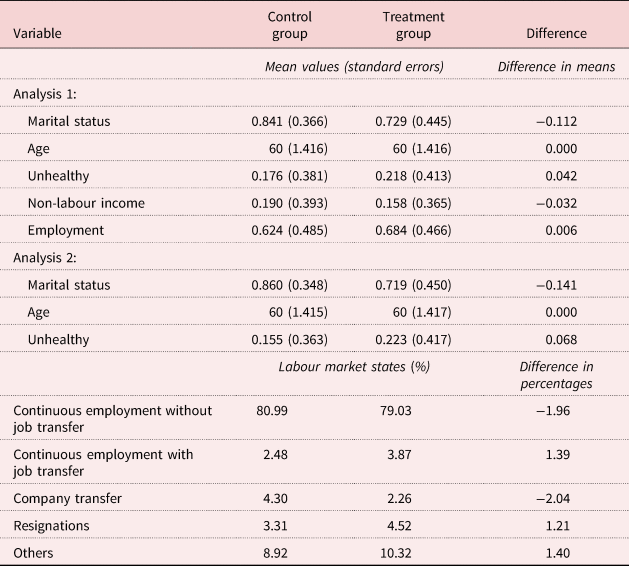
The descriptive statistics for the control and treatment groups are given in Table 2. To maximise the sample size, this study cleaned the data to conduct an analysis of the impact of the revision on employment and job transfer. In addition, with respect to group means, the table also shows the differences. As can be seen, there is little difference in the personal characteristics, such as health status, marital status and non-labour income. The treatment group was more likely to experience job transfer, and choose to leave the company, but was less likely to experience company transfer. However, the differences were rather moderate.
Sample statistics for treatment and control groups

Trends by cohort group
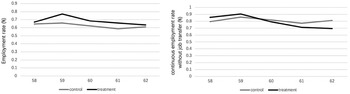
To illustrate graphically the labour supply and demand responses affected by the 2013 EESL revision and pension revision, Figure 4 displays the employment trends and job transfers over time among the treatment and control groups. As Figure 4 illustrates, the employment rate has been declining steadily for these two groups. In comparison to the employment rate of the control group, that of the treatment group increased slightly at the age of 61, suggesting that the revisions may have had little effect on employment. The continuous decline in employment without a job transfer at the age of 61 was larger for the treatment group than for the control group, indicating that the revisions may have had a positive effect on job transfers of older adults.
Employment rate and continuous employment rate without job transfer.

Identification strategy
Since the EESL revision and the social security revision in Japan are inextricably linked, one way to examine the effect of the two revisions simultaneously is to investigate them by cohort. Thus, the effect of the 2013 EESL and pension revisions is estimated by comparing the labour market behaviour of younger birth cohorts to older birth cohorts unaffected by the revisions.
To clarify the effect of the 2013 EESL and the pension revision, this study used a DD approach, a method used in other studies that estimate the effect of this type of policy, with its basic regression equation being as follows:

where Y i(t) represents one of the outcome variables, such as a dummy for being a salaried worker or being employed without job transfer, and Cohorti is a dummy variable indicating whether an individual i belongs to the treatment group. Since there are no annual data on non-labour income in the 2008 waves, this study only used data from the 2009–2018 waves to estimate the impact of the revisions on employment. Here, Cohorti equals 0 if an individual i was born between February 1950 and March 1953, and 1 if he was born between April 1953 and January 1956. However, for the analysis of the impact of the revisions on job transfer, this study can use data for the 1949 cohort from the 2008 wave. Thus, Cohort i equals 0 if an individual i was born between April 1949 and March 1953, and 1 otherwise. The dummy variable Age i(t) indicates an individual's age, while I i(t) represents the characteristics at period t such as ‘self-reported health status’ and ‘marital status’, with the ‘self-reported health status’ being equal to 1 if individual i was unhealthy, and 0 otherwise. ‘Marital status’ equals 1 if individual i is married, and 0 otherwise. In addition, I i(t−1) represents the characteristics at period t − 1, such as ‘non-labour income’; I i(t−1) equals 1 if an individual i earns non-labour income in period of t – 1, and 0 otherwise. The coefficient δ then captures the effect of the 2013 EESL and pension revisions.
This study used an individual fixed-effects model to control for time-invariant factors. In addition, this study used individual characteristics as explanatory variables to control the time-varying factors related to employment status. Table 2 shows the explanatory variables. In particular, the study controlled for self-reported health status and non-labour income. To avoid the problem of simultaneous decisions, this study used the data for non-labour income from year t − 1.
Two robustness checks were conducted by adding to discussions of large-sized companies and regular workers’ circumstances. The study used a triple difference method (DDD) to investigate the effect of the 2013 EESL and pension revisions on older adults in large-sized companies and on regular employees’ circumstances. This approach is useful because the effects may be more concentrated among employees in large-sized companies and in the circumstances of regular employees. Before the 2013 EESL revision was implemented, many small and medium-sized companies already continued to employ staff after the age of 60. Large-sized companies applied the mandatory retirement age of 60 more strictly and may have set selection criteria when continuing to employ older adults. Moreover, since the specially provided pension system is mainly applied to regular workers, it may be more significant for this group than for non-regular workers, such as fixed-term contract workers, part-time workers and dispatched workers.
The regression equation is as follows. Firmsize i(59) represents the large-sized company dummy, which takes 1 if individual i was employed in a company with 500 or more employees at the age of 59, and 0 otherwise. In addition, Regular i(59) denotes the regular employment dummy, which takes 1 if individual i worked as a regular employee at the age of 59, and 0 otherwise.


Empirical results
The impact on employment
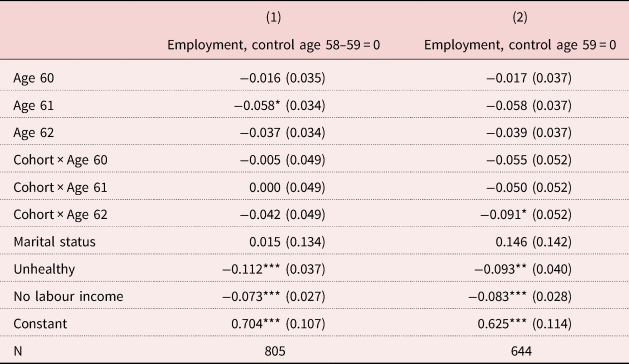
Table 3 presents the estimated reform effects on employment of older adults based on Equation 1. Of interest is the coefficient δ, which represents the effect of the 2013 revision. However, δ is not statistically significant for the models in which men aged 58–59 or men aged 59 are used as control groups. The results indicate that the treatment group was not affected by the revisions more significantly than the control group.
Impact of revisions on employment

Note: Standard errors are in parentheses.
Significance levels: * significant at 10%, *** significant at 1%.
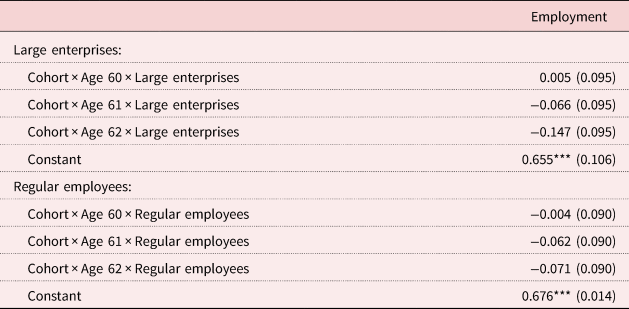
Table 4 presents the estimated reform effects on employment of older adults based on Equations 2 and 3. First, this paper studied whether the revisions have been effective when older adults were employed in large enterprises. Table 4 presents the effects of the 2013 revision and the pension revision, defined as the difference between the DD estimates of work in large-sized enterprises and others. Second, to confirm the effectiveness of the revisions when older adults were employed as regular employees, this study used the same method as above and changed the data from ‘being employed in large-sized enterprise when aged 59’ to ‘being employed as a regular employee when aged 59’. As shown in Table 4, almost all the estimated coefficients are negative but not statistically significant, which indicate that the revisions have almost no effects. More specifically, the treatment group who had worked in large-sized enterprise or were regular employees were not affected by the revisions more significantly than the control group.

Kondo and Shigeoka (Reference Kondo and Shigeoka2017) find that the effects of the 2006 EESL revision on the employment of older adults are more significant on employees at large-sized firms, because re-employment after the mandatory retirement age was already common in small-sized firms even before the EESL revision. However, this study found that the 2013 revisions are not effective in large-sized firms. One of the probable reasons for this phenomenon is that older workers were not rejected through the setting of criteria by large-sized firms before the 2013 revision due to the insufficient workforce. Besides, most of the employees of large-sized enterprises are able to receive a ‘company pension’ after retirement,Footnote 7 with the possibility of being affected by a rise in the eligibility age for the ‘specially provided pension’ being slight.
The impact on job transfers and resignations
As mentioned previously, under the 2013 EESL, companies are allowed to arrange for older adults to work in subsidiaries or affiliated companies, which may affect their job transfer. Owing to the lack of job positions for older adults, the provision of promotion space for young people or the need to reduce company costs, companies have an incentive to relocate older adults to their subsidiaries or affiliates.
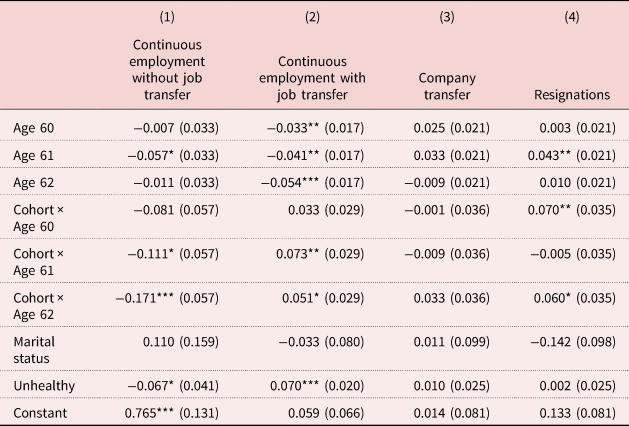
Job transfers involve older adults being employed either in the same company, albeit in a related subsidiary company (i.e. continuous employment with job transfer) or in another company (i.e. company transfer). Table 5 presents estimates for the impact of the revisions on continuous employment without job transfer, continuous employment with job transfer, company transfer and resignations. The dependent variable is a dummy, which is equal to 1 if the individual is in the state in question, and 0 otherwise.
Impact of the revisions on job transfer

Notes: N = 915. Standard errors are in parentheses.
Significance levels: * significant at 10%, ** significant at 5%, *** significant at 1%.
Column 1 of Table 5 shows that for men aged 61 or 62, the revisions reduced the probability of not being transferred to other workplaces by −11.1 per cent and −17.1 per cent, respectively. Column 2 of Table 5 shows that the increase in the probability of being transferred to other workplaces among men aged 61 and 62 was 7.3 and 5.1 per cent, respectively. The results indicate that some older workers may be transferred to related subsidiary companies. In addition, this study finds that the rate of job transfer is considerably larger at the age of 61 than at 62.
However, this study finds that the revisions have almost no impact on company transfers, as shown in column 3 of Table 5. Moreover, this study estimates that the probability of quitting employment increased by 7.0 and 6.0 per cent at ages 60 and 62, respectively.
The impact on receipt of pension
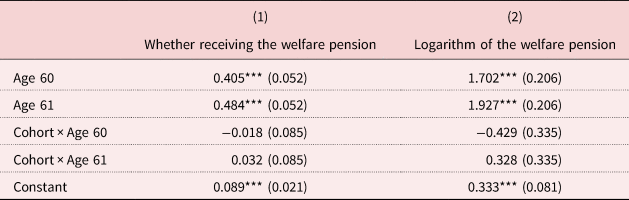
This study also examines why the 2013 EESL and the Pension Reform have almost no impact on the employment of men. The effect of the ‘advance pension payment system’ related to the Pension Reform may affect the results. As mentioned previously, the Pension Reform gradually raised the eligibility age from 60 to 65 for the remuneration-based proportional part of the ‘specially provided pension’. For example, if a man was born in 1953 or 1954, he can start to receive the remuneration-based proportional part of the pension when he is 61 years old, in 2014 or 2015, respectively. However, under ‘the advance pension payment system’, if he applied, he could start to receive pension advances at the age of 60, although the pension would be reduced. To verify the result, this study estimates the effect of the pension revision on receipt of pension using a DD model as in Equation 1 and taking ‘whether receiving the welfare pension’ or ‘logarithm of the welfare pension’ as the explanatory variable.
Table 6 demonstrates that the revisions had no impact on the probability of receiving one's welfare pension and the amount of the welfare pension. This may explain why the revisions had almost no effect on employment.
Impact of revisions on receipt of pension

Notes: N = 410. Standard errors are in parentheses.
Significance level: *** significant at 1%.
Discussion
Impact on employment
There are four possible reasons for the low impact of the 2013 EESL and the Pension Reform on the employment of older adults. First, although the Pension Reform gradually raised the eligibility age, due to the ‘advanced pension payment systems’ to receive a pension earlier, the revision might not have affected the age at which older adults actually received their pension.
Second, there was an increase in the probability of job transfer among older adults. The revisions significantly increased the possibility of job transfers, since older adults may not have been able to accept the working conditions and could choose to leave the company.
Third, in response to the revisions, firms could cut older workers’ wages to induce them to retire voluntarily. According to a survey by the Japan Institute for Labour Policy and Training (JILPT),Footnote 8 55.4 per cent of older men aged 60 to 64 saw their wages cut after the mandatory retirement age. Moreover, 51.6 per cent of them experienced a 40 per cent or more decline in wages. However, owing to the income effect caused by the reduction in annuities, older adults could increase their working hours. Simultaneously, the substitution effect brought about by the decline in wages would lead to reduced work hours and increased leisure time.
The fourth reason is the difference in the type of revision. Compared to the 2006 revision of the EESL, the 2013 revision was not strong. Before 2006, the EESL asked companies to make efforts to employ older adults, but with the amendment of the EESL this changed so that it became a duty. In other words, the policies changed from ‘not enforced’ to ‘enforced’. Meanwhile, the 2013 revision strengthened this duty by removing transitional measures, such as setting the employee selection mechanism, but also weakened the duty through expansion of hiring companies.
The results are not consistent with Yamada (Reference Yamada2017), who found that the employment rate rose due to these revisions. One explanation for this phenomenon is that Yamada (Reference Yamada2017) used ‘whether he is engaged in a paid job’ not ‘whether he is employed by a company’, as the dependent variable. Therefore, the sample may have included people who became self-employed after retirement. Kondo and Shigeoka (Reference Kondo and Shigeoka2017) found that the employment rate of self-employed older adults, who are not the policy target group, also increased after the 2006 EESL revision. This was because the EESL revision altered the social norm. Even self-employed workers believe they should continue to work after they reach 60. Thus, inclusion of this non-target group may lead to some bias in the results.
Our results indicate that the employment of males aged 60 and above has not increased due to the 2013 revision of the EESL and the pension revision. This suggests that after the 2013 revision of the EESL, companies were likely to have employed older adults based on somewhat ambiguous criteria, as before.
The impact on job transfers and resignations
As mentioned earlier, the revision led to a continuous employment increase with job transfers and resignations among older adults. This study suggests that the following reasons explain this phenomenon. About half of older employees saw their wages cut in half after the age of 60. If older adults were to do the same job as before retirement, they would not be able to accept a substantial wage drop. Thus, one strategy pursued by companies has been to transfer them to subsidiaries or affiliated companies. Moreover, some companies are likely to use the job transfers allowed by legislation to make older adults retire voluntarily, because older adults who do not want to work in subsidiaries or affiliated companies could choose to quit. The JILPT questionnaire surveyed the reasons why older men aged 60–64 did not want to be re-employed or to extend their employment. Apart from reasons such as health and personal interests, the main reasons were ‘bad atmosphere and relationships in the workplace’, ‘not having a job worth doing’ and ‘pay too low’. These three reasons accounted for 19.3, 18.6 and 15.3 per cent of the total, respectively.
Conclusions
The main objective of this paper was to examine the labour supply responses to raising the pension eligibility age and the labour demand responses to the 2013 EESL revision. In 2013, the 2013 EESL and pension revisions were implemented to promote employment of older adults. The 2013 EESL had two main points. The first was the abolition of the mechanism that allowed companies to employ older adults according to certain standards. The second was the expansion of the categories of companies that allowed businesses to employ older employees in their group companies, such as the parent company's affiliated companies or any associated corporations.
This paper shed light on these issues by exploring the impact of EESL in Japan. Understanding the impact of the pension revisions and EESL in Japan is of general interest. Among the Asian nations, Japan was the first country to become an ageing society. As a result, it tried to implement many social policies to solve problems associated with the ageing of its population. Of these policies, the EESL has attracted a lot of attention. This policy is unique to Japan due to its amendments and transitional measures. Therefore, the responses of labour demand and supply represent important research issues.
Estimates suggest that the revisions had almost no impact on the employment of older adults and receipt of pensions. On the basis of the results, this paper discussed why the 2013 EESL revision and pension revision had almost no impact on the employment rate of males aged 60 and above. One reason was that it is affected by the ‘advance pension payment system’. Although the Pension Reform Act, which was implemented gradually, raised the eligibility age, older adults could still apply to the government to receive their pensions earlier. In addition, there was a decline in wages and an increase in job transfer likelihood among men after 60. Third, there were differences in the types of EESL revision. Compared to the 2006 revision of the EESL, the 2013 revision was not strong; it simultaneously strengthened and weakened the duty to employ older adults.
This study further find that the revisions had significant positive effects on job transfer, which increased by 7.3 percentage points among men at the age of 61 and 5.1 percentage points at the age of 62. Finally, this study want to emphasise the importance of the working environment of older adults. This paper shows that even though older adults continue to be employed, they faced a job transfer problem. Therefore, in the future, to solve this problem, companies should provide job training from middle age to update the skills of their employees.Footnote 9 In addition, companies should also develop positions so that older adults can find jobs that are more suitable for them without the need for job transfer.
In an ageing society, the issues concerning older people's lives have become important. Since Japan is the first Asian country to become an ageing society and has tried to pursue appropriate social policy changes, its actions will be an important reference source for other countries. On the basis of the results, this study can identify the following implications.
Compared to other countries, Japan has taken a flexible approach in reforming its policies to promote employment of older adults, giving companies more options. However, revisions to the labour demand side could not always achieve the policy objectives. In Japan, although companies were prohibited from establishing standards for selecting older adults, they could still do so and force older adults to retire voluntarily through alternatives unconstrained by the policy. Thus, more attention needs to be paid to the impact of those factors unaffected by the revisions.
This study only analysed the impact on men, and it remains to be seen whether the revisions affect women. However, as mentioned above, the reason for the focus on men is that the 2013 EESL mainly applied to them. Here, it should be noted that the fact that women are not a concern of the EESL is itself an important policy issue. Because ageing is expected to deepen rapidly in Japan in the future, the Japanese government should make policies to promote the employment of older females in order to keep more of the workforce in the labour market.
Data
The data for this analysis, Keio Household Panel Survey, was provided by the Panel Data Research Center at Keio University.
Acknowledgements
I would like to thank the reviewers for their very useful comments.
Conflict of interest
The author declares no conflicts of interest.
Ethical standards
Ethical approval was not required.