INTRODUCTION
Despite improved survival rates, cancer diagnosis and treatment still impose a considerable burden on patients—physical as well as mental. In fact, a significant proportion of cancer patients experience psychiatric comorbidity, with depression and anxiety being the most common psychiatric problems that constitute the major reasons for referrals of cancer patients to psychiatric services (Akechi et al., Reference Akechi, Nakano and Okamura2001; Grassi et al., Reference Grassi, Gritti and Rigatelli2000). In a metaanalysis, the prevalence of depression as defined by the Diagnostic and Statistical Manual of Mental Disorders (DSM) or the International Classification of Disease (ICD) criteria was 16.3% and that of anxiety disorder (AD) 10.3% in oncological and hematological settings (Mitchell et al., Reference Mitchell, Chan and Bhatti2011). According to National Registry data from the National Health Insurance Services, 10.4% of Koreans with newly diagnosed cancers have a comorbid psychiatric disorder after the diagnosis of cancer, and the incidence of ADs (3.37%, 18.13 cases per 1000 person-years) was highest, followed by depressive disorders (DDs) (2.45%, 13.16 cases) (Lee et al., Reference Lee, Choi and Sung2015). These rates of DD and AD in cancer patients are higher than those of 1.47% found for mood disorder and 1.89% for AD in the general Korean population over the age of 20 years (Kang et al., Reference Kang, Sung and Park2014). Although these rates of DD and AD in Korean cancer patients appear to be lower than the rates reported in Mitchell et al.'s (Reference Mitchell, Chan and Bhatti2011) metaanalysis, where the majority of studies were done in Western countries, these rates cannot be directly compared due to different assessment methods, the former rates reflecting synthesized results from diagnostic interview-based studies and the latter reflecting the rates of diagnostic codes from insurance claims data. To the best of our knowledge, no previous studies have examined the prevalence of DD and AD in Korean patients with mixed types of cancer using structured diagnostic interview tools, which would allow for a comparison of the rates reported in Western patients to those of the Korean general population.
The detrimental impact of depression and anxiety on various patient-reported outcomes has been well-established in previous studies with cancer patients (Arrieta et al., Reference Arrieta, Angulo and Núñez-Valencia2013; Grabsch et al., Reference Grabsch, Clarke and Love2006; Kissane et al., Reference Kissane, Grabsch and Love2004; Wilson et al., Reference Wilson, Chochinov and Skirko2007). For instance, depression showed a strong and negative association with quality of life (QoL) in Japanese patients with colorectal cancer (Tsunoda et al., Reference Tsunoda, Nakao and Hiratsuka2005). Depression appears to affect the treatment process by reducing patients' participation in medical care (Mitchell et al., Reference Mitchell, Chan and Bhatti2011) and/or lowering their compliance with treatment. In fact, the rate of poor treatment compliance among patients with no depression was 42%, while this value reached 58% among patients with depression (Arrieta et al., Reference Arrieta, Angulo and Núñez-Valencia2013). Psychiatric morbidity was also found to be associated with a prolonged length of hospital stay in hematological cancer patients (Prieto et al., Reference Prieto, Blanch and Atala2002). Furthermore, a metaanalysis with 76 prospective studies showed that depression was associated with a high rate of mortality, even after controlling for disease-related confounds (Pinquart & Duberstein, Reference Pinquart and Duberstein2010). Regarding AD, patients with anxiety reported a stronger wish for a hastened death (Shim & Hahm, Reference Shim and Hahm2011; Wilson et al., Reference Wilson, Chochinov and Skirko2007), and more anxiety over difficulties with the physician–patient relationship has been observed in advanced cancer patients (Spencer et al., Reference Spencer, Nilsson and Wright2010).
Given the pervasive and serious impact of psychiatric morbidity (e.g., DD and AD), numerous studies have been carried out on its prevalence and correlates. However, research targeting East Asian populations is still relatively underrepresented in the literature, and considering the high and increasing incidence of cancer in this population, there is a strong need for more such studies.
To this end, the present study examined the prevalence; the sociodemographic, clinical, and psychological correlates (such as mental adjustment to cancer); and the association of DD and AD with QoL and such other outcomes as the use of complementary alternative medicines, treatment satisfaction, and the need for professional psychosocial services in a multicenter study involving patients with the most common-occurring types of cancer in Korea.
METHODS
Participants and Procedures
A multicenter survey was implemented at five cancer treatment hospitals (three located in Seoul and the other two in southwestern and southeastern Korea) from March to May of 2009. Cancer patients over the age of 18 years and currently on treatment or follow-up were recruited. A total of 400 patients who provided informed consent participated in the survey and were provided a small gift (worth about 8 USD). Our study was approved by the institutional review board of the National Cancer Center (no. NCCNCS-08-170).
Measures
“Psychiatric comorbidity” was determined using the Korean version of the Mini-International Neuropsychiatric Interview (K–MINI) (Sheehan et al., Reference Sheehan, Lecrubier and Sheehan1998; You et al., Reference You, Kim and Noh2006). The measure of interrater reliability (Cohen's κ) for the K–MINI ranged from 0.22 to 0.93. Diagnoses of DD and AD were determined using the respective modules (major depressive disorders [MDDs]: major depressive episode single and recurrent; anxiety disorders: panic disorder, agoraphobia, social phobia, specific phobia, obsessive compulsive disorder [OCD], posttraumatic stress disorder (PTSD), and generalized anxiety disorder [GAD]). Psychiatrists, clinical psychologists, or clinical psychology graduate students supervised by psychiatrists conducted the interviews, and the interview records were checked by psychiatrists at each institution.
“Physical symptoms” were assessed by 11 physical symptom items (e.g., pain, fatigue, nausea) from the MD Anderson Symptom Inventory–Korean (MDASI–K). Participants rated the severity of each symptom on an 11-point Likert-type scale (from 0 = “not present” to 10 = “as bad as you can imagine”) with reference to the previous 24 hours (Yun et al., Reference Yun, Mendoza and Kang2006).
“Mental adjustment to cancer” was assessed via the Korean version of the MINI-Mental Adjustment to Cancer (K–MINI-MAC) (Kang et al., Reference Kang, Chung and Kim2008). The 29-item MINI-MAC assesses five cognitive, emotional, and behavioral responses to a cancer diagnosis on a 4-point Likert-type scale (from 1 = “definitely does not apply to me” to 4 = “definitely applies to me”): helplessness/hopelessness (HH), anxious preoccupation (AP), cognitive avoidance (CA), fighting spirit (FS), and fatalism (FA). The K–MINI-MAC demonstrated satisfactory internal consistency (Cronbach's α = 0.50–0.86) and test–retest reliability (0.68–0.88).
“Quality of life” was assessed by the Short-Form Health Survey (SF–8, with a 4-week recall) (Ware et al., Reference Ware, Kosinski and Dewey2001), where eight items assess various dimensions of health: general health, physical functioning, role physical, bodily pain, vitality, social functioning, mental health, and role emotional. Two summary scores of physical and mental health (the physical component score [PCS] and the mental component score [MCS]) are provided, and the scores from each item or summary measures range from 0 to 100, with higher scores indicating better health.
“Performance status” was assessed using the Eastern Cooperative Oncology Group (ECOG) scale (Oken et al., Reference Oken, Creech and Tormey1982). ECOG performance status scores range from 0 (fully active) to 5 (death), with higher values indicating poorer performance status.
The survey also included questions regarding satisfaction with the services provided in terms of cancer treatment, the need for professional psychosocial services, and the experience of complementary and alternative medicine (CAM) or future intention of CAM use. Satisfaction with treatment was rated on a 5-point Likert-type scale (from 1 = “very dissatisfied” to 5 = “very satisfied”) and the need for professional psychosocial services on a 3-point scale (0 = no, 1 = yes, sometimes, 2 = yes, often). We also asked patients about their experience with CAM since the cancer diagnosis and whether or not they intended to continue with it.
Statistical Analyses
We conducted a univariate logistic regression analysis in order to explore the sociodemographic, clinical, and psychological factors (e.g., mental adjustment to cancer) associated with DD and AD. Multivariate logistic regression analyses were performed so as to evaluate the degree of association between variables that were significant in the univariate analyses. The impact of psychiatric comorbidity status on QoL, their satisfaction with treatment-related services, and the need for professional psychosocial services were examined utilizing an analysis of covariance (ANCOVA). Chi-square tests were employed to examine the CAM experience and future intention of CAM use in relation to psychiatric comorbidity status. All statistical analyses were performed using the Statistical Package for the Social Sciences (SPSS, v. 21 for Windows, SPSS Inc., Chicago, IL).
RESULTS
Participant Characteristics (see Table 1)
Their mean age was 51.2 (SD = 11.58), and there were more females (59.2%) than males. The majority of participants were married (85.5%), educated through to high school or a higher level (70.4%), professed a religion (68.0%), and had a monthly income below 3,000,000 Korean won, equivalent to 2,616 USD (64.4%). With regard to cancer type, most participants had one of the six major types of cancer common among Koreans (breast 30.5%, stomach 14.0%, colorectal 12.7%, lung 10.4%, cervix 4.6%, and liver 3.6%); the remainder had other types (24.2%). The majority of patients had been diagnosed within 24 months (74.1%), as stage 2 or 3 (45.7%), with no recurrence (72.8%) or metastases (64.3%), and had received surgery (73.5%) and/or chemotherapy (82.8%). Most participants were outpatients (67.2%) with an ECOG performance status of 1 (“restricted in physically strenuous activity,” 54.8%) or 0 (“fully active,” 26.5%).
Participant characteristics

a Eastern Cooperative Oncology Group Performance status: 0 = fully active, able to carry on all predisease performance without restriction; 1 = restricted in physically strenuous activity but ambulatory and able to carry out work of a light and sedentary nature; 2 = ambulatory and capable of all self-care but unable to carry out any work activities; 3 = capable of only limited self-care.
b 3 million Korean won (equivalent to 2,616 USD).
Prevalence and Correlates of Depressive Disorders
The prevalence of DD determined by the MINI was 16% (64/399). The rate of major depressive single (MDE) was 10.8% (43/399), and that for MDE recurrent was 9.0% (36/399).
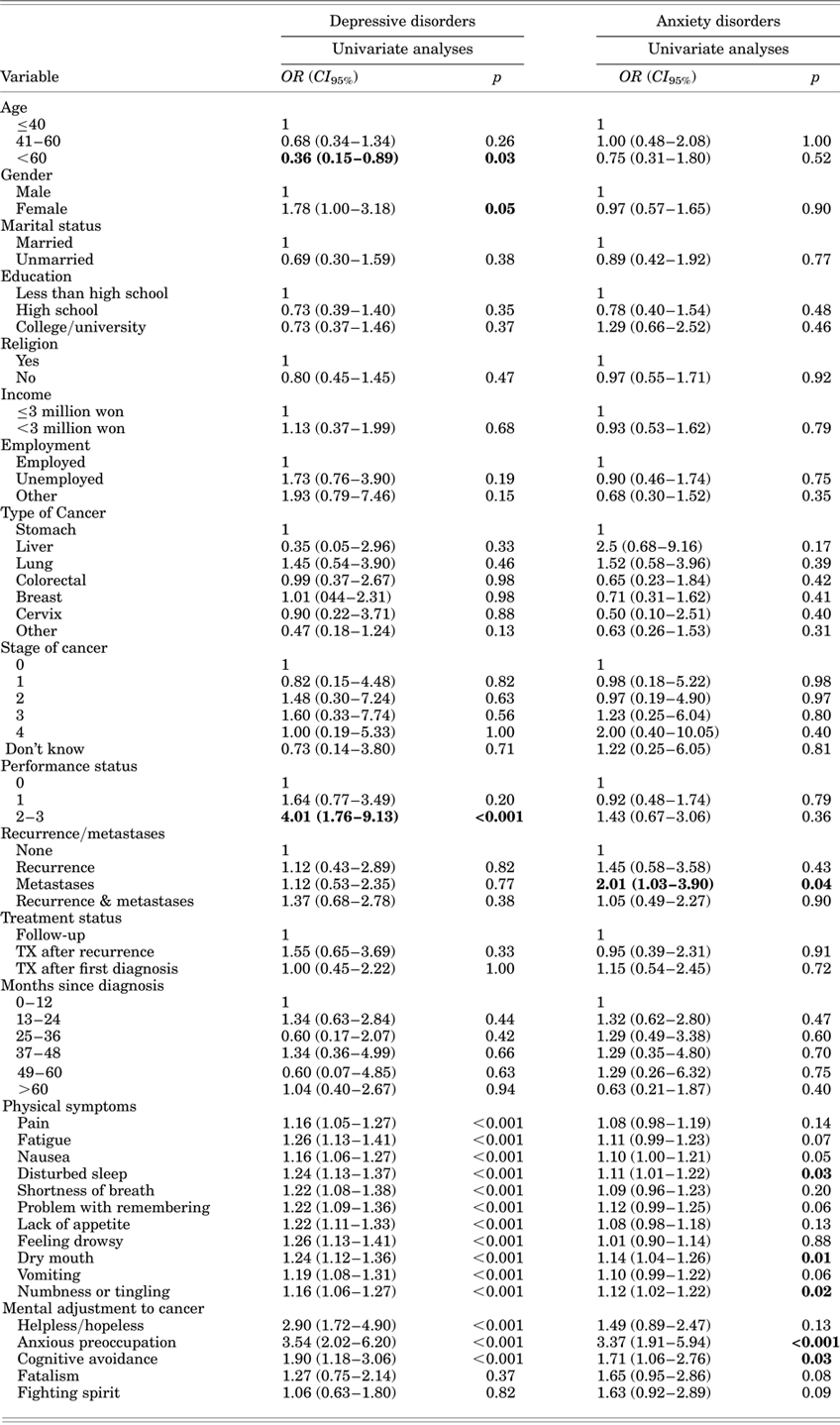
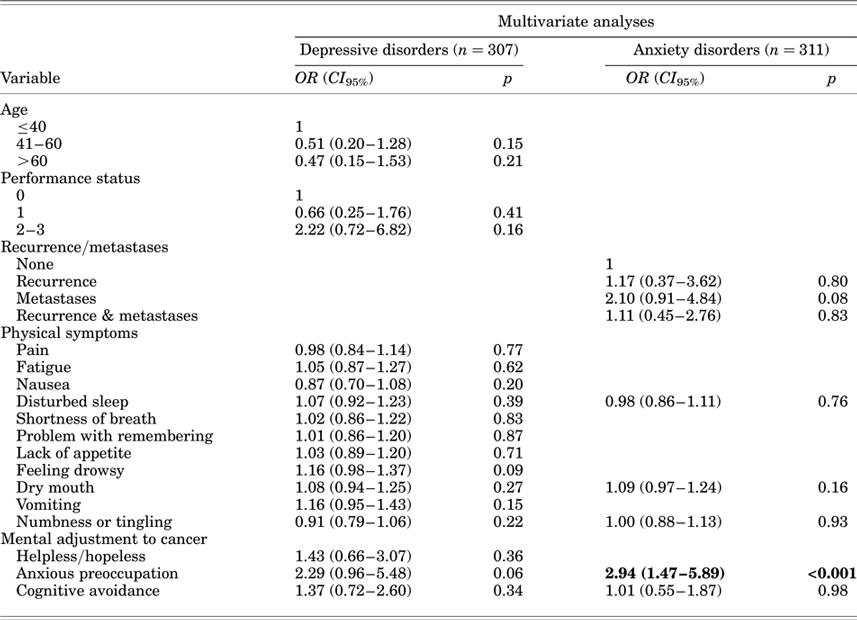
The sociodemographic, clinical, and psychological correlates of DD were examined in the univariate and multivariate logistic regression analyses (see Tables 2 and 3 for the results).
Univariate logistic analyses for depressive and anxiety disorders

Multivariate logistic analyses for depressive and anxiety disorders

Among the sociodemographic factors, age was a significant correlate of DD in the univariate analysis but was not in the multivariate analysis. The risk of DD was significantly lower in patients over the age of 60 compared to those under 40 (odds ratio [OR] = 0.36, p = 0.03). There was a trend of association between female gender and DD (OR = 1.78, p = 0.05), but this relationship was not statistically significant.
Among the clinical variables, ECOG performance status was found to be related to DD in the univariate analysis. The risk of DD was significantly higher in patients who were “ambulatory and capable of all self-care, but unable to carry out any work activities” (2) and “capable of only limited self-care” (3) when compared to those who were “fully active” (0) (OR = 4.01, p < 0.001).
Regarding physical symptoms, all were significantly associated with DD in the univariate analysis. A one-unit increase in each symptom was associated with a 1.16- to 1.26-fold higher risk of DD.
With regard to mental adjustment to cancer, HH, AP, and CA were significant correlates of DD. A one-unit increase in HH was related to a 2.9-fold increased risk of DD, while the risk of AP was 3.54 times higher and that of CA 1.90-fold higher.
The results of hierarchical multivariate logistic regression analysis with significant variables in univariate analyses are presented in Table 3. These variables explained 26% of the variance for DD (Nagelkerke R 2 = 0.26), and the Hosmer–Lemeshow test indicated an appropriate model fit (χ2(8) = 9.37, p = 0.31). None of the variables significant in the univariate analysis reached statistical significance. However, there was a nonsignificant trend for an association between the symptom of “feeling drowsy” and AP, such that a one-unit increase in “feeling drowsy” was associated with a 1.16-fold higher risk of AP (p = 0.09), while each unit increase in AP was associated with a 2.29-fold higher risk of DD (p = 0.06).
Prevalence and Correlates of Anxiety Disorders
The prevalence of any AD was 17.1% (68/397): panic disorder 0.8% (3/399); agoraphobia 2.5% (10/399); social phobia 4.5% (18/398); specific phobia 3.0% (12/398); OCD 2.3% (9/398); PTSD 1.5% (6/398); and GAD 6.8% (27/398).
The correlates of AD were examined in univariate and multivariate analyses, the results of which are provided in Tables 2 and 3.
Among the sociodemographic and clinical variables, only the presence of metastases was significantly associated with AD, the risk being 2.01 times higher in patients with metastases (p = 0.04). Among the physical symptoms, “disturbed sleep” (OR = 1.11, p = 0.03); “dry mouth” (OR = 1.14, p = 0.01); and “numbness or tingling” (OR = 1.12, p = 0.02) were significant correlates.
In terms of mental adjustment to cancer, AP and CA were significant correlates, where the risk of AD was 3.37 times higher with a one-unit increases in AP and the risk of CA was 1.71 times higher.
The results of multivariate logistic regression analysis with the significant variables in univariate analyses are summarized in Table 3. These variables explained 14% of the variance for AD (Nagelkerke R 2 = 0.14), and the Hosmer–Lemeshow test indicated an appropriate model fit (χ2(8) = 5.00, p = 0.76). Only AP remained significant in the multivariate analysis, with a one-unit increase in AP being associated with a 2.94-fold increased risk of AD. There was a trend for the presence of metastases to be related to a higher risk of AD (OR = 2.10, p = 0.08), but this effect was not statistically significant.
Impact of Psychiatric Comorbidity on Quality of Life and Other Outcomes
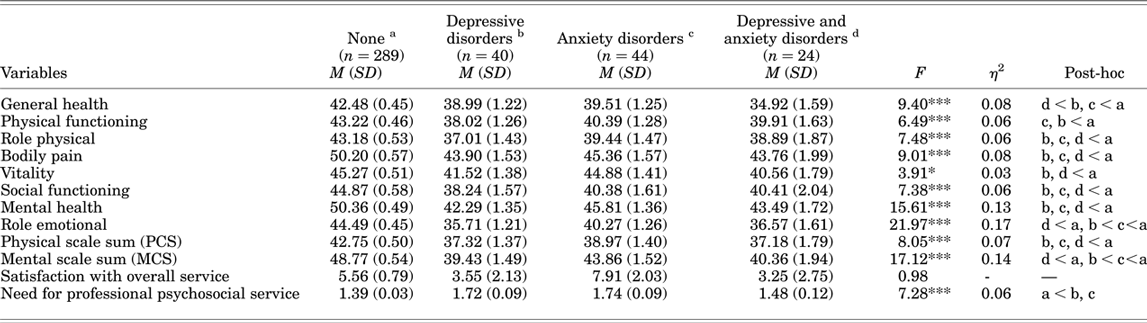
The results of the ANCOVA examining the impact of psychiatric comorbidity status on QoL and other outcomes are presented in Table 4. The factors that were significantly correlated with QoL (i.e., age, gender, marital status, education, religion, income, employment status, and ECOG performance status) and other outcomes (i.e., age, marital status, ECOG performance status and need for psychosocial services) were entered as covariates.
Quality of life across psychiatric comorbidity status

* Satisfaction with overall service: item mean (1 = very dissatisfied, ~5 = very satisfied).
** Need for professional psychosocial service: item mean (0 = no; 1 = yes, sometimes; 2 = yes, often).
*** p < 0.001.
Overall, psychiatric comorbidity status affected all eight dimensions of QoL and the PCS and MCS, and, in general, patients with a comorbidity had lower scores, with varying effect sizes.
The associations between psychiatric comorbidity status and QoL were particularly prominent for role emotional (RE, η2 = 0.17); mental health (MH, η2 = 0.13), and mental QoL (MCS, η2 = 0.14). The levels of RE and MCS were highest in patients with no psychiatric comorbidity, followed by those with AD and DD. Patients with concurrent DD and AD reported lower RE and MCS, but their RE and MCS levels did not significantly differ from the corresponding values seen in patients with a single comorbidity. The MH level was lower in patients with any psychiatric comorbidity compared to those with none.
The level of general health was highest in patients with no psychiatric comorbidities, followed by participants with AD and DD, and then those with concurrent DD and AD (η2 = 0.08). Also, physical QoL (PCS) was significantly lower in patients with psychiatric comorbidities compared with those with none (η2 = 0.07). The level of social functioning was lower in patients with DD and AD compared to those with no psychiatric comorbidity (η2 = 0.06). In the dimensions of role physical (η2 = 0.06) and bodily pain (η2 = 0.08), patients with a psychiatric comorbidity scored lower compared to those with none. The level of physical functioning was higher in patients with no psychiatric comorbidity compared to patients with DD and AD (η2 = 0.06). Vitality was lower in patients with DD and with concurrent DD and AD compared to those with no psychiatric comorbidity (η2 = 0.03).
Satisfaction with the services received related to cancer treatment did not show significant differences across the status of psychiatric comorbidity [F = 0.98, p = 0.40]. Similarly, neither CAM (χ2 = 2.19, p = 0.90) use since cancer diagnosis nor future intention to use CAM (χ2 = 6.78, p = 0.87) significantly differed across psychiatric comorbidity status.
On the other hand, the need for professional psychosocial services significantly differed across psychiatric comorbidity status [F = 7.28, p < 0.000, η2 = 0.06]. Post-hoc analysis indicated that, as compared to patients with no psychiatric comorbidity, those with DD and AD reported a significantly higher need.
DISCUSSION
The present study examined depressive and anxiety disorders in patients with mixed types of cancer in a multi-institutional study, exploring its sociodemographic, clinical, and psychological correlates, as well as its association with QoL and other outcomes.
Above all, a substantial proportion of our patients had DD and AD (16 and 17.1%, respectively), which is considerably higher than the prevalence of 3.1% for MDD and 6.8% for AD observed in the general population in a Korean epidemiologic catchment area study (Cho et al., Reference Cho, Seong and Park2015). Major depressive episode single was the most common morbidity (10.8% of patients), while GAD was common among patients with AD (6.8%), which was a higher rate than that reported in the general Korean population (lifetime prevalence = 1.9%, 12-month prevalence = 1.0%) by Cho et al. (Reference Cho, Seong and Park2015). Although a direct comparison is not possible due to the difference between incidence and prevalence and different assessment methods, the prevalence of DD and AD in the present study appears to be higher than the incidence of AD (3.37%) and DD (2.45%) reported in the National Registry data from the Korean National Health Insurance Services (Lee et al., Reference Lee, Choi and Sung2015). This seeming discrepancy might reflect the fact that, although a significant proportion of cancer patients might have a psychiatric comorbidity, the rates of patients who were actually diagnosed or treated for such a condition in healthcare settings might be low, given that the incidence rates from the National Registry data are derived from the actual insurance claims data for the entire Korean population (Kang et al., Reference Kang, Chung and Kim2008). In this regard, previous studies have suggested that not all patients with a psychiatric morbidity receive mental health services. In fact, 55% of advanced cancer patients with a psychiatric disorder were reported not to have received mental health services by Kadan-Lottick et al. (Reference Kadan-Lottick, Vanderwerker and Block2005). In a Japanese study, among 39 patients with possible major depression, 61.5% knew about the psychiatric division at their institution, but only 29.7% received such services (Fujisawa et al., Reference Fujisawa, Park and Kimura2010). There might be several reasons why patients with psychiatric comorbidity do not report the need for or seek professional help. First of all, one study found that a high probability of mental health visits was associated with race and unmarried status, but not with depression (Brown et al., Reference Brown, Kroenke and Theobald2010), suggesting that individual sociodemographic factors were a better predictor of seeking help seeking for mental health issues. Furthermore, patients might consider the diagnosis of a psychiatric disorder and use of psychiatric services as stigmatizing (Patrick et al., Reference Patrick, Ferketich and Frame2003), they might lack insight regarding the cause and negative impact of their distress (Ryan et al., Reference Ryan, Gallagher and Wright2012), or perhaps they believe that they do not need help with mental health issues (Carlson et al., Reference Carlson, Angen and Cullum2004). Related to the latter reason, considering that a previous review on supportive care needs among breast cancer patients (Fiszer et al., Reference Fiszer, Dolbeault and Sultan2014) suggested that Asian women report greater information needs and lower psychological needs compared to Western women, potential crosscultural differences regarding supportive care may also be considered. In fact, higher informational needs in Korean patients with breast cancer have also been observed (Yi et al., Reference Yi, Cho and Noh2007).
Moreover, the prevalence found in the present study is similar to the values reported in a metaanalysis of 70 interview-based studies in oncological and hematological settings (Mitchell et al., Reference Mitchell, Chan and Bhatti2011): the prevalence of DSM- or ICD-defined depression was 16.3% (95% confidence interval [CI 95%] = 13.4–19.5); 14.9% (CI 95% = 12.2–17.7) for DSM-defined major depression; and 10.3% (CI 95% = 5.1–17.0) for AD. Similarly, the current and 12-month rates of affective disorders determined by the Composite International Diagnostic Interview were 9.5 and 17.5%, respectively, while the rates for AD were 13.0 and 20.5% in a German study with 200 patients with various types of cancer (Härter et al., Reference Härter, Reuter and Aschenbrenner2001). Comparable rates of 8.5% for major and minor depressive disorder (CI 95% = 5.2–11.8%), defined by the structured clinical interview in the DSM–IV, were also reported in 282 Japanese patients with mixed types of cancer (Kawase et al., Reference Kawase, Karasawa and Shimotsu2006). The prevalences observed in the present and previous studies indicate that cancer patients are vulnerable to psychiatric comorbidity, necessitating its regular monitoring as an integrative part of their cancer care.
With respect to the sociodemographic correlates of psychiatric comorbidity, age was found to be a significant correlate of DD in the univariate analysis, while none were statistically significant with respect to AD. Patients aged over 60 had a lower risk of DD compared to those younger than 40 years of age, which is in line with prior findings (Burgess et al., Reference Burgess, Cornelius and Love2005; Mosher & Danoff-Burg, Reference Mosher and Danoff-Burg2006). Interestingly, younger age was a significant predictor of psychological comorbidity in breast cancer survivors (Mehnert & Koch, Reference Mehnert and Koch2008). Although marginally significant, female gender showed a trend of association with DD, consistent with the finding that a diagnosis of a current affective disorder was higher in females and its diagnosis in women was related to cancer (Härter et al., Reference Härter, Reuter and Aschenbrenner2001).
Among the clinical factors, congruent with previous reports (Akechi et al., Reference Akechi, Okuyama and Sugawara2004; Härter et al., Reference Härter, Reuter and Aschenbrenner2001; Jeon et al., Reference Jeon, Shim and Shin2007; Spencer et al., Reference Spencer, Nilsson and Wright2010), a poor ECOG performance status score was significantly associated with a 4.01-fold higher risk of DD in our univariate analysis. In fact, Akechi et al. (Reference Akechi, Okuyama and Sugawara2004) found that a lower performance status along with a greater concern about being a burden to others and a lower satisfaction with social support were significantly associated with major depression at baseline in a prospective study with terminally ill cancer patients in Japan. However, the mutual causative nature of a relationship between performance status and DD should be considered when interpreting the observed association. For instance, depression scores constituted the sole variable contributing to patient-evaluated performance status in cancer patients (Jeon et al., Reference Jeon, Shim and Shin2007).
With respect to anxiety disorders, patients with metastases were at a 2.01-told higher risk compared to those with neither recurrence nor metastases. This finding is consistent with previous results indicating an independent association of the presence of metastases with anxiety in cancer patients (Vodermaier et al., Reference Vodermaier, Linden and MacKenzie2011). Patients with poor performance status or advanced status with metastasis have a heavier physical and psychosocial burden related to cancer (Lo et al., Reference Lo, Zimmermann and Rydall2010), thus increasing their risk for psychiatric comorbidity.
All the physical symptoms were significantly correlated with DD, while only the symptoms of “disturbed sleep,” “dry mouth,” and “numbness or tingling” were related to AD in our univariate analysis. In the multivariate analysis, none of the physical symptoms significant in the univariate analysis reached statistical significance for both DD and AD. However, there was a trend toward a marginally significant association between the symptom of “feeling drowsy” and DD, which is in line with a previous finding that depressed patients with cancer reported a higher frequency and intensity of drowsiness (Delgado-Guay et al., Reference Delgado-Guay, Parsons and Li2009). Similarly, an examination of the physical symptom profiles of 121 hospitalized cancer patients revealed that insomnia was the most prevalent symptom in cancer patients and that depressed patients were more likely to report a greater number of symptoms (Chen & Chang, Reference Chen and Chang2004). The association of AD with “dry mouth” and “numbness or tingling” is understandable given that these symptoms are standard somatic symptoms of AD (Stark & House, Reference Stark and House2000). In addition, sleep disturbances have been observed in advanced cancer patients (Mystakidou et al., Reference Mystakidou, Tsilika and Parpa2005). However, as disturbed sleep, dry mouth, and numbness or tingling were the second, fourth, and fifth most severe symptoms among the 13 core oncology symptoms reported in a study with 3,106 ambulatory patients with breast, prostate, colon/rectum, or lung cancer (Cleeland et al., Reference Cleeland, Zhao and Chang2013), these symptoms' association with cancer treatment in patients with AD should also be considered. In this regard, in addition to the need to consider the bidirectional nature of the relationship between a physical symptom and DD or AD, it should be noted that physical symptoms might reflect disease- or treatment-related effects. For instance, “tingling” might be related to peripheral neuropathy or the toxicity of taxanes (Argyriou et al., Reference Argyriou, Koltzenburg and Polychronopoulos2008), while disturbed sleep might be related to fatigue (Anderson et al., Reference Anderson, Getto and Mendoza2003). In fact, fatigue, depression, and sleep disturbances are frequently cooccurring behavioral symptoms of cancer treatment (Bower et al., Reference Bower, Ganz and Irwin2011). With regard to the complex relationships among physical symptoms, psychiatric morbidity, and different cancer treatments, further crosscultural issues may also be considered. Specifically, though not significant in our multivariate analysis, the level of fatigue, a significant correlate of DD, appears to be higher in patients with DD in the present study. While the association of fatigue with cancer treatment has been established (Berger et al., Reference Berger, Gerber and Mayer2012), a prior study examining the crossnational differences of the pattern of depressive symptoms between Koreans and Americans indicated that Koreans with MDD tend to report incidences of low energy and difficulties with concentration compared to the depressed mood and thoughts of death reported by American patients (Chang et al., Reference Chang, Hahm and Lee2008).
With regard to a psychological correlate (i.e., mental adjustments), HH, AP, and CA were associated with DD, but none of these observed associations reached statistical significance in our multivariate analysis. At the same time, there was a trend toward a marginally significant relationship between AP and DD. For AD, AP and CA were significant in the univariate analysis, while only AP remained significant in our multivariate analysis (OR = 2.94). This association of HH and AP with depression and anxiety is consistent with prior findings (Andreu et al., Reference Andreu, Galdón and Durá2012; Grassi et al., Reference Grassi, Travado and Moncayo2004; Tojal & Costa, Reference Tojal and Costa2015). A study with laryngeal cancer patients found that patients who experienced HH and AP reported higher depression and anxiety and decreased QoL (Johansson et al., Reference Johansson, Rydén and Finizia2011). Another previous study suggested that intrusive cognition plays a role in the association between anxiety and AP and HH. In fact, anxious patients reported more intrusive cognition when compared to patients who were not anxious. Furthermore, the presence of intrusive cognition was significantly related to maladjustment, including AP and HH (Whitaker et al., Reference Whitaker, Brewin and Watson2008). In a study with 150 hospitalized cancer patients, AP and HH were found to be strong determinants of the severity of trauma-related symptoms, accounting for 49% of the variance with respect to symptom severity (Oniszczenko & Laskowska, Reference Oniszczenko and Laskowska2014). Similarly, the caseness of AP was associated with unmet needs for help across all domains in cancer survivors (Boyes et al., Reference Boyes, Girgis and D'Este2012), warranting careful attention to this kind of patient response.
With regard to the impact of psychiatric comorbidity status, consistent with previous findings (Hegel et al., Reference Hegel, Moore and Collins2006), psychiatric comorbidity had an overall negative association with QoL. In fact, depression was shown to have a pervasive association with various domains of health-related QoL and disability in 405 cancer patients by Brown et al. (Reference Brown, Kroenke and Theobald2010). They found that the presence of psychiatric comorbidity explained 17% of the variance of role emotional on the SF–8, in line with the significant association previously observed between psychiatric disorders and lower emotional functioning (Okamura et al., Reference Okamura, Yamawaki and Akechi2005). Furthermore, psychiatric comorbidity explained 14% of the variance for mental component scores. In terms of physical functioning, the difference was significant between patients with no psychiatric comorbidity and those with DD or AD. The significant negative association of DD with physical functioning was prominent, fully in line with the previously observed association between low levels of physical function and affective disorders (Härter et al., Reference Härter, Reuter and Aschenbrenner2001). Our findings suggest that efforts to improve QoL in cancer should include care of psychiatric comorbidities (Miovic & Block, Reference Miovic and Block2007).
In addition, as expected, the need for professional psychosocial services was higher in patients with DD or AD compared to those with neither. However, this need was not significantly higher in patients with concurrent DD and AD when compared to those with a single comorbidity or with none. In a study with 381 patients in palliative cancer care (Wilson et al., Reference Ryan, Gallagher and Wright2007), individuals with comorbid depression and anxiety disorder reported a higher level of sense of coping poorly and a loss of control when compared to those with only depression, which might affect motivation to seek help. This aspect also requires further investigation. In a study with advanced cancer patients, discussing mental health issues after a cancer diagnosis was the strongest predictor of receiving mental health services (Kadan-Lottick et al., Reference Kadan-Lottick, Vanderwerker and Block2005). As such, efforts to overcome these barriers to adequate care can benefit from integration of care for psychiatric comorbidities into routine cancer care.
STRENGTHS AND LIMITATIONS OF THE STUDY
The present study has several limitations that need to be addressed in future research. Above all, due to its cross-sectional design, any causal interpretation of the association between DD, AD, and their correlates cannot be made. For instance, regarding the association between physical symptoms and DD or AD, as their influence is reciprocal (Lloyd-Williams et al., Reference Lloyd-Williams, Dennis and Taylor2004), the direction of the relationship should be determined in the context of a prospective and longitudinal examination. Also, due to the use of convenience sampling, we cannot truly determine response rates. Thus, a potential sample bias cannot be excluded, which might compromise the representativeness of our sample and the generalizability of our findings. Nonsignificant associations between variables that were previously identified as significant correlates in prior research and DD and AD might be due to the fact that the present study was underpowered. Moreover, there is a risk that the participants may have been hesitant to answer truthfully regarding the presence of psychiatric problems due to the stigma associated with mental illness, in addition to the stigma connected with cancer (Cho et al., Reference Cho, Choi and Kim2013). In a related way, the stigma of cancer itself might be a significant correlate of psychiatric morbidity. For instance, the results of a nationwide survey involving 466 cancer survivors in Korea found that more than 30% of respondents had a negative attitude toward cancer and stereotypical views of themselves, while about 10% reported experiences of social discrimination due to cancer. This experience of cancer stigma was associated with a 2.5-fold higher risk of depression when compared to patients with positive attitudes (Cho et al., Reference Cho, Choi and Kim2013). Also, several significant variables identified as significant correlates of psychiatric morbidity in cancer, such as social support (Akechi et al., Reference Akechi, Okuyama and Sugawara2004; Eom et al., Reference Eom, Shin and Kim2013), were not included in our study. In this regard, a national survey involving 296 patient–caregiver dyads in Korea demonstrated that the family's avoidance of communication about the cancer and the level of emotional support were associated with patients' anxiety and depression (Jeong et al., Reference Jeong, Shin and Kim2016), warranting the need to include these factors in future studies. Finally, our data were collected in 2009, and there may have been changes in some aspects of the study variables (e.g., the use of CAM or the need for psychosocial services), warranting caution about the applicability of our findings.
Despite these limitations, to the best of our knowledge, the present study is one of the first to provide comprehensive information about the prevalence and correlates of DD and AD in cancer patients with the most common types of cancer in Korea, as well as on its impact on patient QoL and other outcomes. Given the substantial prevalence and pervasive association of DD and AD with various aspects of QoL, their assessment and care should be integrated as a regular part of oncological care throughout the cancer continuum, as recommended by the American Society of Clinical Oncology (Andersen et al, Reference Andersen, DeRubeis and Berman2014).
ACKNOWLEDGMENTS
This study was supported by the 2008 National Research and Development Program for Cancer Control (no. 0830690-1), and Eun-Jung Shim was supported by the Brain Korea 21-Plus Program (no. F16HR31D1802).
DISCLOSURES
The authors hereby declare that they have no conflicts of interest to disclose.