The guidelines for perioperative antibiotics in the United States recommend cefazolin as the first-line agent in most surgeries because it provides effective coverage for skin flora, which are a predominant cause of surgical site infections (SSIs). Reference Bratzler, Dellinger and Olsen1 However, patients with penicillin allergies often receive second-line therapies. At a large urban academic medical center, although 89% of patients who underwent a general, vascular, or plastic surgery procedure without a documented penicillin allergy received cefazolin, this was true for <10% of penicillin-allergic patients. Instead, these patients received second-line alternatives including clindamycin (41%), aztreonam (24%), vancomycin (13%), and levofloxacin (8%).
The use of alternative agents for perioperative antimicrobial prophylaxis has negative implications for antimicrobial stewardship and healthcare-associated infections. Several of these antibiotics are associated with higher rates of Clostridioides difficile infection Reference Blumenthal, Lu, Zhang, Li, Walensky and Choi2 and increased risk of SSI. In a retrospective evaluation of >8,000 patients undergoing surgery, the adjusted odds of an SSI were 50% higher in patients with penicillin allergy labels. Reference Blumenthal, Ryan, Li, Lee, Kuhlen and Shenoy3 Similarly, in a Swedish registry of 55,530 patients undergoing 80,018 knee arthroplasties, the use of clindamycin prophylaxis in penicillin-allergic patients was associated with a 50% higher risk of revision secondary to infection than use of a penicillin. Reference Robertsson and Thompson4 Use of second-line antibiotics has also been associated with increased SSI risk in gynecologic, head and neck, and cardiothoracic surgeries. Reference Bull, Worth and Richards5–Reference Uppal, Harris and Al-Niaimi7 Side effects are also a concern. In a recent study, perioperative use of vancomycin was linked with a higher risk of acute kidney injury as well as decreased compliance with timely perioperative administration, and β-lactam allergy played a role in driving vancomycin use. Reference Strymish8
Accumulating evidence also suggests that avoidance of perioperative cephalosporins in patients with a penicillin allergy label is largely unnecessary. Cross reactivity is mediated by the β-lactam R1 and R2 side chains, and cefazolin does not have a side chain with structural similarity to the penicillins. Reference Zagursky and Pichichero9 We therefore formed a multidisciplinary team from anesthesiology, surgery, infectious disease, allergy/immunology, and pharmacy services with the goal of optimizing perioperative cephalosporin use in patients with penicillin allergy labels recorded in the electronic medical record. As part of this collaborative quality improvement initiative, a protocol for penicillin-allergy risk stratification was implemented. All patients who did not have a history of a severe delayed reaction to penicillin Reference Kuruvilla, Shih, Patel and Scanlon10 were recommended to receive cefazolin or cefuroxime if either was the recommended antibiotic for the procedure. We present the results of this intervention strategy, including algorithm adherence percentages following staged interventions and antibiotic costs.
Methods
Antimicrobial stewardship interventions
Stepwise quality-improvement interventions were undertaken to improve antibiotic prescribing in the perioperative setting. Responsibility for antibiotic selection and ordering moved from the surgery service to the anesthesiology service in October 2017. Surgeons had previously had the option of using electronic order sets or placing their own antibiotic orders, which lacked standardization. The anesthesia providers moved to using a protocol provided by the antimicrobial stewardship committee that recommended cefazolin or cefuroxime as the first-line agents for most procedures, with the addition of vancomycin, further gram-negative coverage, and/or anaerobic coverage as indicated by national guidelines. Reference Bratzler, Dellinger and Olsen1 This intervention led to improvements in on-time antibiotic administration and appropriate antibiotic selection overall. However, the use of first-line agents in penicillin-allergic patients remained low, so a multidisciplinary group was established to develop and implement interventions to improve this metric.
In May 2018, this multidisciplinary team administered a brief e-mail survey to anesthesia providers that queried their perioperative antibiotic prescribing practices in patients with penicillin allergy to gauge baseline willingness to administer cephalosporins in this population. Once providers had completed the survey, they had the opportunity to view a brief description of the low rate of cross reactivity between cefazolin and penicillins.
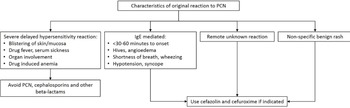
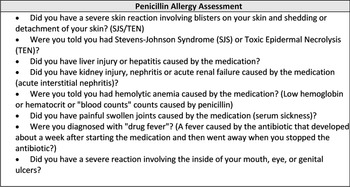
This multidisciplinary team utilized the results of this survey to assist with development of a decision-support algorithm to guide cephalosporin use in penicillin-allergic perioperative patients. As described previously, this algorithm recommended cephalosporin use in all patients without a history of severe delayed hypersensitivity reactions to penicillin (Fig. 1) and included use of a screening questionnaire to help anesthesiologists identify patients with a history of reactions that should preclude β-lactam antibiotic use (Fig. 2). Reference Kuruvilla, Sexton, Wiley, Langfitt, Lynde and Wolf11
Algorithm for approach to penicillin-allergic patients in the perioperative setting. Note. PCN, penicillin.

Penicillin allergy evaluation questionnaire given to the anesthesia providers to aid in their evaluation for a history of a severe delayed hypersensitivity reaction to penicillin. They were told to avoid all beta lactam antibiotics including cefazolin if the patient answered yes to any of the questions, or if the electronic medical record allergy listing included any of these reactions.

The information gained from the survey was also used to design an educational presentation for a Department of Anesthesia conference in August 2018 to introduce the algorithm and screening questionnaire, explain the rationale, and review safety data. This presentation reviewed the benefits of first-line therapy and potential detrimental effects associated with alternative antibiotic utilization in penicillin-allergic patients, including poor coverage of skin flora, increased SSI risk, and increased risk of C. difficile infection. An allergist explained the limited risk of cross reactivity to cefazolin or cefuroxime in penicillin-allergic patients and described the new algorithm for utilization in all patients without a history of a severe delayed hypersensitivity reaction to penicillin (Figs. 1 and 2). Because the survey data had revealed hesitancy around cephalosporin use in patients with a history of penicillin anaphylaxis, data supporting safety of the new algorithm in that patient population were a focus.
After observing initial uptake of the algorithm, a decision was made to reinforce the information with a presentation to a larger audience at the Department of Anesthesiology Grand Rounds in January 2019. The same multidisciplinary team presented the algorithm for cefazolin and cefuroxime use in penicillin-allergic patients, with an increased focus on evidence in the allergy literature supporting its safety for anyone who was still hesitant.
Data collection
Patients were included in the analysis if they had a surgical procedure performed in the hospital operating room between January 1, 2017, and August 31, 2019, with perioperative antibiotic administration. Patients were excluded if a penicillin or carbapenem was administered because these selections were indicative of procedures for which cefazolin or cefuroxime was not a first-line therapy (eg solid-organ transplantation). Patients could be included more than once if they had multiple procedures performed on different dates that met the inclusion criteria; procedures performed on the same date were considered a single case.
The following information was abstracted from a Clinical Data Warehouse for each surgical case included in the data set: surgical date and time, presence or absence of a documented penicillin allergy, and a list of all antibiotics administered during the case and whether any of those antibiotics was classified as a cephalosporin. Any patient with a penicillin listed in their electronic allergy record was classified as allergic, regardless of whether additional information (eg, allergy type or verification) was documented because this was often the only information available to the anesthesiologist.
Data analysis
The percentage of penicillin-allergic patients receiving a cephalosporin was calculated for each month during the study. These percentages were then averaged for the months included in each period: a baseline period from January 1, 2017, to September 30, 2017; the period after anesthesia control of prescribing began from November 1, 2017 to July 31, 2018; the period after the initial educational session about the new allergy algorithm from September 2018 to December 2018; and the period after anesthesia department grand rounds from February 2019 to August 2019. These periods were compared via a 1-tailed analysis of variance (ANOVA) performed in Microsoft Excel (Microsoft, Redmond, WA). The months in which the interventions were implemented (October 2017, August 2018, and January 2019) were excluded from this portion of the analysis.
Antibiotic costs were compared by calculating the total number of penicillin-allergic patients who had an order placed for each antibiotic (eg, cefazolin, aztreonam, vancomycin, etc) during 3 periods: the baseline from January 1, 2017, to September 30, 2017; the period after anesthesia control of prescribing from November 1, 2017 to July 31, 2018; and the period after the allergy algorithm was introduced from September 1, 2018, to August 31, 2019, which included the second educational intervention so that similar lengths of time were compared. If patients received combination therapy (eg, cefazolin and metronidazole), they were included in the counts for both antibiotics. Each antibiotic order was considered to indicate a single dose given. A small number of cases may have involved a need for antibiotic redosing because of case length; however, these cases were likely equally distributed over the study period and so were not included in the calculations. We multiplied the average wholesale cost per antibiotic dose by the number of penicillin-allergic patients who received that antibiotic to obtain a total cost for each perioperative antibiotic during each period. Antibiotics with weight-based dosing were handled as follows: for cefazolin, a 2-g dose was utilized because the need for a 3-g dose is relatively rare; for vancomycin the costs of the 1-g and 1.5-g doses used most frequently were averaged; and for gentamicin, the cost was calculated for a 70-kg patient. The total cost of all perioperative antibiotics was then divided by the number of penicillin-allergic patients in that period to obtain a mean cost per penicillin-allergic patient, and these means were compared via 1-tailed ANOVA (P < .05 significance) in Microsoft Excel (Microsoft, Redmond, WA).
The Emory Institutional Review Board granted approval (IRB no. 00095280) for this study as part of a larger group of interventions to improve on-time perioperative antibiotic administration throughout the healthcare system.
Results
In total, 24,467 qualifying were surgeries performed during the study period, and 2,284 were done in patients with a reported penicillin allergy (9.3%). As previously described in a subset of these patients, ∼38% of those with a penicillin allergy had no reaction type documented in the electronic medical record, ∼27% had a type 1 hypersensitivity reaction history, ∼21% had rash or itching, ∼7% had a side effect rather than a true allergy, ∼5% had a reaction listed as unknown, and ∼1% had a severe delayed hypersensitivity reaction. Reference Kuruvilla, Sexton, Wiley, Langfitt, Lynde and Wolf11 The mean patient age was 55.6 years in those without a penicillin allergy and 56.4 in those with a penicillin allergy. During the study period, 28.0% of surgeries were general or gastrointestinal surgeries, 18.4% were neurosurgery or ENT surgeries, 16.0% were urologic surgeries, 11.4% were cardiothoracic surgeries, 8.1% were vascular surgeries, 6.9% were oncologic surgeries, 4.3% were gynecologic surgeries, 3.8% were plastic surgeries, and 3.2% were reported as another type of surgery.
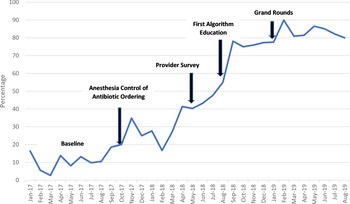
The percentage of penicillin-allergic patients receiving a perioperative cephalosporin improved after each successive intervention (Fig. 3). During the baseline period of January–September 2017, a mean of 11.0% of penicillin-allergic patients were given a cephalosporin (Table 1). Transition to anesthesiology control of perioperative antibiotic administration with a standardized protocol occurred in October 2017, and over the next 9 months, from November 2017 to July 2018, the mean increased to 33.8%. Following the August 2018 educational conference about the new allergy algorithm, the mean percentage of patients receiving a cephalosporin from September 2018 to December 2018 rose to 76.6%. Following the January 2019 Anesthesiology Grand Rounds dedicated to re-emphasizing the protocol, it reached 83.7% from February 2019 to August 2019. The mean percentage of cephalosporin utilization in each of these periods was statistically significantly different (P = 2.03 × 10−Reference Chang, Chen and Lin17 ).
Percentage of penicillin-allergic patients receiving a cephalosporin over time. The percentage of penicillin-allergic patients receiving a first-line cephalosporin increased over the study period. The baseline period was measured from January to September 2017 prior to any intervention. In October 2017, all perioperative antibiotic ordering transitioned from the surgical team to anesthesia, using detailed guidelines. In May 2018, a survey was administered regarding providers’ typical prescribing practices for penicillin-allergic patients in the OR; the survey contained a brief paragraph at its conclusion explaining a low risk of cross-reactivity between penicillins and first-line perioperative cephalosporins. In August 2018 the new algorithm for perioperative prescribing in penicillin-allergic patients (Figs. 1 and 2) was introduced via an educational conference, and in January 2019 it was reinforced at anesthesia grand rounds.

Penicillin-Allergic Patients Receiving a Cephalosporin in Each Study Period

Of the 756 patients with a labeled penicillin allergy who received a cephalosporin following algorithm implementation (September 2018–August 2019), no immediate hypersensitivity reactions were identified during the intervention period. Through May 2019, <1% of patients had complained of itching or rash, as described previously. Reference Kuruvilla, Sexton, Wiley, Langfitt, Lynde and Wolf11 No providers filed safety reports regarding any other type of reaction.
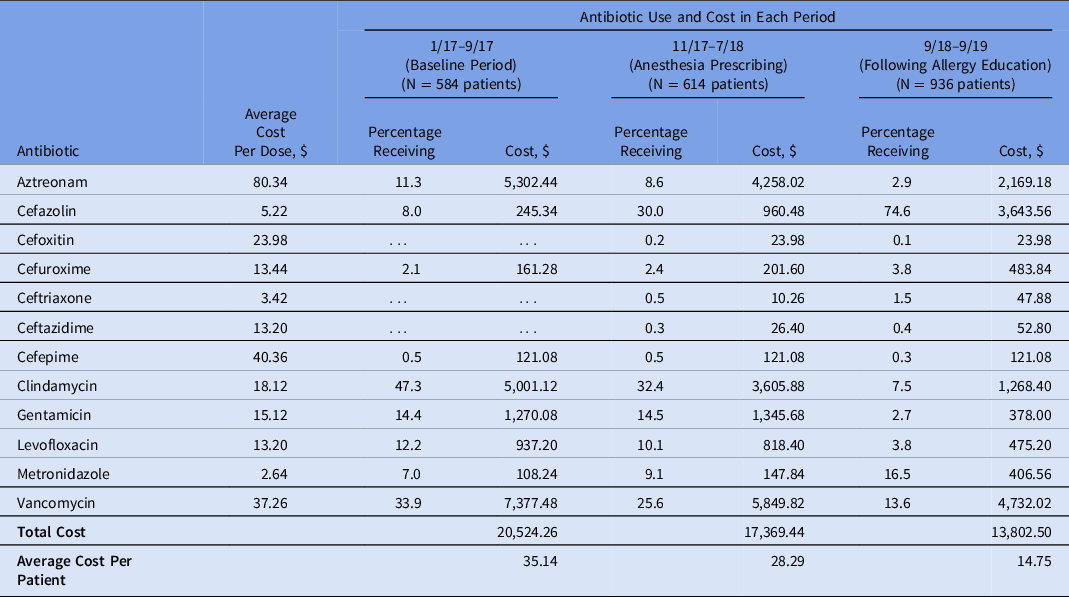
There was a reduction in the use of second-line agents with the intervention. The percentage of penicillin-allergic patients receiving aztreonam decreased from 11.3% at baseline to 2.9% following algorithm implementation; the percentage receiving clindamycin decreased from 47.3% to 7.5%; the percentage receiving gentamicin decreased from 14.4% to 2.7%; the percentage receiving levofloxacin decreased from 12.2% to 3.8%; and the percentage receiving vancomycin decreased from 33.9% to 13.6% (Table 2).
Perioperative Antibiotic Selection and Costs Across 3 Study Periods: Baseline, Anesthesia Control of Prescribing, and Following Allergy Education

These decreases were accompanied by a 58% reduction in the average antibiotic cost for each penicillin-allergic patient over the course of the study. The average antibiotic cost per penicillin-allergic patient was $35.14 during the baseline period, which decreased to $28.29 per patient in the period after anesthesia assumed responsibility for antibiotic administration and then decreased further to $14.75 per patient after algorithm implementation (Table 2). Each cost decrease was statistically significant (P = 1.52 × 10−Reference Kuruvilla, Shih, Patel and Scanlon10 ).
Discussion
We describe the implementation and impact of a decision support algorithm to safely increase cephalosporin use for perioperative antimicrobial prophylaxis in patients with penicillin allergy labels using several quality-improvement interventions focused on provider education. The use of this algorithm significantly augmented cephalosporin administration, with the percentage of penicillin-allergic patients receiving a cephalosporin each month increasing from ∼11% to >80% without any severe adverse reactions reported. Reference Kuruvilla, Sexton, Wiley, Langfitt, Lynde and Wolf11
These findings emphasize the ongoing need for strategies to risk-stratify patients with penicillin allergy labels so that they can receive appropriate targeted antimicrobial coverage. The guidelines for perioperative antibiotics in the United States currently recommend utilizing alternative antibiotics when a patient has a history of type 1 hypersensitivity reactions, such as anaphylaxis, to penicillins. Reference Bratzler, Dellinger and Olsen1 However, cefazolin does not appear to have clinically relevant cross-reactivity with penicillin. In a recent study of 129 patients with a history of anaphylaxis to penicillin, there were no reactions to a dedicated cefazolin challenge, and a recent meta-analysis identified only 1 patient with cross reactivity to cefazolin. Reference Romano, Valluzzi, Caruso, Zaffiro, Quaratino and Gaeta12,Reference Picard, Robitaille and Karam13 Likewise, in our study, no severe adverse events were reported with cefazolin administration despite use in a wide range of reported penicillin allergies, including anaphylaxis. Thus, it may be beneficial to revisit the recommendations related to penicillin allergy within the guidelines, as more recent data suggest that most allergic patients can safely receive a first-line antibiotic.
Our study results also suggest that transitioning penicillin-allergic patients to first-line therapy has significant benefits with respect to decreased use of higher-cost, less-effective second-line antibiotic agents. We observed an almost 60% reduction in per-patient antibiotic costs with the combination of anesthesia control of antibiotic prescribing and implementation of the penicillin allergy algorithm. This was a much larger decrease in direct antibiotic costs than was seen in a prior study that evaluated the financial impact of delabeling penicillin allergies among breast surgery patients. Reference Fan, Udeh, Quinn, Bernard, Grobmyer and Valente14 However, in that study the primary alternative for penicillin-allergic patients was clindamycin, and there were costs associated with allergy testing. Some of our patients were receiving higher-cost antibiotics, such as aztreonam and vancomycin, prior to the intervention, and our algorithm did not require any allergy testing, which may account for the greater savings. The ability to avoid allergy testing is therefore a strength of this algorithm with respect to both simplicity and cost. Overall cost savings are difficult to determine given intangible costs associated with the time of our team, but a decrease in direct antibiotic costs may be appealing to healthcare administrators as a justification for pursuing the effort needed to enact this type of intervention.
Our algorithm was implemented via a multistep educational program focused on allergy history taking and interpretation. This education initiative led to significant behavior modification, with a resultant safe increase in cephalosporin use, which represents a somewhat unusual success of an educational intervention. Although numerous prior studies have identified a critical role for education in antimicrobial stewardship, Reference Molina, Penalva and Gil-Navarro15–Reference Chang, Chen and Lin17 expert guidance for stewardship programs recommends against relying solely on provider education without other reinforcement. Reference Barlam, Cosgrove and Abbo18 Educational interventions are more effective when combined with other modalities, including provider-specific feedback and decision support within the medical record. Reference Meeker, Linder and Fox19,Reference Roque, Herdeiro, Soares, Teixeira Rodrigues, Breitenfeld and Figueiras20 One Australian study in the surgical population found that posting guidance about appropriate selection and timing of perioperative prophylaxis and providing related education for providers without other interventions produced no significant change in compliance. Reference Knox and Edye21
The success of our intervention may be attributable to several factors. First, the simplicity of the message, with cefazolin or cefuroxime recommended in almost all penicillin-allergic patients, may have made algorithm compliance easier. Additionally, the multidisciplinary nature of the team may have contributed to provider willingness to trial a new protocol. During the educational sessions, providers heard from physicians in their specialty who were familiar with their workflow and patient safety concerns, infectious disease physicians regarding risks of second-line therapy and benefits of first-line therapy, and an allergist regarding safety data to support cephalosporin use. Finally, the incorporation of multiple implementation science strategies, including using a multidisciplinary collaborative team, assessing for provider readiness and barriers via survey, conducting educational sessions with new targeted materials, and ongoing assessment of the project success, may have also had significant benefits. Reference Powell, Waltz and Chinman22
Ensuring that this type of behavioral change is sustained will be challenging, although a review of recent data is encouraging, with a mean of 77.3% of penicillin-allergic patients receiving a cephalosporin from September 2019 to March 2021. This finding suggests the algorithm is ingrained in practice because this change was sustained despite turnover. At our facility, all house staff, 50% of anesthetists, and 60% of anesthesiologists turned over from January 2017 to September 2020. However, ongoing monitoring and reinforcement of the algorithm will be critical, which we plan to do via provider-specific feedback.
This study has several limitations. Although perioperative prescribing improved significantly in penicillin-allergic patients, we did not seek to identify spurious penicillin-allergy labels, so these patients continued to have penicillin allergies listed in their charts, which may affect future antibiotic selection. Also, the scope of our study did not allow for a cost analysis of our intervention beyond direct acquisition costs. Although a greater financial impact is possible with potential for decreased C. difficile and SSI rates, these end points require future study. Finally, this study was conducted within a single institution, and it is unknown whether our findings can be extrapolated to other institutions, although a recent study identified a similar increase in perioperative cephalosporin utilization in penicillin-allergic patients with implementation of an algorithm at clinic visits prior to elective surgeries, which is encouraging with respect to generalizability. Reference Lam, Tarighi and Elligsen23
In conclusion, we present a low-cost, low-effort intervention centered around provider education to optimize perioperative antimicrobial prophylaxis in the setting of self-reported penicillin allergy, with associated cost savings. We will continue to monitor antibiotic utilization in these patients, with additional reinforcement of the algorithm if necessary. It may also be possible to liberalize the algorithm further, based on recent work that supports the tolerability of cephalosporins even in patients with history of severe delayed reactions to penicillin. Reference Trubiano, Chua and Holmes24 We additionally plan to expand utilization of similar algorithms with associated provider education to other medical specialties and inpatient populations.
Acknowledgments
We are grateful to Dr. Terry Langfitt for assistance with initial intervention design, and to Lisa Cogdill and Sun Choi for assistance with data abstraction from our Clinical Data Warehouse.
Financial support
No financial support was provided relevant to this article.
Conflicts of interest
All authors report no conflicts of interest relevant to this article.