Essential hypertension is a public health and socio-economic challenge to populations worldwide.Reference Waghmare, Shrivastav and Khatib1 Childhood hypertension is common, and usually tracks into adulthood.Reference Reich, Muller, Gelbrich, Deustcher, Godicke and Kiess2 Childhood hypertension can be associated with adverse health outcomes which may track into adulthood.Reference Thompson, Dana, Bougatos, Blazina and Norris3 Considering the personal and public health burden of hypertension, exploring the predisposing factors and their pathways to hypertension in children are necessary. Unravelling those factors will make it possible to address the problem early enough and thereby reduce future prevalence of hypertension in adulthood.Reference Mistra and Khurana4, Reference So, Sung and Li5
Other than gene disorders for secondary hypertension, the causes of essential hypertension are not well understood.Reference Chobanian, Bakris and Black6 Indeed, essential hypertension usually manifests through poor lifestyles. Physical inactivity and obesity are important lifestyle-related, public health concerns.Reference Dubbert, Carithers and Sumner7 These concerns are independent risk factors for cardiovascular diseases.Reference Fang, Wylie-Rosett, Cohen, Kaplan and Alderman8,Reference Hu, Barengo, Tuomilehto, Lakka, Nissinen and Jousilahti9 Ample evidence from prospective studies shows that regular physical activity behaviour reduces the risks for hypertension.Reference Dubbert, Carithers and Sumner7,Reference Gidding10 This reduction is thought to be partly mediated through decreased body weight.Reference Willett, Dietz and Colditz11 In fact, the predictors of future blood pressure are body mass index, and changes in body mass index has been documented in studies tracking blood pressure from childhood to adulthood.Reference Gidding10,Reference Cook, Gillman, Rosner, Taylor and Hennekens12 Furthermore, overweight and obesity is one of the 10 leading risk factors for hypertension globally.13 Thus, obesity management, weight control, and increased physical activity level are associated with long-term beneficial effect on blood pressure.Reference Becque, Katch, Roccini, Marks and Moorehead14 Despite the associated cardiovascular risks, physical inactivity and obesity are, however, rapidly increasing in countries of the world.Reference Willett, Dietz and Colditz11,15
Positive associations of body mass index and waist circumference with systolic and diastolic blood pressure have been reported in American,Reference Reich, Muller, Gelbrich, Deustcher, Godicke and Kiess2,Reference Katzmarzyk, Srinivasan, Chen, Malina, Bouchard and Berenson16,Reference Sorof, Lai, Turner, Poffenbarger and Portman17 Asian,Reference Goel, Misra, Angarwal and Vikram18–Reference Leung, Sung and So20 and EuropeanReference Maffeis, Pietrobelli, Grezzani, Provera and Tato21–Reference Savva, Tornaritis and Savva23 children. In addition, inverse associations between physical activity level and blood pressure have been reported.Reference Leung, Sung and So20,Reference Gaya, Alves, Aires, Martins, Ribeiro and Mota24,Reference Leary, Ness and Smith25 However, studies on associations of obesity indicesReference Akor, Okolo and Okolo26–Reference Moselagkomo, Toriola, Shaw, Goon and Akinyemi28 and physical activity level or physical fitnessReference Arazi, Hoseini and Behrozi27,Reference Akinpelu, Oyewole and Oritogun29 with blood pressure in African population are not readily available. Furthermore, the accessible studies on the mediating roles of obesity indices in the association between physical activity level and blood pressure are scarce, and the few available are not on African populations.Reference Leary, Ness and Smith25,Reference Maximova, O’Loughlin, Paradis, Hanley and Lynch30 The findings in studies from non-African countries may not be easily extrapolated to African children, perhaps, due to genetic variations among races.Reference Sebanjo and Oshikoya31 In the current study, we hypothesised that obesity indices will mediate the association between physical activity level and blood pressure in schoolchildren. Thus, this study explored the mediating effects of adiposity indices in the association between physical activity level and blood pressure in a Nigerian schoolchildren population.
Materials and methods
Participants
This cross-sectional study involved 1517 pupils (714 males and 803 females) from 12 randomly selected primary schools (7 private and 5 public schools) out of a total of 107 primary schools (65 private and 42 public) registered with the Local Education Authority in Nnewi. Each of the selected schools has six grades (1–6). Where a grade had more than one class, a class was randomly selected. Otherwise, the only class in the grade was selected, and this was the case only in five private schools. The study sample was drawn from the selected class. The drawing of participants was done separately for public and private schools to ensure equal representation in the sample. Participants were excluded if they had any chronic conditions or physical deformity, such as sickle cell disease or poliomyelitis deformity, and any other conditions that could make measurement of height and weight difficult. They were also excluded if they could not show proof of informed consent from their parents or guardians.
Procedures
The procedures employed in this study were approved by the Ethics Committee of University Teaching Hospital affiliated to the institution of this study. At the first visit to the selected schools, the head teachers of the schools were approached with a letter introducing the researchers, explaining the nature and purpose of the study, and seeking their permission to collect information required in the study on their pupils. They all granted the permission, and approved dates and times for the data collection. Before the agreed day for data collection, another visit was paid to the schools to randomly select a class from different grades in the schools where it was necessary. The pupils in the selected classes were given letters to their parents and guardians, informing them about the nature and purpose of the study, and requesting their consent. The parents granted this request by signing against “accept” at the end of the letter.
On the day of data collection, the eligible pupils from the selected classes, who had obtained their parents’ consent, were included in the study. All measurements were taken using the same type of instruments and following the same corresponding procedures. To ensure that none of the eligible pupils in a selected class was omitted, the class register was obtained from the class teacher, and each name was ticked off as the required data were collected on the respective pupils. The data collection spanned March 2017 to June 2017. Thirteen research assistants, who were final-year students of the physiotherapy programme in the institution of study, had been trained in the relevant assessment procedures, and were involved in the data collection in all the schools. In addition to the information collected on their age and gender, the following measurement procedures as well as derivations were carried out.
Physical activity level
The physical activity level of participants was assessed using Physical Activity Questionnaire for Older Children. It was administered while the students were seated in the classroom. Physical Activity Questionnaire for Older Children is a 10-item questionnaire. Items 1–9 are measured on five-point scales, ranging from “1” to “5,” but with varying response sets, while the item 10 is measured on a two-point scale which could be denoted as “0” representing “No” and “1” representing “Yes.” Only items 1–9 are used to calculate the Physical Activity Questionnaire for Older Children activity summary score. The detailed description of the questionnaire and the scoring criterion are available elsewhere.Reference Kowalski, Crocker and Domen32 Higher Physical Activity Questionnaire for Older Children activity summary scores indicate higher physical activity levels. Physical Activity Questionnaire for Older Children has been reported to have internal consistencies of r = 0.83 for females and r = 0.80 for males, and 1-week test–retest reliability of r = 0.75 for male and r = 0.82 for females.Reference Crocker, Bailey, Faulkner, Kowalski and McGrath33 Also, Physical Activity Questionnaire for Older Children has a convergent validity of r = 0.63.Reference Kowalski, Crocker and Faulkner34
Obesity indices
Height of the patient was measured using a height meter (Seca, 213 Measuring Rod): participants stood barefoot and erect, looking straight ahead, and the height was read from the height meter at the level of vertex of the head, and recorded to the nearest 0.1 cm. Body weight was measured to the nearest kilogram using a weighing scale (Hana, model BR90 11, China). Before the participants got on the scale, the scale pointer was on the zero point. The participants were measured barefoot and with minimal clothing while standing on the weighing scale. The weight was read from the scale with the observer bending over the scale. Body mass index was determined from measured height and weight of the participants using the relation: Weight/height2. From these body mass index values, age- and gender-specific overweight and obesity were determined using the International Obesity Task Force cut-off points.Reference Cole, Bellizzi, Flegal and Dietz35
Waist circumference was measured at the level of the umbilicus to the nearest cm, at the end expiration, using an inelastic tape measure (Butterfly, China). In addition, waist circumference–height ratio was determined by dividing the measured waist circumference by the height.
Skinfold thickness was measured at the triceps, the abdomen, and the subscapular regions using a skinfold calliper (Slim Guide, Michigan, United States of America). The triceps skinfold thickness was taken at the mid-point between the acromion of the scapula and olecranon processes of the ulna of right upper limbs with the elbow relaxed and extended. The examiner pulled a perpendicular skinfold, about 1 cm to the left of the mid-point. The contact surfaces of the calliper were placed perpendicular to the length of the fold. Then the examiner released the calliper and read the dial after approximately 3–4 seconds, while the finger still held the skinfold. The reading was recorded to the nearest millimetre. For the abdominal skinfold measurement, the examiner located a point of intersection of right mid-clavicular line and a horizontal line from the umbilicus. Then the measurement was taken and recorded at the intersection, as described for the triceps skinfold. For subscapular skinfold measurement, the examiner located a point 1.0 cm below the inferior angle of the scapular and pulled a skinfold. Then the measurement was taken and recorded as described for the triceps skinfold. Three readings were taken on each site and the average of the last two readings was recorded to the nearest 0.01 mm. The averages of skinfold thicknesses from the three sites were added up to give sum of skinfold thickness.
Blood pressure
Resting systolic and diastolic blood pressure of the participants was taken using automatic blood pressure monitor (Omron, HEM-712) following the procedures explained elsewhere.Reference Thompson, Dana, Bougatos, Blazina and Norris3,Reference Revelas and Tahmazidis36 In brief, participants were asked to rest for at least 5 minutes, and seat, with back supported and the feet resting comfortably on the floor. Using cuffs of appropriate sizes, the right arm was supported at the heart level, measurements were taken three times in each patient, and at least 2 minutes was allowed between each measurement. Average of the last two measurements was recorded for systolic blood pressure and diastolic blood pressure. Five research assistants who had been trained in the assessments of variables examined in this study, and were trained in recording of the collected data, were involved in the data collection procedures.
Sample size estimation
A sample size of 652 participants was estimated to have 95% power to detect an effect size of 0.02 at 0.05 level of error using G*Power 3.0.10. However, considering that the analyses were carried out by gender, this was multiplied by 2 giving a minimum sample size of 1304 pupils.
Statistical analysis
The data were summarised using the descriptive statistics of mean and standard deviation, and distributions of categorical variables were presented using frequency and proportion. Bivariate Pearson correlation was used to determine correlations among physical activity, blood pressure, body mass index, waist circumference, waist circumference–height ratio, and skinfold thickness. Multiple linear regressions were used to determine the associations between physical activity level, systolic blood pressure, diastolic blood pressure, and each of body mass index, waist circumference, waist circumference–height ratio, and skinfold thickness in turn. Sobel Test was used to determine the significance of the mediating effects of each of body mass index, waist circumference, waist circumference–height ratio, and skinfold thickness in the predictive association between systolic blood pressure and diastolic pressure, and physical activity level. All analyses were carried out using SPSS version 21 at a significant level of 0.05.
Results
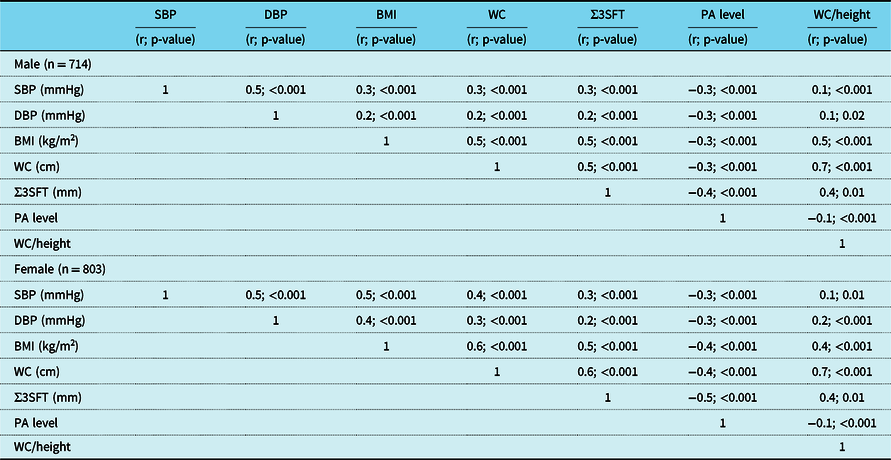
Table 1 shows that participants in this study comprised 52.9% females and had a mean age of 10.45 ± 1.71 years for males and 10.17 ± 1.64 years for females. Mean values for body mass index, waist circumference, skinfold thickness, waist circumference–height ratio, systolic blood pressure, diastolic blood pressure, and physical activity levels are as shown in Table 1. Table 2 shows that there were significant correlations among systolic blood pressure, diastolic blood pressure, body mass index, waist circumference, skinfold thickness, waist circumference–height ratio, and physical activity levels in males (r = 0.1–0.7; p = 0.02 to <0.001) and in females (r = 0.1–0.7; p = 0.01 to <0.001).
Characteristics of the participants

BMI = Body mass index; BP = Blood pressure; PA = Physical activity; Σ3SFT = Sum of skinfold thickness at three sites; WC = Waist circumference
Correlation matrix of the relationships among the BP, adiposity indices, and PA level of the participants

BMI = Body mass index; BP = Blood pressure; DBP = Diastolic blood pressure; PA = Physical activity; SBP = Systolic blood pressure; Σ3SFT = Sum of skinfold thickness at three sites; WC = Waist circumference
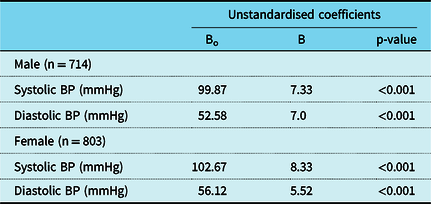
Data in this study showed that physical activity level significantly predicted systolic blood pressure (Bo = 99.87; B = 7.33; p < 0.001) and diastolic blood pressure (Bo = 52.58; B = 7.0; p < 0.001) in males, and systolic blood pressure (Bo = 102.67; B = 8.33; p < 0.001) and diastolic blood pressure (Bo = 56.12; B = 5.52; p < 0.001) in females (Table 3).
Association between PA level and BP

BP = Blood pressure
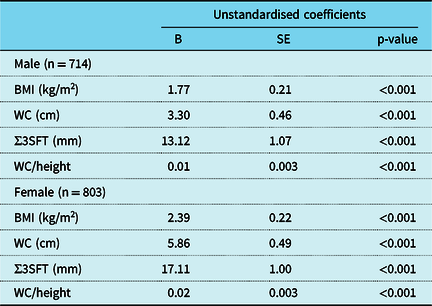
The unstandardised coefficients for the associations of physical activity level with body mass index (B = 1.77; standard error (SE) = 0.21), waist circumference (B = 3.30; SE = 0.46), skinfold thickness (B = 13.12; SE = 1.07), and waist circumference–height ratio (β = 0.01; SE = 0.003) in males, and body mass index (B = 2.39; SE = 0.22), waist circumference (B = 5.86; SE = 0.49), skinfold thickness (B = 17.11; SE = 1.00), and waist circumference–height ratio (B = 0.02; SE = 0.003) in females are as shown in Table 4.
Unstandardised coefficients for the association between PA level and adiposity indices

BMI = Body mass index; BP = Blood pressure; PA = Physical activity; Σ3SFT = Sum of skinfold thickness at three sites; WC = Waist circumference
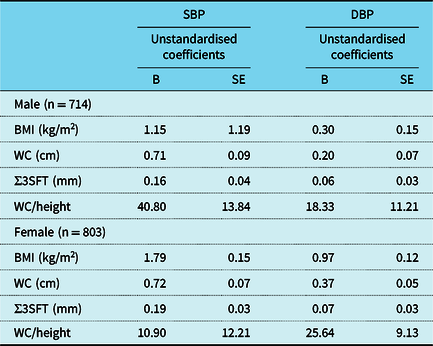
Table 5 shows the unstandardised coefficients for the associations between systolic blood pressure and adiposity indices in males [body mass index (B = 1.15; SE = 1.19), waist circumference (B = 0.71; SE = 0.09), skinfold thickness (B = 0.16; SE = 0.04), and waist circumference–height ratio (B = 40.80; SE = 13.84)] and females [body mass index (B = 1.79; SE = 0.15), waist circumference (B = 0.72; SE = 0.07), skinfold thickness (B = 0.19; SE = 0.03), and waist circumference–height ratio (B = 10.90; SE = 12.21)], and between diastolic blood pressure and adiposity indices in males [body mass index (B = 0.30; SE = 0.15), waist circumference (B = 0.20; SE = 0.07), skinfold thickness (B = 0.06; SE = 0.03), and waist circumference–height ratio (β = 18.33; SE = 11.21)] and females [body mass index (B = 0.97; SE = 0.12), waist circumference (B = 0.37; SE = 0.05), skinfold thickness (B = 0.07; SE = 0.03), and waist circumference–height ratio (B = 25.64; SE = 9.13)].
Unstandardised coefficients for the associations between adiposity indices and BP when PA level is also a predictor

BMI = Body mass index; BP = Blood pressure; DBP = Diastolic blood pressure; PA = Physical activity; SBP = Systolic blood pressure; Σ3SFT = Sum of skinfold thickness at three sites; WC = Waist circumference
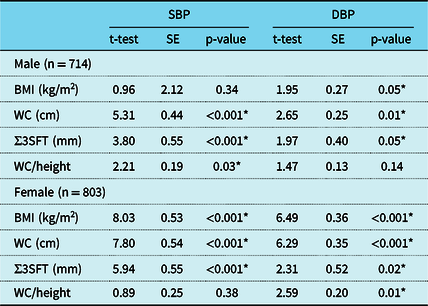
Table 6 shows that the mediating effects of adiposity indices in the prediction of systolic blood pressure from physical activity level were significant for only waist circumference (t = 5.31; p < 0.001), skinfold thickness (t = 3.80; p < 0.001), and waist circumference–height ratio (t = 2.21; p = 0.03) in males, and for only body mass index (t = 8.03; p < 0.001), waist circumference (t = 7.80; p < 0.001), and skinfold thickness (t = 5.94; p < 0.001) in females. In addition, the mediating effects of adiposity indices in the prediction of diastolic blood pressure from physical activity level was significant for only body mass index (t = 1.95; p = 0.05), waist circumference (t = 2.65; p = 0.01), and skinfold thickness (t = 1.97; p = 0.05) in males, and body mass index (t = 6.49; p < 0.001), waist circumference (t = 6.29; p < 0.001), skinfold thickness (t = 2.31; p = 0.02), and waist circumference–height ratio (t = 2.59; p = 0.01) in females (Table 6).
Mediating effects of adiposity indices in the prediction of BP from PA level among the participants using Sobel Test

BMI = Body mass index; BP = Blood pressure; DBP = Diastolic blood pressure; PA = Physical activity; SBP = Systolic blood pressure; Σ3SFT = Sum of skinfold thickness at three sites; WC = Waist circumference
* significant at P < 0.05
Discussion
The objective of this study was to explore the mediating effects of adiposity indices in the association between physical activity level and blood pressure in a Nigerian schoolchildren population. The findings in this study showed that waist circumference, skinfold thickness, and waist circumference–height ratio significantly mediated the association between physical activity level and systolic blood pressure in males, and body mass index, waist circumference, and skinfold thickness in females. In addition, body mass index, waist circumference, skinfold thickness, and waist circumference–height ratio significantly mediated the association between physical activity level and diastolic blood pressure in females, but only body mass index, waist circumference, and skinfold thickness in males.
The multiplicity of factors that influence blood pressure is an indication of the complex nature of development of childhood hypertension. The lifestyle interventions recommended for hypertension management in children include weight reduction through dieting and/or regular physical activity behaviour as well as reduced salt intake.Reference Maximova, O’Loughlin, Paradis, Hanley and Lynch30 Salt intake level, parental history of hypertension, and dieting are possible confounders in the association between physical activity level and blood pressure. However, these variables were not examined in this study, and their possible confounding effects may present a limitation to the findings in this study.Reference Leary, Ness and Smith25 In addition, physical activity level was assessed in this study through self-report. Self-report measures have been reported to have poor estimation of physical activity level in children, as childhood activity is sporadic.Reference Armstrong and Bray37 This poor estimation can be compounded with recall bias.Reference Leary, Ness and Smith25 However, the standardised physical activity level measure employed in this study was meant to minimise subjectivity and bias in reported physical activity. In addition, information on socio-economic background of the children was not collected. Inclusion of socio-economic status in the predictive models may affect the findings in this study. It is recommended that more studies of this nature adjusting out all these potential confounders of the association between physical activity level and blood pressure, and adopting objectively measured physical activity level be carried out. The strength of this study is the use of adequate sample size obtained through random selection of participants.
Obesity and low physical activity level have been serious public health concerns in about the last two decades because of its health consequences and increasing prevalence. Childhood obesity and inadequate physical activity level in children are particularly health concerns by virtue of their adverse effects on the future adult health. Low physical activity level or physical fitness and obesity in children have been well reported as contributing to childhood hypertension, which tracks into adulthood. In fact, many previous studies reported associations between obesity indices and blood pressure in children.Reference Goel, Misra, Angarwal and Vikram18,Reference Riberio, Guerra, Pinto, Oliveira, Duarte and Mota22,Reference Babinska, Kovacs, Janko, Dallos and Feber38,39 The obesity indices examined in those previous studies included body mass index, waist circumference, and percent body fat with the first two indices being the most frequently reported. Although, percent body fat was not examined in this study, the skinfold thickness examined in this study is a surrogate index of percent body fat. In addition, the findings of predictive inverse associations of physical activity level with body mass index, waist circumference, and skinfold thickness have been previously observed.Reference Crocker, Bailey, Faulkner, Kowalski and McGrath33,Reference Kimm, Glynn and Orbazanek40 However, contrary to the findings in this study, Ribeiro et al observed no association between physical activity level and blood pressure in children aged 8–16 years in Portugal.Reference Riberio, Guerra, Pinto, Oliveira, Duarte and Mota22
The associations between physical activity level and each of systolic blood pressure and diastolic blood pressure were variedly mediated by body mass index, waist circumference, skinfold thickness, and waist circumference–height ratio. However, the strength of these mediations was graded, with waist circumference and skinfold thickness exerting the strongest effects on the association between physical activity level and blood pressure in males, while body mass index and waist circumference do in females. Similar to the findings in this study, the associations between physical activity level and blood pressure in children have been well reported in the literature.Reference Gaya, Alves, Aires, Martins, Ribeiro and Mota24,Reference Leary, Ness and Smith25,Reference Andersen, Harro and Sardinha41 However, reports on mediating roles of adiposity indices in the association between physical activity level and blood pressure are not readily available. A previous study has demonstrated that adjustment of body size and obesity index make the association between physical activity level and blood pressure weaker, in line with the findings in this study.Reference Leary, Ness and Smith25 In addition, similar to the findings in this study, Maximova et al reported that changes in body mass index, waist circumference, and skinfold thickness, from early adolescence, attenuated the association between physical activity level and systolic blood pressure in males in late adolescence, whereas no such attenuation was observed in females.Reference Maximova, O’Loughlin, Paradis, Hanley and Lynch30 Indeed, LearyReference Leary, Ness and Smith25 et al reported that it is difficult to isolate the interrelationships between physical activity level and body mass index, as body mass index is assumed to be on the causal pathway between physical activity level and blood pressure, and that including body mass index in the model predicting blood pressure from physical activity level may represent over-adjustment. Furthermore, a previous study demonstrated that, after adjusting for potential confounders, the volume rather than the intensity of physical activity is more important in the association with blood pressure.Reference Leary, Ness and Smith25
The findings in this study have implications for public health in schoolchildren. The findings of inverse relationship between physical activity level and blood pressure, in this study, suggest the need to emphasise adequate physical activity in these children, especially during the school hours. Leung et al have reported that two or more extracurricular sessions per week at school reduce the risk of childhood hypertension.Reference Leung, Sung and So20 Similarly, a decline in moderate-to-vigorous physical activity by one session per week with each advancing age is associated with higher systolic blood pressure in males and females, and in males alone, in early and late adolescence.Reference Maximova, O’Loughlin, Paradis, Hanley and Lynch30 Furthermore, a higher exercise frequency is associated with lower blood pressure.Reference Cole, Bellizzi, Flegal and Dietz35 In addition, the mediating effects of the adiposity indices in the predictions of systolic blood pressure and diastolic blood pressure from physical activity level in this study suggest the need for body fat management in these children either through increased physical activity level and/or proper dieting.Reference Revelas and Tahmazidis36 Although high blood pressure has been associated with family history,Reference Munger, Prineas and Gomez-Marin42 this association is partly mediated by a shared and modifiable environment, which includes low physical activity level and improper dieting.Reference Chobanian, Bakris and Black6,Reference Savitha, Krishnamurthy, Fatthepur, Yashwanth Kumar and Khan43 Furthermore, the findings also suggest the need for measurement of adiposity indices, especially body mass index and waist circumference, as part of clinical examinations and screening protocols in children. The clinical utility of these obesity indices as cardiovascular risk factors has been previously reported.Reference Katzmarzyk, Srinivasan, Chen, Malina, Bouchard and Berenson16,Reference Ng, Kong and Choi44
In conclusion, the obesity indices that mediate the association between physical activity level and blood pressure vary, and their mediating effects are graded. While waist circumference and skinfold thickness exert the greatest mediating effects on the association in males, body mass index and waist circumference do in females.
Acknowledgements
The authors of this manuscript appreciate the cooperation of the heads and teachers of the schools where the data were collected, and appreciate the parents and guardians of the pupils for giving their consents for the study. We also thank our research assistants for their assistance during the data collection.
Financial Support
This research received no specific grant from any funding agency, commercial or not-for-profit sectors.
Conflict of Interest
None.
Ethical Standard
The authors assert that all procedures contributing to this work comply with the ethical standards of the relevant national guidelines on human experimentation and with the Helsinki Declaration of 1975, as revised in 2008, and has been approved by Ethics Committee of Nnamdi Azikiwe University Teaching Hospital.