Invasive fungal infections (IFIs) are a significant cause of morbidity and mortality in children with malignancy, with overall incidence as great as 7%, and mortality rates as high as 31% for invasive candidiasis and 88% for invasive aspergillosis.Reference Ozsevik, Sensoy and Karli 1 Surveillance of IFIs is important in guiding prophylaxis and treatment regimens by informing local incidence and monitoring trends.Reference Ananda-Rajah, Martinez and Slavin 2 However, the complexities of diagnosing IFIs makes surveillance challenging; IFI case definitionsReference De Pauw, Walsh and Donnelly 3 cannot always be applied in the clinical setting. Thus, a gold standard surveillance tool is yet to be established.Reference Ananda-Rajah, Martinez and Slavin 2
Hospital-based antimicrobial stewardship (AMS) programs provide evidence-based antimicrobial recommendations to optimize treatment; they minimize adverse patient outcomes and development of resistance. 4 – Reference Davey, Brown and Charani 7 Antifungal stewardship is an important component of AMS programs; antifungal misuse is common,Reference Mondain, Lieutier and Hasseine 8 exposing patients to unnecessary toxicities, promoting resistance, and incurring unnecessary costs to healthcare facilities.Reference Ananda-Rajah, Slavin and Thursky 9 By monitoring physician prescribing practices, AMS programs have the potential to provide infectious diseases surveillance. This surveillance could be particularly advantageous in the context of IFIs, given their diagnostic complexities and a lack of convenient surveillance tools.Reference Ananda-Rajah, Martinez and Slavin 2 The incorporation of a computerized decision support system (CDSS) to facilitate evidence-based recommendations and approvals for antifungal use enables convenient monitoring of antifungal prescribing and could therefore be used for surveillance of IFIs. The aim of this study was to compare the CDSS as a surveillance tool for IFI in our pediatric hematology/oncology inpatient cohort against a standard of hospital diagnosis-related group (DRG) coding.
PATIENTS AND METHODS
The Sydney Children’s Hospital is a tertiary pediatric hospital with a Haematology/Oncology Department and Haematopoietic Stem Cell Transplant (HSCT) Unit. A CDSS for antimicrobials (GuidanceMS) was introduced in October 2012 as part of a hospital-wide AMS program. Access to restricted antimicrobials is approved through the CDSS with indication-specific dosing and duration recommendations reflecting hospital guidelines, statewide policies, and evidence-based practice. All systemic antifungal agents used in the facility—liposomal amphotericin, caspofungin, fluconazole, itraconazole, posaconazole, and voriconazole—require approval through the CDSS prior to administration. Dosing regimens and duration are based on specific indications (Appendix 1).
IFI Detection
Using an audit function of the CDSS, a list of all patients admitted to the Haematology/Oncology Department who received approval for treatment with an antifungal agent between November 1, 2012, and October 31, 2013 was generated. All patients identified were included in the analysis, and clinical data were obtained by review of electronic and hard-copy medical records. For each antifungal approval episode identified, the following data were collected: (1) patient demographic details; (2) diagnosis and treatment protocol (including HSCT); (3) antifungal agent approved; (4) duration of antifungal approval; (5) CDSS indication for approval; (6) and criteria for possible, probable, and proven IFI, according to the European Organization for Research and Treatment of Cancer/Invasive Fungal Infections Cooperative Group and the National Institute of Allergy and Infectious Diseases Mycoses Study Group (EORTC/MSG) Consensus Group.Reference De Pauw, Walsh and Donnelly 3 Once all details for each antifungal approval episode were collected, the prescribing of the antifungal agent was assigned to one of the following categories: (1) prophylaxis; (2) empiric therapy; (3) possible IFI treatment; (4) probable IFI treatment; (5) proven IFI treatment; (6) secondary prophylaxis; and (7) other.
A list of diagnostic codes that correlated with any fungal infection was obtained through the coding department of the hospital (codes B35-B49, The International Statistical Classification of Diseases and Related Health Problems, 10th Revision, Australian Modification, 8th ed.). 10 A search was then conducted for all patients admitted to the Haematology/Oncology Department between November 1, 2012, and October 31, 2013, who had been assigned a diagnostic code consistent with a fungal infection. For each episode identified, a review of the patient’s medical record was undertaken to determine whether a diagnosis of possible, probable, or proven IFI had been confirmed, based on EORTC/MSG criteria. The records of those diagnosed with an IFI were then compared with the records of those identified using the CDSS as having been treated for a possible, probable, or proven IFI.
The Infectious Diseases (ID) service at the hospital maintains a database of all inpatient consultations that records patient details, the treating inpatient medical team, nature of consultation, and recommendations. A review of the consultation database for the 12-month period was conducted to extract all consults that involved patients with either a suspected or confirmed IFI admitted under the care of the Haematology/Oncology Department. For each consultation identified, the medical record was reviewed to confirm the diagnosis of possible, probable, or proven IFI. The records of all patients identified as having an IFI were then compared with the records of the patients identified by audit of the CDSS.
Ethics
Ethics approval was obtained through the Human Research Ethics Committee of the Sydney Children’s Hospitals Network.
RESULTS
CDSS Audit
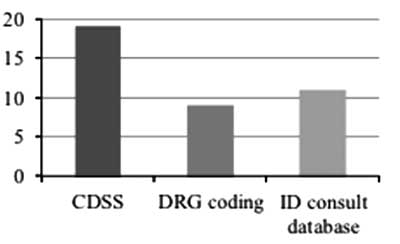
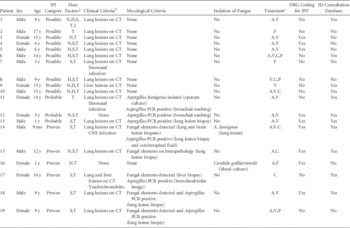
A total of 265 patients had 1,042 inpatient admissions to the Haematology/Oncology Department between November 1, 2012, and October 31, 2013. In total, 83 patients were identified by the CDSS as having been prescribed antifungal therapy, accounting for 219 CDSS antifungal approval episodes. By medical record review, 19 patients were identified who satisfied the EORTC/MSG Consensus Group criteria for an IFI. The final diagnostic categories for these 19 patients included 10 patients with possible IFI, 3 patients with probable IFI, and 6 patients with proven IFI (Figure 1). Patient characteristics and host factors for the various IFI categories are shown in Table 1. Of these 19 patients, 17 (89%) had a CDSS indication for approval consistent with an IFI, while the remaining 2 patients had indications for prophylaxis and esophageal candidiasis. Of the 19 patients, 4 patients were diagnosed with an IFI prior to the study start date, but they required treatment for their IFI during the study period. There were 15 patients with a new IFI diagnosis during the study period, resulting in an annual IFI incidence of 5.66% for our hematology/oncology inpatient cohort. A total of 64 patients did not meet the EORTC/MSG Consensus Group criteria for an IFI and were determined to have received antifungals as either prophylaxis or empiric antifungal therapy. Of these 64 patients, 1 had a CDSS indication of an IFI but was determined (by patient record review) to have received empiric antifungal therapy for prolonged fevers with respiratory symptoms.
Number of confirmed IFI cases (y-axis) detected based on surveillance method (x-axis).

All Patients Identified by CDSS with IFI and Relevant Diagnostic Criteria, Treatment, Coding, and ID Consultation.

a N, recent neutropenia >10 d; H=HSCT recipient; S=prolonged corticosteroid use (>3 weeks); T, treatment with T-cell immunosuppressant; I, inherited immunodeficiency.
b CT, computed tomography; CNS, central nervous system.
c A, amphotericin liposomal; V, voriconazole; F, fluconazole; C, caspofungin; P, posaconazole.
DRG Coding
Analysis of DRG coding identified 10 patients who were admitted to the Haematology/Oncology Department and assigned a DRG code consistent with an IFI. The DRG coding descriptions include “candida sepsis,” “candidiasis of other sites,” “disseminated aspergillosis,” “invasive pulmonary aspergillosis,” “other pulmonary aspergillosis,” “other specified mycoses,” and “unspecified mycosis.” Of these 10 patients, 9 were confirmed to have an IFI on medical record review (Figure 1). All 9 patients confirmed with an IFI based on DRG coding and medical record review had been identified through the CDSS. The 1 patient not confirmed to have an IFI received a diagnostic code for “candidiasis of other sites” and by review of their medical record, was found to have had candiduria.
ID Consultation Database
A total of 19 hematology/oncology inpatients had consultation episodes consistent with either a suspected or confirmed IFI. Medical record review confirmed 11 of these patients with an IFI (4 possible IFI, 3 probable IFI, and 4 proven IFI) (Figure 1). All 11 patients with a confirmed IFI were identified in the CDSS audit.
DISCUSSION
The burden for patients and costs to healthcare facilities associated with IFIs emphasize the need for IFI surveillance and rational use of antifungal agents in clinical practice.Reference Ananda-Rajah, Martinez and Slavin 2 , Reference Mondain, Lieutier and Hasseine 8 , Reference Ananda-Rajah, Cheng and Morrisey 11 This retrospective pilot study demonstrates the superiority of a CDSS-based AMS program to capture IFIs in a pediatric hematology/oncology inpatient cohort compared with routine hospital diagnostic coding. CDSS was also superior to the Infectious Diseases consultation database, which could reflect a lack of routine referral for children with an IFI to the Infectious Diseases team. Incorporating this CDSS-based surveillance into routine practice has the potential to improve IFI surveillance capacities, which could lead to more accurate information on local IFI epidemiology and improve management of IFIs for hematology/oncology patients. Similar CDSS-based AMS programs have been shown to reduce broad-spectrum antibiotic prescribing and to improve gram-negative resistance patterns.Reference Yong, Buising, Cheng and Thursky 12 , Reference Thursky, Buising and Bak 13 This is the first study, to our knowledge, that demonstrates the surveillance properties of a CDSS-based AMS program for invasive fungal infections.
Improved IFI surveillance may assist hospitals that rely on activity-based government funding to recoup costs as well as guide financial projections and budgets. An additional median cost of AU$30,957 has been attributable to an IFI for an adult hematology/oncology inpatient; this cost increases to AU$80,291 if management in an intensive care unit is required.Reference Ananda-Rajah, Cheng and Morrisey 11 The relative insensitivity of DRG coding in detecting IFIs, as evidenced by this study, highlights the significant remuneration hospitals are not recovering by relying on diagnostic coding. Finding innovative ways to improve IFI surveillance should therefore be of interest to hospital executive units and heads of departments.
The success of a CDSS in measuring antifungal prescribing depends on physicians appropriately requesting antifungal approval. Prior studies with computerized management systems have identified prescriber engagement as one of the greatest challenges to the success of this component of an AMS program.Reference Shojania, Yokoe, Platt, Fiskio, Ma’luf and Bates 14 , Reference Evans, Pestonik and Classen 15 Based on antifungal indications for approval, CDSS appropriately captured 89% of patients with a confirmed IFI. If conducted in a prospective and routine manner, accurate real-time capturing of antifungal use and IFI surveillance through a CDSS may be feasible.
We are aware of two main limitations to this study. First, this study was conducted in a retrospective manner, thereby limiting its utility in determining the ability of a CDSS-based AMS program to monitor real-time epidemiological trends of IFIs. However, this retrospective pilot study provides impetus for prospective studies of CDSS-style surveillance. Furthermore, incorporation of a CDSS-based AMS program into an electronic medication management system is anticipated for our hospital network, which could facilitate future prospective analyses on real-time IFI surveillance capacities of a CDSS.
Second, because we did not compare the performance of a CDSS for detecting IFIs against screening radiology, microbiology, and histopathology records, we may not have detected all IFI cases. Ananda-Rajah et alReference Ananda-Rajah, Martinez and Slavin 2 reported promising results using a computational method to analyze CT reports as a means to detect adult IFI cases, demonstrating an overall sensitivity of 90% and a negative predictive value of at least 97%. However, this strategy may be less useful in pediatric patients, as radiologic findings are more often nonspecific.Reference Thomas, Owens, Veys, Novelli and Costoli 16 Screening of microbiology results for positive fungal cultures and non–culture-based tests is also expected to underreport cases of IFI due to the variable sensitivity of culture methods isolating fungusReference Oren and Paul 17 and varying performance of PCR and other assays on different clinical specimens (eg, blood, pleural fluid, tissue, or cerebrospinal fluid).Reference Alanio and Bretagne 18 In addition, not all patients are optimally investigated because the clinical status of unwell patients often limits their ability to undergo procedures for specimen collection (eg, bronchoalveolar lavage). Histopathology records may similarly underreport IFI cases because they also rely on patient stability for specimen collection and quality of specimens for processing.
This pilot study demonstrates a role for a CDSS in the surveillance of IFIs with superiority to hospital DRG coding; however, its success depends on prescriber engagement and compliance with the program. Further prospective studies to assess the ability of a CDSS-based AMS program to conduct real-time surveillance of IFIs are warranted.
ACKNOWLEDGMENTS
Financial support: No financial support was provided relevant to this article.
Potential conflicts of interest: All authors report no conflicts of interest relevant to this article.
APPENDIX 1. CDSS Approval Process
Once a patient has been identified as requiring an antimicrobial, the medical staff member logs onto the CDSS program, available through the hospital intranet, and searches for the patient record by name or medical record number. Once the patient has been selected, a list of antimicrobials becomes available from which the medical officer may choose to request approval. In the context of a hematology/oncology patient, antifungal indications acceptable for automatic approval during the study period included: (1) prophylaxis in patients at high risk of invasive fungal infections (eg, allogeneic hematopoietic stem cell transplant recipient; patient with acute myeloid leukemia, relapsed lymphoma or leukemia, or high-risk acute lymphoid leukemia; patient with graft versus host disease grade 2 to 4); (2) empiric therapy for febrile neutropenia in an immunocompromised host (with respiratory symptoms or abnormal chest x-ray; fever for >5 days without localizing features or respiratory infection); (3) candidiasis treatment; (4) probable or confirmed mold infection in an immunocompromised patient. These automatic approvals have specific durations depending on the indication. Should the indication for the antifungal agent fall outside of the automatic approval criteria, or should extension of approval duration be required, the treating team contacts the hospital antimicrobial stewardship service to discuss treatment choices and durations.