Implications
Beef industries in tropical regions that rely on pasture-based production systems may benefit from crossbreeding schemes using zebu, adapted taurine, composites and British breeds, due to complementarity of characteristics like improved adaptability, greater resistance against parasites, higher growth rate and superior meat quality. Recommendations on the use of Nellore (zebu), Caracu (tropically adapted Brazilian native taurine), Charbray (Charolais × zebu composite), Braford (British × zebu composite) and Angus (British) may be provided, so improvements in growth performance and in carcass quality can take place. Consequently, greater revenues from enhanced productivity and higher carcass commercial value can be achieved.
Introduction
Success in beef production depends on the effects of genetic and environmental (e.g. nutrition, health and climate) factors, as well as the interaction among these elements. It is known that approximately 80% of the meat produced in Brazil, one of the largest producers in the world, originates from zebu breeds, predominantly the Nellore breed (Ferraz and Felício, Reference Ferraz and Felício2010). Zebu breeds stand out for their greater adaptability to the climatic conditions present in the tropics and greater resistance to ectoparasites and certain diseases; however, they usually show lower growth rates and worse meat quality, especially with regard to tenderness, when compared to taurine breeds (Wheeler et al., Reference Wheeler, Cundiff, Shackelford and Koohmaraie2010; Elzo et al., Reference Elzo, Johnson, Wasdin and Driver2012). In this context, crossbreeding between Bos indicus and Bos taurus animals is an effective strategy to optimise the use of genetic and environmental resources, since it allows genetic gains through heterosis (Gama et al., Reference Gama, Bressan, Rodrigues, Rossato, Moreira, Alves and Bessa2013) and a combination of desirable traits through breed complementarity, promoting an increase in the productive potential of animals in tropical environments (Miguel et al., Reference Miguel, Faria, Roça, Santos, Suman, Faitarone, Delbern, Girao, Homem, Barbosa, Su, Resende, Siqueira, Moreira and Savian2014).
However, it is important to note that increases in the proportion of genes from zebu animals in the crossbred progeny result in lower reproductive precocity, lower deposition of fat in the carcass and less tender beef (Rotta et al., Reference Rotta, Prado, Prado, Valero, Visentainer and Silva2009). The challenge of maintaining both adaptation to tropical conditions and sufficient taurine genes may be overcome by using crossbreeding schemes with Nellore or crossbred dams (Bos taurus × Bos indicus) and sires of composite breeds (Bos taurus × Bos indicus), such as Braford and Charbray, or sires of taurine breeds (Bos taurus) adapted to tropical conditions, such as the Brazilian native Caracu breed. An added advantage of this approach is that it allows for the possibility of using natural mating.
Despite the advantages of crossbreeding in terms of carcass and meat quality and performance, it is necessary to identify crossbreeding schemes that are better suited to particular environments and production systems, such as systems developed in tropical environments that are designed for the slaughter of young animals. Thus, the objective of this study was to evaluate the effects of different sire and dam breeds, adapted to the tropical climate, on the performance and carcass traits assessed by ultrasound of crossbred cattle reared in tropical pasture and finished in feedlot.
Materials and methods
This study was carried out at Embrapa Beef Cattle in Campo Grande, Brazil (20°27′ S and 54°37′ W, at 530 m above sea level). The climate, according to the Köppen climate classification, is type AW (rainy tropical savanna) with a defined dry season from May to September. Mean annual temperature and precipitation are 23.4°C and 1449 mm, respectively.
Experimental animals were generated from mating Nellore (N_N), ½ Angus + ½ Nellore (A_N) and ½ Caracu + ½ Nellore (C_N) cows (4 to 8 years old) with Braford, Charbray and Caracu sires (9, 10 and 18 sires, respectively) using fixed-time artificial insemination in breeding seasons carried out from November 2012 to February 2013 (batch 1) and November 2013 to February 2014 (batch 2). Crossbred progenies were evaluated along the pre-weaning (0 to 8 months of age, n = 173), post-weaning (8 to 20 months of age, n = 173) and finishing (20 to 23 months of age, n = 119) phases. Either for producing the cows or their progenies, sires were chosen from animal breeding programmes for their respective breeds, opting for individuals from different lineages so that each breed could be widely represented. Table 1 summarises the different phases of the study and the number of observations.
Summary of experimental phases and number of animals1

m = month.
1 Cattle were generated from mating Nellore, ½ Angus + ½ Nellore and ½ Caracu + ½ Nellore cows with Braford, Charbray and Caracu sires.
During the pre-weaning phase, cows and calves were maintained in Brachiaria spp. and Panicum spp. pastures receiving mineral supplements. Calf BW was obtained at birth and at weaning (8 months old on average). Weaning BW was adjusted for day 240 regressing calf BW on time. Pre-weaning phase average daily weight gain (ADG) was calculated for calves from the difference between birth and weaning BW.
Following weaning, calves were enrolled in the post-weaning phase, which was split into two consecutive phases: phase 1 (P1, June to October) and phase 2 (P2, November to May). This was carried out to consider the expected effects of forage quality seasonality on growth performance. Lower precipitation and temperatures from June to November (P1) result in low quality pastures and low ADG, while higher precipitation and temperatures from December to May (P2) lead to higher quality pastures and greater ADG. In this phase, cattle were allotted to one of eight paddocks (single sex and balanced for the different breeds) of 8 ha each, planted with Brachiaria brizantha cv. Marandu, at continuous stocking with a fixed stocking rate.
Cattle had access to protein supplements (1 g/kg BW per day) in phase 1 and to mineral supplements (ad libitum) in phase 2. Animals were treated ectopically to control ticks and horn flies (cypermethrin pour-on topical solution) and endoparasites (injectable doramectin 1%). Male calves were castrated at 14 months of age and cattle were weighed following 16-h fasting every 56 days, on average. Average daily weight gain was calculated separately for P1, P2 and the total post-weaning period (P1 + P2).
Pasture sampling was conducted five times a year, distributed through the different seasons. Leaf samples were ground to 1 mm and analysed for percentages of CP, NDF and ADL, using NIRS, as described by Marten et al. (Reference Marten, Shenk and Barton1989). The forage mass, green forage allowance and stocking rate varied from 10.5 to 16.1 tons DM/ha, 11.4 to 18.5 kg DM/kg BW and 0.76 to 1.30 animal units/ha in the 2 years, respectively. Crude protein, NDF and ADL contents varied from 6.6 to 8.7%, 66.9 to 73.7% and 2.1 to 2.9%, respectively.
On the final weighing of the post-weaning phase, cattle were scanned using a real-time ESAOTE Piemedical Aquila Vet (ESAOTE Pie Medical Imaging, Inc., Maastricht, The Netherlands) ultrasound unit equipped with an 18-cm, 3.5-MHz linear array transducer and a coupled acoustic guide. Vegetable oil was used as an acoustic couplant. Ultrasound images of the longissimus between the 12th and 13th ribs were used to measure ribeye area (R_A) and subcutaneous backfat thickness (B_T), and an image of biceps femoris muscle was used to obtain rump fat thickness (R_T). Ultrasound images were interpreted using Lince software (M&S Consultoria Agropecuária Ltda, Pirassununga, SP, Brazil).
Following the post-weaning phase, cattle were housed in individual pens that were 2 × 19 m and soil-surfaced. Cattle were allowed to adapt to the diet and feeding procedures for 24 days. After the adaptation period, the experimental diet was offered ad libitum, at 0800 h and 1500 h, so that 5% refusals were allowed. The duration of the feeding period was 83 and 84 days for heifers and 119 and 98 days for steers from batches 1 and 2, respectively.
Diet consisted of 35% sorghum silage, 49.8% ground dry corn, 9% soybean hulls, 3.6% soybean meal, 1.1% urea and 1.5% mineral premix, in dry basis, and the same composition was used in both batches. Predicted metabolisable energy (ME) content was 2.66 Mcal ME/kg DM, according to National Research Council (NRC, 1996). Crude protein and NDF contents were 12% and 38%, respectively, and were determined according to the Association of Official Analytical Chemists (AOAC, 1990) and Van Soest et al. (Reference Van Soest, Robertson and Lewis1991). Feed refusals were weighed daily before the morning feed delivery to calculate the daily dry matter intake (DMI).
Cattle were weighed following 16 h of feed withdrawal every 28 days on average. Average daily gain was computed as the slope of the linear regression of BW on feeding days. Gross feed efficiency (ADG/DMI) and feed conversion ratio (DMI/ADG) were calculated. Cattle were also scanned for carcass traits at the beginning and the end of the feeding period, according to the procedures described previously.
The data were analysed for outliers (> 3 standard deviations), homogeneity of variance (Hartley test) and normality of residuals (Shapiro–Wilk test). Linear mixed models were fitted in restricted maximum likelihood (REML) analysis to evaluate the effects of breed, using PROC MIXED of SAS (version 9.2, SAS Institute Inc., Cary, NC, USA).
For traits evaluated in the pre-weaning phase, the model included as fixed effects: (i) contemporary group (eight levels); (ii) sire breed (three levels – Braford, Caracu and Charbray); (iii) dam breed (three levels – A_N, C_N and N_N); (iv) the interaction between sire and dam breed; (v) cow age at calving (linear and quadratic covariates); and (vi) and the deviation of calf birth date from the average birth date of the respective birth season, nested in the contemporary group (linear covariate). Contemporary groups were composed of batch (two levels – batches 1 and 2), calving season (two levels – season 1 = August to September, and season 2 = October to November) and sex (two levels – male and female). To accommodate the effect of sampling some few sires within a breed, random effect of individual sire nested within sire breed was included in the analysis model. As covariance structure, independent covariance model was adopted, where the within-subject error correlation is zero.
To analyse the variables obtained in the post-weaning phase, a similar model to the one adopted to pre-weaning phase was employed. Cattle age at the end of phase 1 was added as a linear covariate and paddock as a random effect. For variables obtained in the finishing phase, the model included as fixed effects: (i) contemporary group (as previously described); (ii) sire breed (as previously described); (iii) dam breed (as previously described); (iv) the interaction sire by dam breed; (v) cattle age at the beginning of the finishing period (linear covariate); and (vi) days on feed (linear covariate). Individual sire nested within sire breed and paddock were included as random effects. As covariance structure, independent covariance model was adopted, where the within-subject error correlation is zero. Additionally, contrasts were performed to compare: (1) progeny of crossbred cows (A_N and C_N) v. progeny of purebred N_N cows and (2) composite breed sire progeny (Braford and Charbray) v. Caracu sire progeny. When needed, means were compared by the Tukey–Kramer adjusted test. A treatment difference of P ≤ 0.05 was considered significant, and 0.05 < P ≤ 0.10 was considered a tendency.
Results
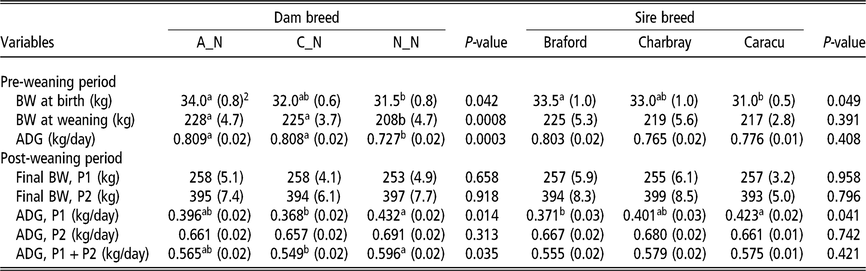
Table 2 shows the results of growth performance of the progenies during the pre- and post-weaning periods. There was no interaction between dam and sire breed genetic effect for birth BW, weaning BW, pre-weaning phase ADG, final BW in post-weaning P1, final BW in post-weaning P2, post-weaning P2 ADG or post-weaning P1 + P2 ADG (P > 0.05). By comparing dam breeds, calves from A_N cows were heavier than those from N_N cows (P < 0.05). Calves from C_N cows did not differ from the other two breeds (P > 0.05). Calves from A_N and C_N had greater weaning weights than calves from N_N cows (P < 0.01) but did not differ from each other (P > 0.05). This result is consistent with the verified ADG, as calves from A_N and C_N cows had greater ADG than did those from N_N cows (P < 0.01).
Effect of dam and sire breeds on progeny growth performance during the pre- and post-weaning periods1

A_N = ½ Angus + ½ Nellore cows, C_N = ½ Caracu + ½ Nellore cows; N_N = Nellore cows; P1 = phase 1 of post-weaning period; P2 = phase 2 of post-weaning period; ADG = average daily gain.
1 Cattle were generated from mating Nellore, ½ Angus + ½ Nellore and ½ Caracu + ½ Nellore cows with Braford, Charbray and Caracu sires.
2 Standard error of mean.
a,b Values within a row with different superscripts differ significantly at P < 0.05.
Sire breed genetic effects were observed for birth BW (P < 0.05). Calves from Braford sires were heavier at birth than calves from Caracu sires, whereas calves from Charbray calves were intermediate. Sire breed did not affect weaning BW or pre-weaning ADG (P > 0.05). For the post-weaning period, no sire or dam breed effects were observed for P1 final BW, P2 final BW or P2 ADG (P > 0.05). Calves from N_N cows had greater P1 and P1 + P2 ADG when compared to C_N cows (P < 0.01), and A_N cows were intermediate (P > 0.05). Progeny of Caracu sires had higher P1 ADG than the progeny of Braford sires (P < 0.05), but neither breeds differed from Charbray (P > 0.05).
There was a significant interaction effect of dam and sire breeds on P1 ADG (P < 0.05, data not shown). Progeny that were ½ Caracu + ½ Nellore had greater ADG than all other breeds. Braford × C_N had the lowest ADG, which did not differ from Charbray × A_N. Braford × A_N, Braford × N_N, Charbray × C_N, Charbray × N_N, Caracu × A_N and Caracu × C_N did not differ from each other.
Table 3 shows the results of ultrasound carcass traits of the progenies, during the pre- and post-weaning periods. There were no interaction effects of dam and sire breeds on ultrasound carcass traits, measured at the end of the post-weaning P2 (P > 0.05). There were no effects of dam breed (P > 0.05) for R_A, but progeny of N_N cows had higher B_T and R_T (P < 0.01) when compared to progeny of C_N cows, whereas A_N progeny were intermediate (P > 0.05). Progeny of Caracu sires had greater R_A than did those of Braford sires, but did not differ from values for Charbray progeny, which were similar to values for Braford progeny as well (P > 0.05). No sire breed effects on B_T were observed (P > 0.05), but progeny from Braford sires had greater R_T when compared to those of Charbray sires (P < 0.05), whereas the values for Caracu were similar to those of the other two breeds (P > 0.05).
Effect of dam and sire breeds on progeny ultrasound carcass traits at the end of post-weaning period1

A_N = ½ Angus + ½ Nellore cows, C_N = ½ Caracu + ½ Nellore cows; N_N = Nellore cows; R_A = ultrasound ribeye area; B_T = ultrasound backfat thickness; R_T = ultrasound rump fat thickness.
1 Cattle were generated from mating Nellore, ½ Angus + ½ Nellore and ½ Caracu + ½ Nellore cows with Braford, Charbray and Caracu sires.
2 Standard error of mean.
a,b Values within a row with different superscripts differ significantly at P < 0.05.
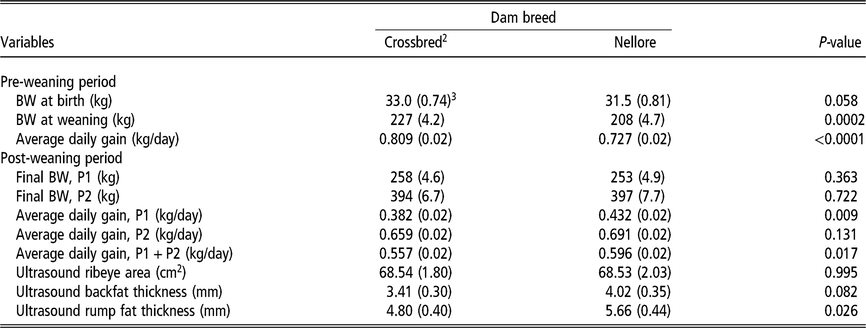
Table 4 shows the results from the contrasts approach to compare progenies from crossbred (A_N and C_N) and N_N cows for growth and carcass traits in the pre-weaning and post-weaning periods. Relative to the progeny of N_N cows, the progenies of crossbred cows tended to have greater birth BW (P = 0.058) and significantly greater weaning BW (P < 0.001) and pre-weaning ADG (P < 0.0001). Nevertheless, the progeny of N_N cows had greater post-weaning P1 and P1 + P2 ADG (P < 0.05). Regarding carcass traits, the progeny from crossbred cows tended to have greater B_T (P = 0.08) and had significantly greater R_T (P < 0.05). No differences were observed for post-weaning P2 final BW, post-weaning P2 ADG or R_A (P > 0.05).
Effect of dam breed on progeny growth performance and ultrasound carcass traits in the pre- and post-weaning periods1

P1 = post-weaning phase 1; P2 = post-weaning phase 2.
1 Cattle were generated from mating Nellore, ½ Angus + ½ Nellore and ½ Caracu + ½ Nellore cows with Braford, Charbray and Caracu sires.
2 ½ Caracu + ½ Nellore and ½ Angus + ½ Nellore cows.
3 Standard error of mean.
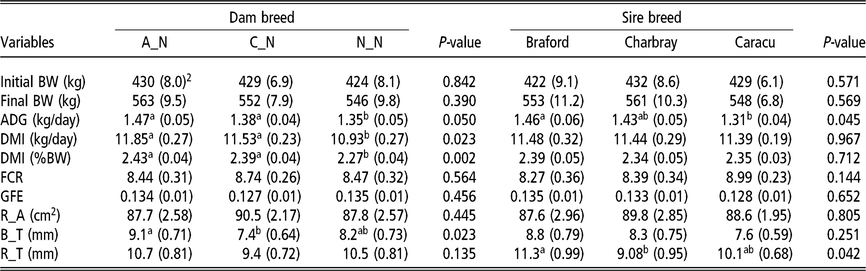
Table 5 shows the results of the feedlot performance and ultrasound carcass traits of progenies from different dam and sire breeds, during the finishing period. There were no interaction effects of sire and dam breeds on any evaluated traits (P > 0.05). Dam breed did not affect (P > 0.05) initial or final BW, feed conversion ratio or gross feed efficiency but influenced ADG and DMI (P ≤ 0.05). Progeny of A_N cows had greater ADG than those of N_N cows, whereas C_N cows did not differ from either. Progenies from A_N and C_N cows had similar DMI values but higher values than those from N_N cows, both in kg/day and in percentage of BW. Sire breed did not affect (P > 0.05) initial or final BW, DMI, feed conversion ratio or gross feed efficiency but influenced ADG (P≤0.05). Relative to those from Caracu sires, progenies from Braford sires had a greater ADG, whereas those from Charbray sires did not differ from either.
Effect of dam and sire breeds on progeny growth performance and ultrasound carcass traits in the finishing period1

A_N = ½ Angus + ½ Nellore cows, C_N = ½ Caracu + ½ Nellore cows; N_N=Nellore cows; ADG = average daily gain; DMI = dry matter intake; FCR = feed conversion ratio; GFE = gross feed efficiency; R_A = ultrasound ribeye area; B_T = ultrasound backfat thickness; R_T = ultrasound rump fat thickness.
1 Cattle were generated from mating Nellore, ½ Angus + ½ Nellore and ½ Caracu + ½ Nellore cows with Braford, Charbray and Caracu sires.
2 Standard error of mean.
a,b Values within a row with different superscripts differ significantly at P < 0.05.
Dam breed did not affect R_A or R_T (P > 0.05). Progeny of C_N cows had lower B_T (P < 0.05) than those of A_N cows, but they did not differ from those of N_N cows (P < 0.05). No sire breed effects were observed for R_A or B_T (P > 0.05). However, progeny of Braford sires had greater R_T than did those from Charbray sires (P < 0.05), and those from Caracu did not differ from either.
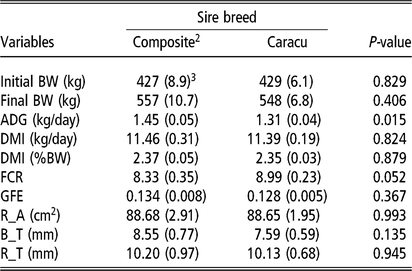
Table 6 shows the results from the contrasts approach to compare progenies from composite (Braford and Charbray) and Caracu sires for feedlot performance and ultrasound carcass traits. No differences were observed for initial or final BW, DMI, gross feed efficiency, R_A, B_T or R_T (P > 0.05). Relative to the progeny of Caracu sires, progeny of composite sires had greater ADG (P < 0.05) and tended to have a lower feed conversion ratio (P = 0.052).
Effect of sire breed on progeny feedlot performance and ultrasound carcass traits in the finishing period1

ADG = average daily gain; DMI = dry matter intake; FCR = feed conversion ratio; GFE = gross feed efficiency; R_A = ultrasound ribeye area; B_T = ultrasound backfat thickness; R_T = ultrasound rump fat thickness.
1 Cattle were generated from mating Nellore, ½ Angus + ½ Nellore and ½ Caracu + ½ Nellore cows with Braford, Charbray and Caracu sires.
2 Composite breeds = Braford and Charbray.
3 Standard error of mean.
Discussion
Nellore cows and Caracu sires had calves with lower birth weight, a characteristic that can be considered an advantage due to lower risk of dystocia (Ahlberg et al., Reference Ahlberg, Kuehn, Thallman, Kachman, Snelling and Spangler2016). Compared to crossbred cows, Nellore cows may have a uterine environment that limits foetal growth which may partially explain these findings (Ferrel, Reference Ferrel1991). This agrees with Calegare et al. (Reference Calegare, Alencar, Packer, Leme, Ferrell and Lanna2009), Lema et al. (Reference Lema, Gimeno, Dionello and Navajas2011) and Reggiori et al. (Reference Reggiori, Torres Júnior, Menezes, Battistelli, Silva, Alencar, Oliveira and Faria2016) who reported that the use of the Nellore breed as a maternal line in a crossbreeding scheme can reduce the birth weight of calves as well as by the study of Perotto et al. (Reference Perotto, Cubas, Molettra and Lesskiu1998) who observed lower birth weight in the progeny of Caracu sires compared to those of Charolais sires.
The occurrence of lower weaning weight, due to poor maternal ability or low calf growth potential, has a significant negative effect on cow/calf operations due to lower commercial value of the offspring. When considering sire breeds, no influences were observed on weaning weight, which may suggest that any of the three evaluated breeds may be employed in crossbreeding schemes. On the other hand, when looking at dam breed effects, Nellore cows weaned calves approximately 8% lighter in relation to the crossbred dams, which is confirmed by the results of the contrasts approach. This finding is consistent with regard to differences in birth BW, as well as with regard to pre-weaning growth rate.
Crossbred progenies showed greater weaning BW which may be explained by the superiority of crossbred cows in relation to purebred cows in terms of milk yield as well as by gains obtained through heterosis (Calegare et al., Reference Calegare, Alencar, Packer and Lanna2007; Rodrigues et al., Reference Rodrigues, Menezes, Azambuja, Suñe, Barbosa Silveira and Cardoso2014). On the other hand, the sire breed effects on weaning BW are not supported by the literature, which extensively reports significant differences between British and Continental breeds (Wheeler et al., Reference Wheeler, Cundiff, Van Vleck, Snowder, Thallman, Shackelford and Koohmaraie2006; Casas et al., Reference Casas, Thallman and Cundiff2012).
From the economic point of view, these results may indicate that using Nellore cows may bring lower revenues to producers who depend on the sale of weaned calves when compared to the use of crossbred cows, due to lower weaning BW. However, one should mention that higher resistance to parasites and diseases usually observed in zebu cattle is important to avoid economic losses. Despite the present study not having evaluated health status and treatment of diseases, this may be considered of great concern. In addition, crossbred cows may be heavier than Nellore cows, which results in higher nutritional costs to maintain the herd.
In the context of the present study, the post-weaning period was divided into two phases due to intrinsic pasture-related nutritional differences between them, as previously explained, and confirmed by growth performance results, as the overall performance was 40% lower in P1 compared to P2. The progeny of Nellore cows had ADG values 12% higher than those of crossbred cows during post-weaning phase 1. As post-weaning phase 1 represented the dry season of the year, a better performance in this phase is probably related to the greater degree of adaptation to a lower nutritional level of the animals with a higher proportion of zebu genes (Burrow, Reference Burrow2012).
Regarding sire breed effects, the performance considering the total post-weaning period (P1 + P2) was similar among Caracu, Braford and Charbray. However, during P1 the progeny of Caracu sires had ADG values approximately 14% higher than those of progenies of Braford sires. This difference may be related both to greater adaptability of the Caracu breed and to a greater difficulty of adaptation of the Braford breed, which is derived from a British taurine breed (Hereford). A result that supports this assumption is that Caracu × N_N cattle had a value of ADG 57% higher than that of Braford × C_N.
Although not reflected in significant changes in final feedlot BW, both dam and sire breed effects were observed on feedlot growth rate, where N_N cows and Caracu sires had progenies with significant lower ADG. This difference in ADG also led to the superiority of the composite breeds for this variable in the contrasts approach. Lower ADG may be partially explained by lower DMI found for the progeny of N_N cows and by a worse feed conversion ratio of progeny of Caracu sires (contrast approach). From an economic point of view, poor ADG and feed conversion ratios are undesirable, because they are highly correlated with profitability (Cruz, et al., Reference Cruz, Sánchez, Oltjen and Sainz2010). Therefore, for feedlot-based finishing systems, progeny of composite sires and crossbred cows would be recommended.
Ribeye area was weakly influenced by breed, except for the measure taken at the end of the post-weaning period, when a slight superiority was observed for progeny of Caracu sires compared to progeny of Braford sires. The greater ribeye measurements observed in progeny of Caracu sires relative to those of the Braford sires at the end of the post-weaning period may be related to possible higher heterosis gains obtained from the use of an adapted taurine breed compared to the use of composite breeds in crossbreeding, or to the greater degree of adaptability to tropical pasture-based production system conditions of the Caracu breed relative to Braford, resulting in greater muscular growth. However, such differences were not confirmed at the end of the finishing period following a better nutritional regime compared to the previous production phase.
On the other hand, marked changes in backfat and rump fat were evident due to differences in dam and sire breeds. The higher backfat and rump fat values observed in offspring of N_N cows relative to offspring of C_N cows are probably related to the better performance of the former in the total post-weaning period or to a late fat deposition profile of the latter. Moreover, when the contrasts approach was performed, this difference was large enough to establish the superiority of N_N cows over crossbred cows for rump fat.
No effects of sire breed were observed on B_T measures; however, the Braford sire progeny presented higher R_T than did those of Charbray. This result may be related to the fact that the Braford breed is partially derived from the British Hereford breed (5/8 Hereford + 3/8 Zebu), which is early-maturing in regard to the deposition of fat in the carcass relative to the continental taurine breeds such as Charolais. The Charbray breed is partially derived from Charolais (5/8 Charolais + 3/8 Zebu) and is larger in size (frame) and has delayed fat deposition in the carcass relative to that in the Hereford breed. Several studies have shown that continental breeds are larger and heavier than British and Zebu breeds, mature later and have leaner carcasses at the same age (Barton et al., Reference Bartoň, Řehák, Teslík, Bureš and Zahrádková2006; Albertí et al., Reference Albertí, Panea, Sañudo, Olleta, Ripoll, Ertjberg, Christensen, Gigli, Failla, Concetti, Hocquette, Jailler, Rudel, Renand, Nute, Richardson and Willams2008; Bidner et al., Reference Bidner, Humes, Wyatt, Franke, Perisca, Gentry and Blouin2009). Thus, for markets that require greater fat finishing, the present study indicates Braford sires with N_N or A_N dams as the best alternatives.
In relation to the Nellore cows, higher B_T values observed at the end of the post-weaning period compared to the C_N progeny were probably due to the better growth rate in the post-weaning period. The superiority of the A_N cow progeny when compared to those of C_N cows in the B_T measured at the end of the finishing period may be related to the presence of genes from the Angus breed in the former, promoting better fat deposition.
At the end of the finishing period, the progeny of Braford bulls presented higher R_T in comparison to the Charbray progeny, following the tendency observed at the end of the post-weaning period and confirming the studies reporting the superiority of British breeds relative to continental breeds in fat deposition (Casas and Cundiff, Reference Casas and Cundiff2006; Prado et al., Reference Prado, Aricetti, Rotta, Prado, Perotto, Visentainer and Matsushita2008; Bidner et al., Reference Bidner, Humes, Wyatt, Franke, Perisca, Gentry and Blouin2009). These results suggest the need to slaughter progeny of Charbray bulls with higher BW, aiming to increase the degree of subcutaneous fat.
It is concluded that in the production system evaluated, the use of crossbred dams promotes increased productivity until weaning, but these benefits are not maintained in the post-weaning and finishing phases. When the objective is to increase the fat finishing rate of the carcasses, the use of ½ Angus + ½ Nellore and the use of Nellore cows are considered better options than using ½ Caracu + ½ Nellore cows. Regarding the sire breeds evaluated, the use of Braford bulls allows improvements in carcass fat deposition in the finishing period. Considering other carcass variables and performance in the different growing phases, the Braford, Charbray and Caracu breeds produce similar results, though Caracu tends to have inferior weight gain and feed efficiency.
Acknowledgements
The authors are grateful to the State University of Londrina, CNPq (National Council for Scientific and Technological Development – Process No. 476203 / 2013-9) and Fundect (Foundation for Support to the Development of Education, Science and Technology of the State of Mato Grosso do Sul – Processes 123/2014 and 037/2015) for the financial and operational support to carry out this research, CAPES (Coordination for the Improvement of Higher Education Personnel) by the scholarship and Connan Animal Nutrition for the supply of nutritional supplements.
R. C. Gomes, 0000-0001-8410-7216
Declaration of interest
Authors have no conflict of interest to declare.
Ethics committee
All procedures were approved by Embrapa Beef Cattle Animal Care and Use Committee (#02/2014).
Software and data repository resources
None of the data were deposited in an official repository.