Introduction
Since the advent of agriculture, tillage has been used to provide suitable soil conditions for crop establishment and growth (Cannell Reference Cannell1985). Additionally, cultivation is a useful presowing weed control strategy that has a major influence on the vertical weed seed distribution in arable soils (Cousens and Moss Reference Cousens and Moss1990), a critical factor affecting weed survival, germination, and emergence, and thus the effectiveness of weed management tactics (Mohler Reference Mohler1993).
Under direct drilling (also called no-till or zero-till), in which the soil is left intact and the only disturbance is a narrow slot of a few centimeters width created at sowing, the use of broad-spectrum herbicides such as glyphosate is recommended (Kleemann and Gill Reference Kleemann and Gill2009). Therefore, the greater reliance of direct-drilling systems on herbicides due to the absence of tillage can complicate the management of herbicide-resistant (Renton and Flower Reference Renton and Flower2015) and other problematic weeds (García et al. Reference García, Royo-Esnal, Torra, Cantero and Recasens2014).
The adoption of conservation tillage systems is increasing throughout Spain in rainfed arable crops because of environmental benefits and savings in time and economic inputs (Holland Reference Holland2004; Sánchez-Girón et al. Reference Sánchez-Girón, Serrano, Suárez, Herranz and Navarrete2007). In these areas, corn poppy (Papaver rhoeas L.) is the most widespread broadleaf weed species (Torra et al. Reference Torra, Royo-Esnal and Recasens2011). The ability of this species to invade and persist in arable fields can be attributed to the development of a persistent seedbank, an extended germination period, and high fecundity (Torra and Recasens Reference Torra and Recasens2008). Furthermore, P. rhoeas is a growing problem due to the appearance of biotypes resistant to synthetic auxins and/or acetolactate synthase (ALS) inhibitors (Rey-Caballero et al. Reference Rey-Caballero, Royo-Esnal, Recasens, González and Torra2017a).
Herbicides alone are not usually enough to control herbicide-resistant P. rhoeas populations (Rey-Caballero et al. Reference Rey-Caballero, Royo-Esnal, Recasens, González and Torra2017b). Therefore, integrated weed management (IWM) programs need to be developed for this species (Torra et al. 2010a). Various chemical and nonchemical tools have been used to control herbicide-resistant P. rhoeas populations. They included crop rotations, herbicide programs, late sowing, mechanical control, or different types of fallow management as part of different IWM programs (Cirujeda et al. Reference Cirujeda, Recasens and Taberner2003; Rey-Caballero et al. Reference Rey-Caballero, Royo-Esnal, Recasens, González and Torra2017b; Torra et al. Reference Torra, Cirujeda, Taberner and Recasens2010b, Reference Torra, Royo-Esnal and Recasens2011). However, though most were adequate to manage herbicide-resistant P. rhoeas, especially under intensive tillage, none have been tested under direct drilling. So far, there are no studies on the long-term effects of an IWM program on herbicide-resistant P. rhoeas populations under direct-drilling situations. Additionally, it is unknown whether the proportion of resistant plants might change with time depending on the management strategies, such as tillage regimes. No changes would be expected if herbicide-resistant plants do not carry a fitness penalty compared with the susceptible ones (Panozzo et al. Reference Panozzo, Scarabel, Rosan and Sattin2017). However, no fitness studies have been carried out on herbicide-resistant P. rhoeas.
Several studies have shown that P. rhoeas is better adapted to direct-drilled rather than conventionally tilled cropping systems (Dorado and López-Fando Reference Dorado and López-Fando2006; Dorado et al. Reference Dorado, Del Monte and López-Fando1999). Non-inversion tillage such as direct drilling allows the weed seeds to remain mainly in the 0- to 5-cm soil layer (Scherner et al. Reference Scherner, Melander and Kudsk2016), and weed species with small-sized seeds, such as P. rhoeas (≈1 mm), are able to emerge from this soil profile (Froud-Williams et al. Reference Froud-Williams, Chancellor and Drenan1984). Therefore, with the expansion of direct drilling, it is important to develop and test IWM programs for herbicide-resistant P. rhoeas adapted to rainfed cropping systems. Considering that enhanced metabolism to ALS inhibitors or synthetic auxins can evolve in P. rhoeas (Rey-Caballero et al. Reference Rey-Caballero, Menéndez, Osuna, Salas and Torra2017a; Torra et al. Reference Torra, Rey-Caballero, Royo-Esnal, Salas and De Prado2017), it is even more crucial to improve IWM programs so that they more effectively provide sustainable control of such biotypes, rather than using herbicides alone (Rey-Caballero et al. Reference Rey-Caballero, Royo-Esnal, Recasens, González and Torra2017b). Enhanced detoxification poses a great threat to agriculture because multi-herbicide resistance to unexpected modes of action can occur involving multi-genes (Yuan et al. Reference Yuan, Tranel and Stewart2007), threatening the design and development of herbicide programs.
This study was therefore conducted to: (1) test and compare the effectiveness of crop rotation, sowing date, and herbicide programs under two contrasting tillage systems, direct drilling and intensive tillage, in controlling herbicide-resistant P. rhoeas populations in winter cereals; (2) determine the impact of IWM strategies on the frequency of ALS inhibitor–resistant individuals in the population under both tillage systems; and (3) characterize the herbicide-resistance status of P. rhoeas with respect to different ALS-inhibitor families and 2,4-D through dose–response experiments.
Materials and Methods
Site Description
A field trial was established in a commercial winter cereal field with high P. rhoeas infestations in the province of Lleida in northeastern Spain. The field was in Cubells (41.866°N, 0.933°E), at an elevation of 465 m. The soil was silty clay loam (11% sand, 33% clay, and 56% silt), pH was 8.1, and organic matter content was 2.5%. In the preceding years, the field had been under a winter cereal monocropping system managed with intensive tillage. Selective POST herbicides (florasulam + 2,4-D [Mustang® from Dow]; iodosulfuron-methyl+mesosulfuron-methyl [Atlantis® from Bayer]) had been employed at recommended label rates for weed control the last 5 yr. Precipitation and temperature were recorded at a meteorological station located 9.5 km away from the experimental field (41.916°N, 1.166°E).
Integrated Weed Management Assessments
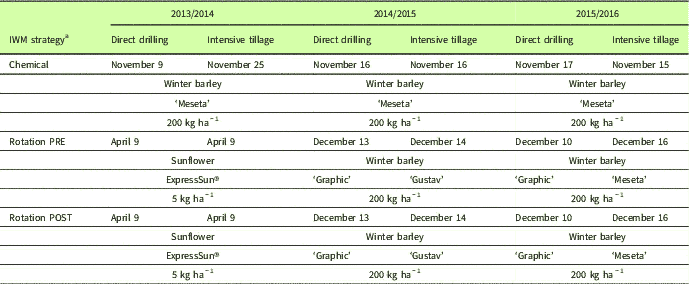
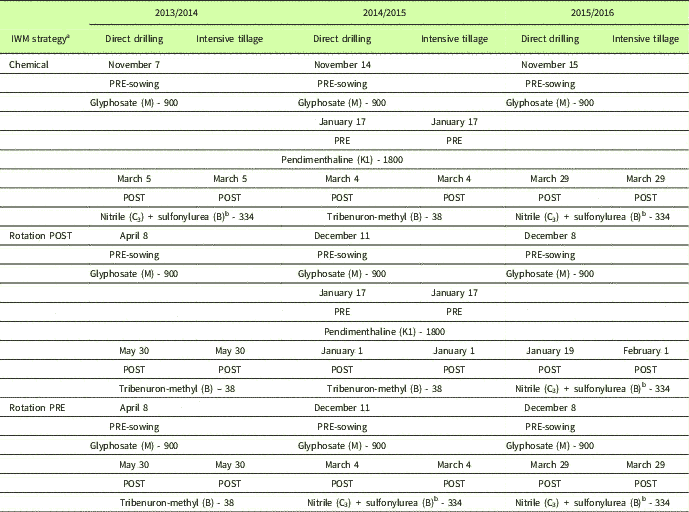
A field experiment with a split-plot design with three replicates was conducted during three consecutive cropping seasons (2013 to 2016) to evaluate the effect of three different IWM strategies under different tillage systems on a multiple herbicide–resistant P. rhoeas population. Main plot treatments consisted of two tillage systems, direct drilling and intensive tillage, whereas the subplot treatments (plot size: 9 by 10 m) consisted of three IWM strategies in randomized arrangement, including: (1) a barley (Hordeum vulgare L.) monocrop with normal seeding date (November), wherein weed control was carried out by chemicals only, hereafter “Chemical”; (2) a sunflower–barley–barley rotation with delayed sowing (December) for barley in both seasons, which included PRE and POST applications, hereafter “Rotation PRE”; (3) a sunflower–barley–barley rotation with delayed sowing (December) for barley in both seasons, but only POST herbicide applications in all years, hereafter “Rotation POST.” Sowing dates, rates, crops, and varieties for each IWM strategy in each tillage system are specified in Table 1. The main plots (direct drilling, intensive tillage) were separated by a 10-m-wide corridor. Tillage included a single pass in late summer and another in early autumn with a chisel plow for seedbed preparation. Herbicide treatments were applied using a backpack sprayer with a 3-m-wide boom, calibrated to deliver 300 L ha−1 of spray liquid at a pressure of 253 kPa. All details on the herbicide applications are summarized in Table 2. Agronomic practices were as usual for each crop in the area of study. In each season, fertilizer was applied before sowing at 70 units of phosphorus-nitrogen fertilizer (UPN) and again at 100 UPN in February.
Crops (and varieties) and cultural practices (dates and sowing densities) for three different weed management strategies, under either direct drilling or intensive tillage, in 2013/2014, 2014/2015, and 2015/2016 seasons at Cubells (Spain).

a Chemical, weed control was carried out using chemicals only; IWM, integrated weed management; Rotation POST, delayed sowing with only POST herbicide applications; Rotation PRE, delayed sowing with PRE and POST herbicide applications.
Herbicide management, application date, active ingredient (with HRAC group), and rate (g ai ha−1) used for three different management strategies, under either direct drilling or intensive tillage, in 2013/2014, 2014/2015, and 2015/2016 seasons at Cubells, Spain.

a Chemical, weed control was carried out using chemicals only; IWM, integrated weed management; Rotation POST, delayed sowing with only POST herbicide applications; Rotation PRE, delayed sowing with PRE and POST herbicide applications.
b Experimental mixture.
Data Collection
Papaver rhoeas density was counted twice each year, at the beginning and at the end of each season, by randomly placing ten 0.10-m2 frames into each plot. Depending on the crop-sowing date of each treatment, initial densities were estimated between December and February in each season. These estimations were proxies of the management effects of the preceding season on the P. rhoeas populations. The 3-yr experiment ended in June 2016 (2015/2016 season), but P. rhoeas densities were also counted at the beginning of the 2016/2017 season in December 2016. This sampling was considered as a proxy of the overall cumulative effect of the different IWM strategies tested after 3-yr of application on the P. rhoeas population.
Winter barley yield was measured (kg ha−1) using a commercial combine harvester at the end of the season, usually at the beginning of July. Sunflower was not harvested.
DNA Extraction, ALS Gene Sequencing, and Restriction Analysis
To evaluate whether the three different IWM strategies applied during three consecutive seasons, under either direct drilling or intensive tillage, affected the frequency of plants resistant to the ALS-inhibitor tribenuron-methyl, the frequency of resistant plants was estimated in each IWM strategy in both tillage systems. For the herbicide-resistant field population, two samplings were carried out: the first at the beginning of the first season (2013/2014) at the end of autumn 2013, and the second at the beginning of the fourth season (2016/2017) at the end of autumn 2016. At each sampling date, leaf fragments (~50 mg) from 25 different plants subplot−1 were taken and frozen for subsequent molecular analyses. DNA from the leaf fragments was extracted using the SpeedTools Plant DNA Extraction Kit (Biotools B&M Labs, Valle de Tobalina, Madrid, Spain), and the DNA sample concentration was measured in a NanoDrop Thermo Scientific spectrophotometer (ThermoFisher, NanoDrop Products, Wilmington, DE). Each DNA sample was diluted to a final concentration of 10 ng µl−1 and used immediately for the polymerase chain reaction (PCR) test or stored at −20 C until use.
Mutations conferring ALS-inhibitor resistance in P. rhoeas at Pro-197 and Trp-574 codons were first analyzed in all the samples. Fragments of the ALS gene that included the regions of those codons were amplified using primers described in a previous work (Kaloumenos et al. Reference Kaloumenos, Dordas, Diamantidis and Eleftherohorinos2009), and amplification was accomplished following the procedures described in that work (Kaloumenos et al. Reference Kaloumenos, Dordas, Diamantidis and Eleftherohorinos2009). PCR amplification products were separated in a 1.5% agarose gel. Gels were then observed under UV light (320 nm; AlphaDigiDoc Pro instrument, Alpha Innotech, Johannesburg, South Africa), and images were recorded with gel photography. Amplified DNA fragments were purified using the SpeedTools PCR Clean-up kit (Biotools B&M Labs) and then sequenced. Restriction analyses were conducted to define double peaks detected in the sequence chromatograms. For this analysis, primers and procedures were as described by Kaloumenos et al. (Reference Kaloumenos, Dordas, Diamantidis and Eleftherohorinos2009). The resulting electrophoresis bands were visualized under UV light after being stained with GelRed (Biotium, Fremont, CA, USA). The digestion profile for each population was compared with its respective, nondigested control profile and the susceptible control digestion profile. Haplotype inference was determined by comparing sequences obtained from the other samples within the same population.
Dose–Response Experiments
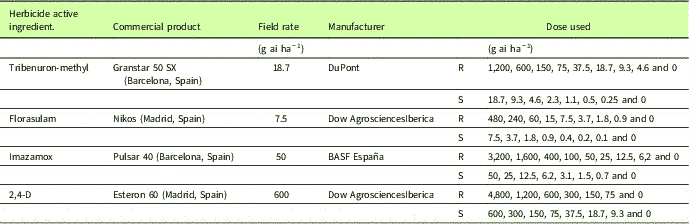
Seeds from the experimental site were collected and stored during summer 2012. In autumn, dose–response experiments were conducted using these seeds and seeds from one susceptible population from a seed dealer (Herbiseed, Twyford, UK). Seeds were sterilized in a 30% hypochlorite solution and sown in petri dishes with 1.4% agar supplemented with 0.2% KNO3 and 0.02% gibberellin. The petri dishes were placed in a growth chamber at 20/10 C day/night and a 16-h photoperiod under 350 µmol m−2 s−1 photosynthetic photon-flux density. After 14 d, seedlings were transplanted to 8 by 8 by 8 cm plastic pots filled with a mixture of silty loam soil, sand, and peat (1.3:1:1 by volume). Five seedlings were transplanted per pot, and later thinned to three. In the putative herbicide-resistant population and the susceptible one, at the 5- to 6-leaf stage (5 to 6 cm), ALS inhibitors tribenuron-methyl, florasulam, and imazamox, and the synthetic auxin 2,4-D (2,4-D ethyl-hexyl) were applied at the rates detailed in Table 3. A total of four replicates (pots) was included for each dose in a complete randomized design. Herbicides were applied using a precision bench sprayer delivering 200 L ha−1 at a pressure of 215 kPa. Pots were placed in a greenhouse at the University of Lleida, Spain (41.629°N, 0.598°E) and were watered regularly. At 4 wk after treatment, plant mortality from each dose was evaluated for each pot. Plants without green tissues were classified as dead. The experiment was repeated twice.
Herbicides used in dose–response experiments and dosage for the susceptible (S) and resistant (R) populations.

Statistical Analysis
Data from dose–response experiments were analyzed using a nonlinear regression model. The herbicide rate causing 50% of plant mortality (LD50) was calculated using a type 1 four-parameter logistic curve (Seefeldt et al. Reference Seefeldt, Jensen and Fuerst1995):
 $$y{\equals}{\rm c}{\plus}{{\left( {d{\minus}c} \right)} \over {1{\plus}{\rm EXP}\left[ {b(\log \left( x \right){\rm }{\minus}{\rm }\log \left( {{\rm LD}_{50}} \right)} \right]}}$$
where c is the lower limit, d is the upper limit, LD50 is the herbicide rate required for 50% growth reduction, and b is the slope at LD50. In this equation, the herbicide rate (g ai ha−1) was the independent variable (x) and the dry weight (percentage of the untreated control for each population) was the dependent variable (y). The resistance index (RI) was computed as LD50(herbicide-resistant)/LD50(susceptible).
The effectiveness of the IWM strategies within season was estimated (percentage of density reduction, or DR) between the initial and final densities (seedlings m−2). Moreover, the reduction in P. rhoeas densities after 3 yr of management was calculated by comparing weed densities between the seasons 2013/2014 and 2016/2017 (3 yr percentage of density reduction, or 3-yr DR) as Equation 2:
 $${\hskip-3}3{\minus}{\rm yr DR}{\equals}100{\minus}\left[ {{{({\rm Initial\,density\,in\,season\,}2016\,/\,2017{\rm {\asterisk}}100)} \over {{\rm Initial\,density\,in\,season\,}2013\,/\,2014}}} \right]$$
From analyses of ALS gene sequence at position 197, the percentage of wild-type plants (Pro/Pro) and the percentage of mutant plants (heterozygous plus homozygous plants) were estimated for the two sampling dates in each subplot. Mean values for each IWM strategy and tillage system were then calculated.
For the field experiment, three-way ANOVA was performed on six data sets: initial P. rhoeas density, final P. rhoeas density, DR, crop yields, and percentage of wild-type plants and percentage of mutant plants at positions (Pro-197), with season, tillage type, and IWM strategy as the fixed factors. If year*treatment interactions were statistically significant, then data were analyzed and presented separately for each year. If new interactions were found, a new separation of factors was done. Data were transformed as needed [log (x + 1) or <COMP: Please set full square root symbol over (x + 0.5).>√(x + 0.5)] before the analysis, because exploratory analysis revealed some nonnormal data distributions and heterogeneity of variances (Zuur et al. Reference Zuur, Ieno and Elphick2010). Finally, a post hoc Tukey’s pairwise comparison was employed to test differences between IWM strategy means (at P < 0.05). For the 3-yr DR, a two-way ANOVA was performed considering tillage type and IWM strategy as factors. For the initial density in the fourth season, a two-way analysis of covariance (ANCOVA) was carried out considering the same factors and the initial density in the first season as a covariate.
Dose–response analyses were carried out with the use of the R programming language (R Development Core Team 2013). The ‘drc’ package was used for the nonlinear regression (Ritz and Streibig Reference Ritz and Streibig2005), while the ‘LME4’ (Bates et al. Reference Bates, Maechler, Bolker and Walker2014) and ‘nlme’ (Pinheiro et al. Reference Pinheiro, Bates, DebRoy and Sarkar2014) packages were employed for the LMM analysis. The rest of the statistical analyses were carried out with the use of the software SigmaPlot v. 11.0 (San Jose, CA, USA). When necessary, data were back-transformed to the original scale for presentation.
Results and Discussion
Papaver rhoeas Density Changes
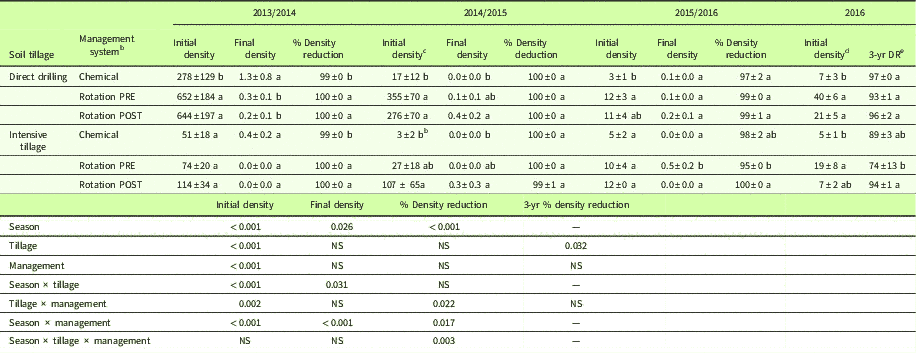
At the beginning of the first season (2013/2014), the densities were not homogenous, with statistical differences detected between both tillage systems. Initial P. rhoeas density in direct drilling was on average 525 seedlings m−2, higher than in intensively tilled plots, where there was an average of 80 seedlings m−2 (Table 4). All three management systems significantly reduced (≥99%) P. rhoeas density at the end of the season irrespective of the tillage system, but the Chemical system resulted in the highest weed densities under direct drilling, with 1.3 plants m−2 (Table 4).
Initial and final Papaver rhoeas densities (plants m−2±SE), density reduction each season (%±SE), and density reduction after 3 yr or 3-yr DR (%±SE) under three management strategies, under either direct drilling or intensive tillage, during three seasons at Cubells, Spain.Footnote a

a Means within a column (year factor) and soil tillage (tillage factor) followed by the same letter indicate that no significant difference (P < 0.05) was detected by means of Tukey’s honest significant difference test. NS, not significant.
b Chemical, weed control was carried out using chemicals only; Rotation POST, delayed sowing with only POST herbicide applications; Rotation PRE, delayed sowing with PRE and POST herbicide applications.
c Initial density data with PRE treatments that avoid the natural germination pattern of P. rhoeas seedlings were included in the analysis.
d These data were analyzed with an analysis of covariance using initial density the first season as covariate; please see text for details.
e 3-yr DR, see text for calculation details.
Initial weed densities in the second season (2014/2015) were significantly lower than those observed in the preceding season (Table 4). Nevertheless, densities were higher under direct drilling (216 seedlings m−2) than intensive tillage (46 seedlings m−2). At the end of the season, all management systems were equally effective in reducing P. rhoeas densities (<0.4 plants m−2 with ≥99%). Applications including K1 herbicides PRE or C3 herbicides POST are good chemical options to manage herbicide-resistant P. rhoeas populations (Rey-Caballero et al. Reference Rey-Caballero, Royo-Esnal, Recasens, González and Torra2017b; Torra et al. Reference Torra, Cirujeda, Taberner and Recasens2010b), as observed in the second season in this research.
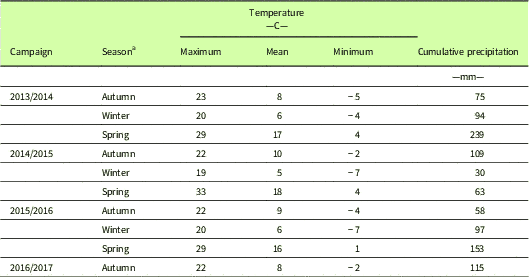
Initial P. rhoeas densities in the third season (2015/2016) were the lowest (only 9 seedlings m−2 irrespective of tillage and management system) compared with preceding seasons (Table 4). This was due to the cumulative effect of management systems, but also because that autumn was the driest out of all three growing seasons (Table 5). At the end of this season, densities were significantly reduced in all plots, revealing that the Rotation PRE system was the least efficient (93%) system compared with other systems (≥99%).
Average season maximum, mean, and minimum temperatures and rainfall over the trial period, from October 2013 to December 2016.

a Autumn: October to December; winter: January to March; spring: April to June.
The initial density evaluated in 2016 before any herbicide application reflects the cumulative effect of the three preceding seasons for the different IWM strategies evaluated. Data showed that all three management systems were able to greatly reduce P. rhoeas densities in both tillage systems, with 23 and 10 seedlings m−2 on average in direct drilling and intensive tillage, respectively (Table 4). The density achieved during the fourth season in each management system was independent of the different initial densities in the first season in each tillage system, as evident from insignificant ANCOVA results when the initial densities were used as a covariate in the analysis (unpublished data). Previous studies have shown that within 3 to 5 yr of establishing proper IWM practices, it is possible to significantly reduce populations of herbicide-resistant P. rhoeas (Rey-Caballero et al. Reference Rey-Caballero, Royo-Esnal, Recasens, González and Torra2017b; Torra et al. Reference Torra, Royo-Esnal and Recasens2011). The main nonchemical cultural practices successfully incorporated here were tillage system, delayed sowing, and rotation of winter cereals and summer crops. These cultural practices are considered among the most efficient in managing the worst herbicide-resistant weeds worldwide, such as rigid ryegrass (Lolium rigidum Gaudin) or blackgrass (Alopecurus myosuroides Huds.) (Gerhards et al. Reference Gerhards, Dentler, Gutjahr, Auburger and Bahrs2016; Gill and Holmes Reference Gill and Holmes1997).
On the other hand, after 3 yr of management, all management systems were more efficient in reducing densities under direct drilling than in intensive tillage. A possible reason to explain these results could be that higher soil water content in direct-drilled plots might have promoted a earlier P. rhoeas emergence compared with tilled plots, making delayed sowing in Rotation PRE and Rotation POST systems or presowing treatment with glyphosate in the Chemical system a more effective strategy. In fact, the Chemical system under intensive tillage was the least effective after the 3 yr (without delayed sowing or presowing treatments). Lampurlanés et al. (Reference Lampurlanés, Angás and Cantero-Martínez2002), comparing different tillage systems in the region, confirmed that direct drilling favored greater and deeper water accumulation in the soil profile. This is in accordance with higher mean yields under direct drilling than in intensive tillage observed in these trials.
The Rotation POST system was overall the most efficient (Table 4). All cereal seasons included later POST herbicide applications. Papaver rhoeas has an extended emergence periodicity and seedlings can still emerge in spring (Cirujeda et al. Reference Cirujeda, Recasens, Torra and Taberner2008), if it is rainy, as it was in the third growing season in this study (Table 5). These results highlight the relevance of herbicide application timing with regard to P. rhoeas emergence and the importance of avoiding the incorporation of new seeds into the soil, both from early- and late-emerging plants, to achieve an effective management in the mid- to long term for herbicide-resistant populations (Norsworthy et al. 2012).
Winter Barley Yields
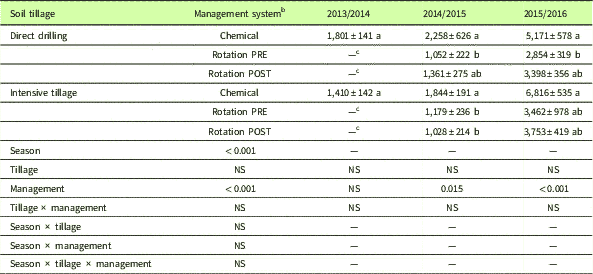
Significant differences were observed between the yields of the three management systems in 2014/2015 and in 2015/2016. In both of these seasons, barley yields were higher in the Chemical system compared with the other two systems with delayed sowing (Table 6). Sunflower was not harvested in the first season (2013/2014), and therefore yield was only estimated in the Chemical system. No significant differences were found between both tillage systems in the three seasons. Yields in these trials were normal for the study area, which usually can change substantially from season to season (García et al. Reference García, Royo-Esnal, Torra, Cantero and Recasens2014; Torra et al. Reference Torra, Royo-Esnal and Recasens2011).
Cereal yields in kg ha−1 (mean±SE) for three management systems, each under direct drilling and intensive tillage, during three seasons in Cubells, Spain.Footnote a

a Means within a column (year factor) followed by the same letter indicate that no significant difference (P < 0.05) was detected by means of the Tukey’s test. NS, not significant.
b Chemical, weed control was carried out using chemicals only; Rotation POST, delayed sowing with only POST herbicide applications; Rotation PRE, delayed sowing with PRE and POST herbicide applications.
c Sunflower was not harvested.
It has been shown, in the absence of weeds, that a delayed sowing reduces cereal yields in rainfed cropping systems, because the crop cannot reach the optimal or potential development in a shorter growing period (Spink et al. Reference Spink, Semere, Sparkes, Whaley, Foulkes, Clare and Scott2005). However, other studies have shown that delayed sowing can avoid autumn–winter annual weed competition, thus providing higher yields (García et al. Reference García, Royo-Esnal, Torra, Cantero and Recasens2014; Singh et al. Reference Singh, Malik, Panwar and Balyan1995). However, those studies were on grass weeds, such as ripgut brome (Bromus diandrus Roth), which can emerge in early autumn (García et al. Reference García, Royo-Esnal, Torra, Cantero and Recasens2014; Recasens et al. Reference Recasens, García, Cantero-Martínez, Torra and Royo-Esnal2016). For broadleaf weed species such as P. rhoeas, which have a more extended and delayed emergence period, benefits from delayed sowing in terms of yield were not observed here, hindering the implementation of this cultural strategy by farmers to manage herbicide-resistant populations.
Changes in the Papaver rhoeas Resistance Status to ALS Inhibitors
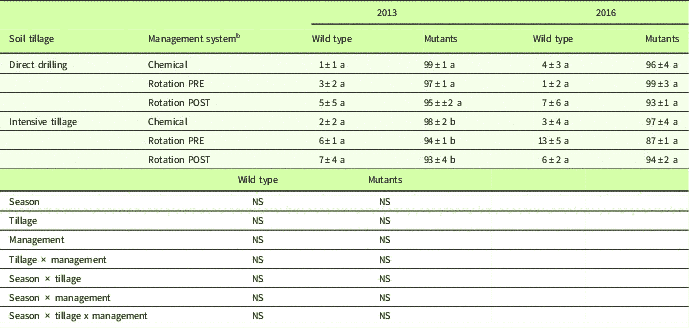
The initial proportions of susceptible and resistant plants (homozygous plus heterozygous in position 197) were equal and homogenous between both tillage and management systems (Table 7). Overall averages of 4% and 96% of susceptible and resistant plants, respectively, were estimated. After 3 yr of management, these proportions did not change, with averages of 6% and 94%. No mutations in position 574 of the ALS gene were found in more than 900 sequenced plants. Recent studies on fitness costs of several ALS resistance alleles (for Ala-122, Pro-197, Asp-376, or Trp-574) in grass species (rigid ryegrass) or dicot species (wild radish [Raphanus raphanistrum L.] or kochia [Bassia scoparia (L.) A. J. Scott]) demonstrated a negligible effect on ALS enzyme kinetics, plant growth, and competitiveness (Yu and Powles Reference Yu and Powles2014). Therefore, ALS resistance alleles, once selected in the field, are likely to remain unchanged in the population. In the absence of selection pressure by ALS inhibitors for several years, these resistance mutants will persist in the population and not decline with time. This study showed that ceasing to use the selection agent did not significantly modify the ratio between resistant and susceptible plants when resistant seeds initially made up more than 90% of the P. rhoeas seedbank. Long-lived seeds, such as those of P. rhoeas, impose long-term resistance management strategies when the seedbank contains predominantly resistant individuals (Panozzo et al. Reference Panozzo, Scarabel, Rosan and Sattin2017).
Percentage of wild-type plants (no substitution at position 197 of the ALS gene: Pro/Pro) and mutant plants with any substitution in this position for any of the two alleles (X/Pro, Pro/X, or X/X) for three management systems, each under direct drilling and intensive tillage, in 2 yr in Cubells, Spain.Footnote a

a No mutant plants were found out of 900 in position Trp-574 of the ALS gene. Means within a column (year factor) followed by the same letter indicate that no significant difference (P < 0.05) was detected by means of the Tukey’s test. NS, not significant.
b Chemical, weed control was carried out using chemicals only; Rotation POST, delayed sowing with only POST herbicide applications; Rotation PRE, delayed sowing with PRE and POST herbicide applications.
Dose–Response Experiments
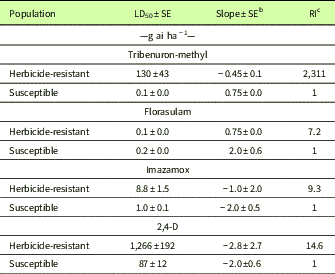
The presence of multiple-herbicide resistance in the experimental P. rhoeas population was confirmed initially. There was no mortality at the commercial label rates for the herbicides. The LD50 for tribenuron-methyl was 2,311 times higher in the herbicide-resistant population compared with the susceptible standard (Table 8). In addition, cross-resistance to triazolopyrimidines (florasulam) and imidazolinones (imazamox), with resistance factors (RFs) of 9.3 and 7.2, respectively, was observed in this population (Table 8). High tribenuron-methyl resistance levels and cross-resistance to triazolopyrimidines or imidazolinones were also found in Spanish P. rhoeas populations from the area studied (Rey-Caballero et al. Reference Rey-Caballero, Royo-Esnal, Recasens, González and Torra2017a). Furthermore, multiple resistance to 2,4-D was confirmed, with an RF around 15 (Table 8). Previous studies have also confirmed the presence of multiple herbicide–resistant P. rhoeas populations in Spain (Rey-Caballero et al. Reference Rey-Caballero, Menéndez, Giné-Bordonaba, Salas, Alcántara and Torra2016, Reference Rey-Caballero, Royo-Esnal, Recasens, González and Torra2017a).
Estimated LD50, slope at LD50, and resistance factor (RF) values for a population from Cubells, Spain (herbicide-resistant), and a susceptible Papaver rhoeas population when sprayed with tribenuron-methyl, florasulam, imazamox, and 2,4-D.Footnote a

a LD50, ALS-inhibitor concentration for 50% reduction of survival.
b The slope at LD50.
c RI, resistance index.
Conclusions
This research demonstrates that it is possible to manage herbicide-resistant P. rhoeas populations under different tillage systems such as direct drilling or intensive tillage. Crop rotation (with sunflower), delayed sowing, and robust herbicide programs (inclusion of PRE) were successful options in both tillage systems. Several IWM strategies, including different herbicide programs, have been shown to be successful in managing herbicide-resistant weeds under different tillage systems, such as no-till (e.g., Norsworthy et al. Reference Norsworthy, Korres, Walsh and Powles2016). This research highlights that IWM tactics can be equally effective in no-till as they are in conventional till systems. Therefore, farmers are encouraged to diversify strategies at all levels—crop rotation, sowing date, herbicide sites of action, and application timing—to manage herbicide-resistant P. rhoeas populations in direct-seeded systems where tillage is no longer a weed control option. Finally, this research demonstrates that the rapid worldwide adoption of no-till in rainfed cropping systems can be accompanied with suitable IWM strategies to manage herbicide-resistant weeds.
Acknowledgments
The authors gratefully acknowledge Du Pont de Nemours for funding the trials. They also thank E. Edo, L. Pallares, L. Mateu, and N. Moix for their help in the field trials. JR-C was funded by Ph.D grants from the Agència de Gestió d’Ajuts Universitaris i de Recerca (FI-2013) from Generalitat de Catalunya. No conflicts of interest have been declared.