Introduction
Benign vocal fold mucosal disorders impair communication and have important public health implications. Roy et al. reported that 29.9 per cent of the general public suffer at least one voice disorder in their lifetime, 6 per cent have a current voice disorder, and 7.2 per cent miss one or more work days for voice disorder related issues.Reference Roy, Merrill, Gray and Smith1 Therefore, determining appropriate treatment may benefit not just the individual but society as a whole.
Diverse treatments have been recommended for benign vocal fold mucosal disorders, including medical therapy, voice therapy and laryngeal microsurgery, alone or combined. Earlier studies primarily focused on voice therapy for vocal nodules. Regarding vocal polyps and cysts, previous studies have recommended a combination of laryngeal microsurgery (using laser or ‘cold steel’ dissection) and voice therapy.Reference Zeitels, Hillman, Desloge, Mauri and Doyle2–Reference Lancer, Syder, Johns and Le Boutillier4
The available evidence suggests that voice therapy to address excessive, hyperfunctional and/or maladaptive vocal practices can effectively improve voice quality and reduce the size and/or extent of pathology.Reference Sulica and Behrman3 In addition, voice therapy after laryngeal microsurgery for vocal nodules has a significant influence on recurrence rate.Reference Lancer, Syder, Johns and Le Boutillier4 However, there is no previously published, systematic study of the efficacy of post-operative voice therapy after surgical removal of vocal polyps.
The purpose of the current study was to evaluate the efficacy and usefulness of voice therapy after phonomicrosurgery for vocal polyps.
Materials and methods
Study design
The study group consisted of 55 retrospectively selected, consecutive patients who had undergone voice therapy following phonomicrosurgery for vocal polyps at the otolaryngology and head and neck surgery department, Anam Hospital, Korea University, Seoul, South Korea, between June 2010 and June 2011. A historical group of 63 similar patients who had received only phonomicrosurgery for vocal polyps between May 2009 and May 2010 was used as an external control group.
The exclusion criteria for both groups were diffusely oedematous lesion (e.g. Reinke's oedema), insufficient post-operative evaluation and management, and an irregular follow-up period.
All subjects gave informed consent to inclusion in the study. The institutional review board of our institution approved the study protocol.
Surgery and vocal rehabilitation
The timing of surgery was individualised according to the patient's preference, lesion characteristics and concomitant problems (e.g. poor vocal hygiene). All of the patients received behavioural intervention for vocal hygiene, including instruction in voice rest and adequate hydration, and anti-reflux therapy was prescribed for at least two months before surgical treatment.
All of the surgical procedures were performed under general anaesthesia by the same surgeon. The operation aimed to preserve the vocal fold's layered microstructure (including the lamina propria and epithelium) as much as possible.
After surgery, absolute voice rest was recommended for the first 7 days. For two to three weeks after surgery, patients were instructed gradually to increase their daily phonation time.
Voice analysis
Subjects were assessed twice: before and two months after surgery. The following were undertaken: acoustic analysis (measuring fundamental frequency, jitter, shimmer and noise to harmonic ratio); aerodynamic analysis (measuring mean flow rate, maximum phonation time and subglottic pressure); vocal assessment using the grade-roughness-breathiness-asthenia-strain scale, with additional assessment of aphonia; and assessment of Voice Handicap Index.
Acoustic variables were measured using the Multi-Dimensional Voice Program software application from the Computerized Speech Lab system (model 4500; KayPentax, Lincoln Park, New Jersey, USA), assessing a few seconds of sustained phonation of the vowel /a/.
Subjective assessment of voice quality was performed using the grade-roughness-breathiness-asthenia-strain scale designed by De Bodt et al.,Reference De Bodt, Wuyts, Van de Heyning and Croux5 with additional assessment of aphonia. This assessment was undertaken by an experienced phonetician with no knowledge of the study design.
The Voice Handicap Index consists of 30 questions divided by content into 3 subscales covering functional, physical and emotional parameters. All patients completed a Voice Handicap Index questionnaire, using a five-point rating scale to indicate their response. The scale was ordinal and scored from 0 (meaning never) to 4 (meaning always) for each of the questions, with a minimum total score of 0 and a maximum total score of 120. Higher scores indicated worse perceived disability due to the patient's voice problem.
Voice therapy
All of the patients in the study group received two voice therapy sessions (approximately 30 minutes per session) in the fourth week after laryngeal microsurgery. Voice therapy included a general approach toward managing vocal hygiene, including voice rest, adequate hydration, the reduction or elimination of laryngeal irritants, reduction of vocal abuse and hard glottal attacks, reduction of vocal loudness and speech rate, and elimination of chronic throat clearing and coughing. Vocal resonance exercises, such as humming, and relaxation exercises that aimed to release musculoskeletal tension in the shoulders and neck, were also taught.
Statistics
Paired or independent t-tests were used to compare the voice analysis outcomes and questionnaire scores before and after surgery, and between the study and control groups. For all tests, a probability of less than 0.05 was accepted as statistically significant. All statistical analysis was performed using version 12.0 SPSS software (SPSS Inc, Chicago, Illinois, USA).
Results
Demographics
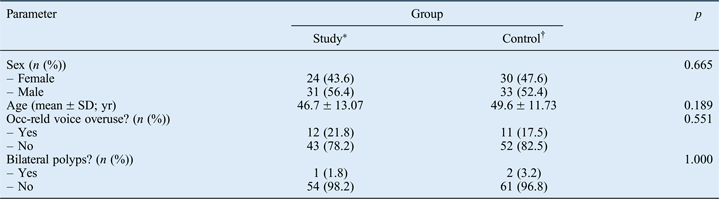
The mean age was 46.7 years in the study group and 49.6 years in the control group. The patients' various occupational fields were divided into two groups: an occupation-related voice overuse group, which included teachers, counsellors and salespeople, and a no-overuse group. Three patients had bilateral vocal polyps, one in the study group and two in the control group. Baseline demographics did not differ significantly between the two groups (Table I).
Patient demographic data by group

*n=55; †n = 63. SD = standard deviation; yr = years; Occ-reld = occupation-related
General treatment effectiveness
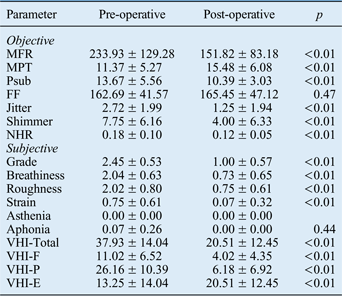
In the study group, most of the voice analysis parameters showed significant improvement after surgical treatment and post-operative voice therapy, with the exception of fundamental frequency, asthenia and aphonia (Table II).
Voice outcomes: study group*
Data represent means ± standard deviations unless specified otherwise.
* n = 55. MFR = mean flow rate; MPT = maximum phonation time; Psub = subglottic pressure; FF = fundamental frequency; NHR = noise:harmonic ratio; VHI = Voice Handicap Index; F = functional subscale; P = physical subscale; E = emotional subscale
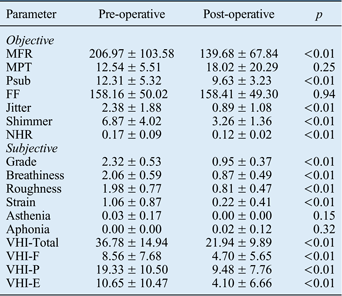
The control group showed significant vocal improvement following surgical treatment alone, for all parameters except mean phonation time, fundamental frequency, asthenia and aphonia (Table III).
Voice outcomes: control group*
Data represent means ± standard deviations unless specified otherwise.
* n = 63. MFR = mean flow rate; MPT = maximum phonation time; Psub = subglottic pressure; FF = fundamental frequency; NHR = noise:harmonic ratio; VHI = Voice Handicap Index; F = functional subscale; P = physical subscale; E = emotional subscale
Effectiveness of post-operative voice therapy
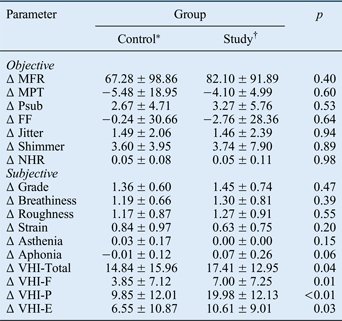
The difference between the mean pre- and post-operative values of each voice analysis parameter (i.e. the pre-operative value minus the post-operative value) was calculated for both groups and compared in order to assess the effectiveness of post-operative voice therapy. The difference between pre- and post-operative values for the objective parameters and the grade-breathiness-roughness-asthenia-aphonia-strain scale parameters did not vary significantly between the two groups. However, results for the total Voice Handicap Index score did vary significantly between the two groups (p = 0.04). Furthermore, a significant difference was seen for each of the three Voice Handicap Index subscales, i.e. functional, physical and emotional (p < 0.05 for all three) (Table IV).
Post-operative voice change by group
Data represent means ± standard deviations unless specified otherwise. *n=63; †n = 55. Δ = pre-operative mean value − post-operative mean value; MFR = mean flow rate; MPT = maximum phonation time; Psub = subglottic pressure; FF = fundamental frequency; NHR = noise:harmonic ratio; VHI = Voice Handicap Index; F = functional subscale; P = physical subscale; E = emotional subscale
Recurrence
All patients were followed for at least three months. Recurrent vocal polyps occurred in three patients (5.5 per cent) in the study group and four patients (6.3 per cent) in the control group; this difference was not statistically significant (p = 0.83) (Table V).
Recurrence by group
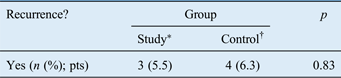
*n=55; †n = 63.
Discussion
Vocal fold vibration produces stress on both vocal fold surfaces during phonation. The maximum mechanical stress occurs in the mid-portion of the membranous vocal fold.Reference Titze6 Therefore, vocal overuse, abuse and misuse may lead to excessive stress and trauma in the mid-membranous vocal fold, resulting in wound formation and tissue remodelling during the wound healing process. As a result, pathological changes may occur in the vocal folds, such as vocal nodules, polyps and cysts. The pathogenesis of vocal fold lesions remains incompletely understood; however, a recent study suggested that these lesions can be classified into five stages of wound maturation in the lamina propria of the vocal fold, and that vocal fold lesions such as nodules can be considered ‘younger’ lesions and polyps ‘older’ lesions.Reference Marcotullio, Magliulo, Pietrunti and Suriano7 This hypothesis may explain why newer lesions, such as vocal nodules, are best treated with voice therapy whereas older lesions, such as vocal polyps, are best treated with surgical intervention.
Although aspects of treatment modality may differ according to the particular type of benign vocal fold mucosal disorder, behavioural intervention to reduce vibratory trauma to the vocal fold may be considered a fundamental underlying treatment. Benign vocal lesions often respond favourably to voice therapy irrespective of wound maturation, so pre-operative voice therapy may be warranted in most cases of vocal fold lesions arising from vocal misuse. In the present study, all patients received behavioural intervention to improve vocal hygiene, before surgical treatment.
However, when voice problems remain unresolved after maximal behavioural and medical treatment, surgical treatment may be considered for patients with older lesions (e.g. vocal polyps). The technique and instrumentation of laryngeal microsurgery have significantly improved over the past three decades. Previous authors have reported that phonomicrosurgery should aim to preserve the vocal fold's layered microstructure as much as possible; to this end, new instruments, such as CO2 lasers, have been introduced and have shown some benefit compared with classic cold dissection.Reference Gray, Chan and Turner8–Reference Benninger10 However, these same authors have suggested that the surgeon's knowledge and experience are the most important factors in improving clinical outcomes following phonomicrosurgery. Similar to these previous studies,Reference Gray, Chan and Turner8–Reference Benninger10 the vocal polyp patients in the present study showed significant improvement in both objective and subjective parameters following phonomicrosurgery. This suggests that, when performed by surgeons with appropriate knowledge and experience, most patients with vocal polyps who undergo phonomicrosurgery will obtain improved voice outcomes.
Most previous studies have described the effectiveness of voice therapy for patients with vocal nodules only; to our knowledge, there has been no previous, systematic study of the effectiveness of voice therapy following phonomicrosurgery for vocal polyps. The present study assessed the effect of post-operative voice therapy for patients with vocal polyps undergoing phonomicrosurgery, compared with similar patients not receiving post-operative voice therapy.
In the present study, although there was no significant inter-group difference regarding acoustic or aerodynamic analysis parameters or grade-roughness-breathiness-asthenia-aphonia-strain scale score, the mean Voice Handicap Index score of the post-operative voice therapy group were significantly better than that of controls. The Voice Handicap Index is a self-assessment tool that evaluates the functional, physical and emotional aspects of voice disorders. The various subscales include statements about the impact of the voice disorder on daily activities (in the functional subscale), affective responses to the voice disorder (in the emotional subscale), and self-perceptions of laryngeal discomfort and voice characteristics (in the physical subscale).Reference Jacobson, Johnson, Grywalski, Sibergleit, Jacobson and Benninger11, Reference Rosen, Lee, Osborne, Zullo and Murry12 The present study found that the pre- to post-operative reduction in each of the Voice Handicap Index subscale mean scores was significantly greater in the study group than the controls, suggesting that post-operative voice therapy may improve patients' voice discomfort, emotional responses and self-perceptions in daily life.
• Benign vocal fold mucosal disorders, including polyps, have important public health implications
• Treatments include medication, voice therapy and laryngeal microsurgery, alone or combined
• In this study, phonomicrosurgery for vocal polyps improved most voice outcome measures
• Additional post-operative voice therapy improved patients' quality of life
These results suggest that, in patients with vocal polyps who undergo phonomicrosurgery, the quality of post-operative personal, daily life is improved by receiving post-operative voice therapy.
In contrast to the results of a previous study that assessed patients with vocal nodules,Reference Lancer, Syder, Johns and Le Boutillier4 the recurrence rate for patients with vocal polyps in the present study did not differ between the study and control groups. However, the post-operative follow-up period was relatively short; recurrence rates may have differed over a longer-term follow-up period.
The results of this study must be interpreted with caution, as it was a non-randomised, retrospective, clinical study. Nevertheless, our patient population was relatively homogeneous. In the future, we plan to perform a randomised, prospective study with a large population and longer-term follow up, in order to better evaluate the effectiveness of post-operative voice therapy for vocal polyp patients undergoing phonomicrosurgery.
Conclusion
In the current study of patients with vocal polyps treated with phonomicrosurgery with or without post-operative voice therapy, although vocal outcome results for acoustic and aerodynamic analysis and the grade-roughness-breathiness-asthenia-aphonia-strain scale did not differ significantly, results for the Voice Handicap Index did. This suggests that post-operative voice therapy can improve these patients' quality of life.
A limitation of this study was that the study group received only two sessions of post-operative voice therapy. More frequent post-operative voice therapy sessions may have enabled significant improvement in objective vocal parameters and a reduction in polyp recurrence.
Acknowledgments
This study was supported by a Grant-in-Aid from the Korea University Research and Business Foundation.