Introduction
Impulsive decision-making, reflected in a tendency to prefer smaller, immediate rewards over larger, delayed rewards (Reynolds, Reference Reynolds2006; Winstanley, Eagle, & Robbins, Reference Winstanley, Eagle and Robbins2006) has been emphasized in theories of attention-deficit/hyperactivity disorder (ADHD) postulating altered sensitivity to reinforcement (see review by Luman, Tripp, & Scheres, Reference Luman, Tripp and Scheres2010). However, the empirical literature is fairly mixed. This may be due, in part, to variability in the paradigms used to assess immediate reward preference in terms of whether the rewards and delays were actually experienced by participants, among other important task parameters. Improving our understanding of impulsive decision-making in ADHD is important for elucidating the etiology of this highly prevalent disorder and for informing the development of effective treatments.
The earliest studies of delay-related impulsive choice in relation to ADHD were conducted by Sonuga-Barke and colleagues using the Choice Delay Task (CDT; Sonuga-Barke, Taylor, Sembi, & Smith, Reference Sonuga-Barke, Taylor, Sembi and Smith1992), involving 20 choices between a smaller reward (1 point) after a shorter delay (2 s) or a larger reward (2 points) after a longer delay (30 s). Several investigators have used a version of the CDT to study immediate reward preference among individuals with ADHD compared to typically developing (TD) controls. Many found a stronger preference for immediate reward in ADHD (Antrop et al., Reference Antrop, Stock, Verte, Wiersema, Baeyens and Roeyers2006; Bitsakou, Psychogiou, Thompson, & Sonuga-Barke, Reference Bitsakou, Psychogiou, Thompson and Sonuga-Barke2009; Coghill, Seth, & Matthews, Reference Coghill, Seth and Matthews2013; Dalen, Sonuga-Barke, Hall, & Remington, Reference Dalen, Sonuga-Barke, Hall and Remington2004; Gupta & Kar, Reference Gupta and Kar2009; Marco et al., Reference Marco, Miranda, Schlotz, Melia, Mulligan, Muller and Sonuga-Barke2009; Solanto et al., Reference Solanto, Abikoff, Sonuga-Barke, Schachar, Logan, Wigal and Turkel2001; Wahlstedt, Thorell, & Bohlin, Reference Wahlstedt, Thorell and Bohlin2009), although some reported no diagnostic group differences (Bidwell, Willcutt, Defries, & Pennington, 2007; Solanto et al., 2007). Interpretation of these findings is confounded, however, by two issues. First, a majority of these studies did not impose a post-reward delay (i.e., a delay after receiving the reward to keep the rate of reinforcement constant), such that choosing the smaller, immediate reward would also end the task more quickly (c.f., Marco et al., Reference Marco, Miranda, Schlotz, Melia, Mulligan, Muller and Sonuga-Barke2009; Sonuga-Barke et al., Reference Sonuga-Barke, Taylor, Sembi and Smith1992). Second, participants were often told that the goal of the task is to maximize the number of points they earn, although these points are infrequently associated with an actual reward (c.f., Solanto et al., Reference Solanto, Abikoff, Sonuga-Barke, Schachar, Logan, Wigal and Turkel2001, Reference Solanto, Gilbert, Raj, Zhu, Pope-Boyd, Stepak and Newcorn2007). These procedural aspects may impact impulsive decision-making if, for example, the participant is more motivated to end the task rather than earn more points or if they are not making valid choices because they do not actually receive the reward.
Temporal or delay discounting tasks have also been used to study impulsive decision-making in ADHD and other disorders associated with poor impulse control (see review by Reynolds, Reference Reynolds2006). Delay discounting tasks involve choices between smaller, immediate rewards and larger delayed rewards, similar to the CDT, although the magnitude of the rewards and delays is varied rather than presenting the same choice repeatedly as is done in the CDT. There is also variation among delay discounting tasks regarding whether the delays and rewards are experienced by the individual in “real-time” or hypothetical in nature (see review by Reynolds, Reference Reynolds2006; e.g., Shiels et al., Reference Shiels, Hawk, Reynolds, Mazzullo, Rhodes, Pelham and Gangloff2009). Although research conducted with adults has suggested that real and hypothetical rewards are not discounted differently (e.g., Lagorio & Madden, Reference Lagorio and Madden2005; Madden, Begotka, Raiff, & Kastern, Reference Madden, Begotka, Raiff and Kastern2003), whether children discount real and hypothetical rewards to the same degree has not yet been tested in a systematic way.
In the ADHD literature, the majority of studies have used hypothetical rewards with inconsistent results. Several studies have reported greater discounting of hypothetical rewards among individuals with ADHD (Costa Dias et al., Reference Costa Dias, Wilson, Bathula, Iyer, Mills, Thurlow and Fair2013; Dai, Harrow, Song, Rucklidge, & Grace, Reference Dai, Harrow, Song, Rucklidge and Grace2013; Demurie, Roeyers, Baeyens, & Sonuga-Barke, Reference Demurie, Roeyers, Baeyens and Sonuga-Barke2012, Reference Demurie, Roeyers, Baeyens and Sonuga-Barke2013; Hurst, Kepley, McCalla, & Livermore, Reference Hurst, Kepley, McCalla and Livermore2011; Paloyelis, Asherson, Mehta, Faraone, & Kuntsi, Reference Paloyelis, Asherson, Mehta, Faraone and Kuntsi2010; Wilson, Mitchell, Musser, Schmitt, & Nigg, Reference Wilson, Mitchell, Musser, Schmitt and Nigg2011) and a stronger preference for immediate reward, regardless of delay (Barkley, Edwards, Laneri, Fletcher, & Metevia, Reference Barkley, Edwards, Laneri, Fletcher and Metevia2001) whereas other studies have found similar discounting rates among ADHD and control samples (Chantiluke et al., Reference Chantiluke, Christakou, Murphy, Giampietro, Daly, Ecker and Rubia2014; Crunelle, Veltman, van Emmerik-van Oortmerssen, Booij, & van den Brink, Reference Crunelle, Veltman, van Emmerik-van Oortmerssen, Booij and van den Brink2013; Rubia, Halari, Christakou, & Taylor, Reference Rubia, Halari, Christakou and Taylor2009; Wilbertz et al., Reference Wilbertz, Trueg, Sonuga-Barke, Blechert, Philipsen and Tebartz van Elst2013, Reference Wilbertz, van Elst, Delgado, Maier, Feige, Philipsen and Blechert2012). Studies involving real rewards, typically money, delivered in real-time, have shown greater discounting in ADHD (Scheres, Tontsch, Thoeny, & Kaczkurkin, Reference Scheres, Tontsch, Thoeny and Kaczkurkin2010; Schweitzer & Sulzer-Azaroff, Reference Schweitzer and Sulzer-Azaroff1995) and no significant diagnostic group differences (Scheres et al., Reference Scheres, Dijkstra, Ainslie, Balkan, Reynolds, Sonuga-Barke and Castellanos2006). Thus, despite the theoretical emphasis on a strong preference for immediate reward among individuals with ADHD (Luman et al., Reference Luman, Tripp and Scheres2010), the empirical evidence is inconsistent.
Delay discounting tasks in which the delays and rewards are experienced in real-time are thought to be better suited for children, who may have greater difficulty with abstract decision-making than adults. However, the majority of the real-time discounting tasks involve choices about money, which is a secondary reinforcer in that it is not an immediately consumable reward, such as food or drugs, and has limited utility in the moment that it is received. While there have been some studies using immediately consumable rewards such as video game playing (e.g., Millar & Navarick, Reference Millar and Navarick1984) and food (e.g., Logue, Forzano, & Ackerman, Reference Logue, Forzano and Ackerman1996), which have been shown to elicit more impulsive responding than do monetary-based reinforcers (Forzano & Logue, Reference Forzano and Logue1994), these studies were not conducted with clinical populations. Therefore, the question remains as to whether children with ADHD would display greater delay discounting during a task that involves immediately consumable rewards experienced in real-time compared to TD children. The current study builds on the existing literature by examining delay discounting on two tasks that differ in the extent to which the rewards and delays are experienced in real-time. Specifically, participants completed a real-reward classic discounting task in which they were told that some of the choices were real and two rewards were actually delivered at the chosen delays. They also completed a novel, real-time discounting task which involved immediately consumable rewards delivered in real-time before making the next choice.
Beyond task characteristics, there may also be sample characteristics that contribute to delay discounting, such as age, sex, intelligence, socioeconomic status, ethnicity, and ADHD symptoms. In the ADHD delay discounting literature, studies have shown that intelligence (IQ) accounts for diagnostic group differences in delay discounting (e.g., Wilson et al., Reference Wilson, Mitchell, Musser, Schmitt and Nigg2011), that younger kids show a stronger preference for immediate reward (Gupta & Kar, Reference Gupta and Kar2009), and that greater discounting is associated with greater hyperactive/impulsive symptoms (Scheres & Hamaker, Reference Scheres and Hamaker2010; Scheres, Lee, & Sumiya, Reference Scheres, Lee and Sumiya2008) and greater inattention symptoms (Wilson et al., Reference Wilson, Mitchell, Musser, Schmitt and Nigg2011). Sex differences have been examined in the broader delay discounting literature (not specific to ADHD) with inconsistent results. Studies have reported greater self-control among girls during a delay of gratification task (Mischel & Underwood, Reference Mischel and Underwood1974), greater delay discounting (i.e., poorer self-control) among adult women during a delay discounting task (Reynolds, Ortengren, Richards, & de Wit, Reference Reynolds, Ortengren, Richards and de Wit2006), and an absence of sex differences in preference for delayed larger versus immediate smaller rewards (e.g., Mischel & Metzner, Reference Mischel and Metzner1962; Wilson et al., Reference Wilson, Mitchell, Musser, Schmitt and Nigg2011). The majority of the ADHD delay aversion/discounting literature has contained samples of primarily, if not exclusively, boys (e.g., Bitsakou et al., Reference Bitsakou, Psychogiou, Thompson and Sonuga-Barke2009; Coghill et al., Reference Coghill, Seth and Matthews2013; Gupta & Kar, Reference Gupta and Kar2009; Marco et al., Reference Marco, Miranda, Schlotz, Melia, Mulligan, Muller and Sonuga-Barke2009; Solanto et al., Reference Solanto, Abikoff, Sonuga-Barke, Schachar, Logan, Wigal and Turkel2001) and none of the existing studies have reported sex differences.
Despite the lack of attention paid to ADHD-related sex differences in delay discounting, important sex differences have emerged in terms of prevalence rates, symptom presentation, comorbidities, and functional outcomes (Biederman et al., Reference Biederman, Monuteaux, Mick, Spencer, Wilens, Silva and Faraone2006; Derks, Hudziak, & Boomsma, Reference Derks, Hudziak and Boomsma2007; Gaub & Carlson, Reference Gaub and Carlson1997; Hinshaw, Owens, Sami, & Fargeon, Reference Hinshaw, Owens, Sami and Fargeon2006; Keltner & Taylor, Reference Keltner and Taylor2002; Mikami, Hinshaw, Lee, & Mullin, Reference Mikami, Hinshaw, Lee and Mullin2008; Rucklidge, Reference Rucklidge2010). Studies have also reported sex differences in neuropsychological functioning in children with ADHD (Hasson & Fine, Reference Hasson and Fine2012; O’Brien, Dowell, Mostofsky, Denckla, & Mahone, Reference O’Brien, Dowell, Mostofsky, Denckla and Mahone2010; Seymour, Mostofsky, & Rosch, Reference Seymour, Mostofsky and Rosch2015; Wodka et al., Reference Wodka, Loftis, Mostofsky, Prahme, Larson, Denckla and Mahone2008), with girls generally showing more deficits in planning and strategy mediated by prefrontal circuits, and boys showing greater impairments in more basic aspects of response control mediated by motor/premotor circuits. Two recent studies revealed a sexually dimorphic effect of working memory demands (Seymour et al., Reference Seymour, Mostofsky and Rosch2015) and reinforcement (Rosch, Dirlikov, & Mostofsky, Reference Rosch, Dirlikov and Mostofsky2015) on response control. Specifically, girls with ADHD only displayed impaired response control under conditions of greater working memory demands, whereas response control was impaired among boys with ADHD regardless of working memory demands (Seymour et al., Reference Seymour, Mostofsky and Rosch2015). In addition, reinforcement did not improve response control among girls with ADHD, whereas it did among boys with ADHD (Rosch et al., Reference Rosch, Dirlikov and Mostofsky2015). Thus, it appears that response to reward and cognitive control may differ among girls and boys with ADHD and this may relate to differences in delay discounting. Given these findings and the lack of ADHD studies examining sex differences in delay discounting as well as the inconsistent findings in the broader delay discounting literature, we intentionally oversampled for girls to determine whether delay discounting differed among girls and boys with ADHD relative to typically developing same-sex peers. In addition, only participants with the combined subtype of ADHD were included in the study to permit examination of sex differences without the possible confound of subtype differences.
Another factor that may influence delay discounting is how unpleasant the subjective experience of waiting is for an individual, as shown in a recent study (Scheres, Tontsch, & Thoeny, Reference Scheres, Tontsch and Thoeny2013) in which individuals who reported having greater difficulty waiting for a particular delay tended to choose the smaller reward, particularly among children with ADHD. Thus, it may be important to consider the subjective experience of waiting when interpreting diagnostic group differences. The current study builds on the existing literature by obtaining subjective ratings of reward desirability and difficulty waiting, building on the previous study by Scheres et al. (Reference Scheres, Tontsch and Thoeny2013), and examining associations among subjective ratings and delay discounting.
The specific hypotheses include: (1) children with ADHD-C will show increased delay discounting relative to TD children, particularly on the real-time discounting task; (2) for the subjective ratings, children with ADHD-C will report wanting to play the preferred game more than TD children and liking waiting to play the game less than TD children; and (3) girls and boys with ADHD-C will differ in the extent to which they show delay discounting relative to same-sex TD children. Exploratory analyses were also conducted to examine whether subjective ratings of reward desirability and difficulty waiting and ADHD symptoms were associated with delay discounting.
Methods
Participants
A total of one hundred twenty 8- to 12-year-old children participated in this study: 65 children with ADHD-C (19 girls) and 55 TD children (15 girls). Participants were primarily recruited through local schools, with additional resources including community-wide advertisement, volunteer organizations, medical institutions, and word of mouth. This study was approved by the Johns Hopkins Institutional Review Board, and all data were obtained in compliance with their regulations. After complete description of the study to the participants, written informed consent was obtained from a parent/guardian and assent was obtained from the child.
An initial screening was conducted through a telephone interview with a parent. Children with a history of intellectual disability, seizures, traumatic brain injury or other neurological illnesses were excluded from participation. Intellectual ability was assessed using the Wechsler Intelligence Scale for Children, Fourth Edition (WISC-IV; Wechsler, Reference Wechsler2003) and participants with Full-Scale Intelligence Quotient (FSIQ) scores below 80 were excluded. Children were also administered the Word Reading subtest from the Wechsler Individual Achievement Test, Second Edition (WIAT-II; Wechsler, Reference Wechsler2002) to screen for a reading disorder and were excluded for a significant discrepancy between FSIQ and WIAT-II.
Diagnostic status was established through administration of the Diagnostic Interview for Children and Adolescents, Fourth Edition (DICA-IV; Reich, Welner, & Herjanic, Reference Reich, Welner and Herjanic1997). Children meeting criteria for diagnosis of conduct, mood, generalized anxiety, separation anxiety, or obsessive–compulsive disorders on DICA-IV interview were excluded. A comorbid diagnosis of oppositional defiant disorder (ODD) was permitted. Parents and teachers (when available) also completed the Conners’ Parent and Teacher Rating Scales-Revised Long Version or the Conners-3 (CPRS and CTRS; Conners, Reference Conners2002, Reference Conners2008) and the ADHD Rating Scale-IV, home and school versions (ADHD-RS; DuPaul, Power, Anastopoulos, & Reid, Reference DuPaul, Power, Anastopoulos and Reid1998).
An ADHD diagnosis was established based on the following criteria: (1) t-score of 60 or higher on the ADHD Inattentive or Hyperactive/Impulsive scales on the CPRS or CTRS, when available, or a score of 2 or 3 on at least 6/9 items on the Inattentive or Hyperactivity/Impulsivity scales of the ADHD-RS and (2) an ADHD diagnosis on the DICA-IV. This information was then reviewed and the diagnosis was confirmed by a child neurologist (S.H.M.). Children taking psychotropic medications other than stimulants were excluded from participation and all children taking stimulants were asked to withhold medication the day before and day of testing.
Inclusion in the TD group required scores below clinical cutoffs on the parent and teacher (when available) rating scales (CPRS, CTRS, and ADHD-RS). Control participants could not meet diagnostic criteria for any psychiatric disorder based on DICA-IV nor could they have history of neurological disorder, be taking psychotropic medication or meet criteria for diagnosis of learning disability based on WIAT-II word reading scores being significantly discrepant from FSIQ, and were required to have an FSIQ above 80. Children included in the TD group also could not have an immediate family member diagnosed with ADHD.
Procedures
Classic “Real-Reward” Discounting Task
Participants completed a computer-based delay discounting task involving 91 choices between a varying amount of money now ($0–$10.50 in $0.50 increments) or $10.00 after a varying delay (1, 7, 30, or 90 days) (Wilson et al., Reference Wilson, Mitchell, Musser, Schmitt and Nigg2011). Participants were instructed to indicate whether they preferred the immediate or delayed option using a computer mouse. They were also told that some of the choices were real and they would actually receive the amount of money at the specified delay that they chose for some of the items in the form of gift cards or prizes (two choices semi-randomly selected). This task took 10–15 min to complete.
Novel “Real-Time” Discounting Task
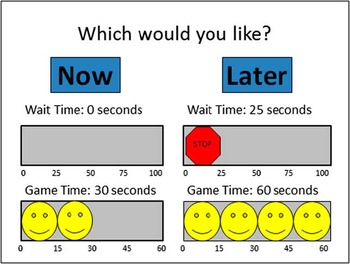
We developed a novel real-time delay discounting task involving immediately consumable rewards and variable reward and delay amounts, an advancement from most previous designs which have primarily used monetary rewards (c.f., Forzano & Logue, Reference Forzano and Logue1994; Logue et al., Reference Logue, Forzano and Ackerman1996; Millar & Navarick, Reference Millar and Navarick1984). During this task, participants make nine choices between getting to play a preferred game for a shorter amount of time (either 15, 30, or 45 s) immediately or for a fixed longer amount of time (60 s) after waiting (either 25, 50, or 100 s; see Figure 1). Once the participant makes a choice, they experienced the delays and rewards associated with that choice in real-time before making their next choice. For example, the participant would have to wait 25 s to play a game for 60 s if they chose the “Later” option in Figure 2. The trial duration was held constant at 160 s (i.e., the length of the longest possible trial when the child chooses to wait 100 s to play for 60 s) regardless of the child’s choice by imposing an adjusting post-reward delay. Participants could bring their own game and were offered several game options (handheld video game, coloring, Legos, etc.) to maximize the rewarding value for each individual. Their preferred game was placed in a clear box in front of them when they made their choices and while waiting to play. This task involved two practice choices, during which participants experienced both the immediate and delayed options, followed by nine test choices and took 40 min to complete. The immediate reward values were presented in ascending order within each delay and the order of the delays was fully counterbalanced across subjects.
Novel Real-Time Discounting Task choice presentation screen. This trial represents a choice between playing a preferred game for 30 s immediately (left option) or playing a game for 60 s after a delay of 25 s (right option).

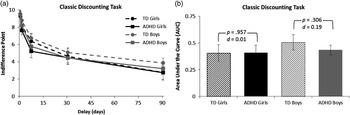
Choice preferences on the Classic Discounting Task. a: The mean indifference point (adjusted for the model covariate, GAI) for each delay and b: the area under the curve (AUC) (adjusted for the model covariate, GAI) are plotted separately for girls and boys with ADHD and typically developing (TD) girls and boys. Error bars represent standard error of the mean; d=Cohen’s d effect size estimate. There were no significant main effects of diagnosis or sex nor was there a Diagnosis×Sex interaction for delay discounting (AUC) on this task.

Subjective Ratings
A brief subjective measure of the participant’s experience of waiting and reward delivery during the real-time task was also obtained on a subset of the sample (TD: 32 boys, 11 girls; ADHD: 38 boys, 11 girls). After selecting a game to play, participants were asked (1) “How much do you want to play the game?” Ratings were provided on a Likert scale ranging from 1 (I don’t want to play it at all) to 10 (I really want to play it!). After completing the task, participants were asked (2) “How much did you like playing the game?” and (3) “How much did you like waiting to play the game?” Ratings were provided on a likert scale ranging from 1 (I didn’t like it at all) to 10 (I really liked it a lot!).
Data Reduction
The primary dependent variable derived from each discounting task was the area under the curve (AUC) calculated based on the indifference point for each delay. For the classic discounting task, the indifference point was defined as midway between the smallest value of the immediate alternative consistently accepted and the largest value consistently rejected for each delay (Wilson et al., Reference Wilson, Mitchell, Musser, Schmitt and Nigg2011). For the real-time discounting task, the indifference point was defined as the lowest immediate value selected for each delay. These indifference points were used to determine the AUC (Myerson, Green, & Warusawitharana, Reference Myerson, Green and Warusawitharana2001), a common approach to analyzing discounting data (e.g., Reynolds, Penfold, & Patak, Reference Reynolds, Penfold and Patak2008; Scheres, Tontsch, Thoeny, & Sumiya, Reference Scheres, Tontsch, Thoeny and Sumiya2014; Shiels et al., Reference Shiels, Hawk, Reynolds, Mazzullo, Rhodes, Pelham and Gangloff2009) that eliminates some of the problems associated with measures assuming a hyperbolic function. Smaller AUC values indicate greater delay discounting and greater impulsivity. The AUC was calculated in excel (Reed, Kaplan, & Brewer, Reference Reed, Kaplan and Brewer2012).
Data Analysis
The AUC was analyzed for each task, providing a single value to quantify delay discounting. As an initial screen for nonsystematic data, we applied Johnson and Bickel’s (Reference Johnson and Bickel2008) model-free method based on the assumption that indifference points should get smaller as delay increases. Specifically, data are considered to be nonsystematic if any indifference point is larger than the indifference point associated with the adjacent shorter delay by more than 20% of the delayed reward. Based on these criteria, data from 28 children (23%) were deemed invalid on one or both of the delay discounting tasks. Analyses were conducted with and without participants with nonsystematic data and the results were qualitatively similar. Therefore, all participants were retained in the analyses reported below.
Separate univariate analyses of covariance (ANCOVA models) were used for each task with the between-subjects factors of diagnosis (ADHD vs. TD) and sex (girls vs. boys). The WISC-IV general ability index (GAI), a measure of intellectual reasoning ability, was included as a covariate for all analyses examining diagnostic group differences given the evidence for associations among intelligence and delay discounting (Shamosh & Gray, Reference Shamosh and Gray2008). We chose to use GAI as a covariate in the analyses rather than FSIQ because FSIQ is influenced by difficulties in working memory and processing speed, which are often present in children with ADHD. In contrast, GAI is based on verbal and perceptual reasoning abilities and may, therefore, be a more appropriate measure of broad intellectual ability in children with ADHD. However, all analyses were also conducted without covarying for GAI, with FSIQ instead of GAI as a covariate, and without children with comorbid ODD, and the results did not change. Therefore, only results with GAI as a covariate for the full sample of children with ADHD (including those with comorbid ODD) are reported below.
Subjective ratings were examined with a multivariate analysis of variance (MANOVA) with the ratings provided for each of the three questions as the dependent variables and diagnosis and sex as the between-subjects factors. Cohen’s d is reported as a measure of effect size for diagnostic group differences (Cohen, Reference Cohen1988). Bivariate correlations were also conducted in the overall sample examining associations among (1) delay discounting on each task (AUC) and ADHD symptom domains (ADHD-RS raw score for ADHD Inattentive and Hyperactive/Impulsive Scales) and (2) delay discounting on the real-time task and subjective ratings.
Results
Sample Characteristics
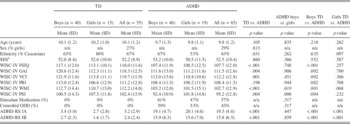
Demographic information for the sample is provided in Table 1, along with inferential statistics regarding diagnostic group differences and sex differences within the ADHD sample. The sample was drawn from largely middle class socioeconomic status and was 65% white, 17% African American, 15% biracial, and 3% Asian. Diagnostic groups did not differ in several important demographics including age, sex, ethnicity, and SES. The ADHD group had lower FSIQ, as is often seen in the childhood ADHD literature (Frazier, Demaree, & Youngstrom, Reference Frazier, Demaree and Youngstrom2004). Girls and boys with ADHD also did not differ in age, sex, ethnicity, and SES, nor did they differ in current use of stimulant medication, comorbid ODD, or parent ratings of ADHD symptoms (ADHD-RS Inattention and Hyperactive/Impulsive raw scores).
Participant demographic and clinical characteristics.

a SES was missing for 1 TD and 2 ADHD participants.
SES=Socio-economic status from Hollingshead total score; WISC-IV=Wechsler Scale for Children, Fourth Edition; FSIQ = Full Scale Intelligence Quotient; GAI=General Ability Index; VCI=Verbal Comprehension Index; PRI=Perceptual Reasoning Index; WMI=Working Memory Index; PSI=Processing Speed Index; ADHD-RS IA=ADHD Rating Scale Home Version Inattention raw score; ADHD-RS HI=ADHD Rating Scale Home Version Hyperactive/Impulsive raw score.
Classic “Real-Reward” Discounting Task
On the classic discounting task, there were no differences in delay discounting (AUC) between the diagnostic groups, F(1,115)=0.3, p=.606, d=.10. There was also no evidence of overall sex differences in delay discounting, F(1,115)=1.0, p=.324, nor was there a Diagnosis×Sex interaction, F(1,115)=0.4, p=.542, d=.11 (see Figure 2).Footnote 1
Novel “Real-Time” Discounting Task
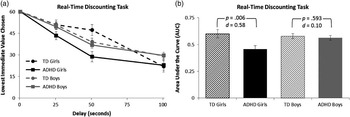
On the novel real-time discounting task, during which participants experienced the delays and rewards associated with their choices in real-time, children with ADHD displayed greater delay discounting (AUC) as evidenced by a main effect of diagnosis, F(1,115)=6.8, p=.010, d=.48. However, this main effect was qualified by a Diagnosis×Sex interaction, F(1,115)=4.2, p=.044, d=.38, such that girls with ADHD showed greater delay discounting compared to TD girls (p=.006; d=0.58), whereas delay discounting did not differ among boys with ADHD compared to TD boys (p=.593; d=0.10) (see Figure 3).
Choice preferences on the Novel Real-Time Discounting Task. a: The mean indifference point (adjusted for the model covariate, GAI) for each delay b: and the area under the curve (AUC) (adjusted for the model covariate, GAI) are plotted separately for girls and boys with ADHD and typically developing (TD) girls and boys. Error bars represent standard error of the mean; d=Cohen’s d effect size estimate. There was a significant main effect of diagnosis that was qualified by a Diagnosis×Sex interaction for delay discounting (AUC) on this task.

Subjective Ratings
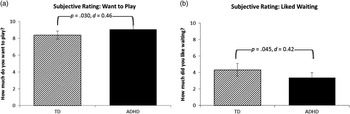
Results of the MANOVA for the three subjective ratings provided by participants indicated an overall effect of diagnosis, F(3,89)=3.3, p=.024, d=.38, but no main effect of sex, F(3,89)=0.4, p=.638, nor was there a Diagnosis×Sex interaction, F(3,89)=0.6, p=.638, d=.16. Examination of the between-subjects effects for each question suggested that children with ADHD reported wanting to play their chosen game more than TD children before making their choices (i.e., reward desirability, p=.030; see Figure 4a) and liking waiting less than TD children after making their choices (i.e., difficulty waiting, p=.045; see Figure 4b), whereas there was no difference between diagnostic groups in their rating of how much they liked playing their chosen game (p=.538).
Subjective ratings obtained for the novel real-time discounting task. (a) Mean rating on a 1–10 likert scale in response to the question “How much do you want to play the game?” asked after selecting a preferred game and before making choices. (b) Mean rating on a 1–10 likert scale in response to the question “How much did you like waiting to play the game?” asked after completing all choices. Higher values indicate wanting to play more and liking waiting more. Error bars represent standard error of the mean; d=Cohen’s d effect size estimate. Children with ADHD reported wanting to play their chosen game more than TD children (a) and liking waiting less than TD children (b).

Correlations among Delay Discounting, ADHD Symptoms, and Subjective Ratings
Examination of bivariate correlations indicated that greater inattentive symptoms were significantly correlated with greater discounting (i.e., smaller AUC) on the classic discounting task (r=−.199; p=.030), but not on the real-time task (r=−.158; p=.086). Hyperactive/impulsive symptoms were not significantly correlated with delay discounting on either the classic discounting task (r=−.153; p=.099) or the real-time discounting task (r=−.130; p=.159). Subjective ratings of reward desirability, experience of reward, and difficulty rating were not significantly correlated with delay discounting on the real-time task (rs<.12; ps>.26).
Discussion
The current study examined delay discounting among 8- to 12-year-old girls and boys with ADHD-C relative to TD controls on two tasks that differed in the extent to which the delays and rewards were experienced by participants. Consistent with theoretical models of ADHD emphasizing altered reinforcement sensitivity (Luman et al., Reference Luman, Tripp and Scheres2010), children with ADHD displayed greater delay discounting. However, this finding was specific to girls with ADHD and to the task in which the rewards were immediately consumable (i.e., playing a game) and the delays were experienced in real-time. Furthermore, children with ADHD reported wanting to play their preferred game more than TD controls and liking waiting to play less than TD controls, although they did not significantly differ in their rating of how much they liked playing their chosen game. ADHD inattentive symptoms were significantly correlated with greater discounting on the classic discounting task.
This is the first study to show ADHD-related sex differences in delay discounting, such that only girls with ADHD showed greater discounting of playing a preferred game during a real-time discounting task. Interpretation of this finding is guided by consideration of the lack of diagnostic group differences among girls and boys in delay discounting on the classic discounting task, similar to tasks commonly used in the ADHD literature. The finding of similar discounting rates among ADHD and TD children, regardless of sex, on the classic discounting task is consistent with some previous studies (Chantiluke et al., Reference Chantiluke, Christakou, Murphy, Giampietro, Daly, Ecker and Rubia2014; Crunelle et al., Reference Crunelle, Veltman, van Emmerik-van Oortmerssen, Booij and van den Brink2013; Rubia et al., Reference Rubia, Halari, Christakou and Taylor2009; Wilbertz et al., Reference Wilbertz, Trueg, Sonuga-Barke, Blechert, Philipsen and Tebartz van Elst2013, Reference Wilbertz, van Elst, Delgado, Maier, Feige, Philipsen and Blechert2012), although other studies have reported greater discounting among individuals with ADHD on similar tasks (Costa Dias et al., Reference Costa Dias, Wilson, Bathula, Iyer, Mills, Thurlow and Fair2013; Dai et al., Reference Dai, Harrow, Song, Rucklidge and Grace2013; Demurie et al., Reference Demurie, Roeyers, Baeyens and Sonuga-Barke2012, Reference Demurie, Roeyers, Baeyens and Sonuga-Barke2013; Hurst et al., Reference Hurst, Kepley, McCalla and Livermore2011; Paloyelis et al., Reference Paloyelis, Asherson, Mehta, Faraone and Kuntsi2010; Wilson et al., Reference Wilson, Mitchell, Musser, Schmitt and Nigg2011). The discrepant findings from those of Wilson and colleagues (2011) may be particularly informative given our use of a nearly identical task, except for participants being told that some of the choices were real. Consideration of characteristics of the sample or task that differed across these studies may inform our understanding of the inconsistent findings in the broader ADHD delay discounting literature.
First, it is important to consider the role of intellectual ability, both in terms of the greater difference in FSIQ between the ADHD and TD samples in the Wilson et al. (Reference Wilson, Mitchell, Musser, Schmitt and Nigg2011) study (13-point difference: ADHD=105; TD=118) compared to our study (8-point difference: ADHD=108; TD=116) and the relatively higher IQ of our ADHD sample than is typically reported in the ADHD literature (e.g., Parke, Thaler, Etcoff, & Allen, Reference Parke, Thaler, Etcoff and Allen2015 report an average FSIQ of 102). Differences in IQ between ADHD and control samples are often reported, but it has been suggested that covarying for IQ may be inappropriate as this would control for a component of the disorder (Dennis et al., Reference Dennis, Francis, Cirino, Schachar, Barnes and Fletcher2009). This issue is particularly relevant for delay discounting studies given that higher intelligence is associated with lower delay discounting (see meta-analysis by Shamosh & Gray, Reference Shamosh and Gray2008), although the contribution of IQ is not consistently addressed in ADHD delay discounting studies. Wilson et al. (Reference Wilson, Mitchell, Musser, Schmitt and Nigg2011) reported that the significant diagnostic group difference in discounting was eliminated after controlling for IQ, whereas the results did not change in our study regardless of whether FSIQ or GAI was included as a covariate. The relatively high IQ of our ADHD sample may reduce the potential confound of IQ differences in delay discounting studies of individuals with ADHD, but it may also limit the generalizability of our findings. Interestingly, GAI was correlated with discounting on the classic discounting task in the current study (r=.235; p=.020), but not with the real-time task (r=.100; p=.276). This might suggest that intelligence is more strongly related to decision-making on tasks involving primarily abstract and long-term decisions whereas choices in which the delays and rewards are experienced in real-time are less influenced by intellectual ability. Further research is warranted to better understand the relationship between intelligence and delay discounting.
The role of inattention may have also contributed to the discrepant findings. Specifically, Wilson et al. (Reference Wilson, Mitchell, Musser, Schmitt and Nigg2011) included younger children (7–9 year olds vs. 8–12 year olds in our study) and participants with the predominantly inattentive subtype of ADHD (41% vs. all combined subtype in our study). These sample characteristics, along with the use of hypothetical rewards, may have resulted in greater inattention to the task and likely influenced the discounting slopes. The diagnostic group differences were no longer significant after controlling for attention to task (based on how they answered attention check questions), suggesting that Wilson et al.’s finding of greater delay discounting among children with ADHD may have been due to greater inattention rather than a heightened preference for immediate reward. The use of real rather than hypothetical rewards in our study may have improved participants’ attention to each choice, resulting in more accurate measurement of delay discounting. It is unclear how this procedural difference impacts delay discounting among children, although studies with adults have shown that real and hypothetical rewards are discounted to the same degree (e.g., Lagorio & Madden, Reference Lagorio and Madden2005; Madden et al., Reference Madden, Begotka, Raiff and Kastern2003).
Although theories of ADHD postulate stronger associations among delay discounting and hyperactive/impulsive symptoms than inattentive symptoms (Sagvolden, Johansen, Aase, & Russell, Reference Sagvolden, Johansen, Aase and Russell2005), studies examining the association among ADHD symptom domains and delay discounting suggest that correlations with symptoms may be task dependent such that hyperactive/impulsive symptoms are associated with discounting on real-time tasks (Scheres & Hamaker, Reference Scheres and Hamaker2010; Scheres et al., Reference Scheres, Lee and Sumiya2008), while inattention symptoms are associated with discounting on classic discounting tasks involving all or mostly hypothetical rewards as shown in the current study and in the study by Wilson et al. (Reference Wilson, Mitchell, Musser, Schmitt and Nigg2011). The latter task typically involves many more choices, which may place greater demands on attention. However, our sample only included girls and boys with ADHD-C who did not differ in parent ratings of inattention or hyperactive/impulsive symptoms, suggesting that our findings may reflect a true sex difference rather than an artifact of symptom presentation.
Our finding of greater discounting in children with ADHD on a real-time task is consistent with two previous studies using real-time paradigms (Scheres et al., Reference Scheres, Tontsch, Thoeny and Kaczkurkin2010; Schweitzer & Sulzer-Azaroff, Reference Schweitzer and Sulzer-Azaroff1995), although these studies involved choices about money, which has limited utility in the moment compared to an immediately consumable reward. Sex differences were not addressed in either of these studies due to insufficient power (only 6 girls with ADHD in Scheres et al., Reference Scheres, Tontsch, Thoeny and Kaczkurkin2010) or an exclusively male sample (Schweitzer & Sulzer-Azaroff, Reference Schweitzer and Sulzer-Azaroff1995). However, it is interesting that these studies found evidence of greater delay discounting on a real-time task among boys with ADHD, whereas we did not. This might suggest that the use of immediately consumable rewards may be an important procedural difference from previous studies reporting greater preference for immediate reward in primarily male ADHD samples. Perhaps boys with ADHD were better able to exert self-control and wait for the larger, delayed reward when it was a primary rather than a secondary reinforcer delivered in real-time, as in previous studies. In contrast, girls with ADHD may show a diminished response to reward as shown in a previous study (Rosch et al., Reference Rosch, Dirlikov and Mostofsky2015) and perhaps a greater aversion to delay, which they actually experienced during this task, which may have led to a stronger preference for immediate reward.
Alternatively, girls with ADHD may have been differentially sensitive to the delay amount or the type of reward. Studies have shown commodity or domain-dependence of discounting rates (Chapman & Elstein, Reference Chapman and Elstein1995), such that healthy adults discount hypothetical monetary rewards more steeply than hypothetical consumable rewards, such as cigarettes, food, alcohol, and entertainment (e.g., Friedel, DeHart, Madden, & Odum, Reference Friedel, DeHart, Madden and Odum2014), and less steeply than hypothetical health outcomes (Chapman & Elstein, Reference Chapman and Elstein1995). In contrast, children and adolescents (ages 8–16 years) have been shown to discount hypothetical edible rewards, social rewards, and activities more steeply than money (Demurie et al., Reference Demurie, Roeyers, Baeyens and Sonuga-Barke2013). However, the rewards used in most previous studies were not actually consumed in real-time, as was done in the current study, which may limit the comparisons that can be made. Further research is necessary to improve our understanding of how the type of reward, particularly with regard to whether it is an immediately consumable primary reinforcer (e.g., food, drugs, entertainment) that is experienced in real-time or a secondary reinforcer (e.g., money), impacts impulsive decision-making in ADHD. The classic and real-time discounting tasks in this study also differed with regard to the length of the delays, which may impact delay discounting. Thus, it may be that girls with ADHD were differentially sensitive to the length of the delays across the two tasks whereas other children did not display this sensitivity. In future research, it will be important to examine whether these apparent sex differences are a function of the potential for reward consumption, delay amount, or different commodities.
Comparison of diagnostic groups on subjective ratings of reward desirability, experience of reward, and difficulty waiting during the real-time task expand upon the results of Scheres et al. (Reference Scheres, Tontsch and Thoeny2013), in which subjective ratings of difficulty waiting were associated with delay discounting. In the current study, children with ADHD reported wanting to play their preferred game more than TD controls (before completing the task) and liking waiting to play less than TD controls (after completing the task), although they did not significantly differ in their rating of how much they liked playing their chosen game. Thus, it may be that a stronger preference for immediate reward among children with ADHD is related to a combination of greater reward desirability and more difficulty waiting, although differences in discounting were only observed among girls in the current sample. Interestingly, subjective ratings were not significantly correlated with delay discounting on the real-time task. Our approach differed from that of Scheres et al. (Reference Scheres, Tontsch and Thoeny2013) in that we obtained objective ratings for the overall task rather than for each choice trial, which may provide a more sensitive measure of how subjective feelings related to decision making.
It is important to consider these findings within context of the study’s limitations. First, although our sample of girls with ADHD (n=19) is larger than in previous studies of delay discounting, this sample is relatively small and replication with larger samples of girls is important. In addition, the lack of comorbidities other than ODD in our sample of children with ADHD and the relatively high IQ of our ADHD sample may limit comparisons with other studies involving clinical samples of children with ADHD. It will be important for future studies attempting to replicate these findings to include larger samples of girls with ADHD and children with comorbid disorders beyond ODD to determine whether these findings generalize to samples representative of the broader population of children with ADHD. Another limitation of this study is that we did not examine other neurocognitive measures that may be related to delay discounting and may differ between girls and boys with ADHD, such as working memory, inhibitory control, and time perception.
In sum, these findings provide novel information about sex differences in delay discounting among children with ADHD and the importance of considering task characteristics as well as ratings of the subjective experience of reward desirability and waiting. These findings encourage future work investigating sex differences in relation to impulsive decision-making in ADHD and emphasize the importance of multi-method assessment of delay discounting. Further research examining the contribution of intelligence to delay discounting is also warranted, particularly given the differential associations with the tasks used in the current study. Finally, research exploring the neural correlates of delay discounting in children with ADHD will be important for elucidating the relative contribution of cognitive control and reward systems to impulsive decision-making in ADHD.
Acknowledgments
This work was supported in part by grants from the National Institute of Mental Health (RO1 MH078160, RO1 MH085328, K23 MH101322) and the Johns Hopkins University School of Medicine Institute for Clinical and Translational Research National Institutes of Health/National Center for Research Resources Clinical and Translational Science Award program UL1 TR 000424-06. The authors do not have any conflicts of interest to disclose.