
I. INTRODUCTION
Cost-effective non-noble metal nanoparticles (e.g., Cu, Co, Ni metals et al., or alloy) have drawn increasing attention as highly efficient heterogeneous catalysts owing to their earth abundance, low cost, and environmentally friendly nature. Reference Bai, Yao and Li1–Reference Rai, Mahata, Mukhopadhyay, Gupta, Li, Nguyen, Zhao, Pathak and Singh6 However, nanoscale particles are usually recycled by tedious and time-consuming centrifugation–redispersion cycles, thus hampering the recovery and reusability of catalysts in solutions. Reference Lin and Doong7,Reference Jiang, Jiang, Showkot Hossain, Qian and Xie8 Among non-noble metals, Co metal nanoparticles are of particular interest due to their strong magnetic response, and the catalysts could be separated from the reaction system by just using a magnet. Reference Kim, Nam, Park, Kwon, Eom, Yoo, Jang, Kim, Cho and Kwon2,Reference Shi, Jiao, Sun, Chen, Chen, Zhu, Zhou, Zhou, Li and Li9,Reference Yan, Zhao, Li, Wang, Zhong and Chen10 Unfortunately, bare Co metal nanoparticles suffer from poor stability in liquid phase catalysis, due to inevitable particle agglomeration and intrinsic magnetic interaction. Reference Yan, Zhao, Li, Wang, Zhong and Chen10 The double-sided dilemma of agglomeration and separation associated with cobalt-based nanoparticles can be resolved by attaching them on engineering supports so that they are fixed in place against both rapid agglomeration and perpetual suspension. Therefore, the development of a facile and general method to improve the catalytic performance of porous support immobilized nanoscale catalysts is highly desirable. Reference Sun, Zhan, Akita and Xu11
So far, various methods including the layer-by-layer coating process, Reference Zhu, Li, He and Qi12,Reference Li, Li, Qi, Luo and He13 encapsulating, Reference Wang, Gao, Wang, Miao, Wu, Li and Bao3,Reference Zhou, Bai, Cheng, Qiao, Xie and Li14–Reference Nam, Kim, Jin, Chung and Lee17 supporting, Reference Kim, Nam, Park, Kwon, Eom, Yoo, Jang, Kim, Cho and Kwon2,Reference Jiang, Jiang, Showkot Hossain, Qian and Xie8 and surfactant-templated method Reference Gong, Su and Zhang18 have been explored for protection of nanoparticles from agglomeration. Embedding nanoparticles in solid matrix, in particular of high porosity structure, could provide multiple accessible channels for diffusion and transport to take full advantage of the excellent catalytic functionalities of metal nanoparticles. However, the available synthesis procedures for these hybrids usually involve multisteps and complicated synthetic conditions, and may have difficulty in constructing hybrids with strong coupling between nanoparticles and the support. Reference Zhu, Li, He and Qi12
It should be noted that metal–organic frameworks (MOFs) have the feature of exceptional specific surface area and pore volume, have been utilized to generate porous carbon, Reference Chen, Wang, Wu, Xiong, Xu, Yu and Jiang19–Reference Torad, Hu, Kamachi, Takai, Imura, Naito and Yamauchi21 metal oxides, Reference Li, Yue, Yang, Qiu, Xue, Xu and Wang22–Reference Pang, Deng, Du, Li, Li, Ma, Zhang and Chen24 and nanoparticles Reference Yan, Zhao, Li, Wang, Zhong and Chen10,Reference Xi, Xia, Xu, Xiao and Wang25 through solid-state thermolysis of the as-prepared MOF crystals. This strategy is fascinating because carbons or metal compounds with extremely porous structures can be obtained directly from MOFs without extra templates. Recently, zeolitic imidazolate frameworks (ZIF-8, ZIF-67), Reference Yang, Zhang, Lu, Hong, Jiang, Wu and Li26–Reference Wang, Zou, Xia, Ma, Qiu, Mahmood, Zhao, Yang, Xia and Xu28 Prussian blue analogues Reference Yu, Yu, Wu and Lou29,Reference Nie, Shen, Luo, Ding, Xu, Wang and Zhang30 and HKUST-1, Reference Liu, Liu, He, Li, Ji, Zheng, Luo, Liu, Shi and Hu31,Reference Zhang, Liu, Liu, Yang, Feng, Huo and Lu32 were chosen as the templates for obtaining porous polyhedrons. In MOFs, the highly ordered metal ions are regularly isolated by organic ligands, which would play an important role in preventing metal agglomeration during thermolysis. The organic ligands will be carbonized gradually and the resulting carbon composite will play an important role in isolating the metal species to prevent the serious aggregation. These MOF-derived porous carbon materials have shown excellent performance in a variety of applications such as heterogeneous catalysis, Reference Zhong, Liu, Bai, Liao and Li4 electrochemistry, Reference Wang, Zou, Xia, Ma, Qiu, Mahmood, Zhao, Yang, Xia and Xu28 and dye adsorption. Reference Torad, Hu, Ishihara, Sukegawa, Belik, Imura, Ariga, Sakka and Yamauchi33 To the best of our knowledge, reports on the use of MOF-derived uniformly dispersed metal nanoparticles in polyhedron carbon matrix as catalysts for heterogeneous catalysis organic synthesis are rare. Reference Zhong, Liu, Bai, Liao and Li4
We report herein for the first time, a novel type of Co-based hierarchical structures Co@C material with hexagonal-shaped prisms, in which Co nanoparticles are embedded in polyhedron carbon, which were fabricated by in situ pyrolysis of a pre-synthesized cobalt MOF, Co-MOF-74. This approach allows high-content magnetic Co nanoparticles to locate uniformly over the spatial distribution of porous carbon matrix. The obtained Co nanoparticles with the size of several nanometers supported on nanoporous carbon are highly dispersible in aqueous liquids and capable of efficient catalysis for 4-nitrophenol (4-NP) reduction. The results showed that the Co@C have advantageous reproducibility. The high porosities of these kinds of magnetic materials open a new avenue for the synthesis of heterogeneous catalysts with high catalytic performance in various catalytic reactions.
II. EXPERIMENTAL
A. Synthesis of Co@C
Co-MOF-74 with hexagonal-shaped prismatic structures were synthesized by following our previous report. Reference Li, Yue, Yang, Qiu, Xue, Xu and Wang22 The typical synthesis procedure was as follows: 2,5-dihydroxyterephthalic acid (DHTP, 4 mmol) was dissolved in 40 mL THF, cobalt acetate (4 mmol) and CTAB (1.0 g) were dissolved in 40 mL water. The above two solutions were mixed under vigorous stirring for 10 min, and then the bottle was capped tightly and heated to 110 °C in an oil bath for 3 h with magnetic stirring. After the solution was cooled to room temperature naturally, the product was collected through centrifugation and washed several times with DI water and ethanol. Co@C was synthesized by direct carbonization of Co-MOF-74 in Ar. The temperature was increased gradually at a heating rate of 2 °C/min and maintained at 600 °C for 3 h. The black Co@C sample with strong magnetic attraction was obtained after cooling to room temperature and is named as Co@C-600. Similarly, compounds Co@C-800 was obtained by heating the Co-MOF-74 at 800 °C for 3 h.
B. Instruments and characterization
XRD patterns were collected on a Bruker D8 Advance powder X-ray diffractometer using Cu Kα radiation (Bruker Corporation, Karlsruhe, Germany). Thermogravimetric analysis (TGA) was performed on a Shimadzu DTG-50 thermal analyzer (Shimadzu Corporation, Tokyo, Japan) from room temperature to 800 °C at a heating rate of 10 °C/min. Scanning electron microscopy (SEM) and energy dispersive spectrometry (EDS) were conducted on Hitachi S-8010 (Hitachi Corporation, Tokyo, Japan). Meanwhile, high-resolution transmission electron microscopy (HR-TEM) investigations were performed using a Titan G2 60-300 (FEI Company, Hillsboro, Oregon). The changes in absorbance were recorded at UV–Vis spectrophotometer (UV-2550, Shimadzu Corporation). Magnetic measurement was recorded with a Squid-VSM superconducting quantum interference device magnetometer (Quantum Design, Inc., San Diego, California).
C. Catalytic activity of Co@C for 4-NP reduction in the presence of NaBH4
The catalytic redox reaction process was set up in a standard quartz cuvette with 1.0 cm path length and 4 mL volume. Initially, freshly prepared NaBH4 aqueous solution (0.1 mL, 0.6 M) was added to the above quartz cuvette containing 4-NP (3 mL, 0.1 mM) with stirring at 25 °C and then adding Co@C (1 mg/mL, Co@C was dispersed in deionized water). The change of the mixture solution color was monitored using UV–vis spectroscopy, and the decrease in absorbance at 400 nm was recorded by time scanning of the UV spectrometer. The reusability of the catalyst was demonstrated by using the same catalysts for six times consecutively in the reduction of 4-NP. After every usage, the catalyst was separated from reaction mixture by magnet, washed with deionized water and directly reused in the same reaction conditions again.
III. RESULTS AND DISCUSSIONS
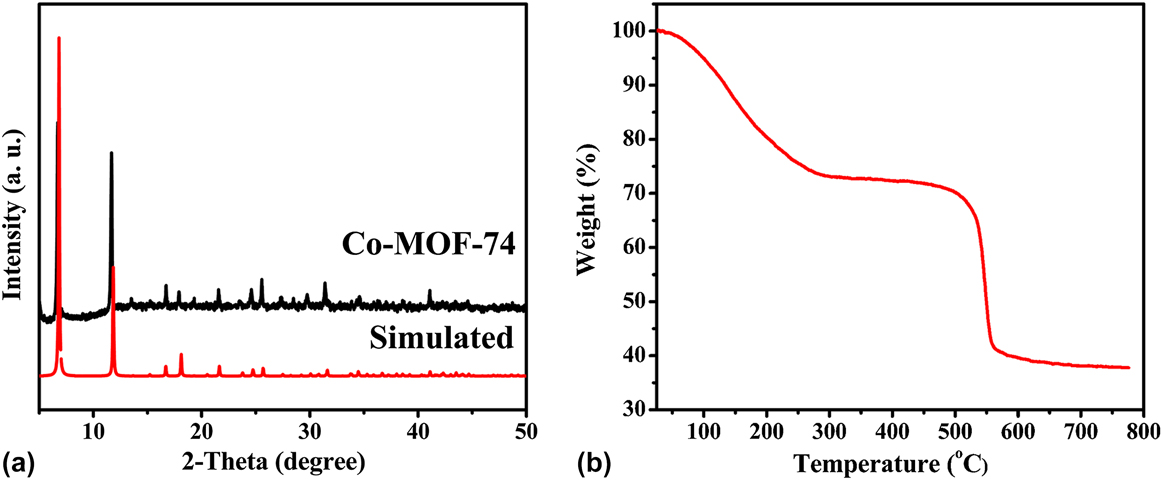
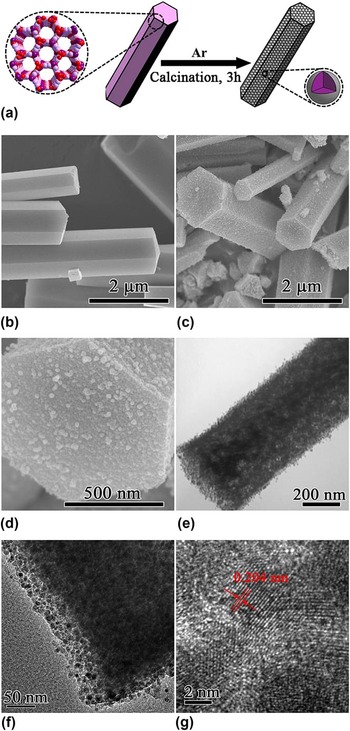
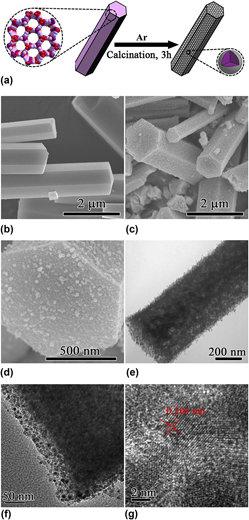
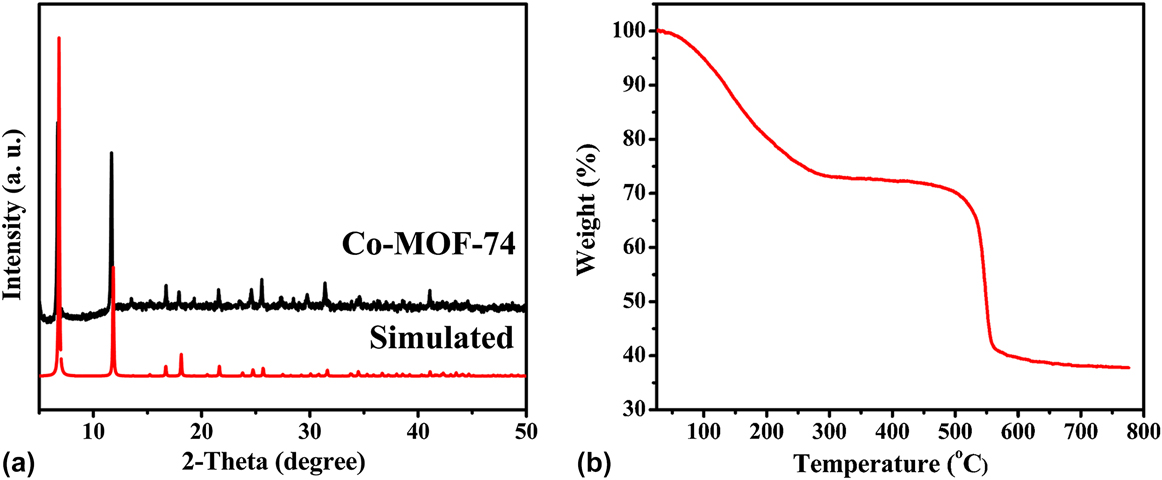
The Co-MOF-74 structure is composed of infinite rods of Co3O3(CO2)3 and DHTP linkers, where Co2+ is coordinated to three carboxyl and two hydroxyl groups. Crystalline samples of the Co-MOF-74 were obtained through a solvothermal reaction. The sample purity was confirmed by powder x-ray diffraction (XRD) patterns, as shown in Fig. 1(a). A SEM image shown in Fig. 2(b) clearly shows that the Co-MOF-74 precursors are composed of hexagonal-shaped prisms with smooth surfaces.
(a) Powder XRD pattern and simulated XRD pattern created from CIF file and (b) TG analysis curve under N2 condition of Co-MOF-74.
(a) Schematic illustration of the formation process of Co@C, (b) SEM image of Co-MOF-74, (c and d) SEM images of Co@C-600, (e and f) TEM images of Co@C-600, (g) HR-TEM of Co nanoparticles.

Figure 2(a) schematically illustrates our selection criteria for Co-MOF-74 was chosen as an ideal precursor for high-performance catalyst. The Co-based MOFs with large channels (about 11 Å) are preferred for providing highly uniformly dispersed active species such as Co nanoparticles with homogeneous mesoporous pore size distribution after pyrolysis. The porosity could prompt diffusion of both reactants and products if it were maintained. Lastly, the trouble of agglomeration of Co nanoparticles can be resolved by embedding them on porous carbon.
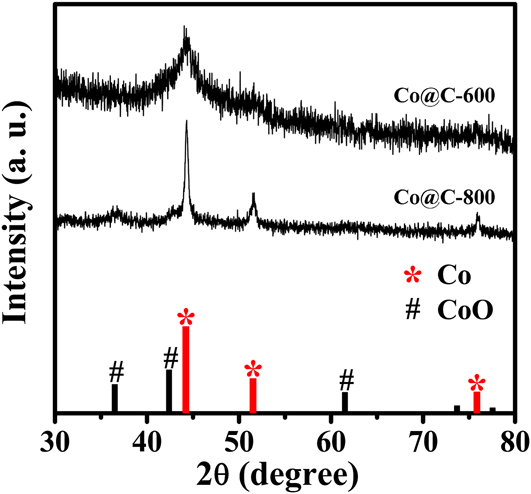
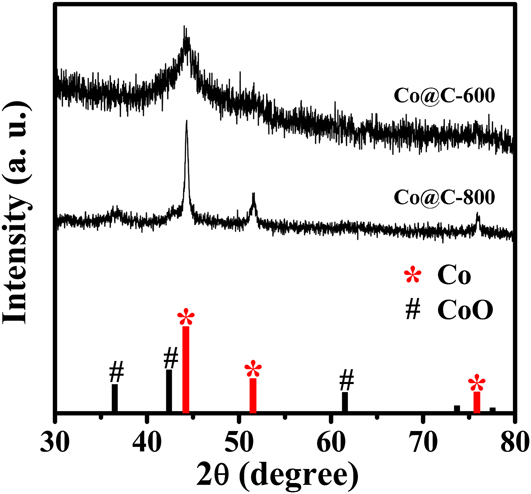
The TG curve of the as-prepared Co-MOF-74 hexagonal-shaped prisms in inert atmosphere indicates two decomposition steps. The first shows a weight loss from room temperature to 290 °C, illustrating the loss of water molecules from the porous structure, which corresponds to coordination and crystallization water molecules. The second weight loss is observed from about 480 °C and terminated at approximately 600 °C, due to the decomposition of the DHTP. The O atoms of the MOFs were released in the form of carbon oxides. Based on the TG result, the pyrolysis temperature was initially set at 600 °C. After decomposition of the as-prepared precursor in inert atmosphere, the XRD pattern indicated that the material was metallic Co (JCPDS no. 15-0806) (Fig. 3). The diffraction peaks are less resolved in Co@C-600, but become increasingly stronger with increasing calcination temperature. Moreover, some weak peaks assigned to CoO (JCPDS no. 01-1227) are also observed for the samples, which are attributed to the oxidation of small Co nanoparticles during the exposure of the samples to air, similar phenomenon have been reported previously. Reference Torad, Hu, Ishihara, Sukegawa, Belik, Imura, Ariga, Sakka and Yamauchi33,Reference Lü, Wang, Li, Lin, Jiang, Xie, Kuang and Zheng34 Furthermore, morphology was successfully maintained during the pyrolysis process, it is clearly observed that Co@C-600 retains the pristine hexagonal-shaped prismatic structure [Fig. 2(c)]. From the high-resolution SEM images, it can be seen that the surface morphology of Co@C are composed by nanoparticles [Fig. 2(d)].
Powder XRD pattern of Co@C-600 and Co@C-800.
In particular, the transmission electron microscopy (TEM) image shown in Figs. 2(e) and 2(f) confirms that Co nanoparticles are uniformly dispersed inside the entire porous prism. The HR-TEM image displays distinct lattice fringes with d spacing of 0.204 nm, which is consistent with the (111) lattice planes of Co metal [Fig. 2(g)]. The diameters of the Co nanoparticles are 5–7 nm. Strong contrast difference between the darker marginal region and the brighter central region further suggests the porous structure of Co@C-600. The pores in the Co@C-600 structures should result from the pyrolysis of the DHTP and the original channel of Co-MOF-74. When the temperature was increased to 800 °C, the obtained Co@C-800 product still keeps the hexagonal-shaped prismatic structure of Co-MOF-74, but Co nanoparticles embedded in the carbon matrix increased to about 100 nm (Fig. 4).
(a) SEM and (b) TEM images of Co@C-800.

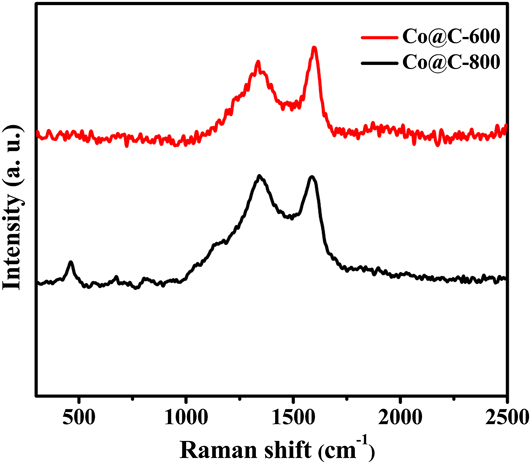
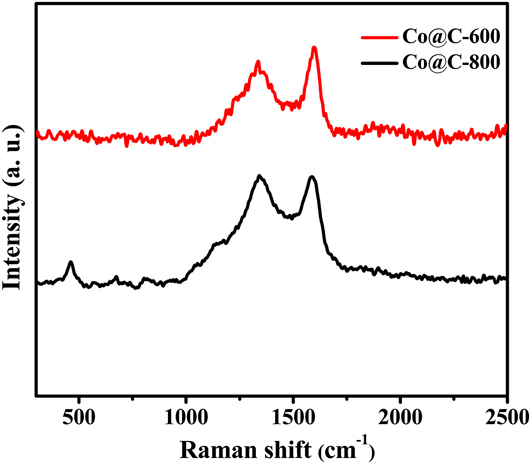
Raman spectra of Co@C-600 and Co@C-800 are shown in Fig. 5. The two major peaks corresponding to the D (1338 cm−1) and G (1587 cm−1) bands reflect the carbon structures in the Co@C-600 and Co@C-800, respectively. Reference Wang, Gao, Wang, Miao, Wu, Li and Bao3 The D (defects and disorder) band is related to disordered structure, and the G (graphite) band is assigned to the vibration of all sp 2 hybridized carbon atoms of the carbon. The intensity ratios of the D band to the G band (I D/I G) calculated from the peak intensity can be considered as a measure of graphitization degree, both of them are calculated to be approximately 1 regardless of the Co content, which indicates the existence of a large amount of defects. Co@C-600 and Co@C-800 have somewhat disordered carbon structure with defects rather than being ideally graphitic.
Raman spectra of Co@C-600 and Co@C-800.
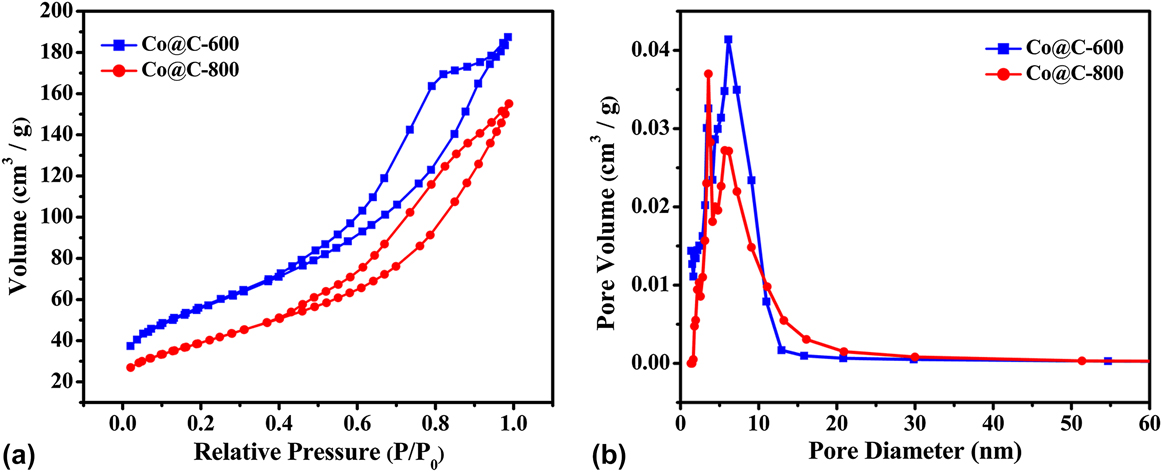
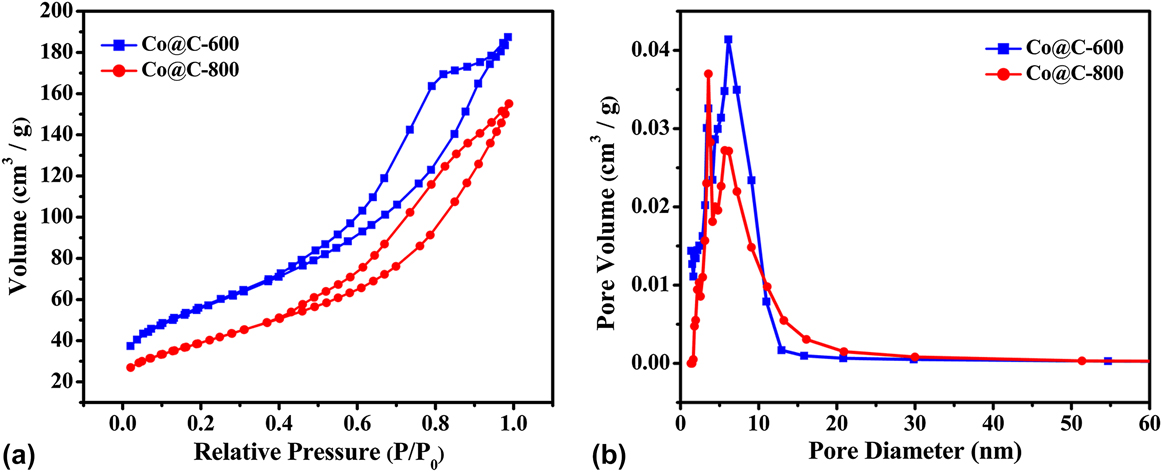
The specific surface area and pore distribution of Co@C-600 and Co@C-800 were analyzed using N2 adsorption and desorption isotherms (Fig. 6). Both of the samples display typical type IV adsorption isotherm with an H3-type hysteresis loop, Reference Xiao, Liu, Li, Zhang, Zhao, Fang and Jia35,Reference Peng, Li, Tan, Cai, Shi, Li, Mhaisalkar, Srinivasan, Ramakrishna and Yan36 which indicate the presence of a mesoporous structure that might originate from the inheritance of porous Co-MOF-74 and the decomposition of the samples during heat treatment. Co@C-600 exhibits a high BET specific surface area of approximately 195.2 m2/g. The high BET surface area may provide more active sites for the catalytic reaction. However, the specific surface area decreases to 138.5 m2/g, when the sample was pyrolysed at 800 °C. The pore-size distribution calculated by using the BJH method shows that both Co@C-600 and Co@C-800 are composed by hierarchical porous composites with two narrow distribution centered at approximately 3 and 7 nm, respectively [Fig. 6(b)]. It is beneficial in improving the throughput rate of the reactants.
(a) N2 adsorption–desorption isotherm and (b) the corresponding pore-size distribution of Co@C-600 and Co@C-800.
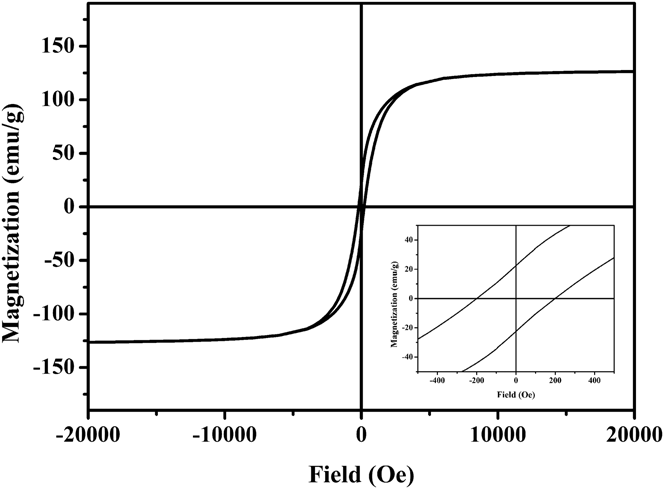
Magnetic properties of the Co@C-600 were investigated at room temperature using a vibrating sample magnetometer. The results shown in Fig. 7 indicate that the sample exhibits ferromagnetic behaviors. The saturation magnetization (M S) is 123.2 emu/g, which is lower than that of bulk Co (164.8 emu/g at T = 300 K) but higher than many of the recently reported Co/C components. Reference Lü, Wang, Li, Lin, Jiang, Xie, Kuang and Zheng34,Reference Yi, Wen, Qiao and Li37 The coercivity (H c) is 195.0 Oe and retentivity (M r) is 22.3 emu/g (Fig. 7 inset), which shows that the resulting Co@C-600 has good magnetic property at room temperature. It can be easily recovered due the good magnetic properties of Co@C-600, which is beneficial for practical application.
Magnetic hysteresis loop of the Co@C-600 measured at 300 K. Inset shows the magnetic hysteresis loop at a lower field.

It should be mentioned that the reduction of 4-NP to 4-AP using different catalysts has been widely reported in the literature. Reference Zhang, Lu, Cui, Liu, Li, Yan, Xing, Chi, Yang and Huo15,Reference Shi, Zheng, Yan and Chen38,Reference Aditya, Pal and Pal39 The catalytic reduction 4-NP to 4-AP is most often used as a probe reaction to test the catalytic activity of metal nanoparticles in aqueous solution. Reference Aditya, Pal and Pal39,Reference Ma, Ni, Guo and Xiang40 4-NP is one of the most refractory pollutants that often exist in industrial effluents, while 4-AP is one of the great commercial importance as an intermediate for the manufacture of pharmaceuticals. Reference Wu, Wen, Wu and Fang41,Reference Jiang, Xie, Jiang, Jing and Qin42 Thus, it is highly desirable to develop more effective, durable, and eco-friendly catalytic systems to produce 4-AP. Reference Aditya, Pal and Pal39,Reference Mandlimath and Gopal43
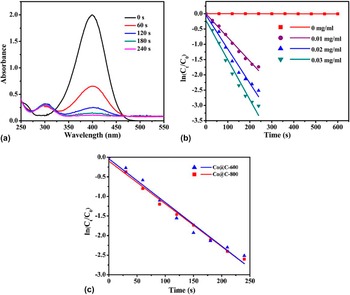
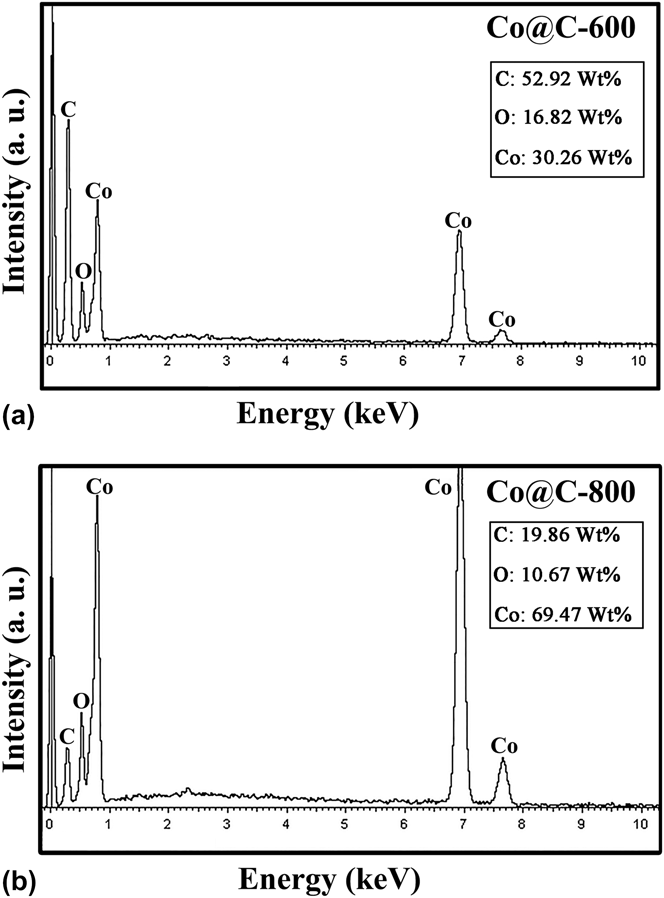
Here, the catalytic performance of Co@C-600 was investigated by employing the catalytic reaction for the reduction of 4-NP in the solution by NaBH4 to produce 4-AP as a model reaction. Figure 8(a) shows the successive UV–vis spectra changes in 4-NP catalyzed by Co@C-600. It can be seen that the characteristic peak of the 4-NP ion at 400 nm decreased gradually with increasing time and almost disappeared after 4 min along with a concomitant increase of the peak at 300 nm of 4-AP. A linear correlation of ln(C t /C 0) versus reaction time was obtained (C t and C 0 are 4-NP concentrations at time t and 0, respectively), and the pseudo-first-order rate constant (k) was estimated to be 0.011 s−1. Conversion of 4-NP in the presence of magnetic Co@C-600 with different dosages was determined by the relative UV–vis absorbance at 400 nm [Fig. 8(b)]. Without catalysts, the maximum absorption peak remains unchanged, indicating that NaBH4 alone cannot initiate the conversion reaction. The reaction rate can be accelerated by increasing the amount of the catalyst from 30 μL (0.01 mg/mL), 60 μL (0.02 mg/mL), 90 μL (0.03 mg/mL), the corresponding kinetic rate constant k was estimated to be 0.0078, 0.011, and 0.013 s−1, respectively. As shown in Table I, the Co@C-600 in our experiments exhibits superior catalytic activity, and ever better than that of some noble metal nanoparticles for the catalytic reduction of 4-NP. Reference Hu, Zhang, Wei, Zhang and Chen44–Reference Deng, Cai, Sun, Liu, Liu, Wei, Li, Liu, Wang and Zhao47 Although the results of EDS indicate that the cobalt content of Co@C-800 is two times as much as Co@C-600 (Fig. 9), there was no substantive change as monitored by UV–Vis [Fig. 8(c)]. This is attributed to the coarsening of the Co nanoparticles, which may decrease the number of surface active sites, thus affecting its catalytic activity.
(a) UV–vis spectra of the reduction 4-NP (T = 25 °C, the amount of the Co@C-600 is 0.02 mg/mL); (b) influence of the amount of the Co@C-600 on the reduction of 4-NP; (c) kinetic curve for the reduction of 4-NP catalyzed by Co@C-600 and Co@C-800.

Catalytic activities of different catalysts for the reduction of 4-NP.

a The amount of catalysts is average dosage of 3.0 mL 4-NP solution.
EDS spectra of the (a) Co@C-600 and (b) Co@C-800.

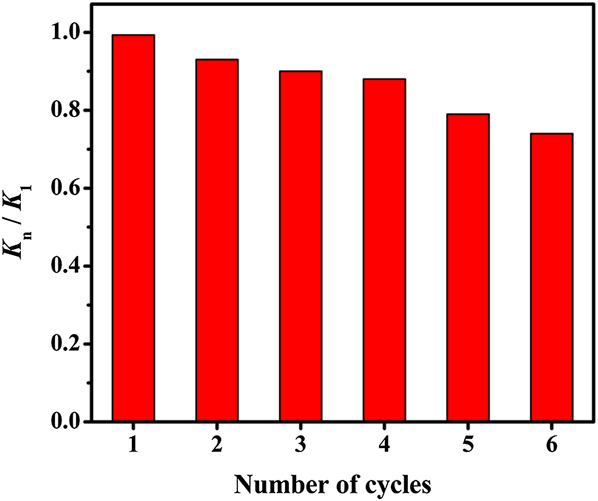
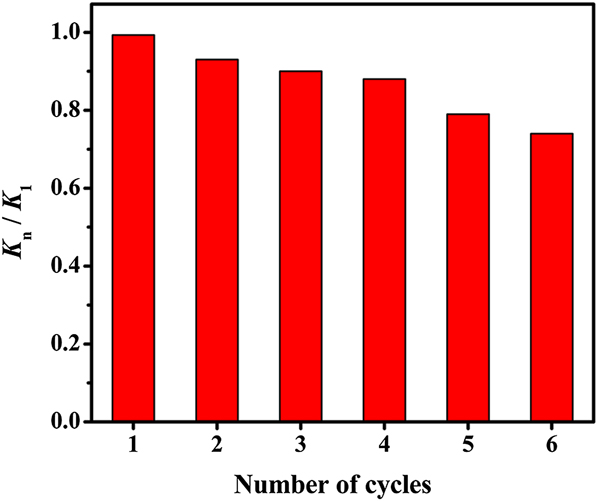
In addition to catalytic activity, the durability and reusability are other important concerns for a catalyst and should be taken into consideration from the viewpoint of practical applications of a catalyst. In this study, uniformly dispersed Co metal nanoparticles in carbon matrix can be easily separated from the reaction system by a magnet and the catalytic reduction of 4-NP with the recovered Co@C-600 catalyst was repeated 6 times. The ratio of k n to k 1 (k 1 and k n represent the rate constant of 4-NP reduction in no. 1 and no. n cycle, respectively) was applied to assess the durability and reusability of the as-prepared catalyst. Figure 10 shows that after 6 cycles of the catalytic reaction transforming 4-NP to 4-AP, Co@C-600 still retains approximately 75.4% of its original catalytic activity. Our Co@C-600 exhibits significantly better durability and reusability in the 4-NP reduction compared with recently reported catalysts. Reference Bhattacharjee and Ahmaruzzaman45,Reference Wu, Wei, Zhou, Wu, Liu, Ye and Wang48
k n /k 1 in different cycles of 4-NP reduction (T = 25 °C, the amount of the Co@C-600 is 0.02 mg/mL).
IV. CONCLUSION
In summary, a novel type of nanoporous hexagonal-shaped prisms Co-based material Co@C-600 has been successfully prepared by direct annealing of pre-synthesized Co-MOF-74. Co@C-600 exhibited superior catalytic activity, recycling efficiency and stability during the heterogeneous catalytic reduction of 4-NP to 4-AP under ambient atmosphere at room temperature. The unique structural features of Co@C catalyst allow its promising applications in other related catalytic reactions. More importantly, our results revealed that MOFs have a great potential for extension to other porous supports to immobilize nanoscale hierarchical catalysts for application in heterogeneous catalysis.
ACKNOWLEDGMENTS
Financial support from the National Natural Science Foundation of China (Nos. 21162027 and 21261022), the Graduate Student Research Innovation Project of Xinjiang (No. XJGRI2013016), and the Outstanding Doctoral Innovation Project of Xinjiang University (XJUBSCX-2012020) is gratefully acknowledged.