

Populism between strategy and ideology
Populism today falls among the most debated and controversial concepts. While some scholars have even recommended that this concept be completely dismissed, others have undertaken considerable efforts aimed at providing a shared domain to which to apply it. In order to add clarity to this strongly blurred conceptual domain, a useful starting point can be a distinction between two conceptions of populism: populism as ideology and populism as political strategy. These two conceptualizations underpin two clearly different approaches to the populist dynamics. Under certain circumstances, however, they can also be successfully combined (Urbinati, Reference Van Den Hoven2014).
Starting from the strategic perspective, Weyland (Reference Weyland2001) emphasizes the recurring features of the definitions of populism. Among these characteristics figure the adoption of a ‘personalistic, plebiscitarian style of political leadership’ whose social base is composed of an ‘amorphous mass’, a strategy of top-down mass mobilization aimed at bypassing the mediating role of institutions, the search by the leader for a direct contact or connection with a ‘largely unorganised mass of followers’, the adoption of instrumentally expansionary socioeconomic policies (Weyland, Reference Weyland2001: 5–9).
Ultimately, the author recommends the adoption of a process-oriented definition. According to this definition, populism should be looked at as a ‘political strategy through which a personalistic leader seeks or exercises government power based on direct, unmediated, uninstitutionalised support from large numbers of mostly unorganised followers’ (Weyland, Reference Weyland2001: 14). In this respect, populism is therefore viewed as a strategic approach aimed at maintaining and reinforcing the leadership status.
According to the second conceptual approach (populism as a political ideology), society can be divided in two opposite fields: one field is embodied by the people, the other by the political elites (Wiles, Reference Wiles1969; Laclau, Reference Laclau1977; Canovan, Reference Canovan1999; Mudde, Reference Papadopoulos2004; Kriesi, Reference Kriesi2014; Kriesi and Pappas, Reference Kriesi and Pappas2015). More specifically, Mudde believes that these are two homogeneous groups in terms of the key characteristics they share. The people are pure while the elites are corrupt. Kriesi and Pappas (Reference Kriesi and Pappas2015) interestingly note that within this scenario politics cannot be other than an expression of the volonté générale’, which relies on the combination of four distinguishing features, such as the existence of two homogeneous groups, a firm opposition between these two groups, the sacredness of the idea of popular sovereignty, and the ‘valorization’ of the key opposition (us, the pure people, vs. them, the corrupt elite).
The reliance on the populist ideology results in the development of specific ‘discursive patterns for identifying foes and solidifying the community of friends’ (Kriesi, Reference Kriesi2015: 178). Jagers and Walgrave (Reference Jagers and Walgrave2007) look at the concept of populism as a discursive pattern/political communication style. This angle can be particularly useful to operationalize populism as an ideology. Indeed, this ideology becomes ‘visible’ in the political leaders’ discursive patterns and in the political communication strategies they adopt, especially during election campaigns. The overlap between style and ideology can be so marked that some authors believe the two cannot be really and fully discernible (Kriesi and Pappas, Reference Kriesi and Pappas2015).
These views of populism share a crucial characteristic, which is pivotal to a correct understanding of modern populism. In fact, it is shown that populism is inextricably linked to, and displays a natural connection with how leadership is exerted and communicated. In this respect, populism is necessarily intermingled with the processes of political personalization (Rahat and Sheafer, Reference Roberts2007; Garzia, Reference Garzia2011; Kriesi, Reference Kriesi2012), presidenzialization (Poguntke and Webb, Reference Poguntke and Webb2007), and mediatization (Campus, 2010; Mazzoleni, 2014; Strömbäck, Reference Taggart2008), which most Western democracies are experiencing. In particular, populism identifies specific forms by which the social base, the people, are appealed to by the political leaders via the media. This article aims at showing how party leaders make use of different elements of populism in their discourse. Indeed, by showing how differently political leaders can use the media to appeal to their social base, and by also showing how differently the media themselves treat the category ‘people’ depending on the political leader to which attention is paid, it is also possible to grasp an understanding of the idea of people each leader has. This approach enables us to understand which political actor tends to appeal to the people in a way that is closer to the criteria identified by Kriesi and Pappas in the definition of populism as an ideology, a definition to which this article sticks, keeping in mind, however, that the adoption of a certain ideology necessarily results in the adoption of a certain style.
The role of the people in the characterization of populism
The populist communicative style is a primary tool by which the populist ideology seeks to further strengthen and emphasize the role of the people within a permanent opposition against the corrupt elite. The key objective is to claim the supremacy of the people themselves (Mény and Surel, Reference Mudde2002). In this respect, it is important to note that many authors have introduced indexes to operationalize populism, which included several elements such as political posters and speeches, press releases, etc. (Pauwels, Reference Rahat and Sheafer2011; Rooduijn and Pauwels, Reference Rooduijn and Pauwels2011; Bruhn, Reference Bruhn2012; March, Reference March2012; Rooduijn et al., Reference Rooduijn, de Lange and Van Der Brug2014). This article, however, is not aimed at measuring populism.
Rather, the key argument that this article makes is that while some approaches to the study of populism stress the dimension of leadership (how leadership is exerted and communicated), the role played by the leaders’ ‘social base’, the people, is considerably under-researched. In this respect, however, two points deserve to be highlighted. With few exceptions, there is little agreement in the academic literature as to how strong the tie between leadership and populism actually is. Second, the Latin populus represents the direct etymological root of the concept of populism, which suggests that the dimension of leadership alone may not be sufficient to thoroughly represent the phenomenon of populism.
People today is a neutral term which only gains a connotation when it is properly contextualized. In other terms, it is the adjective that politicizes the noun by shedding on it an aura of emancipation and collectivism (Badiou et al., Reference Badiou, Bourdieu, Butler, Didi-Huberman, Khiari and Rancière2013). The adjectivation of the people can sometimes produce identification. Other times, it can describe the nature of the legitimacy that a political system enjoys (e.g. sovereign people). In short, depending on the type of adjectivation, the concept of people can gain different characterizations. One of these meanings mostly pertains to the racial and adversarial implications behind the establishment of a type of identity that is closely circumscribed within its boundaries and wants to remain so. In this case, people rely on the state in the capacity of protector of their uniqueness. A second characterization pertains to the people as a group of individuals who share an historical path. In this case, the people forerun the state although their existence may have been denied by an oppressive agent (e.g. a colonizing power). However, regardless of the nature of its characterization, the concept of people has often been treated homogeneously and uniformly, paying little attention to the different meanings it can acquire in a nation’s political discourse. This approach is also reflected to a significant extent in the way in which the concept of people is treated by scholars who have been dealing with the phenomenon of populism.
As already mentioned, the Majoritarian rule is central in the populist perspective. Indeed, it is the tool by which the general will (Kriesi and Pappas, Reference Kriesi and Pappas2015) can be fulfilled and implemented (Canovan, Reference Canovan2002). In this perspective, the people is conceived of as one entity with clearly defined boundaries. Interestingly, these boundaries can never be crossed. The demarcation between who belongs to this group and who falls outside it cannot be filled. As to the nature of these boundaries, Canovan identifies two perspectives. The first perspective relies on a view of the people as a legitimate sovereign. In this case, the people are naturally opposed to the political elites, which illegitimately exert power on behalf of the people. The second perspective uses the people to reinforce a common identity and views all of the adversaries as others. These others conspire against the people, which are therefore called on to come together and unify against this external threat.
Mény and Surel (Reference Mudde2002) analyse the populist discourse and mind-set by looking at two key elements: the valorization of the people and the ideological foundation of populism. The first of the two elements is crucial to the analysis that is carried out in this article. In this respect, the two scholars believe that the concept of people needs to be deeply and systematically analysed in order to shed light on the content of populism and better understand its multifaceted nature. Indeed, the people as an ‘imagined community’ can acquire various meanings in the populist perspective.
Jagers and Walgrave (Reference Jagers and Walgrave2007: 322) claim that populism relies on a view of people as a ‘monolithic group without internal differences’. This monolithic group is exclusively composed of ‘common men’, ordinary people, a conceptual construct upon which the populist leaders place a strong, some say ‘pathetic’ emphasis (Krämer, Reference Krämer2014: 45). This view is also reflected in Taggart’s conceptualization of heartland. According to Taggart (Reference Urbinati2004b), the heartland is a place with uncertain, or even non-existing boundaries. This vagueness is exploited by populist leaders who appeal to the people to justify and legitimize their views and credos. However, it is precisely this high degree of vagueness that makes it possible for political leaders to appeal to the people in different and changing ways. The high level of uniformity of the people that Taggart hypothesizes does not necessarily result in a uniform approach by politicians. This represents a strong argument in favour of the necessity of better understanding how the people can be appealed to. What is precisely meant by heartland can considerably change depending on which politician is taken into consideration. As Mudde (Reference Papadopoulos2004) notes, for the British National Party, the heartland was constituted by ‘the native British people’, a circle with precise and specific boundaries that considerably differs from both Taggart’s definition of heartland and Jagers and Walgrave’s approach to the role of the people. Another important scholar, Laclau (Reference Laclau2005), claims that populism can gain changing characteristics depending on each country’s political discourse. The author interestingly refers to ‘the people’ by highlighting its role in serving collective political actors and ideologies.
This article aims to show that on the one hand, appeal to people can actually be functional for a political leader to maximizing his or her political and electoral performance. On the other, if we assume that the concept of ‘the people’ identifies a circle-shaped group, attention automatically needs to be paid to the criteria according to which some people fall within and some outside it. Therefore, the article maintains two arguments. The use of and reliance on populist accents by political party leaders can sometimes be favoured by the particular circumstances under which a democratic country finds itself, such as the occurrence of an election campaign or an economic crisis (Knight, 1998; Roberts, 1995). Second, the article states that the way in which people(s) are appealed to underpins a precise idea of who should be part of that group and who should instead be left out. To analyse this mechanism, we start by looking at the work by Jagers and Walgrave (Reference Jagers and Walgrave2007). By making use content analysis techniques, the two authors try to operationalize three elements of the populist discourse: an ‘appeal to the people’, where there is an explicit reference to the people in general; an ‘anti-elite feelings’ towards anti-politics, anti-state, and anti-media statements; and an ‘exclusion strategies’ with the exclusion of ‘others’ who do not belong to ‘the people’. Scholars such as Rooduijn and Pauwels (Reference Rooduijn and Pauwels2011) use two indicators in developing content analysis: people-centrism and anti-elitism. March (Reference March2012) adds a third indicator: popular sovereignty. This approach, on which this articles relies, acquires value due to the emphasis placed on three crucial characterizations of the way in which the people can be appealed to and brought within the political game.
For ‘people-centrism’, the people is considered as monolithic entity, in unequivocally positive terms, and the public speaker has to identify with the people. ‘Anti-elitism’ denotes a view of elites in general in unequivocally negative terms. ‘Popular sovereignty’ is operationalized as calls for augmented power to the people. Whereas the three dimensions necessarily need to jointly occur for populist discourses to take place and develop, some leaders or political parties might display the tendency to more strongly emphasize one of these three dimensions.
Methodology and design
In general, studying populism poses various problems. As said, Rooduijn and Pauwels (Reference Rooduijn and Pauwels2011) have proposed two different ways to approach populism in political manifestos: classical content analysis and computer-based content analysis. However, populist ‘messages’ have become stronger in public debates as well (Rooduijn, Reference Rooduijn2014). By following this approach – which only considers two components of populism: people-centrism and anti-elitism – our article takes into account media coverage and aims to complement this perspective with the third dimension (popular sovereignty) proposed by Jagers and Walgrave, and March. The research questions to which this article responds follow:
Looking at the three dimensions of populism on which this article relies, is it possible to identify associations between the three dimensions and the major political leaders in Italy? How do these connections impact on the way in which the people are conceived of and appealed to?
In this respect, it is important to clarify one point. According to the perspective that is here followed, the three dimensions need to jointly occur in order for populist discourses to take place. Therefore, exhibiting a leaning or tendency towards one dimension or another is not sufficient for a leader to be characterized as populist. However, even if only one dimension occurs, it is still possible to strengthen our understanding of the characterization of populism. Indeed, although no dimension alone is sufficient to generate populism, all of them are closely interlinked with this phenomenon and certainly contribute to how it shapes up and develops. Therefore, if an association occurred between one political and a specific dimension of populism, that would certainly not be enough to make that leader a populist, irrespective of what the dimension is. That said, understanding the nature and meaning of these associations can actually say a lot as to how the selected party leaders actually differ from populist politicians.
Therefore, consistent with the ideological definition that this article looks at and strongly relies on, this approach is aimed at understanding the idea of people that lies behind the (allegedly) different ways in which the people is appealed to by different political leaders and the different way in which the media treat ‘the people’ depending on the political actor to which attention is paid.
To answer these research questions, coverage from the two most important quality newspapers in Italy, Corriere della Sera and la Repubblica,Footnote 1 was analysed. The decision of selecting Italy as a case study is best understood in the light of the transformations facing today’s Europe. For some scholars the rise of the populism phenomenon in Western Europe represents a reaction to the failure of political parties to be responsive to several issues: economic and cultural globalization, the European integration, immigration, the decline of ideologies, the growth of corruption in the political elite, etc. (Taggart, Reference Taggart2004a; Albertazzi and McDonnell, Reference Albertazzi and McDonnell2007). Indeed, it is acknowledged that several European countries have been and still are experiencing the rise of populist right-wing parties. Within this scenario, the case of Italy displays several elements of interest. Indeed, while the Mediterranean country, too, is having to deal with political parties whose modus operandi could easily be classified as populist, it would be misleading to make those parties indiscriminately fall within the category of right-wing parties. Rather, Italy is dealing with populist tendencies inspired by factors that have little to do with those parties’ placement on the political spectrum. Factors such as territorial belonging (Lega Nord), anti-politics and anti-establishment feelings [MoVimento 5 Stelle (M5S)], identification with a charismatic leader and acceptance of the leader’s idea of politics/society [Forza Italia (FI)], seem to be playing a particularly strong role (Bobba and McDonnel, Reference Bobba and McDonnel2015). Additionally, attention needs also to be paid to the role played by the Partito Democratico (PD) in this process. This party stemmed from the ‘cold fusion’ of the two most important ‘political traditions’ in Italy, that is, the communist and the Christian democrat ones. After Matteo Renzi’s rise to power, however, the PD drastically transformed into a vertical party, which is increasingly less dependent on the mediating role of its ‘organizational structure’ in the process of leadership selection. With that being said, it would be misleading to look at Renzi-led PD as a populist party. As stated, multiple conditions need to simultaneously occur for populism to take root and thrive. However, given the process of transformation that the PD has been undergoing, as well as Renzi’s ability to bypass the party’s organizational structure in order to try and get in tune with his people without mediation, today’s PD cannot be left out of a study that aims at companying the way in which democratic party leaders appeal to their people. With reference to this point, Mudde argues that ‘the current success of populist actors cannot be separated from the general trend towards strong party leaders and more direct communication between party leadership and party supporters’ (Reference Papadopoulos2004: 545). Furthermore, through the use of multiple examples, Mudde clearly shows that political parties can occasionally display populist tendencies and accents without necessarily being populist parties. These accents and tendencies can be particularly exacerbated under specific conditions such as the occurrence of an election.
This is the main reason behind our choice of the period of analysis: 30 March to 1 June 2014. It corresponds to the period of time between 8 weeks before and 1 week after the European Parliament Elections that were held on 25 May 2014. This selection is methodologically justified in the light of the nature of the phenomenon under study, which is the use of the term ‘the people’ and the different ideas of social base that lie behind the way in which the term is used. In this respect, as said, it should be mentioned that the election campaign is an inherently controversial phase within a country’s democratic life. It is a phase in which successfully appealing to people is vital for a political party to perform well. As a consequence, during an election campaign, appeals to the people can be stronger and more recurrent. In addition to that, it should be noted that this article deals with an European Parliament election campaign. Many scholars (Van Den Hoven, 2006; Papadopoulos, Reference Pauwels2010) have highlighted that European Union (EU) institutions are often privileged targets of the member states’ blame-shifting strategies. Therefore, the EU appears like an ideal terrain on which anti-elite and anti-establishment attitudes can flourish. Indeed, it is certainly not surprising the fact that Taggart claims that ‘Euroscepticism has often taken an anti-elite form, championing the mass demands for more representation and less integration’ (Reference Urbinati2004b: 270). In Taggart’s perspective, Euroscepticism is one of the main drivers of populism, and one of the most significant examples of ‘populist potential’.
As for the content analysis, the full content of 128 issues of Corriere della Sera and la Repubblica (64 issues/title) was analysed via the newspapers’ on-line archives. The unit of analysis was the single sentence, phrase, or paragraph in which one of the Italian words popolo or gente appeared. The decision to stick to these two words was taken on the grounds that people can be translated in Italian as popolo (which is closer to the Latin root) or gente, depending on the speaker’s semantic intention. Furthermore, these are two expressions that politicians often make use of to appeal to people in a similar way to how the populist leaders do. Being the single phrase or sentence the unit of analysis, it was sometimes possible to identify multiple units of analysis within a single newspaper article.
A total of 3063 units of analysis were identified and collected, although a number of them could not be used for analysis as in those cases popolo or gente were used as proper nouns (e.g. Piazza del Popolo in Rome, the weekly magazine Gente, etc.). Per each unit of analysis, in addition to the unit’s identification items (date, local vs. national issue, newspaper section in which the article appears), four key variables were coded: the unit’s primary topic, the unit’s central actor (and his/her political party if the actor was a politician), the connotation of ‘people’, and the components of populism. The primary topic identifies the main issue upon which the unit is centred (e.g. education, elections, foreign policy, etc.). The central actor identifies the actor who makes use of the word ‘people’ or in relation to whom the word is used. The connotation of ‘people’ refers to the previously mentioned process of adjectivation of ‘people’ by which the people gain political significance. It should be noted, however, that by coding this variable, the objective was not exclusively to identify adjectival forms. Rather, it was to select for analysis any item (adjectives, nouns) that could be helpful to describe or connote the word ‘the people’ (e.g. the people of the web).
Finally, as previously said, three components of populism: ‘people-centrism’, ‘anti-elitism’, and ‘popular sovereignty’, were identified.
The selected units of analysis were analysed by creating a codebook as a first step. The fundamental question on which the codebook builds is: Do the single sentences, phrases, or paragraphs emphasize people-centrism? We looked at the context within which an article was situated to make a decision on whether or not a unit of analysis could be considered people-centric. In particular, we classified as people-centric those articles in which the category ‘the people’ is described as a monolithic entity or in which politicians stand out and speak on behalf of the people (e.g. ‘I am in politics with the people, for the people and their needs’, la Repubblica, 25 May 2014; ‘On behalf of the American people, I have had the honour of …’, la Repubblica, 31 May 2014).
Anti-elitism was identified by answering the following question: Do the units of analysis refer to ‘the people’ in order to criticize or oppose elites? Examples for anti-elitist use of the word ‘the people’ can be found in the following samples: ‘We will bring Grillo’s people together, will besiege the Quirinale palace and we will convince Napolitano to dissolve the Chambers …’, la Repubblica, 25 May 2014; ‘Lega Nord’s people responded as anticipated: they booed the Ministry of Interior but cheered the ‘activist’ governor’, Corriere della Sera, 5 May 2014; ‘Italy is tired of bearing these expenses just to please the political class, which, as usual, only care about its own interests rather than those of Italy’s people’, Corriere della Sera, 28 April 2014.
Finally, ‘popular sovereignty’ was identified by answering this question: Do the units of analysis refer to the people to increase its power and/or exclude other people on behalf of popular sovereignty? The ‘others’ identifies those who do not belong to ‘the people’ according to criteria such as identity, race, or ideology. In other terms, popular sovereignty occurs when the people is not only valued as virtuous, but also when it is associated with more power. In this respect and according to this approach, democracy is not an end in itself, but a tool to achieve people’s power (Canovan, Reference Canovan1981).
For example, ‘They won’t stop us: They will be overwhelmed by Padania’s people!’, la Repubblica, 06 April 2014. Admittedly, in some cases it was not always possible to clearly and unequivocally place the unit of analysis within one category or another. In those cases, a decision was made by looking beyond the mere unit of analysis and by understanding the context within which and the conditions under which a press item had been published.
By partly adhering to the strategy that has been recently adopted by Althaus et al. (Reference Althaus, Swigger, Chernykh, Hendry, Wals and Tiwald2014), inter-coder reliability was calculated for these four variables. Prior to carrying out the analysis, the authors (who also acted in the capacity of exclusive coders during the process of data collection) analysed every tenth unit of analysis per each newspaper (the reliability test was therefore conducted on 298 units). PRAM reliability testing software by Cleveland State University’s Kimberly A. Neuendorf was used to calculate inter-coder percentage agreement, which ranged between 87% (connotation of ‘the people’) and 99% (central actor). As for inter-coder reliability statistics, Cohen’s κ was calculated for the multinomial variables (actors, topic, and connotation). The lowest level of Cohen’s κ was 0.85 (connotation). As far as the degree of inclusiveness/exclusiveness of ‘people’ is concerned, Krippendorff’s α (ordinal) was calculated by using the ReCal OIR (Reliability Calculator for Ordinal, Interval, and Ratio data) software by American University of Washington’s Deen Freelon. The value of κ that was obtained is 0.84. It was therefore concluded that the data could be considered satisfactorily reliable.
An analysis of the relationship between variables serves to look at the possible associations that can be helpful to explain crucial elements in our research. The first association that was analysed is the one between the components of ‘populism’ and the topic that is discussed in the unit of analysis, and in relation to which ‘people’ is used. The second one relates to the relationship between the components of populism and the political parties with which each degree is associated. To do that, correspondence analysis (Greenacre, Reference Greenacre1984, Reference Greenacre1993) was used. This methodology allows analysing multinomial qualitative variables, by geometrically representing the contingency table that contains the associations. Furthermore, this approach can be helpful to design perceptual maps by reducing the qualitative variables’ complexity. Complexity is reduced by analyzing a row variable (the three components of populism) in relation to two column variables taken separately (topics and political parties). By following the technique of correspondence analysis, it was possible to identify the scores (i.e. the coordinates) of the modalities of the row variable against a bi-dimensional space based on the modalities of the column variables. The dimensions that are able to synthesize the information contained in the contingency table in a bi-dimensional space were identified through the adoption of a procedure of optimal scaling. The objective is to maximize the variance between alternative modalities, by attributing 0 to the mean of the medium profile and 1 to the variance of the medium profile.
Results
The people and the campaign issues
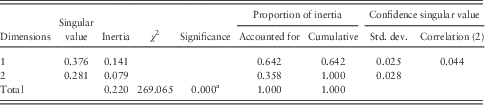
As said in the previous section, correspondence analysis was first used to assess association between the components of populism and the topics on which the units of analysis were centred. An analysis of the issues can be relevant to the study’s research questions because, as political communication literature reveals, news items, issues, and topics are rarely neutral. Especially so during a naturally controversial moment such as an election campaign. In this respect, De Vreese (Reference De Vreese2005: 54) highlights that certain frames are only ‘pertinent’ to specific issues. In other words, issues can acquire specific values due to some of the characteristics they inherently carry. This section is aimed at emphasizing these characteristics and verifying how these relate with the three dimensions of populism. A preliminary analysis (Table 1) of the row-normalized correspondences (46 d.f.) shows a significant χ 2 Footnote 2 (P<0.000), whose value is 269.065. This value identifies a good association between the two variables’ modalities, allowing us to reject the hypothesis of independence between variables. Furthermore, inertia for the two dimensions explains 100% of the model.Footnote 3 Std. dev. equals, respectively, 0.025 and 0.028. Correlation is low: 0.044.
Summary of components of populism vs. topic

a 46 d.f.
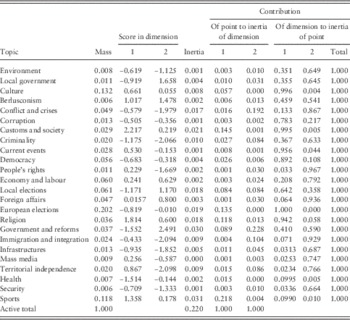
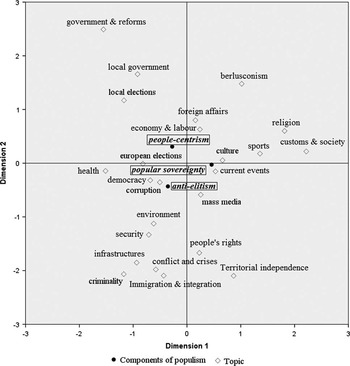
On the other hand, an analysis of the columns reveals a number of interesting elements as regards the two dimensions (Table 2). The scores of the column modalities enabled us to identify the two dimensions on the perceptual map. Dimension 1 is positively characterized by the topic ‘customs and society’ (2.217) and ‘religion’ (1.814), while it is negatively characterized by the following topics: ‘government and reforms’ (−1.552) and ‘health’ (−1.514). Dimension 2 displays positive values in relation to ‘local government’ (1.658) and ‘government and reforms’ (2.491), while it is negatively associated with ‘conflicts and crises’ (−1.979), ‘criminality’ (−2.066), ‘immigration and integration’ (−2.094), and ‘territorial independence’ (−2.098). In short, Dimension 1 was defined as ‘religion’ (+) vs. ‘reforms and public expenditure’ (−), while Dimension 2 was defined as ‘reforms’ (+) vs. ‘decentralization and security’ (−).

Row normalization made it possible for row modalities (components of populism) to be interpreted against the two dimensions that have been drawn from the analysis. The following step was to calculate the angle formed by the two vectors originating in the point (0,0), and the directions determined by the coordinates of the row and column points, in relation to which association is calculated. The formula is as follows:
 $$\theta {\equals}\left[ {{\rm arccos}\left( {{{r'c} \over {\,\mid\!\,\!\mid\,\!\!\!r\,\!\!\!\mid\!\,\!\mid\,{\times}\,\mid\!\,\!\mid\,\!\!\!c\,\!\!\!\mid\!\,\!\mid\,}}} \right)} \right]{\times}\left( {{{180} \over \pi }} \right),$$
where ‖r‖ is the length of the vector originating from (0,0) whose direction is defined by the coordinates of the row point r. It can be calculated by using Pythagoras theorem. ‖c‖ is the length of the vector originating from (0,0), whose direction is defined by the coordinates of the column point c. It, too, can be calculated by using Pythagoras theorem. Finally, r'c is the vector scalar product (Figure 1):
 $$\mathop{\sum}\limits_q {r_{q} {\times}c_{q} .} $$
Correspondence analysis of components of populism and topic.

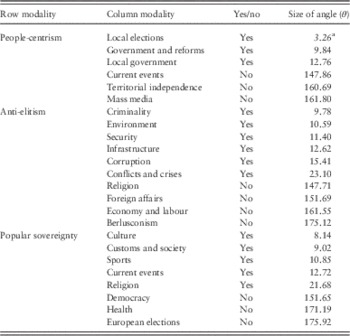
The calculation of the anglesFootnote 4 (and of the type of association with certain topics) allows tracing a profile of the three components of populism (Table 3). First, ‘people-centrism’ displays a significant association with topics related to government and administration, as well as with the European and local election campaigns.Footnote 5 Conversely, this dimension is weakly associated with ‘current events’, ‘territorial independence’, and ‘media and information’. Second, ‘popular sovereignty’ shows close ties with topics in relation to which identity generally plays a strong role. Topics, which is to say, in relation to which emphasis is placed upon the importance of belonging to a group rather than upon the contrast and differences with other groups. In this respect, identity is treated in a positive manner. The topics are ‘culture’, ‘sports’, and ‘religion’. The degree of association is weak with ‘health’, ‘public expenditure’, and campaign issues. Third, the ‘anti-elitism’ displays a close connection with such topics as ‘criminality’, ‘environment’, ‘security’, ‘conflicts and crises’, ‘corruption’. Association is weak with ‘religion’ and economic issues.
Size of angles and associations between row and column modalities

a Radian measure of a central angle, often denoted by the Greek letter θ, is defined to be the ratio of the arc length to the length of the radius.
The people and the political leaders
Once the strength of associations between ‘people’ and various topics is assessed, attention turns to the type of association between the components of populism with the main political parties running in the 2014 European Elections. The objective is to understand whether specific connotations of ‘people’ can be associated with specific political parties, and whether a classification of the types of people can be attempted. To do so, correspondence analysis was used again, maintaining components of populism on the rows and placing the political parties on the columns.
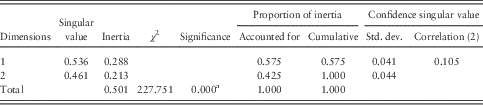
At first glance, the row-normalized correspondences (Table 4) show a significant χ 2 (P<0.000), with a value of 227.751, while inertia explains 100% of the model. Std. dev. (0.041 and 0.044) and correlation (0.105) have low values (although higher than in the previous analysis).
Summary of components of populism vs. political party

a 16 d.f.
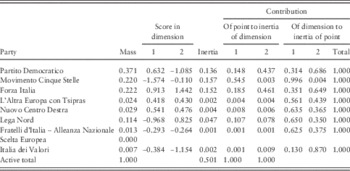
As for the scores for the column modalities (Table 5), data shows some important information as far as the two dimensions of the perceptual map are concerned. Indeed, Dimension 1 is positively characterized by FI (0.913) and PD (0.632). It is negatively characterized by M5S (−1.574). Dimension 2 shows positive values for FI (1.442) and negative values for PD (−1.085). In this case, the perceptual map is neatly distributed by referring to Dimension 1 as ‘systemic (FI and PD) vs. anti-systemic parties (M5S)’, and to Dimension 2 as ‘opponent (FI) vs. incumbent (PD)’.

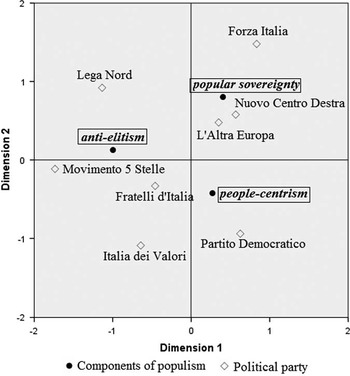
Figure 2 clearly shows the type of association between political parties and the three components of populism. ‘People-centrism’ is strongly associated with PD (θ=3.15), ‘popular sovereignty’ with FI (θ=1.75), ‘anti-elitism’ with M5S (θ=9.80).
Correspondence analysis of components of populism and political party.

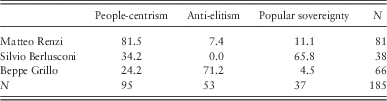
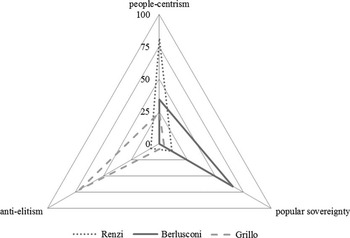
After analysing the characterization of ‘people’ against the political parties, it is possible to move on to examining the relationship between party leaders and components of populism. In this case, the analysis relied upon a contingency table thanks to which the distribution of the frequencies between three leaders, Silvio Berlusconi (FI), Beppe Grillo (M5S), and Matteo Renzi (PD), and the components of populism could be assessed. Table 6 (χ 2=142.237, P<0.000) reveals a significant association between specific components of populism and party leaders.
Party leader×components of populism cross-tabulation (%)

Figure 3 shows even more clearly the associations in question. Indeed, each of the three leaders reveals a marked inclination towards one specific component of populism. This data, if combined with a qualitative analysis of the newspaper articles, allows us to define the three different associations. Matteo Renzi is best defined against those articles in which ‘the people’ is used to signify ‘people-centrism’. Beppe Grillo is best characterized in articles in which ‘the people’ displays ‘anti-elitism’. Berlusconi leans towards a ‘popular sovereignty’.
Correspondence analysis of dimensions of populism and party leader (%).

Discussion
On the grounds of the data presented in the previous section, it is now possible to advance a possible interpretation of three different dimensions of populism. Starting with Partito Democratico, it has been clearly shown that the Italian main centre-left party, and its leader in particular (who is also Italy’s current prime minister), are closely associated with ‘people-centrism’. In this respect, it can be interesting to report various examples of how ‘people’ is used by Matteo Renzi and of how the media use this term when attention is devoted to Renzi. First, it is worth starting off by reporting a comment by a known Italian political scientist, Ilvo Diamanti, which appeared on the newspaper la Repubblica on 11 August 2014. The article falls outside the period of analysis, but Diamanti’s point is key to a correct understanding of the rationale behind our classification. Diamanti says that ‘Renzi managed to widen his and PD’s public by more than one third. He emptied Scelta Civica and UDC, while gaining a significant part of FI’s and M5S’s supporters. Equally, PD lost a considerable part of its ideological electorate, which has now been replaced by a personal electorate’.Footnote 6 The dimension of ‘people-centrism’ is here strongly emphasized and goes along with a central role played by the figure of the leader. Renzi, in the capacity of PD leader and prime minister, was the primary agent who transformed PD into an inclusive party. In this respect, the first dimension relies on a direct relationship between the leader and people. It is important to highlight one aspect. Due to its highly inclusive nature, this dimension does not place a strong emphasis on who is (or is not) legitimized to be part of the circle-shaped group identified by the term ‘people’. Emphasis is instead placed on the directness of the relationship between the leader and the people, regardless of who these people are. In fact, because of its inclusive ethos, this dimension ideally aims to include within its boundaries the highest number of people possible. Therefore, by maximizing its inclusiveness, this approach aims to nullify the differences between individuals, downgrading these differences to a mere obstacle that can be easily overcome by establishing an immediate and direct connection between the leader and a group of followers which lacks definite boundaries.
There are numerous examples that could be looked at to support this point. One of the most interesting ones relates to an article published in Corriere della Sera on 4 April 2014. In that article, Matteo Renzi is reported as using the word ‘people’ three times. He is quoted as saying: ‘People will judge us on the basis of what we will have achieved, and not of our empty promises’. Another statement by Renzi reads as follows: ‘People are with us and are tired of indefinite discussions and postponements’. Lastly, a final statement reads: ‘These reforms are in tune with what people think’. These examples well convey the core of our argument. By claiming a direct relationship not only with his people, but with the Italian people as a whole, Matteo Renzi acts as the people’s mouthpiece. He claims the validity of the reforms he is putting forward not only and not so much due to the merits of those reforms, but because they are in tune with what Italians really want. Therefore, in this case, the directness of the leadership–people connection is used as a source of legitimacy for the leader, who acts on behalf of the people themselves.
This directness, however, is not simply sought for by Renzi. Indeed, it is also acknowledged as one of Renzi’s key features by the Italian media commentators and observers when the figure of Italian prime minister is put under scrutiny. As an example, it is particularly interesting to refer to an article appeared on la Repubblica on 22 April 2014. In this article, it is claimed that ‘People need a common ground, something into which individuals can identify themselves […]. Renzi is more capable than anyone else to speak to the people and take up both symbolic and actual challenges. […] He speaks to people directly. To all of us. He stares at the camera and calls us by name’. The first dimension on which this article relies could not be described any better. Once again, emphasis is placed on the close connection that Renzi tries to establish with the people, while little or no attention is paid to understanding who these ‘people’ are, and who is believed to be in or out that circle-shaped group. Attention is not paid to that because, as argued, in this dimension understanding who is in or out is not really relevant. Conversely, speaking to each single individual is more important than establishing a shared identity. People are therefore addressed like a single, homogeneous entity, and this communicative style relies on the directness and immediacy of the relationship between leader and individuals. It is finally interesting to once again state that this dimension is strongly associated with topics related to government, reforms, and institutions. This aspect further shows that Renzi, in the capacity both of head of government and PD leader, strongly bets on delivering an image according to which the country is governed and reforms are put forward on behalf of the people.
Second, data revealed that FI and its leader, former prime minister Silvio Berlusconi, are strongly associated with ‘popular sovereignty’ in relation to how the term ‘people’ is used both by the members (and the leader) of that party and the Italian press. In this case, the variable of identity can be assumed to play a role. Therefore, in this case, the people to which FI and Berlusconi appeal are not constituted of a homogeneous and undifferentiated group of individuals. Rather, the circle includes people who share an identity. Also, the common ground they share represents a constitutive part of who these people actually are. In that form, however, greater emphasis is placed on what unifies the people within the circle rather than on what distinguishes them from those who fall outside it. As a result, the second dimension is identity based. The leader calls attention on the common elements and acts as the one who is best capable of giving voice and putting forward the needs and instances of his/her people. This approach also clearly emerges from the way in which use the term ‘the people’ in connection with Silvio Berlusconi.
Given the specific characteristics of this dimension, it can also be interesting to analytically look at how ‘people’ is used not by the leader, but by those who constitute the people. In this respect, in an article published in Corriere della Sera on 20 April 2014, Renato Brunetta, one of the leading figures within Berlusconi-led FI is quoted as saying: ‘Are you sure that [Berlusconi] is not eternal? Silvio Berlusconi is his people. They live in a perfect symbiosis. It is utterly impossible to even think of another leader who might embody so strong an identity’. It is possible to identify a number of similarities and differences with the previously discussed dimension. As for the similarities, both forms share the relevance of the figure of the party leader. Nevertheless, in the previous dimension, the type of contact (and connection) between the leader and the people is the fulcrum around which the political process rotates. In the present model, on the other hand, the function of the leader is primarily aimed to create identification between the leadership and the individuals to whom the leader speaks. In the dimension under consideration, falling within or outside the circle becomes a crucial discriminating factor.
It is possible to identify the same type of connotation in the way in which Italy’s principal printed outlets use the term ‘people’ in relation to FI and its leader. In one article appeared in Corriere della Sera on 7 April 2014, the topic of institutional reforms is discussed, and Berlusconi is reported as saying that he will obstacle the reforming process undertaken by Matteo Renzi. Furthermore, according to the reporter, ‘FI leader makes himself very clear at the party convention. He once again denounces ‘the four coups of the left-wing judiciary’, exacerbates his attacks on the executive, and calls his people on to unity’. It is interesting to point out how often the possessive adjective ‘his’ is used in regard to the way in which Berlusconi appeals to FI supporters. As a final remark, it is interesting to mention once again that the topics that are more strongly associated with this dimension were found to be culture, religion, and sports. As a matter of fact, it is possible to look at identification as the characterizing element par excellence of these social arenas. Furthermore, within Italy’s political spectrum, Silvio Berlusconi is the politician who best embodies the parallelism between sports (and football in particular) and politics. In this respect, an article published in la Repubblica on 10 May 2014 is emblematic. At the time, former AC Milan’s (the Berlusconi-owned football team) manager, Clarence Seedorf, is on the verge of being sacked, and Berlusconi seems to be backing the decision of getting rid of him. The author writes that ‘The words spoken by the boss [Berlusconi] do not leave room for misunderstanding. Other words will follow, though, because sacking a winning manager is an unpopular action and needs to be explained to the people of supporters, who, in Berlusconi’s universe, correspond to the people of electors’.
Shifting to the third dimension, the data showed that M5S and its leader, comedian Beppe Grillo, displayed a significant degree of association with the ‘anti-elitism’ component. This association was both found in the way in which Grillo directly appealed to the people and how the media used ‘the people’ in connection with Grillo. Therefore, in this respect it could be said that identity is no more used to emphasize a sense of belonging to a group that relies on shared values, beliefs, or attributes. Rather, in this case, identity and belonging to ‘the people’ are used in an adversarial way to remark distinctiveness and diversity from those who are not included in that group. Due to this aspect, this dimension is strongly similar to the definition provided by Mudde (Reference Papadopoulos2004: 543), who approaches the concept in terms of an ‘ideology that considers society to be ultimately separated into two homogeneous and antagonistic groups, “the pure people” vs. “the corrupt elite”’. Also, this dimension closely relates to the characterizations of populism as an ideology identified by Kriesi and Pappas. Therefore, the third dimension that emerges from this study does not primarily build on the direct connection between leader and individuals, and not even on a shared view of the world. Rather, it relies on opposition and diversity. This is the principal reason why in the dimension the key distinction is between ‘the people’ and ‘the others’. And it does not really matter who the others are. As long as they cannot be classified as ‘the people’, they indiscriminately fall within the category of the corrupt elite.
Given this type of scenario, it is certainly not surprising that this dimension was found to be closely associated with a topic such as, for example, corruption. Equally, Beppe Grillo’s M5S, and, to a less significant extent Matteo Salvini’s Lega Nord, seem to be the natural carriers of this exclusive connotation of ‘people’. Furthermore, an aspect that is worth highlighting is that Beppe Grillo exhibits a dual way to refer to ‘people’, which is strongly consistent with Mudde’s dichotomy. One way is used to appeal to the pure people, in which case the accents and tones are emancipatory and positive. Another way ‘people’ can be made use of is to connote ‘the others’, in which case ‘people’ acquires markedly pejorative accents. In either case, though, the element of exclusiveness is strongly highlighted.
An interesting example for this phenomenon can be found in two articles, both of which were published in la Repubblica (on 7 May and 23 May 2014, respectively). The first article covers Grillo’s campaigning activity and reports about a speech held by the comedian in the city of Bari. During his speech, Grillo calls Renzi’s leadership into questions and says: ‘He’s dangerous! These people must not only be fought. They must be thrown away like you do with food gone bad. It is either us or them’. In the second article, ‘people’ identifies Grillo’s circle, due to which tones and implications dramatically change as compared with the previous example. In fact, in another speech Grillo shouts: ‘We are the moral people, while they have become bankers’ party, a party that only pursues the interests of the big lobbies!’. Although the expression under exam has been used in a considerably different way across the two articles, attention should be paid to the fact that in either case an opposition clearly stands out, an opposition between ‘us’ and ‘them’.
In conclusion, the three dimension that are identified in this article are clearly tailored on the three-party political system that is currently characterizing Italian politics. Nevertheless, this classification can (and is hoped to) provide a different angle from which to look at populism in established democracies. This article does certainly not aim to question the centrality of the dimension of leadership, which, as maintained, is inextricably and indissolubly linked with the phenomenon of populism. Having said that, however, the article also maintains that taking into consideration the various forms by which people can be addressed and appealed to by their leaders can represent an additional strategy thanks to which to gain an even more granular understanding of such a complex phenomenon.
Conclusions
This article showed that to properly understand today’s populism in Europe, an analysis of party leadership needs to be accompanied by a critical assessment of how the people are appealed to by their leaders. Admittedly, there are some limitations of this study, the most important of which probably is generalizability.
Having said that, though, this article provided an interpretation of populism that can be suitable to envisage how populism will evolve in tomorrow’s Europe, not only in Italy. More specifically, there are two ways in which this article contributes to advancing knowledge in the field of populism. First, it provides an empirical assessment of how differently, in an inherently controversial phase of a country’s democratic life, the election campaign, party leaders of different nature, background, and political affiliation, can appeal to the people of their (potential) supporters.
Second, depending on how the people are appealed to by their leaders, the article identified and empirically discussed three dimensions of populisms in today’s Italy. The first form looks at appeals to people as a way to communicate with every person, regardless of his or her political beliefs. This dimension relies on the directness and immediacy of the relationship between leader and individuals. The second dimension is based on an identity-based form of communication. This form places greater emphasis upon what unifies the people within a given circle rather than what distinguishes them from those who fall outside it. Third, appealing to people can become a communicative strategy aimed at stressing the differences between the pure people and the corrupt elites. In this dimension, the sense of identity is used in an adversarial way to claim distinctiveness from those who are not included in that group.
This categorization provides a renewed understanding of the phenomenon of party populism. Whether or not this conceptualization can be useful to fruitfully understand this phenomenon in other established democracies, too, is for further research to find out.
Acknowledgement
The authors thank the discussant and the attendees for their comments and insights, which were crucial to the development of the paper.
Financial Support
The research received no grants from public, commercial, or non-profit funding agency.
Data
The replication dataset is available at http://thedata.harvard.edu/dvn/dv/ipsr-risp