Different goods have different production functions. The types of goods produced by an economy are bound to influence its development path. This influence is more apparent in economies with a prominent, undiversified primary export sector, as highlighted by the staple theory of growth (Innis Reference Innis1930, Reference Innis1940). The production function of export staples determines factor demands and the distribution of income. In addition, the backward and forward linkages of staples determine investment opportunities in other activities. Thus, the features of staple products can shape the whole economy and have a marked influence on the process of growth and structural change.
This paper examines how primary production patterns shaped development across local economies in Argentina. In the late nineteenth and early twentieth century, Argentina underwent a rapid process of integration into the international economy as an exporter of primary goods. The leading staples were ranching products and cereals, which had contrasting features along multiple dimensions. Ranching was characterized by an extensive production system, whereas cereals were labor-intensive and usually more intensive in the use of inputs and capital. Cereals’ main forward linkage, flour mills, often located close to their input sources, while ranching’s main forward linkage, meat-processing industries, were concentrated around the Buenos Aires port.
Taken together, ranching products and cereals represented the greater part of the country’s exports and employed most of the land in the Pampas, Argentina’s core agricultural region. At the same time, there was considerable variation across local economies in the prevalence of each staple, partly due to variation in climatic features. This is an interesting context to examine the effects of primary products on the process of development.
Our identification strategy exploits the climate-induced variation in the agricultural production mix. In particular, we construct an instrumental variable (IV) based on high-resolution spatial data on climate- based potential yields for pastures, wheat, corn, and flaxseed. The IV is based on the estimation of a fractional multinomial logit (FML) model of crop choice in which the county-level shares of primary products in total agricultural land use are functions of the product-specific potential yields. In particular, the predicted share of ranching in local agricultural land (“potential ranching specialization”) can be used as an IV for actual ranching specialization.
We find that localities specializing in ranching historically had weaker linkages with other activities, higher land concentration, lower population density, and less immigration of Europeans. In terms of linkages, ranching areas had less investment in agricultural machinery, lower railroad density, and weaker development of agro-processing industries. Moreover, ranching’s extensive production system was conducive to land concentration, presumably increasing income inequality. In addition, ranching’s low labor intensity led to low populations densities. Thus, ranching areas were likely to have thin local markets and limited agglomeration effects. Finally, ranching localities had low shares of European immigrants, whose skills were more complementary to cereal production. In turn, the European presence in cereal-producing areas created an advantage for industrial and commercial activities.
After studying how ranching specialization shaped local economies historically, we move on to show how it hampered subsequent development. The importance of ranching was lessened as the national economy industrialized and diversified, but the influence of early ranching specialization across local economies did not wash out over time. The negative effects on population density and urbanization were remarkably persistent. Moreover, ranching locations displayed weaker industrialization, with lower skill intensity in manufacturing activity. Ultimately, ranching had negative long-run effects on income per capita and education. According to our estimates, a reduction of one standard deviation in ranching specialization would increase long-run levels of population density and income per capita by 0.35 and 0.52 standard deviations, respectively.
Our results suggest that the composition of agricultural production shaped the process of development in multiple ways. We highlight the likely feedbacks among the various channels mentioned previously without attempting to assess their relative importance in accounting for the long-term effects of ranching specialization. We discuss some potential forces that cannot be captured in our subnational analysis but may be relevant from an aggregate perspective, possibly affecting the overall effects of ranching on development.
We examine three other mechanisms through which ranching may have affected development. First, ranching could have been associated with differential productivity growth or export prices in the primary sector, which may have affected the reallocation of labor to the industrial sector. Second, ranching differed from cereal production in terms of seasonality patterns, which may have had implications for the process of structural change. Third, the association of ranching with land concentration suggests possible negative effects on education through political economy mechanisms. Based on an assessment of available evidence, these channels do not seem relevant in our context.
Our regressions control for state fixed effects, land productivity measures, and other geo-climatic features that might be correlated with ranching specialization and have direct effects on development, such as precipitation, temperature, elevation, terrain ruggedness, and distance to Buenos Aires City. Given that our IV is based on measures of productivity for specific crops, it is important to control for overall agricultural productivity to mitigate potential concerns about the exclusion restriction. In our robustness checks, we show that flexibly controlling for multiple measures of land productivity in a variety of specifications does not affect the results. Our findings are also robust to accounting for spatial dependence using Conley standard errors with various distance cutoffs.
This paper contributes to a large literature on the role of agriculture in economic development (e.g., Johnston and Mellor Reference Johnston1961; Gollin Reference Gollin2010). In particular, we add to a strand of this literature that studies the effects of specialization in particular products as a result of their distinctive features, for instance, returns to scale, seasonality, or labor intensity (Engerman and Sokoloff Reference Engerman and Kenneth L.1997; Sokoloff and Dollar Reference Sokoloff1997; Eberhardt and Vollrath Reference Eberhardt and Dietrich2018). We rekindle the staple theory of economic growth (Innis Reference Innis1930, Reference Innis1940) and the theory of linkages (Hirschman Reference Hirschman1958), examining various ways in which primary products can shape the process of growth and structural change. We exploit rich subnational variation and propose a modern empirical strategy aimed at identifying the causal effects of primary products on development, like the recent contributions of Bustos, Caprettini, and Ponticelli (Reference Bustos, Bruno and Jacopo2016) and Dell and Olken (Reference Dell and Benjamin2020). We are the first to do this with data from Argentina, leveraging the presence of two salient staples with contrasting features within the same macro-institutional context.
We also contribute to Argentina’s economic historiography. A prominent theme in the literature is the “Argentine puzzle” (Della Paolera and Gallo Reference Della Paolera and Ezequiel2003; Taylor Reference Taylor2018)—the contrast between the glowing prospects of the early twentieth century and the weak, erratic economic performance over the long run. Our research links the growth trajectories of local economies after the period of rapid growth led by primary exports with the economic features from that booming period. Ranching specialization, limited diversification into related activities, land concentration, and low population density, which hampered development at the subnational level, were salient characteristics of the Argentine economy as a whole. Our findings may thus be suggestive for country-level narratives, though direct extrapolation from subnational analysis would only be speculative. After presenting our results on the effects of ranching on long-run development, we discuss reasons why the effects of ranching at the national level may have been different than in our subnational analysis.
A broad implication of our results is that models with finer levels of aggregation than standard two- or three-sector macro-development models may be needed to understand the process of growth and structural change. This is in line with a number of recent contributions that stress the relevance of input-output connections (e.g., Jones Reference Jones2011; Bartelme and Gorodnichenko Reference Bartelme and Yuriy2015) as well as other types of linkages, like those based on similarities in labor skills and technologies (Hausmann and Hidalgo Reference Hausmann and Hidalgo2011; Ellison, Glaeser, and Kerr Reference Ellison, Edward L and William R.2010; Hanlon and Miscio 2017; Cai and Li Reference Cai and Nan2019). Focusing on the relatively simple context of highly specialized agricultural economies, we provide clear-cut evidence that the composition of production can influence the growth process through various sorts of linkages. Moreover, our paper suggests that is important to study the role of linkages in the growth process over the long run.
CONCEPTUAL FRAMEWORK
To analyze how primary production patterns at early stages of development influence the evolution of the economy, we draw from the staple theory of growth and the concept of linkages. The staple thesis was advanced by the studies of Innis (Reference Innis1930, Reference Innis1940) on the Canadian fur trade and cod fisheries, and it was further elaborated by Baldwin (Reference Baldwin1956), Watkins (Reference Watkins1963), and several others. The focus was on “regions of recent settlement” (a term adopted by the League of Nations (1942) and Nurkse (Reference Nurkse1954)), such as Canada, Argentina, Australia, New Zealand, South Africa, the United States, and Uruguay, which underwent rapid integration into world markets during the “first globalization” (1870–1914). These economies had an abundance of land relative to labor and capital, which created a comparative advantage in primary exports. The export sector thus became the leading engine of growth, leaving a mark on the whole economy.
The proponents of the theory argued that in staple-export economies development is the process of diversification around the staple and that this process is shaped by the characteristics of the staple’s production. The production function of the staple determines the demands for factors and intermediate inputs, the distribution of income, and investment opportunities in related activities. For instance, a key feature of the production function emphasized in the literature is the degree of returns to scale: crops with increasing returns to scale have been associated with slave plantations, inequality in the distribution of income, and low levels of diversification.
The study of how staples shape development can be organized around the notions of backward linkages, forward linkages, and demand linkages advanced by Hirschman (Reference Hirschman1958) (see also Hirschman Reference Hirschman1977). Backward linkages are determined by the production function of the staple and the domestic potential to produce the required inputs. While intermediate inputs and capital goods used in the staple’s production are often imported, in some cases, the staple requires an array of goods that can be domestically supplied. This fosters local production capabilities. One requirement of staple exports is the creation of transport systems. These, in turn, have positive economy-wide effects.
Forward linkages are investment opportunities induced by staples in activities that use them as inputs; the features of a staple and the related processing industries determine the scope for vertical integration. Demand linkages are investment opportunities induced by staples in consumer goods industries; these are determined by the overall income created by staple production as well as income distribution patterns induced by each staple’s production function.
A number of contributions have examined the influence of specific agricultural products on industrialization through channels other than backward, forward, and demand linkages. Goldin and Sokoloff (1984) point out that specialization in hay, wheat, and dairy provided a lowcost labor supply for manufacturing because the relative productivity of women and children in these crops was much lower than in plantation crops. Earle and Hoffman (Reference Earle and Ronald1980) link the availability of cheap labor for manufacturing to the production of wheat, corn, and livestock due to their highly seasonal labor requirements. Sokoloff and Dollar (Reference Sokoloff1997) also emphasize the seasonality of grains, but they argue that the seasonal availability of cheap labor could hinder the adoption of more efficient manufacturing technologies. Vollrath (Reference Vollrath2011) and Eberhardt and Vollrath (Reference Eberhardt and Dietrich2018) study how the elasticity of agricultural output with respect to labor affects the process of structural change.
Other work has shown that agricultural production patterns can influence institutions and culture. In their influential work on comparative development in the Americas, Engerman and Sokoloff (Reference Engerman and Kenneth L.1997, 2002) argue that scale economies in the production of cotton, sugar, rice, tobacco, and coffee induced slave plantations and generated inequalities that became embodied in institutions, ultimately harming long-run performance (see also Nunn Reference Nunn2008; Bruhn and Gallego Reference Bruhn and Gallego2012). In a recent study with Chinese data, Talhelm et al. (Reference Talhelm, Xu, Shinya, C., Dongsheng, Xiaoli and Shinobu2014) argue that rice production fosters collectivistic cultures, whereas wheat production is more conducive to individualism.
While the classic formulation of the staple theory focuses on backward, forward, and demand linkages, all the contributions mentioned previously could fit into the “generalized linkage approach” proposed by Hirschman (Reference Hirschman1977). This version of the theory encompasses all possible connections between staple production and subsequent development. As Hirschman (Reference Hirschman1977, p. 80) put it, “development is essentially the record of how one thing leads to another, and the linkages are that record.”
We study the multiple ways in which staples shaped the development process across local economies in the Argentine pampas. We find that localities specializing in ranching historically had weaker linkages with other activities, higher land concentration, and lower population density. These distinctive features of ranching were noted by Geller (Reference Geller1970) in his analysis of the Argentine economy; Dyster (Reference Dyster1979, p. 109), citing a study of Uruguay by Winn (Reference Winn1976), wrote that “a pastoral economy generates of itself very few linkages for the region in which the grasslands are located,” because “[o]nce the crude extraction of the primary commodity has taken place, all that is needed in the country of origin is a set of rails or a caravan of drays, a long wharf and some sturdy fellows to load and unload.” We provide evidence on the channels previously mentioned as well as on the link between ranching and European immigration. We also study how ranching shaped the process of development over the long run.
The classic staples approach was widely applied in development research, featuring in studies of Canada (Caves and Holton Reference Caves and Richard H1959; Caves Reference Caves and Jagdish1971), Australia (McCarty Reference McCarty1964, Reference McCarty1973), the United States (North Reference North1955, Reference North1966; Williamson Reference Williamson1980), and Argentina (Geller Reference Geller1970; Gallo Reference Gallo1970; Díaz Alejandro Reference Díaz and Carlos1970), as well as in cross-country comparative studies (e.g., Schedvin Reference Schedvin1990; Altman Reference Altman2003). However, the theory was criticized for overemphasizing the importance of the export sector, and ultimately its influence diminished. Most research in this tradition consisted of case studies focusing on one or a few economies, making their findings wide-open to confounding factors. Such concerns are mitigated in our analysis, which uses data from 150 local economies and exploits climate-induced variation in primary production patterns.
HISTORICAL BACKGROUND AND DATA
In the late nineteenth century and early twentieth century, Argentina went through a rapid process of integration into the international economy as an exporter of primary goods. Between 1880 and 1913, exports grew at average annual rates of 7.5 percent, led by cattle products and cereals. During the same period, income per capita grew at an average annual rate of 3.4 percent, with annual population growth averaging 3.4 percent. Population growth partly reflected a massive arrival of international migrants, mostly from Europe. Between 1880 and 1913, the population grew from about 2.5 million to 7.5 million, with a cumulative net inflow of migrants in this period above 2.8 million (Ferreres et al. Reference Ferreres2005).
The take-off of export-led growth was based not only on the famed fertility of Argentine plains coupled with labor force expansion through immigration but also on the sweeping extension of railroads (Campi Reference Campi2012). The first railway was inaugurated in 1857, with a route of 10 km within Buenos Aires City; by 1914, the tracks stretched over 34,500 km. In 1880 railroads transported less than one million tons of cargo; in 1914, they hauled over 40 million tons. Passenger travel grew from 2.75 million in 1880 to 82.3 million in 1913 (Tornquist Reference Tornquist1919). Connecting the Pampas to the port of Buenos Aires City greatly expanded the scope for profitable production of agricultural goods oriented to world markets.
More broadly, the reductions in transport costs and increased flows of commodities and labor facilitated by railroads were key sources of growth in this period (Fajgelbaum and Redding Reference Fajgelbaum and Redding2014; Pérez Reference Pérez2018).
Our sample covers the provinces of Buenos Aires, Córdoba, Entre Ríos, and Santa Fe, the core of the so-called Pampas, the fertile plains stretching westward from the Atlantic coast (see Figure Al). The starting point of our analysis is the year 1914, commonly identified as the closing of the agricultural frontier and the height of the agricultural export-led growth period (Di Telia and Zymelman Reference Di Telia and Manuel1973). We consider counties (departamentos or partidos Footnote 1) as defined in 1914; for counties that experienced changes in boundaries after 1914, we consider the post-1914 data of the county that corresponds most closely to the 1914 county.Footnote 2
Argentine exports were heavily concentrated. In 1913, ranching products represented over 35 percent of exports; almost two-thirds of these were cattle products (chilled and frozen meat, live cattle, jerked beef, cattle hides), and the rest were sheep products (wool, meat, and hides). Cereals (wheat, corn, and oats) amounted to about 45 percent of exports. Flax represented 9.6 percent. The remainder comprised quebracho tree products (2.5 percent), wheat flour (1.4 percent), and other products (6.6 percent) (Rayes Reference Rayes2015). In stylized terms, as discussed in detail later in this section, we view the agricultural production of the Pampas in this period as comprising two main staples: ranching products and cereals.
Exports of frozen meat surged starting in the late nineteenth century, prompted by the advent of refrigerated ships. Technical innovations enabled a rapid expansion in cattle production (Hora Reference Hora2001; Sesto Reference Sesto2005; Campi Reference Campi2012). Ranchers made large investments to introduce imported breeds, mostly from the United Kingdom, adapting local production to international demand. Between 1895 and 1914, pure breeds increased from 0.6 to 2.5 percent of all cattle, and mestizos, the crossbreed between pure breed and local cattle, increased from 49 to 94 percent (Comision Nacional del Censo Reference Comision1916–1919).Footnote 3 Accompanying the advances in livestock management, there was a broad modernization of ranches, including the introduction of pasture grasses and better infrastructure such as fencing and sheds.
Despite increased investments, ranching continued to display an extensive production system, using low levels of labor and capital relative to land. By contrast, cereals were intensive in labor, tools (e.g., plows), and inputs (e.g., fertilizer). As cereal production took off in the late nineteenth century and early twentieth century, propelled by the expansion of railroads and the inflow of migrants, technology improved and capital intensity increased, with the incorporation of threshing machines as a key milestone (see, e.g., Bil Reference Bil2009a).
We use detailed data on the county-level composition of primary production from the 1914 National Census compiled from the original books published by Comision Nacional del Censo (Reference Comision1916-1919). Table 1 shows summary statistics for the shares of land corresponding to each of the seven main uses in the Argentine Pampas in 1914. The share of farmland used for ranching in the first column of this table is our measure of ranching specialization in the analysis presented in the following sections. The eighth category, “others,” combines 15 agricultural products, each one representing less than 0.5 percent of total agricultural land use. Ranching was by far the dominant use of agricultural land, with a share much larger than the share of ranching products in exports or output, partly reflecting its extensive nature.
LAND USE SHARES (1914)

Notes: The table displays the mean, standard deviation, minimum and maximum values of the shares of total farm land by product for the counties in our sample.
Sources: See the text and the appendix section on variable definitions and sources.
We view the agricultural production of the Pampas as comprising two main staples—ranching products and cereals. We abstract from differences in the production of cattle and sheep. The production processes involved were relatively similar. Moreover, while sheep products still had a large presence in Argentine exports by 1914, in the Pampas, cattle were already markedly dominant, as sheep had been largely reallocated to less productive farmland outside this region.Footnote 4 We also abstract from differences between wheat, corn, and oats, and consider flax as another cereal, given the similarities in production.Footnote 5 All other primary products of the Pampas were marginal or for home consumption.
Figure 1 displays the spatial distribution of ranching specialization, measured by the share of farmland used for ranching, across counties in the Pampas in 1914. All four provinces in our sample displayed significant variation in the importance of ranching across counties. In each province, there were counties with more than 80 percent of land allocated to ranching as well as counties where other products accounted for more than 50 percent of agricultural land. There were barely any cases of full specialization in our sample; mixed production of ranching products and cereals was common at the local economy level and even at the micro level.Footnote 6 But for convenience, we often refer to the right and left tails of the distribution of ranching specialization across counties with the terms “ranching areas” and “cereal producing areas.”
RANCHING SPECIALIZATION, 1914
Notes: The map displays the county-level shares of agricultural land corresponding to ranching activity.
Sources: See the text and the appendix section on variable definitions and sources.

To trace the effects of ranching specialization on development, we use historical data on population, farm sizes, farm capital, railroads, immigration, industrial production, employment, and occupational structure from the 1914, 1947, and 1970 National Census of Population and the 1947 Census of Manufactures. To capture long-run economic development, we use proxies of income per capita and non-agricultural income per capita in 1994 and two measures of human capital, years of schooling, and primary school completion in 2001. Figure A2 shows the spatial distribution of some key long-run outcomes: non-agricultural income per capita (in logs) in 1994, the urban share in 2001, and average years of schooling in 2001. The Appendix contains detailed descriptions of all variables and data sources. Appendix Table A1 provides summary statistics. The data and code for replication are available from Droller and Fiszbein (2021).
EMPIRICAL STRATEGY
Estimating Equation
Our estimating equation takes the following form:
 $${y_c} = \alpha + \beta Ranchin{g_{c,1914}} + {\delta _p} + {\rm{ }}\gamma '{X_c} + {\varepsilon _c},$$
where y c is a development outcome for county c, Ranchingc,1914 is ranching specialization in 1914,
 $${\delta _p}$$
is a state (provincia) fixed effect, Xc is a vector of control variables, and
 $${\varepsilon _c}$$
is an error term.
Throughout the paper, we consider multiple outcome variables. We start by considering a number of outcomes in 1914, at the height of the agro-export period, capturing how staples shaped local economies historically. We then consider population density, industrialization, and other outcomes at various points in time to establish the effects of ranching specialization on the development process. For each outcome, we consider a variety of specifications, sequentially expanding the set of controls to include provincia fixed effects, land productivity, and other geo-climatic controls (including distance to Buenos Aires City).
As land productivity measures, we use the mean and the first principal component of the climate-based measures of attainable yields (in tons per hectare per year) for pasture grasses, wheat, corn, and flax from the Global Agro-Ecological Zones (GAEZ) project version 3.0 (IIASA/FAO, 2012).Footnote 7 Controlling for land productivity is crucial to avoid confounding the effects of ranching specialization with the effects of agricultural resource abundance. It is also important to control for geo-climatic variables that may be correlated with ranching specialization and also have an independent effect on development outcomes. Thus, we include mean annual precipitation, annual temperature, terrain elevation, and ruggedness. Finally, we control for the distance (in logs) to the city of Buenos Aires, the capital city and main port of the country, which could be correlated with ranching specialization and also affect market access for local production as well as the inflow of new ideas.
Instrumental Variables Strategy
OLS estimates of Equation (1) may not reflect a causal relationship. The correlations observed between ranching and some contemporaneous outcomes might reflect reverse causality. For instance, while land concentration can be a consequence of ranching specialization, the former could also be a determinant of the latter. Moreover, all the correlations of early ranching specialization with contemporaneous historical outcomes and with long-run outcomes might be driven by omitted variables. For instance, ranching specialization—which was prevalent during colonial times— might reflect limited openness to new ideas, which would also hinder development. To address these concerns, we introduce an IV strategy.
Aiming to isolate exogenous variation in the composition of agricultural production, we construct an IV using attainable yields for different crops from FAO-GAEZ. These measures of potential productivity are computed at a high spatial resolution based on climatic data and crop- specific characteristics. They are based on controlled experiments and expert knowledge of climatic features affecting agricultural production processes; they do not rely on a statistical analysis of production patterns observed across the world. The climatic data and crop-specific characteristics are unaffected by the decisions of individuals farmers or the crop mix of any given locality. The climatic data comes from records for 1961–1990, which provide reasonably good proxies for historical conditions (see Nunn and Qian (Reference Nunn and Nancy2011) for a discussion).
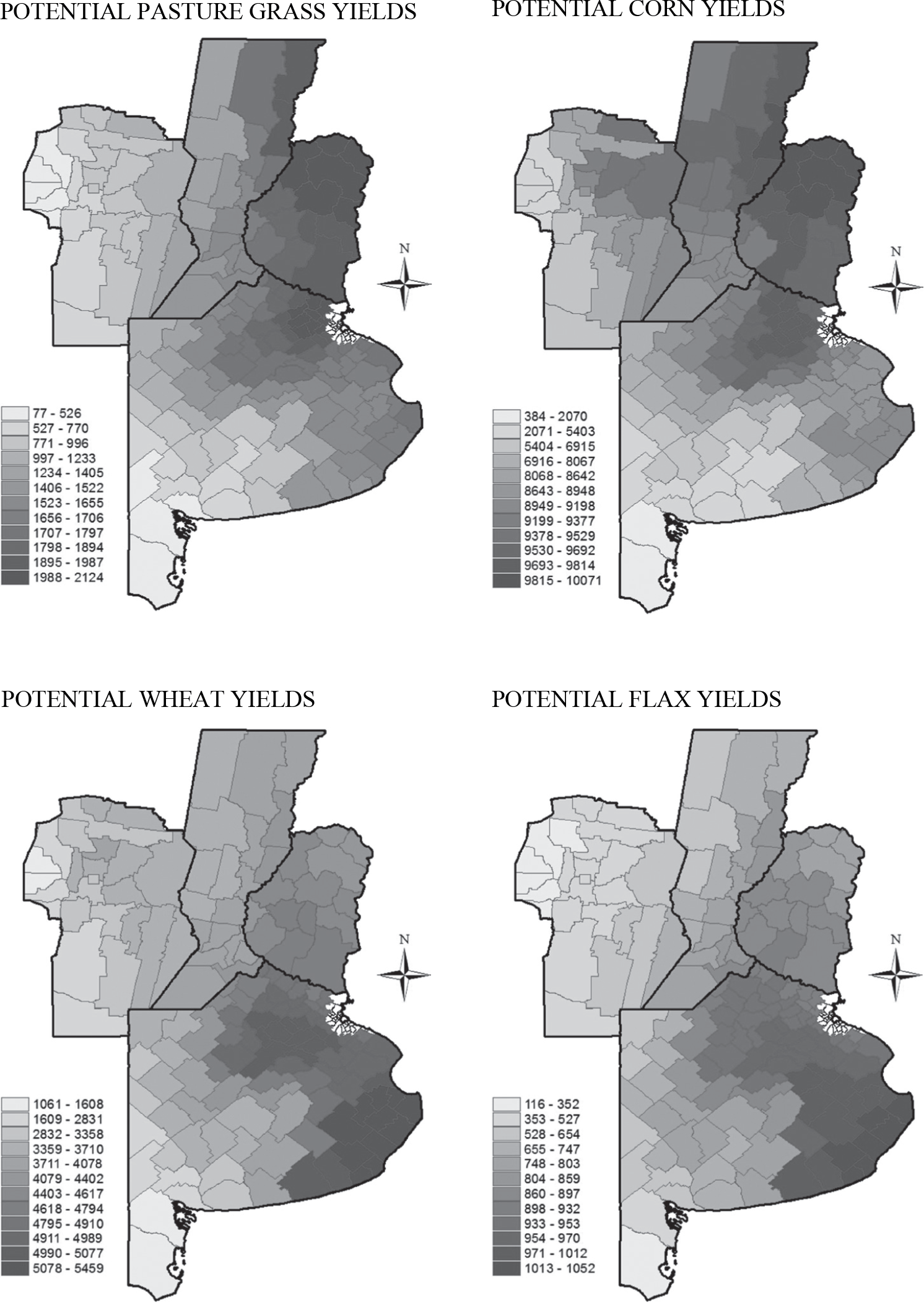
Figure 2 displays the attainable yields for pasture grass, corn, wheat, and flax across counties in the Pampas. For simplicity, we consider county-level means. In all cases, we use attainable yields for rain-fed conditions and intermediate inputs/technology as defined by IIASA/FAO (2012) since these correspond most closely to the historical context under consideration.
POTENTIAL YIELDS FOR KEY CROPS
Notes: The maps displays county-level means of agro-climatic attainable yields from IIASA/FAO (2012) for pasture grass, corn, wheat, and flax in tons per hectare per year for rain-fed conditions and intermediate levels of inputs/technology.
Sources: See the text and the appendix section on variable definitions and sources for full details.

To construct an IV based on crop-specific attainable yields from FAO- GAEZ, we use a FML framework (see Ramalho, Ramalho, and Murteira Reference Ramalho, Ramalho and Murteira2011; Mullahy Reference Mullahy2015). In the context under consideration, the FML model is specified as a system of equations in which the outcome variables are the shares of each agricultural product i in total agricultural land in county c and the regressors are the crop-specific potential yields A c. For simplicity, we focus on ranching, corn, wheat, and flax, with a residual share (which is below 5 percent on average) aggregating all other products. Thus, our vector of potential yields includes crop-specific potential yields for pasture grasses (ranching), wheat, corn, and flax.
The functional form of the FML model is
 $${{\hat \theta }_{ic}} = E[{\theta _{ic}}|{A_c}] = {\rm{ }}{{{e^{\phi _i^{'}{A_c}}}} \over {1 + \Sigma _{j = 1}^{I - 1}{e^{\phi _j^{'}{A_c}}}}}.$$
By construction,
 $$\Sigma _{i = 1}^I{{\hat \theta }_{ic}} = 1$$
, that is, the predicted shares for each county add up to 1. The parameters are estimated by quasi-maximum-likelihood.
The FML model captures how productivity for a specific product relative to other ones influences product choice. Intuitively, for a given location, a higher potential yield for pasture grasses relative to other crop- specific yields is likely to lead to higher specialization in ranching. The presence of multiple alternatives to ranching in the model’s structure makes it more flexible and powerful in capturing how variation in potential yields for various crops across locations influence product choice, including ranching specialization.
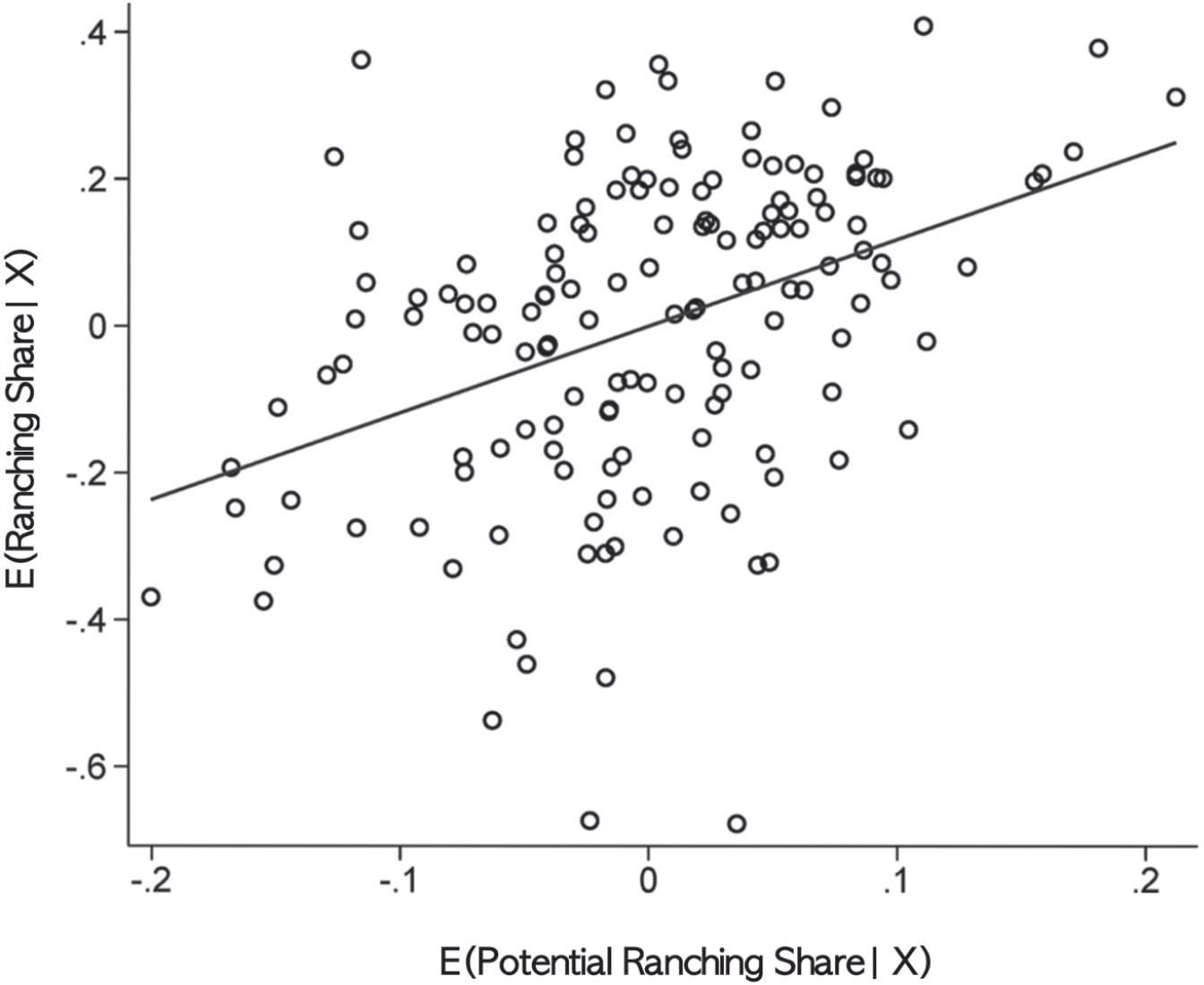
The system of equations for product shares in land use specified by Equation (2) is the basis of the “zeroth stage” in our estimation procedure. With the estimated coefficients of the FML model, in combination with the product-specific potential yields, we get the share of ranching in land use for each county predicted by the FML model. This “ranching potential share” is then used as IV for the actual share of ranching. Figure 3 displays a scatter plot of county-level actual and potential ranching shares in total farmland use.
ACTUAL AND POTENTIAL RANCHING SPECIALIZATION
Notes: The figure displays a scatter plot of the actual and predicted shares of ranching land in total agricultural land (obtained from the FML model), partialing out province fixed effects, land suitability measures and geo-climatic controls.
Sources: See the text and the appendix section on variable definitions and sources.

We proceed with two-stage-least-squares (2SLS) estimations in which Equation (1) is the second stage, and the first stage is given by
 $${\rm{Ranchin}}{{\rm{g}}_{c,{\rm{1914}}}} = \zeta + \rho {\rm{RanchingPotentia}}{{\rm{l}}_{c,{\rm{1914}}}} + {\psi _p} + {\rm{ }}\gamma '{X_c} + {v_c},$$
where Ranchingc,1914 is ranching specialization in 1914 for county c, Ranching Potentialc,1914 is the IV, the ranching potential share generated by the FML model,
 $${\psi _p}$$
is a state (provincia) fixed effect, Xc is the same vector of control variables included in Equation (1), and v c is an error term.
The identifying assumption is that the potential ranching share, predicted by the FML model, only affects development outcomes through actual ranching specialization. For instance, if areas with low suitability for all crops were particularly bad for cereals and not so bad for pasture grasses, our IV would be (negatively) correlated with overall productivity,
violating the exclusion restriction. For the empirical strategy to be valid, we need to appropriately control for overall primary productivity in the 2SLS estimation. In our baseline analysis, we control for the mean and the first principal component of the climate-based product-specific productivity measures used for the IV construction in the zeroth stage. Later in the paper, we show that the results are robust to controlling flexibly for these and other land productivity measures.
To alleviate other possible concerns, recall that the FAO measures of potential yields for different crops do not rely on a statistical analysis of observed production patterns. Moreover, note that insofar as determinants of crop choice other than the climate-based productivity measures have their effects loaded onto the residuals of the FML model, they do not affect the IV estimates of the effects of ranching specialization.
A sufficient condition for standard errors to be correct when using a generated IV (here, ranching potential share) requires the expectation of the error term in the estimating equation, conditional on the variables used in the IV construction (here, the crop-specific potential yields), to be zero (see Wooldridge Reference Wooldridge2010). This sufficient condition is satisfied insofar as the estimating equation adequately controls for measures of overall land productivity and climatic variables that may have direct effects on development outcomes. As mentioned before, our baseline analysis includes controls for mean annual precipitation, annual temperature, terrain elevation, ruggedness, and two measures of land productivity. We include additional controls for land productivity in our robustness checks.
THE DISTINCTIVE FEATURES OF RANCHING ECONOMICS
This section shows how ranching specialization shaped local economies during the period of growth led by primary exports. We show that ranching had relatively weak linkages with other activities. Moreover, its extensive production mode was conducive to large farm sizes and low labor intensity. Finally, ranching areas attracted fewer European migrants, which had important implications for the local composition of skills.
Backward and Forward Linkages
The backward linkages of ranching were weaker than those of cereal production. Besides land, the main investment in cattle production was cattle itself. According to estimates from the 1914 Census, the value of livestock accounted for about 75 percent of the capital (excluding land) in ranching activity. Ranchers invested heavily in animals but relatively little in infrastructure. As discussed before, innovations to improve the quality of cattle, particularly through the introduction of high-quality imported breeds, were key drivers of the rise of cattle exports.
By comparison, cereal production required significant investments in inputs and capital, including fertilizer, tools, and machinery. The expansion of cereal production in Argentina led to the development of small foundries. Santa Fe, the province with the highest cereal shares among the four ones in our sample, had more than 2,500 foundries in 1895 (Martino and Delgado Reference Martino and Mary1977). These produced plows and various other agricultural tools, mills, wire, threshing machine belts, and other replacement parts. Foundries later developed in Córdoba and Buenos Aires, following local demand spurred by the growth of cereal production. While the domestic agricultural machinery industry never supplied more than a small fraction of domestic demand, it displayed considerable dynamism over the twentieth century, entering the production of threshing machines in the 1910s and mass production of tractors in the 1950s (Bil Reference Bil2009a, Reference Bil2009b).
Another difference in backward linkages concerned the demand for transportation services. Cattle production had a relatively low demand for railroad services because cattle could be moved to the Buenos Aires port on foot (Cortés Conde Reference Cortés1968). In contrast, profitably carrying cereals to Buenos Aires usually required access to railroads. Some regions of Santa Fe and Entre Ríos used rivers as a means of transportation, in particular the Paraná River. But the use of waterways as means of transportation was limited. The transportation of cereals also created a demand for grain elevators, although their diffusion in Argentina was slower and more limited than in the United States and Canada (Scobie Reference Scobie1964).
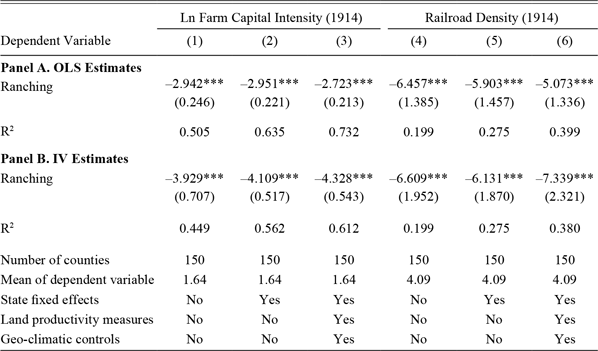
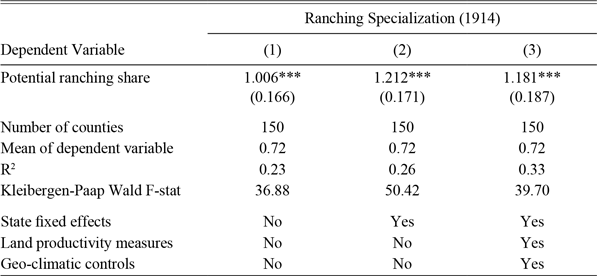
In Table 2, we examine the effects of ranching specialization on capital intensity in farms and railroad density. We present results for three specifications, sequentially expanding the set of controls to include province fixed effects, land productivity measures, and other geo-climatic controls. Panel A displays OLS estimates. Panel B displays IV estimates obtained using the ranching potential share from the FML model as an IV for actual ranching specialization in 1914. Table 3 shows the first stage results and the Kleibergen-Paap F-statistics. The IV has strong predictive power in all specifications.
BACKWARD LINKAGES

* = Significant at the 10 percent level.
** = Significant at the 5 percent level.
*** = Significant at the 1 percent level.
Notes: Farm capital intensity is defined as farm capital (value of tools, implements, and equipment) per hectare. Railroad density is defined as railroad km / 100 km2. Robust standard errors reported in parentheses. Sources: See the text and the appendix section on variable definitions and sources.
FIRST STAGE REGRESSIONS

* = Significant at the 10 percent level.
** = Significant at the 5 percent level.
*** = Significant at the 1 percent level.
Notes: Robust standard errors reported in parentheses.
Sources: See the text and the appendix section on variable definitions and sources.
The estimates indicate that ranching was characterized by significantly weaker backward linkages. The results are robust across all specifications. Throughout the paper, the OLS and IV estimates have, in most cases, comparable magnitudes, showing no systematic pattern of bias in OLS estimates. Appendix Table A3 shows that the association between ranching and railroads is robust to controlling for distance to the Paraná River, an alternative means of transportation.
We now turn to forward linkages. The main downstream connections of cattle and cereal production—meat-processing and milling, respectively—were among Argentina’s main industrial activities at the turn of the century. Both of them were technologically dynamic. However, their locational patterns and the implications for counties supplying their inputs were dissimilar.
Meat processing was concentrated near the Buenos Aires port in a small number of large plants. Traditional slaughterhouses (mataderos and saladeros) were swiftly replaced by modern meat-packing plants (frigoríficos) following the introduction of refrigeration technologies in the late nineteenth century (see, e.g., Gebhardt Reference Gebhardt2000). The British and American firms dominating this activity were located near the port to facilitate transportation to international markets and gain access to large labor pools. These firms had advanced know-how, sophisticated marketing methods, and well-developed distribution networks. But there was little spillover to other activities and no externalities on the local economies that supplied the primary goods.Footnote 8
In contrast, flour mills were geographically scattered, often located close to their primary input sources. In 1907 there were 71 flour mills located in the province of Buenos Aires, 43 in Santa Fe, 36 in Entre Ríos, and 22 in Córdoba, and 178 elsewhere in the country. A large share of mills was steam-powered and used state-of-the-art technologies.Footnote 9 Flour exports were small in comparison to exports of cattle products, but they also experienced rapid growth. In 1913 they represented 1.4 percent of total Argentina exports (Rayes Reference Rayes2015). Most of the wheat flour production was used locally by bakeries and other food processing industries. The technologies and capital goods used in these activities were, in most cases, not very advanced, but they were locally supplied and generated various spillovers in local economies.Footnote 10
In sum, existing historical research suggests that the forward linkages of ranching were much weaker than those of cereal production, at least at the local level. While we do not assess whether the local presence of different primary products favored the development of related agro-industrial activities, later in the paper, we assess how early ranching specialization influenced the process of industrialization more broadly.
Land Concentration and Labor Intensity
Cattle ranching also had differential patterns of factor demand. The extensive nature of cattle ranching led to larger landholdings. Considering the four provinces in our study, the average plot size for farms with crop cultivation as their main use was 133 hectares, while the average size for those with cattle ranching as their main use was 790 hectares (Comision Nacional del Censo Reference Comision1916–1919, Tomo V, p. 691, Tomo VI, p. 523).
The extensive nature of ranching was also associated with low labor intensity, and thus with lower population densities and lower urbanization rates. According to Ortiz (Reference Ortiz1978), in the late nineteenth century, a herd of 5,000 cattle would occupy about 9 square miles and require 3 laborers, while crop cultivation in a similar extension of land would employ about 350 people. Labor requirements remained low after the modernization of ranches. Improved livestock management required additional workers, but on the other hand, fencing reduced surveillance needs (Gebhardt Reference Gebhardt2000).
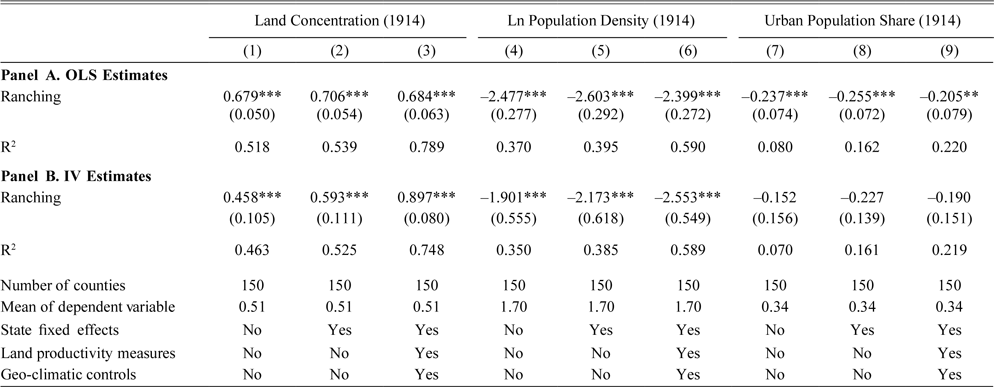
In Table 4, we show that ranching specialization was positively associated with land concentration (Columns (1)–(3)). Moreover, it was negatively associated with population density (Columns (4)–(6)) and urbanization (Columns (7)–(9)), though for the latter, the IV estimates are not statistically significant. These results imply that local markets in ranching areas were significantly thinner.
LAND CONCENTRATION AND LABOR INTENSITY

* = Significant at the 10 percent level.
** = Significant at the 5 percent level.
*** = Significant at the 1 percent level.
Notes: Land concentration is defined as the share of land in farms 1000+ hectares. Robust standard errors reported in parentheses.
Sources: See the text and the appendix section on variable definitions and sources.
Land concentration and population sparsity in ranching areas implied weak demand linkages. The distribution of income in ranching locations was very unequal. Workers had rudimentary living conditions. Their diet was almost exclusively meat, and they had primitive housing. With low labor intensity in production, overall labor shares in income were low, and land shares high. Resource rents were appropriated by a relatively small number of landowners and did not translate into significant demand at the local level. Landowners spent a high share of their incomes in luxury consumption goods produced abroad, and their investments were mostly on improving cattle, with little demand for local suppliers.Footnote 11
Population sparsity in ranching areas implied isolation and contributed to making local markets thin, probably limiting local commerce to a few general-purpose stores scattered in the rural landscape. As an illustration, picture the complete absence of urban agglomerations in the 17 counties in our sample that had urban rates of 0 percent, all of which had ranching shares above 0.90 (in most cases above 0.95). The low population density was also bound to stifle agglomeration effects and scale economies in production.
In cereal-producing areas, the demand from the local population induced the expansion of small shops and artisans. Manufacturing production during the Argentine agro-export model was limited, but small towns often developed a local supply of bread, pastries, beverages, and other food items, as well as garments, candles, soap, bricks, tiles, furniture, and other household goods (Rocchi Reference Rocchi2005). By contrast, in ranching areas, there was little incentive to enter the production of consumer goods or tools.
The weak demand linkages of ranching economies, their low levels of investment, and muted agglomeration effects due to low density were bound to induce a weak process of growth. We discuss this further later in the paper.
Immigration and Skills
Argentina was a leading destination in the age of mass migration. For the region we consider in this study, more than 25 percent of the total population in 1914 had been born in Europe. Close to half of these European immigrants were Italian, and around a third were Spanish.
Ranching offered limited opportunities for migrants due to low labor requirements, whereas cereal-producing areas exerted a stronger pull on immigration. Limited access to land implied that migrants could, at best, exploit relatively small plots of land, which were better suited for cereal production. Moreover, as argued by Gerchunoff and Torre (Reference Gerchunoff and Iván2014), comparative advantage pointed Argentines toward ranching and Europeans toward crop cultivation. Horseback riding, a core skill in extensive cattle-raising, was historically common among Argentines of all social ranks, whereas European migrants rarely had that skill.Footnote 12
The differential human capital thesis advanced by Gerchunoff and Torre (Reference Gerchunoff and Iván2014) is consistent with data on specialization within the primary sector by nationality. Such data is not available from the 1914 census, but it is from the 1895 census micro-data samples collected by Somoza and Lattes (Reference Somoza and Alfredo1967). Among Argentine landowners, 30 percent reported involvement in ranching, whereas among European ones less than 10 percent did so. Similarly, 32 percent of Argentine male adults working in the primary sector (including ranching and agriculture) worked in ranching, whereas the corresponding figure for European migrants was 13 percent.
The contrast in specialization patterns between Argentines and Europeans was particularly stark when we consider Italians. Among these migrants, the share of the primary sector labor reporting involvement in ranching was only 3 percent. For Spaniards, the other major immigrant group, this share was 29 percent, close to the one for Argentines. This is consistent with Spain’s distinct ranching orientation in continental Europe, which can be traced to medieval times (Oto-Peralías Reference Oto-Peralías2020).
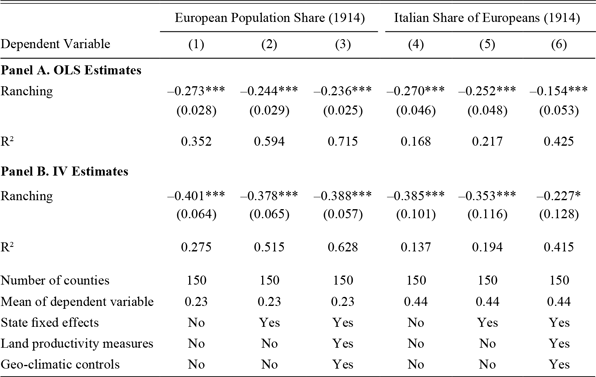
Table 5 shows that cattle raising areas attracted fewer European migrants than other locations (Columns (1)–(3)). Moreover, Columns (4)–(6) show that in ranching locations, there were fewer Italians among Europeans. The results are consistent with the idea that the lower presence of Europeans, particularly Italians, in ranching areas reflected the complementarity of their skills with cereal production rather than ranching.
IMMIGRATION

* = Significant at the 10 percent level.
** = Significant at the 5 percent level.
*** = Significant at the 1 percent level.
Notes: Robust standard errors reported in parentheses.
Sources: See the text and the appendix section on variable definitions and sources.
The larger share of Europeans in non-ranching areas may have indirectly paved the way for subsequent structural change. While Europeans did not have higher levels of literacy than Argentines in this period, they did have more skills for manufacturing and services, as Europe was very far ahead in these activities. We discuss this further in the next section.
RANCHING AND THE PROCESS OF DEVELOPMENT
Having shown how ranching specialization shaped local economies historically, we now analyze its effects on the process of development. We start with a brief summary of the channels through which ranching specialization may have influenced development. Then, we empirically examine the effects of ranching specialization on a set of key development outcomes—population density, urbanization, industrialization, income per capita, human capital—at different points in time.
The various ways in which ranching specialization shaped local economies have relevant implications for subsequent development. Weak forward and backward linkages would imply a reduced incentive for local industrialization. Cereal production supplied milling, a dynamic activity that could, in turn, induce entry into related sectors. It also induced significant investments in agricultural machinery, generating opportunities by domestic producers. In contrast, the lack of linkages in cattle ranching created enclave-type economies, which would likely stifle the process of diversification. Ranching areas were also characterized by lower railroad density and thus reduced access to markets, which would also tend to hamper development.
In addition, land concentration and low population density in ranching areas implied weak demand linkages and muted agglomeration effects. This limitation was likely to interact with the absence of forward and backward linkages. Cereal-producing areas not only presented significant investment opportunities in downstream and upstream activities, but also relatively large markets, dense labor pools, and diverse sets of input suppliers. All of these were lacking in ranching economies.
Finally, historical migration patterns affected the composition of skills in the population. As discussed before, European migrants were differentially attracted to non-ranching areas due to their comparative advantage for crop cultivation. As discussed later in this section, Europeans also had skills valuable for manufacturing and services. Thus, differential migration created differential conditions for subsequent structural change.
We view the different channels examined here as complementary and do not attempt to assess quantitatively their relative importance. Besides the limitations of available data, we would not be able to conduct a proper mediation analysis with only one IV and many potentially relevant mediating variables. In the following section, we examine other possible mechanisms (agricultural prices and productivity, seasonality, school funding) and do not find empirical support for them.
Population Density and Urbanization
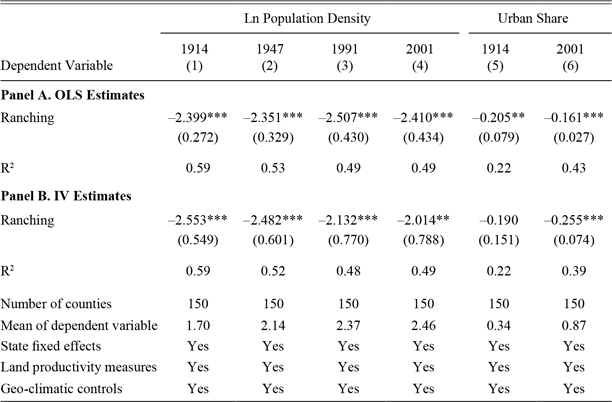
We start our study of ranching’s effects on the process of development by establishing that the negative effects on population were persistent. Table 6 displays estimates of the effects of ranching specialization on population density at different points in time. We report OLS estimates (Panel A) and IV estimates (Panel B) for the specification with the full set of controls (province fixed effects, land productivity measures, and other geo-climatic controls).
POPULATION DENSITY AND URBANIZATION

* = Significant at the 10 percent level.
** = Significant at the 5 percent level.
*** = Significant at the 1 percent level.
Notes: Robust standard errors reported in parentheses.
Sources: See the text and the appendix section on variable definitions and sources.
The results show that there was a stable differential in density between ranching and nonranching areas, which experienced (approximately) parallel growth from 1914 onward. According to the results in Column (4), a reduction of one standard deviation in ranching specialization (0.24) would lead to an increase of 0.35 standard deviations in the log of population density in 2001, which amounts to 48 log points (62 percent in density levels). By comparison, Bleakley and Lin (Reference Bleakley and Jeffrey2012) estimate that counties in the United States being close to a historical portage site increased population in 2000 by about 77–94 log points.
Industrialization
Next, we examine how early specialization in cattle ranching affected structural change. The sharp fall in international demand for primary products during the Great Depression of the 1930s led to the demise of Argentina’s agro-export model and the rise of import-substituting industrialization. Over the next four decades, manufacturing was the fastest growing sector of the economy. Thus, understanding the effects of early ranching specialization on the manufacturing sector over this period is key to understanding its overall effects on long-run development.
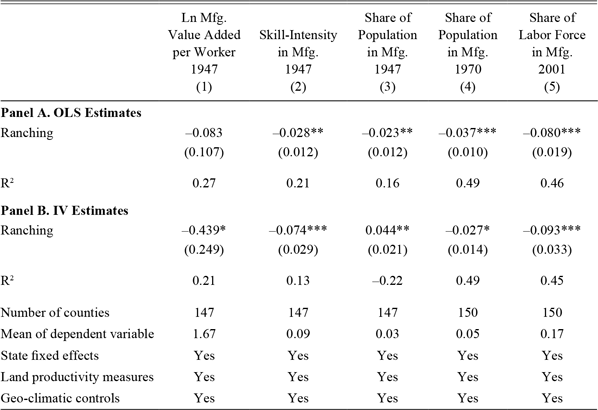
Table 7 displays estimates of the effects of ranching specialization on the industrial sector. Columns (1)–(3) report results for three outcomes in 1947. Ranching is negatively associated with industrial value added per worker and with skill-intensity (proxied by the share of nonproduction workers in manufacturing). For our measure of the overall advance of industrialization (the share of industrial workers in the population), we find a negative coefficient in the OLS estimation but a positive one in the IV estimation. The latter estimate, which contrasts with the rest of our results on the effects of ranching on development, is largely driven by a few counties with the highest shares of the population in manufacturing at the time.Footnote 13
INDUSTRIALIZATION

* = Significant at the 10 percent level.
** = Significant at the 5 percent level.
*** = Significant at the 1 percent level.
Notes: Robust standard errors reported in parentheses.
Sources: See the text and the appendix section on variable definitions and sources.
We also examine the effects of ranching on manufacturing at later time periods (Columns (4)–(5)). We find large and significant negative effects of ranching on the share of the population employed in manufacturing by 1970, close to the height of the industrialization process. Finally, we consider the share of industrial workers in the labor force in 2001 and confirm that ranching specialization had significant negative effects on industrialization over the long run.Footnote 14
The larger share of European migrants in non-ranching sectors may have indirectly contributed to industrialization. Europeans did not have higher average levels of literacy than Argentines in this period, but they were likely more skilled for manufacturing and services, as Europe was far ahead in these activities. This is consistent with the evidence on the role of European migrants in Argentina’s economic development presented by Droller (Reference Droller2018). In the late nineteenth century and early twentieth century, Europeans were over-represented in manufacturing, both in terms of ownership of establishments and employment, and they were over-represented in high-skill occupations; moreover, the presence of Europeans was conducive to human capital formation, industrialization, and higher levels of income per capita across Argentine counties in the long-run.
Long-run Development
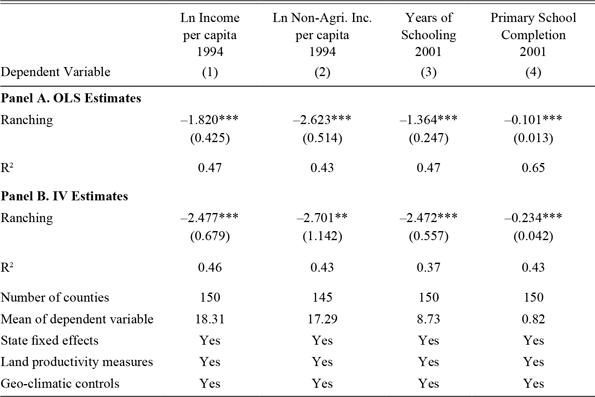
In Table 8, we assess the effects of ranching specialization on long- run development. In Columns (1)–(2), we consider proxies for income per capita and non-agricultural income per capita (in logs; see Appendix for details). For both outcomes, we see significant negative effects of ranching specialization. According to the results in Panel B, Column (1), a reduction of one standard deviation (0.24) in ranching specialization in 1914 would have led to an increase of 0.52 standard deviations in the log of income per capita in 1994, which amounts to 59 log points (80 percent in income per capita levels).
LONG-RUN DEVELOPMENT

* = Significant at the 10 percent level.
** = Significant at the 5 percent level.
*** = Significant at the 1 percent level.
Notes: Robust standard errors reported in parentheses.
Sources: See the text and the appendix section on variable definitions and sources.
Next, we examine two measures of human capital formation: years of schooling and the share of the population between 25 and 60 years of age that completed primary education. This latter measure of human capital, which has a mean of over 0.8 in our sample, is also a proxy for social inclusion. The results in Columns (3)–(4) show negative and significant effects of ranching specialization on both measures of human capital in the long run.
Robustness
We show here that results are robust to including additional land productivity measures in the control set, excluding provincial capitals or urban counties, and accounting for spatial dependence through Conley standard errors (Conley Reference Conley1999).
The identifying assumption in our IV regressions is that our measure of potential ranching specialization, based on the estimation of the FML model, only affects development outcomes through actual ranching specialization. While our identifying variation is given by variation in relative productivities among primary products, the exclusion restriction requires appropriately controlling for overall primary productivity. In our baseline analysis, we control for the mean and the first principal component of all climate-based product-specific productivity measures used in the IV construction. In Appendix Table A4, we show that the results are robust to controlling for these and other land productivity measures in flexible ways. We consider three key long-run development outcomes, and for each of them, we show our baseline specification and the estimated effects of ranching specialization when we add an additional measure of land productivity (an index of land suitability for cultivation from Ramankutty et al. (Reference Ramankutty, Jonathan A, John and Kevin2002), to be interpreted as the probability that a given area is cultivated), and when we include cubic polynomials of all of the land productivity measures. The results are consistent throughout specifications.
Appendix Table A5 shows that the estimated effects of ranching, on the same measures of long-run development, are robust to the exclusion of provincial capitals (Panel A) and the exclusion of urban counties, that is, those with urban shares of the population above 50 percent (Panel B).
In Appendix Table A6, we show that inference is robust to using the heteroskedasticity-autocorrelation (HAC) estimator introduced by (Conley Reference Conley1999) with bandwidths from 50 to 250 kilometers (computed with the acreg command developed by Reference Colella, Rafael, Seyhun O. and MathiasColella et al. (2019)). The estimated effects of early ranching on long-run levels of urbanizations, income per capita, and human capital formation are significant in all specifications.
Discussion: Subnational Analysis versus Country-Level Analysis
When interpreting our results and their implications, it is important to keep in mind that our analysis is based on the subnational variation. Our findings of the effects of particular staples at the local economy level do not necessarily carry over to the country level. The regional and national growth of the United States in the first half of the nineteenth century is a case in point. From the perspective of local economies, Southern cotton production created little to no urbanization and favored stark levels of inequality. But at the same time, according to North (Reference North1966), the massive expansion of Southern cotton exports was a core engine of growth for the American economy, creating a vigorous demand for Northeastern manufactures as well as transportation, finance, and marketing.
Ranching’s forward linkages may have been stronger from a countrywide perspective than they were at the local economy level. We stressed that ranching did not create investment opportunities in downstream industries because the meat-packing industry is located near the Buenos Aires port. From the national viewpoint, though, this activity was an important outgrowth of ranching production, employing many workers (largely of European origin) and using advanced know-how, sophisticated marketing methods, and large distribution networks. On the other hand, meat-processing was dominated by foreign firms, and there was little spillover to other activities.
Ranching’s demand linkages may also have been stronger from a country-wide perspective than at the local level. We stressed that land concentration and income inequality likely induced a lower average propensity to consume and a higher share of luxury goods produced abroad, while investment was limited and also sourced mostly from foreign suppliers. But according to Galiani et al. (Reference Galiani, Daniel, Carlos and Fernando2008), the demand of high-income groups in late nineteenth-century Argentina promoted the emergence of human-capital-intensive services. While these services developed in urban centers, demand may have partly originated in rents from ranching activities.
In contrast, other plausible mechanisms operating only at the countrywide level may have added to the negative overall effects of ranching specialization. In his comparative analysis of Argentina and Canada, Solberg (1987) emphasized how Argentina’s ranching specialization and land concentration hampered development through political economy mechanisms. For instance, Argentina’s large and powerful landowners blocked trade policies favoring industrialization. Adamopoulos (Reference Adamopoulos2008) explains the divergence between Argentina and Canada along similar lines, proposing a formal model in which landed elites hinder industrialization through tariff policy to protect their rents. Landowners may also curtail public funding for schools insofar as human capital is complementary to industrialization (see Galor, Moav, and Vollrath Reference Galor, Omer and Dietrich2009). In Argentina, such funding was mostly determined by the federal government, limiting the relevance of this mechanism at the local level (as further discussed later in the paper), though possibly not at the national level.
Finally, note that the magnitude of ranching’s effects on long-run population density and income per capita depend on the degree of labor mobility. Without labor flows, productivity differences translate into differences in income per capita, with no effects on population density. With perfect mobility, income differentials induce labor flows, translating into differences in population density. Income differences can only remain in equilibrium if they are compensated by differential living costs and amenities.
As the population relocates to places with higher productivity and initially higher income per capita, congestion pushes up living costs, perhaps eroding some of the initial productivity differentials (if there are decreasing returns) or reinforcing them (through agglomeration forces). While the expected effects of higher productivity on income per capita and population density go in the same direction, their magnitudes reflect not only direct impacts but also the ensuing movements toward spatial equilibrium. Given these considerations, when switching from a cross-county analysis to a country-level perspective, lower labor mobility would imply smaller effects on population density and larger effects on income per capita.
OTHER CHANNELS
In this section, we assess the empirical relevance of other channels through which early ranching specialization may have affected the process of development. First, we examine whether the long-term effects of ranching specialization may reflect differences in productivity or prices among staples. Then, we examine whether the observed effects may be connected to the seasonality of different products. Finally, we examine whether land concentration associated with ranching negatively affected education through political economy mechanisms. The available data does not seem to support the relevance of these channels.
Agricultural Productivity and Prices
Differences in technological progress and prices across agricultural products, combined with variation in the composition of primary production across counties, generate variation in county-level agricultural income. In turn, agricultural revenues can influence the process of industrialization. This channel could partly explain the influence of agricultural production (in particular, ranching specialization) on long-run development.
Agricultural income may affect industrialization positively or negatively. On the one hand, higher agricultural productivity may release labor to be employed in manufacturing as well as increase the local demand for industrial goods (Johnston and Mellor Reference Johnston1961). On the other hand, in open economies, the growth of primary productivity or international prices would shift comparative advantage against manufacturing (Matsuyama Reference Matsuyama1992).
We examine whether differences in the composition of agricultural production at the county level influenced industrialization as they entailed differences in physical productivity or revenues of the local agricultural sector. To do so, we consider variation across agricultural products in technological progress as well as in export prices.
First, we estimate the effects of initial levels and subsequent increases in potential agricultural productivity. Initial levels are captured by our baseline controls for agricultural productivity, based on FAO-GAEZ yields for intermediate levels of technology. We consider the gap between our baseline measure of mean potential productivity and the analogous one based on FAO-GAEZ yields for advanced technology, capturing potential productivity increases in more recent decades. Appendix Table A7 shows that there is no evidence that neither productivity levels nor their growth significantly affected the process of industrialization.
Second, we examine the effect of differences in agricultural revenues across counties by considering differences in the product mix of each county and the evolution of export prices. More precisely, we construct a yearly predicted price index for each county’s agricultural output between 1914 and 2001. For each year, we interact the export prices for beef, corn, and wheat with the corresponding land shares in 1914. While we do not have historical price data for other products, land shares for ranching, corn, and wheat added together represented 93 percent of total farmland use for the median county in our sample and over 80 percent for almost nine of ten counties.Footnote 15 With these yearly measures, we calculate the average predicted price index for 1914–1947, 1914–1970, and 1914–2001, and (to capture volatility) the coefficient of variation for the same three periods.
In Appendix Table A8, we repeat the regressions for industrialization in 1947, 1970, and 2001 including the average predicted price indexes and their coefficients of variation in the corresponding periods. We do not find statistically significant coefficients for these new variables. The estimated coefficients for initial ranching specialization remain negative in all cases and statistically significant in most of the cases.
Seasonality
Earle and Hoffman (Reference Earle and Ronald1980) point out that wheat, corn, and livestock had highly seasonal labor requirements, which also lowered labor costs for the industrial sector. Sokoloff and Dollar (Reference Sokoloff1997) also emphasize the high seasonality of grains, but they argue that the availability of cheap seasonal labor could hinder the adoption of more efficient manufacturing technologies.
To assess whether the long-run effects of ranching may be connected to different patterns of seasonality in primary production, we rely on the
fact that wheat was the most seasonal crop among grains (Sokoloff and Dollar Reference Sokoloff1997; Free Reference Free1938). In Appendix Table A9, we include the share of wheat in farmland as a control. Taking into account the differential seasonality within grains, we would expect that if seasonality played a relevant role, the coefficient on the wheat share would be significant, and we would find a lower coefficient for ranching specialization. However, we find that the coefficient on ranching remains stable when controlling for the wheat share, while the coefficient on the wheat share itself is not significant.
Education
Ranching specialization may have negatively affected human capital formation through land concentration. As established by previous work, land concentration may retard the emergence of human capital-promoting institutions (Galor, Moav, and Vollrath Reference Galor, Omer and Dietrich2009).Footnote 16 The main logic is that powerful landed elites may have incentives to hamper finance for public schools insofar as human capital is complementary to industrial capital.
The evidence, however, does not support the relevance of this channel across Argentine counties. Local landed interests had limited influence on the local supply of schooling since school funding came mostly from higher levels of government. Appendix Table A10 shows that ranching localities actually had more schools per capita in 1914 (Column (1)), as a higher density of public schools (Column (2)) more than offset a lower density of private schools (Column (4)). Column (5) shows that there was no significant association between ranching and enrollment rates. While the negative association between land concentration and schooling emphasized in the previous literature may have been relevant at the national level, it did not hold at the county level.
In sum, ranching areas did not have initially lower levels of human capital. The lower share of Europeans in these areas did not significantly change the picture in terms of literacy since their levels were broadly comparable to those of Argentines in this period. Footnote 17 But Europeans did have skills that were instrumental for the development of manufacturing, and this may have played an important role starting in the 1930s when industrialization took off.
CONCLUSION
Using climate-based exogenous variation in primary production patterns within the Argentine Pampas, we show that ranching localities historically had weaker linkages, higher levels of land concentration, lower population density, and fewer European migrants. Moreover, ranching locations remained less dense and less urbanized throughout the twentieth century and experienced more sluggish industrialization. Ultimately, ranching had negative long-run effects on income per capita and education. Our findings show that early patterns of production can have a crucial influence on development patterns, providing suggestive support to the staple theory of economic growth.
We link the long-run economic performance of local economies to their specialization patterns during a period of rapid growth led by primary exports in the late 1800s and early 1900s. Some of the forces we identify may also be relevant to understand the national level growth trajectory since Argentina as a whole was characterized by ranching specialization, limited diversification into related activities, land ownership concentration, and low population density. Our findings echo Solberg (1987)’s comparative analysis of Argentina and Canada, which Watkins (Reference Watkins1993, p. 285) bluntly summarized: “wheat is a much better staple than meat.” That country-level comparative analysis also emphasized the negative effects of ranching and land concentration in Argentina, though it centered more on political mechanisms than our subnational analysis focused on economic linkages.
Of course, findings based on subnational analysis cannot be directly extrapolated to country-level analysis. As we discussed, various relevant forces at the national level may operate across rather than within the boundaries of local economies, amplifying or offsetting the negative local effects that we identify. A country-level analysis of the effects of ranching would require additional data and analysis to examine those cross-location spillovers, ideally through the lens of a quantitative spatial general equilibrium model (see, e.g., Fajgelbaum and Redding Reference Fajgelbaum and Redding2014; Eckert and Peters Reference Eckert and Michael2018; Méndez-Chacón and Van Patten Reference Méndez-Chacón and Diana2019). It is important to note that even if there were positive cross-location spillovers that offset the negative county-level effects, insofar as variation in ranching shaped the distribution of population and economic activity, there could be important aggregate implications in the presence of path- dependence and multiple equilibria (see Allen and Donaldson Reference Allen and Dave2020).
Our results on the importance of primary products in the process of development may have broader implications for the macro-development literature. Focusing on the relatively simple context of highly specialized agricultural economies, we provide clear-cut evidence that the composition of production can influence the growth process through various sorts of linkages. Our paper suggests that it is important to study the role of linkages in the growth process over the long run, calling for models of structural change with finer levels of aggregation than standard two- or three-sector frameworks.