In Robert L. Rands’ Some Evidences of Warfare in Classic Maya Art (Reference Rands1952) the then-blossoming archaeologist expressed certainty that the prolific bound figures of Classic Maya representation hardly reflect a crime-ridden society, but instead show military captives intended for human sacrifice (Rands Reference Rands1952:106–114). His assertion followed Herbert J. Spinden's (Reference Spinden and Hodge1916:442–444) assessment of Maya “memorials of conquest,” and confronted Teobert Maler (Reference Maler1901:61), who, in keeping with the then-popular notion of the Classic Maya as peaceful stargazers, had advanced the explanation that bound figures in Classic Maya art were criminals. Despite the unpopularity of an interpretation that framed the ancient Maya as a violent society, Rands (Reference Rands1952:164) insisted that prevalent captive images in Maya iconography indicate “the existence of fairly intensive patterns of warfare in the Maya Classic period.” Although his proposal was highly controversial in the early 1950s, it is now certain that the ceremonial display of military prisoners was a pervasive theme in pre-Columbian Maya art. No other Maya imagery inflicted so much disgrace upon defeated adversaries or offered more persuasive proof of a ruler's power (Houston et al. Reference Houston, Stuart and Taube2006:203).
FUNCTION AND THEORETICAL FRAMEWORK OF CAPTIVE ICONOGRAPHY
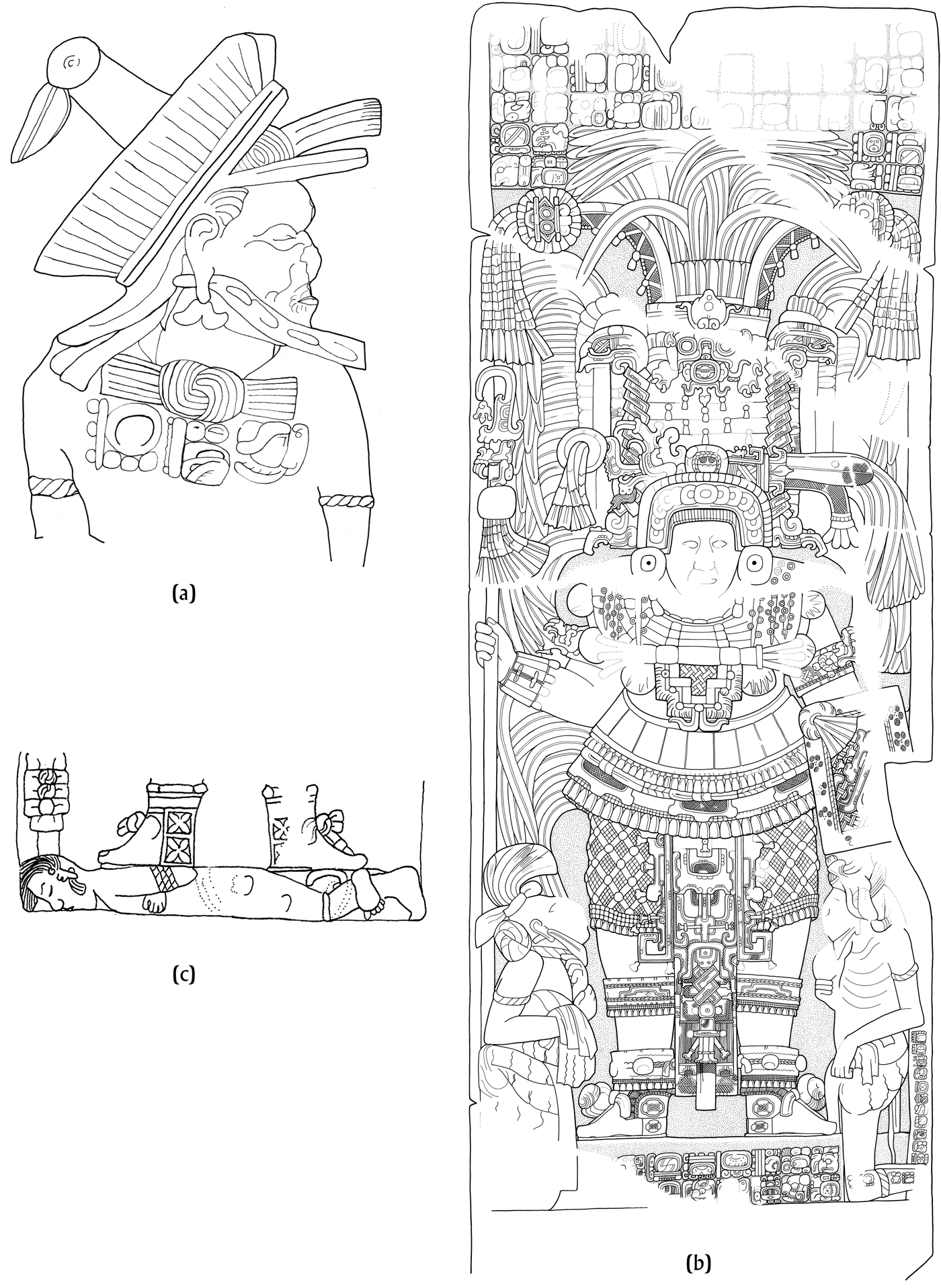
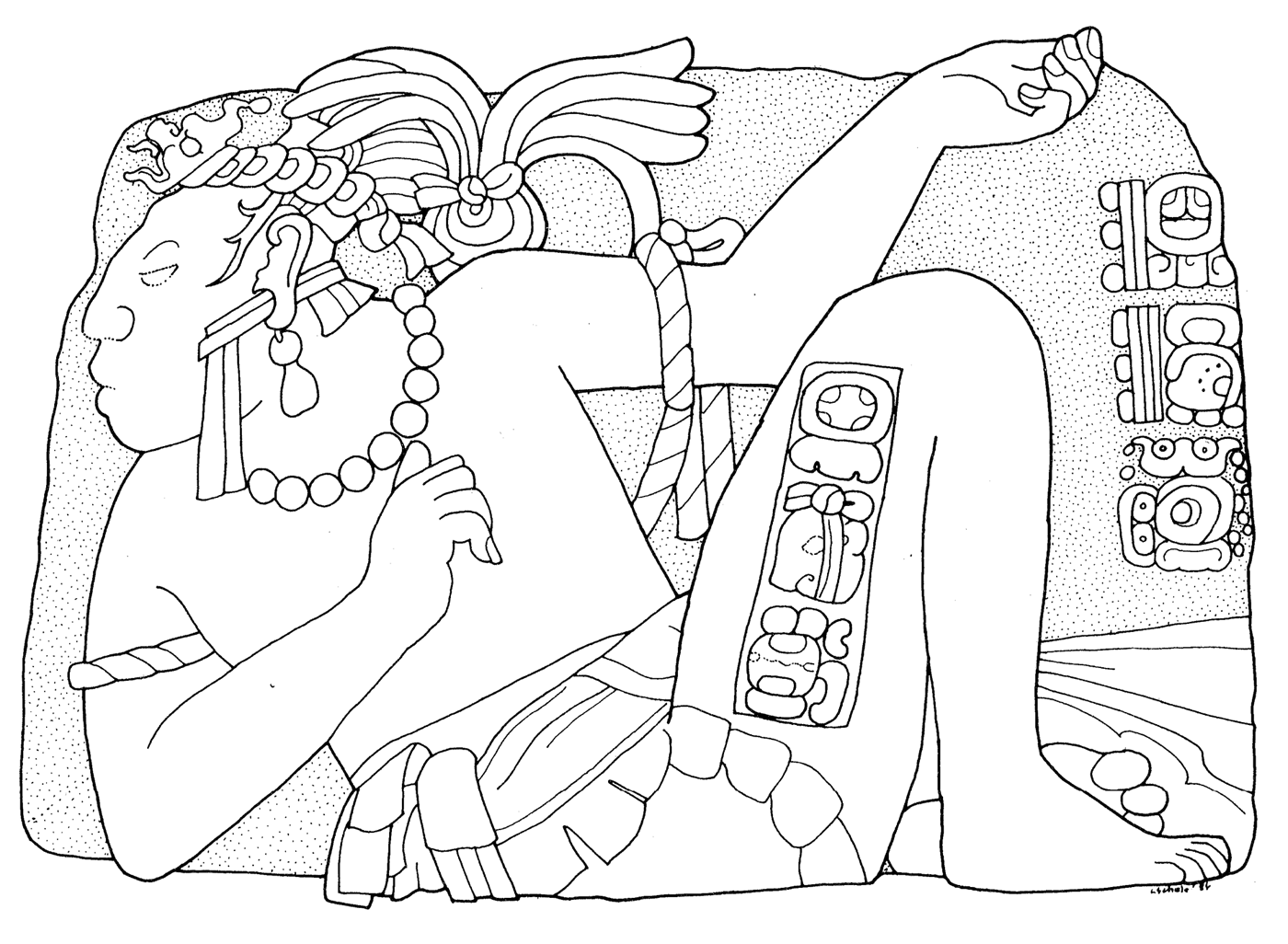
In contrast to postmortem iconographies of the Terminal Classic and Early Postclassic northern Maya region (Miller Reference Miller, Tiesdale and Cucina2007), southern Late Classic captive scenes commemorated elaborate post-battle rituals. Generally, the images under discussion do not emphasize capture in progress but rather depict the presentation of figures in captivity (Miller Reference Miller and Houston1998:203–207; Proskouriakoff Reference Proskouriakoff1950). In these theatrical scenes, conquerors oversaw the exhibition of ill-fated rivals prior to their sacrifice (Schele Reference Schele and Boone1984:19). Such representations were displayed in public and semipublic locations to lend political esteem to captors (Inomata and Triadan Reference Inomata, Triadan, Ruiz, Sosa and Ponce de León2005:202; Johnston Reference Johnston2001). This iconography supports the notion that the Maya tortured military captives in diverse ways, from breaking fingers so that warriors were unfit for battle (Houston and Inomata Reference Houston and Inomata2009:47; Johnston Reference Johnston2001) to tying captives to scaffolding and setting them ablaze (Chase and Chase Reference Chase and Chase1987:20). Although scholars have thoroughly scrutinized Classic Maya captive iconography (Benson Reference Benson, Robertson and Jeffers1978; Baudez and Mathews Reference Baudez, Mathews, Robertson and Jeffers1978; Houston Reference Houston2001; Houston et al. Reference Houston, Stuart and Taube2006:202–207; Johnston Reference Johnston2001; Marcus Reference Marcus1974; Miller Reference Miller and Kowalski1999:348–354, Reference Miller, Tiesdale and Cucina2007; Nalda Reference Nalda2004; Rands Reference Rands1952; Robertson Reference Robertson1985; Schele Reference Schele and Boone1984), the Late Classic Maya convention of pictorially “tagging” captive bodies with hieroglyphs directly on their skin in the manner of a tattoo remains unexplored (Figure 1). This conflation of personal scripted information and figural image transformed anonymous prisoners into particularized historical casualties, and additionally functioned to underscore the stripping of their will (Houston et al. Reference Houston, Stuart and Taube2006:206).
Tagged captives from the Late Classic Maya sculptural corpus. (a) Tonina Monument 147. Author drawing after author photograph. (b) Piedras Negras, Stela 8, front. Drawing by Ian Graham © President and Fellows of Harvard College, Peabody Museum of Archaeology and Ethnology, Harvard University, PM# 2004.15.15.2.1 (digital file# 99160053). (c) Naranjo Stela 30, detail of captive under the feet of a ruler, with (eroded) glyphs on thigh. Author drawing based on detail of drawing by Ian Graham.

Conflations of figural images together with script open theoretical avenues of inquiry that are unavailable for investigations of solitary images. For Joyce Marcus (Reference Marcus1974:92, Reference Marcus1992), hieroglyphic writing replicates information conveyed in iconography, and acts as a caption to narrate or describe portrayals of conquest in which captives stand in for entire polities. Although this reading holds true when texts are placed adjacent to captive images, this interpretation is incomplete for the case of tagged captives, as the artistic imposition of script upon the captive body conveyed information beyond a mechanical reading of text as label. Tags continually reenacted the conquest event, relayed nuanced information regarding power relationships between the victor and the vanquished, and acted upon the body in ways that will be outlined here.
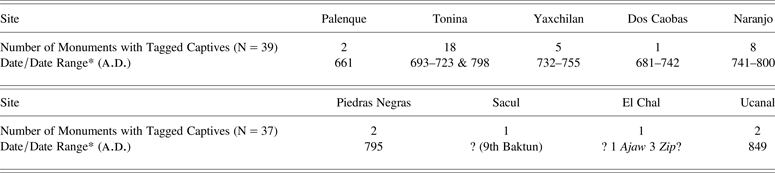
Based upon an investigation of Maya stone relief sculptures primarily from the southern Peten and Chiapas that depict tagged captives (see Table 1), this study proposes that the hieroglyphic tag operates as a mechanism that inflicts artistic violence upon the captive body and acts to subjugate it, shame it, and to indicate loss of agency by referencing the common practice of labeling, or tagging inanimate objects with script. This grim iconography was rendered not for justice, but was carried out in order to enhance the gap between agent and subordinate and to visually intensify the condition of defeat and captivity that extended beyond the participating figures to entire cities or polities.
Tagged captive sculptural images at Late Classic Maya sites
Note: Not all works from this study are securely dated. This table includes only those works which are dateable within a reasonable degree of certainty.
This study draws from Michel Foucault's Discipline and Punish: The Birth of the Prison (Reference Foucault1979) in its exploration of the captive body as a site upon which to act within the context of hierarchical power relationships. The tag is explored as a textual mechanism that alters the status of the captive body, and as one of an extensive set of conventions for humiliating the defeated subject and for provoking his submission. Following Foucault (Reference Foucault1979:138), this study treats the tagged bound figure as a “political anatomy” and explores a “mechanics of power” in order to define the ways captors took hold over others’ bodies. This work also integrates considerations of embodiment (Bachand et al. Reference Bachand, Joyce and Hendon2003; Meskell Reference Meskell and Rautman2000; Meskell and Joyce Reference Meskell and Joyce2003), as provocative captive imagery was not only commemorative, but also causal through its implicit relationship to the actual captive body. As the bodies of captives belonged to others even after their death (Houston et al. Reference Houston, Stuart and Taube2006:206), when placed upon particular bodily locations, the textual tag functions in part to draw attention to the practice of taking military trophies.
OVERVIEW OF THE CAPTIVE THEME IN CLASSIC MAYA ART
Captive portraiture, like the Classic Maya motif, was an artistic convention by which the ancient Maya communicated non-egalitarian political relationships, particularly the authority and military prowess of rulers (Marcus Reference Marcus1974:83; Stuart Reference Stuart2007:42). The frequency of prisoners of war in ancient Maya art suggests that the power of a ruler was ascribed in large part to the conquest of neighboring lands. In fact, we now understand that Classic Maya rulers undertook various types of military actions ranging from small-scale incursions upon nearby villages to full-blown regional conflicts (Brown and Stanton Reference Brown and Stanton2003; Martin and Grube Reference Martin and Grube1995, Reference Martin and Grube2008; Stuart Reference Stuart2007; Webster Reference Webster, Sabloff and Henderson1993). Military captives were not merely a convenient benefit of victory, however, as captive-taking is thought to have been a primary motivation for initiating battle (Berryman Reference Berryman, Chacon and Dye2007). This is likely because war prisoners and their depictions were critical propaganda in a climate of rapidly shifting powers and alliances, and rendered victims undoubtedly represented defeated elites, but also stood in for defeated polities, towns, or lineages. The intensification of the captive theme in representations of the Late Classic period (a.d. 600–900) likely reflects the heightened political conflict that is believed to have characterized this era (Schele Reference Schele and Boone1984:45).
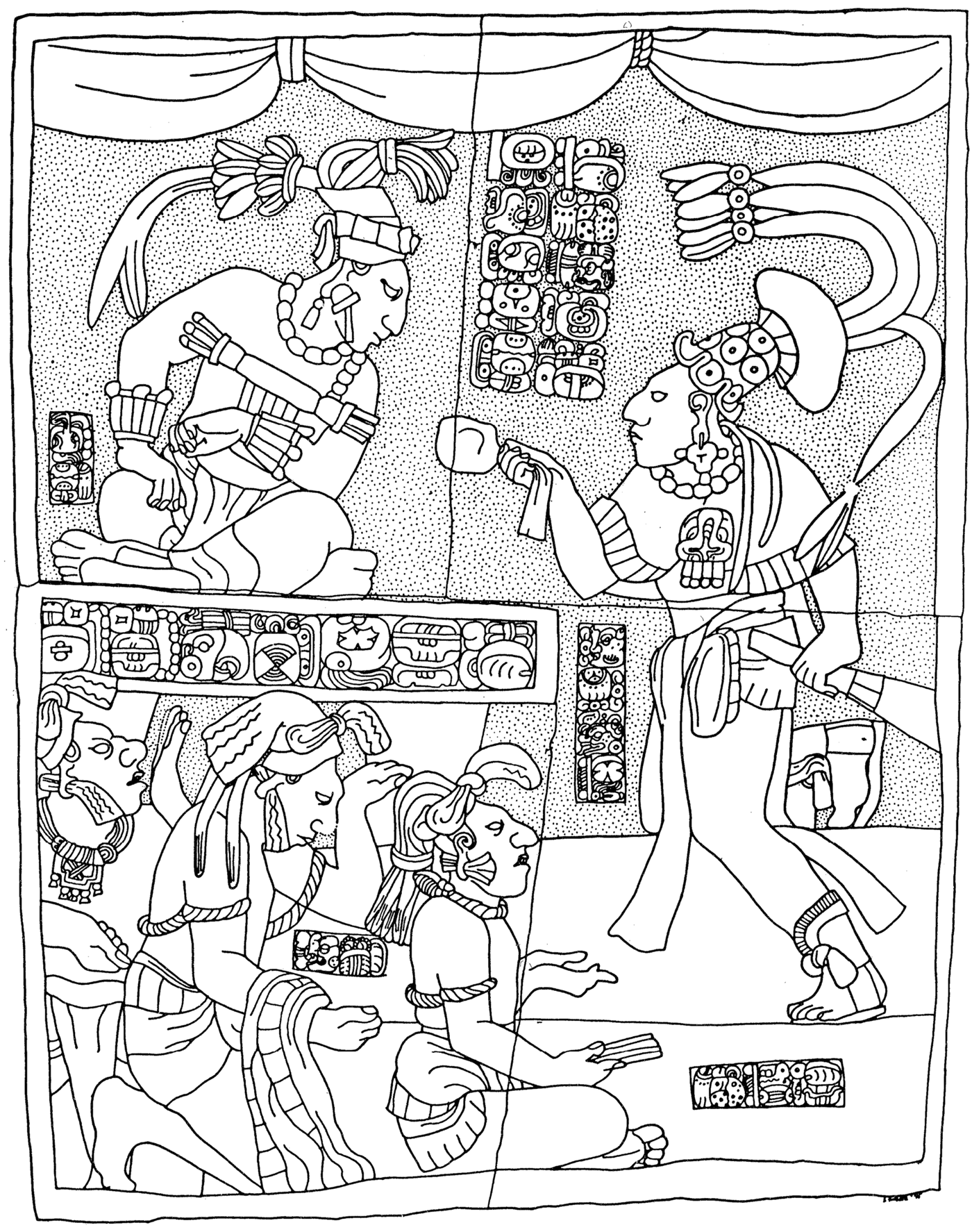
In the same way that captive iconography was utilized as political propaganda to assert a ruler's military skills and conquests, captives and their images also functioned as pawns in competitions for prestige. For instance, the merits of captive-taking extended to tribute and gift-giving among allies, a practice by which individuals enhanced their social and political status (Inomata and Triadan Reference Inomata, Triadan, Ruiz, Sosa and Ponce de León2005:202). The Laxtunich Panel (ca. a.d. 783) (Figure 2), named for a site in the vicinity of the powerful center of Yaxchilan, shows captive gift-giving as an effective method by which lesser nobles negotiated their political mobility. The panel, likely commissioned by the noble Aj Chak Maax, records his offering up of three bound, distraught prisoners to the enthroned Chelte’ Chan K'inich of Yaxchilan (a.d. 769–800) in solicitation of the influential ruler's favor. Adjacent text relates that just three days after seizing the noblemen, Aj Chak Maax presented them in front of his lord (Stuart Reference Stuart2007:45). This image suggests an alliance between the lesser Laxtunich noble and his overlord, but more importantly, it also suggests that Aj Chak Maax hoped that his acquiescence would elevate his own status. In a succinct visual metaphor for political climbing, the opportunistic Aj Chak Maax kneels upon the top step on level with the Yaxchilan king, as if eager to spatially and politically align himself with him. Even the least astute viewer would have noted that the headdress of Aj Chak Max is nearly comparable in height to that of the ruler he approaches, and offers an “alternative” size hierarchy that contradicts a reading of the kneeling vs. enthroned poses of the main figures.
Laxtunich Panel with captive-gifting scene. Aj Chak Maax presents three captives to Chelte’ Chan K'inich, ruler of Yaxchilan. a.d. 785. Drawing by Linda Schele (www.famsi.org: No. 7629).
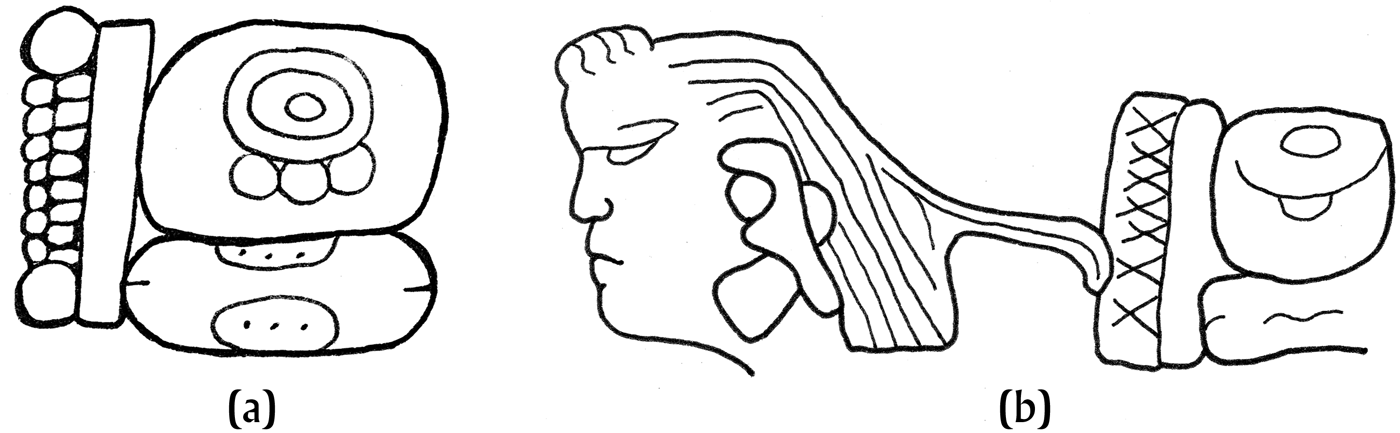
The prestige of captive procurement was reflected in scripted elite titles that included tallies or names of prestigious apprehensions (Schele Reference Schele and Boone1984:44) (Figure 3). A formulaic captive count, or tally of the prisoners one has allegedly procured, appears in elite titles as aj-x baak or “he of x captives” to indicate as many as 20 detainments (Stuart Reference Stuart, Robertson and Fields1985). “He of 20 captives” was a self-aggrandizing military title of the Yaxchilan ruler Bird Jaguar IV (a.d. 752–768), and was also used by Kan III of Hazcap Ceel at the site of Caracol, Belize (Martin and Grube Reference Martin and Grube2008:130). The number 20 (k'al) should not be taken literally in this case, as it is a probable gloss for the concept “many,” which explains why recorded captive counts may remain at this number throughout a ruler's reign (Stuart Reference Stuart, Robertson and Fields1985:101).
Royal title aj–k'al–baak, “he of 20 captives”. (a) Yaxchilan Lintel 16 detail, “he of 20 captives.” Author drawing after author photograph. (b) Hatzcap Ceel, Altar 1, Caracol, Belize. Ruler K'an III and his title aj–k'al–baak, “he of 20 captives” or u-baak, “his captive.” Author drawing after author photograph.
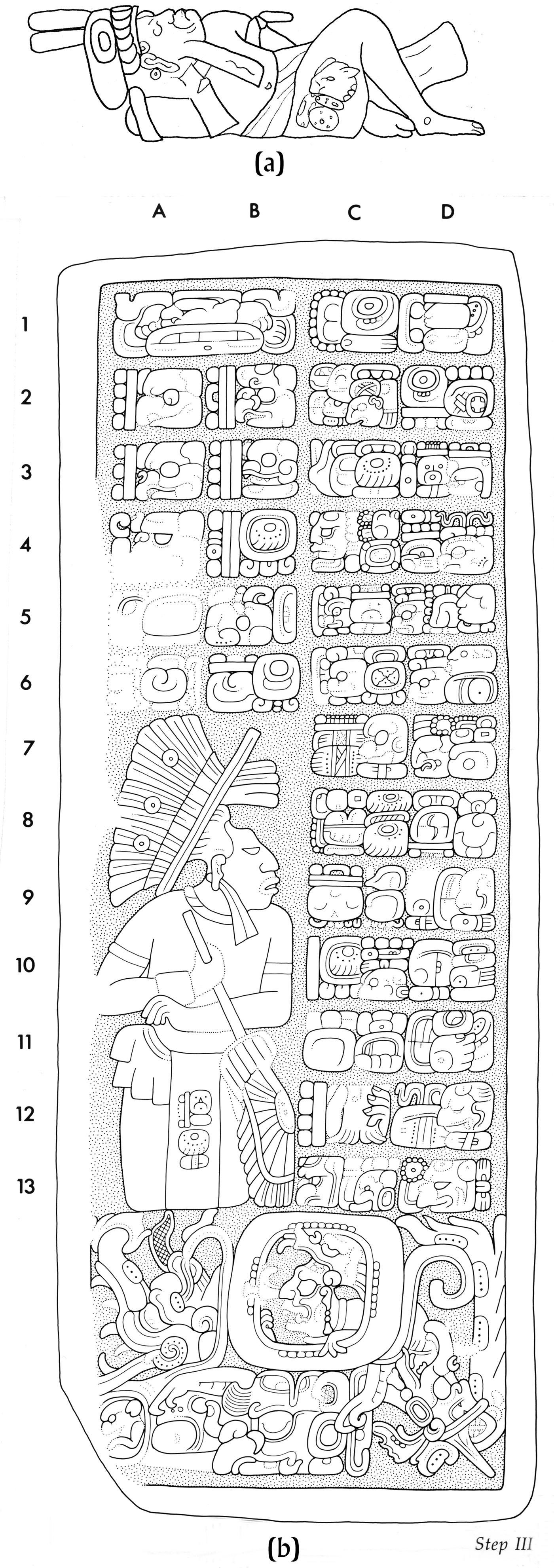
In the south-central Maya region, the captive theme was most commonly sculpted on stelae, but was also rendered on other stone forms including altars, lintels, panels, and staircases. Captive staircases such as those at Tonina, Yaxchilan, Copan, and Dzibanche in southern Quintana Roo constitute a particularly interactive form of sculpture (Figure 4). By ascending a staircase carved with captive iconography, viewers participated in symbolic prisoner abuse as they stepped upon bodies rendered on the tread and kicked them on the riser (Marcus Reference Marcus1974:88; Velázquez García Reference Velásquez García and Nalda2004). For instance, at Yaxchilan Structure 44, ruler Itzamnaaj B'alam commissioned steps with texts and captive images. The arrangement of these glyphs and figures, perpendicular to the length of the stairs, equates climbing them to the ascension of a massive partially-open screenfold codex that relays an account of military victory (Miller Reference Miller and Houston1998:206–207).
Captive stairs. (a) Tonina Monument 27, captive K'awiil Mo’ rendered on a stairway. Author drawing after author photograph. (b) Yaxchilan, Hieroglyphic Stairway 3, Step III. Drawing by Ian Graham ©President and Fellows of Harvard College, Peabody Museum of Archaeology and Ethnology, Harvard University, PM# 2004.15.15.1.235 (digital file # 125540013).
Late Classic Maya captive depictions exhibit a range of stylistic variations. Captives kneel at the feet of their captors or serve as their thrones or pedestals (Schele Reference Schele and Boone1984:16). Stelae at Naranjo give visual precedence to the victors, rendered as imposing figures who crush their diminutive prisoners under their feet. Iconography of this type at Naranjo may in fact reference captive depictions carved onto staircases. Evidence for this idea is found on Naranjo Stela 30 (see Figure 1c), as a tun “stone” sign peaks from behind the bent knee of the captive to suggest that he is either a sculpted image, or alternately is posed before a stone structure. It is tempting to think that such images oscillated between both forms of representation, that is, between a depiction of a living captive and a depiction of his representation. Similarities in the figural arrangement between the aforementioned captive on Naranjo Stela 30 and a captive on a stair step or riser at Tonina (Monument 27, see Figure 4a) lend credibility to this idea.
At Tonina, captive images are rendered as sole subjects and are carved with dramatic flair. Here, sculptors implemented a strikingly emotive and naturalistic variation of individual captive sculptures, most of which appear to have been attached to architecture (Yadeun Angulo Reference Yadeun Angulo1992). When held against figures of rulers, these prisoner images hold up as better candidates for something approaching true portraiture (Marcus Reference Marcus1974:92). In fact, the sculptors at Tonina imbued their captive figures with a sense of humanization that, at least for the modern viewer, enhances visual interest and solicits compassion (see Figure 1a).
A FORMAL COMPARISON OF CAPTIVE AND RULER ICONOGRAPHY
As vital Late Classic iconographies, captives propose a natural counterpart to the Classic Maya motif, or the portrayal of individual rulers as idealized “warrior kings” in ceremonial garb (Martin Reference Martin and Grube2000:175; Proskouriakoff Reference Proskouriakoff1950:4; Spinden Reference Spinden and Hodge1916:443–444). Rendered captured elites display a set of humiliating pictorial conventions, including costumes, poses, gestures, and emotions, visually differentiate them from their captors.
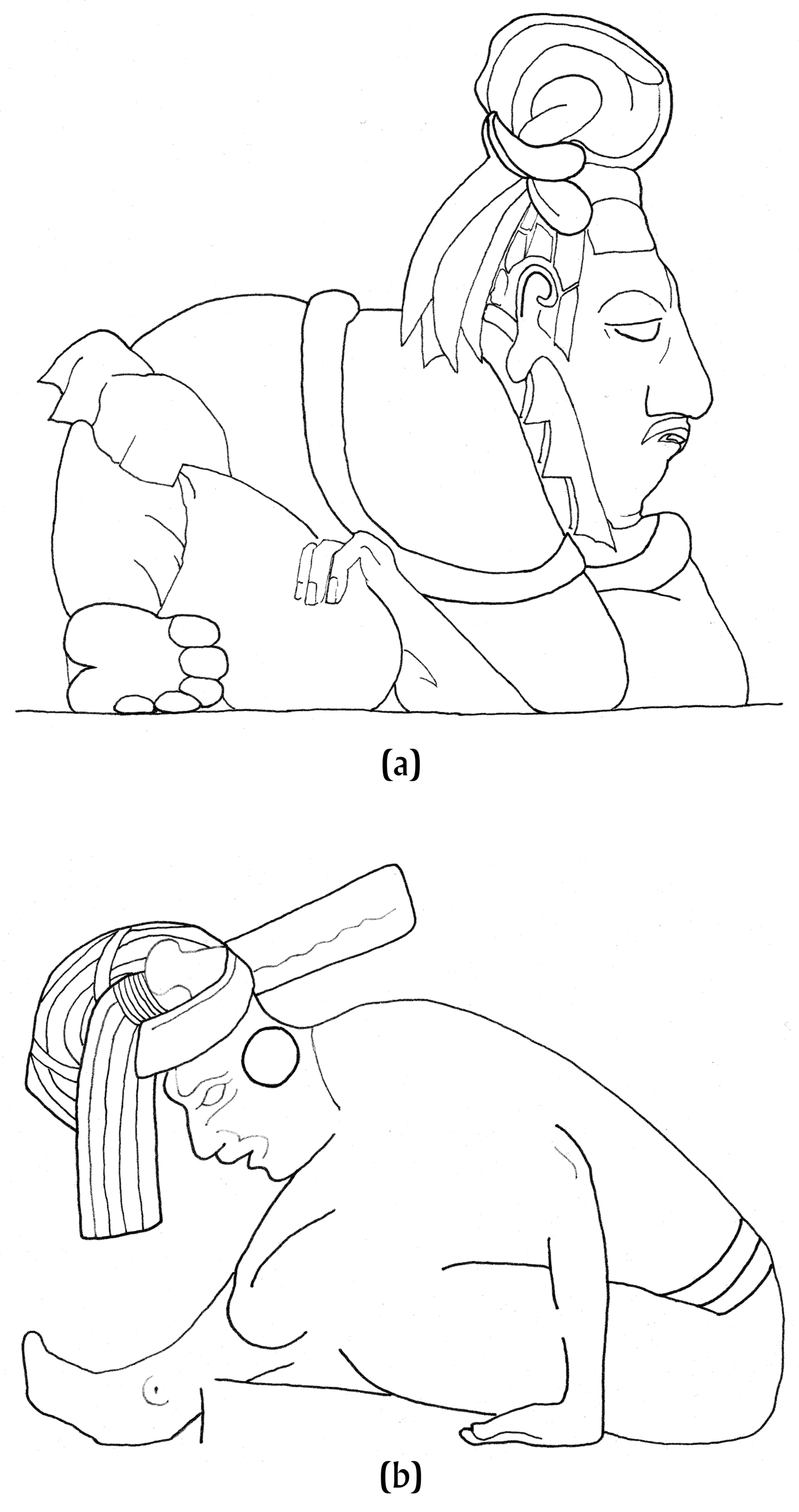
The cowering postures of the detained offer visual relief from the rigid, formulaic figures of rulers, even when the latter are absent from a scene (Marcus Reference Marcus1974; Miller Reference Miller and Houston1998:173). Predictably, many such postures are augmented by rope bindings that bend the limbs in unnatural ways (Dillon Reference Dillon1982). Such bindings not only convey loss of mobility and agency, but they also provide what was likely a welcomed opportunity for artistic experimentation with the human form (Houston Reference Houston2001:210–211; Marcus Reference Marcus1974:92). In various artistic demonstrations of figural play, captives twist in pain, are yanked by the hair, or are bound with rope in unconventional poses (Dillon Reference Dillon1982). These non-standard postures allowed artists to flaunt their mastery of human anatomy in the same way that “revelers” permitted ancient Greek artists to showcase their proficiencies (Figure 5). Christian Prager (Reference Prager2008) has identified an unusual “seated captive” hieroglyph in which the figure's hands are tied behind his back, and the glyph likely denotes the word chan, “guardian, watcher, master, custodian.”
Experimental captive poses. (a) Captive as throne. Palenque, Tablet of the Slaves, detail. Author drawing after author photograph. (b) Captive bending forward. Tonina Monument 131. Author drawing after author photograph.
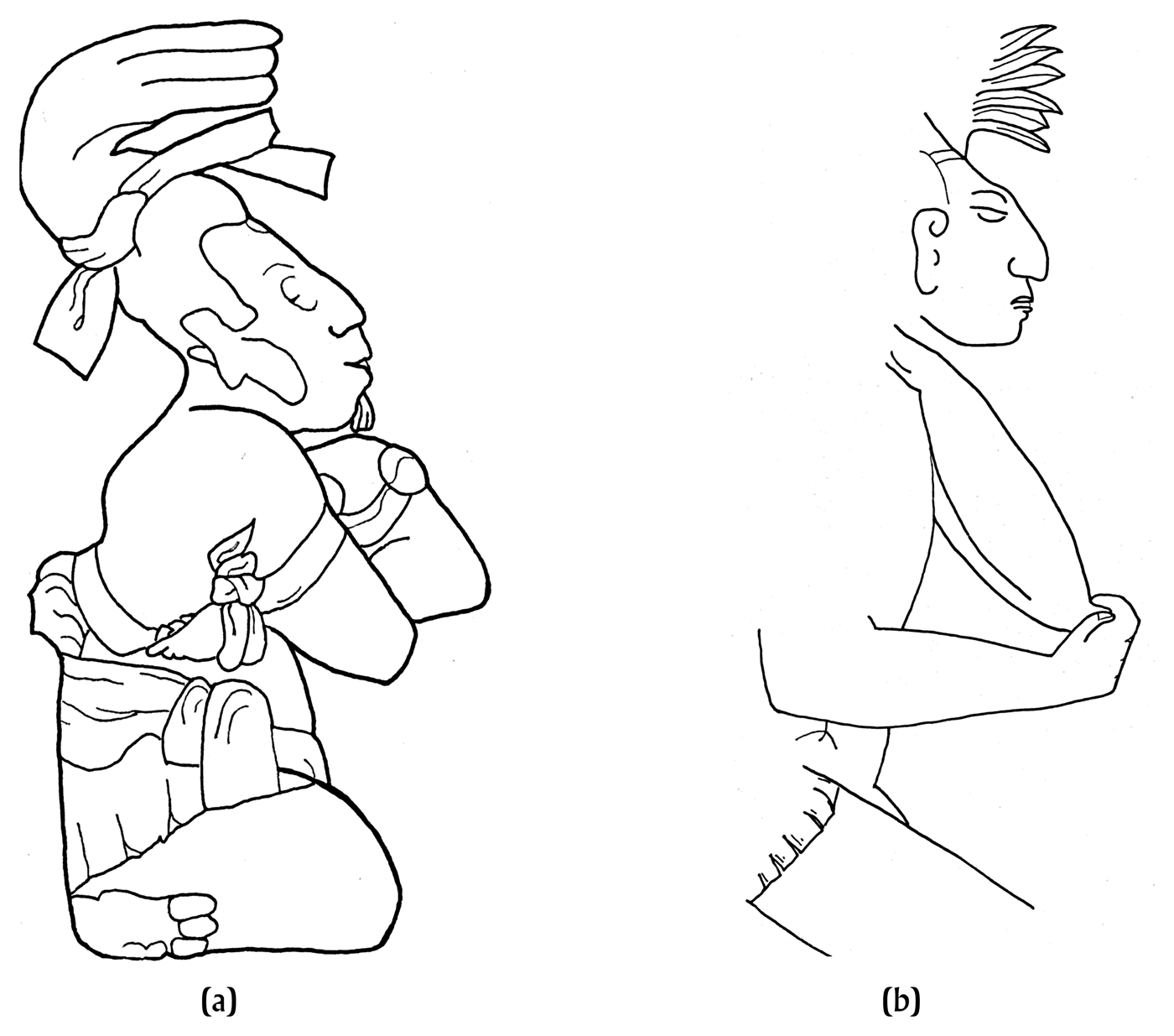
Uncontrolled displays of emotion also separate subordinate from victor. As the formality of rulership was equated with decorum and social order, contrasting emotive expressions and uncontrolled gestures were aligned with loss of will, terror, pain, and humiliation (Houston Reference Houston2001; Houston et al. Reference Houston, Stuart and Taube2006:190; Spinden Reference Spinden and Hodge1916:443–444). The faces of captives relay pain, and their gestures suggest anguish and despair. Furthermore, many Classic Maya formalized postures convey hierarchies, and certain hand and arm poses used by captives in the presence of their captors indicate supplication (Figure 6) (Baudez and Mathews Reference Baudez, Mathews, Robertson and Jeffers1978:32; Miller Reference Miller1983; Pinceman Deliberos Reference Pincemin Deliberos2004). For instance, kneeling, crossing the arms placed in front of the chest, placing one hand on the opposite shoulder, and placing the hand at the mouth (“eating earth”) all constitute “gestures of submission” that likely signal varying degrees of acquiescence (Miller Reference Miller1983).
Captives who display gestures of submission. (a) Folded arms. Palenque Temple XVII Tablet, detail. Author drawing after author photograph. (b) Touching the elbow and shoulder. Yaxchilan Stela 10. Author drawing after author photograph.
Nudity is a charged sign that shames the defeated, underscores the removal of his elite regalia, and draws attention to the paper or cloth strips that serve as replacements for his ear spools (Ardren and Hixson Reference Ardren and Hixson2006:18; Benson Reference Benson, Robertson and Jeffers1978:95). Suggestive poses or visible genitalia may allude to a sensuality verging on sublimated eroticism, or may infer a feminization of the masculine form (Figure 7) (Klein Reference Klein and Trexler1994). Yet the rendering of prisoner genitalia should not always be taken as a sign of abject humiliation, as it reveals social status by directing viewers to the scars incurred during the elite ritual of penile bloodletting (Ardren and Hixson Reference Ardren and Hixson2006:18).
Nude captives. (a) Female captive. Jaina Island. Image in the public domain, courtesy of Yale University Art Gallery. (b) Male captive. Cumpich, Campeche. Author drawing after author image.
As previously described, the hieroglyphic tags scripted upon captive bodies constitute part of the visual rhetoric that differentiates captors from their captives. While texts located adjacent to captive bodies function as captions to clarify their identities, such scripts lack the intricate layered meanings that inflect the captive body in particular ways, and these relationships are to be further outlined in this study. At its essence, the sculpted infliction of hieroglyphs directly on the captive body indicates the imprisoned condition as a state of objectification and possession by the captive. Although elites occasionally wear nominal glyphs on their faces or in their crowns in the artistic record, no other figure in the Classic Maya artistic corpus is so blatantly and noticeably marked directly on the body's core, legs and arms as military prisoners. Like the rulers who boast hieroglyphic versions of their names in their headdresses (Burdick Reference Burdick2010), the convention of denoting the conquered with text was easily interpretable, even for the illiterate or foreign observer.
TAGGED CAPTIVE IMAGERY
Tagged captive images are an unusual form of portraiture that transform anonymous and generic victims into specified historical personages. In his study of Lintel 4 at Piedras Negras, Herbert J. Spinden (Reference Spinden and Hodge1916:442–443) accurately proposed that hieroglyphs on prisoners can record “the names of both persons and places.” The convention of attaching names to prisoners was subsequently recognized by Tatiana Proskouriakoff (Reference Proskouriakoff1963) in her examination of Lintel 8 from Yaxchilan (Figure 8). Upon observing that the glyph sets on the main text following the “to capture” verb are identical to the glyphs sets on adjacent captives, she concluded, “on the thigh of each captive…is a glyph that doubtless gives his identity” (Proskouriakoff Reference Proskouriakoff1963:150). For scholars of Late Classic Maya history, these tags have become an important source of historical information that reveal appellatives for major and minor political figures as well as power dynamics among sites and polities (Johnston Reference Johnston2001; Marcus Reference Marcus1974:87; Schele and Grube Reference Schele and Grube1994:3; Stuart Reference Stuart2004).
Yaxchilan Lintel 8, detail. Two captives with tags on their thighs. Author drawing based on details of drawings by Ian Graham and John Montgomery.
Dates for tagged captive sculptures fall within the three centuries that modern scholars have termed the Late Classic Maya period, ca. a.d. 600–900. All examined images that are paired with a Long Count or Calendar Round date were sculpted after a.d. 650 (see Table 1), with the final known instance appearing at Ucanal in a.d. 849. These captive depictions are primarily clustered at sites in what is now Chiapas, Mexico and along the Usumacinta River that bounds contemporary Guatemala and Mexico. Although not all instances of tagged prisoners are datable, the convention appears to have first developed at Palenque and Tonina before moving eastward to sites along the Usumacinta River, and was later adapted by sculptors in what is currently Guatemala at sites such as Naranjo and Ucanal.
Hieroglyphic tags relay that the Maya captured rulers, high ranking officials, and perhaps scribes in order to disrupt an enemy's political and intellectual ventures. These tags do not, however, disclose the fate of prisoners. Based upon lurid portrayals of battle aftermath such as those depicted on the Bonampak murals, we presume that a victim's destiny was ritual sacrifice. Yet David Stuart's (Reference Stuart2004, Reference Stuart2007) investigation of the tagged portrait of ruler K'inich K'an Joy Chitam II of Palenque (captured by Tonina opponents during a “star-war” event at Palenque in August, 711 and subsequently depicted at Tonina), offers evidence that some elite captives may have been released so as to continue their reign under the aegis of their captor (Martin and Grube Reference Martin and Grube2008:184) (Figure 9). In fact, monuments at Palenque and Piedras Negras mention K'inich K'an Joy Chitam II in connection with events that occurred after his capture by Tonina and his presumed death, and this unexpected finding has provoked David Stuart to suggest that one's capture should perhaps be taken at face value when more specific information is missing (Stuart Reference Stuart2004:3).
Tonina Monument 122. Ruler K'an Joy Chitam II of Palenque depicted as a tagged captive at Tonina, a.d. 711. Drawing by Linda Schele (www.famsi.org:No.149).
Although in some sense the bodily inscription of elite name, title, and rank may provide a captive dignity and heighten the status of the captive trophy (Houston et al. Reference Houston, Stuart and Taube2006:203), such dignity was certainly countered by the humiliation of defeat. Furthermore, such tags enhance the vulnerable state of a publicly paraded victim by physically engaging with it. These scripts impose themselves upon the exposed surface of the body, draw attention to its physicality, its contours and postures, and invite the viewer's eye to move across it, perhaps to simultaneously pity and admire it. As illustrated in the Bonampak murals, captives were stripped of their regalia, bound, tortured after battle, and were put on display; the tagged captive image memorializes this event in enduring stone with the added sting of specificity.
It is unclear whether tags ever marked real captive bodies. Although abuses such as nudity and rope binding were certainly inflicted upon prisoners of war, two points suggest that hieroglyphic tags may have served exclusively as an artistic convention. First, captive tags appear solely in monumental sculptural works, perhaps with the exception of the Bonampak murals, but are absent from the multitude of captives shown on ceramics. In addition, these scripts are rendered so as to facilitate their comprehension; they are always located prominently on broad, relatively flat areas of the body, and they never “wrap” around the body's contours so as to appear cropped. Some captive bodies are intentionally contorted in order to fully display their textual tags. In other words, each tag is rendered so as to be visible in its entirety from a single, generally frontal vantage point. Both the restriction of tags to a single medium and their conventional artifice on otherwise naturalistic figures suggest that the practice of tagging did not extend beyond the pictorial frame. On the other hand, colonial sources do suggest that important persons bore tattoos or painted versions of their names on their arms and hands, as well as on the soles of the feet (Thompson Reference Thompson1962:50).
AN ATYPICAL TAGGED FEMALE FIGURE AT TONINA
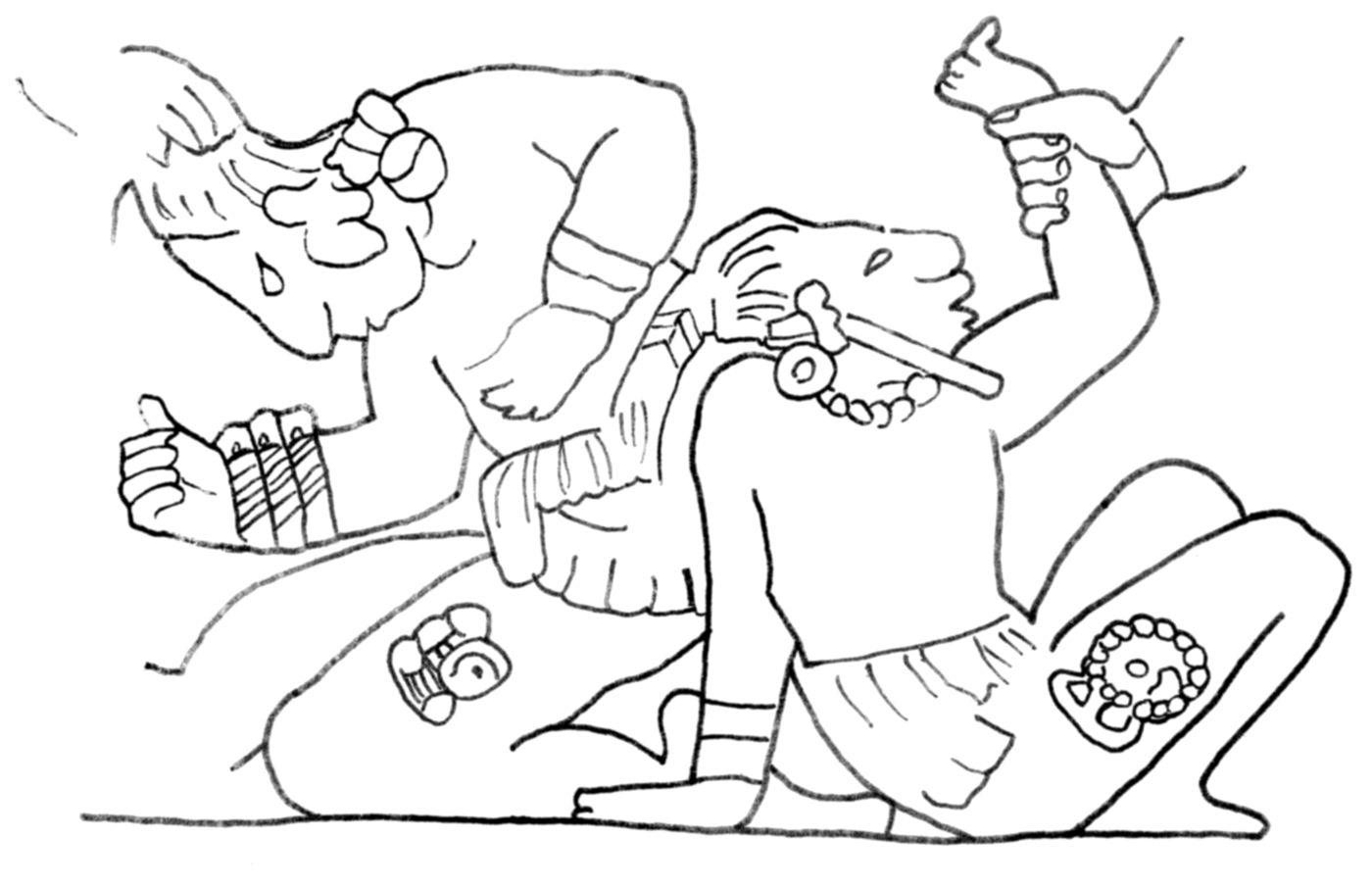
The tagged captive images in the archaeological record are exclusively male with the exception of a single female figure on Monument 148 from Tonina (Figure 10). In this eroded image, an elite female with a tagged thigh and a weapon in hand struggles against a male attacker. Her unbound breasts, raised weapon, and her grasp of the male figure's hair suggest sexual assault, perhaps within the context of military conquest and captivity (Houston et al. Reference Houston, Stuart and Taube2006:207–208). A short adjacent text includes an eroded Calendar Round date to fix the image in time. The tag on her thigh is also eroded, but appears to carry the female ix title, which would have imparted additional historical specificity to the scene. This faint tag may signal her captivity, but she is neither bound nor stripped of regalia in the manner of male prisoners. A significant difference between this image and those of male captives is that she is depicted in the act of defending herself, and this may suggest that her defensive efforts are to be viewed as particularly valiant or honorable.
Tonina Monument 148. Female figure (left) with tagged thigh fends off a male attacker. Author photograph.
WHAT DO CAPTIVE TAGS RECORD?
Captive tags are succinct texts that record personal data regarding the identity of the subject and the context of his detainment. When located on the captive body, these script blocks are often recessed, while adjacent names of captors and other nobles are placed in raised cartouches or boxes, a convention which correlates to and signals their relative status. Three types of information may mark such figures: the identity of the captive, the identity of the captor, and the date of the capture event. Personal names, titles, and emblem glyphs all fall under the umbrella of captive/captor identity. The event itself is often documented with a Calendar Round date followed by the completive form of the “capture” verb, chukaj. While Yuri Knorozov (Reference Knorozov1958:471) first read this verb in the codices, it was Proskouriakoff (Reference Proskouriakoff1960:470, Reference Proskouriakoff1963:150) who isolated the capture verb in prisoner scenes and noted that it often precedes a prisoner name.
Tonina Monument 178 carries one of the more lengthy texts applied to a captive body, as it includes a date as well as personal information for the elite prisoner. Carved across the victim's chest, the horizontal inscription begins with the Calendar Round 7 Ben 11 Sip (written as 7 Ben 10 Sip) followed by the chukaj “captured” event. Along his loincloth runs a vertical text: the first glyph provides the prisoner's name, Ik'nal, followed by a glyph that names him as the ruler of a site spelled phonetically as pu-wa-la, perhaps Puwal (Mayer Reference Mayer2007:134–135). The final glyph describes the captive as a high-ranking B'a Ajaw, or “First Lord,” an impressive title which indicates that his defeat was a particular triumph.
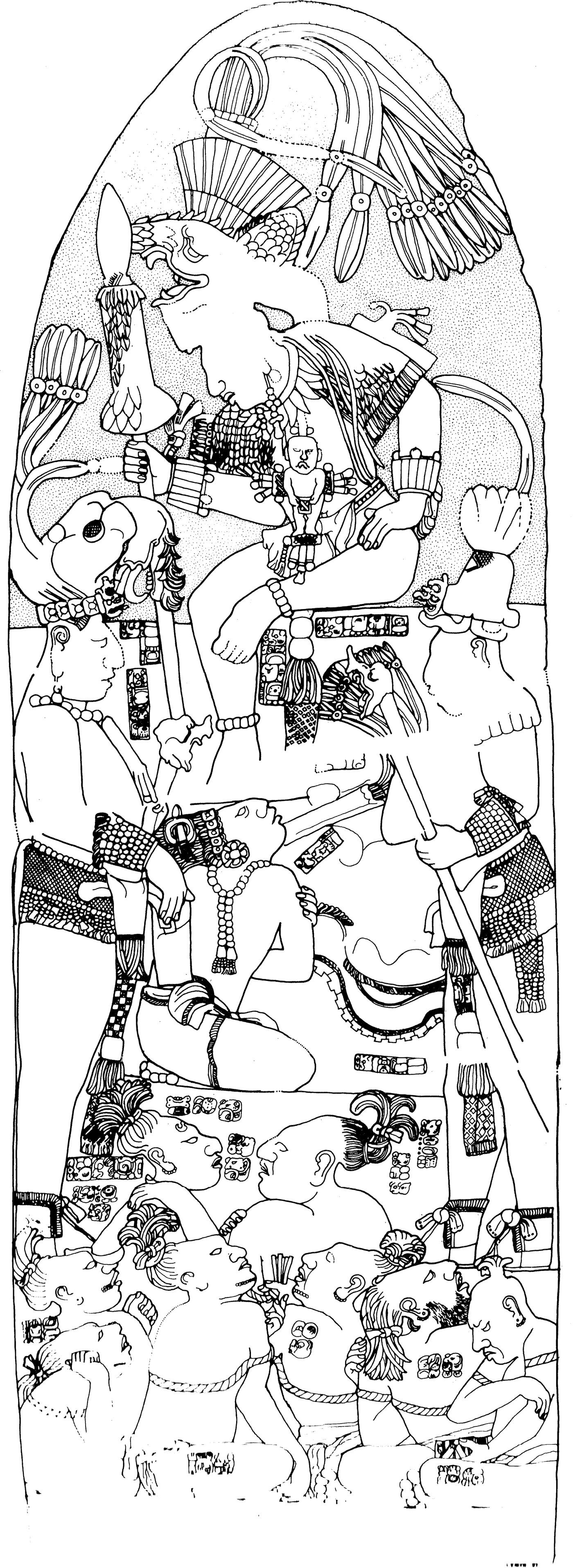
Other prisoner tags are more succinct than those of the Tonina prisoner, including texts inscribed on nine captives rendered on Piedras Negras Stela 12 (Figure 11). Labeled with a diverse smattering of elite titles, the captives include a bak pitzal sajal, “captive ballplayer lord” and a chuk-? toxat(?) sajal, “captured bled-penis lord,” to convey the captive's participation in bloodletting rituals. Occasionally, tags record seemingly esoteric information about the captive and his circumstance. At Palenque's House A, hieroglyphic tags suggest that captive-taking functioned to combine political and religious imperatives, as the captives here are referred to as the displayed “sacred creations” of the king and governor of Palenque (nahwaj yahil k'uhul baakal ajaw and nahwaj yahil kalomte’) (Stuart Reference Stuart2003:28).
Piedras Negras Stela 12. Drawing by Linda Schele (www.famsi.org:No. 7621).
TAGGED OBJECTS, TAGGED BODIES
Above all, the tagged captive is a highly atypical rendering of the human form. Tagging is, by convention, primarily restricted to inanimate objects in Classic Maya art and no other human figure is routinely marked with text directly on the body. Certainly the placement of hieroglyphic script onto the skin raises questions of intentionality and significance: Why is the depicted captive body an appropriate location for inflicted script in the manner of a brand or a scarlet letter, like a slave or a criminal? What nuanced meanings did artists intend to convey by imposing text upon human skin in this manner?
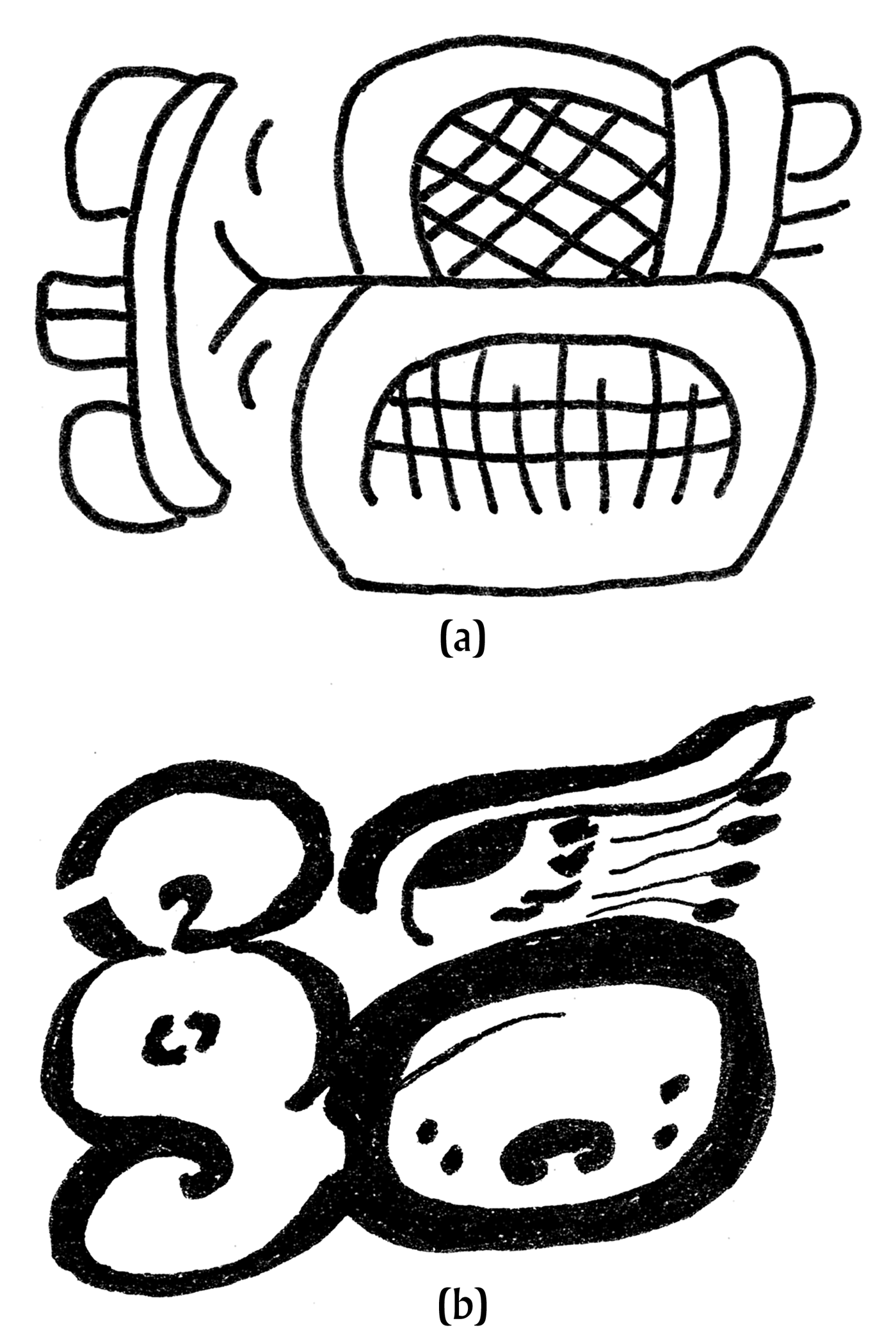
In addition to relaying personal information about a defeated figure, captive tags mimic the common Classic Maya practice of labeling objects with short texts to describe them or to identify their owner, and as such, establish implicit connections between scripted names and possessions. The Maya archaeological and artistic records indicate that persons who commissioned or otherwise owned portable objects often claimed them with textual tags. Possessive tags for asserting ownership are comprised of a formulaic structure consisting of a third-person possessive pronoun (u/yu, “his/her”), the name of the object (e.g., lak, “plate”), and the name of individual who owned or commissioned the object. To further illustrate this formula, we might consider the first use of the term “name-tagging,” which was applied to the inscription on an ear spool from the site of Altun Ha, Belize (Mathews Reference Mathews and Pendergast1979) (Figure 12a). The text reads u-tup ix-??, “her ear spool, Lady ??” to indicate that the object was the property of a woman. Tagged portable objects of special value to their owners such as ear spools, ceramics, weaving bones, and shell and are often found in elite burials (Houston and Taube Reference Houston and Taube1987:38; Mathews Reference Mathews and Pendergast1979; Trik Reference Trik1963). Other examples such as jade plaques have been uncovered in sacrificial contexts (Justeson Reference Justeson and Houston1983). In the case of ceramics, the tags that comprise part of the Primary Standard Sequence (PSS) allowed viewers to trace and interpret social and political networks (Houston et al. Reference Houston, Stuart and Taube1989; Reents-Budet Reference Reents-Budet1994:4) (Figure 12b).
Inscribed possessive tags. U-tuup, “his ear spool” tag on an ear spool from tomb A–1/1, Altun Ha. Author drawing based on detail of drawing (Mathews Reference Mathews and Pendergast1979:79). Possessive tag yu-k'ib, “his drinking vessel.” Author drawing based on drawing detail (Houston and Taube Reference Houston, Stuart and Taube1989: Figure 1) and photograph #1383, Kerr Associates.
Tags were not restricted to portable objects, but were also applied to monumental sculpture and architecture. Maya artists signed their works with a scribal signature that included the phrase u-ts'ib, “his writing”, or alternately used the “lu-bat” phrase for carved or incised works (Stuart Reference Stuart and Kerr1989:154). In other instances, tags specify the noble who commissioned a specific artwork. A stela now in the Fine Arts Museum of San Francisco depicts queen Ix Mutal Ajaw engaged in ritual events, and the text specifies that the sculpture is u-lakamtuun, “her stela” (Miller and Martin Reference Miller and Martin2004:102). At Yaxchilan, possessive inscriptions on Structure 23 convey that the building is the property of Ix K'ab'al Xook (a.k.a. “Lady Xook”), the principal wife of ruler Itzamnaaj B'alam. This inscription occurs at least twice at Structure 23: on the edge of Lintel 25 and on the underside of Lintel 23 (Plank Reference Plank2004:36–39). A stone dog from Tonina (Monument 89) constitutes a particularly unusual example of tagging as it appears to display the name of its owner across its back, although it is unclear whether the sculpted canine stood in for an actual pet or alternately was a spiritual animal counterpart.
As captives taken during the course of battle are the only depicted human figures to receive the hieroglyphic tags otherwise reserved for possessed objects, the captive tag replicates the practice of attaching script to object, and functions as a visual tactic to objectify the human body. This is not a claim that the captive ceased to be human, as the body has a very different relationship to the world than non-sensing, non-cognitive objects. Rather, the inflicted hieroglyphic tag indicates revocation of human agency and signals that the body has become the prestigious acquisition of its captor, akin to a prized ear spool or ceramic vessel.
INSCRIBED CAPTIVE THIGHS AND FEMORAL TROPHIES
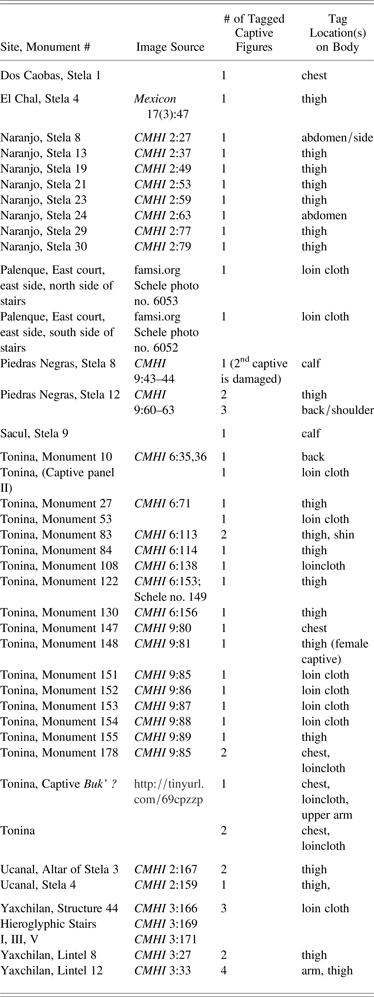
For the corpus of tagged captive images gathered in the course of this study, the most frequently marked location of the body is the thigh (Table 2). Here I am in agreement with Rands’ observation that the thigh or adjacent loincloth serve as a canvas for script in about half of all tagging cases (Rands Reference Rands1952:74). The high rate of marking the upper leg cannot be random; while the thigh provides a relatively large expanse for glyphs, the upper arm, chest, and back all provide similarly broad surfaces. Such discriminate placement suggests that tags upon the upper portion of the leg carry additional significance. The present study proposes that thigh tags visually link the actual captive body to his image, and particularly to his femur as a symbol or even a physical memento of the capture and sacrifice events.
Tags on captive bodies and loincloths in Classic Maya sculpture
The human femur was a common Mesoamerican military trophy and an emblem that stood in for an entire victim. When brandished, it served as a spectacular memento mori that permitted celebratory events to be relived (Miller Reference Miller, Tiesdale and Cucina2007). The femur is an appropriate pars pro toto fragment of the detained, as the human body can function in battle without particular bones and appendages, but without the thigh bone a warrior is incapacitated. Because it is not only the longest and thickest bone in the human body, but is also the strongest, the femur stands in for the physical tenacity of the defeated. Additional signification is revealed by Dennis Tedlock (Reference Tedlock2003:146–147), who notes that the contemporary Quiché Maya believe that one's patrilineage resides in the thigh. Hence the excised femur is not merely evidence of a worthy foe; it also constitutes proof that the future lineage of this enemy has literally been “chopped off.”
EVIDENCE FOR COLONIAL BONE MILITARY TROPHIES
Sixteenth-century chroniclers refer to the use of captive bones as military trophies in their records. In his account of Yucatec Maya customs published in 1566, Diego de Landa (Reference Landa1978:49–50) stated that if sacrificial victims “were slaves captured in war, their masters kept the bones, and displayed them in the dances, as a mark of victory.” Similarly, in the Florentine Codex Bernardino de Sahagún records the preferential treatment displayed toward the captive thigh during Aztec festivals. During the festival of Tlacaxipeualitztli (or Tlacaxipehuliztli), celebrants sacrificed a prisoner and distributed his body parts, and one of his thighs was always presented to Moctezuma. The captor and his relatives then engaged in a celebratory form of cannibalism, as he ate a stew of dried maize, called tlacatlaolli, upon which was placed a piece of his slain captive (Sahagún Reference Sahagún, Anderson and Dibble1951:47). In a separate ceremony, the captor set up a pole and hung his captive's femur at the top. In this instance the femur took on an overtly sacred role as, wrapped in cord and paper and decorated with feathers and a mask, it was called the “god captive” (Sahagún Reference Sahagún, Anderson and Dibble1951:57).
FEMORA IN THE ARCHAEOLOGICAL RECORD
If it were not for the discovery of related human osteological remains, the relationships traced in the previous paragraphs among captives, tags, and femora might be interpreted as the exclusive domain of representation. Carved human femora, many of which are incised with male portraits and hieroglyphic texts in the manner of miniature stelae, have been uncovered throughout the Maya realm as well as in other regions of Mesoamerica (Figure 13). Across Mesoamerica, two primary reasons for isolating and collecting human femurs were captive trophy taking and ancestral reverence. Importantly, when human femora are discovered apart from their original burial/corporeal contexts, it can be difficult to ascertain whether they truly fulfilled either of these functions.
Carved human femora carved with male figures. (a) Femur from Xcalumkin with inscribed standing male warrior and text. Image courtesy of Yale University Art Gallery, 1991.130.1. Purchased with a gift from Frederick R. Mayer, B.A. 1950, and the Leonard C. Hanna, Jr., Class of 1913, fund. (b) Long bone, possibly human, carved with a male head surrounded by volutes. Author drawing after author photograph. (c) Image of seated elite carved on the end of a human femur. Drawing by Linda Schele (www.famsi.org:No. 7326).
In an interesting twist, however, femora owners seem to have commissioned their own likenesses, or alternately those of their foe, upon the femurs of defeated victims in celebration of their military prowess. A carved human femur from the Puuc-region site of Xcalumkin (Herring Reference Herring1995–1996:51) bears a full-figure warrior portrait in an ornate headdress that presumably represents either the captive or the captor (Figure 13a). This portrait bears Toltec influence in the wrapped and tied wristlet and belt, traits reminiscent of those worn by the Atlantean figures at Pyramid B, Tula. Furthermore, the figure holds a curved object in his left hand that resembles a Toltec spear thrower, and if this is the case it can be argued that such warrior iconography is in keeping with portrayals of victors rather than their victims.
A similar likeness on a femur from Jaina Island, Campeche displays a full-figure ruler in Toltec warrior garb holding weapons (Coe Reference Coe1973:Figure 82). The directionality of such portraits supports the idea that the femur functioned as a trophy for ceremonial display, held upside down by the “hip end” as a scepter-like instrument (Herring Reference Herring1995–1996:55). When brandished, the inscribed portrait imposed upon the inverted femur would have constituted an irrefutable claim of conquest, as the formalized inversion of one's body, image or name signified defeat.
A carved longbone perforator dated to ca. a.d. 790 was excavated from the burial of a ruler, Ukit Kan Ke'ik (Grube et al. Reference Grube, Lacadena, Martin and Wanyerka2003:45–46) or Ukit Kan Le'k (Fitzsimmons Reference Fitzsimmons2009:169), of Ek’ Balam. The bone was clearly a treasured possession, as it was found grasped in the ruler's hand. Its carved surface bears a seated figure holding a small curved object. In addition, the cross-legged figure wears a prominent bone adornment in his hair which may represent the very same perforator, perhaps designating him as the owner of the object and hence the victorious captor.
Other Classic-period bones also display carvings, many of which have obvious connections to military captives and human sacrifice (Tiesler and Cucina Reference Tiesler and Cucina2007); undoubtedly the best-known example was the calligraphically rendered carving from Tikal Burial 116. This masterpiece shows a beautifully rendered bound captive, and an adjacent tag reveals that he is a relative of the king of Calakmul (Miller Reference Miller and Kowalski1999:Figure 194; Trik Reference Trik1963:Figure 9). A Terminal Classic femur from Campeche now housed in Brussels is less elegant than the Tikal bone, but is carved with a male head surrounded by volutes (Graulich and Dorsinfan-Smets Reference Graulich and Dorsinfang-Smets1990: Pièce N° 12) (Figure 13b). Heads and femora are related by their role as trophies of war, and in Yucatán, skulls and long bones passed centuries together in the Cenote of Sacrifice at Chichén Itzá (Agrinier Reference Agrinier1960:4; Miller Reference Miller, Tiesdale and Cucina2007:166–167).
Linguistic evidence also supports a conceptual relationship between captives and their bones in the Maya region. The word baak (a.k.a. b'aak, b'ak) (Montgomery Reference Montgomery2002:41) refers to both “bone” and “captive” in many contemporary Mayan languages as well as to “meat” and “game”. A royal title on Yaxchilan Lintel 16 literally states that ruler Bird Jaguar IV has 20 “bones,” a metaphor or linguistic substitute for captives that may reference the practice of collecting femora as portable proof of conquest. On Yaxchilan Lintel 24, the royal titles of ruler Itzamnaaj B'alam are read u-i(?)-chan ahk-baak Kujul-Ajaw-Yaxchilan (“he is a captor, he of the bone, holy lord of Yaxchilan”). Word play and substitution are characteristics of the parallel structuring of couplets, a frequently used device in Mesoamerica in which two phrases are organized so that the second segment metaphorically relays the same meaning as the first segment. In this title, the concepts “captor” and to “possess a bone” are arranged so as to suggest that they are interchangeable.
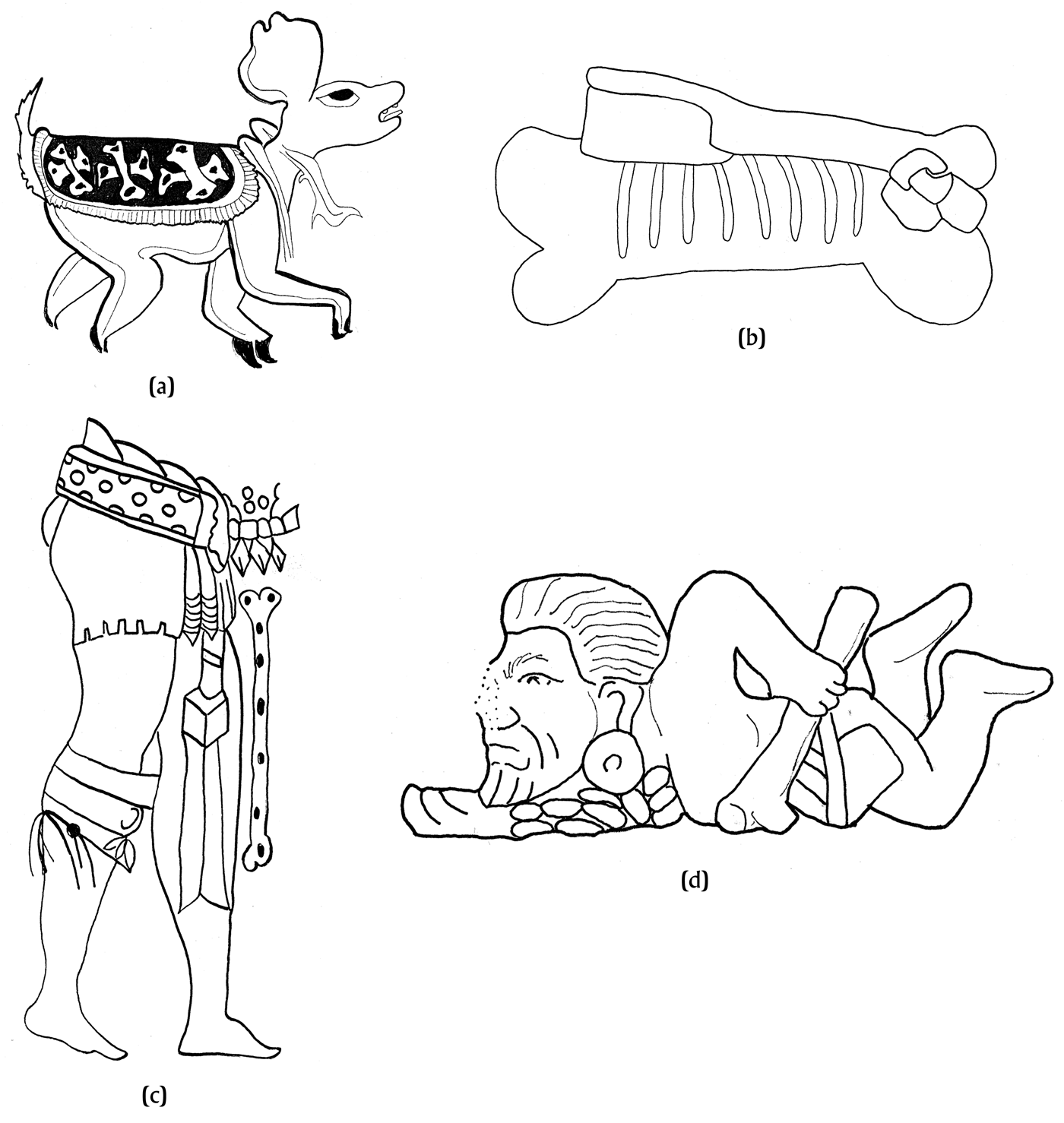
Conceptual links between captives and their femora appear to have extended beyond the Maya to other Mesoamerican cultures. In central Mexico, prevalent dismembered legs used within texts are thought to signify defeated enemies (Klein Reference Klein2002). Central Mexicans even had a specific vocabulary for the prized loot captured from conquered foes (Berdan Reference Berdan, Berdan, Chance, Sandstrom, Stark, Taggart and Umberger2008:111–112). Ethnic insignia, warrior regalia, and other accoutrements which likely included the bones of captives, were called quetzalpatzactli and were flaunted by victors. Throughout Mesoamerica, crossed long bones signal war and sacrifice, as exemplified by a painted ceramic at Dumbarton Oaks that includes a caped deer (Figure 14a). The sacrificial associations of an Aztec stone “rasp” in the form of a long bone excavated from the Templo Mayor are underscored through a sacrificial “knot” carved to resemble a strip of red paper fastened at one end (Figure 14b). A battle mural at Cacaxtla (ca. a.d. 650) shows a still-bloody thigh bone, perhaps recently ripped from a foe, as a warrior costume element (Figure 14c). Like a captive tag, this unanchored bone is strategically located near the thigh of a warrior as if to emphasize its role as a femoral trophy. Oriana Baddeley (Reference Baddeley and Berlo1983:63) and Claudia Brittenham (Reference Brittenham2008:47–48) convincingly argue that this motif is an instance of writing that names the adjacent warrior; in light of the bone's role as a relic, it would certainly have been an effective name or title that called attention to the warrior's military prowess.
Mesoamerican femur iconography. (a) A deer wears a cape decorated with crossed long–bones on a Maya ceramic vessel. Author drawing from author photograph. (b) Aztec notched stone femur form with red paper knotted around it. Author drawing from author photograph. (c) Cacaxtla, detail of warrior from battle mural. Bloody femur that may represent the scripted name of the adjacent figure and/or a captive trophy. Author drawing after photographs provided by University of California. (d) Detail, Zapotec male figure holding femur. Lambityeco, sculpted south frieze at entrance to Tomb 6. Drawing by J. Klausmeyer (Marcus Reference Marcus, Elson and Covey2006:Figure 11.6).
Tied to trophy-taking is the related practice of bone-carrying, which was practiced in the Valley of Oaxaca by rulers or other elites as symbols of power. Excavations of a grave at a residential terrace of the Zapotec Mitla fortress in the Valley of Oaxaca uncovered a male figure missing a femur, and this very femur was found in a distinct cist internment under an excavated house. This finding may exemplify a custom of removing ancestral bones from graves for use as symbols of authority (Feinman et al. Reference Feinman, Nicholas and Baker2010). The discovery resonates with other Zapotec findings, particularly Tomb 6 at Lambityeco. Here a modeled frieze located at the tomb entrance includes two male figures who each brandish a femur as a relic of an ancestor or captive (Marcus Reference Marcus, Elson and Covey2006:225–226) (Figure 14d). In addition, inside the tomb were the remains of six people, yet only three femurs were recovered. Finally, the erroneously named danzantes at Monte Alban (ca. 400 b.c.) and similar captive images at San José Mogote are worth mention here, as these victims of war presumably boast script on their bodies. While our inability to read the texts prevents us from securely understanding them as tagged captives, they may foreshadow the later Maya tagging convention.
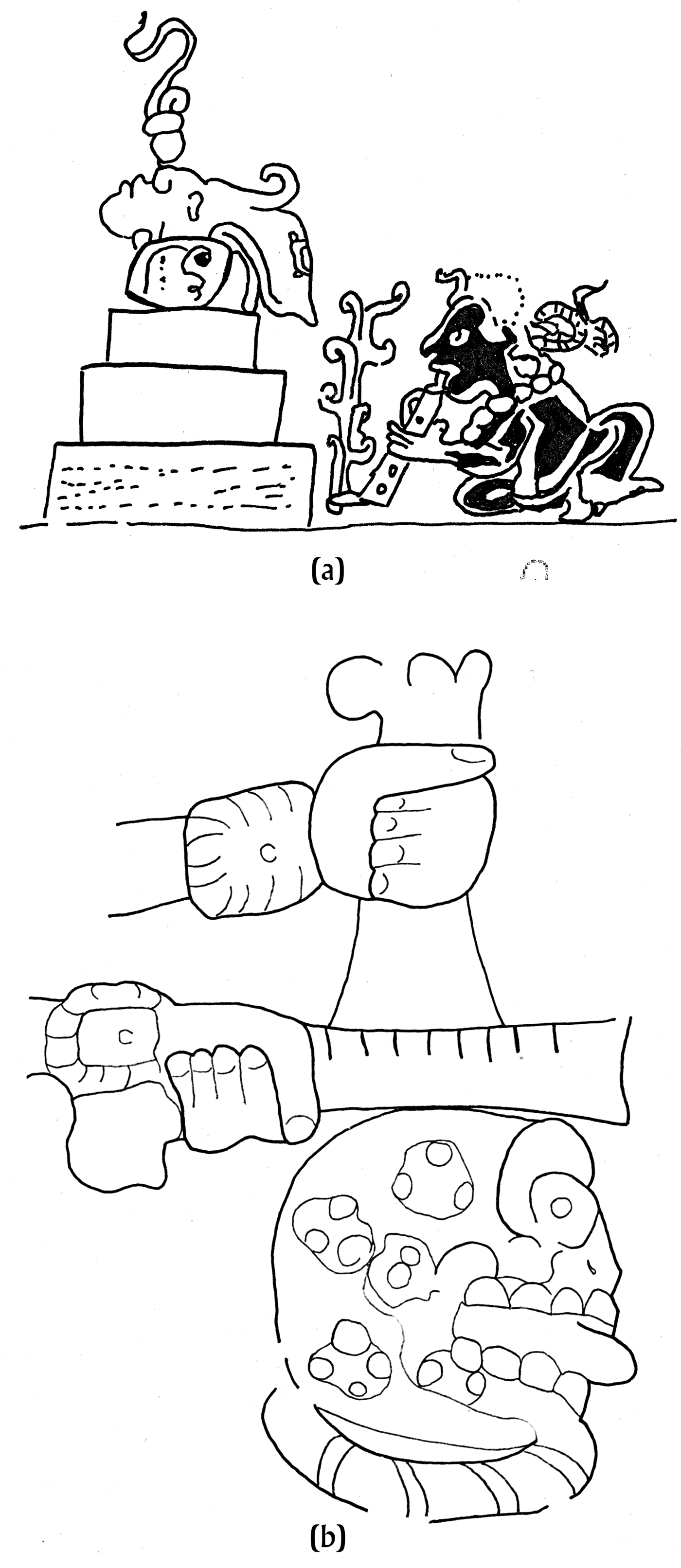
A particularly grisly pan-Mesoamerican practice appears to have involved the modification of human remains to engage the sense of hearing, as some human long bones were likely fashioned into musical instruments (Figures 15 and 16). Although relationships between captive bones and such instruments are unclear, various sources point to their interconnectedness. In the pre-Columbian K'iche' play Rabinal Achi (Tedlock Reference Tedlock2003:105–106), just prior to his decapitation the captive warrior Cawek proposes a rhythmic fate for his limbs: “And as for this bone of my arm when it becomes the handle of a metal rattler they will marvel at the clatter.… And as for this bone of my leg when it becomes the stick for a toponowos, a slit drum, they will marvel.” For Cawek, the music produced from his sacrificed body was to be a noble tribute to his life. His desire that his bones provide auditory pleasure after his death is perhaps mirrored in an image of sacrifice from the Dresden Codex (Villacorta and Villacorta Calderon Reference Villacorta and Villacorta Calderon1992:34) in which a decapitated head displayed atop a pyramid is serenaded by figures playing a flute and a rattle, perhaps created from the bones of the same unfortunate victim (Figure 15a).
Iconography in codices that links bones, sacrifice, and music. (a) Dresden Codex (Villacorta and Villacorta Calderon Reference Villacorta and Villacorta Calderon1992:34a detail). Decapitation image with musicians in which the head of the victim (the maize god) is displayed on top of a pyramid. Author drawing after Villacorta and Villacorta Calderon Reference Villacorta and Villacorta Calderon1992:68. (b) The deity 9 Wind plays a bone rasp with a scapula on a human skull resonator. Codex Vindobonensis (McVicker Reference McVicker2005:Plate 24 detail). Author drawing after McVicker Reference McVicker2005:Figure 6.
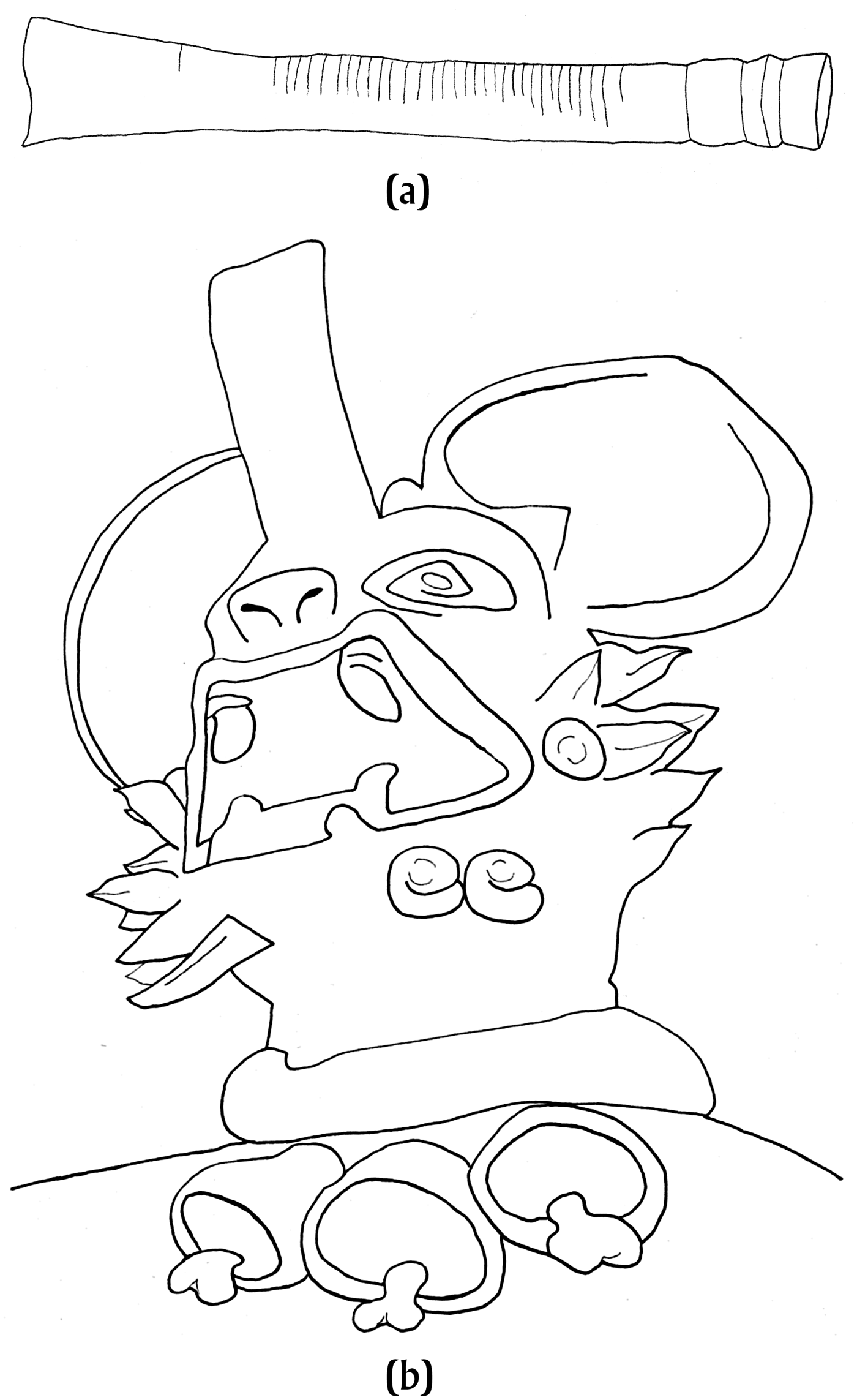
Musical instruments with bone iconography. (a) Maya ceramic notched flute and rasp in the shape of a long bone. Author drawing after author photograph. (b) Ceramic bat deity wearing a bell necklace with long bone clappers. San Mateo Tezoquipan. Author drawing after author photograph.
In the Mesoamerican archaeological record, modified human long bones or their replicas in clay functioned as rasps, flutes, and other musical instruments. Images from Late Postclassic codices suggest that human sacrifice was accompanied by music played with instruments, some fabricated from the bones of victims. In Late Postclassic central Mexico, notched femurs functioned as rasps, or omichicahuaztli, and are thought to have been played during mortuary rituals in a manner illustrated by the deity 9 Wind in the Codex Vindobonensis (McVicker Reference McVicker2005:83–84)(Figure 15b). In the Valley of Mexico and in the Maya region, human long bones and clay replicas of such bones were fashioned into flutes (Figure 16a) and perhaps trumpets similar to those played in the Bonampak murals (Valdés et al. Reference Valdés, Fahsen and Escobedo1994:64). An immense ceramic bat deity excavated near San Mateo Tezoquipan (ca. a.d. 700), southeast of Mexico City, wears a necklace of bells around his neck, each of which contains a bone clapper (Figure 16b). Hence, as suggested by evidence from literary and artistic records, the role of the human femur may have included a chilling musical function.
A POLITICAL CONTEXT FOR TAGGED CAPTIVES
Under what social and political conditions did the name-tagged captive emerge during the Late Classic Maya period? This period witnessed peak population growth as well as significant artistic and intellectual advances; it is considered by many to be the height of Maya civilization (Martin and Grube Reference Martin and Grube2008:9). Unfortunately this success was not enduring, and the ninth century resounded with signs of stress that culminated in what is termed the Terminal Classic collapse. One of the hallmarks of the Late Classic period was an ongoing tension among rival polities that resulted in an unstable political landscape and as a consequence, in frequent military activity. Within this volatile context, the greatest calamity for any ruler was to be taken captive by an enemy, after which he would certainly be publicly humiliated and probably executed. The tagged captive image made this catastrophe permanent and ongoing by engraving it in stone and locating it in public view.
Polities like those of the Maya relied upon mechanisms and strategies to maintain authority that often took the form of “competitive displays motivated by political objectives but justified through reference to ceremonial imperatives” (Johnston Reference Johnston2001:373). Captive name-tagging is one strategy by which rulers displayed their power through representations of specified elite prisoners prior to their ritual sacrifice. For Mary Miller (Reference Miller2002:21), rather than a pure history of the victors, Mesoamerican art often posits a more complex picture that exposes “the fragile and constructed reality of the victors and their dependence upon those they defeat.” The multitude of captives exhibited within this unstable landscape suggests that by portraying an enemy polity as frail and susceptible to defeat, one might bolster conceptions of one's own lineage as enduring.
Simon Martin (Reference Martin and Grube2000:174) proposes that in order to understand conflict among the Maya we must consider incentives for war making and the rewards of victory. Although material benefits from capture, raids, and tribute were sufficient motivations for going to war, noble egos and dynastic retaliations were also key factors. Additionally, warfare had a strong religious component in which deities were thought to have decisive influence on the outcomes of such events (Martin Reference Martin and Grube2000:185). Therefore, political prestige and earthly rivalry were likely factors in the public display of captive humiliation, but the desire of the ruler to impress and sway opinion may have extended to the spiritual realm.
CONCLUSIONS
Images of military captives were critical propaganda for the Classic Maya, as they offered a pitiful counterpart to the ubiquitous Classic Maya motif, or conventionalized ruler portrait. As increasing instability gripped the Late Classic political landscape, Maya artists were the innovators of the tagged captive, a convention that allowed Maya elites to display the human spoils of their victories long after their captives’ sacrifice. Although the hieroglyphic tag functioned to identify a captive, a more fundamental intention of this inscription would have been understood by even illiterate audiences. When hieroglyphs are scripted on the captive's skin, the captive body becomes a site upon which claims of victory are imposed and reenacted. By referencing the common convention of tagging objects, these images function to revoke a captive's agency and emphasize his role as treasured possession.
The captive tag most frequently marks the thigh, and in doing so references the practice of harvesting the human femur as a military trophy. Iconography and archaeology throughout Mesoamerica support the claim that long bones were taken from captives, and carved femora provide physical evidence of trophy taking. Many of these long bones bear images of male warriors who likely represent the captive himself or his captor. Human bones were also modeled into musical instruments that may have added a macabre audible component to funerary or sacrificial rituals. As the captive served as a powerful symbol of political might and as a worthy offering to the gods, the tagged captive image was an important means by which victorious rulers awed a human and supernatural audience that likely included the captive himself.
RESUMEN
Aunque imágenes de cautivos mayas clásicos han sido examinadas, todavía nos falta una comprensión más profunda de estas representaciones de cautivos como motivos pictóricos. Por otra parte, la convención de “etiquetar” a los cautivos de esculturas mayas del clásico tardío con escrituras que les describen fue identificada por académicos hace un siglo. Pero la manera en que los textos funcionaron como una “etiqueta” no es bien entendido. Esta superposición de texto en la figura abre líneas de investigación sobre las relaciones que existen entre textos mayas, imágenes figurativas y cuerpos reales. En este artículo exploro la iconografía de los cautivos y sugiero funciones para la “etiqueta” como un medio de ampliar la vergüenza de la condición de cautividad.
Este estudio utiliza los conceptos desarrollados por Michel Foucault en Discipline and Punish: The Birth of the Prison (Reference Foucault1979) para explorar el cuerpo del cautivo como objeto para acciones en el contexto de relaciones jerárquicas. La “etiqueta” es explorada como un mecanismo textual que cambia el estatus del cuerpo, y como una convención iconográfica usada para provocar la sumisión del sujeto derrotado. Esta obra integra también las consideraciones del “poner en cuerpo” (Bachand et al. Reference Bachand, Joyce and Hendon2003; Meskell Reference Meskell and Rautman2000; Meskell and Joyce Reference Meskell and Joyce2003), porque la iconografía de los cautivos no era solamente conmemorativa, sino que también causal a través de su relación al cuerpo físico. En el arte maya, los cautivos militares son las únicas figuras humanas que por convención reciben “etiquetas”, las que típicamente son reservadas para objetos poseídos, se sigue que la “etiqueta” del cautivo indica la posesión del cuerpo del prisionero. La tendencia artística a “etiquetar” el muslo con más frecuencia que otras regiones corporales sugiere un significado secundario para esas marcas, y propongo la etiqueta se refiere al rol del fémur como trofeo de guerra.
ACKNOWLEDGMENTS
This author would like to recognize, first and foremost, the extensive contribution to this work of Virginia E. Miller. In addition, I would like to thank Ellen T. Baird, Claudia Brittenham, Gary Feinman, Peter Hales, Adam Herring, Mary Miller, Jeff Karl Kowalski, Elizabeth Olton, and Joel Palka for their assistance in the development of this project. Finally, I am indebted to Michael D. Coe and to an anonymous reviewer for their valuable comments. An early version of this work was presented at 96th Annual College Art Association Conference in Dallas in a session chaired by Adam Herring. This article is a revision of the fourth chapter of my dissertation, Text and Image in Classic Maya Sculpture: a.d. 600–900 (2010).