

Bowlby's (Reference Bowlby1969, Reference Bowlby1975, Reference Bowlby1980) attachment theory has been used to understand phenomena related to disease and chronic illness. Many of the earliest applications of attachment theory to health contexts focused on chronic pain (Kolb, Reference Kolb1982; Mikail, Henderson, & Tasca, Reference Mikail, Henderson and Tasca1994; McWilliams, Cox, & Enns, Reference McWilliams, Cox and Enns2000). However, attention has also been paid to other conditions, such as diabetes (Ciechanowski, Katon, Russo, & Walker, Reference Ciechanowski, Katon, Russo and Walker2001), and to more general issues, such as the role of attachment in physiological responses to stress (Gallo & Matthews, Reference Gallo and Matthews2006). A review by Maunder and Hunter (Reference Maunder and Hunter2001) concluded that those with insecure attachment may be at increased risk of disease through three mechanisms, including increased susceptibility to stress (e.g., a tendency to perceive more stress and more extreme physiological responses to stress), increased use of maladaptive external methods of regulating affect (e.g., substance use and food consumption), and altered help-seeking (e.g., lower levels of social support seeking during distress, high levels of symptom reporting, and non-adherence to treatment recommendations). Related to this third mechanism, the present study investigates the potential influence of adult attachment characteristics on relationships with primary healthcare providers (i.e., family physicians or general practitioners).
Attachment theory posits that interactions with caregivers in early childhood lead to the development of enduring cognitive schemas that guide behaviour and expectations in future relationships. The most prominent early approaches to adult attachment posited three (Hazan & Shaver, Reference Hazan and Shaver1987) or four (Bartholomew & Horowitz, Reference Bartholomew and Horowitz1991) distinct attachment styles. Self-report measures based on this approach required respondents to categorise themselves into one of the styles or to rate themselves on each style. Personality and social psychologists now most often assess adult attachment characteristics using self-report measures that are based on a model positing two underlying dimensions, anxiety and avoidance (Brennan, Clark, & Shaver, Reference Brennan, Clark, Shaver, Simpson and Rholes1998). It should be noted that these dimensions are occasionally referred to as model of self and model of others respectively. The anxiety dimension ranges from an internalised sense of self-worth to fears of rejection based on beliefs of personal unworthiness. The avoidance dimension ranges from trust and comfort with intimacy to mistrust and avoidance of close relationships. These dimensions can be used to define the four attachment styles. Secure attachment is conceptualised as a combination of low anxiety and low avoidance; insecure attachment is conceptualised as involving high anxiety and/or high avoidance. These insecure styles include preoccupied (high anxiety and low avoidance), dismissing (low anxiety and high avoidance), and fearful (high anxiety and high avoidance).
Both attachment dimensions are associated with specific affect regulation strategies. Attachment anxiety is associated with hyperactivation of the attachment system. This involves a heightened vigilance regarding the availability and responsiveness of one's attachment figures, exaggerated responses to stress, and clinging and controlling behaviours designed to elicit care and support from attachment figures. This approach is thought to develop early in life as a strategy for obtaining support from unreliable caregivers (Mikulincer & Shaver, Reference Mikulincer and Shaver2007). Attachment avoidance is associated with deactivation of the attachment system. This strategy is designed to avoid frustration and distress caused by the unavailability of attachment figures, and involves the denial of attachment needs, the minimisation of threats, avoidant coping, and compulsive self-reliance. This approach is thought to develop early in life in response to caregivers that are unavailable or unsupportive (Mikulincer & Shaver, Reference Mikulincer and Shaver2007). These affect regulation strategies would be expected to influence responses to illness, such as treatment seeking and interactions with informal and formal caregivers.
Several efforts have been made to utilise attachment theory for understanding behaviours related to illness. One of the key ideas underlying this body of research is that one's attachment characteristics influence decisions regarding treatment seeking. In the first such study, Feeney and Ryan (Reference Feeney and Ryan1994) obtained reports of attachment from late adolescents and obtained prospective information regarding health behaviours over a 10-week period. They found that those classified as having avoidant attachment (i.e., a combination of dismissing and fearful attachment) had the lowest level of medical help-seeking. The second study on this topic was based on health utilisation and cost data collected by a health maintenance organisation (Ciechanowski, Walker, Katon, & Russo, Reference Ciechanowski, Walker, Katon and Russo2002). It found differences across attachment styles in terms of the treatment-seeking variables. For example, those with preoccupied attachment had higher healthcare utilisation rates and greater primary care costs compared to those with secure, dismissing, or fearful attachment. As well, those with fearful attachment had the lowest utilisation rates and costs. The third study on this topic examined patients who had received treatment for chronic pain (Ciechanowski, Sullivan, Jensen, Romano, & Summers, Reference Ciechanowski, Sullivan, Jensen, Romano and Summer2003). Patients provided ratings of four attachment styles as well as pre- and post-treatment reports of healthcare utilisation. Preoccupied attachment was associated with greater than weekly pain-related visits at post-treatment. While not directly related to help-seeking per se, another study of patients with diabetes belonging to a health maintenance organisation found some forms of insecure attachment were associated with missed primary care appointments (Ciechanowski et al., Reference Ciechanowski, Russo, Katon, Simon, Ludman, Von Korff and Lin2006).
The second key idea in research applying attachment theory to health-related behaviours is that one's attachment characteristics influence the quality of interactions with one's healthcare providers. Six studies have utilised patient samples to investigate associations between self-reports of attachment and self-reports of one or more components of relationship quality with physicians involved in their care. In the first of these, Ciechanowski et al. (Reference Ciechanowski, Katon, Russo and Walker2001) investigated attachment and the role of patient-provider communication in adherence to diabetes treatment. This study included: (a) a categorical self-report measure of attachment, (b) a self-report of perceived ability to initiate communication about diabetes with one's healthcare provider (sample item, ‘It is hard for me to tell the person about new symptoms’), which was used to categorise participants as either having good or poor communication, and (c) health records reflective of treatment adherence. Ciechanowski et al. found no differences between attachment groups in terms of patients’ perceived communication difficulties with their diabetes care provider. However, consistent with their hypotheses, those with dismissing attachment (relative to those with secure, preoccupied, and fearful attachment) had poorer treatment outcomes, as indicated by poorer glucose control. Subsequent analyses indicated that there was an attachment category by patient-provider communication interaction effect. Patients with dismissing attachment who perceived the quality of communication with their provider as poor had more elevated blood glucose levels than patients with dismissing attachment who perceived the quality of communication with their provider as good.
In another study of patients with diabetes, Ciechanowski et al. (Reference Ciechanowski, Russo, Katon, Von Korff, Ludman, Lin and Bush2004) used self-reports provided by the patients along with their clinical data. Patients’ attachment styles were associated with diabetes self-management and outcomes. For example, in comparison to those with secure attachment, those with dismissing attachment reported poorer adherence to recommendations related to diet, exercise, foot care, oral hypoglycemic medications, and smoking. Patient-provider relationships were assessed with three items reflecting the patients’ perceptions of self-management support (sample item, ‘My doctor who treats my diabetes regularly reviews with me how I am doing in managing all aspects of my diabetes’). Planned contrasts indicated that those with a secure attachment style perceived themselves as receiving more self-management support relative to those with fearful and dismissing attachment styles. The patient-provider variable also partially mediated the relationships between dismissing attachment and the above noted adherence variables.
Three studies have investigated relationships between self-reports of attachment and patient-provider relationship variables among individuals participating in treatment related to cancer. The most complex of these studies (Clark, Beesley, Holcombe, & Salmon, Reference Clark, Beesley, Holcombe and Salmon2011) investigated 100 women with primary breast cancer who were scheduled to receive surgery (i.e., a mastectomy or a wide local excision). During a pre-operative visit, participants completed the Relationship Questionnaire (Bartholomew & Horowitz, Reference Bartholomew and Horowitz1991) and the Relationship Scales Questionnaire (Griffin & Bartholomew, Reference Griffin, Bartholomew, Bartholomew and Perlman1994). Responses to these measures were combined to create model of self and other scores, with higher scores reflecting more positive models. Participants also completed self-report measures of recalled childhood abuse and emotional distress. Following their post-operative appointment, participants completed a brief measure of support and relationship quality related to their surgeons. Immediately following each patient's post-operative consultation, the patient's surgeon completed a modified version of the Difficult Doctor-Patient Relationship Questionnaire (Hahn, Thompson, Wills, Stern, & Bunder, Reference Hahn, Thompson, Wills, Stern and Budner1994). It included items regarding being frustrated by the patient, feeling uneasy with the patient, and the degree to which the patient was time consuming. Model of self and other were both positively associated with perceptions of support and negatively associated with surgeons’ reports of difficulty. However, in multivariate analyses that included both attachment dimensions as well as emotional distress and childhood abuse as independent variables, only the relationship between model of self and patient-perceived support remained statistically significant. Based on past research on social support (e.g., Ognibene & Collins, Reference Ognibene and Collins1998), it is surprising that model of self, rather than model of others, had a statistically significant association with patient-perceived support in the multivariate model. It is important to note that participants had little contact with their surgeons and that they completed their ratings of them following a post-operative visit. It may be that one's model of self or attachment anxiety is the most influential aspect of attachment when considering relatively short-term relationships with healthcare providers.
Two additional studies have investigated relationships between cancer patients’ attachment characteristics and reports of patient-physician relationship quality. The first of these investigated physician-patient working alliance in a sample of women due to undergo surgery (i.e., mastectomy or wide local excision) related to breast cancer (Pegman, Beesley, Holcombe, Mendick, & Salmon, Reference Pegman, Beesley, Holcombe, Mendick and Salmon2011). Physician-patient working alliance refers to the level of agreement between a patient and a physician regarding the goals of treatment, the tasks associated with treatment, and the presence of an emotional bond involving trust and liking (Fuertes et al., Reference Fuertes, Mislowack, Bennett, Paul, Gilbert, Fontan and Boylan2007). Participants completed two measures of attachment (i.e., the Relationship Questionnaire and Relationship Scales Questionnaire) that were used to classify them as either secure or insecure. Participants also rated the quality of their relationship with their surgeons using a short version of the Working Alliance Inventory (Tracey & Kokotovic, Reference Tracey and Kokotovic1989) that was reworded to be appropriate for patients with cancer. Patients’ assessments of relationship quality were conducted prior to surgery after having met their surgeon once. Patients with secure attachment reported higher levels of working alliance with the surgeons than patients with insecure attachment.
More recently, Hinnen et al. (Reference Hinnen, Pool, Holwerda, Sprangers, Sanderman and Hagedoorn2014) investigated patient-physician trust in a sample of 119 patients with different types of cancer. At 3 months following their diagnosis, participants completed the revised version of the Experiences in Close Relationships questionnaire (ECR-R; Fraley, Waller, & Brennan, Reference Fraley, Waller and Brennan2000) to assess attachment anxiety and avoidance, and they completed the Wake Forest Physician Trust Scale (Bachinger, Kolk, & Smets, Reference Bachinger, Kolk and Smets2009) to assess their trust in the physician who had been most involved in their treatment. Participants also completed a measure of emotional distress and physical functioning at this time and 9 and 15 months after diagnosis. Of direct relevance to the current study, associations of the two attachment variables with the trust variable were small and not statistically significant. However, the attachment variables were related to distress and physical functioning. As well, additional analyses indicated significant interaction effects between trust and the attachment variables. In general, these findings indicated that low trust was associated with negative outcomes, and that these relationships were moderated by attachment security. For example, trust was positively associated with physical functioning at follow-up, but this was only found among patients with higher levels of attachment anxiety.
One study has addressed the relationship between patient attachment and patient-physician relationship quality in patients attending a rheumatology clinic (Fuertes, Anand, Haggerty, Kestenbaum, & Rosenblum, Reference Fuertes, Anand, Haggerty, Kestenbaum and Rosenblum2015). Patients provided reports of physician-patient working alliance, satisfaction with treatment, adherence self-efficacy, and treatment expectations. Physicians’ ratings of patient adherence were also obtained. Patients’ attachment characteristics were assessed with the short-form of the Experiences in Close Relationships Scale (Wei, Russell, Mallinckrodt, & Vogel, Reference Wei, Russell, Mallinckrodt and Vogel2007). However, rather than use the original anxiety and avoidance scales, a factor analysis of the items was used to create a scale that assessed comfort with trust and intimacy and another scale that assessed discomfort with trust and intimacy. These scales were labelled security and insecurity. The attachment insecurity scale had a significant negative association with treatment satisfaction. It was not related to physician-patient alliance ratings or the other study variables (e.g., adherence). The attachment security scale was not significantly associated with any of the study variables. While this study did not provide strong support for the potential influence of patients’ attachment characteristics on relationships with healthcare providers, it did highlight the possibility that attachment may be related to some variables related to such relationships (e.g., satisfaction with treatment) but not others (e.g., working alliance).
Each of the studies reviewed above focused on a specific group of patients selected on the basis of either a specific medical diagnosis or on the basis of involvement in a particular type of medical procedure. In contrast to this approach, Maunder et al. (Reference Maunder, Panzer, Viljoen, Owen, Human and Hunter2006) conducted a study of patients attending an emergency department for a wide range of reasons, including minor conditions (e.g., urinary tract infection, spider bite, and gout) and major conditions (e.g., kidney stone, appendicitis, and vaginal bleeding). Patients’ attachment characteristics were assessed with the ECR-R. However, when assessing patient-physician relationship quality, Maunder et al. focused on the perspectives of the patients’ emergency room physicians. These experiences with the patients were assessed with a 10-item version of the Difficult Doctor-Patient Relationship Questionnaire (Hahn et al., Reference Hahn, Kroenke, Spitzer, Brody, Williams, Linzer and deGruv1996).
Maunder et al. (Reference Maunder, Panzer, Viljoen, Owen, Human and Hunter2006) reported that the ECR-R anxiety and avoidance scales accounted for 10.9% of the variance in patient difficulty ratings, but they did not report the degree to which these variables were related to difficulty ratings (i.e., beta coefficients were not reported). Maunder et al. instead emphasised the findings obtained with a categorical attachment variable with four levels (i.e., secure, preoccupied, dismissing, and fearful) and a dichotomous categorical patient difficulty variable (i.e., difficult vs. not difficult). Only 2% of those classified as secure were also classified as difficult patients. Higher rates of difficulty were found in the insecure attachment groups, with highest rate of difficulty occurring in the fearful group (39%).
Maunder and Hunter (Reference Maunder and Hunter2016) conducted the only study to investigate relationships between attachment variables and relationship quality with healthcare providers in a sample that was not drawn from a specific treatment program or patient diagnostic group. They obtained self-reports via an anonymous online survey that was distributed using a snowballing method on various social media platforms. Their sample was primarily female (80%), well-educated (53% had a graduate or professional degree) and middle aged (mean age = 47.6 years). As well, most indicated having: (a) an illness that required treatment or monitoring (66%), and (b) consulted with a physician 6 or more times in the past year (53%). It should be noted that this study concerned relationships with healthcare providers in general, rather than relationships with physicians. However, most participants (76%) indicated that they had considered their relationships with a physician when answering the survey questions about healthcare providers.
The first aim of Maunder and Hunter's (Reference Maunder and Hunter2016) study was to determine whether healthcare providers serve attachment functions. Participants’ responses to questions assessing this general possibility (e.g., ‘This person might see me at a time when I am in pain or feel worried, anxious or upset’), as well as safe haven (e.g., ‘This is a person who I count on for advice’) and secure base (‘This person makes me feel more confident about my health’) functions suggested that healthcare providers do fulfill attachment functions. For example, the endorsement rates for the questions listed above were 90%, 91%, and 82% respectively. Maunder and Hunter's second aim was to develop a measure of attachment-related attitudes toward healthcare providers. They created such a measure by modifying a measure of clients’ attachments to psychotherapists (i.e., The Client Attachment to Therapist Scale; Mallinckrodt, Gantt, & Coble, Reference Mallinckrodt, Gantt and Coble1995). It has three scales assessing the degree to which contact with a healthcare provider was experienced as supportive and safe, the degree to which such contact was experienced as aversive, and the degree to which more and closer contact was wanted. The survey also includes a modified version of the ECR (see Lo et al., Reference Lo, Walsh, Mikulincer, Gagliese, Zimmerman and Rodin2009). Attachment anxiety and avoidance were both unrelated to the support scale of the attachment-related attitudes measure. In contrast, they both had statistically significant positive associations, with the scales assessing aversive experiences and wanting more contact. This study provides evidence that relationships with healthcare providers are somewhat similar to relationships that are more commonly considered attachment relationships, and also provides additional evidence that adult attachment dimensions are related to some aspects of patients’ relationships with their healthcare providers. Importantly, this study was the first to demonstrate such associations within a sample that was not directly recruited from a healthcare facility or program. Given participants were not undergoing a specific treatment at the time of the study, it would be appropriate to characterise this sample as non-clinical. However, it is important to recognise that all participants were reporting on their experiences with specific healthcare providers.
Interview methods, such as the Adult Attachment Interview (AAI; George, Kaplan, & Main, Reference George, Kaplan and Main1996), have also been used to assess adult attachment characteristics. Since this approach is rarely employed in healthcare and social psychology research, the small body of research using interviews to investigate attachment and healthcare relationships will not be reviewed in detail. However, it should be noted that two studies have used interview methods to examine the relationship between attachment and a healthcare relationship. In the first of these, a form of attachment insecurity related to unresolved trauma was positively associated with reports of negative interactions with healthcare providers assessed via an interview (Green et al., Reference Green, Kaltman, Chung, Holt, Jackson and Dozier2012). In the second such study, attachment security was associated with higher ratings of physician-related trust and satisfaction provided by patients recently diagnosed with cancer (Holwerda et al., Reference Holwerda, Sanderman, Pool, Hinnen, Langendijk, Bemelman, Hagedoorn and Sprangers2013). Patients’ ratings of trust were also found to mediate the relationship between attachment insecurity and satisfaction with their physicians.
To summarise, seven studies with clinical samples have investigated patients’ self-reports of adult attachment and some component of the patient-physician relationship. Of these, five utilised patients’ self-reports of relationship variables (Ciechanowski et al., Reference Ciechanowski, Katon, Russo and Walker2001; Ciechanowski et al., Reference Ciechanowski, Russo, Katon, Von Korff, Ludman, Lin and Bush2004; Pegman et al., Reference Pegman, Beesley, Holcombe, Mendick and Salmon2011; Hinnen et al., Reference Hinnen, Pool, Holwerda, Sprangers, Sanderman and Hagedoorn2014; Fuertes et al., Reference Fuertes, Anand, Haggerty, Kestenbaum and Rosenblum2015), one used reports from both patients and physicians (Clarke et al., Reference Clark, Beesley, Holcombe and Salmon2011), and one used physicians’ ratings of patient difficulty (Maunder & Hunter, Reference Maunder and Hunter2009). In addition, one online survey (Maunder & Hunter, Reference Maunder and Hunter2016) found participants’ attachment characteristics related to some aspects of their relationships with healthcare providers, including physicians. In general, this research has found those with insecure attachment report poorer relationships with physicians involved in their medical care. However, this has not been the case in all studies (i.e., Ciechanowski et al., Reference Ciechanowski, Katon, Russo and Walker2001; Hinnen et al., Reference Hinnen, Pool, Holwerda, Sprangers, Sanderman and Hagedoorn2014) or for all relationship variables included within a study (e.g., alliance in Fuertes et al., Reference Fuertes, Anand, Haggerty, Kestenbaum and Rosenblum2015).
There are two broad methodological limitations of the existing research on relationships between self-reports of adult attachment and patient-provider relationship quality variables. First, the self-report measures used to assess attachment often did not capture the dimensions of anxiety and avoidance (or models of self and others) that are thought to underlie adult attachment (Brennan et al., Reference Brennan, Clark, Shaver, Simpson and Rholes1998). Two studies (Ciachanowski et al., Reference Ciechanowski, Katon, Russo and Walker2001; Ciachanowski et al., Reference Ciechanowski, Russo, Katon, Von Korff, Ludman, Lin and Bush2004) relied on older measures that either assign participants into a particular category or provide continuous ratings of specific attachment styles. Two studies used dimensional measures, but either emphasised the findings obtained with the categorical approach to attachment (Maunder et al., Reference Maunder, Panzer, Viljoen, Owen, Human and Hunter2006) or only reported on differences between insecure and secure patients (Pegman et al., Reference Pegman, Beesley, Holcombe, Mendick and Salmon2011). Another study (Fuertes et al., Reference Fuertes, Anand, Haggerty, Kestenbaum and Rosenblum2015) used an idiosyncratic method of creating security and insecurity scales. The second methodological limitation is that most have focused on one specific aspect of patient-provider relationships, such as communication difficulty (Ciechanowski et al., Reference Ciechanowski, Katon, Russo and Walker2001), self-management support (Ciechanowski et al., Reference Ciechanowski, Russo, Katon, Von Korff, Ludman, Lin and Bush2004), working-alliance (Fuertes et al., Reference Fuertes, Anand, Haggerty, Kestenbaum and Rosenblum2015), or physicians’ ratings of patient difficulty (Maunder et al., Reference Maunder, Panzer, Viljoen, Owen, Human and Hunter2006).
While not a limitation per se, it should be noted that with one exception (Maunder & Hunter, Reference Maunder and Hunter2016), all of the research on adult attachment and healthcare relationships has been conducted with clinical samples that could be characterised as high in treatment need, including those attending an emergency room, those receiving surgery related to cancer, and those with a chronic condition (e.g., diabetes and arthritis). It is noteworthy that no research has examined attachment and relationships with family physicians or general practitioners. Given the central role of family physicians within most healthcare systems, research on patient attachment and relationships with this type of healthcare provider is warranted. It is possible that patients’ attachment characteristics only influence their relationships with healthcare providers in the context of chronic and/or life threatening conditions that are likely to give rise to intense feelings of vulnerability and uncertainty. However, Maunder and Hunter's (Reference Maunder and Hunter2016) findings obtained with a non-clinical sample suggest that adult attachment characteristics may have a more broad influence on the quality of relationships with healthcare providers. It is also important to recognise that consultations with family physicians are often prompted by intensely unpleasant symptoms and/or involve uncomfortable emotional experiences, so they may have much in common with consultations with medical specialists. Furthermore, there may be a great deal of opportunity for attachment characteristics to influence relationships with family physicians because of the long-term nature of many of these relationships. The present study used a convenience sample of university students to investigate associations between adult attachment characteristics and relationship quality with family physicians or general practitioners. To address limitations of past research in this area, the two underlying dimensions of attachment were assessed and two broad indicators of relationship quality were used. Based on previous research regarding the relationships between attachment dimensions and perceptions of social support and support seeking (e.g., Ognibene & Collins, Reference Ognibene and Collins1998), it was hypothesised that attachment avoidance and anxiety would both be associated with ratings reflecting poorer relationship quality and that attachment avoidance would be most consistently and strongly associated with poor relationship quality.
Method
Procedure and Participants
Participants were recruited from a psychology department's subject pool after the study had received approval from the university's Psychology/Sociology Research Ethics Board. Participants (N = 308) completed a series of questionnaires during one of several data collection sessions. This sample had an average age of 20.25 (SD = 4.43) years and was primarily single (92.2%) and Caucasian (67.1%). The sample was almost equally distributed with regard to gender (50.6% female). Data from this sample has been used previously in a largely unrelated study (McWilliams & Asmundson, Reference McWilliams and Asmundson2007).
Measures
A brief demographics questionnaire was used to obtain information from the participants regarding their age, gender, marital status, and ethnic/racial background. The materials related to the present study are described below.
Experiences in Close Relationships Questionnaire. The Experiences in Close Relationships Questionnaire (ECR; Brennan et al., Reference Brennan, Clark, Shaver, Simpson and Rholes1998) was developed based on a series of analyses (i.e., factor analytic and correlational) designed to select items from existing attachment measures that best capture the two attachment dimensions. It includes two 18-item scales that utilise a response format ranging from 1 (disagree strongly) to 7 (agree strongly). The anxiety scale measures the extent to which an individual is concerned about being cared for and loved, as well as worries about being abandoned. The avoidance scale measures discomfort with closeness, intimacy, and dependence. Scale scores are created by taking the average score of the items from each scale. In the present sample, the internal consistencies (i.e., alpha coefficients) of the anxiety and avoidance scales were .90 and .92 respectively.
Physician contact and relationship quality. Participants were asked whether they have a ‘regular family physician or general practitioner’. Those responding yes were asked to complete a nine-item questionnaire, based on the Patient Reactions Assessment (Galassi, Schanberg, & Ware, Reference Galassi, Schanberg and Ware1992). Five items were designed to assess the quality of affective relationship with their doctor (e.g., ‘My doctor makes me feel comfortable discussing personal issues’) and four items concern difficulties communicating with their doctor (e.g., ‘It is hard for me to tell my doctor about my symptoms’). Please note that the communication difficulties scale was similar to that used by Ciechanowski et al. (Reference Ciechanowski, Russo, Katon, Von Korff, Ludman, Lin and Bush2004), but was used as a continuous variable. The questions utilised a response format ranging from 1 (very strongly disagree) to 7 (very strongly agree). Higher scores on these measures indicated greater affective quality and greater communication difficulties. Among those with a family physician (n = 239), the internal consistency (i.e., alpha coefficient) of the affective quality scale was .79 and the internal consistency of the communication difficulty scale was .77.
Results
The mean scores on the ECR avoidance and anxiety subscales were 2.86 (SD = 1.09) and 3.27 (SD = 1.11) respectively. The correlation between these two scales was small and non-significant, r(306) = .04, ns. Two hundred and forty-three participants (78.9%) reported having a family physician. Those with a family physician did not differ from those without one in terms of attachment anxiety, M = 3.24 vs. 3.37; F(1,306) = 0.66, ns, or attachment avoidance, M = 2.86 vs. 2.84; F(1,306) = 0.02, ns. Of the 243 who reported having a family physician, 239 provided complete data on the affective quality and communication difficulties scales. Respectively, the average scores on these measures suggested that the participants generally had positive relationships with their family physicians (M = 27.70, SD = 5.99; maximum possible score = 35) and that they experienced few difficulties communicating with them (M = 8.93, SD = 4.71; maximum possible score = 28). The two physician relationship scales had a large negative correlation, r(237) = -.51, p < .001, indicating they shared common variance, but yet measured separate constructs.
Simple bivariate associations between the two ECR scales and the physician relationship variables were examined initially. Attachment anxiety was not significantly associated with affective quality, r(237) = -.09, ns, but was positively associated with communication difficulties, r(237) = .24, p < .001. Attachment avoidance was significantly and negatively associated with affective quality, r(237) = -.38, p < .001, and significantly and positively associated with communication difficulties, r(237) = .32, p < .001.
Griffin and Bartholomew (Reference Griffin, Bartholomew, Bartholomew and Perlman1994) indicated that relationships between attachment dimensions and dependent variables may be moderated by the other attachment dimension. To explore this possibility, hierarchical multiple regression analyses were used to test for interaction effects involving the two attachment dimensions. These analyses involved two steps. In Step 1, demographic variables consisting of age and sex (male = 0, female = 1) were entered along with the ECR scales. In Step 2, the interaction term was entered. Following Aiken and West's (Reference Aiken and West1991) recommendations for testing interaction effects, the ECR scales were centred (i.e., put in deviation score form with means of zero) and the interaction term (a variable created by multiplying the two ECR scales) was formed using the centered versions of the ECR scales.
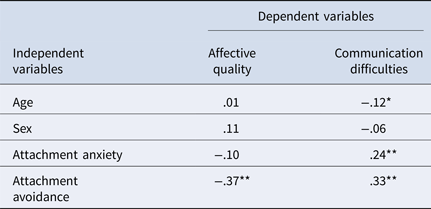
The linear regression findings are presented in Table 1. The model including the first block of variables (i.e., age, sex, and attachment dimensions) was statistically significant for affective quality, F(4,234) = 11.81, p < .001, and for communication difficulties, F(4,234) = 13.12, p < .001. The adjusted R 2 values indicated that the models including the two attachment dimensions accounted for 15.4% and 16.9% of the variance in affective quality and communication difficulties scores respectively. The findings were similar to those obtained with the correlation analyses. A significant negative association was found between attachment anxiety and affective quality, and significant positive associations were found between communication difficulties and both of the attachment dimensions. Sex was not significantly associated with either dependent variable. Age had a significant negative association with communication difficulties and was unrelated to affective quality. The addition of the interaction term did not significantly improve the model for either affective quality, F Change(1,233) = 0.02, ns, or communication difficulties, F Change (1,233) = 1.56, ns, so Step 2 of the models are not reported in Table 1.
Standardised Beta Values From Regression Models Predicting Physician-Related Variables

Note: Attachment anxiety and avoidance are from the Experiences in Close Relationships Questionnaire. The affective quality and communication difficulties scales are based on the Patient Reactions Assessment.
*p < .05; ** p < .001 (2-tailed tests).
Discussion
The present study was the first to investigate relationships between adult attachment characteristics and relationship quality with family physicians. In light of the central role of family physicians in healthcare delivery, this study is an important extension of past research that has generally focused on patients selected on the basis of a specific diagnosis or treatment. To address common limitations of past research in this area, attachment was assessed using a measure that assesses both dimension of attachment (i.e., anxiety and avoidance), and two broad components of patient-physician relationship quality were assessed (i.e., communication difficulties and affective quality). It was hypothesised that attachment avoidance and anxiety would both be associated with ratings reflecting poorer relationship quality, and that avoidance would be most consistently and strongly associated with poor relationship quality.
As hypothesised, attachment avoidance was positively associated with communication difficulties (r = .32) and negatively associated with affective quality (r = -.38). Based on Cohen's (Reference Cohen1992) suggestions for characterising effect sizes, these associations met the criteria for a medium effect size (r > .30). Consistent with what was hypothesised, attachment anxiety had a weaker and less consistent relationship with the relationship quality variables. It was positively associated with communication difficulties (r = .24), but this association was characterised as a small effect size. Attachment anxiety was not associated with affective quality.
Multiple regression analyses were used to test whether the two attachment dimensions interacted in the prediction of the dependent variables. The findings of the regression analyses paralleled those of the correlation analyses, but also indicated that the attachment anxiety by attachment avoidance interaction effect was not statistically significant. Interaction effects were tested because Griffin and Bartholomew (Reference Griffin, Bartholomew, Bartholomew and Perlman1994) noted that combinations of the two dimensions have ‘emergent properties’ (p. 39) that are not apparent when only the linear combinations of the attachment dimensions are considered. These null findings are consistent with much of the attachment literature that has also failed to obtain significant interaction effects (e.g., Ognibene & Collins, Reference Ognibene and Collins1998). However, they are noteworthy as they were obtained under circumstances well suited to detecting interaction effects. The findings of Stone-Romero and Anderson's (Reference Stone-Romero and Anderson1994) simulation study indicated that the multiple regression approach to detecting moderation effects is highly accurate when applied in samples similar in size to the present study and when using predictor variables with similar levels of internal consistency. For example, with predictor variables with internal consistencies of .80 and a sample size of 240, the null hypothesis of no moderating effect would be correctly rejected 99% of the time when considering associations with medium effect sizes. Thus, the present null findings regarding moderation effects were particularly noteworthy because they demonstrated that even with excellent statistical power moderation, effects were not observed. Based on these findings, it is expected that further attempts to find moderation effects with regard to attachment and patient-provider relationship variables will be unsuccessful.
Past research on relationships between patient attachment characteristics and patient-physician relationship quality has almost exclusively focused on patients selected on the basis of a specific diagnosis or treatment. It generally suggests that attachment insecurity is associated with poor relationships. The current findings provide further evidence of this association and suggest that those with greater attachment insecurity also have poor relationships with their family physicians. Beyond this general pattern, there are no other specific trends regarding these relationships. Given the differences between studies in terms of the measures of attachment used and the components of physician-relationship quality considered, this absence of trends is not surprising. Other potentially important contributors to the variability of findings across studies include differences in levels of threat and distress associated with the condition experienced by participants, differences in the nature of the consultations or treatments provided, and variations in the amount and frequency of physician contact. For example, relative to the influence of attachment on relationships with family physicians who are often consulted for minor and easily treated conditions (e.g., ear infections), the threat associated with a potentially fatal condition that requires surgery (e.g., cancer) might prompt a greater influence of trait-like attachment characteristics on relationships with those involved in treating such a condition. However, it is also possible that trait-like attachment characteristics might be particularly important influences on the relationship with family physicians because most people are likely to have more frequent contact with their family physician than with other medical specialists. Additional research investigating the conditions that amplify or suppress the influence of attachment on relationships with healthcare providers is warranted.
In addition to the issue noted above, several further directions for research are worth noting. First, it is unclear whether the findings were obtained simply because those with insecure attachment hold more negative perceptions in the face of very similar patterns of interactions with their physicians, or instead the findings reflect observable differences in the interactions between insecure participants and their physicians. For example, it is possible that those high in avoidance may selectively attend to their physicians’ behaviours that confirm their negative views of others. Alternatively, those high in avoidance may behave in a manner that prevents them from developing high levels of affective quality, such as disclosing little information or presenting in a manner that is perceived as difficult by their physicians. Maunder et al.’s (Reference Maunder, Panzer, Viljoen, Owen, Human and Hunter2006) finding that those with insecure attachment are perceived as difficult by emergency room physicians is consistent with the latter possibility. However, it is possible that both mechanisms could be involved. Second, the implications of these relationships in terms of outcomes were not explored. Two studies with patients with diabetes found that attachment variables related to adherence to treatment recommendations (Ciechanowski et al., Reference Ciechanowski, Russo, Katon, Von Korff, Ludman, Lin and Bush2004) and the diabetes-related clinical outcome of poorer blood glucose levels (Ciechanowski et al., Reference Ciechanowski, Katon, Russo and Walker2001). Given the cross-sectional nature of the study and the use of a convenience sample, appropriate outcome variables could not be investigated in relation to attachment or the relationship quality variables. However, future research could investigate whether attachment and relationship quality variables are related to outcomes and health behaviours relevant to a broad segment of the general population, such as adherence to common medication regimes and suggestions regarding health behaviours.
Similar to the observations of Ciechanowski et al. (Reference Ciechanowski, Katon, Russo and Walker2001) and Ciechanowski et al. (Reference Ciechanowski, Russo, Katon, Von Korff, Ludman, Lin and Bush2004), the need to tailor treatments based on attachment variables are implied by the present findings. Those with high levels of avoidance are more likely than those with lower levels of avoidance to have difficulties communicating with their physicians and to experience lower levels of affective quality. Effective brief interventions for improving physician-patient communication, such as providing written instructions and encouraging patients to ask questions and raise concerns, have been developed (Harrington, Noble, & Newman, Reference Harrington, Noble and Newman2004). Such interventions might hold promise for improving treatments provided to those with high levels of attachment avoidance and/or anxiety. However, it may be unreasonable to expect individuals with insecure attachment to adopt such strategies. As well, given the strong tendency of those with insecure attachment to experience difficulties in their relationships, these strategies could well be ineffective in preventing similar problems from developing in relationships with healthcare providers. It is likely that more intensive forms of intervention may be required. This could involve training healthcare providers to: (a) identify patients’ attachment characteristics, (b) understand the potential of patients’ attachment insecurity to compromise their healthcare, and (c) tailor their approach on the basis of patients’ attachment characteristics. While suggestions have been made regarding the tailoring of treatment on the basis of patients’ attachment characteristics (e.g., Hunter & Maunder, Reference Hunter and Maunder2001, Reference Hunter and Maunder2016; Maunder & Hunter, Reference Maunder and Hunter2009), the effectiveness of such strategies has not yet been empirically tested.
As noted above, the cross-sectional design and the absence of outcome variables were limitations of the study. A convenience sample of university students was used because it was expected to include participants able to report on their relationships with family physicians. However, this sampling approach precluded investigating: (a) characteristics of participants’ physicians that may have impacted the quality of the relationships studied, and (b) potential variability in relationship quality across specific physicians. Further limitations were the absence of information regarding the participants’ health status, patterns of treatment seeking, and access to healthcare, all of which could have influenced the quality of their relationships with their family physicians. Nonetheless, the present study contributes to a growing literature suggesting that patients’ attachment characteristics influence the quality of patient-physician relationships. It remains to be investigated whether insecure attachment is also related to negative outcomes for routine medical interventions. While several studies have suggested the need to tailor treatments on the basis of patients’ attachment characteristics, strategies of this nature have not yet been evaluated.
Financial Support
This research received no specific grant from any funding agency, commercial or not-for-profit sectors.
Conflicts of Interest
None.
Ethical Standards
The author asserts that all procedures contributing to this work comply with the ethical standards of the relevant national and institutional committees on human experimentation and with the Helsinki Declaration of 1975, as revised in 2008.