Some years ago in a former career, one of the authors was a third-party arbiter and consultant brought in to ensure that two companies would successfully merge. The most detailed and painful parts of this particular merger involved negotiations between the chief operating officers, who were tasked with the grueling and painstaking process of decommissioning one of the manufacturing divisions and rolling critical staff from one division into another. The end results extinguished a good part of the hard work, visions, and dreams of the executives on both sides, forcing these two individuals to renege on promises each had made to those they cared about. In addition, their actions would put a lot of people out of work, likely wreaking havoc on already stressed families. The entire negotiation was one of relative losses, for every point conceded by one extracted both a personal and professional cost to the other. Yet, the three participants, including the arbiter, went through this process every day, often for 16 hours or more, with humility, passion, frustration, anger, and at times, shame, but with mutual respect. Over the weeks, the two executives became friends and held each other in high regard, while compromising and giving ground on just about everything else each held dear. When the negotiation was settled and the terms agreed, everyone breathed a collective sigh of relief. As the conversation finally moved away from the painful topic at hand, and toward more mundane matters, the two protagonists sat in the executive suite where several large-screen televisions aired a news story about a controversial referendum on immigration. As both executives watched, their “small” talk turned to politics. Within minutes, all they had worked for over the weeks was thrown out the door. These two intelligent, well-educated, and reasonable people, who had for weeks held informative, constructive and positive conversations involving opposing agendas and views with grace, and who each had sacrificed so much, and sustained tremendous personal loss to achieve their mutual goal, instantaneously lost all respect for one another because of the televised report on immigration. At the time, it would be impossible to aptly describe the way they looked at one another, except to say they viewed one another with disbelief, confusion, ire, and disgust.
How can two equally intelligent, educated, and reasonable people discuss almost any topic with divergent views in a positive, constructive manner, but when the talk turns to politics (or religion), their conversation degenerates into one of frustration and mutual resentment? In this example, two people who had just successfully engaged in an intellectual fencing match involving the highest possible stakes instantaneously looked at one another as if the other were simply crazy or stupid for holding an opposing political opinion.
All of us are familiar with similar occurrences in our own lives, watching two people talk around and past each other when it comes to politics. Indeed, such antagonism is also commonly found in Congress. In announcing his decision not to seek reelection, senator Evan Bayh of Indiana cited his reason being that Congress was driven by “too much narrow ideology and not enough practical problem solving.”Footnote 1 People who have equated Obama with Hitler, or universal health care to Stalinist Communism and Nazi Germany,Footnote 2 or called progressivism a “cancer”Footnote 3 obviously incite others by invoking dramatic and emotional comparisons. Policy debates on complex and important topics, such as health care, take on the characteristics of hostile theatre with many accusations involving analogies to physical assault and violations of the body envelope; for example, common renderings describe health-care reform as being “rammed down the throat of the American public.”Footnote 4 Political elites, who are ostensibly the most sophisticated, lead the way in fueling the flames of outrage in response to real or imagined threats or violations of political rights. Representative Michelle Bachmann (R-MN) intimated that the Democrats somehow caused the swine flu.Footnote 5 In a rally, demonstrators, inspired by her, covered themselves in fake blood and carried “dolls representing aborted fetuses, as the Grim Reaper led them in chains to hell” (Milbank Reference Milbank2009).
Academics, policy makers, pundits, and members of the interested body politic have struggled with the question of how people exposed to the same political information react so differently in their response to it. People gazing at each other across a political divide often cannot have a productive conversation about their disagreements. Why is there so much acrimony? As long ago as Hobbes (1660/2009), authors recognized that disagreements lead to shouting and that this behavior makes it difficult for parties to engage in reasoned debate, or to keep negotiation civil, and that war might erupt when such diplomatic arguments fail. Since then, we have made little progress in learning how to overcome this division. Why does this occur? What does visceral hostility across the political divide mean for the nature of democratic debate and the ability to reach effective compromise on emotionally evocative issues? Do emotionally hostile interpersonal exchanges in the Senate, for example, affect the kinds of agreements that can be reached, or indeed the likelihood for resolution of any hot-button issues? Political hostility is not new; indeed, both sides of the aisle accuse each other of “ramming bills down my throat.” But why do these conflicts tend to arise in certain areas but not in others? Why do particular social questions evoke instantly visceral responses whereas economic issues rarely catapult such reactions? And what might these gut feelings mean for the nature of democratic debate and compromise? If reasoned deliberation is the foundation for a liberal democracy, what prospects for compromise exist if debate actually makes it more difficult for individuals to listen to one another? An ability to bargain and negotiate across interests provides a healthy democracy, and obstacles to rational discourse challenge this promise.
These issues have been largely overlooked possibly because the focus has remained on either the influence of emotion on the opinions of the mass public (Brader Reference Brader2006; Lupia and Menning Reference Lupia and Menning2009; Marcus Reference Marcus2002; Marcus, Neuman, and MacKuen Reference Marcus, Neuman and MacKuen2000; Neumann et al. Reference Neumann, Marcus, Crigler and MacKuen2007) or on the substantive nature of differences in policy position independent of emotional charge. But while it is well understood that emotion is important to politics, it has proved challenging for scholars to capture the essence of emotion's influence on public policy debates. Most of the extant literature argues that anxiety, enthusiasm, and aversion represent the emotions that drive partisans' reactions to political topics (Marcus, Neuman, and MacKuen Reference Marcus, Neuman and MacKuen2000). The influence of other emotions on prospects for reasoned discourse over hot-button political topics has been less explored (for a notable exception, see Lerner and Keltner Reference Lerner and Keltner2000). Indeed, one emotion, which has gone largely unnoticed in political science, but has gained increased traction in psychology (Graham, Haidt, and Nosek Reference Graham, Haidt and Nosek2009; Haidt Reference Haidt2012; Rozin, Haidt, and Fincher Reference Rozin, Haidt and Fincher2009) for its impact on political discourse, is disgust.
Here we address this lacuna, by first discussing how emotion, in general, can influence political perceptions, and second, by providing a specific overview of how disgust triggers the value judgments that undergird policy preferences. In doing so, we provide a thorough elucidation of the specific emotion of disgust. We note that a growing amount of important research is emerging that highlights the role of disgust in political debate outside of political science. Here, we review this research and argue for its inclusion into mainstream political science literature. We then describe how disgust affects the psychology of politics through its influence on the cognitive and emotional processes that govern judgments of morality, as well as its direct impact on specific policy preferences. Finally, we suggest ways that disgust might affect the nature and function of democratic debate and tolerance, and what these findings mean for public policy. In this way, we hope to illuminate the way in which issues of sanctity and purity fuel particular acrimony along the liberal-conservative divide.
EMOTION AND THE STRUCTURE OF POLITICAL MEANING
Emotion influences behavior and decision making through its powerful effect on thoughts, behavior, motivation, and attachment. So far, most of the emotion and political behavior scholarship has focused on the prediction of ideology or attitudes of the mass publics (Marcus, Neuman, and MacKuen Reference Marcus, Neuman and MacKuen2000; Neumann et al. Reference Neumann, Marcus, Crigler and MacKuen2007). However, early and recent debates in the political science literature have focused on whether general valence theories of affect adequately characterized political activation and discourse, or whether more discrete models of emotion would prove more accurate (e.g., Neumann et al. Reference Neumann, Marcus, Crigler and MacKuen2007; Petersen, Slothuus, and Togeby Reference Petersen, Slothuus and Togeby2010). This debate is not trivial; rather, the specific nature of the emotion explored holds tremendous import for the political and institutional consequences we explore.
Various emotions exert important but potentially different public policy consequences; different emotions influence the interpersonal nature of how people work together in a democracy in different ways. Because more than one emotion exists, different emotions can pull in different directions, may exert their influence in one area of public policy and not in others, or become differentially activated in the face of particular triggers. For example, anger exerts a different effect than fear (Lerner and Keltner Reference Lerner and Keltner2000) and encourages more optimistic assessments of future outcomes and more top-down decision-making strategies. As a result, the effect of anger on public policy may be different when we contemplate war than when we assess prospects for health-care reform.
Recently, the nature of political debate has increasingly centered on one emotion, disgust, yet explications of disgust have been largely absent from the scholarly literature on political debate. Indeed, certain emotions, such as fear or anger, have more to do with the specifics of political attitudes and preferences, while other emotions, such as disgust, may disproportionately affect other domains of evaluation. Disgust primarily appears to affect how we perceive and understand the nature of morality (Koleva et al. Reference Koleva, Graham, Iyer, Ditto and Haidt2012). In this way, particular issues may prime specific emotions; for example, talk of war may heighten the sense of fear or anger among certain individuals, while discussions of gay marriage may trigger disgust among others. However, the exact same idea simultaneously may trigger other emotions, such as happiness, among different members of society. In this way, the same topic can generate vastly different emotional responses, and thus entrain entirely divergent decision-making strategies, depending on a myriad of personal, biological, and environmental factors in an individual's personal history.
In the past, emotion has been typically explored within the realms best suited to analyze the topics of greatest substantive interest to scholars, such as vote choice; this work has provided important insights in these areas (Brader Reference Brader2006; Marcus, Neuman, and MacKuen Reference Marcus, Neuman and MacKuen2000; Neumann et al. Reference Neumann, Marcus, Crigler and MacKuen2007). This research has proved critically important for understanding policy positions, but it has not enlightened the underlying nature of the public policy making process, or shown how certain topics trigger variant emotions among different people, which in turn shape perception, stimulate reactions, and structure responses. Yet these factors strongly influence the interpersonal aspects of political negotiation and disagreement, including processes of communication, group affiliation, and the ways in which personal feelings and relationships influence the interpretation of political meaning.
Until recently, the mechanism for explaining underlying emotional differences in the psychology of morality in the academic literature did not exist, but now we have indicators that such a motivator lies in the emotion of disgust in particular (Pizarro, Inbar, and Helion Reference Pizarro, Inbar and Helion2011). Disgust has emerged as a critical force distinguishing conservatives and liberals in its elicitation, interpretation, and influence (Haidt and Graham Reference Haidt and Graham2007; Inbar et al. Reference Inbar, Pizarro, Iyer and Haidt2011). Experiences of disgust dramatically affect the dimensions along which individuals assess moral values. In fact, disgust encompasses the cognitive, emotional, and physical properties that are predictably divergent across ideological positions and infuses evaluations of morality along dimensions of purity and sanctity in conservatives but not in liberals. In its most recent instantiation in the hard sciences, much attention has been placed on this emotion (Haidt and Graham Reference Haidt and Graham2007; Haidt et al. Reference Haidt, Rozin, McCauley and Imada1997); indeed, disgust has received widespread attention for its importance in structuring ideology, morality, and political preferences (Inbar, Pizarro and Bloom Reference Inbar, Pizarro and Bloom2009; Inbar et al. Reference Inbar, Knobe, Pizarro and Bloom2009; Inbar and Pizarro Reference Inbar and Pizarro2009).
In the past, scholarly attention to the origins of political division primarily concentrated on individual differences in policy preferences. Some may argue that political divides reflect power differentials, and we do not suggest otherwise. However, it is not just that political opponents may not start off on level playing fields. Rather, we suggest they may be playing entirely different games on the same field; one team may be playing soccer while the other is playing baseball, and yet both are on the same field believing they are playing the same game but the “other side” is the one failing to play by the “rules” of the game. The sense that the other side is cheating, or playing dirty, incites aversion on both sides. Unfortunately, neither side realizes that although they are playing side by side on the same field, each side is actually playing a very different game with very different rules, goals, and values. Each side remains unaware of the other side's equal lack of awareness, like a hall of mirrors in which each side, seeing only their own reflection, experiences the images as though they were realistic representations of the other.
These differences often fuel the already hostile nature of contentious political issues. Personal and antagonistic rhetoric clearly signals frustration on all sides of the debate. However, the consistent use of visceral, often physical, terms for signaling displeasure has largely gone unnoticed in explaining the division among ideologues. Yet, this language and imagery does not emerge by accident. Rather, it occurs precisely because people use the emotion of disgust to signal rejection in the face of objects, events, and people they consider objectionable or contaminated. Invoking associations and triggers associated with disgusting things in a political context provides a communication strategy to inform allies that allowing particular thoughts or people or policies into one's life can lead to unknown negative consequences, much like infection can lead to disease, which, after it takes hold, can threaten the life of its victim. Why do some people see illness in the same place others discover cure? Indeed, some people fear botulism from improperly canned food, while others seek out injecting it to hold the signs of aging artificially at bay; some see abortion as abomination while others view it as a sometimes necessary requirement.
The fact that individuals may be less influenced by the rational cost-and-benefit calculations on which economists often rely to predict decision making than by other normative or emotional factors hardly constitutes a novel recognition (Marcus et al. Reference Marcus, Sullivan, Theiss-Morse and Wood1995; Quattrone and Tversky Reference Quattrone and Tversky1988). However, the mechanisms that drive these alternative forces have not been fully explicated. These issues receive new attention in light of recent research in neuroscience and psychology that highlights the links between moral judgment and emotion in general and concerns about purity and disgust in particular. Indeed, emotions such as disgust even mediate what is considered economically fair (Moretti and di Pellegrino Reference Moretti and di Pellegrino2010). This response is important because previous work on emotion in politics has focused on either the influence of emotion on the opinions of the mass public (Brader Reference Brader2006; Lupia and Menning Reference Lupia and Menning2009; Marcus, Neuman, and MacKuen Reference Marcus, Neuman and MacKuen2000; Marcus Reference Marcus2002; Neumann et al. Reference Neumann, Marcus, Crigler and MacKuen2007) or on the substantive nature of differences in policy position independent of emotional charge.
Here, we offer an initial resolution to explain how and why people come to play different political games. We review evidence, heretofore largely unknown to political science, that shows that people literally interpret the same information differently and evaluate policies, people, and actions using different dimensions of values by assigning different psychological weights to the value of purity that, in turn elicit different degrees of disgust. Personal disgust then launches a series of physiological and cognitive mechanisms that distance the disgusting object from the recipient. These psychological propensities operate to keep potentially harmful objects and individuals from potentially contaminating the disgusted person. These strategies, designed to keep the observer safe from injury, increase resistance, acrimony, and intolerance toward the offensive object or person. Although links between democracy and disgust in the political science literature (Brown Reference Brown1993; Hancock Reference Hancock2004; Krause Reference Krause2008; Norval Reference Norval2008; Sabl Reference Sabl2002; Thiele Reference Thiele2006) have been considered in the subfield of political theory, the relationship between moral judgments, emotion, and substantive political decision making in the rest of political science has been seldom discussed. Rather, the discussion on the importance of disgust in politics has largely occurred without the input of political scientists.
DISGUST IN THE STUDY OF POLITICS
As we intimated earlier, research on disgust has been widely circulated in high-profile science publications, but this research has found less purchase in political science. Some work has focused on theoretical applications of emotion to political decision making more broadly construed. For example, Marcus (Reference Marcus2002) addresses how disgust may shape democratic politics and MacKuen et al. (Reference MacKuen, Wolak, Keele and Marcus2010) provide an empirical discussion of how the larger phenomenon of aversion plays a role in their theory of affective intelligence. In each of these constructs, however, disgust constitutes one aspect of a larger posited affective state they label aversion. Along with anxiety and enthusiasm, aversion represents one of the affective states that can drive and influence political choice and action. To return to discrete versus more general aspects of emotion, however, aversion can also encompass emotional states such as anger, which we understand to embody a distinct affective state from disgust. To explore the manifestation, operation, and functioning of disgust more specifically in its impact on public discourse, in this article we concentrate on disgust, not aversion. So far, however, only one previous work has delineated some of the implications of disgust in a manner similar to the way we do here. Specifically, Smith et al. (Reference Smith, Oxley, Hibbing, Alford and Hibbing2009) have previously provided the most direct exploration of this topic and should be credited with having introduced recent research on this concept to the more general political science audience.
In addition, we note that any model that locates the source of political preference and action in a single affective state, however powerful, risks underestimating the complexity of the interactive process that drives outcomes of interest. Personality traits may have enduring influence over time, but transient emotional states, such as anger or disgust, while often coinciding with a particular ideology or personality trait nonetheless constantly interact with other, and often divergent, emotional states so that various processes remain concurrently operative. Whereas our ultimate goal is to explore the political conditions under which disgust is dominant and environmental forces either weaken or strengthen its influence, in this article we introduce its significance to lay a critically important physiological and psychological foundation for ideological divergence. We celebrate those authors who have begun to interrogate specific moral emotions in political context (e.g., Petersen, Slothuus, and Togeby Reference Petersen, Slothuus and Togeby2010) and we contribute to their discussions by concentrating specifically on the influence of disgust on political ideology and democratic discourse.
Existing scholarship on disgust has focused on its ability to predict political differences across left–right dimensions. This focus on whether or not disgust affects such variance has yet to be fully exploited for its greater value. We suggest that such difference delves much deeper than mere differences along a simple political continuum. Indeed, in this regard, conceptualizing ideology along a more two-dimensional space and characterizing economic and cultural issues along separate dimensions (Kriesi Reference Kriesi2007) is helpful. Disgust prompts people to literally think, and evaluate, along different dimensions within any given issue; disgust triggers different cognitive mechanisms of evaluation so that people view and interpret the very same information differently (Gray et al. Reference Gray, Young, Barker, Curtis and Gibson1997; Moll et al. Reference Moll, de Oliveira-Souza, Moll, Ignácio, Bramati, Caparelli-Dáquer and Eslinger2005); people focus on different preferences in its presence than in its absence. Distinct neural systems appear to manifest for different components of morality (Parkinson et al. Reference Parkinson, Sinnott-Armstrong, Koralus, Mendelovici, McGeer and Wheatley2011); Moll et al. (Reference Moll, de Oliveira-Souza, Moll, Ignácio, Bramati, Caparelli-Dáquer and Eslinger2005) found that areas of the prefrontal and orbital frontal brain regions appear critical in rendering moral judgments and making automatic assessment of morality with regard to social events. Research using functional magnetic resonance imaging (fMRI) located the origin of disgust in the anterior insular cortex (Phillips et al. Reference Phillips, Young and Senior1997). The basal ganglia may be implicated in disgust as well (Gray et al. Reference Gray, Young, Barker, Curtis and Gibson1997). In fact, disgust provides an exceptionally powerful foundation on which acrimony in debate escalates. Given the same information, people who experience disgust see things differently than those who do not (Phillips et al. Reference Phillips, Young and Senior1997). This phenomenon does not result from different preferences or derive from diverse childhood socialization, but represents a truly inherent difference in psychophysiological experience. These physiological differences are similar to those reported by Oxley et al. (Reference Oxley, Smith, Hibbing, Miller, Alford, Hatemi and Hibbing2008) in their study showing that conservatives demonstrated a greater physiological response to threat than liberals, while leaving open the question of whether ideology or physiology leads the charge. In other words, different emotional elicitations, whether anxiety or disgust, entrain more than a simple difference on a political left-right ideological dimension. In this sense, we point to a much deeper underlying latent cognitive-emotive information and categorization process, whereby different individuals literally see the world differently, and evaluate input along different dimensions. These mechanisms, in turn, have critical implications for political discourse and for the evaluation of political “others” (Kristeva Reference Kristeva1982).
We do not claim that disgust represents the only emotion worth investigating for its impact on political outcomes of interest. However, as an emotion, disgust remains critical for explicating the relevant processes involved in political debate, but has yet to be incorporated into mainstream political science analysis. Understanding the nature of disgust can also illuminate the dynamics and consequences of public discourse, deliberation, and representation to break down the behavioral implications of these findings within an interpersonal context. As individuals model and replicate particular predispositions, so too do leaders; these attitudes can be reflected in the actions of states as well. In this way, we can begin to understand how emotion fits into our political decision-making strategies and responses to those who have opposite views.
The findings on disgust, summarized here, argue that disgust is a critical emotion for understanding the nature and character of democratic debate because it is a discrete affective state that ties the moral dimensions on which people evaluate others' attitudes, preferences, and behaviors. We then discuss the important ways disgust interacts with political ideology. We argue that it is not that conservatives are heartless or that liberals are sexually indiscriminate, but the nature of the relationship between political ideology and morality remains subtle and nuanced. If political opponents strive to overcome pernicious divides characterized by internecine fractures, greater transparency in understanding the foundations of each other's judgments can aid reconciliation across such chasms.
THE EMOTION OF DISGUST
Traditionally overlooked as an important emotion for understanding the nature of social behavior, disgust originally constituted one of Darwin's six basic emotions. It possesses cross-cultural recognition in signature facial expression (Curtis and Biran Reference Curtis and Biran2001; Ekman and Friesen Reference Ekman and Friesen1977) patterned by a wrinkling of the nose and a down-turning of the mouth, as well as physiological correlates, including lowered blood pressure and sympathetic nervous system activation (for a review see Smith et al. Reference Smith, Oxley, Hibbing, Alford and Hibbing2009). The definitive behavioral response involves stopping or ceasing any approach toward the object eliciting disgust (Haidt et al. Reference Haidt, Rozin, McCauley and Imada1997).
Most of the factors that elicit disgust seem to coalesce around a few broad categories. Curtis and Biran (Reference Curtis and Biran2001) identifies five basic categories which include bodily excretions; decaying and spoiled food; particular things such as toilets which are assumed to be contaminated; certain categories of “other” people; and violations of morality (e.g., homosexuality) or social processes. The category of moral disgust, similar to what Moll et al. (Reference Moll, de Oliveira-Souza, Moll, Ignácio, Bramati, Caparelli-Dáquer and Eslinger2005) categorize as “indignation,” finds the universal inclusion of politicians, along with injustice, prejudice, vulgarity, and abuse of power. These categorizations build on earlier typologies that suggest that physical contact with unpleasant or unknown people evokes disgust (Rozin and Fallon Reference Rozin and Fallon1987), as does uncertainty and violations of social rules (Miller Reference Miller1997; Rozin et al. Reference Rozin, Lowery, Imada and Haidt1999b).
Harris and Fiske (Reference Harris and Fiske2006) found that individuals who are judged as both low warmth and low competence, such as drug addicts and homeless people, differentially elicited disgust. Their work demonstrated greater activation in the insula and amygdala of subjects judging such individuals and less activation in the medial prefrontal cortex (mPFC). This suggests that these individuals may be perceived as less human because judgment of disgusting objects similarly fails to activate the mPFC. Other work by this team (Reference Harris and Fiske2007) shows that forcing subjects to make individuating judgments about extreme out-group members who elicit disgust (age, food preference) raises activation of the mPFC, indicating at least one mechanism by which individuation can reduce disgust.
Haidt et al. (Reference Haidt, Rozin, McCauley and Imada1997) delineate seven categories that overlap with Curtis and Biran's characterization incorporating food, animals, body products, sexual deviance, body envelope violations, poor hygiene, and death.Footnote 6 Biological and cross cultural validation suggests that disgust rests on far more than constructed cultural norms.Footnote 7 Recognized for his seminal contribution to the area, Paul Rozin indicated that the most universal aspects of disgust related to aversion to waste, and, in particular, oral incorporation of anything associated with waste (Rozin and Fallon Reference Rozin and Fallon1987).Footnote 8 It is easier to extinguish conditioned disgust reactions to some objects, like flowers, than to others, which commonly elicit disgust, such as spiders and snakes. Not surprisingly, it also appears easier to condition disgust to some objects, such as feces, than to say, a food like chocolate (Mineka and Cook Reference Mineka and Cook1993). Before dismissing this last finding as obvious, remember that such a finding runs counter to all the standard behaviorist literature that both assumes and argues that any object can be paired equally well and easily with any unconditioned stimulus to produce equivalent conditioned responses, much as Pavlov's dogs learned to salivate in response to the bell presented just prior to food during learning trials. Yet introspection clearly supports the finding that some things more easily elicit disgust than others.
Several theories attempt to explain the development and evolution of disgust. In his cultural examination of the history of disgust, Miller (Reference Miller1997) argued that disgust developed as a mechanism to defend both the body and soul against various forms of pollution, including moral violations. Rozin et al. (Reference Rozin, Haidt and McCauley1999a) argued that disgust operated according to two laws. The first relates to the contiguity of contagion, whereby people believe that after an object has come into contact with something that has been contaminated, that second object must also be considered contaminated. So, for example, after dog feces have touched a plate, that plate is thereafter treated as similarly polluted. The second involves similarity in such a way that appearance becomes reality; for example, things that resemble contaminated objects also elicit disgust, as when plastic objects shaped like feces arouse aversion.
In related work, Rozin et al. (Reference Rozin, Haidt and McCauley1999a) described how primates, including bonobos, chimpanzees, and humans remain supremely sensitive to violations of social order, especially defections in dyadic relationships. They argued that this characteristic forms the foundation of human morality and informs our notions of loyalty. Obviously, this characteristic aversion to dyadic defection holds tremendous social and political consequences. For example, this reaction can explain, in part, the disgust that can arise when spouses cheat. It also illuminates the social sanctioning that occurred against Linda Tripp, who in turning in Monica Lewinsky, received little purchase for arguing that she was doing the “right” thing by uncovering the president's adultery precisely because people were disgusted by her disloyalty to a friend whose trust she exploited.
Rozin et al. (Reference Rozin, Haidt and McCauley1999a) argued that disgust serves the function of protecting people from harm by extending aversion from the physical to the social world, treating social parasites as though they embodied the contamination inherent in physically aversive objects. By treating social objects of disgust in a manner similar to physical objects that elicit disgust, such perpetrators are avoided, punishing them while protecting those who quarantine the undesirables. In this way, Rozin et al. (Reference Rozin, Lowery, Imada and Haidt1999b) suggested that disgust helps police the portals of the body and soul that remain vulnerable to either physical or social forms of contamination. As Curtis and Biran (Reference Curtis and Biran2001, 23) argue: “If the selective force of the pathogens was sufficient to modify our physiology, it is reasonable to suggest that the same forces were at work on our behavioral traits.”
Rozin et al. (1999) proposed that three basic emotions of anger, contempt, and disgust were differentially activated by violations of three particular moral codes. Anger emerged in reaction to violations of autonomy and individual rights, contempt became aroused in response to violations of community including authority and hierarchy such as status violations, and, importantly, disgust manifests when violations of so-called divinity, referring to purity and sanctity, occurred. In this way, moral dimensions related to social and religious contamination selectively elicit disgust.
The most convincing explanations for the emergence and maintenance of disgust rest on evolutionary logic. Early work by Nesse and Williams (Reference Nesse and Williams1995) suggested that natural selection designed disgust to ensure that people avoided potential sources of infection and contagion. Curtis and Biran (Reference Curtis and Biran2001) demonstrated that in all but one case, the mechanisms of transmission for major infectious diseases (i.e., food-borne illness) all correlated with one of more categories of factors that elicited disgust (i.e., rotten food). Pinker (Reference Pinker1998) similarly argued that natural selection crafted disgust as the operative psychological mechanism by which individuals came to experience an “intuitive microbiology,” prompting a differential aversion to those objects or people who were most likely to cause infection, contamination, or disease.
FROM DISGUST TO THE PSYCHOLOGY OF POLITICAL ORIENTATION
How does disgust influence important political factors? Recent research in psychology implicates disgust as the instigating mechanism that exerts a predictable influence on responses to particular political policies, possibly through the direct and indirect mediating mechanism of a left-right political orientation (Haidt Reference Haidt2012).Footnote 9 One of the ways it may accomplish this is by regulating responses to in-group attraction and out-group hostility (Hodson and Costello Reference Hodson and Costello2007; Jost Reference Jost, Napier, Thorisdottir, Gosling, Palfai and Ostafin2007; Skitka, Bauman, and Sargis Reference Skitka, Bauman and Sargis2005). As noted earlier, this work fits well within the burgeoning investigation of the influence of emotion on decision making, which focuses on discrete emotions such as anger, and examines how these emotions can bias certain judgments, such as those involving risk (Lerner and Keltner Reference Lerner and Keltner2000).
Note that this relationship provides a clear link between the specific nature of emotional elicitation and out-group discrimination. In other words, the problem is not just that liberals and conservatives see the world in different ways, but also that this worldview is seen as a direct contradiction of one's own way of life. So, taking the issue of gay marriage as an example, it is not that conservative hostility simply confuses liberals. Rather, liberals interpret gay marriage as an assault on in-group members while conservatives understand those individuals who advocate for gay marriage as out-group members. Thus, acrimony arises not only because of principled differences on public policy, and the anger that it elicits, but acrimony also emerges from each group espousing mutually inconsistent approaches to the appropriate resolution to the enduring problems of group social and political life.
In providing an overview and integration of the work on disgust and its relationship with political orientation, we emphasize the way in which moral judgments differ depending on ideology. Ideology, in turn, informs our understanding of who constitutes a member of the in-group and who remains outside the fold. In what is argued to be the foundational work on disgust with regard to democratic debate, Haidt and Graham (Reference Haidt and Graham2007) show a clear delineation in the type and number of moral dimensions along which people evaluate other individuals, actions, and events. These differences are partly why liberals and conservatives appear to have such difficulty achieving agreement on issues involving moral and cultural judgments in particular; they literally bring different definitions and moral compasses to their evaluation and assessment of the meaning and value of objects, events, and people.
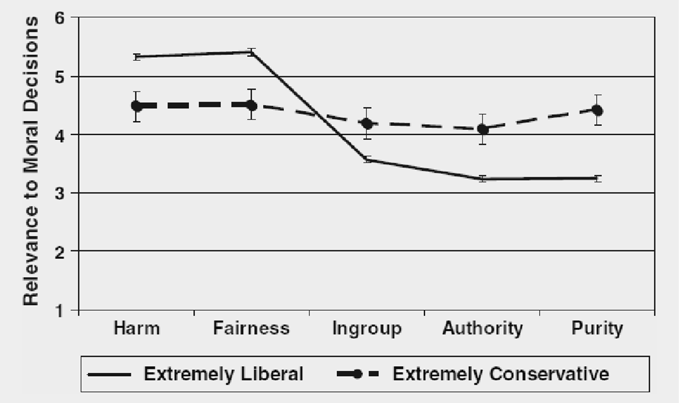
Figure 1, originally presented in Haidt and Graham (Reference Haidt and Graham2007), shows that while liberals tend to focus on two main aspects of morality—those related to harm/care and fairness/reciprocity—conservatives rely on three additional factors to make judgments, in-group/loyalty, authority/respect, and purity/sanctity, to those which liberals espouse (also see Graham, Haidt, and Nosek Reference Graham, Haidt and Nosek2009). Their work demonstrates, for example, that liberals and conservatives necessarily give different weight to different dimensions, with conservatives evaluating morality along five dimensions and liberals typically evaluating morality only along two dimensions. Specifically, conservatives focus on issues of sanctity and purity, whereas liberals stress the importance of values such as fairness.
Moral Relevance by Domain for Political Ideologues
Figure modified from Haidt and Graham Reference Haidt and Graham2007

Graham, Haidt, and Nosek (Reference Graham, Haidt and Nosek2009) used various methods in four distinct tasks to assess how liberals and conservatives relied on particular values in making moral assessments. The first task examined tradeoffs between the abstract values of violence and loyalty; the second task asked people to evaluate various scenarios; the third explored how people handled the idea of “sacredness”; and the fourth examined reactions to moral and religious texts. Their findings showed that on any given issue, liberals base 50% of their judgments of moral rectitude on assessments of fairness, for example, while for conservatives this value only constitutes 20% of their evaluation. Note that purity and sanctity, while representing an important dimension on which conservatives evaluate moral judgments, remains essentially blind in liberals' judgments. The purity dimension is specifically related to disgust and includes:
Whether or not someone did something disgusting
Whether or not someone violated standards of purity and decency
Whether or not someone did something unnatural or degrading
Whether or not someone acted in a virtuous or uplifting way
Whether or not someone was able to control his or her desires
This is not to say that purity does not matter to liberals, but rather that such a value is not brought to bear the same way as conservatives do when they evaluate moral rectitude. This particular factor also highlights why understanding disgust sensitivity remains crucial to a comprehensive analysis of the origins of political ideology.
In a series of critical contributions, Inbar, Pizarro, and Bloom (Reference Inbar, Pizarro and Bloom2009) and Inbar et al. (Reference Inbar, Knobe, Pizarro and Bloom2009, Reference Inbar, Pizarro, Iyer and Haidt2011) documented that individuals differ in their sensitivity to disgusting stimuli and that this sensitivity is related to self-reported political conservatism. Disgust sensitivity became particularly activated around precisely those issues that evoked purity and sanctity concerns, such as abortion, homosexuality, and gay marriage (Inbar et al. Reference Inbar, Knobe, Pizarro and Bloom2009). Drawing on Knobe (Reference Knobe2006) who showed that individuals are more likely to ascribe intentionality to someone whose behavior they find morally wrong or offensive, Inbar et al. (Reference Inbar, Knobe, Pizarro and Bloom2009) found that individuals with greater disgust sensitivity were more likely to attribute intentionality to someone whose behavior caused gay men to kiss in public, even if they did not report an aversion to the behavior itself. Note, this attributional bias did not extend to cases involving heterosexuals kissing.Footnote 10 In what we believe to be the first introduction of disgust into the political science discourse, Smith et al. (Reference Smith, Oxley, Hibbing, Alford and Hibbing2009), in similar fashion to Inbar et al. (Reference Inbar, Knobe, Pizarro and Bloom2009) ran a physiological demonstration of the influence of disgust on politics.
The combined work of Haidt, Rozin, Inbar, and their followers shows that conservatives are truly more sensitive to disgust-related stimuli than are liberals. As a result, conservatives remain more prone to bring these dimensions to bear when making moral judgments because their purity-related concerns activate these sentiments differentially. In this way, people actually rely on different dimensions in making their moral and political judgments of actions, actors, and activities. Disgust becomes intrinsically linked to the expressed and manifest differences we witness along the right-left political spectrum.
In summary, it is not simply that conservatives are more easily disgusted, but rather people with greater disgust sensitivity, showing greater neurological and physiological activation when confronting disgusting stimuli, tend to be more politically conservative. In addition, these individuals also seem to invoke more dimensions when evaluating the morality of various people and events. Alternatively, those who espouse fewer dimensions when assessing morality, typically focused on concerns of fairness and equality, are likely to advocate more liberal proclivities. We believe this point remains critical for democratic debate. To be clear, disgust sensitivity varies across individuals, with some people experiencing a lower threshold at which they find objects disgusting. However, conservatives are more easily disgusted and, in general, appear more prone to integrate disgust into their moral evaluations and, in turn, the political preferences these judgments trigger. In this way, people on opposite sides of the political divide apply different dimensions to morality. These values then inform the positions they take on important issues such as the balance between liberty and defense. This realization provides insight into the intractable nature of many political disagreements because people do not understand that the other side literally experiences, sees, and evaluates the same information in different ways with incommensurate and nonoverlapping dimensions.
Relating Disgust to Moral Judgments
Disgust exerts a powerful emotional influence in areas related to avoiding disease and contamination; however the evidence to support any contention that it can exert a political effect beyond the manipulation of its arousal by political elites is not as well understood. Why would we expect such a relationship to emerge? What do these experiences tell us about the origin and manifestation of political ideology and moral outrage? Several lines of evidence explain which differences on the liberal-conservative spectrum mediate the relationship between disgust and politically relevant responses and behaviors. As noted earlier, disgust sensitivity is associated with conservative political attitudes, especially related to dimensions of purity (Inbar et al. Reference Inbar, Knobe, Pizarro and Bloom2009 and Inbar, Pizarro, and Bloom Reference Inbar, Pizarro and Bloom2009). This finding is important: conservatives are more likely to make moral evaluations of everyday objects, such as refrigerators, categorizing such things as good or bad, than liberals; this tendency is also independently exacerbated by age independent of ideology (Jarudi et al. Reference Jarudi, Kreps and Bloom2005).
This insight explains, in part, why we see moral outrage surrounding political topics when they might not arise while discussing other issues. Political topics, like religious ones, easily become more heated than other types of debate. At a basic level, partly due to different sensitivities to disgust, conservatives and liberals literally interpret things differently and take different moral stances on the same issue because they are using different moral thermometers. This recognition may help explain why small initial differences in policy positions in Congress or in the public can quickly blow up into major internecine fights; individuals rely on different emotions (anxiety or disgust) to evaluate different politicians, policy options, and public events. Congressional debates are an example of how a single message can be constructed and interpreted in vastly different manners based on small degrees of substantive policy nuance. Depending on which dimensions get triggered by a particular debate, after a disgust response ensues, moral outrage follows for those who incorporate purity concerns into their evaluation of morality. Then it becomes seemingly insurmountable for opposing camps to negotiate and achieve agreement, thereby instigating paralysis as well as antagonism.
In popular culture books such as What's the Matter with Kansas? How Conservatives Won the Heart of America (Frank Reference Frank2004) political pundits, journalists, and other observers characterize the reason for the heated intransigence and internecine nature of the political divides that seem to characterize modern political culture. Obviously political scientists have empirically engaged the question of whether Americans are angry and disaffected, or whether they are culturally hostile to one another, and what this means for democratic accommodation (Bartels Reference Bartels2006; Fiorina, Abrams, and Pope Reference Fiorina, Abrams and Pope2010). Although Bartels (Reference Bartels2006) finds that social issues do not appear to trump economic ones as Frank claims, he notes that the political significance of social issues has increased among better-educated white voters in the past 20 years. This group of voters represents, of course, precisely the demographic many politicians hope to capture in seeking money for electoral campaigns. As a result, astute political actors might be well served by establishing an entrepreneurial identity that adheres to the social values espoused by their wealthier constituents.
Many people note that the rancorous tenor of these crevasses appear particularly acute when it comes to social policy issues such as abortion and gay marriage. Often these explanations center around the way political ideologies, such as liberalism or conservatism, inform responses to specific issues. In many cases, such debates generate more heat than light, managing to recreate the same animosities they seek to ameliorate by blaming, however implicitly, one side or the other for the problems that emerge.
Indeed, acrimonious debate results when people cannot understand one another precisely because they interpret information on the basis of different values. Individuals differ in how they interpret and feel a wide range of emotions. Principled differences on policy can generate anger as well as disgust; as noted earlier, disgust does not represent the only operative emotion in politics, nor does it act in isolation. Rather, in those domains that affect judgments of morality, differences in disgust sensitivity elicit predictably different reactions across the right-left ideological spectrum. These differences may be expressed on a left-right political dimension, but often physiological differences originate from deeper sources and manifest across wider domains. People interpret information differently based not only on their political preferences but also on the specific emotions that are activated in reaction to particular choices. They then use value dimensions to evaluate the morality and “rightness” of options. Understanding these differences can make bridging these divides tenable and feasible. Making this knowledge transparent can only encourage a healthier democracy and more constructive democratic debate. Rather than arguing past one another, individuals across a policy divide, for example, might begin to discuss the implications of those policies for deeper values and concerns involving otherwise implicit trade-offs between equality and purity.
One mechanism that may integrate these seemingly disparate phenomena combines regulatory focus theory (Crowe and Higgins Reference Crowe and Higgins1997) with ideo-affective polarity theory (Tompkins Reference Tompkins1965) as Choma, Busseri, and Sadava (Reference Choma, Busseri and Sadava2009) convincingly argue. Drawing on a definition of happiness by Diener (Reference Diener1994), which combines life satisfaction with the occurrence of positive feelings and the avoidance of negative ones, Choma, Busseri, and Sadava (Reference Choma, Busseri and Sadava2009) find that all sorts of strong partisans show higher life satisfaction. This suggests that these ideological systems provide orienting world views that supply adherents with a particular kind of meaning, purpose, or certainty that adds to their sense of well-being relative to those who remain more agnostic about politics. Rather than using the simple bipolar measure of liberalism and conservatism commonly used by scholars, they employ separate measures of each proclivity to assess positive and negative emotions. This innovation is similar to the one devised by Sandra Bem (Reference Bem1981) in designing her sex role inventory to propose distinct scales for masculinity and femininity, as distinguished from earlier work when these concepts were considered to be at opposite ends of a single continuous bipolar spectrum.
By providing separate assessments of liberalism and conservatism, Choma, Busseri, and Sadava (Reference Choma, Busseri and Sadava2009) ascertained that conservatives were not happier overall, but rather that estimates of happiness depended on the definition used. In particular, liberals showed greater positive affect, and conservatives reported fewer negative emotions. This would make sense if part of the function of a conservative ideology is to diminish uncertainty (Jost et al. Reference Jost, Glaser, Kruglanski and Sulloway2003); recent brain imaging demonstrates that the brain activates internal reward circuitry in response to certainty, absolutism, and dogmatism.Footnote 11
Choma, Busseri, and Sadava (Reference Choma, Busseri and Sadava2009) explain their findings in light of a regulatory model that suggests that liberals focus on promotion and prefer to move toward gains and seek positive emotions. In the political realm, for example, this might encourage support for humanitarian public policies. In addition, left-wing proponents appear to demonstrate greater degrees of emotional approach.
In contrast, conservatives prefer a more prevention-oriented regulation of emotion, seeking a more normative, rule-based protective approach to government action. This argument finds additional evidence in work reported by Leone and Chirumbolo (Reference Leone and Chirumbolo2008) that shows a relationship between emotional avoidance and right-wing authoritarianism, social dominance orientation, and conservatism.
In short, conservatives and liberals direct their attention and emotive evaluation toward different facets of the human experience, with liberals more sensitive to a promotion system geared to gains and positive emotions and conservatives more governed by a prevention system that remains more responsive to losses and negative emotions (Choma, Busseri, and Sadava Reference Choma, Busseri and Sadava2009; Crowe and Higgins Reference Crowe and Higgins1997). Choma, Busseri, and Sadava (Reference Choma, Busseri and Sadava2009) tie these differences in so-called regulatory style to important differences in how each ideological type experiences emotion. They suggest that a promotion style potentiates a humanistic world view, which assumes that people are basically good and governments and societies should help support them, whereas a prevention style encourages a more normative view, suggesting that people are basically bad and the job of society should be to regulate and constrain the behavior of those who can hurt others. This theoretical approach supports observed differences in the acceptance of political integration of out-groups as well, particularly in areas such as defense and immigration. Again, this points to the experience of disgust as a critical factor directing the influence of ideology on political outcome in domains of moral judgment.
Just as differences in regulatory style manifest across a left-right divide, the psychological architecture of disgust also reflects these divergences as well, potentiating different evaluations of morality. If true, the public policy consequences of these basic dispositional differences are profound and enduring. Sometimes, the effect can prove beneficial, as when increased disgust sensitivity appears to decrease risk taking in women (Fessler Reference Fessler2001). This predilection has direct positive health consequences, such as when pregnant women in the first trimester, the period when they are most vulnerable to infection, show heightened in-group favoritism and ethnocentrism, both of which decline in the second and third trimesters when immunosuppression, and thus risk of infection, decline (Navarrete, Fessler, and Eng Reference Navarrete, Fessler and Eng2007). This automatic mechanism makes it less likely for pregnant women to either miscarry or contract an illness that might compromise the health of their offspring.
In fact, the mechanism by which disgust can elicit predictably biased attitudes toward public policy appears particularly pronounced exactly in this realm of out-group prejudice and ethnocentrism, as might be expected from the evolutionary perspective discussed earlier. Specifically, differences in interpersonal disgust sensitivity predict revulsion and rejection toward out-groups. In one study, Navarrete and Fessler (Reference Navarrete and Fessler2006) found that ethnocentric attitudes increased as a function of perceived vulnerability to infection, just as in-group attraction increased as a function of disgust sensitivity. This makes sense if individuals share more common flora with in-group members and thus are more likely to contract disease from out-group members. Moreover, when individuals possess heightened disgust sensitivity, they would likely want to rely on in-group members for help in the case of infection and contamination.
However, greater disgust sensitivity produces negative attitudes toward immigrants, foreigners, and other presumed (perceived) socially deviant groups such as homosexuals, even controlling for prospects of disease contamination. Note that the effect is not direct, but rather mediated by ideology. In other words, interpersonal disgust sensitivity affects political ideology; those with higher levels of disgust sensitivity demonstrate higher levels of social dominance orientation and right-wing authoritarianism and dehumanizing attitudes toward the out-group (Hodson and Costello Reference Hodson and Costello2007). Obviously, this finding holds enormous implications for intractable cases of internecine conflicts, especially those that might become easily exacerbated by ethnic or religious differences. Here, again, the intriguing findings provided by Harris and Fiske (Reference Harris and Fiske2007) prove instructive; to the degree that it becomes possible to force more individuating experiences and assessments of out-group members, disgust may decline and thereby more reasoned debate may increase.
Clearly, strong ideological positions generate fierce moral evaluations that produce enormous interpersonal consequences. In one study, Skitka (Reference Skitka2002) found that individuals display a strong preference for keeping greater social and physical distance between themselves and those who they judge attitudinally dissimilar. This fact alone might explain some of the rise in gated communities or self-segregation in housing, education, or marriage. Moreover, this intolerance is not restricted to strangers; people show a similar preference for distance in relationships with both intimates and strangers who espouse different attitudes. Regardless of ideology, people demonstrate much less goodwill and cooperation in groups that contain members who endorse heterogeneous attitudes. This phenomenon may undergird some of the striving for consensus seen in groupthink models of decision making (Janis Reference Janis1982). In public policy, people in these groups also display a heightened inability to create procedural resolutions to solve disputes. In other words, they cannot agree on how to regulate themselves out of their divergent positions to achieve outcomes of mutual benefit. This work has direct implications for making public policy. It clearly illustrates the experience and intuition shared by many observers when watching political adversaries attempt to resolve conflicts; when one's opponent takes a particular stance the other side seems to become more extreme and entrenched in their own position. Anyone who has sat through a contentious faculty meeting or watched a congressional or parliamentary debate can attest to the reality of this behavior. Conflict not only emerges more frequently as cooperation and goodwill decline, but prospects for constructive resolution also diminish as each side literally fails to see potential common ground.
DISGUST AND DEMOCRATIC DEBATE
Emotion does influence behavior. Some efforts have sought to explain what specific emotions mean for democracy in more than a polemical sense. Barrington Moore (Reference Moore2000) examined how disgust and fixations on purity affected public discourse, and Julia Kristeva (Reference Kristeva1982) explored how impurity, abjection, and other forms of “othering” can inform our understanding of public policy issues such as immigration.
George Lakoff, in his work on Moral Politics (Reference Lakoff2002), argued that the left-right spectrum could be mapped onto a parental model of nurturance, whereby the mother represented the liberal nurturing approach, and the father offered an exemplar of authority. If Haidt and Graham's (Reference Haidt and Graham2007) argument concerning the foundation of morality proves correct, and additional evidence from subsequent studies have validated their contentions, then it is not that conservatives are more authoritative than liberals (Altemeyer Reference Altemeyer1981), but rather that conservatives approach issues of morality and public policy with a wider set of dimensions on which to evaluate their worth. This approach incorporates concerns about harm and care and fairness and reciprocity just like liberals, but also brings three other dimensions on which they base judgments of morality, that is in-group/loyalty, authority/respect, and purity/sanctity. Note that these last three dimensions are only those that research has discovered more closely relate to conservative political preferences. This difference in perception appears tied to fundamental evolved physiological sensory mechanisms related to disgust, whether such measures are taken by surveys, observations of facial expression, neurological function, or physiological reactivity.
Politically, the most important connection lies in the recognition that greater disgust sensitivity can provoke greater concerns with purity and in-group loyalty. These associations are not always obvious. For example, people with strong moral conviction actually demonstrate less trust in political authorities, whereas those who espouse greater religiosity demonstrate more trust in those authorities (Wisneski, Lytle, and Skitka Reference Wisneski, Lytle and Skitka2009). The diminished trust in political authority may be the result of conservative emphasis on the more negative role of government in preventing harm rather than promoting welfare. Note that those who displayed greater religiosity and distrust made quicker, less considered decisions. These evaluations stem from different levels of disgust sensitivity and hold huge implications for both the hair trigger factors that instigate political conflict, and also portends poorly for resolving contentious issues that serve the most people in the best way. If liberals and conservatives cannot understand that they bring different currency to the exchange, their intrinsic differences in approach and perspective will be difficult to overcome.
Readers should not infer any moral judgment in this analysis. Viewed from this perspective, conservatives and liberals should be understood as equally moral and empathetic. Conservatives spread out across a wider array of domains in their assessment concerning what constitutes moral action than do liberals. The continuum of morality across political ideology differs in a fundamental way. Liberals appear more confined to two domains of morality while conservatives espouse five. This may partly explain why some liberals painted as “bleeding hearts” appear to manifest greater intensity; they engage fewer domains so they appear to concentrate more energy into those areas. Conservative evaluations, in contrast, are spread out more evenly across all domains, while liberals remain confined primarily to two dimensions on which they evaluate the morality of particular events, people, and positions. Thus, conservatives appear “less caring” precisely because they divide attention across more domains. Liberals do experience these emotions, but they rely on them differently than conservatives do to determine the morality of given individuals or actions.
Liberals and conservatives do converge on dimensions about harm/care and justice/fairness, although they would likely start from a different baseline because liberals would invest a higher percentage of their evaluation in those domains than conservatives. In these areas, achieving consensus should be easier because opposing camps can share overlapping concerns and values. However, on those domains on which conservatives evaluate morality but liberals do not, such as in-group loyalty, authority, and purity, conservatives and liberals would find it more difficult to locate common ground. In those areas, conservatives attach tremendous weight to dimensions in which liberals do not, such as issues related to sexual morality. In short, some things, such as fairness, simply matter more to liberals because they do not evaluate other issues, such as those related to purity, on the same template of moral reasoning as conservatives do. Similarly, some things that matter acutely to conservatives, such as purity, do not affect the moral judgments of liberals. As a result, in allocating a restricted amount of time, energy, and money to given issues, liberals allocate more units to fewer pots, while conservatives put fewer units across more pots.
CONCLUSIONS
Liberals and conservatives differ in their basic physiological propensity toward disgust. Not only are conservatives more prone to feel disgust, but they are also much more likely to interpret this feeling as possessing moral relevance. Things that make them feel disgusted are judged immoral. Because of these physiological and psychological differences, liberals and conservatives literally experience the same world differently and thus confront a huge challenge in trying to reconcile those views. These insights, particularly those related to the basic physiological underpinning of a specific emotional state, challenge several political science orthodoxies, including those related to assumptions of rationality, or the power of deliberation in overcoming basic policy differences (Fishkin Reference Fishkin1993; Morrell Reference Morrell2010).
Liberals and conservative do not think the same way nor do they interpret or evaluate information, or its meaning, in the same way or along the same dimensions. In short, popular intuition is accurate: political partisans actually do talk around one another, almost as though they were speaking a foreign language the other did not recognize. Both believe they experience simultaneous translation, and the other side simply remains obstinate despite mutual recognition of the same reality. In fact, they do not hear the same language or see the same reality. This may represent one of the reasons for the widespread emergence of so much acrimony across the political divide. Although it sounds like each side is listening, in reality, each side is hearing a different message and evaluating the morality of content on the basis of different criteria, which remains unbeknownst and incomprehensible to the other side. It is not a matter of “if they only knew better,” or more, or understood, but rather individuals literally think about and evaluate the same information differently. In fact, each side does know the same thing; they just attribute different meaning and value to that information when it comes to particular domains of moral judgment. The psychological mechanisms of morality and right and wrong that liberals and conservatives use have different dimensions, which are weighted differently by each side.
Given our focus on the American political science literature, we have stuck closely to the left-right continuum in making our argument regarding the influence of disgust on political outcomes. However, the insights provided by the literature on disgust provide motivation to further investigate the validity of the European literature on ideology, which suggests a more sophisticated two-dimensional space (Kriesi et al. Reference Kriesi, Grande, Lachat, Dolezal, Bornschier and Frey2006; Kriesi Reference Kriesi2007). In this conceptualization, one dimension relates to economic issues such as redistributive policies, while the second relates to social and cultural issues, such as abortion, that we have highlighted here as eliciting disgust. Therefore, the research on disgust may help explain why ideology exists in a multidimensional space. Because distinct physiological parameters regulate each dimension, the emotion of disgust differentially mediates the cultural space.
These arguments have important implications for public policy and for scholars. For purposes of public policy, it remains crucial, if the political compromises necessary for perpetuating a functional democracy are to be achieved, to recognize that morality means different things for adherents of opposing political orientations. Attempting to debate on the morals is akin to debating which religion is correct. Conservatives evaluate the basis of morality along more dimensions than liberals. On a practical level, this means that many discussions within policy groups take place along domains that literally do not exist for liberals, which engender frustration and misunderstanding on both sides of the aisle. In reality, what matters a great deal to conservatives does not even register for liberals, rendering each side angry and frustrated with the intransigence, obstinacy, and purported immorality manifested by the opposing side. In many ways, the processes by which many groups talk past each other increases political strife in public life. Conversations and disputes surrounding topics of fairness and harm, such as those involved in the financial or economic realm, can achieve resolution through considered debate and deliberation. In many other areas, such as those involving purity, discussion becomes truncated and paralyzed. Public recognition of this is important in order to render the bases of acrimony in certain areas of discourse more transparent to each side. Rather than simply scream at each other, and claim that the other side is immoral or unjust, each side can begin to access the other on a dimension that the other side can grasp in hopes of achieving compromise. Liberals can try to recognize the importance of purity for conservatives; conservatives can begin to see the implications of their positions for the values of equity that liberals prize. This mutual recognition might facilitate better communication and improve prospects for negotiation. Neither side will necessarily espouse the values and weighting the other side prefers, but they can at least realize that they are playing different games and begin to read each other's rule book.
In topics revolving around in-group loyalty, authority, or purity, liberals and conservatives continually attempt to compare apples and oranges because no middle ground exists. Conservatives want to discuss topics that do not undergird the moral reasoning of liberals. Liberals want to discuss issues that are not as important to conservatives as they are to liberals. The result is that on topics that activate heightened disgust sensitivity for conservatives, especially those that involve issues of purity, the very basis and purpose for their ideological orientation becomes activated in a way that is not true for liberals. Conservatives cannot understand why liberals are so licentious; liberals cannot understand why conservatives are so rigid. And, it is on these topics, including abortion, gay marriage, or immigration, that no reasoned debate seems to take place. Thus, controlling the agenda itself can become a locus of conflict. In addition, no compromise on beliefs is possible because what matters to one side simply does not enter the calculation or moral reasoning of the other.
This argument is not simply about disgust but speaks to much larger, and more important, themes in governance. When we combine this different moral range across individuals who espouse alternative ideological frames with genetic and neurological differences as well, the implications of this realization remain profound for policy making, negotiation, and representation.
An open discussion of these issues in policy circles, research centers, and within the interested public is warranted. Liberals are not immoral; conservatives are not mean-spirited. But people inherently evaluate information through a different lens. Democratic debate and discourse can only improve by mutual recognition that while we are all the same, and every human being should be accorded the same value and rights, each person does feel and think and evaluate morality along different domains. Communication and compromise can only be improved by accepting and understanding these evaluative differences, rather than resorting to name calling and further acrimony. Without such transparency, those who choose to exploit and manipulate the public will continue to take free reign in attempting to spark outrage in service of their own purposes, whether for profit or power. And little progress will be made toward establishing the reasoned compromise on which democratic systems depend.