1. Introduction
The international trade of waste between developed and developing countries has been increasing. Developing countries import waste as scraps to be recycled. However, the environment of these developing countries has been polluted because hazardous substances are included in the imported scraps and because primitive and improper methods have been used by the informal sector that engages in recycling activity.
The Basel Convention on the Control of Transboundary Movements of Hazardous Wastes and Their Disposal (hereafter, the Basel Convention) has been effective since 1992. The Basel Convention admits the right of each signatory party/country to prohibit the import of hazardous waste and to prohibit other parties from exporting hazardous waste to its own country (Article 4.5). However, the Basel Convention failed to solve environmental contamination caused by the trade of hazardous waste because there is increasing demand for resources in developing countries. The developing economies have confronted the trade-off between economic growth and environmental preservation, and economic growth has taken priority over the environment in these countries. Because of the ineffectiveness of the Basel Convention, the contracting parties have become conscious that the developed/exporting countries should take more responsibility for environmental preservation in the developing/importing countries.Footnote 1 In this article, we focus on the regulation on exports led by developed countries.
An amendment of the Convention was proposed in 1994. In contrast to the Basel Convention, the amendment (hereafter, the Ban amendment) requires all OECD countries to unconditionally ban the export of hazardous waste to non-OECD countries. Although this amendment has yet to come into force, there is strong support for its enactment.Footnote 2 If the amendment comes into effect, the international trade of scraps for recycling will be significantly affected.
The objective of this article is to examine the rationality of the Ban amendment. Here, we must note that trade policies are usually implemented on the basis of classification under the HS code. Therefore, a necessary condition for the Ban amendment to be rational is that the scraps that are assigned an HS code are homogeneous among the exporting countries. We define two sets of scraps as being homogeneous to each other when both the decomposability and the material composition of the scraps is the same.Footnote 3
If the scraps within a particular HS code are homogeneous, we can state that the severity of the externalities that can be measured by the marginal external cost are equivalent among those scraps, regardless of their original location. Then, a common policy such as the Ban amendment would be a rational policy because the policy can be attuned to the level of externalities generated from the recycling of waste imported from any country. Moreover, homogeneity implies that a unilateral export restriction by one exporting country would lead to increases in imports from the other countries (demand leakage) because wastes imported from different countries are substitutes for each other. Thus, a unilateral export restriction is likely to be ineffective. In this respect, the common policy is desirable.
Alternatively, if the scraps within an HS code are heterogeneous among the exporting countries, the Ban amendment could lead to an inefficient resource allocation and it could be inferior to other policies, e.g., a flexible trading agreement between the individual exporting and importing countries.Footnote 4 This inefficient allocation occurs because the externality level of the waste depends on the origin, and a common policy cannot be attuned to the externality level of waste from each exporting country. Moreover, in this case, a unilateral export restriction is also effective because there is no demand leakage to other exporting countries.
To examine the substitutability among scraps, we estimate the export demand functions of scraps within an HS code. In particular, we focus on the sign of the cross-price elasticity in these export demand functions. If we find substitutability for scraps among the exporting countries, the sign of the cross-price elasticity will be significantly positive, i.e., increasing the export price of one country will always increase the exports from the other countries. We choose China as a representative importing country and estimate the export demand functions for two types of scraps, i.e., other ferrous waste and scrap (HS code 720449) and other waste, parings and scrap of plastics (HS code 391590). China is a major importing country of scraps and is also widely recognized as a country that severely pollutes the environment by recycling scraps (Basel Action Network and Silicon Valley Toxics Coalition, 2002). Our estimation results show that, in almost all of the export demand functions, the cross-price elasticities are not significantly positive, which means that we can reject the hypothesis that scraps within an HS code are substitutes for each other, regardless of their country of origin. We can then conclude that scraps imported from different countries are heterogeneous.
Our estimation results throw doubt on the optimality of the Ban amendment. Alternatively, we can recommend more flexible trading agreements that will make it possible to regulate the international trade of scraps, depending on the level of externality, without generating a demand leakage problem. If the scraps generated in an exporting country (assigned an HS code) include significant hazardous substances and the decomposability is quite low, so that they cannot be properly recycled in a developing country, the exporting country should prevent these scraps from being exported to that country.
When we are facing the trade-off between economic growth and environmental preservation, the Ban amendment and free trade are both corner solutions to the problem. Although the Ban amendment might be superior to free trade, the marginal benefit of recycling scraps can be greater than the marginal cost, including the external cost, under the Ban amendment. Therefore, a movement toward a flexible trading agreement apart from the polar situation can increase the world's social welfare. Flexible trading agreements can help developing countries gain from the import of scraps while reducing the environmental damage with the cooperation of the developed countries.
Several studies have empirically examined international trade in recyclable materials. Berglund and Söderholm (Reference Berglund and Söderholm2003a, Reference Berglund and Söderholm2003b) investigated the effect of trade in waste paper on domestic recycling activities.Footnote 5 Baggs (Reference Baggs2009) identified the factors that influence the volume of bilateral trade in hazardous waste using a gravity model, and she concluded that when a country's per capita gross domestic product is higher, the country imports more waste. Kellenberg (Reference Kellenberg2012) found empirically that there is an international waste haven effect (i.e., the export of waste to low environmental regulation countries). Moreover, he also demonstrated that the Basel Convention can decrease the waste trade. There is, however, no empirical study that tested the homogeneity of scraps among the exporting countries or that estimated the export demand functions of scraps.
The rest of the paper is organized as follows. Section 2 presents the background behind the proposal of the Ban amendment. Section 3 describes the theoretical model, while section 4 refers to the empirical method. Section 5 provides the empirical results and their implication for policy. Section 6 gives our conclusion.
2. Waste recycling as an international problem
In the past few decades, the volume of exports of recyclable materials, which are usually classified as waste and scrap in trade statistics, has been steadily increasing around the globe.Footnote 6 A significant volume of scraps have been exported from developed to developing countries, especially to China. The primary reason for this trend is the huge demand for resources in China to sustain its rapid economic growth.Footnote 7 The other reason for this export to China is that recycling activities are labor-intensive because scraps must be completely separated into each material and the process cannot be performed mechanically. The large gap in the wage rate between developed and developing countries means that recycling, especially the recycling of low-grade scraps that consist of many types of materials, can only be economically recycled in developing countries. Thus, both developing countries and developed countries have gained from the trade of waste and scraps.
However, an informal sector with inadequate technology has engaged in the recycling of imported scraps in developing countries. Recently, severe environmental pollution associated with the recycling of scraps has been reported in several developing countries, including China, India, Pakistan and Nigeria (Basel Action Network and Silicon Valley Toxics Coalition, 2002). In particular, the process of recovering valuable metals from compound metal scrap such as e-waste can cause serious damage to the environment. It is well known that China has been a center of e-waste recyclingFootnote 8 (Schwarzer et al., Reference Schwarzer, De Bono, Peduzzi, Giuliani and Kluser2005; Widmer et al., Reference Widmer, Oswald-Krapf, Sinha-Khetriwal, Schnellmann and Boni2005; Shinkuma and Huong, Reference Shinkuma and Huong2009).
As stated in the previous section, our purpose is to examine the rationality of the Ban amendment by estimating the export demand functions for several types of waste and scrap and checking empirically whether there is substitutability in those scraps among the exporting countries. In particular, we estimate the exporting demand functions of China for two types of waste and scrap, i.e., other ferrous waste and scrap and other waste, parings and scrap of plastics. We choose Japan, the US, the EU and Hong Kong as the main exporting countries/regions to China. The exports from these countries/regions of scraps to China represent over 75 per cent of the total volume of exportation to China.
China has experienced rapid economic growth in the past two decades, and, consequently, the import demand for recyclable waste and scrap has increased. The major developed countries have been exporting almost every type of scrap to China and in very large quantities. This role makes China a suitable object for an empirical analysis of its export demand for waste and scrap.
The reason that we focus on these two types of scraps is as follows. Other ferrous waste and scrap is a mix of metals and other materials. In addition, this scrap often includes hazardous substances such as lead, and e-waste scrap is classified in this category. We can thus expect that the trade of scrap in this category would be severely restricted under the Ban amendment. For a similar reason, we applied our estimation method to other low-grade scraps: other waste, parings and scrap of plastics. We can obtain similar estimation results for the two types of waste and scraps. The results show that those scraps in the same category are heterogeneous among the exporting countries. It can then be concluded that the Ban amendment will lead to inefficient resource allocation.
3. Theoretical framework
In this section, we provide a simple theoretical model to support our goal. Consider a country that imports waste and scrap from more than one foreign country. There is one industry in this country, which produces the final good F from both recyclable and virgin materials: the recyclable materials are waste and scrap. The utility of a representative consumer is represented as the following additively separable function:
 $$u = U\lpar Q_f\rpar = u\lpar Q_f\rpar + z\comma \; u^{\prime} \gt 0\comma \; \quad u^{\prime \prime} \lt 0\comma \; $$
where Q f and z denote the amount of consumption of the final goods F and the numeraire, respectively. The expenditures for goods are constrained by income (M):
 $$M = P_f Q_f + z\comma \; $$
where P f denotes the price of the final good F. Assuming that the wage is equal to one and that the labor endowment is L, the income can be exogenous: L = M.Footnote 9 The first-order condition (FOC) for the utility maximization is
 $$u^{\prime} - P_f =0. $$
The market for good F is perfectly competitive, and the production function of industry F is given by
 $$\eqalign{Q_f & = G\lpar X_1 \comma \; \cdots \comma \; X_i \comma \; \cdots X_N \comma \; V\rpar \comma \; \, \partial G/ \partial X_i \gt 0\comma \; \, \, \partial^2G/\partial X_i^2 \lt 0\comma \; \cr & \qquad \partial G / \partial V \gt 0\comma \; \, \partial^2 G / \partial V^2 \lt 0\comma \; }$$
where X i (i = 1, …, N) and V represent the input amounts of recyclable materials imported from country i and virgin materials, respectively. For simplicity, we assume that there are no domestic supplies of recyclable and virgin materials.
The quality of virgin material does not depend on which country exports it. Thus, the price of virgin material is constant, i.e., P v. However, the quality of the recyclable materials can be different between the source countries: that is, they are imperfect substitutes. We let P i denote the price of recyclable material imported from country i. Assuming that the transportation costs are zero, those prices can represent both the export and import prices. Thus, the profit of industry F is given by
 $$P_f G\lpar{\cdot}\rpar - \sum P_i X_i -P_v V.$$
The FOCs for the profit maximization are
 $$P_f \displaystyle{{\partial G} \over {\partial X_i}} - P_i = 0\comma \; \quad P_f \displaystyle{{\partial G} \over {\partial V}} - P_v = 0. $$
Let us now consider the benefit from export restriction for both the exporting and importing countries. Let T i denote the export tax on recyclable materials imposed by exporting country i.Footnote 10 Assuming that the domestic price of recyclable materials in exporting country i, which is denoted by P r, i, is constant, P i = P r, i + T i holds. This assumption implies that the supply curves of waste and scrap in exporting countries are horizontal. Then, from (1) and (4), the sum of the welfare of the importing country and the export tax revenue is represented as
 $$B = u\lpar Q_f\rpar -P_f Q_f + P_f G\lpar{\cdot}\rpar - \sum P_i X_i - P_v V + \sum T_i X_i - \sum \sigma_i X_i\comma \;$$
where σi denotes the marginal environmental damage from using one unit of recyclable material imported from country i.Footnote 11 For simplicity, we exclude the environmental damage generated by virgin materials. From (3) and (5), we obtain the FOC for the benefit maximization:
 $$\displaystyle{{\partial B}\over{\partial T_i}} = \sum_j T_j \displaystyle{{dX_j} \over {dT_i}} - \sum_j \sigma_j \displaystyle{{dX_j} \over {dT_i}} = 0\comma \; \quad i = 1\comma \; 2\comma \; \cdots\comma \; N. $$
First, suppose that there is no substitutability between recyclable materials imported from one country and from any other country: i.e., dX j/dT i = 0 if i ≠ j. Then, (6) implies T i = σi, which implies the standard optimal Pigouvian tax.
Second, suppose that there is substitutability between recyclable materials supplied by any two different countries. That is, dX j/dT i > 0 (i ≠ j) holds, which implies the existence of demand leakage. In addition, consider a situation in which the other exporting countries do not impose export taxes. Then, (6) implies
 $$T_i = \sigma_i + \displaystyle{{\sum\limits_{j\ne i} \sigma_j dX_j /dT_i} \over {dX_i/dT_i}} \quad i = 1\comma \; \cdots\comma \; N. $$
In general, dX i/dT i < 0 holds because an increase in the export tax (T i) means an increase in the price of waste and scrap imported from country i. Therefore, (7) implies T iσi.
Third, consider a situation in which there is substitutability between the recyclable materials supplied by any two different countries and in which every country sets the export tax so that T i = σi. In this case, condition (6) is satisfied.
Thus, on the one hand, when there is no substitutability between the recyclable materials imported from any two different countries, country i's unilateral export tax as represented by T i = σi is efficient (the first case above). On the other hand, when there is substitutability, the unilateral export restriction of country i is not efficient because the optimal export tax rate is not equal to the marginal environmental damage (the second case above). In this case, a multilateral cooperative export restriction represented by T i = σi for any country i is needed (the third case above): the Basel amendment is included in the category of multilateral cooperative export restrictions.
4. Empirical methods
4.1. Export demand
Our aim is to examine the homogeneity/substitutability of waste and scrap that are classified under the same category or assigned the same HS code in exporting countries. Because import demand and export demand are equivalent to each other in principle as long as transportation costs remain constant, we can choose either of them to achieve our aim. In the following empirical analysis, however, we analyze export demand, which means that we use export prices.
We focus on export demand rather than import demand because the classification code attached to a particular consignment of scrap in an exporting country is often different from the one attached to the same consignment of scrap in an importing country. For example, let us examine the trade of ferrous (7204) and copper (7404) waste and scrap from Japan to China. According to the export data reported by the Japanese government, the amount of ferrous waste and scrap exported to China is much larger than that of copper waste and scrap (figure 1). However, according to the import data reported by the Chinese government, the amount of copper waste and scrap imported from Japan is often larger than that of ferrous waste and scrap (see figure 2). Even when the amount of ferrous waste and scrap is larger than that of copper, the difference is smaller than that recorded in the export data provided by Japan. This example means that we cannot examine the substitutability of exported recyclable materials using import data because the classifications of waste and scrap are different between the exporting and importing countries. This difference is why we chose to estimate the export demand functions rather than the import demand functions.
Export of ferrous and copper waste and scrap from Japan to China

Import of ferrous and copper waste and scrap from Japan into China
Even though we examine heterogeneity by estimating the export demand functions of China, we can easily provide an example that shows the heterogeneity of waste and scraps among exporting countries. For example, figure 3 shows the export prices of various types of ferrous waste and scrap from the US and Japan to China, including other ferrous waste and scrap (720449). According to these data, the scrap exported from Japan and the US might qualitatively differ from each other – i.e., be heterogeneous – even if they are assigned a common HS code.Footnote 12
Export prices of ferrous waste and scrap to China ($/kg)
4.2. Estimation equations
To examine the substitutability of waste and scrap exported from different countries, we estimate the following basic export demand function:
 $$\ln X_t^i =\beta_0 +\beta_1 \ln Y_t +\beta_2 \ln P_t^i +\sum_{j\ne i} \gamma_j \ln P_t^j +\beta_3 \ln E_t +u_t\comma \; $$
where X ti is the amount of waste and scrap (in weight) exported from country i to China in period t, Y t is the industrial value added of China, P ti is the export price of waste and scrap from country i to China in period t, P tj is the export price of waste and scrap from country j(j ≠ i) in period t, E t is the real effective exchange rate index, and u t is an error term in period t.
In equation (8), the demand for export is related to its price, the economic indicator of the importing country and the export price of the other countries. In that respect, this equation is essentially consistent with the demand equation used in conventional empirical studies, including Houthakker and Magee (Reference Houthakker and Magee1969), Khan (Reference Khan1974) and Arize (Reference Arize1990). The difference between our formulation and those in the literature lies in the usage of the other country's export price. While the latter aims to capture the effect of the export price of other countries, using the aggregate relative price index as a whole, we use the export prices of other countries separately as explanatory variables to estimate their cross-price elasticities. One of the biggest difficulties in estimating this type of demand equation is an identification problem. However, in the studies of international trade, including Murray and Ginman (Reference Murray and Ginman1976) and Tegene (Reference Tegene1989), this problem has been resolved by assuming the infinite elasticity of the supply function. We adopt the same assumption in this study.
As discussed in the introduction, economic growth leads to increases in demand for resources and intermediate goods. Therefore, β1 is expected to be positive. In addition, it is natural to expect that an increase in the price of waste and scrap from country i will reduce the demand for waste and scrap from country i. Therefore, β2 is expected to be negative.
We can represent by γj the substitutability of waste and scrap among the exporting countries. If γj is not significantly positive, we can conclude that there is no substitutability between the waste and scrap exported from country i and that exported from country j. Contrarily, if we observe a significantly positive γj, it can be stated that the two scraps are substitutes. Our method of estimating the substitutability between tradable goods is the same as that presented in the fundamental work of Grossman (Reference Grossman1982). Finally, because the purchasing power of China increases as its real effective exchange rate index increases, we can expect that the coefficient of ln E t is positive.
4.3. Data
We choose the following four countries/regions as exporters of other ferrous waste and scrap (720449) and other waste, parings and scrap of plastics (391590) to China: Japan, the US, the EU and Hong Kong. These countries/regions are the primary trading partners of China not only in regard to waste and scrap but also in regard to other types of products. For other ferrous waste and scrap, the sum of imports from these four countries/regions represents approximately 90 per cent of the total importation of this type of waste and scrap in 2009. For other waste, parings and scrap of plastics, the sum of imports from those four countries/regions represents approximately 75 per cent of the total importation of this type of waste and scrap in 2009.
The bilateral export data are obtained from the World Trade Atlas provided by GTI Inc., including the amounts of export to China from the four countries/regions and the corresponding export prices. In particular, the export price denotes the selling price of goods that is paid by the buyer (importing country). In the World Trade Atlas data, the amount of export is measured by weight, and the export price is measured by constant US dollars. To convert the price data into real terms, we discount the data using China's Consumer Price Index (CPI).Footnote 13
We use the data provided in the People's Bank of China Quarterly Statistical Bulletin for the industrial value added, which is considered to represent the scale of industrial production. These data are provided in current prices, so we also discount the value by the CPI. Finally, the data for the real effective exchange rate index of China are obtained from the Bank for International Settlements website.Footnote 14
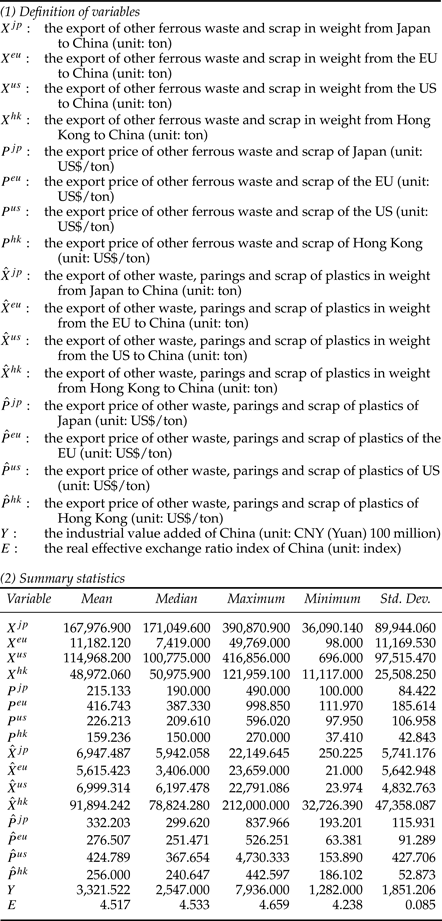
The sample period is the 10 years from July 1997 through November 2006 (the number of observations is 113). This period is the longest that we could use because of our data constraint: the industrial value added of China is only available for this period. Table 1 shows the summary statistics of each variable. The variables without a hat correspond to other ferrous waste and scrap, while the variables with a hat correspond to other waste, parings and scrap of plastics.
Summary statistics
4.4. Preliminary test results
Time series data typically exhibit non-stationarity, which raises the problem of spurious correlation. However, it is also well known that this problem can be avoided by applying specific estimation techniques if the data exhibit co-integrating relationships. Although there are several ways to test the co-integrating relationships, we use the bounds testing approach developed by Pesaran et al. (Reference Pesaran, Shin and Smith2001). While other types of co-integration tests, such as Johansen's procedure, usually require that all of the variables in the estimation equation should be first-order difference stationary, the bounds testing approach can be applied regardless of whether the variables are either first-order difference stationary or trend stationary.
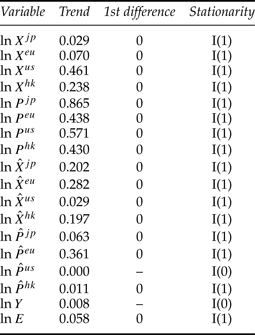
However, this approach cannot be used when the equation includes the second-order or the higher order difference stationary variables. In this situation, we must begin by checking whether all variables are either first-order difference stationary or trend stationary. For this purpose, we use the Augmented Dickey–Fuller (ADF) test. The results of the ADF test are shown in table 2. The second and third columns report the MacKinnon approximate p-value for the trend series of each variable and the p-value for the first difference of each variable, respectively (MacKinnon et al., Reference MacKinnon, Haug and Michelis1996). We determine the lag length used in the ADF regression such that the Schwarz's Bayesian information criterion (SBC) can be minimized. The result shows that ln Y and ln  $\hat{P}^{us}$ are trend stationary, all other variables are first-order difference stationary, and there are no variables that are second-order or higher order difference stationary.
ADF test
Note: I(1) for difference stationary and I(0) for trend stationary.
We can now proceed to the bounds testing to examine whether there are co-integration relationships in the data. The approach starts by estimating the following equation:
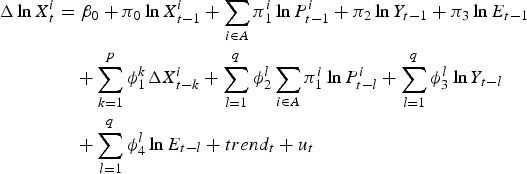 $$\eqalign{\Delta \ln X_t^i & = \beta_0 +\pi_0 \ln X_{t-1}^i +\sum_{i\in A} {\pi _1^i \ln P_{t-1}^i } +\pi_2 \ln Y_{t-1} + \pi_3 \ln E_{t-1} \cr & \quad + \sum_{k=1}^p {\phi_1^k \Delta X_{t-k}^i}+\sum_{l=1}^q {\phi_2^l } \sum_{i\in A} \pi_1^i \ln P_{t-l}^i +\sum_{l=1}^q {\phi_3^l } \ln Y_{t-l} \cr & \quad + \sum_{l=1}^q \phi_4^l \ln E_{t-l} +trend_t +u_t} $$
where Δ represents the first-order difference, trend t indicates the time trend, and A is the set composed of the elements eu, jp, us and hk. The lag orders represented by p and q are determined using the SBC.
Pesaran et al. (Reference Pesaran, Shin and Smith2001) show that the existence of co-integrating relationships can be tested by calculating the F-statistics for the null hypotheses that π0 = π1eu = π1jp = π1us = π1hk = π2 = π3 = 0. If the calculated F-statistics exceed the upper threshold value shown by Pesaran et al. (Reference Pesaran, Shin and Smith2001), then we can conclude that there is a co-integrating relationship. However, if the F-statistics fall below the lower threshold value, then there is no co-integrating relationship. Finally, if the F-statistics stay between the upper and lower threshold, then we cannot draw a conclusion regarding the co-integrating relationship.
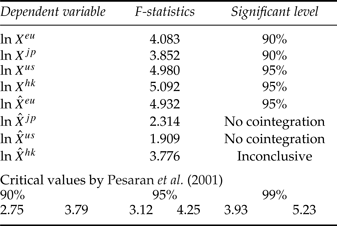
Table 3 reports the results of the bounds testing procedure. The upper part of the table shows the F-statistics, and the lower part indicates the critical values calculated by Pesaran et al. (Reference Pesaran, Shin and Smith2001). If the calculated F-statistics exceed the upper threshold value (4.25, for example), the co-integrating relationship exists at a 95 per cent significance level. By examining the results for other ferrous waste and scrap, we can conclude that there is a co-integrating relationship in all four equations at a significance level of at least 90 per cent.
Bounds testing for cointegration
However, the co-integrating relationship is less common for other waste, parings and scrap of plastics. Although the export demand equation of the EU exhibits a co-integrating relationship at a significance level of 95 per cent, there is no co-integrating relationship in the cases of both Japan and the US. For Hong Kong, we can draw no conclusion regarding the co-integrating relationship because the calculated F statistics (3.776) remain between the upper and lower thresholds. Thus, for other waste, parings and scrap of plastics, the co-integrating relationship exists for the exports of the EU and might exist for those of Hong Kong.
When we observe a co-integrating relationship or a long-run equilibrium relationship, we can apply an autoregressive distributed lag (ARDL) model to estimate a long-run export demand equation.Footnote 15 We can estimate these equations for all four countries/regions for other ferrous waste and scrap, while we can only estimate them for the EU and Hong Kong in the case of other waste, parings and scrap of plastics.
Using an ARDL model, the long-run coefficient can be obtained as β1, β2, γj and β3 in the following equation:
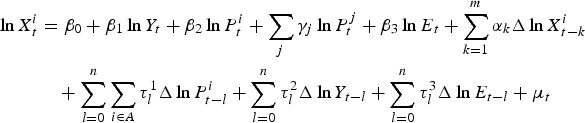 $$\eqalign{\ln X_t^i & = \beta_0 +\beta_1 \ln Y_t +\beta_2 \ln P_t^i +\sum_j \gamma_j \ln P_t^j +\beta_3 \ln E_t +\sum_{k=1}^m \alpha_k\Delta \ln X_{t-k}^i \cr & \quad + \sum_{l=0}^n \sum_{i\in A} \tau_l^1\Delta \ln P_{t-l}^i+\sum_{l=0}^n \tau_l^2 \Delta \ln Y_{t-l} +\sum_{l=0}^n \tau_l^3 \Delta \ln E_{t-l} +\mu_t} $$
where the lag orders represented by m and n are determined using the SBC.
5. Results on substitutability
5.1. Estimation results
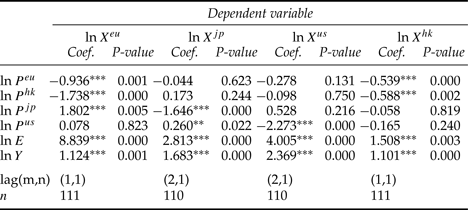
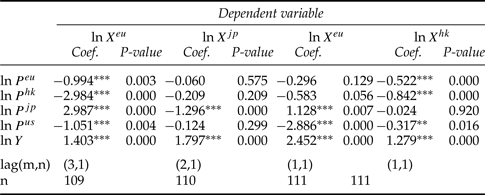
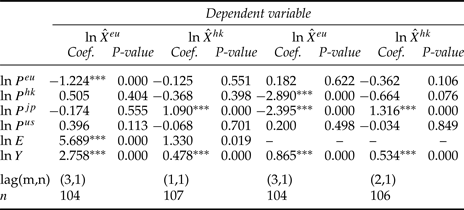
The long-run estimation results are shown in table 4a, 4b and 4c.Footnote 16 These results include the estimation results for two types of equation: the equation with ln E t and that without ln E t. Estimating two types of equations enables us to check the robustness of our results. We obtain several interesting results. First, for the export from each country/region, the coefficient of its own price is significantly negative, as expected.
Long-run results (other ferrous waste and scrap with ln E)
Notes: ***significance level: 1%; **significance level: 5%; *significance level: 10%.
Long-run results (other ferrous waste and scrap with ln E)
Notes: ***significance level: 1%; **significance level: 5%; *significance level: 10%.
Long-run results (other waste, parings and scrap of plastics)
Notes: ***significance level: 1%; ***significance level: 5%; *significance level: 10%.
Secondly, the coefficients of the industrial value added and those of the real effective exchange ratio index for all countries/regions are positive, and they are statistically significant. These results are also consistent with economic theory and the actual situation. Because industrial value added represents the scale of industrial production, the positive sign of these coefficients implies that waste and scrap are important inputs for production activities in many industrial sectors. The real effective exchange ratio index represents the purchasing power of China. Thus, its coefficient should also be positive.
Thirdly, we obtain a clear result for the coefficients γj, which are the most important for our purpose. While some of the coefficients γj are significantly positive, some are significantly negative and others are not significant. These results imply that the substitutability of waste and scrap exported from different countries is weak.Footnote 17
Fourthly, in almost all of the estimated equations, we find that the signs of the export prices of Hong Kong are negative, although some of coefficients are not significant. This result could occur because Hong Kong is a major gateway through which products enter China. The waste and scrap exported from Hong Kong to China could have originally been exported from other exporting countries to Hong Kong. The negative sign of the export price of Hong Kong is considered to reflect this fact, which accounts for its weak substitutability.
This weak evidence of substitutability reflects that the waste and scrap that are classified into the same category differs from one exporting country to another. There are several reasons why this can happen. First, differences in the industry structures in the exporting countries can affect the composition of the materials in waste and scrap. In addition, the differences in exported scrap can reflect differences in the lifestyles of exporting countries.
5.2. Policy implications
In terms of policy implications, the most important result in our estimation is the effect of the export prices of other exporting countries. In some cases, the effects are significantly negative, which means that exportation from one country decreases when the export prices of the other countries become higher. These results indicate that loads of waste and scrap exported from different countries are not substitutes or that, even if they are substitutes, their substitutability is weak. In other words, waste and scrap are generally heterogeneous even though they are assigned the same HS code. It is natural to expect that the levels of externality associated with recycling such waste and scrap will also differ from each other depending on the origin. Thus, although the amendment of the Basel Convention might improve the problem, we must be aware that an unconditional ban can malfunction for the following reason.
Internalizing the externalities represented by environmental pollution requires that any policy must be attuned to the level of the externality. For example, any textbook of environmental economics would tell us that a Pigouvian tax should be set at a level that is equal to the marginal environmental cost. This requirement means that the policy regulating trade in hazardous waste must be fine-tuned depending on the country from which it is exported if waste and scrap are not substitutes among the exporting countries.
Waste and scrap are indispensable resources for developing economies. This fact is clear from the estimation results: the sign of the coefficient of the industry value added is significantly positive. Natural resources can be partly replaced by waste and scrap. Because the prices of natural resources have been increasing in recent years, an ample supply of waste and scrap is important for the industrial activities in developing economies.Footnote 18 In this respect, the cost of an unconditional ban could be very large indeed.
Thus, our empirical results state that a uniform trade ban on a specific category of waste and scrap as represented by the Basel Convention's ban amendment could be an inefficient environmental policy and that the problems should be settled individually, e.g., in a flexible trading agreement between the importing and exporting countries. Alternatively, a unilateral trade restriction by an exporting country would also be efficient and effective. There is no demand leakage effect when waste and scraps with a common HS code are not substitutes (see the theoretical results presented in section 3).
There is another reason why it is inefficient to impose a uniform ban on the trade of waste and scrap, including hazardous substances. The externality associated with recycling such waste and scraps also depends on the technological level of recycling in the importing countries. How the scraps are recycled depends on the maturity of the recycling systems used in the importing countries.
The Chinese government has built recycling industrial parks along the coastal line.Footnote 19 Imported scraps are recycled there in an environmentally friendly manner. China has also introduced a license scheme for e-waste recycling, and recycling by unauthorized recyclers has been prohibited by law (Hicks et al., Reference Hicks, Dietmar and Eugster2005). India has also established a license scheme similar to that of China, although the level of enforcement of the law is not as high as it is in China. A uniform ban on trading in hazardous waste and scrap will inevitably negate the benefits gained from the various types of policies that have been implemented in the importing countries to mitigate environmental pollution.
6. Conclusion
We examine the substitutability of waste and scrap exported from different countries. To this end, we estimate the export demand functions of China. In particular, we focus on the export of the two types of low-grade scraps: other ferrous waste and scrap (HS code 720449) and other waste, parings and scrap of plastics (HS code 391590).
Our estimation results show that the substitutability of this waste and scrap is weak. In some cases, the coefficients of the export prices of other countries are significantly negative. There are several reasons for this negative sign or weak substitutability.
First, it is likely that the components of the waste and scrap differ from one exporting country to another. The method in which materials are consumed and the method for collecting waste might also differ from one exporting country to another. Secondly, for Hong Kong, the estimation result reflects the fact that Hong Kong is a gateway to China and that the waste and scrap exported from Hong Kong to China was originally exported from other exporting countries to Hong Kong.
Our estimation results suggest that the waste and scrap that are assigned the same HS code are not homogeneous. This lack of homogeneity means that the severity of the externality associated with recycling scraps can differ depending on the country of origin. Therefore, the policy regulating trade in waste and scrap must be decided based on their country of origin. Our estimation results imply that it is inefficient to impose a uniform ban on trading in waste and scrap that might include hazardous substances. The government of each exporting country should attune its trade restriction depending on the level of the external cost.
Although the Basel Convention does not function well, we should be careful about imposing an unconditional ban on the trading of hazardous waste because it could drastically decrease the trade in related waste and scrap and, accordingly, damage industrial activities in developing economies. Our estimation results throw doubt on the efficiency of the amendment of the Convention.