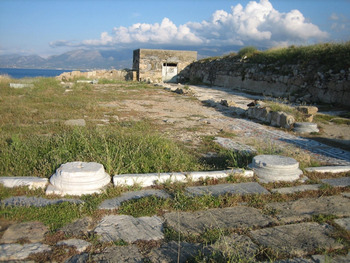
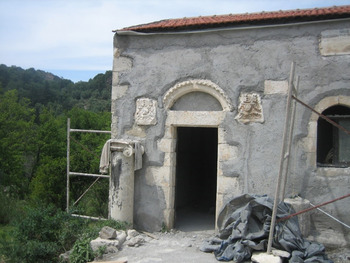
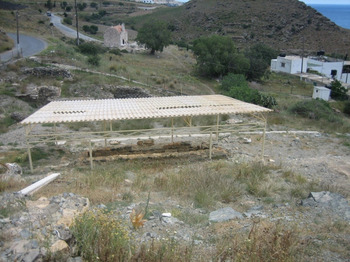
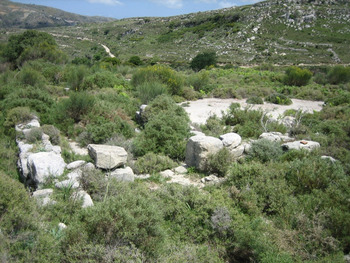
INTRODUCTION: HISTORY AND TOPOGRAPHY OF THE LATE ANTIQUE PELOPONNESE
A topographic analysis of the Late Antique churches of the Peloponnese showed that the process of Christianisation of the region was a result of strategic change with planned and unintended outcomes (Sweetman Reference Sweetman2015b). Given the persistent issues concerning secure chronologies for church foundations, this study approached questions of Christianisation through an innovative methodology: locations of churches were used as indices of change; their construction was attributed – depending on their topographic location – to a range of sociological processes, such as complexity, social movement and tipping point (Sweetman Reference Sweetman2015b). Churches built in large port towns in the north-east (such as Kiato), and on the edges of major sanctuaries (like Epidavros), are likely to have been strategic foundations with intended outcomes. Such constructions are a result of complexity processes, feasible in communities used to change and which adapt quickly. The situation of churches on the edges of sanctuary space is a conscious use of community tradition and memory in an attempt to help integrate the church into society (Sweetman Reference Sweetman2015a). Through more organic processes of unplanned change, articulated through social movement (which includes patronage, inheritance and other factors), it is likely that church building in the Peloponnese spread from sanctuaries and ports through a range of network connections (including, but not limited to, clerical, local and governmental factors) to the edges of busy towns such as Corinth and Argos (Sweetman Reference Sweetman2015a). Within the broader context of the urban sphere, it is likely that the earliest churches were located on the edges of the Roman town and often on major routes, or in cemeteries, making the best of existing gathering-points (Sweetman Reference Sweetman2015b). Churches erected in the centre of urban space, sometimes reusing earlier buildings, often represent a later phase of urban construction which commenced only after a number of Christian churches had already been well established in the surrounding area. This can be seen in the case of Corinth and Argos, where the construction of the churches on the hilltop sanctuaries of Apollo occurs well after their establishment in the suburbs and surrounding areas (Sweetman Reference Sweetman2015a). This feature is not restricted to the Peloponnese; a recent publication edited by Lavan and Mulryan (Reference Lavan and Mulryan2011) brought together a number of scholars showing that there were similar processes taking place across the Empire. The final stage of Christianisation in the Peloponnese was also an unplanned consequence of strategic change. At this point, church construction in isolated (and rural) locations, commonly on mountains or beside rivers, occurred in part because a critical mass of churches had already been reached in other locations (such as sanctuaries, urban spaces and ports); that is to say, a tipping point had been reached. Such developments were not period specific, and diverse locations could experience different processes of Christianisation simultaneously. This perspective on Christianisation does not exclude other interpretations, including the following: the importance of the church building as part of the symbolic landscape (Gregory Reference Gregory1986); complete separation between communities of Christians and non-Christians (Frantz Reference Frantz1965 and Speiser Reference Speiser and Jantzen1976); and the role of the church in the changing political landscape (Caraher Reference Caraher2003).Footnote 1 The nature of religious change means that a well-networked area may be fully Christianised while even a close-by area may just be beginning to be Christianised. For this reason, in this new study covering a wider area, it is necessary to cover a chronological range to ensure consideration of different phases of conversion.
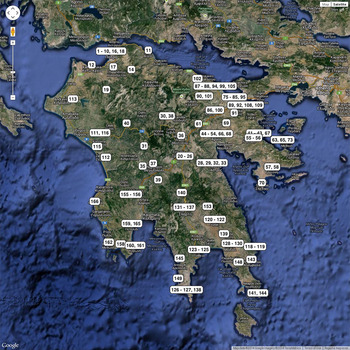
The topographic analysis of Peloponnesian churches makes clear the importance of location; positions in places of high visibility were chosen for the churches to publicise the new religion (Sweetman Reference Sweetman2015b and Reference Sweetman2015a). Many of the Late Antique churches appear to be positioned on routes between places of interest in the Peloponnese; for example the church at Talanta (Fig. 1: 139) lies between the major towns of Geraki (Fig. 1: 120–2) and Molaoi (Fig. 1: 128–30) and Neapoli (Fig. 1: 141, 144). While still maintaining the importance of place in terms of tradition and visibility, the majority of Peloponnesian churches were located in relatively accessible locations, avoiding particularly challenging areas like the peaks of the Kylini and Taygetos mountains (Fig. 1).
The Peloponnese: Late Antique church location. For the key, see Sweetman Reference Sweetman2015b, 288–9.

While pottery chronologies are being refined, issues involved in establishing good chronologies for the foundation of many Late Antique churches remain critical (Sanders, G.D.R. Reference Sanders, Schowalter and Friesen2005 and Tzavella Reference Tzavella2014); even in more recent excavations with good stratigraphy, chronologies are often postulated on the basis of church architecture and sculpture. In spite of the persistent dating issues, progress has been made in terms of the study of Christianisation through other means, but until chronologies can be reasonably established uncertainties will remain. Comparative analysis is fundamental to progress in the study of the Late Antique period. When considered in relation to areas like Crete and the Cyclades and the eastern provinces, the Peloponnese was Christianised at a rather late point. Saradi and Eliopoulos (Reference Saradi, Eliopoulos, Lavan and Mulryan2011, 263–4) have argued that this is in part because the province of Achaia had a modest role in the networks of Late Antique society, given that it did not figure on pilgrimage routes to the Holy Land. Although a tradition of contact does not necessarily mean shared architectural forms (Krautheimer Reference Krautheimer, Krautheimer and Curcic1986, 108), the surprising general uniformity of Peloponnesian churches perhaps supports this assertion of a comparatively insular region, in spite of the diversity of local religious and political arrangements.Footnote 2 Other possibilities might include a more active decision to maintain an independent tradition necessitated by its location on the borders of both the western and eastern political jurisdictions.Footnote 3 Consequently, it may be that potential network connections were not made as a conscious choice. Ultimately, while it is possible that the Late Antique Peloponnese was relatively isolated, certain locations, such as Corinth and Argos, were still important players in the Mediterranean trade network. It is argued here that the slower rate of Christianisation in the Peloponnese can be explained by reference not just to the absence of connections but the lack of a range of different types of network connections, and choices made not to participate in others.
The aim of this work is to show that areas with more dynamic and varied network connections were Christianised earlier than areas with more static connections as evidenced by church architecture and location. The methodology devised for understanding the Christianisation of the Peloponnese through church location will be applied to other provinces. Consequently, an examination of three different locations and topographies will enable a broader assessment of the role of network connections in the Christianisation process. The three areas are: Crete, which has been identified as having multiple roles in both the Roman and Late Antique network due to its geographic location (Sweetman Reference Sweetman2013); Cyprus, as another island to examine in assessing the impact of island status in terms of networks; and Lycia, which has a topographic variety similar to the Peloponnese, such as large coastlands and major mountain ranges, creating microcosms but with different network connections (Fowden Reference Fowden and Sakellariou1990, 343–70). The inclusion of three different areas enables a more focused discussion on the diverse network connections; accordingly, the spotlight will be on a range of external networks for Crete; connections made through pilgrimage will be the emphasis for Cyprus; internal networks will form the main focus for Lycia. While there were shared elements of political, religious and administrative policies between the provinces, each area of focus here has distinct features of church building which enhance the analysis; we might point to, for instance, the tripartite transepts of Crete, the early churches on Cyprus and the monasteries of Lycia.Footnote 4 In each case, a brief historic and topographic context will be provided, followed by an analysis of the location and spread of churches, which will lead to a synopsis of the Christianisation of the region in terms of strategic change. This kind of survey approach to the regions is necessary in order to establish an understanding of the network connections in this area and throughout the Late Antique period. It is thus inevitable that the discussion of individual sites is brief and issues of reliable chronologies for church buildings cannot be given the full treatment that would be expected of a more concentrated study on a specific area or period (as was the case for the Peloponnese: see Sweetman Reference Sweetman2015b). The data used here comes from fieldwork which focused largely on the topography of the buildings, while other archaeological data comes from a number of published corpora: for Crete, Sweetman Reference Sweetman2013; for Cyprus, Maguire Reference Maguire2012 and Rautman Reference Rautman and Callaway2002; for Lycia, Harrison Reference Harrison1963 (117–51); and for Cilicia and Isauria, Hill Reference Hill1996, in addition to further specialised bibliography on specific sites and areas.Footnote 5
NETWORKS
Application of network analysis to archaeological evidence has recently developed significantly, particularly through the work of Brughmans (Reference Brughmans2010, 277–303) and Knappett (Reference Knappett2011). Both social networks of people (particularly craftspeople) and non-social relationships (as expressed through artefacts) have been the subjects of analysis (Brughmans Reference Brughmans2010, 282). Additionally, Collar (Reference Collar2009, 144–57), Bowden, H. (Reference Bowden2009, 70–82) and Rutherford (Reference Rutherford, Malkin and Panagopoulou2009, 24–38) have successfully shown how network analysis can be applied to the spread of religious ideas and practices of different periods in the Greco-Roman world.
A network is the means through which knowledge is distributed; there are multiple types, such as social, organisational, infrastructural and biological. Network analysis allows a view of changing levels of connectivity over time, and networks can be active or dormant (Brughmans Reference Brughmans2010, 283). They can be created through personal connections (such as exile, tourism and religious experience) and may be organisational (based upon, for instance, trade or information exchange). They can be controlled or mediated by different groups or individuals, and can be generated organically or be manipulated (D'Souza et al. Reference D'Souza, Borgs, Chayes, Berger and Kleinberg2007). Networks may be scale-free (large networks displaying preferential attachment), such as the Roman Empire, or small-world (local) (Brughmans Reference Brughmans2010, 278–80). The study of network connections through material culture enables the understanding of mobilities. Vannini (Reference Vannini2012, 69) suggests that large-scale movement between places has to be made through considered processes; they are planned mobilities. On the other hand, the notion of wayfaring, which describes local movements, is less planned and more organic. Ingold (Reference Ingold2007, 15, 78–81) suggests that organised movement between distant places (transport) encloses spaces, while wayfaring opens boundaries. He argues also that the latter concept is made up of multiple lines of movement which are not always obvious: this is why the study of network connections helps to clarify how ideas spread as a consequence of personal choice. Thus, application of network analysis enables the identification of the possible impetus behind church building, be it planned or unplanned; moreover, it sheds light on the order in which it happened even when we are working with material that lacks securely fixed dates. Furthermore, Ingold (Reference Ingold2007, 89) notes the differences between modes of habitation and occupation: the inhabitant is knowledgeable of the space in which they dwell, whereas the occupant learns over a period of time and has to consciously develop knowledge.Footnote 6 In this way, studies of mobility allow a distinction to be made between different groups resident within the same areas.
Well-connected loci within a network are known as hubs. These do not necessarily have to be spaces of a particularly large size, but must have multiple connections. In this way a hub is not restricted to being a powerful city: it might just as easily be a sanctuary such as Epidavros. Detecting control of religious, financial or other networks is a clearer indicator of power than considering just the size of a city. The idea that wide-scale communication between locations (hubs or nodes) will create further nodes underpins network analysis; this process is known as phase transition (Chen and D'Souza Reference Chen and D'Souza2011, 1). When significant change takes place either within the network or with the creation of a new network (phase transition), it is caused not by one process but by multiple players and is deemed an emergent process (Collar Reference Collar2009, 145). In terms of Christianisation, network connections help to explain how changes can occur incrementally and why discrete areas may share similar conversion trajectories while other, possibly even contiguous, places have quite different processes of Christianisation. Accordingly, application of network analysis to church location helps to explain why churches are located where they are, and the more organic Christianisation processes that took place in the regions under scrutiny here. Processes of conversion have in the past been understood in terms of a linear process, an imposition on a community at the behest of a single decision-maker (individual or group). However, application of network analysis enables the detection of variant means by which conversion processes were initiated (for example local elite or metropolitan clergy) and spread (such as through trade, craftspeople and pilgrimage), and how they were enacted on the ground. While it is not always possible in current circumstances to be sure of precisely when socio-religious changes happen, network analysis allows access to an understanding of the processes behind the change on interregional and regional levels.
LATE ANTIQUE CRETE
Crete was well networked, in part because of its location in the Mediterranean but also because it came under a number of different official jurisdictions. Like Achaia, the island was part of the Prefecture of Illyricum and under the jurisdiction of Rome in terms of ecclesiastical administration, but it was administered as part of the Eastern Empire (Tsougarakis Reference Tsougarakis1988, 155).
As with other areas of Greece, archaeological data for Late Antique Crete consists primarily of the data from church excavations. Analysis of these and more recent survey evidence now means that the island is quite well documented in the Late Antique period (Sanders, I.F. Reference Sanders1982; Sweetman Reference Sweetman2013). Written sources are largely made up of episcopal letters (dated between the sixth and seventh centuries), hagiography (such as Saints' Vitae dating primarily from the seventh century onwards) and the sixth-century Synekdemos of Hierokles, an account of the 64 Byzantine provinces and 912 cities (Tsougarakis Reference Tsougarakis1988, 211). The Epistle of St Paul to Titos, Bishop of Crete, included in the New Testament, provides indirect evidence of Titos' duties regarding the island. Crete seems to have prospered throughout the Late Antique period on the basis of its strong agricultural economy and its location on the grain route between Egypt and Constantinople (Sanders, I.F. Reference Sanders1982, 35).Footnote 7 The argument for it being an entrepôt in the Roman period suggests that it played this role also during the Late Antique period (Sweetman Reference Sweetman2013, 13). The fortunate location also had its downside, in that the accessibility of Crete meant that it suffered from raids (by Vandals, Slavs, Avars and Moors) throughout the Late Antique period. The Arabs, who had been attacking the island since the seventh century, finally conquered it in the early ninth century.Footnote 8
The Late Antique churches
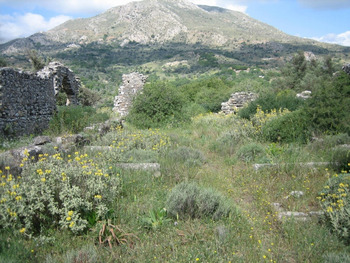
The earliest churches on the island appear to date to the early fifth century and two churches have been dated to the seventh or eighth century. The date of the visible remains of the earlier church at Fodele remains contested, though it is accepted that it is Late Antique and possibly seventh or eighth century (Whitley et al. Reference Whitley, Germanidou, Urem-Kotsou, Dimoula, Nikolakopoulou, Karnava and Evely2007, 109). The construction of the church at Vizari during the eighth century marks the last of the Late Antique church constructions in Crete (Fig. 2) (Kalokyres Reference Kalokyres1956, 250–61).
Vizari: central aisle from west.

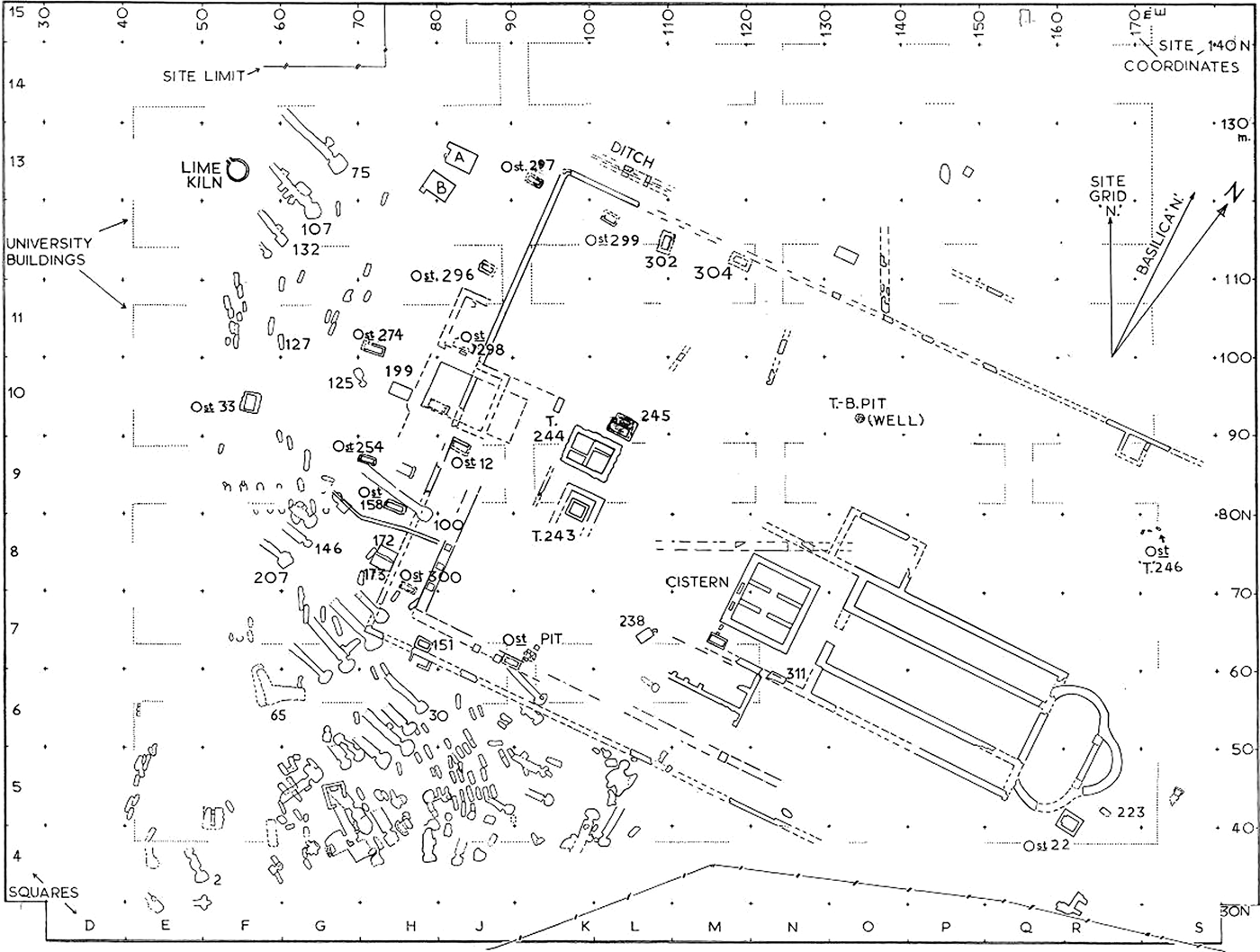
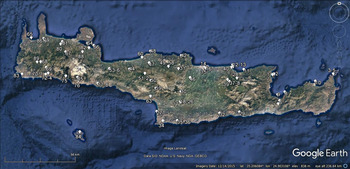
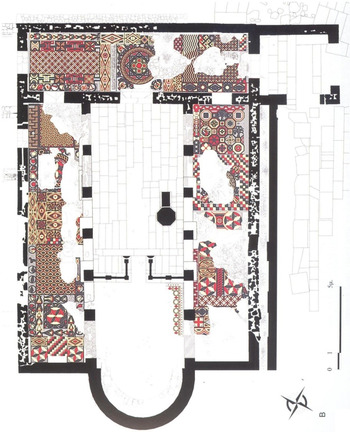
The KMF Basilica (Fig. 3) marks the construction of one of the first churches on the island in the early fifth century (Sweetman Reference Sweetman2004, 315–54). However, evidence for Christian communities is known much earlier in the Roman period from Eleutherna and Knossos from epigraphic and literary data (Sweetman Reference Sweetman2013, 294). From the fifth to eighth centuries, 93 churches were constructed across the island, most of which have been dated to the late fifth to the early sixth century (Fig. 4 and Table A1 in the Appendix) (Sweetman Reference Sweetman2013, 21–3).Footnote 9 This is a little earlier than the majority of the Late Antique churches in the Peloponnese, which appear to date from the sixth century. There are earlier churches constructed in the fifth century, such as those at Epidavros and Hermione, but these are not so common (Sweetman Reference Sweetman2015a). Some 50 of the Cretan churches cannot be dated, but four of the remainder have been securely dated on the basis of clear stratigraphic and/or epigraphic evidence. These four consist of the KMF and Sanatorium Basilica at Knossos (which have been dated stratigraphically) as well as Eleutherna and Gortyn Mitropolis (which were both dated through mosaic inscriptions: Table A1) (Sweetman Reference Sweetman2004, 315–16; Sweetman Reference Sweetman2013, 221–2). At Eleutherna, the mosaic in the narthex records the name of the founder, the first bishop of Eleutherna, Euphratas, who is recorded in Hierokles' Synekdemos as attending the fourth ecumenical council at Chalcedon in 451 (Fig. 5). This indicates a foundation date of roughly 451 for the church. The original foundation date for the Gortyn Mitropolis church is likely to have been late fifth or early sixth century (Fig. 6) (Sweetman Reference Sweetman2013, 221–2). However, the combined evidence of two mosaic inscriptions in the nave helps to provide a date for the restoration of the church. One records that the repairs took place during the reign of Bishop Vetranios. Farioli Campanati identifies this as the bishop in service at Gortyn between 553 and 597, and whose monograms appear on the capitals at Ag. Titos (SEG LI 1167). It is a convenient fit, particularly as an earthquake is recorded for 552 which may have caused some damage to the existing building (Stiros and Papageorgiou Reference Stiros and Papageorgiou2001, 383–6). However, this alone is not substantial evidence, but a second fragmentary inscription can be reconstructed as reading ἐπὶ Θ[εοδώρου τοῦ ἁγιωτά]του [καὶ μακαριωτάτου ἡμῶν ἀρχι]επι[σκόπου ---] (‘in the reign of Theodoros, our most holy and most blessed archbishop’) (Di Vita Reference Di Vita1996–7, 467–584: 566; figs 112 and 113). If the reconstruction of the name of the clergyman is correct, it is known that the Archbishop Theodoros of Gortyn participated in the Council of Constantinople in 536 and 553 (Di Vita Reference Di Vita1996–7, 567, n. 135; see also IC IV 460). Both bishops may well have been responsible for the repair to the church in the mid-sixth century.
KMF Basilica Knossos (courtesy of the BSA).

Map of Crete showing church location (Google Earth v. 7.1.8.3036; imagery date: 14/12/15).

Eleutherna including Narthex Mosaic with inscription (courtesy of P. Themelis).

Gortyn Mitropolis: central apse from south.


The rest of the Cretan churches have been dated largely through comparative evidence using the architectural form, mosaics or sculptures, as is the case with the Peloponnesian examples (Saradi and Eliopoulos Reference Saradi, Eliopoulos, Lavan and Mulryan2011, 264; Sweetman Reference Sweetman2015b).
Topography and church location
The formidable mountains of Crete (White, Idean and Dikti) divide up the island's fertile and well-exploited plains, such as the Mesara in the south-west and Lasithi in the north-east. In some areas such as Lendas in the south, the coastline is quite cut off from the interior as the mountains have their foothills just a few kilometres from the seashore. There are some clear routes north–south across the island, such as that between Ierapetra and the Bay of Mirabello on the east side and on the west, through the Amari Valley between Agia Galini and Stavromenos (Fig. 4). Of the 93 known churches, the locations of 65 can be reasonably well identified (Fig. 4);Footnote 10 27 have coastal locations while 38 are away from the coast. Of these 38, 12 are situated in large Roman towns such as Knossos, Gortyn, Ini, Eleutherna, Lappa and Vizari (Fig. 4; Table A1). Many are located in smaller Roman settlements such as Kandanos and Elyros (Sanders, I.F. Reference Sanders1982, 126; Sweetman Reference Sweetman2013, 261–2). Others come from settlements that had been thriving in earlier periods (Classical and/or Hellenistic), such as Axos. There are also examples of churches where there is little evidence (as yet) of a sizeable Roman settlement, such as Episkopi, Glossa, Agia, Armenoi, Kyriakosellia, Meskla, Alikianos, Plemeniana, Aradena, Kera, Fodele, Piskopiano and Avdhou (Sweetman Reference Sweetman2013, 147–8). This is not necessarily surprising given the growth of new settlements in previously under-occupied areas, as seen in the Peloponnese (Sweetman Reference Sweetman2010, 203–61), Lycia (Foss Reference Foss1994, 1–52) and Cilicia (Hill Reference Hill1996).
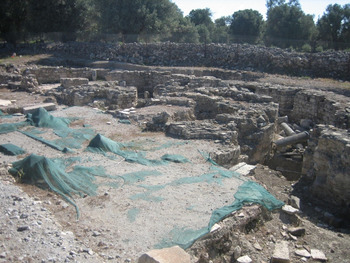
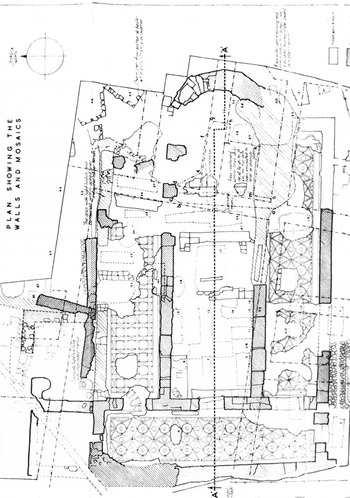
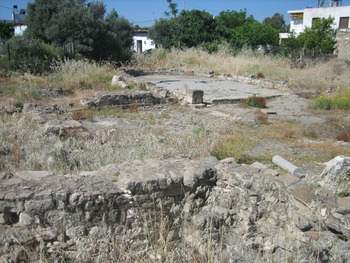
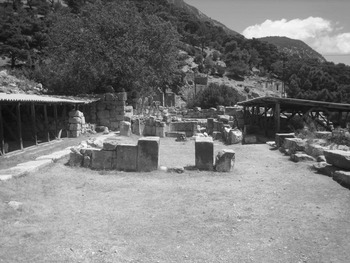
The earliest churches constructed on the island occur in the two largest cities, Knossos and Gortyn. The KMF Basilica (early fifth) is probably a martyrium churchFootnote 11 (Sweetman Reference Sweetman2004, 340); and the Sanatorium Basilica (mid-fifth) was constructed shortly afterwards (Fig. 7). Both were also located in the northern suburbs of the Roman city at Knossos. The two earliest religious buildings at Gortyn, the triconch martyrium (fifth) (Fig. 8) and the Mitropolis church (late fifth/early sixth) (Fig. 6) both lie on the southern edge of the Roman city. As with the Peloponnese, it is likely to be the case in other towns too that the earliest urban churches appear in the suburbs. The presence of the early churches at Eleutherna (mid-fifth) and Sybrita (fifth) is not surprising because of the size of the pre-existing Roman cities (Figs 4 and 9). Two other fifth-century churches, Olus and Almyrida, are found directly on the coast in highly visible locations (Figs 10 and 11). Churches continue to make full use of the visibility afforded by coastal positions with constructions on the north at Panormos (late fifth/early sixth), Chersonisos (basilicas A [late fifth/early sixth] and B [sixth]) (Figs 12 and 13), Malia, (mid-sixth), and Tholos, Siteia and Itanos (early sixth); and on the south Lasaea (n.d.), Lissos (n.d.), Suia (sixth), Tarrah (n.d.), Agia Galini (n.d.), Lebena (late fifth/early sixth), Matala (n.d.) and Frangokastelli (sixth). It is striking that in comparison to the Peloponnese, the earliest churches in Crete are located in urban centres rather than on the coast. Other churches can be found at gathering-places such as water sources, as in the case of Lappa (n.d.) (Fig. 14) and Ini, which has been recently discovered (Whitelaw and Morgan Reference Whitelaw and Morgan2009, 90).
Sanatorium Basilica, Knossos (after Frend and Johnson Reference Frend and Johnston1962, courtesy of the BSA).

Gortyn: Triconch Martyrium from south-east.

Sybrita: church from north-west with later church to the north.

Olus: nave with mosaic from north-east.

Almyrida: nave and tripartite transept from south-west.

Chersonisos: Basilica A from south-west.

Chersonisos: Basilica B nave and apse from west.

Lappa: church with reused architecture by river (below).

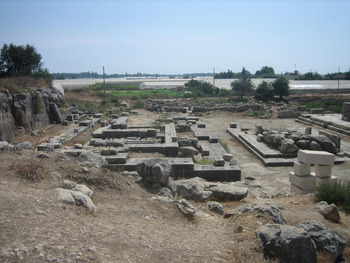
Only a small number of temples are known on the island, and a few of these have evidence for church constructions on or close to the temple. The basilicas at Lissos and Lebena (Fig. 15) are located at the edges of the sanctuaries (both to Asklepios). A baptistery is associated with the church at Lebena (Sweetman Reference Sweetman2013, 113). In other cases, the data are less certain. Excavations at Eleutherna revealed a building below the Basilica which excavators have suggested is a possible temple (Themelis Reference Themelis and Stampolidis2004, 54–5, 71–2). At Gortyn, Sanders suggests that the Mavropappas and Acropolis churches are constructed on earlier cult buildings which are no longer visible (Sanders, I.F. Reference Sanders1982, 102 and fig. 35). The later apse in the west end of Apollo Pithos at Gortyn is believed by some to represent a Christian church (Sanders, I.F. Reference Sanders1982, 108). However, the presence of an apse in the west end of a church would be unique in Crete and Greece more generally. There is evidence to suggest pre-existing cult practice at Viranepiskopi (sixth) (a possible temple to Diktyanna), Itanos Basilica A (possible temple of Athena) and Chersonisos Basilica A (possible temple to Britomartis) (Sanders, I.F. Reference Sanders1982, 117; 89 and 95 respectively). At Pigi, Sybrita and Chersonisos Basilica B there are architectural elements which indicate earlier unidentified cult buildings (Sanders, I.F. Reference Sanders1982, 104; 115 and 101 respectively).
Lebena: sanctuary of Asklepius in the foreground with church in the background from the west.

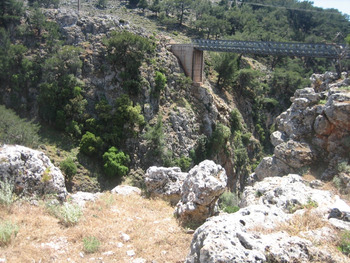
The Cretan churches are constructed in visible locations: on hilltops (Episkopi [late fifth/early sixth], Kera [late fifth/early sixth; Fig. 16], Piskopiano [sixth]); by a river or springs (Lappa [n.d.; Fig. 14], Armenoi [n.d.], Plemeniana [late fifth], Fodele and Avdhou [n.d.]); or in conspicuous locations such as on the edge of a deep gorge (Aradena [n.d.; Fig. 17]) or overlooking a valley (Glossa [n.d.]). As in the case of the Peloponnese, some Cretan churches are clearly situated along major routes, such as along the course of the Amari Valley. Starting at the church on the south coast at Agia Galini, the route moves north through the Amari Valley; along the way, the churches of Apodoulou, Vizari, Sybrita and Viranepiskopi were constructed, leading to the church at Panormos on the north coast (Fig. 4).Footnote 12
Kera: nave and narthex from south-west.

Aradena: view of gorge from meagre remains of church.

Architectural form
A wide variety of architectural forms is seen in the Cretan churches; the well-established evidence for mosaic workshop production indicates the important role the island played in terms of networks and communications in the Late Antique period (Sweetman Reference Sweetman2013, 149–51). It has been shown that the mosaics of the Sanatorium Basilica, Knossos, can be connected with those from Elis, Gytheion, Sardis and Constantinople because they had craftspeople in common (Sweetman Reference Sweetman2013, 134). Once established in Knossos, this mosaicist group may then have gone on to work on mosaics at Kera, Suia and Chersonisos (Sweetman Reference Sweetman2013, 134).
The most common architectural form features a single apse and triple aisle (for example Knossos Sanatorium and Eleutherna). Variations are found in the internal space with the presence of a tribelon and ambo (Chersonisos Basilica B) or a synthronon (Panormos), and some have high stylobates between the aisles (Eleutherna), while others have low ones (Chersonisos Basilica A) (Sweetman Reference Sweetman2013, 112–13). Some striking church forms are found on the island, such as the trefoil apse of the KMF Basilica, Knossos (Fig. 3) and the tripartite transept forms at Almyrida (Fig. 11), Kolokythia and Panormos.
External Networks
It is clear from even a brief survey that Crete's central location in the Mediterranean allowed it access to a range of different network connections. While the island shared a similar political and religious jurisdiction to that of the Peloponnese, its multiple networks indicate that unlike the Peloponnese it embraced the diversity that this afforded. It has been argued that Crete functioned as an entrepôt and from the third to sixth centuries it is likely that the trade patterns for Crete in the eastern Mediterranean did not change significantly (Sweetman Reference Sweetman2013, 13). Therefore, it is possible that due to its multiple network connections, partly through trade, there was no fundamental need for targeted and intended Christianisation at an early stage. There was enough movement of people into and out of the island for ideas to spread rapidly. This would in part explain the divergence seen in Crete, where the earliest churches are found in towns like Knossos and Gortyn, rather than in ports and sanctuaries as they were in the Peloponnese. The wealth of different connections is supported by the possible Italian inspiration for the trefoil form of the KMF Basilica, the movement of mosaicists from Asia Minor to Crete and the occurrence of tripartite transept churches, particularly at coastal locations such as Panormos and Almyrida. This does not preclude some imperial involvement. The largest basilica on the island, the Sector M Basilica, Gortyn (c.68 × 35 m), may have had some imperial patronage; it shares some parallels with the Lechaion Basilica, which was arguably also constructed with imperial support (Caraher Reference Caraher2007; Sanders, G.D.R. Reference Sanders and Christie2004, 187). It should be noted that the Lechaion Basilica is later in date. Both churches have complex arrangements, with a tribelon in the Gortyn church and a pentabelon in Lechaion. Both are richly decorated, each with a synthronon. The ambo in each is centrally located in the nave and linked to the bema with a solea. These features are also seen in the Acropolis Basilica, Sparta (Sweetman and Katsara Reference Sweetman and Katsara2002, 429–68). Caraher (Reference Caraher2007) suggests that the location of the ambo in the central aisle may be indicative of either an imperial placement or a desire to emulate imperial practices in Constantinople. The comparative lack of churches using mountain locations in Crete (the only real exception being Piskopiano above Chersonisos) indicates that achieving long-range visibility was not as critical in Crete as it was in the Peloponnese. This may reflect the size of the island and the key locations of churches along well-trodden routes. One of the most efficient routes from south to north is from Agia Galini through the Amari Valley to Stavromenos, which is marked by a number of churches such as those at Vizari, Sybrita and Viranepiskopi.
Further study of pottery distribution in the Late Antique period allows a further layer of understanding of network connections. Gallimore's Reference Gallimore2015 study of Roman pottery from Hierapytna and Crete has provided evidence for Cretan participation in the Annona Militaris with exports of wine to Constantinople, Rome and in particular the Black Sea. Importantly however, his work has also shown that commercial exchange continued alongside this in other parts of the Eastern Mediterranean, including Olympia, Argos, Corinth, Thessaloniki and Ephesus (Gallimore Reference Gallimore2015, fig. 11.5). While there may be some overlap with the trade routes, it seems likely that the mosaicists and architects were creating their own separate network connections. Another layer which is not as visible in the archaeological record is the movement of wayfarers or individuals, such as the clergy or patrons who might have commissioned the church or its decor.
LATE ANTIQUE CYPRUS
In recent years, the work of scholars such as Jeffery, Soteriou, Megaw and Dikigoropoulos on Late Antique CyprusFootnote 13 has been renewed by scholars such as Rautman (Reference Rautman and Callaway2002; Reference Rautman2003; Reference Rautman, Stewart and Carr2014, 39–56), Papalexandrou and Caraher (Reference Papalexandrou, Caraher, Childs, Smith and Padgett2012, 233–49) and Maguire (Reference Maguire2012). As with Crete, the location of Cyprus makes it a critical inclusion in an analysis of the networks and routes of the Late Antique Mediterranean (Rapp Reference Rapp, Stewart and Carr2014, 29). Maguire (Reference Maguire2012, 2) argued that Cyprus, through its direct connections with Constantinople, played a critical role in the Christianisation process of the eastern Mediterranean, perhaps even serving as a hub. This status is perhaps highlighted by the fact that many of the cities with episcopal status were not necessarily large (Papalexandrou and Caraher Reference Papalexandrou, Caraher, Childs, Smith and Padgett2012, 42). Maguire further suggests, however, that this began to change at the end of the fifth century and that Cyprus increasingly focused on its western neighbours and Rome. As part of the reorganisation of the provinces undertaken by Diocletian, Cyprus was part of the Diocese of Oriens administered by Antioch, but its ecclesiastical independence was confirmed in 431 with the creation of the metropolitanate at Salamis and its own archbishop (Rautman Reference Rautman and Callaway2002). The early Christian presence on the island with holy men such as Saints Barnabas and Paul marked the start of a consistent affinity with Christianity. In 325 Cyprus was the only island to send bishops to the Council of Nicaea and by 400 it had 15 bishops (Rapp Reference Rapp, Stewart and Carr2014, 30).
Historical sources for the island include Socrates' Ecclesiastical History, covering the eastern Mediterranean in the fourth and early fifth centuries, and that by Sozomen, which largely covers the fourth century (Maguire Reference Maguire2012, 22). Although some scholars would see the earthquake of 365 as a watershed after which the pre-Christian cult sites were abandoned, such change born out of tension is not as much in evidence as the more gradual transformation of cult (Davis and Stewart Reference Davis, Stewart, Stewart and Carr2014, 17). Vitae of saints such as Saints Auxibios (seventh) and Epiphanios (late fifth–sixth) can be helpful as long as account is taken of their various levels of reliability (Efthmiadis with Déroche Reference Efthymiadis, Déroche, Binggeli, Aïnalis and Efthymiadis2011, 76–7); according to Rautman (Reference Rautman and Callaway2002, 2) these sources indicate a largely peaceful Christianisation of the island. The indications of tension later in the period (under Theodosius) appear to have been somewhat exaggerated in the written sources such as the early seventh-century Vita of Tykhon (Rautman Reference Rautman and Callaway2002, 9), as is indeed the case for other areas too. The early Christian presence and the cult of the saints were a point of local pride which helped consolidate community identity, particularly during the times that Cyprus was asserting its independence from Antioch in the mid-fifth to seventh centuries (Rapp Reference Rapp, Stewart and Carr2014, 32–3). This is further emphasised by the connections with the Levant that were manifested through dedications to specific saints: for example, when Lazarus fled Judea for Cyprus he was invested as Bishop of Larnaca and then venerated there in the Late Antique period. The connections worked in the opposite way too; for example, John the Merciful was revered at Amathous, having left it to become Patriarch of Alexandria. The island flourished in the Late Antique period, in part through its extensive trade in minerals; many of the important Roman cities such as Salamis, Paphos and Amathous, expanded during this time (Papacostas Reference Papacostas, Kingsley and Decker2001, 109). The island, and certainly the southern part, is one of the best documented through archaeological survey and there is good evidence for a well-organised landscape with nucleated settlements and internal networks including a presumed coastal roadway (Rautman Reference Rautman, Stewart and Carr2014, 41). Although it seems that copper mining continued and agricultural produce sustained the island well, it is likely that external wealth (from trade and pilgrims) would have bolstered the island's economy (Papacostas Reference Papacostas, Kingsley and Decker2001, 110–13).
The Late Antique churches
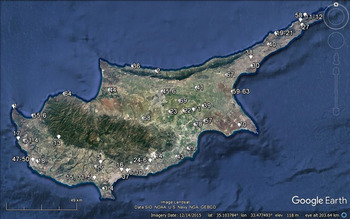
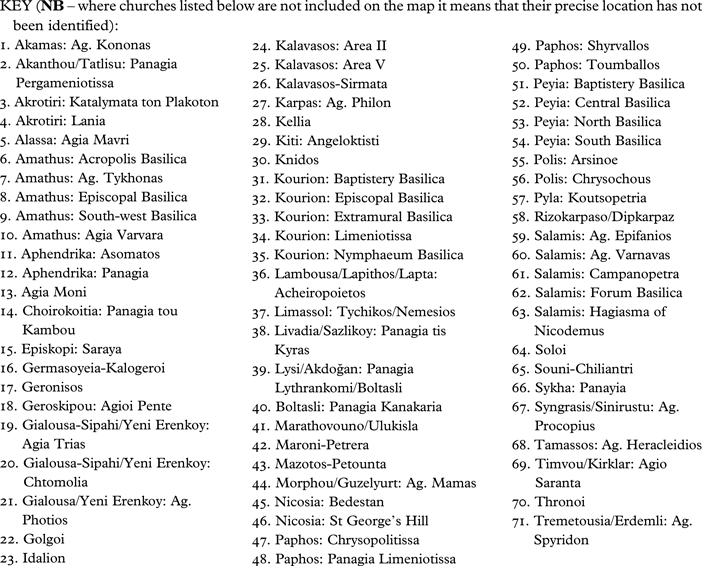
Maguire identified 71 churches on Cyprus (Fig. 18). In spite of the difficulties of dating them, three fourth-century churches have been identified, located in the major Roman coastal towns of Salamis (Ag. Epiphanius), Paphos (Panagia Chrysopolitissa) and Kyrenia (Acheiropoiitos) (Maguire Reference Maguire2012, 4).Footnote 14 Elsewhere, many of the churches founded in the fourth, fifth and sixth centuries also have identifiable seventh-century phases, such as Maroni-Petrera (Manning et al. Reference Manning, Manning, Tomber, Sewell, Monsks, Ponting and Ribeiro2002, 36–7, 77–8). In spite of the seventh-century Arab invasions, it is notable that Cyprus has a number of quite late churches, many of which are located in the north of the island, particularly around Karpas (in the northern peninsula). As noted already, churches continued to be built well into the seventh century and later in Cyprus, such as Kalavassos (Kopetra) Giorkous, Atheniou and Episkopi Saraya, Kourion (eighth century). Renovations and reconstructions were also being undertaken in the seventh and eighth centuries (particularly in the churches of the Karpas peninsula). This may in part be explained by the commercial growth of the north coast in the sixth and seventh centuries as evidenced by finds of LR1 and LR4 amphorae through underwater survey (Rautman Reference Rautman, Stewart and Carr2014, 41).
Map of Cyprus showing church locations. Adapted from Maguire Reference Maguire2012, fig. 1 (Google Earth v. 7.1.8.3036; imagery date: 14/12/15).

Topography and church location
The Kyrenia Mountains are a long range of limestone peaks which run for around 160 km across the north coast of the island. Although they are not as high as the Troodos range in the south, they are precipitous in that they rise dramatically from the plain. The Troodos Mountains partition off the southern coast from the rest of the island as they stretch from the western to eastern coasts. For the most part their foothills reach the coastal areas, leaving only a few plains around areas such as that between Paphos and Kouklia, the Akrotiri Peninsula and Limasol (Fig. 18). A smaller plain surrounds the area of Maroni on the east; while the plain around Poli Chrysochou and Agia Marina on the west coast is almost entirely enclosed by the mountains on its east side. The island is heavily forested in the areas of Agia Irini in the north-west, Zorras in the north-east and Troodos and Paphos in the southern mountains.
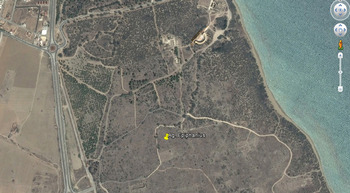
The majority of churches are located on the coasts and on coastal plains primarily in urban locations such as Poli Chrysochou (2 churches), Paphos (4 churches), Kourion (4 churches), Amathous (5 churches) and Salamis (5 churches) (Fig. 18). The southern concentration is not surprising given the problems of sailing along the northern coast (Papalexandrou and Caraher Reference Papalexandrou, Caraher, Childs, Smith and Padgett2012, n. 5). Where it is possible to define their surroundings, it seems likely that the earliest churches in urban contexts are built in suburban areas. The Limeniotissa Basilica at Kourion is located close to the harbour and was founded in the late fourth century (a date based on the excavation evidence and mosaics) (Maguire Reference Maguire2012, Gazetteer, 35). Another suburban basilica lies just outside the walls and has been dated to the fifth century; it is unclear, though, whether this was constructed before or after the Episcopal Basilica in the centre of the urban space (Fig. 19). At Paphos, the church of Toumballos was constructed in the fourth century just within the walls beside the north gate of the city (Maguire Reference Maguire2012, Gazetteer, 51). Its location close to the sanctuary of Apollo Toumballos is based on epigraphic evidence: the excavators suggested the church functioned as a martyrium for St Hilarion (Maguire Reference Maguire2012, Gazetteer, 51). Chrysopolitissa was constructed in the fourth century, on the eastern edges of Paphos, which Rautman (Reference Rautman and Callaway2002) considered to be the new part of the city; Maguire notes that it would have dominated the ancient harbour. Another church, Shyrvallos – Ktima was built in the sixth century (Maguire Reference Maguire2012, Gazetteer, 47 and 49). A different format is seen in Salamis, where the earliest church identified, Ag. Epiphanios (Fig. 20), the largest church on the island, was constructed in the fourth century, located close to the Agora, along a roadway and in the centre of the city. Ag. Barnabas and another small church were constructed in the fifth century and the Hagiasma of Nicodemus was founded in the sixth century. The church by the harbour, Kampanopetra, dates to the sixth century (Roux Reference Roux1998).
Kourion church (after Caraher Reference Caraher2011).

Ag. Epiphanius, Salamis (Google Earth v. 7.1.8.3036; imagery date: 14/10/16).

Although some churches – such as that at Agias Mamas, Morphou (fifth–sixth) or Ag. Procopius (mid-sixth) at Syngrasis, Famagusta or the three churches at KalavasosFootnote 15 – can be up to 7.5 km inland, only 10 of the 71 churches included here have truly inland locations (Fig. 18). Some of these are in small towns such as Tamassos, the location of Ag. Heracleidios (fourth and fifth). At least some of the inland churches may be located on routes out of major cities, with examples such as Ag. Spyridon (late fourth/early fifth) at Tremethoushia, which is around 7 km north-west of Paphos, and Agia Mavri, Alassa (mid-seventh), which is 15 km west of Limasol. The Karpas Pennisula, already mentioned for its late churches, also has a number of rural examples such as Panagia tis Kyras, Livadi (late sixth/early seventh) and Panagia Kanakari (sixth). Lapithos (late fourth and sixth) and Trimithos (late fourth/early fifth) are in mountainous regions in the Kyrenia and Troodos respectively (Fig. 18).
Very few churches have non-urban locations. This cannot simply be a peculiarity of the available archaeological material, as Cyprus is one of the best-surveyed islands in the Mediterranean (Rautman Reference Rautman and Callaway2002, 39). Rautman (Reference Rautman and Callaway2002) noted that there was far less focus upon rural cult in Cyprus than there was in other locations such as the Peloponnese (Alcock Reference Alcock1993 and Caseau Reference Caseau2004, 105–44). The beauty and fertility of the region and the availability of water may have played a part in sustaining the popularity of the churches. As with Crete and the Peloponnese, churches are commonly located in areas of natural beauty (such as Alassa and Akamas), and visibility is also important. Although monasteries at Stavrovouni near Larnaca and St Nicholas of the Cats supposedly have Constantinian foundations, there is no architectural evidence to support this (Papacostas Reference Papacostas, Kingsley and Decker2001, 107). Possible monastic complexes have been identified in association with the church at Chiliantis, Souni (sixth–seventh) and possibly at Ag. Varnavas (discussed above) (Maguire Reference Maguire2012, Gazetteer, 75). Possible martyria churches have been identified at Limeniotissa, Kourion (late fourth/fifth), Toumballos, Paphos (fourth), Ag. Philon, Karpas (early fifth and early seventh), the Extramural Church at Kourion (late fifth–seventh), Panayia Sykha, Aphrendrika (sixth) and Akrotiri Katalymata (seventh). Supporting evidence for the identification includes partitioning one of the apsidioles and the presence of a sarcophagus or the indications of a mensa martyris (holy table) (Maguire Reference Maguire2012). The high number of martyrial sites from the fourth to the seventh century is in keeping with what would be expected of an area that played such a key role in terms of pilgrimage. Gartzonika has shown that many of the martyrial sites in the Balkan Peninsula are situated in highly connected areas and along major routes such as the Adriatic and Black Sea coasts as well as the delta of the Danube (Gartzonika Reference Gartzonika and Rakocija2009, 134). Furthermore, Gartzonika (Reference Gartzonika and Rakocija2009, 104) suggests that the earliest churches were founded as part of a strategic plan, with the next phase of church building moving along networks. A similar pattern is seen in Cyprus, which is itself on a major pilgrimage route, and nearly all of the martyria sites are in major ports along the north, east and south coasts (Ag. Heracleidios [fourth], located inland at Tamasos, was a well-known pilgrimage site but the martyrium has not yet been identified [Maguire Reference Maguire2012, Gazetteer, 78]).
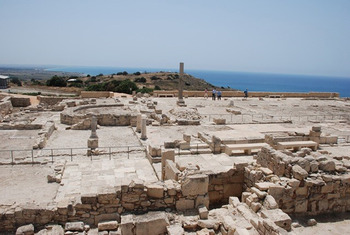
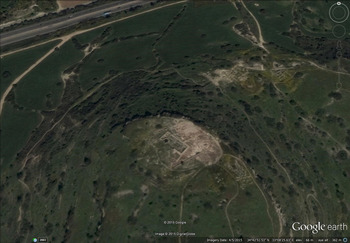
In terms of the relationship between church location and earlier cult, Rautman identified three sanctuaries on Cyprus with Late Antique churches: the sanctuary of Aphrodite at Paphos, the sanctuary of Aphrodite at Amathous (Fig. 21) and the Sanctuary of Zeus Olympios at Salamis (Rautman Reference Rautman and Callaway2002). A fourth example may be that noted by Maguire (Reference Maguire2012, Gazetteer, 51): the basilica near the temple of Apollo Toumballos, though it does not directly occupy the site of the temple. The Aphrodite sanctuary at Paphos is likely to have been abandoned in the third or fourth century, and in any case before the construction of the first church in Paphos in the late fourth century (Rautmann Reference Rautman and Callaway2002). At Amathous, the Aphrodite sanctuary was located on the acropolis. The foundation of the church on the acropolis is dated to the late sixth or early seventh century, and at this point three other churches had already been constructed below the acropolis, one of which was the cemetery church of Ag. Tykhonos (fourth century). Historical sources note that Bishop Tykhon threw the priestess of Aphrodite out of the temple in the mid-fifth century, but at least a century passed before a church was constructed on the site using spoliated temple material (Maguire Reference Maguire2012, Gazetteer, 8). It is likely that the conversion of the temple to a church was a secondary stage of the Christianisation process, similar to what is seen in the sanctuaries in the Peloponnesian cities (Sweetman Reference Sweetman2015a). Ag. Epiphanios was located close to the Sanctuary of Zeus Olympios at Salamis. It is unclear whether there was any overlap in period of use between the temple and the church; however, by the late fifth or early sixth century the temple was clearly defunct when various shops and then a later church occupied part of the original sanctuary space (Maguire Reference Maguire2012, Gazetteer, 67). The church of the Hagiasma of Nicodemus was constructed above two Roman cisterns in the sixth century (Maguire Reference Maguire2012, Gazetteer, 67). In this case, the importance of a water source was exploited and linked to cult practice from around the fifth century.
Acropolis at Amathous (Google Earth v. 7.1.8.3036; imagery date: 5/4/15).

Architectural form
The architecture of the Cypriot churches is markedly different from that of Crete and the Peloponnese, as particularly seen in the dominance of the triapsidal form; examples include the Episcopal Basilica, Amathous (second half of the fifth century), two at Aphendrika (sixth century) and all three of the Kalavassos churches (sixth–seventh centuries). However, the triconch apse found in both Crete and Lycia is not yet identified in Cyprus. There is, as yet, no evidence for tripartite transept forms on Cyprus that are found on Crete and Lycia (Maguire Reference Maguire2012, 176). Notably, a large number of Cypriot churches have long annexes, many of which run eastwards from the terminal of the south aisle or sometimes the north aisle (for example at the South-west Basilica, Amathous [late fifth] and Kalavassos V [seventh]). Their uses appear to range widely, finding employment as hostels, treasuries and baptisteries. Others have suggested that they were for catechumens (Manning et al. Reference Manning, Manning, Tomber, Sewell, Monsks, Ponting and Ribeiro2002, 79). Baptisteries are identifiable at Ag. Epiphanius, Salamis and Ag. Philon, Karpas; Maguire postulates that the annexe on the north aisle of the Acropolis Basilica, Amathous may also have been used as a baptistery or a place for offerings (Maguire Reference Maguire2012, Gazetteer, 10). Large baptistery churches are also found at Pegia (sixth) and Kourion (early fifth to early seventh). Evidence for domes on churches first occurs in the seventh century with the reconstruction of the church of Ag. Epiphanius, Salamis (Maguire Reference Maguire2012, Gazetteer, 60). The late use of domes is slightly later than the pattern suggested in the Peloponnese: they appear over the Acropolis Basilica, Sparta, Tigani, Mani and Ag. Sofia, Korone in the sixth century (Sweetman Reference Sweetman, Cavanagh, Gallou and Georgiadis2009, 331–43). The sixth-century church of Ag. Titos in Crete might also have had a dome. Domes are more commonly found at earlier periods in the Lycian churches (see below).
Pilgrimage
Pilgrimages to the Holy Land intensified in the fourth century and Cyprus exploited its location well in terms of being located on a number of pilgrimage routes, for example, from Constantinople to Jerusalem and Cilicia to Alexandria. Coastal villages, with churches such as Ag. Georgios, Peyia and Kalavasos-Kopetra, may well have benefitted as stopping-off points on the routes, as their multiple churches indicate (Caraher Reference Caraher2008). Furthermore, the vast quantities of imported marbles used in the churches in this and other areas appear to reflect the accessibility of the material as well as the means to purchase it (Maguire Reference Maguire2012, Gazetteer, 52). Caraher (Reference Caraher2003) also argues that the use of imported marbles reflects wide network connections such as in the case of the Lechaion Basilica, Corinth. Being on the pilgrim route would have stimulated further investment in pilgrimage sites, such as the construction of the church of Ag. Varnavas (fifth century), with a mensa martyris (holy table), near the location of the relics of the Apostle Barnabas west of Salamis, as well as Ag. Epiphanius, Salamis (late fourth century) and Ag. Heracleidios, Tamassos (fifth–sixth century). Ancillary rooms in some, such as the Acropolis Basilica, Amathous (sixth century?) may have provided accommodation for pilgrims (Maguire Reference Maguire2012, Gazetteer, 9) which may be for practical purposes or possibly for incubation (Bowersock, Brown and Grabar Reference Bowersock, Brown and Grabar1999, 644).
Other than pilgrimage, Cyprus had a number of network connections made through trade of its own resources such as copper and pottery, as well as through import of material such as luxury goods like Proconnesian marble (found for example at the Katalymata ton Plakoton [Procopiou Reference Procopiou, Stewart and Carr2014]). Papacostas (Reference Papacostas, Kingsley and Decker2001, 113) suggested that there may have been production sites of LR1 amphorae on Cyprus and that much of the LR1 material found in Egypt may be Cypriot in origin. He goes on to note that Cypriot red slip was found in large quantities at Tarsus and Antioch in the fifth and sixth centuries, while at Anemurium it was the most frequent fine ware, with a particular density in the seventh century. The Late Antique mosaics indicate strong connections with the Levant and Antioch in particular (Michaelides Reference Michaelides1989, 195). The connections with Antioch via mosaics (or perhaps mosaicists) show the diversity of network connections the island hosted. In turn, this highlights the differences between transport and wayfaring connections, as noted earlier. In this case, on a local level there were no significant issues in having networks with Cyprus; however, on a state level it was likely to have been problematic given their antagonistic relationship, as already noted.
LATE ANTIQUE LYCIA
After Diocletian split Pamphylia and Lycia, Lycia continued to flourish as it had done in the Roman period, and episcopal seats were established in some 25 Lycian cities (Foss Reference Foss1994, 1–2). Lycia came under the ecclesiastical jurisdiction of Constantinople as part of the Diocese of Asia in the Prefecture of Oriens. As with the other provinces under study here, the literary sources pertaining to Late Antique Lycia are not abundant. Brief mentions of bishops are sometimes made in reference to attendance at ecumenical councils, and some 34 Lycian cities and towns are included in Hierokles' Synekdemos (Foss Reference Foss1994, 2). Foss suggests that the concentration of analysis on ecclesiastical evidence in Lycia may be producing an exaggerated view of the region's prosperity (Foss Reference Foss1994, 45). Regardless, it still seems to be the case that the region prospered during the Late Antique period. Patterson notes that the focus of most of the archaeological work in Lycia has been on urban centres, with little exploration of the rural areas or even villages (Patterson Reference Patterson, Rich and Wallace-Hadrill1992, 162–3), which is in contrast to the position of Cyprus and, to a lesser degree, Crete. As in the Roman period, the coastal cities of Lycia such as Patara and Phasalis prospered (Foss Reference Foss1996, 19). Other inland sites like Myra did very well, in part because of its port and significant storage capabilities at nearby Andriake (Fig. 22). In other areas, more specialised industries appear to have had an impact on the local economy. For example, at Aperlae, the production of murex to make purple dye was enough to warrant a significant town there, even in spite of the scarcity of water and its location on a fault line, making it prone to seismic activity (Hohlfelder Reference Hohlfelder2005, Leadbetter Reference Leadbetter and Drake2006, 113–15). There are few historical sources pertaining to the presence of the earliest Christians; however, Foss (Reference Foss1994, 2) argues that the church as an institution was already quite active in the fourth century in Lycia. The earliest churches seem to have been constructed around Xanthos in the fifth century (Fig. 22). Like other areas of the East, Lycia suffered significantly from the effects of plague from the mid-sixth century and it is possible that the coastal towns were more adversely affected than the inland ones, as they had more contact with external carriers. Harrison (Reference Harrison1963, 120) notes that the plague of 542–3 at Myra was then followed by famine. Foss suggests that the dramatic decrease seen in many of the coastal towns such as Andriake is a result of a more general move inland away from the coast (Foss Reference Foss1994, 36). Persian raids had a detrimental impact on the province in the early seventh century; following the defeat of Constans II at the Battle of Phoenix in 655 (Foss Reference Foss1990, 721–5), Arab raids became more persistent, with destructions in cities like Xanthos; later, in 672, the Arab fleet was based along the Lycian coast (Hohlfelder Reference Hohlfelder2005, 1 and Foss Reference Foss1994, 2). As yet, there is little evidence of seventh- or eighth-century foundations.
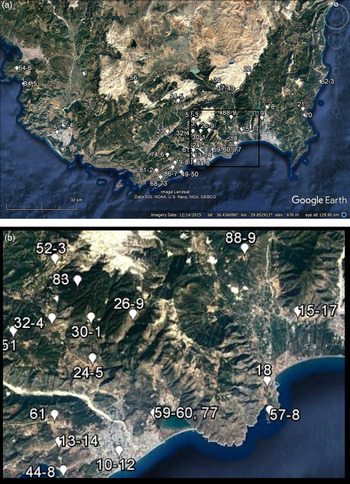
(a) Map of Lycia showing church location; (b) close-up showing south-central Lycia (Google Earth v. 7.1.8.3036; imagery date: 1/6/13).


The Late Antique churches
There are at least 85 known churches in Lycia (Fig. 22), and Foss has suggested that there may be more in the Late Antique settlements that surround the area of Cyaneae (Foss Reference Foss1994). Thus far, the Lycian evidence indicates that other than Xanthos, the earliest churches constructed were the Triconch at Andriake and the baptistery church on Kekova island, both dating to the fifth century (Harrison Reference Harrison and Young2001 and Foss Reference Foss1994, 12 respectively). There may be a fifth-century phase at the Alakilse monastery based on architectural fragments (Harrison Reference Harrison and Young2001). The basilica in the northern half of the Agora at Phaselis has been dated to the late fifth or early sixth century.
Where there are multiple churches in cities (such as Xanthos, Patara and Arif) it is possible that the earliest examples were constructed outside the city walls and that a move to the inside came in the later Christianisation phases. In the case of Xanthos, it is possible that the Basilica church located east of the acropolis and outside the city walls may have been the first to have been built in the fifth century. The other two were constructed in the Agora and on the Acropolis. The apse of the Agora church terminates in a triconch and there is a tetraconch attachment at the eastern end of the north aisle. At Patara, the City Basilica has been dated to the sixth century and the Spring Basilica, located in a Roman cemetery, may also be of a similar date; however, the dates of the Harbour Basilica and the Doğucasari Basilica are not well known, which makes it difficult to assess the evidence for any progression of church building. Seven churches were constructed at Arif; few, however, have been securely dated, although the city seems – to a degree – to have replaced Arycanda in the sixth century as the main settlement, although with little building any later than the seventh century (Harrison Reference Harrison and Young2001, 44). The multiple churches at Aperlae are distributed across the town. One of them is located in the upper city, another by the main gate to the upper city, another at the head of the bay, and two churches beside the sea (Hohlfelder Reference Hohlfelder2005, 1). While firm chronologies are lacking, it would be tempting to suggest that the harbour churches were the earliest ones and were followed by that by the gate.
The lack of extensive excavation means that few Lycian churches have been securely dated. However, Harrison defined a relative chronology for some, suggesting that Alakilise and Muskar should be earlier than those of Karabel, Devekuyusu and Alacahisar (Harrison Reference Harrison1963, 150 n. 164).
Topography and church location
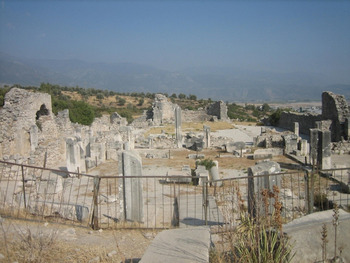
As with parts of Crete, the dramatic mountains of Lycia are such that the fertile plains are primarily between the coast and the mountain foothills. In some areas the plains are widespread, for example around Letoon and Xanthos or east of Myra (Fig. 22), while in other areas they are severely limited, for example around Aperlae or Antiphellos. Most areas could be self-sufficient through agricultural produce, sometime producing enough for export. However, Lycia in the Roman and Late Antique periods owed its success chiefly to the existence of first-rate harbours (particularly at Andriake) (Foss Reference Foss1994, 19). Many of the major settlements were located in the coastal plains around Andriake-Myra (Fig. 22), Phoenix-Limyra, Antiphellos (Kaş) and Patara-Xanthos (Fig. 23); and these areas also contained the majority of churches, although a few large inland towns such as Rhodiapolis and Arycanda also had concentrations of churches (Figs 24, 25). In these cases, it is notable that both cities lie along major river valleys (Fig. 22), making them relatively accessible, unlike other urban settlements in the mountains of Lycia. Churches have also been identified at small settlements, e.g. Keslik and Karkabo (Foss Reference Foss1994, 29 and 37). In some examples, such as Keslik where a number of oil presses have been discovered, it is often difficult to define whether the small settlements grew up as a consequence of the church's presence, or whether the church was constructed because of a pre-existing population (Foss Reference Foss1994, 37). The churches of Alakilise (fifth), Dikmen (sixth) and Turant Dağ (n.d.) are associated with Karkabo and it is likely that the village developed alongside the popularity of the surrounding churches (Foss Reference Foss1994, 28–9). It is also likely that the small clusters of settlements in areas around Alakilise coexisted with the continuously thriving coastal towns (Foss Reference Foss1994, 29). Aperlae was a small coastal settlement but with at least five churches; Hohlfelder (Reference Hohlfelder2005, 2) suggested that such a concentration might reflect levels of prosperity, piety and competition with neighbouring cities. It is tempting to suggest it was a pilgrimage centre. Although Aperlae flourished, it was not easily accessible by land and had notoriously poor weather for sailing all year round (Hohlfelder Reference Hohlfelder2005, 2). Foss suggested that Cyaneae, a city with a number of small settlements or farms in its vicinity, was poorly connected (Foss Reference Foss1994, 20); here, though, at least three basilicas (sixth century) have been identified, one of which is likely to have been constructed on a martyr's tomb in the necropolis of the city (c.500) (Foss Reference Foss1994, 21). Although the city was located close to a route between Antiphellos and Sura, the presence of a martyr may help to explain the reason for the relatively high number of churches in spite of its poor connections (Fig. 22). The arguments posited by Foss and Harrison, for interdependence on trade capabilities and agricultural produce between coastal and inland towns respectively, are unlikely to be tenable for all cities (for example Aperlae) (Foss Reference Foss1994, 20 and Harrison Reference Harrison and Young2001, 15–24). Furthermore, along the coast in Cilicia, such a two-way relationship is not always seen; some of the rural settlements in Cilicia had to be self-sufficient and could not necessarily survive even with a relationship with nearby coastal cities (Blanton Reference Blanton2000, 74–7). Extra-urban churches and monasteries are situated in places such as Alacahiscar (sixth or later), Çağman (later than sixth), Karabel and Dikmen (sixth), and appear to have thrived. While Late Antique monasteries are difficult to identify precisely because of the lack of formulaic architecture (Deligiannakis Reference Deligiannakis2016), it seems that there were a number of monasteries in Lycia, particularly in the interior, which differentiates it from the Peloponnese, Crete and (to a degree) Cyprus.
Xanthos: Agora Church from west.

Rhodiapolis.

Relationship between churches and earlier cult
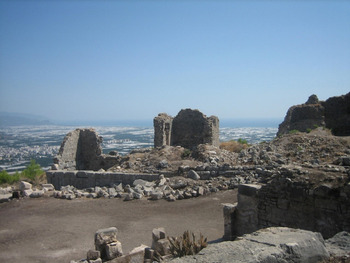
There is mixed evidence for the presence of Christian churches on pre-Christian cult sites. It is suggested by the excavators that the church at Arycanda (late fifth/early sixth) is constructed on a sanctuary, speculatively identified as dedicated to Apollo, Artemis or Leto with a later conversion to an imperial cult temple (Fig. 25) (Bayburtluoğlu Reference Bayburtluoğlu2005, 77–8). While there are reused architectural fragments in the Basilica, evidence for the existence of an earlier structure directly below the church has not been forthcoming. Foss noted that one of the churches at Sura (sixth) replaced a temple of Apollo at the Lagoon, and the fifth-century cathedral at Limyra is constructed on the site of a destroyed temple (Foss Reference Foss1994, 26 and 38). Of the two churches at Tyberissos (n.d.), one seems to have been built over a Doric temple (Foss Reference Foss1994, 26 and 38). The church at Letoon (early sixth) was constructed, using some spolia, just to the south of the temples of Leto, Apollo and Artemis, obstructing views and direct access to the temples (Fig. 26). The centre temple may have been used for imperial cult, and the temple of Leto itself survived without significant destruction until the seventh century. Crosses were carved on the temple, but it is not clear at what point. Foss noted that Christianity ‘brought neglect, not abandonment to the site’ (Foss Reference Foss1994, 12). This is in keeping with the processes of a peaceful conversion where the older religious practices gradually become sidelined in favour of the new. As yet, in the Lycian material there is little archaeological evidence for destruction of cult to clear the way for the new churches.
Arycanda: nave and apse from west.

Letoon with Sanctuary of Leto in the foreground and church in the background from north.

Architectural form
Harrison suggested that the architecture of the Lycian churches reveals its connections with Egypt and Syria (Harrison Reference Harrison1963, 120). The triconch, popular in Egypt, is found quite often in the Lycian churches, for example Andriake (fifth) and Aperlae (n.d.) (Leadbetter Reference Leadbetter and Drake2006). Additionally, the church on the lower slopes of the acropolis at Limyra, with its attached triconch chapel, may have been a monastery (Foss Reference Foss1994, 37). Harrison (Reference Harrison1963, 150) wrote that the construction of triconch churches was a ‘bold initiative in Lycia’. To add to the three already mentioned, there are further examples at Karabel (early sixth century), Dikem (sixth), Devekuyusu (n.d.) and Alacahisar (sixth or later). In Lycia the use of triconches and tetraconches in other parts of the church is also found at Letoon (Fig. 26), Patara, Xanthos (Fig. 23) and Alakilise. Late Antique churches with domes have been identified in a number of locations in Lycia: at Myra (sixth) (Fig. 27), Dereağzi (sixth), Karabel (early sixth), Alachisar (sixth or later) and Ucagiz (n.d.). Domed basilicas are one of the most notable features of the Cilician churches, and they have been identified in five locations (Alakilise, East Church at Alahan, Tomb Church at Corycus, Domed Ambulatory Church at Daǧ Pazarɩ and the Cupola Church at Meryemlɩk), with a further possible two (Mahras Daǧɩ and Köşkerli) (Hill Reference Hill1996, 45). Although some scholars have drawn attention to the location of the domed basilicas in cemeteries and pilgrimage sites, such a small number cannot indicate a specific pattern here (Hill Reference Hill1996, 40).
Myra: bema.

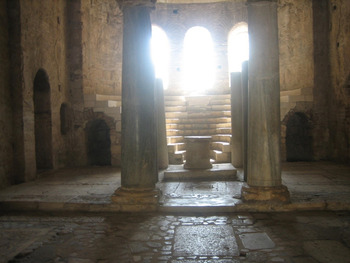
Many of the Lycian churches offer evidence for practices such as baptism, in spite of their limited excavation. The sixth-century church at Karazorza contains a baptistery in an annexe attached to the south aisle (Foss Reference Foss1994, 7). The baptistery is in a similar location in the Cydna Basilica, which dates to the first half of the sixth century. The Agora Basilica at Xanthus (fifth century) also had a baptistery connected to it. The church of Ag. Nikolaos at Myra (Fig. 27) is one of the few churches which has an associated martyr cult; this is supported by the evidence from the sixth century anonymous Vita of Nicholas of Sion, which describes visiting the church at Myra (Efthymiadis with Déroche Reference Efthymiadis, Déroche, Binggeli, Aïnalis and Efthymiadis2011, 69–70; Harrison Reference Harrison1963, 120). It has been suggested that the KMF Basilica in Crete with its triconch apse functioned as a martyrium church, but it is not clear if the same can be applied to all the triconch churches in Lycia (Sweetman Reference Sweetman2004, 340). Of those churches with a triconch as the main form for the central apse (Dikem, Alacahisar, Devekuyusu and Karabel), only the south annexe attached to Karabel contained a sarcophagus, but not enough excavation has been undertaken at Alacahisar, Devekuyusuor or Dikem to indicate comparable arrangements in those locations (Harrison Reference Harrison1963, fig. 11). Moreover, at Dikem, Harrison (Reference Harrison1963, 137) argued for the remains of a secondary chapel, so martyrial functions cannot be ruled out.
Internal Networks
Harrison (Reference Harrison and Young2001) noted the difficulties of moving from coast to interior in contrast with locations within the mountains. This emphasises the importance of the situation of churches along natural routes, such as river valleys, particularly to and from monasteries but also clearly between coastal and inland towns (for example from Limyra to Arycanda, Patara to Xanthos, Andriace to Gürses, which may also have continued on to Dereağzi) (Fig. 22). Regarding the two monasteries of Karabel (early sixth) and Alakalisie (fifth), these sites can be understood in terms of nodes of the communication network. From Muskar (which may have had a route from Andriace) both monasteries were along natural routes to the north-west (Karabel) and north-east (Alakilise). Harrison argued that the Late Antique settlement that prospered around Alakilise may have done so in part as an agricultural supplier to Myra (Harrison Reference Harrison and Young2001, 21). Not only were there a number of other churches within striking distance of the Karabel monastery (Karabel Town, Karabel Acropolis and Alacahisar), but it was also on a route that linked Dereağzi with Çağman (Fig. 22). From Çağman there was easy access to Dereağzi to the west and Karabol to the east. Both these locations were on routes to the coast, to Andriace and Phoenix respectively. The situation at Alakalisie is also quite similar in that a number of ‘satellite’ churches were constructed around the monastery: there was a chapel to the south-west, a church to the east and a rock-cut church to the north. The sixth-century triconch church at Dikmen also lay at the south-west end of the Alakalise valley (Harrison Reference Harrison1963, 130). When the extra-urban churches such as Çağman or Dikmen are examined in context, it is possible to see that they are not as isolated as they might first appear, and in fact in some cases they may be playing critical roles in the communication network. The irony of the location of the monasteries is that while they may have originally been intended to be isolated and difficult to reach, their very presence encouraged church building, making them far less remote. Harrison (Reference Harrison1963, 120) suggests that a growth in monastery construction in the mid-fifth century may have been linked to deeper tensions within the Church; that is to say, between those who believed in the dual nature of Christ and those who argued for a single entity. Harrison argues that monasteries in Lycia may have had more in common with the Egyptian and Syrian church, in part because of shared anti-Chalcedonian views; and perhaps the use of the triconch in places like Karabel (early sixth) and Phoenix (late fifth–sixth) may provide a further link to this. However, not all triconch churches have monastic functions (for example Dikmen [sixth] and Alacahisar [sixth]), and it is difficult to support the manifestation of such tensions in architectural design.Footnote 16
CHRISTIANISATION IN THE AEGEAN: CONCLUSIONS
Crete, Cyprus and Lycia all came under different ecclesiastical jurisdictions but, as indicated above, Christianisation processes concern location and topography as much as ecclesiastical or political affiliation. The choice of church location, be it on the coast, edge of town or sanctuary, on a mountain top or urban centre, is revealing in terms of conversion practices. While common policies may have been intended, their promulgation and interpretation means that a multitude of different Christianisation processes are possible even within the same province, as seen in the Peloponnese (province of Achaia) (Sweetman Reference Sweetman2015b). For other areas such as the Dodecanese (Deligiannakis Reference Deligiannakis2016, 38) and Cilicia (Bayliss Reference Bayliss2004, 116–18) scholars have stressed variability in the enforcement of imperial laws concerning, for example, treatment of temples, given that their implementation was dependent on a range of people (from the governor to the local clergy) and factors (from the topography to existing communities). It is difficult to assess the impact of laws too, in terms of the evidence available (such as epigraphic data) as well as how accurate the accounts were in the first place; as Caseau (Reference Caseau2004, 112–13) notes, the flagrant disregarding of the laws would not have been tolerated. Furthermore, Christian accounts of the process would have been concerned with noting ideas of pagan resistance in order to emphasise the victory of Christianity. As Deligiannikis (Reference Deligiannakis2016, 38) points out, however, those provinces which were under the Prefecture of Oriens should in theory have had some commonality in terms of a general framework of the enforcement of laws. The inclusion here of provinces from both Prefectures of Oriens and Illyricum thus makes for an enhanced analysis. The comparative study of church location, architecture, decor and function allows the differences in strategic Christianisation methods to be elucidated across a range of provinces. In turn, it provides a window on the roles of different communication networks in the eastern Mediterranean and the identification of the key protagonists, including craftspeople, pilgrims, merchants, local population and clergy of different ranks.
Location
The locations of churches in the Peloponnese are indicative of the different network connections that prompted their construction. The earliest examples are located in coastal areas and on the edge of busy sanctuaries in the fifth century; it is likely that they were constructed with significant elements of external input and strategic planning with intended outcomes, some possibly with an imperial origin (Sweetman Reference Sweetman2015b). The spread of churches to the edges of cities appears to be a result of local network connections and undertaken through sociological processes known as social movement (Sweetman Reference Sweetman2015b). The construction of churches in rural areas seems to have taken off later in the process. Caseau (Reference Caseau2004, 105–6) notes the irony of this given that, in some cases, rural pagan shrines were the first to decline.
On Crete, which was also in the Prefecture of Illyricum, the earliest churches were founded on the edges of major cities like Knossos and Gortyn regardless of their location. This implies that, in contrast to the Peloponnese, different kinds of network connections are in action; that the earliest church constructions were the unintended by-products of social movement, and were more likely to have been the result of local instigation than of imperial edict. The topography of the churches indicates that the Christianisation of Crete was less the result of strategic policy and more a result of unplanned circumstances. The same may be true of Lycia, where the earliest churches are found in major cities (both coastal and inland) such as Xanthos, Andriake and Kekova. In both cases, but particularly in Lycia, internal routes are highlighted through church location; and some churches may even have functioned as satellite churches. While more work may provide earlier data, it is surprising that some highly networked cities such as Patara or Myra, which was the seat of a bishop, do not yet have evidence for churches earlier than the sixth century.
A different pattern is seen in Cyprus, where remarkably few non-urban and inland church foundations have been identified. Coastal locations and towns such as Salamis, Kourion, Paphos and Amathous were the first to have Christian churches established. At least some of the Cypriot foundations would have had their origins in strategic initiatives aimed at exploiting their location on the pilgrimage routes. Other factors played a role too: for example, the rich copper resources of Cyprus would have attracted a wide network of trade links furthering the multifarious contacts the island had. There is a wide variation in church architecture in Cyprus which might reflect its multiple communication links.
As seen in all areas, the earliest churches in Cyprus were constructed in highly visible settings and in Kourion and Paphos: the first churches occupy harbour locations. Although there was an exception (Salamis), it seems to have been the rule that only once churches were well established in the suburbs were they constructed in the town centres. This is also clearly the case for the Peloponnese, Crete and Lycia, although in the latter case the absence of chronological data makes it difficult to prove. It is worth noting that this pattern in urban spread is not applicable to all provinces. For example, in Thessalian Thebes the earliest churches appear in the urban centre, with later churches on the periphery. In Cilicia, the Necropolis Church in Anazarbus is dated to the sixth century, while the Church of the Apostles in the centre appears to date to the fifth century (Hill Reference Hill1996, 85–90). In contrast, at Anemurium, the fourth-century Necropolis Church on the edge of town is earlier than the other three churches there (Hill Reference Hill1996, 91).
The majority of temple conversions in the Peloponnese, Cyprus, Lycia and Crete occur only after churches have been in regular use already. Churches were located outside the sanctuary space at the temples of Asklepius at Lebena and at Lissos on Crete. Churches were constructed at Lycian sanctuaries at Letoon (sixth century), Tyberissos and Limyra (fifth century); in these cases, even where sanctuary space was occupied, church construction did not directly impinge on functioning polytheistic temples. Similarly, in Cyprus the occupation of sanctuary space occurs only after it had already been out of use for a sustained period of time: this was the case in the church constructions at the sanctuaries of Aphrodite at Amathous and at Paphos. In contrast, it seems to have been the case that there were at least some Cilician temples that were converted to churches and became the first church construction in a town, for example the temple of Zeus at Diocaesarea. It is worth noting that in other cases there is a gap between the temple going out of use and the construction of the church, such as the Clifftop Church at the Corycian Cave.Footnote 17 Furthermore, Cilican churches have notoriously insecure chronologies (Elton Reference Elton2007).
Architecture
Traditional approaches to revealing communication links in the Late Antique period have often focused on evidence of shared architectural traditions. Even though Krautheimer (Reference Krautheimer, Krautheimer and Curcic1986, 108) stressed that a tradition of contact, such as trade or pilgrimage, did not result in shared architectural practices, he did identify local schools of architecture in his survey of churches. Furthermore, he assessed the impact of neighbouring provinces’ traditions on local ones, as well as defining styles such as that of the Aegean coastlands and the Constantinopolitan; showing that one cannot completely disregard evidence of shared architectural elements, particularly when they are unique (Krautheimer Reference Krautheimer, Krautheimer and Curcic1986, 108, 110). It is more widely accepted that choice of architectural form is likely to reflect liturgical practice, local needs and individual choices of bishops and patrons (Hill Reference Hill1996, 24 and 43; Bowden, W. Reference Bowden, Livadiotti and Simiakaki2004, 796; Maguire Reference Maguire2012). However, this does not necessarily negate the possibility of network connections through craftspeople. For example, a specific architectural form may have been spread by architects who developed a particular tradition, originally in response to local topography or availability of material, such as domes in Cilicia (Hill Reference Hill1996, 42).
The Peloponnesian churches are quite conservative in comparison to those in Crete, Cyprus and Lycia. The majority of the Late Antique churches of Crete are triple-aisled, single-apsed, examples with nartheces; they bear a wide variety of features, such as the triconch apse, tripartite transepts and apses in the nave (Itanos Basilica A). Furthermore, the arrangement of doors, location of ambos and other such features provide further diversity (Bowden, W. Reference Bowden, Livadiotti and Simiakaki2004, 795). The triconch apse is a form more commonly found in Egypt, Lycia, Syria and Palestine in the fifth and early sixth centuries (Harrison Reference Harrison1963, 148–9). Indeed, the KMF Basilica has been compared to the White Monastery (Deir-el-Abiad) in Egypt, which is dated slightly later in the fifth century than the Cretan church (Sweetman Reference Sweetman2004, 340). It has been suggested also that the inspiration for the trefoil sanctuary may have come from Italy: one example is the precinct of St Felix Cimitile Nola, which was founded in the fourth century but was renovated to a trefoil basilica form in 401/2 ce (Krautheimer Reference Krautheimer, Krautheimer and Curcic1986, 196). The presence of the triconch churches such as Dikmen and Karabel in Lycia can be explained as a result of Egyptian trade contacts (Foss Reference Foss1994, 48). In the Lycian context, when used in monasteries, it may indicate connections with the monophysitic tradition. In other contexts, and particularly in Crete, it may well indicate a martyrium church (Sweetman Reference Sweetman2004, 340–2).
In some churches such as Panormos, Kolythia and Almyrida, the diakonikon and prothesis project outwards beyond the width of the north and south aisles, forming a tripartite transept. Bowden notes that, traditionally, tripartite transepts are prevalent in the Ionian and Adriatic areas (Bowden, W. Reference Bowden, Livadiotti and Simiakaki2004, 790). In addition to the two Lycian examples (Tlos and Patara) (Urano [2013]), there are a number of examples in Cilicia, including the Transept Church at Corycus and other possible candidates in the Church of the Apostles, Anavarza, Church 4, Kanlɩdivane and the Basilica of St Thecla, Meryemlɩk (Hill Reference Hill1996, 43 and 40). In all of these cases, the transept wings do not extend beyond the line of the north and south aisles as they do in Crete. Whether the architectural variety is indicative of the liturgical practice (as Krautheimer suggests specifically for Cilicia: Krautheimer Reference Krautheimer, Krautheimer and Curcic1986, 108), the dictates of the bishop, or fashion, the variety reflects the somewhat cosmopolitan nature of Crete in the Late Antique period, as indeed is echoed in the Late Antique mosaics too (Sweetman Reference Sweetman2013, 135–6, 147).
The churches of Cyprus exhibit interesting variations on the triple-aisled basilica plan. Triapsidal forms are most common (for example, Amathous and Aphendrika), a feature that is generally found later in the sixth century in the Peloponnese, where it is associated with domes (for example the Sparta Acropolis Basilica and Tigani, Mani). The early dates of the domed basilica form in Cilicia and Isauria indicate that this province may be the original source (for example the East Church, Alahan and the Cupola Church, Meryemlik, constructed in the fifth century) (Hill Reference Hill1996, 27). The architectural form may have spread westwards through the movement of craftspeople in the sixth century. Five domed churches have been identified in Lycia, and where dates have been established they are later (for example St Nicolas, Myra and Alacahisar, constructed in the sixth century). Evidence for domed churches in Cyprus occurs later than in any of the provinces under discussion, with the earliest being the seventh-century example of the reconstructed Ag. Epiphanios in Salamis. In Crete, Ag. Titos (sixth century) was domed. The three likely Peloponnese examples, Acropolis Basilica in Sparta, Ag. Sofia, Korone and Tigani in the Mani date to the sixth century (Sweetman and Katsara Reference Sweetman and Katsara2002). Given the lack of other architectural connections between the Peloponnese and Cilicia or even Lycia, it is quite likely that there were few direct links between these areas, though there may have been links via Crete or elsewhere.
A key feature of the Cypriot churches is the common addition of annexes attached to the side aisles as well as eastern extensions (for example the Southwest Basilica, Amathous and Kalavassos). Similar examples are found in the Peloponnese (Molaoi Basilica A [Lakonia]) and Crete (Chersonisos Basilica A): see Fig. 12. Eastern courts (Campanopetra, Salamis) and ambulatory passages (Kourion Episcopal Basilica) are also found, reminiscent of the Cilician trend (such as St Thecla, Meryemlik, Anavarza and Alahan). Hill (Reference Hill1996, 69) suggests that Alahan was originally a pilgrimage site before becoming a monastery. It is possible they may have been used for peripatetic elements of services, which were sometimes associated with martyria and pilgrimage (Hill Reference Hill1996, 31–3). The evidence for martyria in the Cypriot churches has been identified on the basis of partitioned apsidioles and/or mensa martyria (Maguire Reference Maguire2012, Gazetteer, 75). While some of the annexes functioned as baptisteries, others may well have been used as accommodation for pilgrims; together with the evidence for the martyria and the location of Cyprus on the pilgrimage route, this makes good sense. Other than the prevalence of monasteries, key features of some Lycian churches include the presence of a triconch, integrated or in an attached annexe, which as discussed above may have martyrial functions.
Crete (and to a slightly lesser degree Lycia) is notable for the variety of architectural forms in the Late Antique churches found there. The churches of Crete demonstrate links with the east and west Mediterranean, and arguably the island was a conduit for new trends in architecture (Sweetman Reference Sweetman2004, 353). This kind of variety, regardless of who made the choice for the building type, owes a great deal to network connections through trade. The clear evidence for workshop connections between the mosaics of Crete, Gytheio, Elis, Eresos, Sardis and Constantinople reveals the impact that craftspeople could have on the creation of network connections and spread of ideas (Sweetman Reference Sweetman2013, 133–6). The architecture and interior decor also reveal a more organic process of conversion, probably instigated at local level. The variety of church architecture found on Cyprus is not quite as significant as that of Crete but the coastal concentration, along with the high number of martyrial sites, indicates something of a planned process of church construction and one, given the political nature of Cyprus, which mainly came from local impetus.
Networks
In Crete, Cyprus and Lycia, the earliest churches are found in network hubs irrespective of the immediacy of the location to visitors. Moreover, the hubs differ in terms of their functions: in Crete and Lycia these are towns with economic, political and administrative functions; in Cyprus they are places connected with Christian pilgrimage, trade and control of resources. In contrast, hubs at this time in the Peloponnese are the Panhellenic sanctuaries (as well as ports). In choice of church location, visibility was critical, be it on the coast or on key routes, by gathering-points such as sanctuaries, or on mountain tops allowing long views.
The concentration of church building on the coast and the relative scarcity of churches in rural regions indicates a focus on external connections for Cyprus. There is little evidence for church location on internal routes as seen in Crete and Lycia. It may also be significant that Cyprus, unlike the Peloponnese, did not have a long-standing tradition of rural cult (Mitford Reference Mitford1990). Mitford notes cults in the 12 Roman cities of Cyprus, and although the inland city of Tamassus is included, even here there is as yet little evidence for cult. It is worth stressing what Maguire has already noted, that although the island lay on well-traversed trade routes, different ports may have had a range of contacts depending on the season and over long periods of time too (Maguire Reference Maguire2012, 40–1). Moreover, Cyprus' location on the pilgrimage route and in an intensively networked location is reflected in the numbers of martyria and other pilgrimage sites identified there. The early dates of the churches as well as their variety and their unusual architectural forms may also be explained by reference to their networked locations, situated on the sea route between Constantinople and the Holy Land. Many of the west–east routes would also have used the southern part of Cyprus as a stopping-off point too (for example, from Corinth to Jerusalem). Pilgrimage was lucrative for the local community, through trade at the sites in souvenirs, as well as in attracting external trade (Bowersock, Brown and Grabar Reference Bowersock, Brown and Grabar1999, 644).
Harrison suggested that the coastal cities of Lycia were more receptive to Christianity because they were already familiar with new and external ideas, particularly through trade with Syria and Egypt (Harrison Reference Harrison1963, 119). It may be the case that some coastal examples (such as Kök Buruni, which included a triconch chapel [n.d.]) were constructed deliberately in a highly visible location to capture the attention of arriving seafarers as well as of the resident population. However, as is the case in Crete, it was not necessarily the coastal cities of Lycia which saw the first churches, but large cities, regardless of location. In contrast to Patterson's (Reference Patterson, Rich and Wallace-Hadrill1992, 151) argument, it is likely that there were some good network connections to the interior; they were marked by the location of churches such as those discussed above, from Andriake to Myra and north-west to Dereağzi or north-east to Muskar and Alakilise. The number of churches and monasteries occupying rural and less accessible space in Lycia, such as Karabel and Muskar, is striking, particularly in comparison to Crete and Cyprus. The monasteries themselves may have functioned as network hubs on routes, with smaller churches and sometimes communities growing up around them. Thus far only one possible monastery has been identified in the Peloponnese (Baths A at Argos: Oikonomou-Laniado Reference Oikonomou-Laniado2003, 21); and as yet there have been no firm identifications on Crete, although a later-period monastery (seventh century) was established on the location of the earlier so-called Praetorium at Gortyn (Zavagno Reference Zavagno2009, 89). In Cyprus there are physical remains indicative of monasteries at Chiliantis, Souni (sixth–seventh) and possibly at Ag. Varnava west of Salamis (late fifth) (Maguire Reference Maguire2012).
Networks and Christianisation
The evidence from the Peloponnese indicates that the impetus for the construction of the earliest churches began in scale-free hubs like the sanctuaries and large ports of the north- east. The links between these hubs and the rest of the Peloponnese, however, were based on small-world (local) networks. This is in contrast to Cyprus, located on a range of important religious (from Constantinople to Jerusalem) and trading routes across the Mediterranean, which made it accessible and cosmopolitan. It may be that the role of Cyprus in the scale-free network eclipsed any potential for small-world networks to develop within the island.
While Crete clearly lay on important trade routes, it did not have such easy access to the religious traffic as Cyprus had (Sweetman Reference Sweetman2013, 10). This is partly reflected in the slightly later construction of churches on Crete; there is a similar situation in Lycia. Whereas Harrison (Reference Harrison1963, 119) wrote that Lycia was ‘as receptive to the new religion as were other, better documented parts of Asia Minor’, Mitchell (Reference Mitchell1993, 138) argued that the small number of Lycian representatives in the fourth-century ecumenical councils was due to a relatively late Christian presence in Lycia. Moreover, it is difficult to detect a Christian presence on the basis of evidence from the ecumenical council: from the fourth century there was a steady presence of Cretan and Peloponnesian representatives at the ecumenical councils but little archaeological data to identify them (Sweetman Reference Sweetman2015b). In the fourth century Gortyn was confirmed as a bishopric at the first ecumenical council, and there were three bishops at the Council of Sardis in 343 (Sanders, I.F. Reference Sanders1982, 45).
In Crete and Lycia there is a reasonably even distribution of early churches in coastal and inland locations. Additionally, a number of churches were constructed on routes of communication, suggesting an emphasis on internal or small-world networks. The number of monasteries in Lycia and Cilicia may reflect particular views of the local clergy (Harrison Reference Harrison1963, 120). Furthermore, the lack of Late Antique rural villas in Cilicia may indicate that monasteries became part of the Christianisation process: they may have functioned as network hubs in place of existing rural shrines (Blanton Reference Blanton2000, 72). If this is the case, it is arguable that the slower rate of church building in the Peloponnese may be explicable in part by reference to the small number of internal hubs (such as monasteries). In the case of Crete, a lack of monasteries may not have been so impactful given the small size of the island and the fact that some of the hubs such as Gortyn, Eleutherna and Knossos were located inland and had early church constructions. In Cyprus, the focus upon external networks meant that the lack of rural cult was insignificant and there was no need to network the rural spaces. The study of these areas shows the variation in speed and date of transformation to Christianity and diversity of processes within and between the provinces. This is seen in other areas, such as Spain, where the Christianisation of rural space occurred more rapidly than the urban (Kulikowski Reference Kulikowski2004, 215–16); in contrast, Bar (Reference Bar, Hahn, Emmel and Getter2008, 286) argued that Christianisation in the towns of Palestine was intensive and vigorous, whereas it was much slower in the villages. He suggested the countryside was of less interest to the Christians than urban space. While this may be true of Cyprus, it was not necessarily the case in the Peloponnese.
The political and religious affiliation of the regions discussed here does not seem to have resulted in processes of Christianisation which took place in accordance with official structures. For example, by using the current chronological and topographic data, the spread of church building in Crete appears to be much more akin to that of Lycia than Achaia. Instead, with some tangible exceptions (such as Lechaion in the Peloponnese or the Metropolis Basilica, Gortyn), many churches were constructed on the basis of local initiative rather than imperial behest. Furthermore, as can be see through the topographic comparisons, while the topography and location of a region may enable network connections (Crete and Cyprus), such advantages need to be acted upon or they become redundant. It is equally the case that network connections can be made and encouraged even in unlikely topographic circumstances (inland Lycia) as long as the desire, means and other mitigating factors (such as the presence of resources) are present.
Saradi and Eliopoulos (Reference Saradi, Eliopoulos, Lavan and Mulryan2011, 263) argue that the delayed Christianisation of the Peloponnese is partly a consequence of its limited network connections. Confirmation of this can now be seen on the basis of comparative analysis of church architecture and topography in Crete, Lycia and Cyprus, where network connections are numerous and varied. Regardless of the timing of the process, religious conversion in all these areas appears to have been largely peaceful, with little evidence for rampant temple destruction. This is similarly the case for Anatolia, Egypt, Palestine, North Africa and Spain.Footnote 18 In these provinces, temple conversion seems largely to have occurred after church building had already been well established: for example, in Spain the earliest church buildings were located in extramural spaces with later church building in the urban centres undertaken in the early sixth century (Kulikowski Reference Kulikowski2004, 215–16).
While Christianisation on a personal scale, as evidenced through rites such as baptismFootnote 19 and burial, and the mobility of the elite, lie beyond the scope of the present undertaking, further exploration would certainly add significantly to the wider debate. In many of the provinces of the eastern Mediterranean, raids by the Arabs had varying degrees of impact on church building and survival; it would be worthwhile examining the diversity of continuity and change in the religious landscape of these areas in the seventh and eighth centuries. The evidence of church topography and architecture in the areas of Crete, Cyprus and Lycia in contrast to the Peloponnese reveals the significance of networks in the Christianisation processes. Even from a brief analysis it is clear that being on any kind of network is important in terms of the conversion processes. Being situated on multiple types of network (such as trade, pilgrimage or craftspeople) had a variety of results in terms of church location and architecture.Footnote 20 The vibrancy of church building in Crete, Cyprus and Lycia over three centuries is somewhat in contrast to that of the Peloponnese, where a slow but methodical start was made in church building; while the spread of churches marks a steady Christianisation, the rather harmonised architecture reflects the limited network connections the region had in the Late Antique period.
ACKNOWLEDGEMENTS
This project was undertaken during a year of research leave funded by the AHRC and a RSE Caledonian Research Fund European Visiting Research Fellowship. The fieldwork for this research was made possible thanks to generous grants by the Carnegie Trust for Universities of Scotland and the School of Classics, University of St Andrews. Brad, Conor and Aidan continue to be willing and happy fieldwork assistants and I am very grateful to them. Saarthak Singh undertook some valuable data processing of the Cypriot material, and I would particularly like to thank Richard Maguire for sending me a copy of his unpublished PhD thesis. The anonymous reviewers provided beneficial advice on earlier drafts of this work which I have very much appreciated.
APPENDIX
Late Antique Churches of Crete.