


When does self-interest motivate people’s opinions on public policy? Much of political science has downplayed the role of self-interest in the formation of public opinion (Kinder and Kiewiet Reference Kinder and Kiewiet1981; Sears and Funk Reference Sears and Funk1991). Especially when it comes to economic self-interest, people often form opinions counter to what political scientists assume would be their rational, self-interested preferences (e.g., Campbell et al. Reference Campbell, Converse, Miller and Stokes1960; Gelman Reference Gelman2008). Instead, researchers note the primacy of partisanship and ideology in public opinion (e.g., Green, Palmquist, and Schickler Reference Green, Palmquist and Schickler2002).
The deepening opioid overdose crisis presents a policy challenge in which self-interest may be especially strong. Each day, nearly 200 Americans die from a drug overdose, making overdose the leading cause of death for Americans under age 55 (Katz and Sanger-Katz Reference Katz and Sanger-Katz2018). Despite the acuity of this crisis, policymakers have faced difficulty in appropriating and allocating the funding public health experts believe is necessary to combat the epidemic (Saloner and Barry Reference Saloner and Barry2018).
Part of this shortfall may stem from variation in need for these policies. Currently, many high-need communities bear a disproportionate share of the financial burden in responding to the crisis.Footnote 1 Municipal and county governments often must cover the increased costs of emergency call volumes, ambulance services, medical examiner and coroner bills, overcrowded jails, and care services for those struggling with addiction (Seligson and Reid Reference Seligson and Reid2017). Moreover, people often fear that the construction of addiction treatment infrastructure will deteriorate public safety, decrease property values, and diminish overall quality of life (e.g., Banker Reference Banker2017). Through these intense forces of financial and spatial self-interest, the opioid crisis provides an opportunity to test when self-interest motivates policy preferences. Furthermore, the crisis affects not only urban areas, but also rural, whiter, less wealthy, and more conservative parts of the United States in a way that previous drug crises have not (Jalal et al. Reference Jalal, Buchanich, Roberts, Balmert, Zhang and Burke2018). This political geography provides new ground for understanding theories of self-interest across political, demographic, and geographic spectrums where these forces may cross-pressure members of the public.
Using a nationally representative survey and an embedded experiment, we test support for policies to address the opioid crisis, specifically the funding of treatment and the construction of new treatment clinics. In our experiment, we vary the location of a proposed clinic to test the influence of a respondents’ spatial self-interest on public opinion. Overall, we find that treatment policy funded redistributively is more popular than policy funded based on a community’s local overdose burden, as current financial burdens are de facto allocated. Under both funding models, people support policies less if they will pay more to fund the policy, demonstrating the influence of financial self-interest. Leveraging the geographic breadth of our survey sample, we also test how self-interest and partisan predispositions cross-pressure voters. While Republicans are less supportive of treatment policies than Democrats overall, financial self-interest cross-pressures lower-income Republicans, leading them to form opinions more in line with partisans across the aisle than they would otherwise. Additionally, we show that the physical proximity of treatment infrastructure activates spatial self-interest: people across the political spectrum oppose clinic construction more when it is proposed closer to their home. Together, these results demonstrate the power of self-interest and its ability to cross-pressure voters on an especially severe policy challenge with concentrated burdens.
THEORETICAL EXPECTATIONS
Research on “policy feedback” has shown that direct policy benefits from social programs—such as Medicare and the GI bill—may galvanize constituencies to protect those policies (e.g., Campbell Reference Campbell2005; Mettler Reference Mettler2005). Similarly, direct policy costs may provoke opposition due to financial self-interest, such as wealthy homeowners opposing high property taxes (Sears and Citrin Reference Sears and Citrin1982). Such costs may be not only financial, but also spatial, provoking self-interest typified by NIMBY (“Not In My Backyard”) opposition (e.g., Hankinson Reference Hankinson2018; Stokes Reference Stokes2016). Public policy to confront the opioid crisis may activate an especially powerful sense of self-interest because of the policies’ concentrated burdens. Specifically, self-interest may motivate people to support policies in which they will pay less relative to policies where they will pay more, and support treatment infrastructure less when it is closer to them rather than far.
However, partisan polarization may limit the influence of self-interest. Preferences for drug treatment policy—as with many other policies—have historically cleaved along partisan lines: Democrats have ordinarily been more supportive of treatment programs than Republicans (Meier Reference Meier1994). At national, state, and local levels, evidence abounds that partisanship shapes policy outputs (Caughey, Warshaw, and Xu Reference Caughey, Warshaw and Xu2017; de Benedictis-Kessner and Warshaw Reference de Benedictis-Kessner and Warshaw2016). Growing polarization among elites and the nationalization of politics may reinforce the degree to which this partisanship affects public opinion (Druckman, Peterson, and Slothuus Reference Druckman, Peterson and Slothuus2013; Hopkins Reference Hopkins2018). Yet in some policy areas, partisan polarization has led to few policy differences (Anzia and Moe Reference Anzia and Moe2017; Grumbach Reference Grumbach2018). Especially in the area of health policy, personal experiences and self-interest may attenuate the role of partisanship (Campbell Reference Campbell, Wailoo, Cohen, Zelizer and Colby2015; Lerman and McCabe Reference Lerman and McCabe2017).
Because of the geography of the opioid crisis, the communities most affected by today’s crisis—those who are also currently paying the cost of treatment policy—are much more likely to be conservative than in past drug crises. Therefore, the voters whose self-interest—based on their income, context, and location—might influence their policy preferences may also have differing partisan predispositions toward health policy. In other words, voters may be cross-pressured (Chong, Citrin, and Conley Reference Chong, Citrin and Conley2001; Klar Reference Klar2013) by their partisanship and self-interest in the formation of policy preferences concerning the opioid crisis. We expect that financial and spatial self-interest may influence individuals to form opinions that decrease attitudinal polarization between parties.
RESEARCH DESIGN AND DATA
To test these theoretical questions, we surveyed a representative sample of 2,000 United States residents in 2018.Footnote 2 In this survey, we asked respondents their support for a policy funding opioid treatment and a policy that would open a new treatment clinic nearby. We measured support for each using a five-point scale from “strongly support” to “strongly oppose.”Footnote 3
The first policy proposal involved a $100 million state bill funding medication-assisted opioid addiction treatment. Using a split-sample design, we described a funding model designed in one of two ways that varied the allocation of the policy’s financial burden.Footnote 4 In the first of the two split-sample options, the income-based option, we describe the policy as funded redistributively, with those people who have a household income higher than their state’s median income paying more than those with a lower household income. In the second split-sample option, the overdose rate-based option, we describe the policy as funded instead according to a community’s overdose rate, with those living in areas with a higher opioid overdose rate relative to their state’s median rate paying more than those in areas with a lower overdose rate.Footnote 5 This second option—allocating financial burden based on the local overdose burden—matches the costs of treatment to those who would benefit from the funding, a framework championed for other policies with spatially concentrated benefits (e.g., Mullin, Smith, and McNamara Reference Mullin, Smith and McNamara2019). Furthermore, this design of policy matches the status quo, in which cities and counties with high rates of opioid use have few outside resources to which they can turn and must shoulder the financial burden for these policies.Footnote 6 In short, our first policy option allocates costs redistributively while the second option mirrors the status quo, allocating financial costs according to need.
The second policy proposal involved the construction of a new opioid treatment clinic. We experimentally varied the clinic’s proposed location to manipulate its spatial cost and therefore assess the causal effect of respondents’ spatial self-interest. We described the proposed location as either two miles away (a 40-minute walk), in the far treatment condition, or 1/4 mile away (a 5-minute walk), in the near treatment condition, from the respondent’s home. The difference in average levels of support for the treatment clinic between the two experimental conditions represents the treatment effect of the proximity of policy infrastructure.
To assess moderators of self-interest, we measured respondent exposure to the opioid crisis, as contact with societal ills may affect political participation and policy attitudes (e.g., Bateson Reference Bateson2012). First, we asked if respondents personally knew anyone who had been addicted to opioids, including heroin and prescription pain killers. Second, we measured respondents’ contextual exposure to overdose deaths by connecting their ZIP code to county-level data on opioid death rates in 2015 from the National Vital Statistics System (NVSS) provided by the Centers for Disease Control’s National Center for Health Statistics. Finally, we recorded respondents’ self-reported partisan identification, ideology, income, and ZIP code.
RESULTS
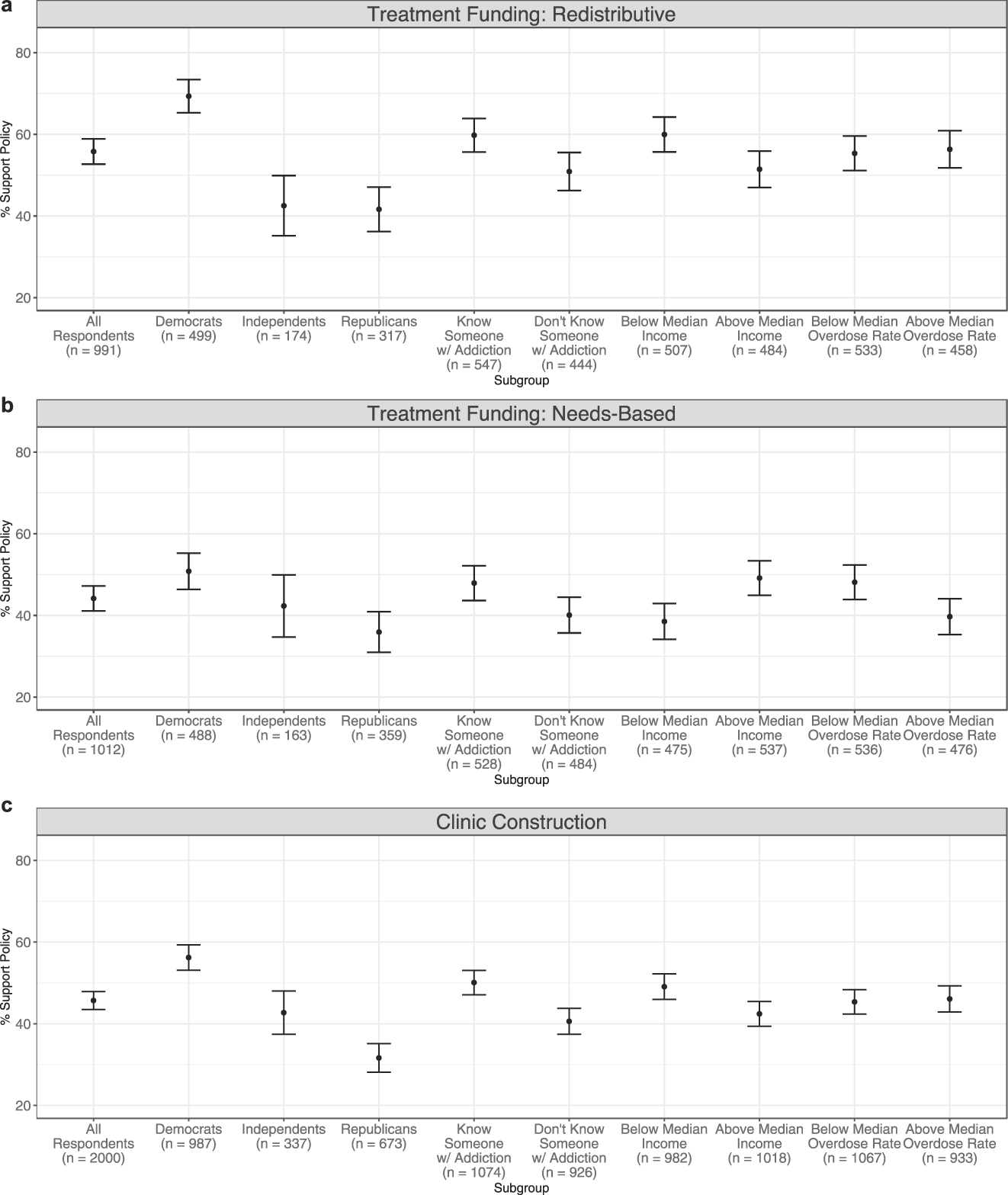
We first assess how respondents’ characteristics determine support for opioid treatment policy, separating the two split-sample funding-allocation options for the first policy proposal and aggregating both experimental treatment groups for our second policy proposal. These descriptive results are presented in the three panels of Figure 1, with the percent of respondents supporting each policy on the vertical axis and subgroups by respondents’ characteristics along the horizontal axis. Overall, 56% supported the redistributive treatment funding proposal, while 44% supported the needs-based funding proposal and 46% supported the construction of a new opioid treatment clinic in their community. This preference for the redistributive over the needs-based funding model for treatment funding extends across all subgroups of respondents.
Policy Support With 95% Confidence Intervals Among Respondent Subgroups

As with most social policies, partisanship and ideology divide public opinion on all three opioid treatment policy options. Republican respondents were 28 percentage points less likely to support the policy proposal with a redistributive funding model for addiction treatment, 15 percentage points less likely to support the needs-based proposal, and 25 percentage points less likely to support the construction of a treatment clinic than Democratic respondents.Footnote 7
Personal exposure to the opioid crisis also affected people’s support for these policies. Fifty-four percent of our sample reported personally knowing someone who had struggled with opioid addiction. Respondents who reported knowing someone who has been addicted to opioids were on average nine percentage points more supportive of each of the three policies than those who did not know someone with addiction issues.Footnote 8 Income and community exposure to the opioid crisis also influence policy preferences, which we explore in detail in the next section.
FINANCIAL SELF-INTEREST
We next assess the role of self-interest in support for our first policy proposal, the state bill funding opioid treatment. In both funding models, we operationalize financial self-interest as the difference in support between those who would pay more and those who would pay less. For those who viewed the proposal funded redistributively, this means the difference in support between above-median income respondents, who would pay $55, and below-median income respondents, who would pay $5. In the overdose rate-based funding model, we operationalize self-interest as the difference in support between those who live in areas with higher rates of overdose and those in areas with lower rates of overdose.
To capture the relative importance of self-interest, we measured the difference in support for each funding condition across the dimension determining self-interest and present these results in Figure 2, with raw differences plotted as circles and covariate-adjusted model coefficients as triangles.Footnote 9 For the redistributive funding model, on the left, higher-income respondents were nine percentage points less supportive of the policy than lower-income respondents. Similar results hold for the needs-based funding model, shown on the right. Respondents living in high-overdose areas were eight percentage points less in favor of needs-based treatment funding than those in low-overdose areas.Footnote 10
Effect of Self-Interest on Policy Support Across Both Funding Models With 95% (Thin Lines) and 90% (Thick Lines) Confidence Intervals

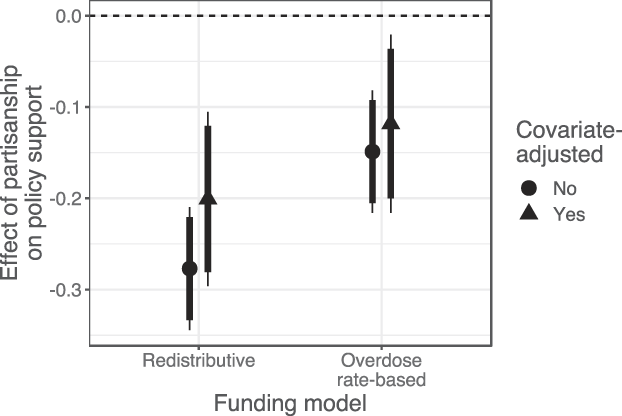
To put these effects in context, we compare these differences between groups with opposing self-interest to the polarization between partisan groups. In Figure 3, we plot the effect of an indicator for whether or not the respondent was a Republican (rather than a Democrat) for both funding models, with raw differences again plotted as circles and covariate-adjusted model coefficients as triangles. For the redistributive funding model, Republicans were 28 percentage points less supportive of the redistributively funded policy than Democrats and 15 percentage points less supportive of the overdose rate-based funding model. These sharp partisan divides show the power of partisanship in policy preferences. In comparison, the effect of partisanship is more than double that of self-interest on support for these policy proposals.
Effect of Partisanship on Policy Support Across Both Funding Models With 95% (Thin Lines) and 90% (Thick Lines) Confidence Intervals

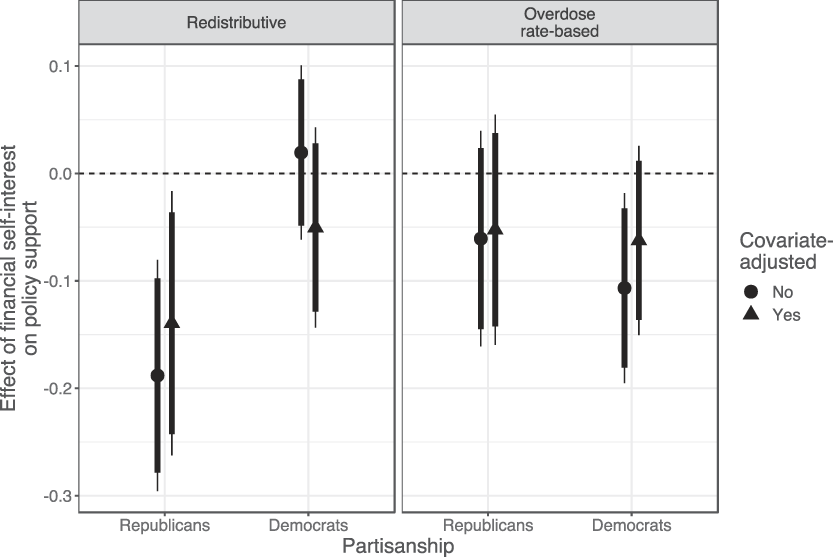
We next assess cross-pressuring within each party by interacting the relevant self-interest variable with an indicator for party identification. We plot these differential effects in Figure 4, for the redistributive funding model in the left panel and the overdose rate-based funding model in the right panel. For the redistributive funding model, self-interest—as measured by income group—has an effect close to zero among Democrats, whereas it has a 19 percentage point effect among Republicans. This interaction of 21 percentage points between self-interest and partisanship is statistically significant (p < 0.01), demonstrating that Republicans were cross-pressured when faced with a redistributive policy proposal. This effect manifests as a boost in support among low-income Republicans and a decrease in the partisan gap in support by more than half, as we show in Online Appendix Figure A.2. In contrast, for the overdose rate-based model, self-interest—as measured by local overdose rates—had a similar effect among both Democrats and Republicans.
Effect of Self-Interest on Policy Support by Partisanship Across Both Funding Models With 95% (Thin Lines) and 90% (Thick Lines) Confidence Intervals

SPATIAL SELF-INTEREST AND THE IMPLEMENTATION OF INFRASTRUCTURE
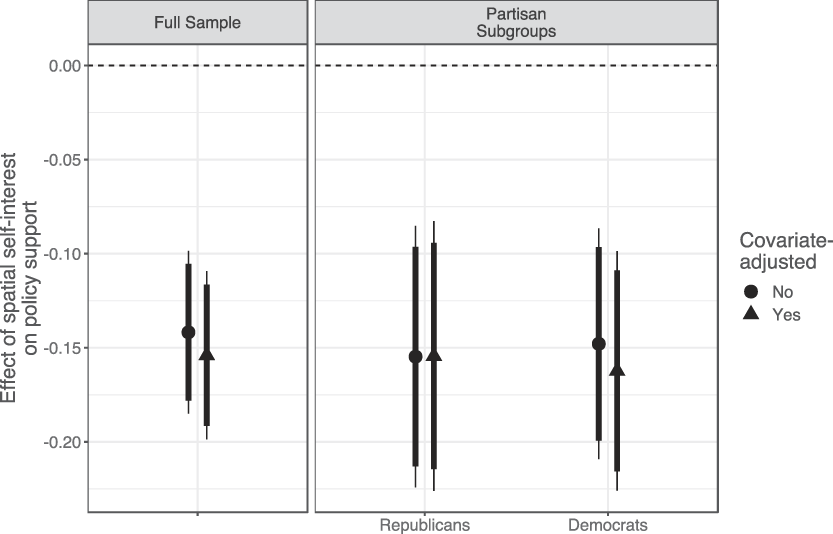
Next, we test the causal effect of spatial self-interest by experimentally varying the proximity of a proposed treatment clinic. We operationalize the effect of self-interest as the difference in support between those respondents in the “near” condition, who evaluated a clinic proposed 1/4 mile away, and those in the “far” condition, who evaluated a clinic proposed two miles away. We plot this treatment effect in Figure 5 for the full sample, on the left, and partisan subgroups, on the right.
Effect of Spatial Self-Interest on Policy Support by Partisanship With 95% (Thin Lines) and 90% (Thick Lines) Confidence Intervals

Among our full sample, 53% who were in the far condition supported the new treatment clinic, whereas respondents who were in the near condition were 14 percentage points less supportive of clinic construction (p < 0.01). This treatment effect demonstrates how the proximity of infrastructure and corresponding spatial self-interest shapes opinion on implementing opioid treatment policy.
To put this effect in context, we can compare the influence of spatial self-interest to that of partisanship for this policy proposal. As discussed earlier, Republicans were 25 percentage points less supportive of clinic construction than Democrats. While the magnitude of self-interest’s influence is less than that of partisanship, it is still substantial.
To test whether spatial self-interest cross-pressures partisans as it did for financial self-interest, we separately estimate this treatment effect by respondents’ partisanship and test for an interaction between spatial self-interest and partisanship. As shown on the right side of Figure 5, the effect of spatial self-interest among Republicans and Democrats is largely similar, whether or not covariates are used in the models. This stability demonstrates the enduring power of spatial self-interest across partisan subgroups.Footnote 11
CONCLUSION
The eventual success (or failure) of government response to the opioid crisis relies at least in part on public opinion. Generating a body of knowledge about which features of policy—both in funding and implementation—are more widely supported is crucial to navigating the policy process on this issue. Moreover, the opioid crisis provides a novel opportunity to assess how self-interest interacts with other political considerations when people form opinions on high-stakes policies.
Using a nationally representative survey, we find considerable support for opioid treatment policies. However, the specifics of policy design substantially alter their palatability. Our split-sample survey demonstrates that people consistently favor treatment policy funded redistributively—allocating the financial burden according to individuals’ income and not local overdose rates, as burdens are currently distributed. We also show that while ideological preferences shape the degree to which people favor redistributive funding, financial self-interest can cross-pressure voters, especially Republicans. Still, such cross-pressuring is not universal, as we show the strength and durability of spatial self-interest in our experiment on siting treatment clinics.
Our results present two direct implications for the policy response to the opioid crisis. First, the popularity of policy funded redistributively suggests that policymakers have wide leeway for structuring opioid treatment legislation progressively. While this type of policy is favored by broad swaths of the population, policymakers should be aware of how financial burdens may influence this support. The cross-pressuring of partisans toward redistributive funding suggests that policymakers may leverage self-interest specifically among lower-income conservative voters to build broad coalitions of policy support. Second, spatial self-interest consistently provokes NIMBY opposition toward new treatment clinics. Historically, such opposition has led policymakers to concentrate unwanted policy infrastructure in low-income and minority neighborhoods where political mobilization is less likely (Bullard Reference Bullard2008). Our results warn of the potential for similar stark inequalities in the spatial distribution of the infrastructure needed to address the opioid crisis.
More generally, our results add to the knowledge of how self-interest structures attitudes. On this policy issue, as on others, the allocation of a policy’s shared burdens—financially and spatially—may drive self-interest and therefore public support. As with policy solutions to other collective challenges—such as climate change (Bechtel and Scheve Reference Bechtel and Scheve2013; Stokes and Warshaw Reference Stokes and Warshaw2017)—when policies target benefits or concentrate costs based on a group’s income, location, or reliance on the policy, self-interest matters for these policies’ public support. Further research is needed to understand whether this self-interest will obstruct policy efforts to confront the opioid crisis and halt the growing number of fatalities.
SUPPLEMENTARY MATERIAL
To view supplementary material for this article, please visit https://doi.org/10.1017/S0003055419000443.
Replication materials can be found on Dataverse at: https://doi.org/10.7910/DVN/OLTXFC.





Comments
No Comments have been published for this article.