

Value pluralism is a cornerstone of our society (Heath, Moriarty, & Norman, Reference Heath, Moriarty and Norman2010: 433–36) and indeed a “fact” of the global economy (Hsieh, Reference Hsieh2017: 295). In a society with pluralistic values, declaring the preferences of some people as more important or valuable than others can only be a matter of controversy. If satisfying people’s many varied preferences is the purpose of a market, then markets that deploy resources as efficiently as possible to maximize system-wide (societal) preference satisfaction would be of great value and could be the basis for claiming that the ethical justification for markets is their ability to optimally satisfy consumer preferences (Cohen & Peterson, Reference Cohen and Peterson2019: 79; Heath, Reference Heath and White2019b: 13; Smith, Reference Smith2018: 605).
Pareto efficient markets minimize overall waste in society because resources are effectively directed to where they are most needed in satisfying preferences. Thus efficiency is valued for improved social welfare, or the satisfaction of preferences (Heath, Reference Heath and Hodgson2004: 74–77). The conditions necessary for the market to achieve Pareto optimality (PO) can therefore act as normative principles, or moral rules, for market participants. These conditions are the rules of perfect competition and include, among others: act to minimize information asymmetry, do not generate negative externalities, and avoid erecting barriers to entry (Heath, Reference Heath and Hodgson2004: 84).
This conceptualization of market morality is known as the Paretian approach (Heath, Reference Heath2013: 50), an efficiency approach (Holley, Reference Holley1986: 3, 17), commercial morality (Matthews, Reference Matthews1981: 294), implicit market morality (McMahon, Reference McMahon1981: 254), or MFA—the market failures approach (Heath, Reference Heath and Hodgson2004: 80). Heath’s work on MFA is the dominant, and surely the most comprehensive, interpretation of this conceptualization. MFA takes its name from the idea that information asymmetry, negative externalities, barriers to entry, and so on cause the market to fail—that is, fail to obtain a PO solution. Rather, it will produce a suboptimal solution, and maximal consumer preference satisfaction will not be achieved.
Scholars writing about the moral limits of markets (MLM) are interested in the question, are there some goods that ought not be bought and sold, or only bought and sold with restrictions? Goods or services that some people have thought unsuitable for the open market include prostitution, body organs, and heroin. These goods could be allocated via the market but heavily regulated (prostitution; e.g., Radin Reference Radin1996: 123–30), allocated via means alternative to the market (body organs; e.g., Elster, Reference Elster1992: 35–38), or not allocated at all (heroin).
While economics factors into the thinking of MLM theorists—after all, they are writing about markets—their justifications for regulating items involve considerations exogenous to market theory. Their arguments turn to Kantian autonomy and respect (Radin, Reference Radin1996), egalitarian considerations (Satz, Reference Satz2010; Stein, Reference Stein2001; Tobin, Reference Tobin1970), and values and concerns about goods being “corrupted” in a market (Anderson, Reference Anderson1993; Sandel, Reference Sandel2012; Titmuss, Reference Titmuss1971; Walzer, Reference Walzer1983).Footnote 1
What seems to be missing so far in all this scholarship is a meeting of the minds—an intersection point between MFA and MLM where a moral limit to markets is derived from the implicit morality of the market.
The stance of the MFA theorists—that economic theory can serve as a basis for determining morality in the market—has not been considered by MLM theorists. MLM theorists have failed to recognize the power of economic argumentation and the potential for formulating a morality from within (i.e., endogenous to) market theory, as Heath and McMahon have. Instead, they have focused their attention exclusively on theories and constructs of “common” morality—for example, Kantian universalism, egalitarianism—that they assume apply to markets.
Conversely, the stance of the MLM theorists—that some goods are unsuited for open market distribution and may even need to be barred from it—has not been addressed fully by MFA theorists. This point has at least been raised by those writing about MFA. Cohen and Peterson (Reference Cohen and Peterson2019: 83–84) have noted that such goods and services as kidneys, prostitution, and babies (born through paid surrogacy) would all appear to be fair fodder for a market, because the market can efficiently distribute them. Norman has essentially said the same about addictive drugs and prostitution (Norman, Reference Norman2011: 51, 55) and weapons and pornography (Norman, Reference Norman2014: 27); however, he notes that they could be regulated or banned for reasons other than efficiency—that is, for non-market reasons. Hsieh (Reference Hsieh2017: 302) has argued that MFA needs to be able to bar goods from markets on moral grounds and has expressed doubt that MFA can do so using the Paretian standard.
Granted, Heath does comment that the markets for goods and services that generate externalities like alcohol and gambling—for which the broader costs to society are substantial—may need to be heavily regulated (Heath & Norman, Reference Heath and Norman2004: 256). The implication would seem to be, though, that if their costs could be better internalized, their sale should be unrestricted, and this leaves one wondering, if the costs associated with heroin, for example, were better internalized, could it be moved into the open market?
In short, according to Heath, the pursuit of PO governs exchanges within the market—that is, how goods are transacted between market participants. Thus it would seem that whether a good can be transacted—that is, can even be in the market—lies outside of the equation.Footnote 2 Whether a good can be transacted would be a political decision, one exogenous to the market (Gustafson, Reference Gustafson2019: 2), and while there may be grounds for restricting goods that are not directly linked to market failures (Norman, Reference Norman2011: 55–56), these grounds need not be related to MFA and are of no real concern to MFA scholarship.Footnote 3
However, government policy makers and regulators are supposed to use the market’s logic in managing the market, according to Heath et al. (Reference Heath, Moriarty and Norman2010), who argue for a “unified normative theory of business obligations” (Norman, Reference Norman2011: 44; see also Martin, Reference Martin2013) to be applied by both market participants and market regulators. For pragmatic reasons, it is desirable that legal and extralegal norms be derived from the same principle(s), that is, based on a logic that produces consistency of thinking (application) between those who participate in the market and those who coordinate their participation.
In sum, it seems like it comes right back around to MFA to provide an argument for any goods that are to be prohibited from the market by regulators. After all, if it’s going to be a policy decision to bar a good from the market, that policy decision should be driven by Paretian logic.
Having said this, it would seem that the value pluralism society prizes will make it hard to block the sale of certain goods. After all, who has the right to decide whose preferences are not to be valued? Cohen and Peterson (Reference Cohen and Peterson2019: 83) have argued that a good like marijuana cannot be blocked from the market on the grounds that it causes market failure—simply because it doesn’t cause such a failure—and no other grounds are available to regulators if one is proposing MFA and its Paretian reasoning as the basis for a unified normative theory for business.
Some have argued that, ultimately, MFA is unworkable, because it is too narrowly construed (Cohen & Peterson, Reference Cohen and Peterson2019: 82; Hsieh, Reference Hsieh2017: 302). Simply put, it can’t do all the heavy lifting it needs to do. In this address, then, I propose a way to broaden its reach. I seek to ground the regulation of goods—up to and including their being banned from the market—in terms of economic theory (as opposed to doing so in terms of common moral theory), but more broadly than in mere market failure terms.
I will do so by arguing that there is more to capitalist market theory than efficiency. There are in fact all sorts of background assumptions regarding preferences, property, rationality, risk, and so on that are important (e.g., Hsieh, Reference Hsieh and Boatright2010: 70). These assumptions underlie arguments regarding Paretian efficiency; specifically, I intend to focus on assumptions regarding preferences. Before describing what exactly I do intend to cover in this address, though, let me quickly note that I will not be contributing to current debates regarding MFA. I mention three in particular. First is considering its applicability to the real world and also the broader conversation regarding perfect markets and ideal theory (Heath, Reference Heath2014a: 176–91; Hsieh, Reference Hsieh and Boatright2010: 70; McMahon, Reference McMahon1981: 256; Moriarty, Reference Moriarty2020: 119–23; Repp & Contat, Reference Repp and Contat2019; Steinberg, Reference Steinberg2017). I instead place myself in Norman’s camp, believing MFA to be a useful way of framing business ethics, because it appeals to a set of assumptions with which both managers and regulators are familiar and to which they ostensibly subscribe (Norman, Reference Norman2011: 51–52; 2014: 25). Second is work on how best to conceptualize efficiency—as Kalder–Hicks or PO (Heath, Reference Heath2019a; Hsieh, Reference Hsieh and Boatright2010: 78; Moriarty, Reference Moriarty2020: 118–19). For the purposes of this address, I will simply assume the latter. Third, there is debate over whether MFA’s foundation is deontological or consequentialist (Cohen & Peterson, Reference Cohen and Peterson2019, Reference Cohen and Peterson2020; Heath, Reference Heath and White2019b: 13–15; Smith, Reference Smith2018: 610–15). While this debate is crucial to understanding the moral foundations of MFA, I do not believe its outcome will either undermine or advance the points I make in this address.
I should also make three points about terminology here. First, to simplify phrasing, “goods and services” will be referred to as goods, with the word services left as understood. Second, my discussion will tend to focus on both utility and preferences, because utility is a way of measuring consumer preference. Third, I will understand markets to mean capitalist ones: those where demand and supply are left free—as much as possible—to determine prices and thus direct resources through the economy. I will refer to these at times as “open markets” but never as “free markets,” because that caveat “as much as possible” is an important one and indicates that limits do exist regarding the functioning of a market, and as MFA theorists argue, these limits are non-trivial, though not my subject here.
The address proceeds with four sections. The first contains my argument regarding how an understanding of preferences can be linked to the regulating (or even banning) of some goods. Second is a brief description of preferences and their nine properties. Third, I discuss goods that violate the preference properties. These goods are “morally suspect goods.” Such goods have non-standard preferences associated with them—the kinds of preferences that constitute the grounds for regulating the goods. The fourth section recaps the argument and the findings of the previous sections and offers directions for future research.
THE ARGUMENT
This address is about preferences. Why discuss them? Because the purpose of a market is to satisfy preferences (Cohen & Peterson, Reference Cohen and Peterson2019: 80; Curtis & Irvine, Reference Curtis and Irvine2017: 123; Hausman & McPherson, Reference Hausman and McPherson2006: 97; Kreps, Reference Kreps2013: 22; Pindyck & Rubinfeld, Reference Pindyck and Rubinfeld2013: 624; Samuelson & Nordhaus, Reference Samuelson and Nordhaus2010: 534). Additionally, demand functions are derived from preferences. For conventional goods, indifference curves (which express preferences) will show that when the price of a good drops, a consumer’s budget will enable the consumer to purchase more of it, thus establishing the basic relationship expressed by a demand function: that price and quantity are inversely related. It is the interaction of the demand function with the supply function, of course, that determines the price at which goods sell and thus ultimately signals the relative scarcity of the good involved. Thus preferences, and assumptions economists make about them, are a crucial part of the foundation of capitalist theory.
A preference, by definition, is a relative ranking between two alternatives. So given two goods or two bundles of goods, consumers simply need to indicate which one they like better. This seems simple enough.
But are preferences a monolithic construct? Are all preferences the same, such that once you have seen one preference, you have seen them all? And when we say that the purpose of the market is to satisfy preferences, does that mean any preference?
The definition given so far is fitting for a standard, plain vanilla preference, or an “ordinary preference” that fits the “vast majority of goods” (Krugman & Wells, Reference Krugman and Wells2009: 276). However, there are non-standard preferences that violate either assumptions underlying the techniques of mathematical optimization used to find PO solutions or basic assumptions about economic behaviour used in modelling the interaction of demand and supply. Non-standard preferences are associated with certain goods, as I will demonstrate further along in the address. The issue is that the preferences for such goods violate important underlying assumptions regarding market morality. This makes the goods “morally suspect” and constitutes the grounds for regulation. The argument goes like this:Footnote 4
-
1. Iff a certain set of background conditions are satisfied, then there is perfect competition in a market (by definition of perfect competition).Footnote 5
-
2. Iff there is perfect competition, then a PO solution results (by the first fundamental theorem; Arrow & Debreu, Reference Arrow and Debreu1954).
-
3. Iff there is a PO solution, then the market is a moral arrangement (by MFA; Heath, Reference Heath and Hodgson2004).Footnote 6
-
4. Therefore satisfying a certain set of background conditions generates a moral arrangement (HS, lines 1–3).
-
5. Good X does not satisfy the set of background conditions (an empirically verifiable claim).
-
6. Therefore perfect competition will not occur in the market (BE and MT, lines 1, 5).
-
7. Therefore a PO solution will not result (BE and MT, lines 2, 6).
-
8. Therefore the arrangement (involving good X) is not moral (BE and MT, lines 3, 7).
Thus, if it is structured a certain way—that is, it conforms to a certain set of background conditions—a market functions “perfectly.” (In this address, the background conditions on which I will focus pertain to those of preferences.) A perfect market will produce a PO solution, and a market that achieves a PO solution is a moral arrangement for transactions. Now we imagine some good X, the inherent nature of which is such that it violates a background condition. Because good X violates a background condition, it is not “covered,” so to speak, by the morality that covers the market. Because it is not covered by the morality of the market, it is morally suspect. Such a good is not one an open market is well suited to handle.
How morally suspect goods then get treated—whether they are prohibited from the market, for example—would be a matter of further debate. However, that a good violates an assumption provides the grounds for regulatory action, including barring it from the marketplace, I believe. The deciding factor in regard to regulatory action will be whether the good is actually immoral or amoral. In the former case, it should be regulated, up to and including it being banned from the market; in the latter case, not so. Making this second determination will require a supplementary economic analysis that examines the cause of the violation, to be discussed further on. It is worth driving home the point here, though, that a good violating an underlying assumption cannot be moral: if markets are to efficiently allocate goods, and if this is achieved through the pricing mechanism signalling market actors as to how best to direct their resources throughout the economy, and the pricing mechanism does not work for a good, then the good is at best amoral (and at worst immoral).
THE PROPERTIES OF PREFERENCES
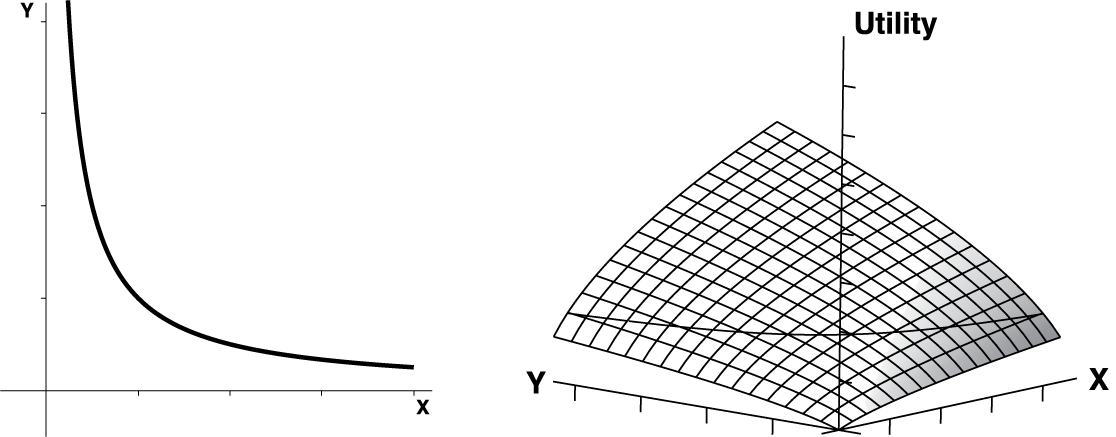
The key question to understand in regard to the consumer’s preferences is this: given a budget, how much of each good will a consumer prefer to purchase? If the consumer’s preferences are “well behaved,” we can apply the techniques of optimization theory to answer the question.Footnote 7 When two goods are involved,Footnote 8 preferences are represented by utility functions that are comprised of indifference curves, as pictured in Figure 1, close variations of which can be found in every microeconomics textbook.
Indifference Curves
(a) Indifference curve in its simplest form.
(b) Utility function, showing the indifference curve on its surface.

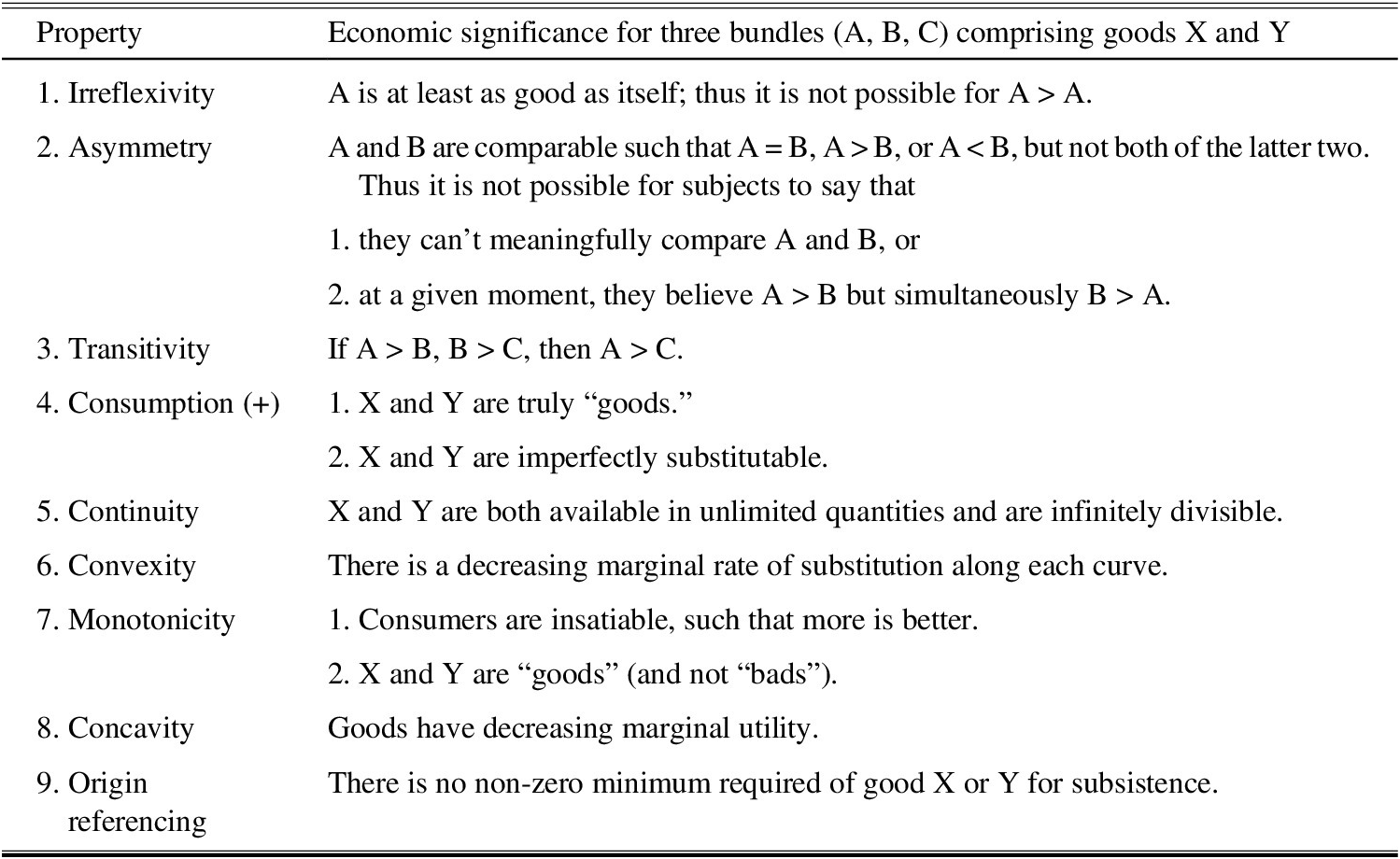
Textbooks present this figure for a reason: it reflects the conventional understanding of consumer preferences. This figure, then, represents the standard for consumer preferences, the starting point from which many exceptions can be shown to exist, but which exist as just that: exceptions. The function has nine properties, shown in Table 1.
Preference Properties

The first three properties are irreflexivity, asymmetry, and transitivity. These three are axiomatic—absolutely essential to a model of consistent consumer preferences. In other words, without them, consumer preferences are incoherent, and it would be impossible to make any sensible statements about them or to apply optimization techniques to them.
The consumption (or “positive” consumption) property (property 4) states that goods are literally just that—they are goods—and as such, positive amounts of them are desired (X > 0 and Y > 0), meaning that indifference curves are asymptotic to the axes. The continuity property (property 5) is a constraint stating that X and Y must be real numbers. This means that indifference curves are numerous, filling the entire x-y plane, and that they are very fine grained, comprising an infinite number of points. The convexity property (property 6) states that indifference curves are convex to (open away from) the origin and thus exhibit a decreasing marginal rate of substitution (MRS). A decreasing MRS means that as a consumer acquires more and more of the one good, X, the consumer will trade away less and less of the other good, Y, to get yet more X. Economists assume these properties because they help define what goods are and effectively model consumer behaviour.
Monotonic functions (property 7) either consistently rise or fall, and the utility function consistently rises, never attaining a peak. Economists argue for this via both the definition of a good—something of which more is preferred to less (Nicholson & Snyder, Reference Nicholson and Snyder2008: 90; Perloff, Reference Perloff2015: A65)—and by arguing that consumers are insatiable. Concave surfaces (property 8) like the utility function open downwards. Economists argue that it is reasonable for them to look like that because standard goods provide us with decreasing marginal utility. Finally, origin referenced (property 9) means the function is anchored at the origin such that the surface is asymptotic to the x-z and y-z planes. This indicates that consumers could be satisfied with bundles where the amount of X or Y could be close to zero, which means that the goods X and Y are not necessity goods where an amount of the goods significantly above zero is required.
VIOLATIONS OF THE PREFERENCE PROPERTIES
All nine properties can be violated, and microeconomists can model the violations. These contraventions were not unforeseen by economists, discovered only after the basic model was created; rather, they were known all along and were not designed into the basic model because economists considered them to be exceptional cases that lie outside conventional consumer behaviour.
Recall the reason I am interested in these violations: the MFA approach to business ethics argues that the market comes with its own set of rules, rules that assure (as much as possible) that the market will effectively do its job. Its job is to satisfy consumer preferences, which we view as a “good,” that is, a good thing, especially in a pluralistic society like ours. We have seen that standard consumer preferences can be described in terms of nine properties. My argument, then, is that products that result in violations to any of these nine properties are not the types of goods that the capitalist market is well suited to handle. Such products are morally suspect—they need to be examined carefully and most likely either banned from an open market or only allowed into the market with restrictions (i.e., regulations somehow limiting aspects of their sale). In short, I’m looking for violations that point to particular products as being incompatible with the market concept. Such incompatibility gives market regulators the grounds for regulation, at times including the outright prohibition of a good from the marketplace.
However, not all of the violations turn out to be of interest to us. For example, there are known violations to property 3, transitivity (Andreou, Reference Andreou2007; Butler & Pogrebna, Reference Butler and Pogrebna2018; Davidson, McKinsey, & Suppes, Reference Davidson, McKinsey and Suppes1955; Tversky, Reference Tversky1969),Footnote 9 but none of the violations appear to point to particular goods being problematic. Thus it does not make sense to go through the nine properties, looking at their violations. Instead, my survey—which I acknowledge here to presumably be incomplete—focuses on particular goods that are associated with violations, and so particular properties will only be discussed if they can be linked to such goods.
S-Shaped Indifference Curves
There are such things as Veblen goods. While most goods follow the “law of demand”—as price goes up, demand goes down—Veblen goods do not. In fact, Veblen goods do the opposite: as price goes up, demand goes up. The more expensive the good, the more people want it, because Veblen goods are status goods.
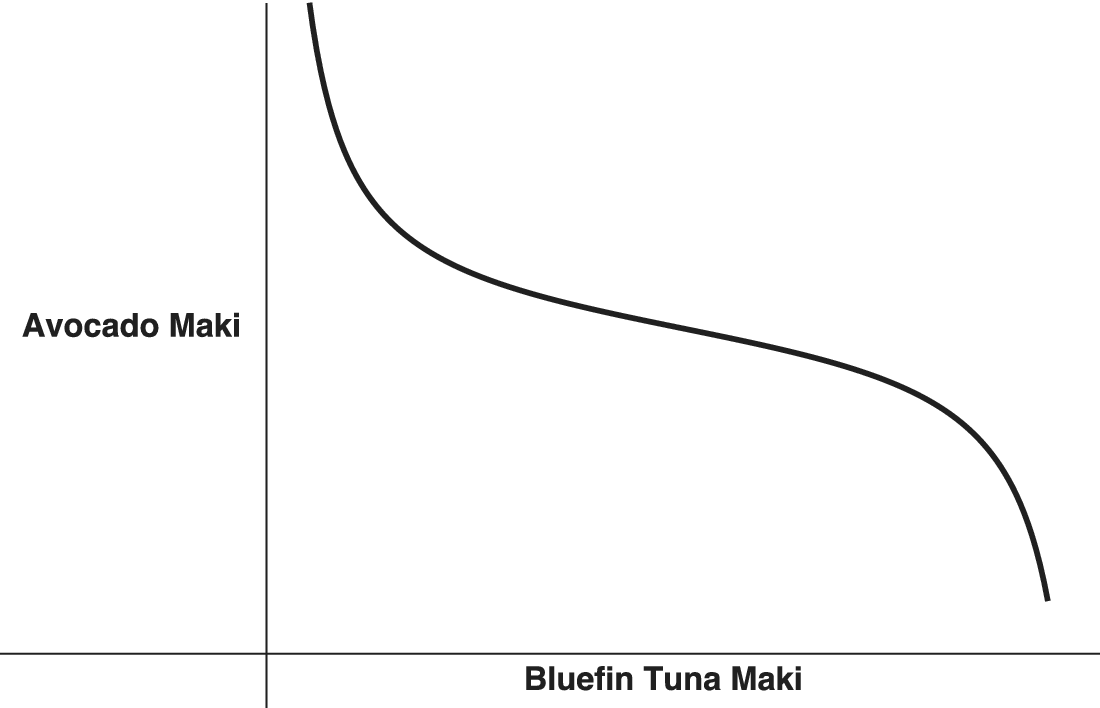
Now imagine you live somewhere where sushi is consumed. To keep our illustration manageable, we imagine a two-good economy, where only two goods are made: avocado maki rolls and bluefin tuna maki rolls. We would expect demand for them to fit a standard indifference curve, which is convex to the origin. As it turns out, though, bluefin tuna is a Veblen good—the higher it is priced, the more demand there is for it. Therefore the correct picture looks more like Figure 2.
An S-Shaped Indifference Curve for a Veblen Good, in this Case, Bluefin Tuna Maki Rolls

At high prices for bluefin tuna, consumers have exhibited unconventional behaviour: they buy even more of it. The MRS, which ought to be continually decreasing, instead has an inflection point after which it begins increasing, creating an S-shaped curve. So when people are running out of avocado maki, they ought to hold on to it more dearly. However, they willingly give up increasing amounts of avocado (which is in shorter and shorter supply for them) to acquire even just a little more bluefin tuna. This is not normal behaviour! Convexity (property 6) is being violated.Footnote 10
What is going on? Bluefin tuna is an endangered species (Paris, Reference Paris2019). Consumers have increasingly prized it as a status symbol as it becomes more and more uncommon, and thus more expensive. The fewer bluefin there are, the more sushi made from them costs, and so the more consumers want it, and thus the more it is overfished: consumer behaviour causes it to go extinct (Barclay, Reference Barclay2015)!
So bluefin tuna ought to be subject to regulation. The grounds for doing so? Consumer preferences for it do not fit the conventional model—it is violating an underlying assumption about standard preferences; it is not the type of good, then, that capitalist markets were designed to handle. To be clear: it is not for environmental reasons that the bluefin should be regulated; rather, it is for economic reasons. (Again, the purpose of this address is to look to economic reasoning to provide the grounds for regulating goods within the market.)
However, we can observe that some designer handbags are also Veblen goods.Footnote 11 For instance, through careful marketing, the Gucci Corporation has engineered an S-curve for its handbags. So by the same reasoning that bluefin tuna ought to be regulated, ought not Gucci handbags be regulated too? But what is so unethical about Gucci handbags?
In response, we can first note that by violating an underlying assumption of preferences, there is sufficient grounds for regulating these handbags. They are not a moral good; the market cannot manage them efficiently. But second, we can ask whether they are an immoral good that necessarily must be regulated or an amoral good that need not be regulated. Here is where a supplementary economic analysis becomes necessary.
What is the underlying cause of the S-curves? In the case of Gucci handbags, it is big advertising budgets creating brand prestige and product differentiation combined with supply being artificially held down to force prices up. In the case of bluefin tuna, advertising does not seem to be pushing up demand. Additionally, it is not as if some company’s marketing team is directing the company not to harvest bluefin tuna from the oceans to force down supply and push prices up. In fact, it’s just the opposite—they are aggressively seeking out the tuna, which is causing its supply to drop all the faster (Hickman, Reference Hickman2009; Rigney, Reference Rigney2013). Bluefin tuna is subject to a mechanism known in economics as the anthropogenic Allee effect, which occurs when the market price of a declining species keeps rising above the escalating costs of searching and harvesting the ever fewer members of the species (Courchamp et al., Reference Courchamp, Angulo, Rivala, Hall, Signoret, Bull and Meinard2006; Holden & McDonald-Madden, Reference Holden and McDonald-Madden2017). So both Gucci handbags and bluefin tuna have S-shaped curves, but the underlying reasons are different, and that difference lies at the heart of whether they should be regulated.Footnote 12
Concave Indifference Curves
Consumers exhibit unconventional preferences for addictive drugs. If we pictured a two-good economy comprising drug capsules and nutritious food capsules (imagine something similar to what astronauts consume in space), we might expect the standard indifference curve, which is convex to the origin. However, the indifference curve that emerges is concave to the origin.
In theory, we would expect that as a person obtained more and more of any inedible good, food would become all the more precious to the person, who would be less and less inclined to give up any further food no matter how much of the other good you offered: the MRS ought to decrease. Instead, the MRS increases. As a person obtains more and more of an addictive drug, for instance, capsules of barbiturates, food becomes less precious to the person. Eventually, a person will give away all the rest of his or her food for one more barbiturate capsule.
Addictions exhibit the kind of consumption pattern that produces a concave indifference curve leading to what economists call a corner solution. At the corner, consumption of other goods has dropped to zero, as addicts have given up everything to maintain their addiction (Bask & Melkerson, Reference Bask and Melkerson2004; Becker & Murphy, Reference Becker and Murphy1988; Cawley & Ruhm, Reference Cawley, Ruhm, Pauly, McGuire and Barros2012; Koksal & Wohlgenant, Reference Koksal and Wohlgenant2016; Saffer & Chaloupka, Reference Saffer and Chaloupka1999).
Both positive consumption (property 4) and convexity (property 6) are violated by addictive substances. I suggest, then, that they should be banned from the market (and they are). However, one might object by arguing that a significant percentage of the time, alcohol also produces concave indifference curves in consumers, and yet it is not banned from the market. Ought it be? Doing so would likely repeat the fiasco of the Prohibition Era in the United States. However, there are clear moral grounds—economically speaking (irony intended)—for regulating its purchase and sale in the market (e.g., not selling to minors, restricting its availability to government-controlled liquor stores, limiting the advertising of it) because it is known to violate assumptions that underlie indifference curves.
Non-continuous Indifference Curves
Continuity (property 5) is the assumption that goods X and Y theoretically come in infinite quantities and are infinitely divisible. Flour fits this description, but most goods do not. Does this mean the sale of such goods as cars, shirts, and laptops should be ended immediately? Hardly. Most economists are willing to let go of the need for infinite divisibility if a good is sold in large enough quantities.
In 2019, Toyota sold 304,850 Corollas in the United States alone (Toyota, 2020). That’s not an infinite number, but it is a pretty big one. And while a car cannot meaningfully be sold in fractional amounts, a utility surface comprising Corollas on one axis and vacations to foreign destinations (which might number in the thousands) on the other axis would have hundreds of millions of points, making it a fairly fine-grained surface. However, a person walking on the utility surface made from Johannes Vermeer paintings on one axis and complete tyrannosaurus skeletons on the other axis would most likely fall to his or her death. The impoverished Vermeer worked painstakingly on the thirty-seven paintings he produced prior to his death at the age of forty-three (Montias, Reference Montias1989). The number of nearly complete tyrannosaurus skeletons found to date can be counted on the fingers of two hands (Erikson, Makovicky, Currie, & Norell, Reference Erikson, Makovicky, Currie and Norell2004; Persons, Currie, & Erikson, Reference Persons, Currie and Erikson2020: 669). It would be difficult to argue that such a surface could be called continuous by any stretch of the imagination. I would contend, then, that these goods—rare goods—do not fit the conventional model of consumer preferences, because they violate the continuity property.
By assuming continuity, or at least something that vaguely approximates it, the conventional model of consumer preferences is referring to the exchange of commodities. Commodities, by definition, are mass-produced, often factory-made goods. Their price fluctuates in response to demand and supply. However, in the last century or so, Vermeer paintings have been sold either at public auction or in private sales only a handful of times (Metropolitan Museum, 2020; Vogel, Reference Vogel2004). Constructing a meaningful demand or supply function from such data is impossible. The same can be said for T-rex skeletons, none of which have ever been sold at auction. Clearly they are not commodities.
What does this mean? The value of the market we said lay in its facilitating the exchange of goods for the purpose of satisfying consumer preferences. Consumer preferences for Vermeer paintings and T-rex skeletons, though, can’t be viewed in terms that even vaguely approach what might be considered typical or “standard.” Should such goods be sold in a capitalist market? I think the question is worth asking. They are truly “priceless” in that they literally cannot be priced by the market for sale, and this may account for in economic terms the sense in which we think these items belong to the public and as such are meant for display in museums.
But now consider an objection: imagine wandering through a farmers’ market and coming across a hapless academic who home brews a beer on weekends—call it Moriarty Malt. If the product is produced in such small quantities that a PO solution can’t be obtained, it means the good lies outside of the market’s morality, and so the good is suspect. Sufficient grounds are there for regulatory action, but is it necessary? Again, supplementary economic analysis is called for.
First, let us start by imagining that Moriarty’s father comes along at the end of the day and, feeling sorry for his son the academic, offers $300 for all six bottles of Moriarty Malt brewed that week, but all of which remained unsold at the close of the market. The market, in a manner of speaking, would then send back a false signal: that Moriarty Jr. needs to make more beer. This signal is absurd—the beer’s most recent bid price is simply measuring the father’s affection for his son, not the price/quality aspects of the beer itself. So, again, what is the goal here? It is to use prices to direct resources throughout the economy to where they are most needed to satisfy system-wide preferences. With small supply, though, the price signal could be said to lack validity, that is, to measure what it is intended to measure. A look at the underlying dynamics is revealing: for Vermeer, the level of demand would appear to be indicating no credible substitutions that are preferred, but this probably isn’t the case with Moriarty Malt (although admittedly, this is mere supposition on my part). If a lot more Moriarty Malt is supplied to the market, we should be able to get a more reliable and valid price signal.Footnote 13
Off-Centred Utility Functions
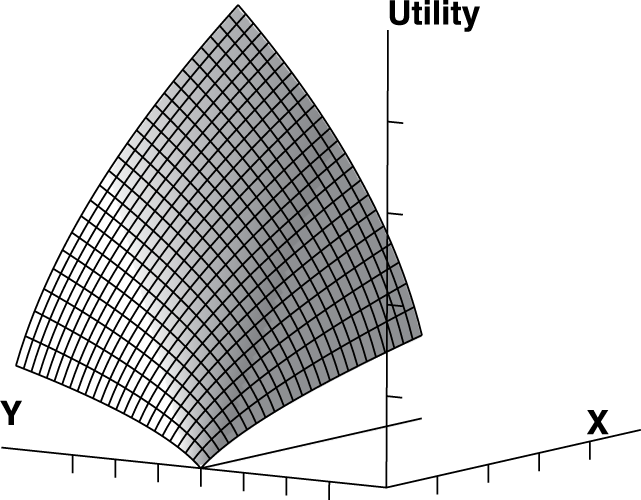
Goods are things people want some of; they desire a non-zero amount of them. A surface anchored at the origin implies, though, that there is no (non-zero) minimum of the goods they need, that is, that are required for subsistence. However, in Figure 3, imagine good Y is potable water and that a human needs a minimum of approximately four litres (per day) to survive. No person, then, would be willing to accept a bundle of good X and good Y that contains less than four units of Y. The result would be a utility surface that is positioned at (0,4,0) and is asymptotic to the plane y = 4. This would be a violation of origin referencing (property 9).
A Utility Function Positioned at (0,4,0)
Note. If the number of litres of water a person purchased for daily consumption were tracked on the y-axis, the utility function would look like this, because a person must consume at least four litres per day.

What would such a violation suggest in terms of consumer preferences relative to capitalist markets? It would suggest that necessities might not be well suited for distribution in markets. I have already suggested—in the context of rare goods that violate the continuity property—that markets are really meant to handle commodities. Commodities are essentially mass-produced goods but include both luxuries and necessities. Luxuries are said to have an income elasticity of demand greater than 1: ε d > 1. This means that increases in income result in proportionally higher consumption of these goods. (People buy more caviar the more income they have.) Necessity goods have an elasticity 0 < ε d < 1. As income rises, purchases of these goods increase, but their percentage increase is less than the percentage increase in income. The more basic the necessity is, the closer the elasticity is to zero, ε d ≈ 0, meaning that consumption of such goods barely increases at all with increases in income. People need to drink water, and the amount of water they consume does not increase significantly with increases in income. Admittedly, the story becomes more complex when we include in the analysis substitute goods like Pepsi, Perrier, and Port Dundas (fourteen-year-aged) Scotch. However, we will consider those beside the point for now. The point is this: what I call “true” necessities, goods with positive income elasticities closest to zero—and economists can provide a list of such goods, such as water (Havranek, Irsova, & Vlach, Reference Havranek, Irsova and Vlach2018: 260; Samuelson & Nordhaus, Reference Samuelson and Nordhaus2010: 93)Footnote 14 —are not the types of goods suitable for sale in capitalist markets. The reason is that consumer preference for them does not fit the standard utility function; they violate the property of being origin referenced. Such goods are “suspect.”Footnote 15
Should water be sold in a capitalist market? Probably not. In fact, this would suggest that water should not be privatized and that corporations should be prevented from going into developing nations or First Nations reserves in Canada (Shimo, Reference Shimo2018) and bottling water for sale to residents who have no other access to potable water. In short, government-subsidized utilities are probably better suited for the distribution of this good, with the water sold at cost or below, and with special considerations given to make sure that everyone has access to it. This is not how open markets work, but I am arguing that water ought not be sold through an open market, because the preferences involved do not conform to the assumptions economists make about standard preferences. This constitutes, then, an economic reason why necessities for human survival, such as water, should not be sold in capitalist markets.
Finally, consider this objection: this ninth property of utility functions—origin referenced—is almost never stated by economists. I concede this point but, in so doing, wish to note that while never stated, it is always pictured.Footnote 16 If always pictured, but never stated, how ought one understand this property? An economist might argue the following:
Well, it’s simply the default option. Why picture a surface not oriented relative to the origin? After all, if one is introducing the generic utility function, the most straightforward case to illustrate is one positioned respective to the origin. In contrast, a surface positioned relative to (0,4,0), for example, would be an exception.
And without a doubt, that would be my point too: situations where the utility function isn’t centred at the origin are not the “standard case,” and it is the standard case and what constitutes exceptions to it in which I happen to be interested—actually, to the exclusion of all else—in this address.
Straight Line Indifference “Curves”
Finally, some goods generate indifference curves that are negatively sloped straight lines (running northwest to southeast), sometimes even perfect forty-five degree lines, thus violating the convexity property (property 6). These could be the indifference curves for the two-good economy comprising two essentially identical beers. What such a picture would show is that a consumer is completely indifferent between the two beers and views them as perfect substitutes (and not really as distinct goods).
Budweiser and Miller Genuine could be the two beers. If the two are basically indistinguishable in taste tests, such that the loyalty shown them is entirely due to marketing (Almenberg, Dreber, & Goldstein, Reference Almenberg, Dreber and Goldstein2014; Consumer Reports, 1996; Elzinga, Reference Elzinga and Adams1990), the cost of that marketing represents deadweight loss to society (Heath, Reference Heath and Hodgson2004: 84; 2019a: 23–24). They would serve as an example of resources wasted through advertising, resulting in a suboptimal solution to the problem of societal-wide preference satisfaction.
Are they morally suspect goods? According to the formal argument given in this address, yes. And to some degree, the practice of not permitting the pointless duplication of product was followed in the administered economy of the Soviet Union, possibly for the very reason given—deadweight loss. But do we have the political will not to permit such duplication here and now? I think no. This situation may be, similar to an addictive substance like tobacco, one involving a morally suspect good that society will choose to tolerate.
DISCUSSION AND CONCLUSION
This address has argued that some goods have preferences associated with them that violate assumptions underlying the argument for perfect competition leading to PO. These assumptions form the backdrop for the first fundamental theorem of welfare economics.
If a market’s moral value arises from preference satisfaction, and if this can be done to the greatest extent possible when PO is achieved, and that when PO obtains the market can be said to be a moral arrangement, then goods associated with preferences that violate the assumptions underlying PO are morally suspect. Such goods require the attention of market coordinators. This may not mean, though, that they cannot be consumed in a society—after all, we need to drink water, to cite an example from the previous section—but simply that they ought not be allocated in an unrestricted manner through an open market. Rather, they need to be administered differently, possibly allocated through a market with restrictions, or possibly through other means (e.g., a public utility, a lottery, on a most-needed basis).
So is this address about economics or ethics? Both, of course. Is it descriptive (positive) theory or prescriptive (normative) theory? Again, both. The way preferences are modelled by economists is descriptive, and much of market theory—as developed by economists—is presented as descriptive. But we also know that market theory may be viewed as containing implicit prescriptions (Heath, Reference Heath2014b; McMahon, Reference McMahon1981; Norman, Reference Norman2011), and as Heath (Reference Heath2014b) points out, policy makers surely view the theory that way. It is in this spirit that I believe preference violations can be viewed as also containing implicit moral prescriptions. While economic purists may balk at this suggestion, there is a message in their graphics of indifference curves and utility functions: the kind of goods for which they seek to obtain PO solutions conform to certain standards. Extraordinary goods, which are indeed beyond ordinary, violate those standards and, in so doing, fail to fit the story, so to speak, that economists tell about markets. And assuming PO solutions are something of value, then the “problematic” preferences I have discussed are not just economically problematic but morally problematic. So if the market can be viewed as moral, as MFA frames it, restricting or even banning products linked to these preferences may not be merely an economic imperative but a moral one.
It is in this way that I see a link between MLM and MFA. The scholars favouring moral limits for markets—that is, placing limitations on the sale of some goods in markets or barring them completely from those markets—have tended to look outside the market, that is, to look outside of economic theory, for the grounds to do so. There is, however, something very pragmatically appealing about the argument for the kind of unified moral theory for markets (Heath et al., Reference Heath, Moriarty and Norman2010; Norman, Reference Norman2014) that MFA strives to be. Were managers, government regulators, and business academics all working from the same playbook—all adhering to a consistent set of rules—perhaps some good could come of it. After all, I cannot help but wonder if the current patchwork of moral messages managers receive must surely be leading to confusion and, worse yet, giving liberty to managers to rationalize away, by cherry-picking from the vast smorgasbord of business ethics theories available to them, just about any action their firms take.
But is this address’s argument part of MFA as Heath and others have developed it? No, not exactly. MFA stands for the “market failures approach” to business ethics, and the non-standard preferences I discuss in this address generally don’t cause a market to fail. Recall that a market succeeds when demand meets supply and produces a market-clearing price where there are no “unrealized exchanges” (Heath, Reference Heath2019a: 23–24). A market fails when demand or supply is manipulated, thus indirectly disabling the pricing mechanism, or when the pricing mechanism is directly disabled (through price fixing). Such manipulations result in some transactions favoured by both buyer and seller never occurring. However, the market can allocate bluefin tuna, for instance, and could arrive at a market-clearing price—of sorts. The problem would be in this particular case that optimization would generate multiple Pareto optimal solutions, a Pareto set, because bluefin violate the assumption regarding strict convex preferences. Thus there would not be a single market-clearing price, because the mathematical technique used to determine optimization doesn’t generate a unique solution in such a setting (Rubinstein, Reference Rubinstein2013: 61–66). To fully solve the problem would require introducing some additional value beyond mere preference to enable one to rank order the solutions. Imposing this value on the solution would be undesirable if value pluralism is prized in our society.
As we have observed, addictive goods like phenobarbital or heroin will generate what economists call a corner solution—where the consumer prefers only heroin at the expense of any other good. This is at least a unique solution, but it defies our understanding of a good. A good is something people actually want—that is, something they want a non-negative amount of—and a corner solution negates that concept. A two-good economy with a corner solution, after all, is not a two-good economy; rather, it is a contradiction in terms.
To make an analogy, consider simple linear regression. Given values for an independent and a dependent variable, one can generate a best-fit line for the data using the ordinary least squares (OLS) method. One will thus have in hand an equation that describes the relationship between the two variables. The problem is that the equation may be meaningless. This will occur when one (or more) of the five assumptions underlying the OLS technique is not met. For example, the expected value of the error terms in the analysis must be zero—the data should not be serially correlated. If they are serially correlated, the OLS method will not generate the best-fit line, and in fact, a different method—the general least squares method (GLS)—will generate a better estimate. In short, the OLS method will indeed give an answer to the question of what the best-fitting line is—a computer program will generate an answer—but the answer will be meaningless. Similarly, were a heroin market to clear, it would not mean a PO solution has been obtained. There might be a “solution”—that is, a price for heroin—but the solution is meaningless. In a nutshell: garbage in, garbage out.
This is a different issue, though, from the one about the strengths and weaknesses of ideal theorizing being discussed in regard to MFA. In that discussion, it is argued that MFA is meaningless because underlying assumptions that could in theory be met are not being met in reality. When we model a market for heroin, though, we are talking about an assumption (i.e., the preference for heroin needing to exhibit the property of convexity) that cannot be met even in theory. The inherent nature of heroin is such that it is not even theoretically possible for it to meet our conceptualization of the setting in which Pareto optimization is performed. So does heroin cause a market to fail? It is a discussion we cannot even have—it lies outside the ken of MFA.Footnote 17
Having said that, though, I believe this discussion of preferences contributes to a larger project of which MFA is a part. In this address, I am unquestionably talking about market morality and am constructing it from within economic theory, similar to the MFA theorists. I have noted that when it comes to business ethics, MFA cannot do all the heavy lifting; several scholars have pointed this out (Hsieh, Reference Hsieh2017: 302; Norman, Reference Norman2014: 26–27), and even Heath acknowledges that MFA is limited—he has commented that MFA provides only a between-firms morality, not a within-firms one (Heath, Reference Heath2007: 360; see also Norman, Reference Norman2014: 26). (It may also be worth observing that an important difference between my work here and Heath’s is that MFA provides rules for how firms engage with competitors, while this address is about what goods firms can supply to the market.)
Still, as I have already observed, from a practical standpoint, there is much to be said for a united theory of business morality that draws on economics for its insights. Here I do just that, turning to other aspects of microeconomic theory (McMahon, Reference McMahon1981: 254)—specifically, preferences—to help broaden the reach of MFA. I like to think, then, that I am working in the spirit of MFA, if not actually within the letter of it.
Further Research
This work raises questions about other issues needing to be explored. Here I touch briefly on just a few of them. First, I identified nine assumptions about preferences, but only some were linked to goods. Might some of the other remaining three assumptions—transitivity (property 3), monotonicity (property 7), and concavity of utility functions (property 8)—also rule some goods out of the market? This would be worth investigating. Transitivity violations, for example, have been observed to lead to money pump scenarios (Davidson et al., Reference Davidson, McKinsey and Suppes1955), but I could see no way that such a situation could lead to banning a particular good. On the other hand, a money pump argument might lead to the banning of practices, like certain up-selling tactics that some sales agents use (Andreou, Reference Andreou2007: 187).
Second, it is well known that preferences are not simply “givens,” as economists often treat them, but are at least partially forged through social interaction (Heath, Reference Heath2009: 501) and personal experiences, thus being subject to manipulation, for instance, through advertising (alluded to by both Heath [Reference Heath and Hodgson2004: 84] and Norman [Reference Norman2011: 55]). It’s also been noted that the poor can’t afford to reveal their preferences (Colander, Reference Colander2003: 87). So what are the different ways in which preferences arise, and how might their varying origins affect this analysis?
Third, besides preferences, we know there to be assumptions about property, rationality, and risk that compose part of the background of microeconomics and the PO approach. For example, private property exists, and the conditions under which this is described involve a set of assumptions (Hsieh, Reference Hsieh and Boatright2010: 70). Additionally, market agents are presumed rational, and how this is defined and understood, and more importantly, how it affects PO, needs to be explored further (Anderson, Reference Anderson1993: xii; Hsieh, Reference Hsieh and Boatright2010: 76). Agents are also assumed to enter into transactions voluntarily, and how best to understand this has been debated (Anderson, Reference Anderson1993; Friedman, Reference Friedman1962: 7–21; Radin, Reference Radin1996; Satz, Reference Satz2010: 9). Furthermore, risk preferences are factored into utility functions as subjective assessments of likelihoods of outcomes, and there is another set of assumptions made about that process (e.g., Luce & Raiffa, Reference Luce and Raiffa1957). These all lead to the question, what happens when goods are associated with violations of these assumptions?
Conclusion
To broadly contextualize this address, one could argue that once a good goes into the market, MFA could be the governing morality that guides its exchange there, because MFA will see that preferences are satisfied as best they can be. But what goes into the market? Some goods have preferences associated with them that a market designed for PO cannot be said to satisfy. So while MFA can tell us how best (morally) a market should distribute goods, the approach I’ve outlined here is precursory—helping to tell us what goods should be allowed into the market in the first place. I believe both approaches can be broadly understood to be coming from the same source, economic theory regarding Pareto optimization, and in that sense can be viewed as part of a “unified normative theory of business obligations” (Norman, Reference Norman2011: 44).
Having read this, though, you may say this entire project is ridiculous: the sale of endangered species typically is not permitted, or at least is heavily regulated. Ditto for addictive drugs like heroin. There are no Vermeers and T-rex skeletons for sale—they are already in museums. So nearly all the bans and restrictions I’m arguing for are already in place. Okay, this is true. However, my goal was to provide a market-based rationale for those bans and regulations, that is, to ground them in economic theory. Such bans and regulations are actually in keeping with market philosophy and a moral code derived from capitalism, specifically, Paretism. Those bans and regulations need not be seen as arising exogenously; rather, I have shown how they can be understood to arise endogenously from within an economic theory of business, in a manner similar in spirit to work being done in MFA.
So why this economic approach to morality, which seems almost oxymoronic? Too often when discussing ethics with managers, I have found myself talking to people who have had little or no exposure to Kant, Arendt, Rawls, and so on, and I find myself instead referring to capitalism—a theory with which they have some familiarity, which employs terms they understand, and to which they ostensibly subscribe. So while the immediate target audience of this address is academics, it is ultimately directed at practitioners. It is about convincing those involved in capitalist markets and who, through their actions, personify its principles—managers and investors, and also regulators and policy makers—why, qua capitalists, they ought not sell bluefin tuna, for instance. This is why I find using capitalist theory as a starting point and deriving from it moral rules regarding firm actions to be such a potentially powerful approach and why I have sought to ground rules for regulating goods in economic market theory.
Acknowledgements
Many thanks to Sareh Pouryousefi and Alyssa Sankey for their thoughts on earlier drafts of this address. Special thanks to Jeff Moriarty for his perspicacious comments both prior to and at the time of the address and to Bruce Barry for all his sensible advice when finalizing this address for publication.
Jeff Frooman is a professor at the University of New Brunswick in Canada. He holds a joint appointment between the Faculty of Management (finance) and the Faculty of Arts (philosophy). His current research interests include market morality and the ethics of agency. He has served as an associate editor of the journal Business and Society and is on the editorial board of both that journal and Business Ethics Quarterly. His PhD is from the University of Pittsburgh.