Introduction
A recent study of herbarium material identified as Curcuma parviflora Wall. and Curcuma thorelii Gagnep. in AAU, BK, BKF, CAL, CMU, E, HN, HNIP, HNU, K, L, P, QBG, SING and VNM revealed that at least five distinct morphotypes, probably representing distinct taxa, have been subsumed under Curcuma parviflora (Leong-Škorničková et al., Reference Leong-Škorničková, Šída and TrẦn2013, Reference Leong-Škorničková, Šída and TrẦn2014). That study stressed the importance of targeted fieldwork to re-collect fresh flowering material from the respective geographical areas in order to better understand this complex. Of the five morphotypes, the first three have wide geographical distributions that partly overlap, whereas morphotypes four and five, both known from very few collections, are each morphologically more distinct and geographically restricted. New collections of flowering material of morphotype number four confirms that it is a new species, which is described and illustrated below as Curcuma prasina Škorničk.
Curcuma prasina Škorničk. sp. nov.
Similar to Curcuma pygmaea Škorničk. & Šída f. in its inflorescence composed of only fertile and green bracts, lacking any coma, and purple flowers, but readily distinguished by a narrow lamina (versus elliptic to narrowly ovate, 5.5–15 × 1.5–5 cm, in C. pygmaea) and a purple labellum with a bright yellow centre (versus a purple labellum with white and dark purple patches in the centre in C. pygmaea). – TYPE: Thailand, Bueng Kan province, Bung Khla, Phu Wua Wildlife Sanctuary, trail on plateau, 320 m altitude, 18°14′6.0′′N, 103°57′47.0′′E, 5 viii 2015, Middleton, D.J., Hemrat, C., Karaket, P., Suddee, S. & Triboun, P. 5889 (holo SING [including spirit as part of a single specimen]; iso BKF, E, QBG). Figs 1 , 2 .
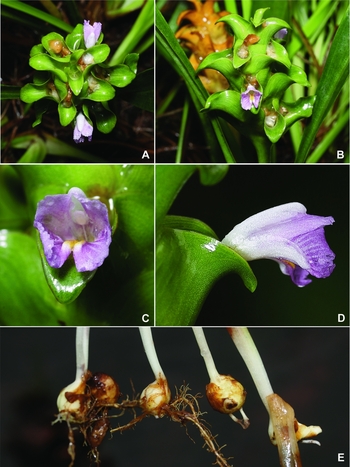
Curcuma prasina Škorničk. A, Inflorescence (top view); B, inflorescence (side view); C, flower in bract (front view); D, flower in bract (side view); E, rhizomes. From type collection Middleton et al 5889. (Photographs by P. Karaket.)

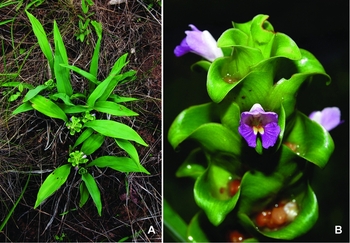
Curcuma prasina Škorničk. A, Habit; B, inflorescence with flower in front view. From Suddee et al. 4175. (Photographs by O. Phueakkhlai.)

Rhizomatous herb, 15–40 cm tall. Rhizome globose to ovoid, c.1.5 × 1–1.5 cm, externally pale yellow, but covered in rusty coloured decayed scales, internally pale yellow, root tubers c.2 × 0.6 cm (when dried), placed close to the rhizome. Pseudostem up to 12 cm long, composed of 1–3 leafless sheaths and 2–4 leaf sheaths, plain green or green with a red tinge, glabrous; ligule to 1 mm long, obscurely bilobed, hyaline, glabrous. Leafy shoot with 2–4 leaves at flowering; petiole 2–12 cm long (the first leaves may be nearly sessile), green, glabrous; lamina narrowly elliptic, 11–19 × 1.5–3.2 cm, glabrous on both sides, adaxially green, glaucous when young, abaxially somewhat paler, glaucous, margin hyaline, c.0.1 mm wide, glabrous, apex attenuate, base narrowly attenuate. Inflorescence central; peduncle 7–20 cm long, basally hidden between the leaf sheaths; thyrse 2.5–6 × 1.8–3.7 cm, composed of 6–18 fertile bracts, coma absent; bracts almost orbicular, slightly wider than long with acute and strongly reflexed apex, lower bracts 1.5–2.1 × 1.5–2 cm, gradually smaller towards the top, bright green, glabrous, connate to one another in lower half or slightly more, all fertile except the uppermost 1 or 2 bracts (these are much smaller). Cincinni with 4 or 5 flowers at the base of the inflorescence, the number gradually decreasing upwards. Bracteoles minute, one per flower, triangular, 3–5 × 1.5–2.5 mm at base, hyaline, translucent-white. Flowers c.2.5 cm long, slightly exserted from bracts. Calyx c.5 mm long (including 3 short teeth at apex), with no obvious unilateral incision, white, glabrous. Floral tube c.1.5 cm long, narrowly cylindrical and funnel-shaped towards the top, externally white, glabrous, internally white, puberulous in apical part; dorsal corolla lobe elliptic, c.6 × 3.5 mm, glabrous, white, apex slightly concave; lateral corolla lobes c.5.5 × 2.5 mm, triangular-ovate, glabrous, white, apex rounded, slightly concave; lateral staminodes unequally obovate, 7–8 × 3.5–4 mm, pale purple; labellum obovate, c.8 × 6 mm, apex bilobed, split c.3 mm, labellum pale to dark purple, with a bright yellow and swollen median band composed of two central lines extending from the base to about two-thirds the length of the labellum towards the apex, sides of the labellum with paler lines radiating towards the margin. Stamen with a slightly versatile anther, filament c.2 mm long, c.2 mm broad at base, less than 1 mm at the point of attachment, very pale pink, glabrous; anther spurless, ovate, c.3 mm long (including crest), c.1.5 mm wide at base, connective tissue pale pink, with glandular hairs on sides and back, anther thecae c.1.7 mm long, white, dehiscing along their entire length; anther crest present, obtuse, c.1.3 mm long, c.1.1 mm wide at base, pale pink, glabrous. Stigma white, unequally funnel-shaped, ostiole glabrous but minutely irregularly serrulate. Epigynous glands absent. Ovary globose to ovoid, 1.5–2 × c.1.5 mm, trilocular, cream-white, glabrous. Fruits and seeds not seen. Description based on herbarium and spirit material (Middleton et al. 5889).
Ecology and phenology
Growing in open grassland in mixed deciduous dipterocarp forest, on sandy bedrock, at altitudes from 200 to 600 m a.s.l. According to herbarium labels, this species flowers between May and August.
Provisional IUCN Red List category
The species is so far known only from three locations in Phu Wua Wildlife Sanctuary. Two of the four known collections are from the vicinity of Chet Si Waterfall (Pooma et al. 2741 and Pooma et al. 4109), and the type collection and Suddee et al. 4175 are from almost the same spot along the trail where the plant is currently fairly common. The remaining collection (Nielsen et al. 1603) does not have an exact locality within Phu Wua Wildlife Sanctuary. The total area of the sanctuary is only c.186 km2, and most of the surrounding area is agricultural land. Because the Wildlife Sanctuary receives a considerable number of tourists, and some decline in the quality of the habitat is therefore possible, the species is here proposed as being Endangered (EN B1ab(iii)), according to IUCN criteria (2016).
Etymology
From Latin prasinus, meaning ‘light green’, referring to the grass green colour of the bracts.
Additional specimens examined. Thailand: Bueng Kan: Se Ka district, Phu Wua Wildlife Sanctuary, Chet Si Falls, 26 viii 2001, Pooma et al. 2741 (L); ibid., 20 v 2004, Pooma et al. 4109 (BKF); Bung Khla district, Phu Wua Wildlife Sanctuary, 18°14′00.9′′N, 103°58′01.0′′E, 316 m, 15 vi 2010, Suddee et al. 4175 (BKF); Phu Wua Wildlife Sanctuary, without exact location, 9 viii 2004, Nielsen et al. 1603 (AAU).
As outlined in the diagnosis, Curcuma prasina is morphologically most similar to the Vietnamese species C. pygmaea. The Thai species Curcuma prasina can be readily recognised by a combination of the following characters: narrow leaves, inflorescence composed of green and fertile bracts with no coma, and flowers with pale purple lateral staminodes and pale purple labellum with a bright yellow patch at the basal central part. Although herbarium specimens of Curcuma prasina have occasionally been misidentified as C. parviflora, in the dried state it more closely resembles Curcuma gracillima Gagnep. (= Curcuma larsenii Maknoi & Jenjitt. as per Leong-Škorničková et al., Reference Leong-Škorničková, Šída, Záveská and Marhold2015) because of its narrow leaves and inflorescence shape, and hence it might be difficult to recognise unless notes on colour and/or shape of the flowers are provided. The two species are, however, unmistakable in living material, because a few of the uppermost bracts are white in Curcuma gracillima and the flower has a deeply bifid, white to yellow labellum with purple or red line markings (for comparison see Fig. 1 in Maknoi & Jenjittikul, Reference Maknoi and Jenjittikul2006, and Fig. 23.8 in Leong-Škorničková & Newman, Reference Leong-Škorničková and Newman2015). Identification of herbarium material that lacks notes on the colour of parts may be aided by the fact that Curcuma gracillima is a fairly widespread species occurring in Laos, Cambodia and southern Vietnam but has been recorded in Thailand only from Ubon Ratchathani province, whereas C. prasina would appear to be a stenoendemic species confined to Phu Wua in Bueng Kan province. Note that older collections from Phu Wua give the province as Nong Khai, but the part of Nong Khai that includes Phu Wua is now in Bueng Kan.
Acknowledgements
We thank the Asian Zingiberaceae Information Centre at Singapore Botanic Gardens and the Zingiberaceae Resource Centre at the Royal Botanic Garden Edinburgh (Newman et al., Reference Newman, Leong-Škorničková and Pullanno date) for providing protologues and other references. We also thank the curators of AAU, BK, BKF, CAL, CMU, E, HN, HNIP, HNU, K, L, P, QBG, SING and VNM herbaria for letting us examine and photograph specimens in the Curcuma parviflora complex in their care. Chandee Hemrat and Preecha Karaket are thanked for their help during the fieldwork. Preecha Karaket, Orporn Phueakkhlai and Orathai Kerdkaew are thanked for sharing photographs of the new species. The research of the first author is supported by the National Parks Board, Singapore, and the Czech Science Foundation, GAČR (grant no. P506/14/13541S), the research of the second author by the National Parks Board, Singapore. We thank the reviewers for their constructive feedback.