Introduction
If Irish is to become once more the language of a nation, it must shape itself to express all the thoughts of a modern nation’s life … The view [of Irish as an inferior language to English] more than anything else, led to the weakening in Ireland of that instinct, universal among nations, of recognizing in the national language the most essential element of national life.
(MacNeill Reference MacNeill1905:17)Footnote 1This passionate declaration by Eoin MacNeill, prolific scholar and committed revolutionary, was boldly asserted in one of his numerous writings for An Claidheamh Soluis ‘The Sword of Light’, the official bilingual weekly publication of the Gaelic League, a grassroots organization dedicated to the revival of Irish.Footnote 2 Such proclamations linking the Irish language with Irish national identity by intellectual and political leaders like MacNeill in the early 20th century became more frequent and popular in the decade directly leading up to the armed anticolonial nationalist struggle for Irish independence from Britain during the Anglo-Irish War (1919–1921). The proliferation of political efforts like MacNeill’s to link the Irish language with an independent Irish people played an undeniably productive role in the process of achieving political sovereignty (Hutchinson Reference Hutchinson1987; Ó Riagáin Reference Ó Riagáin1997; Crowley Reference Crowley2005).
Committed to Irish revitalization in a country where the overwhelming majority of people spoke English, and to Irish independence in a polity under British colonial control, MacNeill clearly looked at the Irish language as emblematic of Irish peoplehood and regarded a vital national language as indicative of a vitally unified collective community of speakers. MacNeill’s dedication to Irish nationalism, manifested in his scholarly involvement with the linguistic analysis of Irish as well as in his political involvement with nationalism, affords us the opportunity to inquire into the larger relationship between constructions of national identity and expert knowledge making. In effect, MacNeill’s unequivocal and authoritative position as a scholar-revolutionary set the parameters for naturalizing the vitality of a national language as a necessary precondition for the existence of a national collectivity. It was in this fashion and within a particular scholarly framework that Irish could be configured as “the essential and universal element of national life” of a unified Irish people. This commonplace instantiation of an “imagined national community” raises an enduring question about the nature of the relationship between language and nationhood that MacNeill assumes—namely the isomorphic relation between them. Indeed, it is a ubiquitous assumption made by theorists as well as activists in historic and contemporary nationalist movements and nation-building projects in and out of Europe (Herder Reference Herder, Moran and Goode1966; Gellner Reference Gellner1983; Handler Reference Handler1988; Anderson Reference Anderson1991; Cojtí Reference Cojtí Cuxil1994; Gal Reference Gal1995, Reference Gal, Mar-Molinero and Stevenson2006; Fischer & Brown Reference Fischer and Brown1996; Crowley Reference Crowley1996; Errington Reference Errington1998; Blommaert & Verschueren Reference Blommaert, Verschueren, Schieffelin, Woolard and Kroskrity1998; Silverstein Reference Silverstein and Kroskrity2000; French Reference French2003).
Handler underscored the importance of recognizing the ways expert scholarship and national identity formation are intimately entwined in his groundbreaking ethnographic analysis of nationalism in Quebec: “The persistent refusal to treat seriously the substantive overlap between nationalist ideology and social science theory constitutes one of the greatest obstacles to our understanding of nationalism” (Handler Reference Handler1988:8). Since Handler’s call to take a closer look at relationships between scholarly theory and national identity construction, more recent research has extended this inquiry beyond objectified notions of “language” and “culture” to examine the very theoretical assumptions that tacitly inform experts’ cultural and historical understandings of collective identity formation (Herzfeld Reference Herzfeld1987, Reference Herzfeld2001; Domínguez & Wu Reference Domínguez and Wu1998; Suny & Kennedy Reference Suny and Kennedy1999; Bauman & Briggs Reference Bauman and Briggs2003). Following this trajectory, I undertake an inquiry into the distinct role that one aspect of social theory, linguistic science in the early 20th century, played in constructions of “Irish identity,” “Irish culture,” and collective sameness in Ireland during the same period. In particular, I focus on the grammatical analyses of and scholarly writing about the Irish language conducted by a “scholar-revolutionary,” Eoin MacNeill, during the formative years of the Gaelic League and the popular mobilization of Irish nationalism in the period leading up to the successful armed struggle for Irish independence.
As I inquire into how the relationship between language and nationhood was propagated by MacNeill in his linguistic analyses and political writing, I will turn my attention to the ideological work involved in promoting particular conceptions of language and their linking with forms of social collectivities, particularly national ones (Woolard Reference Woolard, Schieffelin, Woolard and Kroskrity1998, Blommaert Reference Blommaert1999, Kroskrity Reference Kroskrity and Kroskrity2000, Irvine & Gal Reference Irvine, Gal and Kroskrity2000, Bauman & Briggs Reference Bauman and Briggs2003). Indeed, Woolard has challenged scholars to further the inquiry into the creation of nationalist ideologies of language along the following lines:
Although the validity of the nationalist ideology of language (linking a language with a collective national people) has often been debated or debunked, less attention has traditionally been given to understanding how the view of languages not only as discrete, distinctive entities but emblematic of self and community comes to take hold in so many different settings.
(Woolard Reference Woolard, Schieffelin, Woolard and Kroskrity1998:18; emphasis added)Taking up this call, I investigate one strand of the development of Irish nationalist language ideologies in Eoin MacNeill’s linguistic research. MacNeill, a central figure in the Irish language movement as well as in the armed rebellion for Irish independence, was a key social actor in several remarkable moments during the sovereignty struggle including the cofounding the Gaelic League, a sentence of life imprisonment for his part in the 1916 Easter Uprising, and an appointment as minister of education for the newly formed Irish Free State (Martin & Byrne Reference Martin and Byrne1973, Tierney Reference Tierney1980). In this essay, I pay particular attention to MacNeill’s concern with Irish sounds and sound systems and the crucial role that their regimentation plays within national identity formation and concomitant language standardization projects. This focused investigation will enable me to argue that while MacNeill used linguistic scholarship to engender nationalist sentiment around Irish, he simultaneously challenged a dominant conceptual model of language prevalent in European nationalist movements and foundational in prominent social scientific models of nationalism. In particular, I argue that MacNeill wrote against the unilateral valorization of codified linguistic homogeneity and, antiparadigmatically, embraced heterogeneous variation of speech grounded in multiple communities of Irish speakers, even as he sought to consolidate Irish national identity through sameness claims. This critical examination of linguistic ideological work entailed in MacNeill’s use of authoritative linguistic science and manifested in his analyses of the Irish language encourages scholars of nationalism to reconsider the taken-for-granted homogenizing efforts of nationalist endeavors that are presumed to negatively sanction linguistic variation.
Eoin Macneill and the Gaelic League: Linking Language Revitalization with Political Revolution
Several scholars have examined the central role that the Irish language revival played in engendering popular cultural nationalism (Hutchinson Reference Hutchinson1987, Ó Riagáin Reference Ó Riagáin1997, Crowley Reference Crowley2005). In fact, the Gaelic League was the primary institution that “successfully established language as key to the nationalist movement’s project” (Crowley Reference Crowley2005:145). Conradh na Gaeilge (the Gaelic League) was founded by a group of secular intellectuals in Dublin on July 31, 1893. The organization passionately dedicated its members to “the preservation of Irish as the National Language of Ireland, the extension of its use as a spoken language, the study and publication of existing Irish literature, and the cultivation of a modern literature in Irish” (Ó Fearaíl Reference Ó Fearaíl1975:6). As we will see, these three tenets of the Irish revival were central to MacNeill’s efforts in the scholarly-political domains of his work and, in the movement, exerted tensions between homogenization through standardization and the elevation of variation.
Although only an estimated 19.2% of the population spoke Irish at the time the Gaelic League was founded (Ó Riagáin Reference Ó Riagáin1997:5), the Irish revival was successful in capturing new public interest in the language through popular participation in the League. By 1908 there were approximately 950 branches of the League around the country with an estimated membership of 100,000 (Garvin Reference Garvin1987:40). In particular, then, the Gaelic League played a productive role in creating shared understandings of Irishness based upon ethnolinguistic identification among citizens of the British colonial territory (Hutchinson Reference Hutchinson1987, Garvin Reference Garvin1987, Grote Reference Grote1994, Crowley Reference Crowley2005). Kissane explains the centrality of the Gaelic League in engendering nationalist sentiment: “The significance of the Gaelic Revival, of which the Gaelic League was at the fore, lays not only in providing a rationale for independence, but in inculcating a theory of nationality at odds with Ireland’s continued membership of the British empire … It gave cultural themes an unusual importance in political debate” (Kissane Reference Kissane2005: 23; emphasis added). In this way, the Gaelic Revival provided the essential ballast for the Sinn Féin view that Ireland was culturally a distinct nation (Kissane Reference Kissane2005:28). That ballast of this essentialized cultural distinction that linked cultural nationalism with political sovereignty became the Irish language. It was a conception of nationality generally inculcated in the efforts of the Gaelic League and, as I will illustrate, particularly in the scholarship of its cofounder, Eoin MacNeill.
The two foremost leaders of the Gaelic League were Douglas Hyde (1860–1949) and Eoin MacNeill (1867–1945). Hyde was a Protestant from the upper middle class of the ascendancy and MacNeill was a middle-class Catholic from the North. Both men became scholars of European reputation, gained chairs in Irish Studies at the National University in 1908, and played highly visible political roles in early 20th-century Ireland (Hutchinson Reference Hutchinson1987:120–21). While historians have tended to concentrate on the charismatic Hyde, who would eventually become president of the Republic, John Hutchinson has identified Eoin MacNeill as the most representative figure of the Irish language movement: “It was in fact, MacNeill who was the architect, organizer, and philosopher of the League” (Hutchinson Reference Hutchinson1987:121).
Eoin MacNeill’s many scholarly and political accomplishments embody the fluid lines between his academic and revolutionary efforts in service of Irish nationalism, ambiguous lines that would prove to be productive for the cause of Irish independence. In 1888, MacNeill earned a B.A. degree in economics, jurisprudence, and constitutional history from the Royal University of Ireland. He then commenced the study of Modern Irish, followed by Old and Middle Irish, under Father Edmund Hogan of University College Dublin. In 1893 he cofounded the Gaelic League with Hyde and became the first editor of Irisleabhear na Gaedhilge (the Gaelic Journal) a year later. In 1899 he became the first editor of An Claidheamh Soluis. Just ten years later, MacNeill was appointed Professor of Early Irish History at University College Dublin (Tierney Reference Tierney1980).
While establishing his position as an expert on Irish in the academy, MacNeill furthered other revolutionary activities in service of Irish sovereignty, interweaving the scholarly and the political for nationalist ends. In 1913 he penned a polemic article in the Gaelic League’s weekly entitled “The North Began,” in which he outlined the growing threat of the Ulster Volunteer Force in the north to the project of home rule (Martin Reference Martin, Martin and Byrne1973:131). He charged that there was “nothing to prevent the other twenty-eight counties from calling into existence citizen forces to become an instrument of establishing self-government” (MacNeill Reference MacNeill1913:6). MacNeill’s plea for Irish civilian forces to rise up so that “the empire make terms with Ireland or let Ireland go her own way,” (1913:6) spurred a crowded public meeting in Dublin on November 25, 1913 that led to the formation of an armed militia group, the Irish Volunteers, to do just as he advocated. With MacNeill as their president, the Irish Volunteers sought “to secure and maintain the rights and liberties common to all the people of Ireland” (Tierney Reference Tierney1980:viii). MacNeill and the Irish Volunteers were centrally involved in the fateful Easter Rising of 1916. Their unsuccessful attempt in the streets of Dublin to make a claim for Irish independence spurred an excessive response of force from Britain that included the deployment of a strong military presence in the city under martial law, the arrest of approximately 3,500 people, and execution of fifteen Irish leaders.Footnote 3 The violence of the British colonial apparatus against the Irish nationalists turned mass public support in Ireland toward the revolutionary independence movement in a new way (Kissane Reference Kissane2005). For his role, MacNeill was court-martialed by British authorities and sentenced to life imprisonment. It is not fortuitous that the very same year he was elected president of the Gaelic League, as the linguistic and political were intimately wed at this pivotal point in modern Irish history. Upon his release a year later, MacNeill became a member of the Sinn Féin Central Committee. He was arrested for a second time during a night raid on his home by Crown forces in November of 1920, and his scholarly writings and correspondence going back to the early days of the Gaelic League were confiscated (Tierney Reference Tierney1980). Soon thereafter, MacNeill earned his doctor of literature degree from the National University of Ireland while actively supporting the Anglo-Irish treaty of December 1921. A year later, he became the first minister of education in the newly formed Irish Free State, a position he held until 1925 (Tierney Reference Tierney1980). MacNeill retired from political life in 1927 and dedicated himself to developing the Irish Manuscripts Commission a year later (Martin & Byrne Reference Martin and Byrne1973).
Sounds, Experts, and Nations
The interweaving of the scholarly and the political in MacNeill’s life were instantiated in his research on the Irish language, for, as Gal has shown, “Scholarly arguments about linguistic problems are simultaneously coded contests that propose to define the nation … and claims to professional expertise that can legitimately provide such definitions” (Gal Reference Gal1995:156). Indeed, a critical examination of MacNeill’s scholarship affords us the opportunity to uncover the ideological and semiotic processes by which the Irish language came to stand for the Irish people, a powerful social construction that was central to the successful nationalist project in Ireland (as in numerous other countries). In this endeavor, I rely on the theoretical insights recently developed by Irvine & Gal Reference Irvine, Gal and Kroskrity2000. Irvine & Gal outline the semiotic processes by which linguistic difference becomes mapped onto social difference. In particular, they identify iconization, “the transformation of linguistic features that index social groups appear to be iconic representations of them, as if a linguistic feature somehow depicted or displayed a social group’s inherent nature or essence,” and fractal recursivity, “the projection of an opposition, salient at some level of relationship, onto some other level” (Irvine & Gal Reference Irvine, Gal and Kroskrity2000:37–38), as key mechanisms in the process of creating language ideologies that come to be efficacious, like the nationalist one under consideration here. In the pages that follow, I scrutinize the links between “scientific” linguistic scholarship and national identity formation embedded in Eoin MacNeill’s grammatical analyses of Irish, particularly sound systems. I aim to show that MacNeill invoked a “scientific” framework in his representations of Irish sounds to support the call for an autonomous Irish people, an ethnolinguistic community conceptualized as inherently distinct from the English language and British people, engendered through iconization and fractal recursivity and naturalized by “objective” claims to knowledge.
My point of departure in examining sounds and sound systems of language lies in the fact that phonetics and phonology often become objects of scrutiny, debate, and regimentation when collective forms of social difference and sameness are under negotiation (Irvine & Gal Reference Irvine, Gal and Kroskrity2000, Errington Reference Errington2001). Indeed, efforts to regiment sounds and sound systems are often implicated with political efforts to consolidate national collective identities (Schieffelin & Doucet Reference Schieffelin and Doucet1994, French Reference French2003). This is frequently the case because the regimentation of phonetics enables the development of standardized orthographies and, in turn, standardized orthographies facilitate the proliferation of textual materials for vernacular literacy. This process often becomes key to imagining an independent and bound national community (Anderson Reference Anderson1991).
These tasks involving the scholarly regimentation of language are commonly undertaken by analysts who possess the expert knowledge deemed necessary to do so (Gal Reference Gal1995, French Reference French2003, Bauman & Briggs Reference Bauman and Briggs2003). In the context of modern western European claims to expert knowledge, science has become the dominant scholarly frame and legitimating discourse for authoritative representations of the empirically observable natural and social world, including the place of language in it (Latour Reference Latour and Porter1993, Bauman & Briggs Reference Bauman and Briggs2003). Crowley’s recent work on language politics in Ireland points out that “scientific” analyses were of great importance to the nationalist project in the pre-independence colony: “As a mode of truth, the doctrine Tír is Teanga (the nation is the language) was open to the scientific gaze of the late nineteenth century and to description in its legitimating discourses” (Crowley Reference Crowley2005:146). While Crowley focuses on ethnology in his discussion, I suggest that linguistic science played an equally central role in legitimating and naturalizing the nationalist endeavor, as evidenced in the scholarship of Eoin MacNeill.
Indeed, we find that MacNeill devoted a good deal of “scientific” scholarly attention to the phonetics and phonology of modern Irish as he spearheaded the incipient Gaelic Revival Movement of the early 20th century. One of many examples comes from a Gaelic Journal report in which MacNeill addressed the persistent question regarding the best orthography to be used in Gaelic League publications. Taking on this problem, he first turned toward European philology for answers, explaining that “the spelling of modern Irish, as a French philologist has remarked, is both historical and phonetic” (MacNeill Reference MacNeill1899:262; emphasis original). Framing the intellectual parameters for the graphemic representation of Irish within these two epistemological orientations, MacNeill preferred to privilege science over history. He developed this scientific orientation in a related essay about divergences between early Modern Irish, standardized during the period 1200–1700, and Modern Irish, in an effort to downplay the importance of historical continuity in orthographic representations of the language. In “The modern standard of Irish,” MacNeill chastised scholars who focused on the oldest forms as the inherently most preferable ones. In his words: “The student of Irish is often tempted to stand up for some isolated usage, even when it survives only in some very small district, when he finds authority for such usage in the older written forms of the language. This is surely pedantry” (MacNeill Reference MacNeill1898b:181).
MacNeill’s deep interest in phonetics and the graphemic representations of sounds becomes most apparent in his vehement disapproval of the English phonetic and graphemic systems and their effective cooptation of the Irish language. In an essay on Irish spelling conventions, MacNeill outlined differences between the definition of phonetics from popular and scientific perspectives:
Let me deal with that much-abused word “phonetic.” Owing to the fact that most of us learn to spell in English first, many imagine that spelling according to the English system, or want of a system, has a kind of divine right or prior claim to the representation of sounds. They imagine that “sh” is a more natural way of representing the “slender” sound of “s” (/∫/) than the Irish way, that the “v” is the true way of writing the sound of b (/b/) and so with other characters. And they call theses devices “phonetic.” We daily hear that such and such a thing is written “phonetically,” meaning that it is spelled in the English way. It is time we should hear no more of it. “Phonetic” means according to sound.
(MacNeill Reference MacNeill1899:262–63; emphasis original, IPA symbols added)In the above passage from the Gaelic Journal, MacNeill explicitly linked phonetics with writing in Modern Irish and then moved to launch a critique against a hegemonic notion of the term “phonetics,” which he regarded as doing nothing other than assimilating Irish sounds to English writing. The angle of his critique posited the need for a more scientifically precise definition of phonetics, a point that MacNeill further developed in related scholarship. He was quick to make the analytic distinction about Irish sounds between a perspective informed by prevailing linguistic science and one shaped by common perception based upon written conventions. He cautioned that the untrained student of language is
apt to confuse the idea of a sound with the idea of a letter which is the usual symbol of that sound. In a scientific or perfect alphabet, each sound should have a distinct letter (or character or sign or symbol, as it may be called) to represent it and this symbol should stand for one sound only. In other words, parodying the political watchword, “one man one vote,” the motto of a perfect alphabet is “one sound, one symbol.”
(MacNeill 1868–1979:LAI/C/3:4)Here MacNeill seeks to establish an isomorphic relationship between an individual sound (phoneme) and its written representation (grapheme) based upon explicitly invoked scientific principles. This relationship is recursively projected from the linguistic order onto the political order of democratic representation that MacNeill and Irish nationalists were fighting for at the time. In this way, the seemingly transparent relationship between them demonstrates how “the iconicity of the ideological representation reinforces the implication of necessity” (Irvine & Gal Reference Irvine, Gal and Kroskrity2000:37–38).
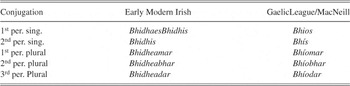
Indeed, MacNeill sought to give phonetics a more scientific direction through his analyses of Irish sounds, a good part of which was devoted to purging a contemporary Irish orthography of unnecessary graphemes. A demonstrative example of MacNeill’s efforts in this direction is visible in his discussion of the imperative form of the copula verb bi ‘to be’, which appeared in the Gaelic Journal. “The stem is bi, therefore, historically the first dh has no business in bidheadh. Phonetically, the first dh is not pronounced, and the word is a monosyllable. Hence it is clear that biodh is the correct spelling” (MacNeill Reference MacNeill1899:263). He offered a similar argument for correcting the spelling of bi in its past tense conjugations (see Table 1).
Correcting Irish orthography with a phonetic orientation.

Explicitly invoking a scientific rationale, MacNeill underscored that the Gaelic League’s orthographic choices were particularly sound because “we save the writing of several silent letters” (MacNeill Reference MacNeill1899:263). The orthographic conventions proposed by MacNeill on behalf of the Gaelic League had as their aim a systematic reduction of graphemes that would give Irish orthography a more accurate phonetic representation. This scientific specificity, in turn, would distinguish the language from others, because with a distinct phoneme-to-grapheme representational system in place, Irish representations of sounds could stand in opposition to English ones.
MacNeill highlighted this point in several related essays that appeared in the Gaelic Journal. Critiquing readers’ volunteered submissions to the journal, he stressed the inherent difference between English and Irish sounds and their orthographic expression in the pages of the League’s publication:
When we see writers using cean for ceann (head), or fuill for fuil (blood), or bi v for bi (to be), we ask ourselves how it comes to be that the same writers take the trouble to master all the intricacies and inconsistencies of English spelling, and yet cannot spell correctly Irish words that they see spelled correctly every day. It looks as if they had very little respect for their native language—certainly far less than for English.
(MacNeill Reference MacNeill1897:26)In this way, MacNeill’s and his interlocutors’ spelling choices came iconically to represent either a colonial or a national consciousness. It is this particular opposition in orthography between English and Irish systems that was recursively projected by MacNeill onto the opposition of Irish people to the British. From this semiotic perspective, an autonomous Irish writing system began to stand for a culturally autonomous Irish people. This linguistic ideological work visible in MacNeill’s scholarship productively and essentially linked the Irish language with Irish national identity and was naturalized by his claims to scientific standards rather than political ones.
Thus far, I have shown how MacNeill used linguistic science and focused on phonetic distinctions in ways that both created and naturalized an iconized relationship between the minority Irish language and the emergent Irish nation in service of the dual projects of revitalization and independence. I now move to demonstrate the ways that his writing on Irish language and linguistics deviated from nationalist norms in both historical and theoretical senses. As I will show, MacNeill privileged an ideology of heterogeneous speech over the linguistic homogenization commonly embraced by scholars and activists involved in nation-making activities and assumed to be universal in some prominent social scientific theories of nationalism. I will outline those trends in European nationalism and social theory before returning to MacNeill’s unique position, which challenges our contemporary understandings of nationalism and language politics that focus predominantly on the elevation of homogenized standards to support national sameness claims.
A Quintessential European Nation: Homogeneity and Standards
The nationalist language ideology that MacNeill engendered through his scholarship and that the Gaelic League mobilized in their activities, namely the language ideology equating a distinct language with the essence of a unified national people, has strong roots in western European intellectual traditions. Such an ideological configuration positing an isomorphic relationship between language and peoplehood was particularly strong in the philosophical orientations of Romanticism during the 18th century fueled by the work of Johann Gottfried Herder. O’Reilly (Reference O’Reilly and O’Reilly2001:79) notes that it was precisely the growing influence of Romantic philosophy that initially fueled a broader European fascination with ancient Celtic culture, particularly the Irish language. The influence of Romanticism on the study of Irish was furthered by “the emerging theoretical importance afforded to all languages by the new science of comparative philology” (Crowley Reference Crowley1996:106). In fact, “European academic interest in the Celtic languages, Irish in particular, was transformed by the publication of Zeuss’s Grammatica Celtica in 1853 and such work outside Ireland further encouraged native study of the language and texts of the past” among the colonial island’s educated population (Crowley Reference Crowley2005:134). As Crowley indicates, the historical linguistic approach developed by German neogrammarian scholarship figured centrally in the study of Irish linguistics at the time.Footnote 4 Kaspar Zeuss, a Bavarian scholar, argued against the prevailing wisdom of European philologists of the time, who had excluded Celtic languages from the Indo-European family.Footnote 5 Zeuss’s comparative philological analysis of Irish (written in Latin) grounded in a broader European family of languages was taken up by prominent Irish nationalists and referenced by MacNeill in his scholarship on Irish grammar, which situated the language as an unambiguously European one (MacNeill Reference MacNeill1892).
While western European linguists looked on Irish with a new inclusive philological perspective, Irish nationalist scholars, in turn, were quick to rely on this scientific perspective as an effective means for claiming a quintessentially “European” identity for Irish people, based on the uniqueness of their deeply historic language. As Hutchinson (Reference Hutchinson1987:167) explains, “MacNeill marshaled the Celtic scholars of Europe to reinstate Ireland as one of the original cultures of Europe.” MacNeill developed this orientation toward European belonging in Phases of Irish history (1919), in which he argued that the Irish Celts were one of the first European peoples to create a national literature. Other Gaelic League leaders and nationalists highlighted the profoundly authentic and historical nature of Irish Europeanness in their scholarly work (Hyde Reference Hyde and Reid1892, Reference Hyde1899). One elaborate version of this construction is expressed in Hyde’s manuscript “On the Irish language and early use of letters in Ireland”:
We have no possible means of reconstructing the ancient world as it was lived in by the ancestors of the leading races in Europe, the Gauls, Spaniards, Britons, and the people of all these countries which trace themselves back to a Celtic ancestry, because these races have left no literature or records behind them; and the Greeks and Romans who tell us about them saw everything through the distorting medium of their own prejudices. But now since the discovery and publication of the Irish Sagas and epics the descendants of these great races no longer find it necessary to view their own past through the coloured and distorting glasses of the Greek or the Roman, since there has now opened for them where they least expected it, a window through which they can look steadily at the life of their race or of one of the leading offshoots of their race in one of its own strongholds, and reconstruct for themselves with tolerable accuracy the life of their own ancestors. It is impossible to overrate the importance of this for the history of Europe, because neither Teutons nor Slavs have preserved pictures of their own heroic past, dating from pagan times. It is only the Celts and of these the Irish Celts who have preserved such pictures, drawn with all the intimacy of romance and given us descriptions which exhibit the life of Western Europeans at an ever earlier culture stage in the evolution of humanity than do the poems of Homer
(Hyde n.d.:8–9).Hyde not only stressed the Europeanness of the Irish language and people, but also furthered that position by configuring the Irish Celts as the oldest, most authentic, and most authoritative repository of a shared European history. These ideological configurations appear frequently in MacNeill’s work on Irish language and linguistics (1897, 1989, 1905). Hyde’s and MacNeill’s scholarly arguments grounded in historical linguistic science explicitly invoked a European debt to Irish people for the preservation of their collective European history. By situating Irish people as living ancestors to a European cultural tradition and identity preserved through and recorded in the Irish language, MacNeill and Hyde justified the recognition of Ireland as an independent nation though an iconized sameness with other sovereign European countries. In this way, their scholarly arguments about the Europeanness of the Irish language furthered the political objective that the aspiring Irish nation-state be properly recognized as independent – a “natural” manifestation of belonging to the European family of nations.
In this prevailing, historically distinct European model of isomorphism among a language, a national identity, and independent nationhood status taken up by Irish scholar-revolutionaries like MacNeill and Hyde, there is a commonplace assumption about and preference for internal homogeneity within national/linguistic borders (Blommaert & Verschueren Reference Blommaert, Verschueren, Schieffelin, Woolard and Kroskrity1998, Gal Reference Gal, Mar-Molinero and Stevenson2006). That is, from nationalist and theoretical perspectives, language is imagined to be a unitary, homogenized code that is shared equally by citizens as the basis of cultural sameness within the polity of the nation-state (Anderson Reference Anderson1991).Footnote 6 Because of this entrenched and often naturalized linguistic ideology, great efforts are undertaken to perfect the homogeneity of a given linguistic code (that is always, already variable in social use) in service to the nationalist project, and these efforts center on language standardization projects (Woolard Reference Woolard, Schieffelin, Woolard and Kroskrity1998, Gal Reference Gal, Mar-Molinero and Stevenson2006). Gal’s recent work highlights the relationship between standardization efforts and nationalist goals in the European context: “Standardization is not primarily a matter of speaking but rather of exhibiting loyalty towards a denotational code whose high status and norms of correctness are created and supported by powerful institutions such as universal education, language academies, press capitalism, linguistic science, and linguistic markets” (Gal Reference Gal, Mar-Molinero and Stevenson2006:17). Indeed, the aforementioned regimentation of sounds by MacNeill and other scholarly experts involved with the Gaelic League enabled the conditions for development of standard versions of language in the manner that Gal suggests. McNeill, Hyde, and other leaders of the Gaelic League instantiated this homogenizing direction as they strove to foster writing in Irish and develop literary forms (MacNeill Reference MacNeill1898b, Doyle Reference Doyle2001, Crowley Reference Crowley2005). However, as we will see below, Eoin MacNeill’s work also challenges this very orientation through his emphasis on linguistic heterogeneity and his caution against reliance on powerful institutions to do the work of engendering ethnolinguistic loyalty among citizens of the emergent Irish nation.
Against the Grain: Heterogeneous Speech in the Irish Nationalist Project
As I have endeavored to show, a homogenized, standard model of language deployed in nationalist movements is often enabled by the science of linguistics and scholarly “experts” writing authoritatively in the field. As Woolard highlights, scholarly activists most often “find themselves imposing standards, elevating literate forms and uses, and negatively sanctioning variability in order to demonstrate the reality, validity, and integrity of their languages” (Woolard Reference Woolard, Schieffelin, Woolard and Kroskrity1998:17). However, MacNeill exerted an antithetical force. In fact, substantive deliberation by Gaelic League leaders like Hyde and MacNeill involved issues of representing and valorizing the range of variation in modern Irish vernaculars in their nationalist endeavors. Doyle explains, “The dilemma for the revivalists of the Gaelic League era was whether to continue to use the old orthography and grammar or whether to accept caint na ndaoine (the vernacular)” (Doyle Reference Doyle2001:12). As we will see, the outcome of this debate and, in particular, MacNeill’s own ideologies of language directly challenged the normative path of nationalist agents in language politics and dominant models of language and national belonging.
Indeed, MacNeill came down hard on the side of valorizing the vernacular and privileged a model of heterogeneous speech grounded in discourse practices and communities of speakers on the island. In an article entitled “The modern standard of Irish,” published in the Gaelic Journal, he eschewed historically standardized forms of Irish. Instead, he unabashedly asserted: “The only thing we have got to build on is the Irish we find spoken” (MacNeill Reference MacNeill1898b:181). MacNeill privileged variable spoken language rather than codified written representations of Irish, explaining that “it is the tendency of dialects to diverge” (1898b:180). With keen attention to the inherent heterogeneity found in spoken Irish among its speakers in the three Gaeltacht regions, MacNeill frequently took care to document variability in his analyses of Irish grammar. For example, his discussion of the subjunctive in Modern Irish highlights multiple rather than unitary forms (MacNeill Reference MacNeill1898a:155). After outlining the derivations used to constitute the present subjunctive in Modern Irish, MacNeill focused on spoken variability among the following forms:
In Connacht, the form go mbadh (go mbudh) is used to express a wish, but varies in the other two regions.Footnote 7
Connacht: Go mbadh amhlaidh dhuit
“May it be so for you”
Munster/Ulster: Gu rab amhlaidh dhuit
“May it be so for you”
The present subjunctive of tá (present of bí) is:

In Munster, the ending of the 3rd person singular, buail-idh, mol-aidh, appears to be sometimes pronounced as –ig with unaspirated g, sometimes as a neutral vowel, buailig, molaig, or buaile, mola.
In southwest Connacht (Aran Islands and northern shores of Galway Bay), the neutral vowel alone is heard, as in most words ending in -idh or –ig.
(MacNeill Reference MacNeill1898a:155)As seen in this and earlier examples, MacNeill continued to devote particular analytic attention to sound. Yet, unlike that of many linguists whose analyses of sound are implicated in linguistic and national homogenization projects (Schieffelin & Doucet 1994, French Reference French2003), MacNeill’s scholarship on Irish sound and sound systems worked in service of a different conceptualization – the valorization of heterogeneousspeech. Writing on the hotly debated potential development of a standard Modern Irish during the years leading up to Irish independence, MacNeill extolled the importance of turning toward the valuable heterogeneity of spoken Irish. He argued: “Instead of turning away in distaste from differences of dialect, we ought, as far as possible, to turn to them, become familiar with them, and master them … If we take the opposite course and avoid all things that are not common usage, we rob the language of much of its strength and reduce it to a beggarly minimum” (MacNeill Reference MacNeill1898a:181). Embracing heterogeneous manifestations of Irish, particularly phonetic and phonological variation, MacNeill challenged the very possibility of a unitary linguistic code to standardize. He put forth the argument that “there is at present no such thing as a common, an average, or a composite pronunciation distinct from a local pronunciation” (MacNeill Reference MacNeill1868–1979:LAI/C/3/(4)) . Viewing homogenization as fundamentally detrimental to promoting and elevating Irish, MacNeill instead praised the diversity inherent in local dialect variation and suggested that fellow nationalists do the same. In so doing, he actually highlighted phonetic differences in regional linguistic variation in Irish, particularly because “phonetics is the area where the variation between dialects is most acute” (Doyle Reference Doyle2001:16).
In his uncommon approach to dialect variation, MacNeill explicitly relied on the “scientific” study of Irish by expert scholars to highlight rather than erase linguistic diversity. In a 1902 issue of the Gaelic Journal, MacNeill authoritatively called for a scientific investigation of regional variation in Irish in order to “fix an accurate basis of knowledge of the extent and character of provincial differences in the Irish vernacular” (MacNeill Reference MacNeill1902:123). He continued to prescribe a specific investigation that would document variation from Old Irish along with that of contemporary dialects in Ulster, Connaught, and Munster in the areas of phonetics and accidence (inflectional morphology). MacNeill asserted:
Much has been written erroneously and definitely on this head [phonetics]. It is best dealt with in paragraphs indicating the characteristics of vowels: long, short, affected by broad or slender juxtaposed consonants, by quiescent or transmuted consonants as well as consonants: primary, aspirated, initial, medial, and final.
(MacNeill Reference MacNeill1902:124)Here MacNeill explicitly invoked the analytic frame of linguistic science in order to diversify knowledge of the Irish language among its cultural and political enthusiasts on an island struggling for autonomy. The desired end of this scientific investigation was to enable Irish students and scholars – whose knowledge of Irish was partly or mainly based on a “familiarity with one local or provincial usage – to extend that knowledge in the easiest possible way, by comparison, to the usage of other localities and provinces” (MacNeill Reference MacNeill1902:123). In this way, the knowledge of linguistic diversity among dialects of Irish served to unify the people of the emerging nation by recognizing and utilizing equally the rich variability in Modern Irish. Even as MacNeill crafted a counter-hegemonic model of linguistic diversity in his nationalist project, he nevertheless relied on a naturalized understanding of scientific epistemology to support his position. He concluded his prescriptive call for the systematic documentation of dialect differences by highlighting that “such an accurate, uncontroversial, scientific treatment of the subject of dialectical differences would be of permanent value and authority” for the citizenry of the emergent nation (MacNeill Reference MacNeill1902:124).
Conclusion: Reconsidering Nationalism and Linguistic Homogenization
In effect, MacNeill’s efforts to appreciate, document, and command linguistic difference was the very cornerstone of his project to promote Irish as a “living, spoken language.” In this way, he went against the foundation of nationalist linguistic ideology that dominated western European models of nationhood at the time. While MacNeill was confident of the necessity for a literary future for Irish (1898b:180), he directly challenged both the validity and utility of creating a homogenized standard Irish. In fact, he wrote against the development of such a codified version of the language. As a leading scholar-revolutionary of the Irish nationalist movement, he pleaded “for no cast-iron code of rules, but for a practical working community of usage” (MacNeill Reference MacNeill1898b:180), and he assured the people of Ireland invested in the Gaelic League that “the genius, general idiom, and ordinary vocabulary of Irish, North and South are sufficiently one to give a common working basis” (1898b:180).
In sum, MacNeill offered a link between the Irish language and Irish people that defied the dominant model of language standardization and concomitant homogenization that had been and continued to be used in nationalist projects, including the post-independence Irish one. The model that MacNeill’s linguistic scholarship challenges is one that emerged in a particular western European historical moment. It is an ideology of language so powerful that it dominated intellectual and political thought among emergent nations of MacNeill’s day and continues to be powerful today among struggling polities seeking recognition (Woolard Reference Woolard, Schieffelin, Woolard and Kroskrity1998, Bauman & Briggs Reference Bauman and Briggs2003, Gal Reference Gal, Mar-Molinero and Stevenson2006, French Reference French, Niño-Murcia and Rothman2008). In fact, MacNeill cautioned his fellow citizens of the soon-to-be-independent Irish nation against uncritically relying upon these inherited European models of standardization:
I have heard it advanced that the dialect that shows itself to the best effect will eventually become the standard. This has happened in Italy, in France, in England, in Greece, everywhere in fact. Are the cases parallel? At what cost will the result be secured? Where will the other dialects be when it is secured?
(MacNeill Reference MacNeill1898b:181)The cost, in addition to loss of diversity, MacNeill later suggests, might be an ultimately unsuccessful nationalist language project that relied too heavily on powerful institutions like the educational system to do the work of linguistic reproduction. While MacNeill strongly advocated that Irish be required for matriculation in the National University, he cautioned that efforts such as a governmental requirement to teach Irish in the schools, while laudable, were potentially detrimental and delusionary:
This delusion about the necessity of laws is paralyzing action. ‘The only way to save the Irish language is to have it taught in the schools,’ i.e. to have its teaching legalized by some board. No thought of the fireside where board’s laws have no jurisdiction. The real meaning of this notion, that by legalizing a thing, you mean getting somebody else to do for you what you can do for yourself. (MacNeill Reference MacNeill1868–1979: LAI/E/15). It was in the multiplicity of Irish dialects spoken by individual families and their communities that MacNeill saw the ultimate promise of Irish preservation for the nation.
MacNeill’s interrogation of the naturalized relationship between linguistic standards and national homogenization projects in service of political sovereignty efforts serves as an additional caution to contemporary scholars of language ideologies and nationalisms. It underscores that analysts of language and politics should not assume that hegemonic nationalist ideologies of language are monolithic or seamless even as they have become globally ubiquitous. The example of MacNeill’s counter-hegemonic tendency through the use of authoritative linguistic analyses in service of political autonomy illustrates an alternative conception of linguistic diversity in nationalist movements that has largely gone without discussion. It is an “expert” conceptualization that views linguistic heterogeneity as an asset to, rather than an impediment for, a unified people within a nation’s borders. In effect, MacNeill privileged linguistic diversity even as he quite successfully engendered national sameness claims in service of Irish cultural and political sovereignty.Footnote 8