


State Sen. Amanda Chase is calling for a forensic audit of Virginia’s 2020 election results. Fortunately, Virginians have a vaccine for this political sophistry…Voting remains the ideal antidote to ‘the big lie’ of election fraud.
—Letter to the Editor, Richmond Times-Dispatch, 11 August 2021.
Introduction
On 6 January 2021, Virginia State Senator Amanda Chase traveled to Washington, DC, to participate in the ‘Stop the Steal’ Rally in protest of the 2020 presidential election outcome. Speaking before a crowd outside the US Capitol building, Chase said, ‘We know this election was fraudulent and they have stolen the vote…We are asking [members of Congress] to openly contest this election which we know was stolen from the people of the United States of America’. Consequences for these actions soon followed. Chase was censured by the Virginia Senate two weeks later in a bipartisan vote and removed from her committee assignment. During the 2021 legislative session, she appeared as a co-sponsor on only sixteen bills, including just two with Republican leadership – considerably fewer than the 115 total bills and twenty-seven with party leaders she cosponsored the previous year. When Chase ran for re-election in 2023, the party donated $24,069 to her campaign – down from $77,778 in 2019. She ultimately lost that 2023 election in the Republican primary by a 1.7 per cent vote margin to challenger Glen Sturtevant, who went on to win her seat.
Senator Chase’s experience, on the surface, illustrates a familiar story of democratic accountability: an out-of-step legislator was voted out of office. Typical explanations for this outcome might include the argument that Chase lacked ideological alignment with her district (Canes-Wrone et al. Reference Canes-Wrone, Brady and Cogan2002) or her party (Pearson Reference Pearson2015). However, in reality Chase was not substantially misaligned with her party or constituents on policy positions or ideology. Instead, journalistic coverage following January 6th suggests that she was rebuked by her legislative peers, party, and voters for her public actions against the peaceful transition of power after a free and fair election. These multifaceted sanctions highlight an important question for scholars of representation: are democratically elected officials systematically held accountable if they engage in undemocratic practices?
We examine this question through a case study of anti-democratic actions taken by US state legislators who refused to accept Donald Trump’s defeat following the 2020 presidential election. Democratic backsliding constitutes the erosion of any institutions or norms that safeguard contestation and participation (Druckman Reference Druckman2024). However, in practice, this erosion is uneven: actors who enforce accountability impose harsher sanctions for transgressions against some democratic principles (for example free speech) compared to others (for example compromise), reflecting differential evaluations of their importance (Ahmed Reference Ahmed2023; Carey et al. Reference Carey, Helmke, Nyhan, Sanders and Stokes2019 Reference Carey, Clayton, Helmke, Nyhan, Sanders and Stokes2022). We extend this logic by proposing that the nature of democratic transgressions also conditions the strength of accountability responses. Put differently, all transgressions against the same democratic principle will not face equal accountability. In the context of our study, we employ novel data on state legislators who publicly rejected the 2020 presidential election outcome through their online actions (for example social media posts about the ‘Big Lie’), offline behaviors (for example signing letters to decertify results), and attendance at the ‘Stop the Steal’ Rally at the US Capitol on 6 January. By examining multiple forms of transgression associated with the same democratic principle (free and fair elections), we assess how the mode of norm violations conditioned accountability.
We expect that the prominence of an anti-democratic action can matter just as much for accountability as the particular democratic norm that it violates. Thus, even violations of fundamental principles of democracy may go unpunished if these transgressions are not widely observed or recognized as anti-democratic. We expect that dramatic, highly public actions against democratic norms, such as participation in the events of 6 January at the US Capitol, generated the strongest accountability response. In contrast, less prominent acts faced weaker repercussions. This theoretical framework may help to clarify mixed findings regarding the strength of accountability in the context of 2020 election denialism (see, for example, Bartels and Carnes Reference Bartels and Carnes2023; Curry and Roberts Reference Curry and Roberts2025; Jacobson Reference Jacobson2023; Malzahn and Hall Reference Malzahn and Hall2025). To test our expectations, we first assess the descriptive differences in the prominence of these various anti-election actions through media coverage. We then estimate the effects of these actions on the electoral fortunes, legislative connectedness, and campaign funding from party sources of these election deniers. To our knowledge, this analysis constitutes the most comprehensive evaluation to date of the consequences for 2020 election denialism, capturing varied anti-democratic acts across multiple venues of accountability.
The decision to take action(s) against the outcome of the 2020 presidential election was entirely under legislators’ control. Our empirical strategy aims to mitigate confounding due to this systematic choice. We measure pre-action versions of all outcome variables and compile data on other pertinent pre-action covariates, including the legislators’ ideology, district ideological preferences, and state-level presidential election vote margin in 2020. We balance these covariates with a weighting method and then estimate weighted regression models to isolate the unique impacts of anti-election actions on the outcomes of interest.
We first demonstrate empirically that different types of anti-election actions can generate variation in prominence. State legislators at the US Capitol on 6 January received significantly more media attention for their actions than those involved in other forms of election denialism. Building on these descriptive analyses, we show that state legislators who took online and offline actions contesting the 2020 election outcome saw negligible accountability from the public, their legislative peers, and political parties. The strongest patterns of accountability were observed among the sixteen state legislators present at the Capitol on 6 January. However, although these latter effects are substantively noteworthy, it is important to acknowledge that their associated uncertainty estimates are also large, warranting some caution in interpretation.
Heterogeneity in democratic accountability for election denialism among state legislators is normatively significant because these lawmakers wield substantial authority over election administration, making their behaviors central to the health of American democracy. In this way, our case study suggests a nuanced conclusion regarding democratic accountability. If prominent, yet isolated, anti-election actions elicit stronger punishment than more widespread but equally harmful behaviors, the threshold for responsiveness may be too high to safeguard democratic health. While not as iconic as the images of January 6th, less prominent acts may prove more dangerous to the US political system by enabling continued subversion of democratic principles.
The Role of State Legislatures in Democratic Backsliding
The influence of political elites on the rise and fall of democracy is well established. This line of work documents how politicians with extremist and authoritarian tendencies manipulate democratic systems to benefit themselves, all while gaining voter approval through ideological appeals (Bartels Reference Bartels2023; Ziblatt and Levitsky Reference Ziblatt and Levitsky2018). Elite rhetoric has the power to sway public support for democratic principles and erode confidence in political institutions (Berlinski et al. Reference Berlinski, Doyle, Guess, Levy, Lyons, Montgomery, Nyhan and Reifler2023; Braley et al. Reference Braley, Lenz, Adjodah, Rahnama and Pentland2023; Clayton et al. Reference Clayton, Davis, Nyhan, Porter, Ryan and Wood2021). The result is a reinforcing cycle of democratic dysfunction, social polarization, and declining support for democracy (Kaufman and Haggard Reference Kaufman and Haggard2019). Common implications for democratic backsliding include weakening checks on the executive branch, as well as diminishing legislative quality and policy deliberation (Sebők et al. Reference Sebők, Kiss and Kovács2023).
Given the critical role of political elites in sustaining democracy, an important measure of democratic health is whether policy makers face accountability for undermining democratic norms and institutions. In the US, recent research finds that members of Congress (MCs) who voted against the certification of the 2020 presidential election saw reduced cross-party collaborations and lower legislative effectiveness (Curry and Roberts Reference Curry and Roberts2025), but did not suffer – and may have benefited – in their subsequent election (Bartels and Carnes Reference Bartels and Carnes2023; Jacobson Reference Jacobson2023; but see Malzahn and Hall Reference Malzahn and Hall2025). Experimental research similarly finds mixed evidence for the punishment of politicians who engage in democratic transgressions (see, for example, Carey et al. Reference Carey, Clayton, Helmke, Nyhan, Sanders and Stokes2022; Graham and Svolik Reference Graham and Svolik2020; Krishnarajan Reference Krishnarajan2023). These conflicting results suggest a need for additional investigation into the nuances of democratic accountability. Furthermore, absent from this line of inquiry is an examination of anti-democratic behaviors among a critical set of politicians: state legislators.
State legislatures are uniquely positioned as high-leverage points for the health of American democracy. However, recent studies highlight that state governments have become significant contributors to democratic backsliding in contemporary US politics. This trend is attributable to affective polarization in state electorates, demographic change in the states, historical inequities, and rising inequality (see, for example, Mickey Reference Mickey2022; Olson Reference Olson2025). State lawmakers tend to reject compromise and the institutions that promote it (Anderson et al. Reference Anderson, Butler and Harbridge-Yong2020; Kirkland and Harden Reference Kirkland and Harden2022), yielding gridlock and ‘tolerance for authoritarian leadership’ (Mickey Reference Mickey2022, 119). Major policies enacted by state legislatures have exacerbated this polarization (Campos et al. Reference Campos, Harden and Bussing2024; Fordham Reference Fordham2024) and contributed to democratic decline (Grumbach Reference Grumbach2023), particularly in states where the presidential election in 2020 was closely contested (Grumbach and Hill Reference Grumbach and Hill2023, but see Druckman et al. Reference Druckman, Kang, Chu, Stagnaro, Voelkel, Mernyk, Pink, Redekopp, Rand and Willer2023).
The role of state legislators in administering elections further underscores their influence in preserving – or undermining – democratic governance. Due to the decentralized nature of the US electoral system, state governments exert considerable authority over electoral administration. For this reason, holding state legislators accountable for actions that threaten electoral integrity is essential for maintaining democratic stability. In what follows, we leverage novel data to examine a diversity of anti-election actions taken by state legislators following the 2020 presidential election. We expect to observe heterogeneous punishment for anti-democratic acts across multiple venues for accountability, arguing that variability in the prominence of different kinds of action allows some severe transgressions to go unchecked, thus worsening democratic backsliding.
Accountability for Anti-Democratic Actions
There exists a long-standing finding that democratic attitudes in the United States are positive and strong (see, for example, Dahl Reference Dahl1966; Holliday et al. Reference Holliday, Iyenga, Lelkes and Westwood2024), while support for undemocratic practices is minimal (Druckman et al. Reference Druckman, Kang, Chu, Stagnaro, Voelkel, Mernyk, Pink, Redekopp, Rand and Willer2023). Recent studies offer a more nuanced perspective, indicating that tolerance for violations of democratic norms and institutions varies significantly across different contexts (see, for example, Graham and Svolik Reference Graham and Svolik2020; Simonovits et al. Reference Simonovits, McCoy and Littvay2022; Svolik Reference Svolik2019). This variability stems in part from differences in how the public and other elites evaluate the importance of specific democratic principles. Ahmed (Reference Ahmed2023) proposes that these principles fall into distinct categories, such as rules of laws (for example free and fair elections), democratic norms (for example judicial deference), and democratic ideals (for example cross-party compromise). Violations of democratic principles across these categories pose varying levels of threat to democracy. For instance, Carey et al. (Reference Carey, Helmke, Nyhan, Sanders and Stokes2019) show that large majorities view fraud-free elections, free speech, and equal rights as essential to democratic governance, while cross-party compromise and democratic participation are seen as less important. Supporting these results, other work documents more consistent accountability for transgressions against foundational norms and institutions (Ahmed Reference Ahmed2023; Carey et al. Reference Carey, Clayton, Helmke, Nyhan, Sanders and Stokes2022).
According to Weingast (Reference Weingast1997), democratic accountability requires consensus on the core principles of democratic governance and the ability of those responsible for enforcing accountability to recognize legitimate transgressions. This underscores the theoretical significance of differentiating between violated democratic principles and the specific nature of violations. Extending prior research, we argue that certain anti-democratic actions elicit stronger accountability responses than others, even when linked to the same democratic principle. To place this theory in the context of our case study: rejecting an election outcome can occur through various actions (for example spreading misinformation, attending a rally, introducing decertification legislation), and we assert that accountability responses vary depending on the mode of the transgression.
We posit that the strength of accountability hinges on the prominence of an anti-democratic action. We build on the perspective that voters hold elected officials accountable when they perceive deviations from their preferences, which motivates officials to align their actions accordingly (see, for example, Canes-Wrone et al. Reference Canes-Wrone, Brady and Cogan2002; Fearon Reference Fearon, Przeworski and Stokes1999; Porter Reference Porter2022). Lawmakers whose actions clearly violate democratic norms become focal points of scrutiny, prompting responses from other actors who either sincerely aim to defend democratic principles or see strategic value in punishing democratic transgressions.Footnote 1 However, such awareness and engagement are not assured. Accountability often weakens due to insufficient information (Rogers Reference Rogers2023) or knowledge (Druckman et al. Reference Druckman, Kang, Chu, Stagnaro, Voelkel, Mernyk, Pink, Redekopp, Rand and Willer2023; Klašnja Reference Klašnja2017). Under these conditions, voters may lack the ability to recognize behaviors that transgress their democratic values, and, in return, politicians and their parties may lack the motivation to punish their colleagues. In this way, we posit that even democracy’s supporters can facilitate democratic erosion, complementing theories of accountability as self-enforcing (Weingast Reference Weingast1997).
We next outline our expectations regarding democratic accountability for state legislators’ anti-democratic actions following the 2020 election across multiple venues for accountability. Following our theoretical framework, we hypothesize that different anti-election acts elicited varying degrees of punishment. Specifically, we expect that legislators involved in the protest at the US Capitol on 6 January faced the harshest penalties. Conversely, we expect that less prominent anti-democratic acts that took place online (for example spreading misinformation on social media) and offline (for example promoting election decertification within state legislatures) saw weaker accountability.
Critically, these online and offline actions do not constitute less severe threats to democracy. It is widely recognized that maintaining free and fair elections is essential to democratic governance (see Carey et al. Reference Carey, Helmke, Nyhan, Sanders and Stokes2019). Thus, rejecting an election outcome that was, in fact, free of fraud represents a serious democratic transgression (Ahmed Reference Ahmed2023). As public figures with online followings, state legislators can influence political discourse through their online rhetoric (Kim et al. Reference Kim, Nakka, Gopal, Desmarais, Mancinelli, Harden, Ko and Boehmke2022). To that end, scholarship demonstrates that elite claims of election fraud in 2020 eroded public trust in electoral institutions (Clayton et al. Reference Clayton, Davis, Nyhan, Porter, Ryan and Wood2021) and undermined support for democratic ideals (Hall and Druckman Reference Hall and Druckman2023). Lawmakers who took action within state legislatures exploited their institutional authority to contest legitimate democratic processes, thereby endangering the impartiality of election administration (Butler and Harden Reference Butler and Harden2023). Per Ahmed (Reference Ahmed2023), violations such as these can quickly escalate to significant backsliding, and are among the most threatening democratic transgressions.
Accountability within the Electorate
Following the 2020 presidential election, political elites’ anti-democratic actions were extensively documented by party organizations, media, and good governance groups, highlighting the significant risks posed to American democracy. This widespread discourse ensured that democratic integrity issues remained salient for voters (Arnold Reference Arnold1990), thereby enhancing traceability and creating conditions conducive to electoral accountability. However, strong partisan loyalties can lead some voters to tolerate anti-democratic actions from politicians within their party, potentially weakening accountability (Graham and Svolik Reference Graham and Svolik2020; Jacobson Reference Jacobson2024; Svolik Reference Svolik2019; Wunsch et al. Reference Wunsch, Jacob and Derksen2025). Still, even highly partisan voters remain sensitive to candidates’ general election viability, recognizing the electoral consequences of diminished candidate ‘electability’ (Lockhart and Hill Reference Lockhart and Hill2023; Simas Reference Simas2017). Such strategic electoral considerations can partially compensate for weaker forms of sincere accountability. In summary, we predict that voters were likely to view state legislators engaging in anti-election behaviors as either misaligned with their democratic preferences or as a threat to their party’s electoral prospects. We anticipate that state legislators who engaged in election denialism experienced diminished electoral success, including at the primary stage.
Hypothesis 1a: Compared to those who did not act against the 2020 election, election-denying state legislators (a) were less likely to advance from their primary election and (b) received a smaller general election vote share in the subsequent election cycle.
The public response to anti-election actions following the January 6th insurrection varied significantly. The insurrection garnered extensive attention at local, national, and international levels, with surveys indicating widespread public awareness and broad condemnation (Jacobson Reference Jacobson2024; Pew Research Center 2022). In contrast, online election denial rhetoric and other offline actions were less visible and likely seemed less explicitly anti-democratic to some citizens. These actions may be more easily rationalized or overlooked due to their relative subtlety, complexity, and prevalence (Druckman Reference Druckman2024; Krishnarajan Reference Krishnarajan2023). Indeed, public opinion is more divided on whether these forms of election denialism represent clear violations of democratic electoral norms (Jacobson Reference Jacobson2024). We argue that this combination of reduced visibility and heterogeneous public tolerance weakened the potential for democratic accountability. Thus, while we anticipate negative electoral repercussions across all anti-election behaviors, we posit that accountability was strongest for state legislators who were physically present at the US Capitol on 6 January.
Hypothesis 1b: State legislators who attended the US Capitol insurrection faced larger electoral penalties compared to those who engaged in other forms of election denialism.
Accountability within Legislative Institutions
On the institutional side, engaging in undemocratic actions presents a strategic challenge for legislators and their parties. Legislators must maintain strong interpersonal connections within and across party lines to achieve policy goals and advance their careers (see, for example, Fong Reference Fong2020; Kirkland Reference Kirkland2011). Even in today’s polarized environment, legislative success most often necessitates compromise between minority-party members and moderates within the majority (see, for example, Curry and Lee Reference Curry and Lee2020; Harden and Kirkland Reference Harden and Kirkland2021). A lawmaker who publicly acts against democratic principles is likely to become a political liability to parties and their members (Druckman et al. Reference Druckman, Kang, Chu, Stagnaro, Voelkel, Mernyk, Pink, Redekopp, Rand and Willer2023). These legislators are not useful allies in passing legislation, supporting their party’s agenda, or ensuring effective governance. Perhaps most critically, broad support for democratic principles among constituents (Carey et al. Reference Carey, Helmke, Nyhan, Sanders and Stokes2019; Holliday et al. Reference Holliday, Iyenga, Lelkes and Westwood2024) means that parties and their members also have strong re-election incentives to distance themselves from legislators who undermine electoral integrity.
An observable implication of this backlash against election-denying lawmakers is a decrease in the significance of interparty and intraparty bill co-sponsorship. Co-sponsorship of legislation is a meaningful relational indicator of collaboration and commitment to policy ideas (see, for example, Bernhard and Sulkin Reference Bernhard and Sulkin2013). All else equal, lawmakers with numerous, varied, and important co-sponsorship ties are key players in the chamber (Kirkland Reference Kirkland2011). We posit that lawmakers avoid working with peers who engage in undemocratic practices, leading to a decline in the centrality of election-denying legislators within their legislature’s co-sponsorship network.
Hypothesis 2a: Compared to those who did not act against the 2020 election, election-denying state legislators experienced a decrease in bill co-sponsorship network connectedness within (a) their party, (b) the opposing party, and (c) their party’s leadership in the subsequent legislative session.
Legislators constantly compete with the opposing party, making decisions to hold colleagues accountable for election denialism a strategically complex calculation. They may be hesitant to publicly rebuke co-partisans for undemocratic behavior due to potential political costs. Indeed, anti-democratic behavior can have political value, helping politicians and parties to attain power, maintain control, and ensure their preferred outcomes (Hassan et al. Reference Hassan, Mattingly and Nugent2022). Other-party legislators also face a trade-off in enforcing accountability. Sanctioning opponents for trespasses against democracy is a messaging opportunity; for example, Curry and Roberts (Reference Curry and Roberts2025) highlight instances where Democratic MCs replaced election-denying Republican co-sponsors with other-party colleagues who voted to certify the 2020 election results. However, this kind of punishment could backfire if the actions in question are not widely regarded as antagonistic to democracy. We expect that state legislators present at the US Capitol on 6 January faced the harshest repercussions both within their own party and across the aisle. Their highly visible actions presented the clearest imperative – and strongest incentive – for fellow legislators to distance themselves from anti-democratic behavior.
Hypothesis 2b: State legislators who attended the US Capitol insurrection experienced the largest decrease in co-sponsorship network connectedness.
Accountability within Party Organizations
Legislative actions are not the only method available to parties seeking to sanction members who engage in anti-democratic behavior. State legislative party campaign committees pursue the strategic goal of winning or maintaining legislative majorities, typically by selectively allocating campaign funds to candidates in competitive races (see Hogan Reference Hogan2002). However, Gierzynski (Reference Gierzynski1992) describes a more nuanced strategy in which party organizations consider the broader popularity of the party within the state. Maximizing resources to support an individual legislator – even one facing a tight race – may not be optimal if doing so undermines the party’s overall electoral appeal. From this perspective, we posit that state parties deprioritize legislators who engage in undemocratic behaviors, providing less financial campaign support. Such legislators represent political liabilities, making them riskier and less attractive investment targets compared to their peers.
Hypothesis 3a: Compared to those who did not act against the 2020 election, election-denying state legislators received less campaign funding support from their party in the subsequent election cycle.
The issue of visibility in election denialism remains relevant in the context of party fundraising. Reducing support is less urgent if a legislator’s actions are not widely recognized or perceived as anti-democratic. However, withholding resources from a legislator whose anti-democratic behavior is highly visible is a clearer strategic decision, as this legislator poses a significant risk to their party’s statewide reputation – even beyond a single election cycle. Because protesters who participated in January 6th were largely seen as violating democratic norms (Jacobson Reference Jacobson2024), we posit that party organizations penalized these lawmakers most severely.
Hypothesis 3b: State legislators who attended the US Capitol insurrection experienced the largest decreases in campaign funding support from their party.
This comprehensive view of accountability underscores the importance of democratic institutions to a diverse range of stakeholders. While our analysis centers on a core group of principals – voters, legislators, and party organizations – our theory could readily extend to other stakeholders in democratic governance, such as political action committees (PACs), private firms, and organized interest groups (see Li and DiSalvo Reference Li and DiSalvo2023). In the next section, we outline our empirical tests of these expectations. Additionally, in the Supporting Information (SI), we theoretically and empirically explore potential heterogeneity arising from contextual differences across state legislatures.
Measuring Anti-Election Action
We define our population of interest as Republican state legislators who held office continuously from 2020 into 2021. These lawmakers experienced a partisan defeat in the 2020 presidential election and exhibited individual-level variation in response to that outcome. We identified this population from Shor and McCarty’s (2011) data on state legislators’ ideological ideal points, official legislative rosters from the states, and Ballotpedia – a non-profit aggregator of US elections data. From this universe of cases, we compiled comprehensive information on each state legislator’s actions related to 2020 election denialism.
Data on state legislators’ actions against the 2020 election are drawn from a reference document compiled by the Democratic Legislative Campaign Committee (DLCC), an organization within the Democratic Party that promotes the election of Democrats to state legislatures. The DLCC compiled extensive information in a 380-page document on the anti-election actions of state-level officials and candidates affiliated with the Republican Party, covering the period from November 2020 to October 2022.Footnote 2 Although this resource was generated with partisan intent, it is structured as a source book with primary and secondary materials documenting each purported action. Generally, supporting evidence came directly from legislators (for example their social media posts) or verified press reports on legislators’ behavior. The DLCC’s complete Source Book is publicly available online; thus, its contents are easily verified (Democratic Legislative Campaign Committee 2022). See the SI for direct examples from our coding process.
We collected data from the DLCC’s materials on three forms of election denialism. We recorded indicator variables for each type, coding ‘1’ if the legislator took that type of action before the end of their state’s 2021 legislative session and ‘0’ otherwise. Figure 1 illustrates the considerable state-level geographic dispersion in anti-election behaviors among our population of interest. Republican legislators in forty-two states took action against the election, but the proportion of state-level legislators engaging in these acts varied widely. Fewer than 10 per cent of lawmakers from the Republican Party in Alabama (2 per cent), California (9 per cent), and Indiana (1 per cent) engaged in anti-election behaviors, while over 60 per cent did so in Arizona (63 per cent), Oklahoma (65 per cent), and Pennsylvania (72 per cent).
Geographic distribution of state legislators’ actions against the 2020 election.
Note: the graphs plot the relative frequency of actions taken by Republican state legislators against the 2020 election.

The first variable we collected measures online anti-election actions (Figure 1, panel a). This category identifies legislators who publicly supported the events of 6 January or election denialism on platforms such as X (formerly Twitter) and Facebook. Examples include sharing claims of a stolen election and posting content that downplayed the insurrection. Our next variable measures offline anti-election actions (Figure 1, panel b). This category identifies legislators who took anti-election actions in their capacity as elected officials. Examples include serving as signatories on letters requesting a forensic audit of election results or introducing resolutions within legislatures to express ‘no faith’ in the validity of the election results. Finally, we collected data on each legislator’s physical presence at the US Capitol on 6 January (Figure 1, panel c). Proof of attendance at the Capitol came either directly from legislators’ statements on social media or indirectly through credible news reports linked in the DLCC’s documentation. It is important to note that only sixteen legislators fit into this category, which necessitates caution in our inferences (see below) and limits the generalizability of our results.Footnote 3 Still, we assert that the significant magnitude of these legislators’ choice to participate in the events of 6 January merits empirical analysis, despite this limitation.
Figure 1, panel (d) consolidates these three previously outlined categories into a distribution of any election-denying action, highlighting the widespread nature of undemocratic acts against the 2020 election. The strongest pairwise correlation between action types is just +0.30 (online action and appearance at the Capitol). Across the complete data, 80 per cent of Republican legislators took no action, 19 per cent engaged in exactly one action, and 1 per cent engaged in two or more.Footnote 4
Demonstrating Variation in the Prominence of Election Denialism
As outlined in our theoretical framework, we anticipate that state legislators who were present at the US Capitol on 6 January 2021 faced greater accountability compared to those who engaged in other forms of election denialism, whether online or offline. We argue that this variation in accountability was driven by differences in the relative prominence of these actions, which can be assessed along several dimensions. One key dimension is the perceived severity of the specific transgression against the 2020 election outcome. Jacobson (Reference Jacobson2024) finds that while the public overwhelmingly condemned individuals who stormed the Capitol, responses to other undemocratic actions against the presidential election outcome were more divided, reflecting uncertainty about whether these actions constituted genuine democratic violations. Another critical dimension is visibility – the extent to which voters were aware of legislators’ actions and could readily attribute these behaviors to specific individuals. Surveys conducted after January 6th indicated that 70 per cent of US adults reported hearing ‘a lot’ about the riot (Pew Research Center 2022). However, to our knowledge, there are no accounts linking this opposition specifically to the actions of state legislators. Importantly, these dimensions of prominence are endogenous; perceptions of severity may heighten visibility and vice versa, complicating efforts to clearly distinguish which dimension most influences accountability.Footnote 5
To establish variation in the prominence of anti-election actions in the context of our study, we descriptively assess the volume and content of the press coverage these actions received. Prior research highlights the central role of the media in shaping public awareness and accountability for state legislators’ election-denying behavior (Myers Reference Myers2025; Rogers Reference Rogers2023). Media coverage also responds to public perceptions of issue importance (Neuman Reference Neuman1990). Therefore, press coverage provides a meaningful proxy for evaluating the relative prominence of different types of anti-election actions. We collected news stories published online and in print by journalistic media outlets from 6 January 2021 to 31 December 2022.Footnote 6 Text was accessed online via NexisUni; see the SI for a complete discussion of our data collection process. We gathered press coverage for all state legislators who were in Washington, DC, on 6 January and a random sample of state legislators who engaged in online and offline anti-election action.Footnote 7 We additionally collected news coverage for a sample of legislators who, according to our measurement strategy, did not engage in any acts of election denialism to establish a baseline for news coverage quality and quantity.
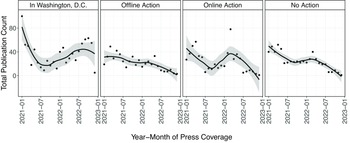
Using these text data, we first measure the volume of media coverage on sampled state legislators. Figure 2 plots monthly counts of news articles published between 2021 and 2022 that referenced the state legislators in our sample. We categorize publication counts by action type. News coverage for both election-denying state legislators and those who did not engage in such behavior remained relatively consistent. The notable exception is legislators who were in Washington, DC, during the insurrection; the number of articles covering these legislators spiked in January 2021. Moreover, their volume of articles steadily rose from mid-2021 to early 2023, while coverage of all other types of legislators declined to varying degrees. Importantly, these plots do not indicate the degree to which this news coverage addressed state legislators’ election-denying behaviors.
Count of news publications about state legislators by month 2021–2.
Note: the graphs plot monthly counts of news articles published between 2021 and 2022 that referenced state legislators in our sample. The trend lines are locally estimated scatterplot smoothing (LOESS) fits with shaded 95 per cent confidence intervals.

To systematically measure the proportion of content within news articles about state legislators devoted to 2020 election denialism, we employ a keyword-assisted topic model (keyATM) as developed by Eshima et al. (Reference Eshima, Imai and Sasaki2024). KeyATM is a semi-supervised topic model that enables the targeted measurement of topics by specifying topical keywords prior to model fitting. In our analysis, we define an election-denialism topic using keywords such as ‘election’, ‘trump’, ‘january’, ‘insurrection’, ‘overturn’, and ‘conspiracy’. Further methodological details, including robustness checks with alternative keyword specifications, are provided in the SI. To validate the substantive interpretation of our election denialism topic, we also present excerpts from randomly selected documents, along with their corresponding topical proportions, in the SI.
Figure 3 plots the average proportion of content dedicated specifically to election denialism in each news article, by month. Coverage referencing state legislators who were present at the Capitol in January 2021 allocated, on average, more than 30 per cent of its total content to the election-denialism topic during that initial month. Although this proportion decreased in subsequent months, it remained notably high, averaging around 12 per cent of article content. In contrast, coverage of legislators who participated in other anti-election activities contained minimal content explicitly focused on election denialism. In fact, the prevalence of election-denial content for these legislators was virtually indistinguishable from that of legislators who engaged in no anti-election activities at all. In a qualitative examination of these news articles (see examples in the SI), we find that the individual visibility of the online and offline actions can be limited. Reporting on these actions typically constituted publishing lists of names (for example all signatories on a letter), essentially spreading the accusation of undemocratic practices rather than highlighting individual actors.
Average document-level proportion of election denial topic by month 2021–2.
Note: the graphs plot the monthly average proportion of content on election denialism in the news articles in the sample. The trend lines are LOESS fits with shaded 95 per cent confidence intervals.

The sustained association between state legislators who participated in January 6th and the topic of election denialism – observed even months or years after the event – provides descriptive evidence linking direct participation in the insurrection to lasting reputational consequences. These patterns highlight the exceptional visibility and recognizability of this specific transgression in relation to the outcome of the 2020 election, starkly contrasting with the coverage of online and offline actions. In the next section, we empirically evaluate whether this variability in the prominence of acts against the 2020 election outcome correlated with the strength of accountability for those acts.
Research Design
Building on the perspective that state legislators’ actions displayed heterogeneous prominence, we assess accountability for election denialism perpetrated online, offline, and in Washington, DC, on 6 January. We employ data that details (1) state legislative election outcomes preceding and succeeding the 2020 election, (2) patterns of bill co-sponsorship before and after that election, and (3) campaign funding provided by state Republican Party organizations across election cycles.
Accountability within the Electorate
To determine whether state legislators are held accountable for their anti-election actions, we analyze electoral performance using Ballotpedia data on state election outcomes. We focus on each legislator’s primary and general results for cycles before and after the 2020 election.Footnote 8 State legislative elections are often uncontested, particularly at the primary stage (Rogers Reference Rogers2023). Accordingly, our first outcome of interest indicates whether a legislator advanced out of the primary. Because general elections produce more competition, our second outcome of interest examines vote shares in these contests. Our empirical strategy (detailed below) accounts for election-related selection effects (whether a legislator ran for re-election).
State legislative general elections commonly feature more than just two candidates from the major parties (see Chamberlain and Klarner Reference Chamberlain and Klarner2016, 336). In these races, using a measure of two-party vote share would mischaracterize the nature of competition. Following past work, we standardize vote shares to account for the total number of candidates in a race (see, for example, Bonica Reference Bonica2020; Case and Porter Reference Case and Porter2025). We compute this standardized vote share measure for legislator i in race j as follows:
 $${\rm{Vote}}\;{\rm{shar}}{{\rm{e}}_{ij}} = {{{v_{ij}}} \over {(\sum {{v_j}} /{n_j})}}$$
where v ij is the raw vote total for legislator i in race j, v j is the total number of votes cast in race j, and n j is the total number of candidates in race j (see Bonica Reference Bonica2020, 266). Values greater than one on this measure indicate legislator i in race j over-performed relative to expectations, and values below one indicate under-performance.
Accountability within Legislative Institutions
The institutional outcome variables we analyze come from data on bill sponsorship and co-sponsorships in state legislatures. We compiled the complete lists of bills for each legislature’s regular sessions in 2019, 2020, and 2021 via the legislation tracking service LegiScan.Footnote 9 Using these data, we create measures of legislators’ institutional influence, operationalized as bill co-sponsorship network centrality and network closeness with Republican Party leadership. Intuitively, these indicators capture lawmakers’ connectedness to their colleagues in the legislature.
To measure the centrality of Republican members within networks, we generate undirected graphs with valued (that is, weighted) edges representing the count of co-sponsorship ties between two legislators.Footnote 10 The decision to co-sponsor a bill implies directionality (co-sponsor → sponsor); however, not all states differentiate between sponsors and co-sponsors in bill metadata. For this reason, we use undirected graphs to maintain comparability across states. We calculate legislators’ eigenvector centrality from these networks. This measure conceptualizes influence as strategic by accounting for the importance of a node’s connections (Jackson Reference Jackson2008, 41). In our application, a legislator’s influence increases with their tie count and the centrality of their connections (see the SI for an illustrative example). We compute centrality measures for the full legislature and by party, which allows us to assess whether accountability towards election objectors varied between the Republican and Democratic members.Footnote 11
We also measure the connections between Republican legislators and their party’s leadership, defined as lower chamber speakers, upper chamber presidents, and majority or minority leaders. For our first measure, we calculate each lawmaker’s average edge distance to party leaders within the full network of all members. This indicator reflects their proximity to leaders in the context of all interdependent relationships encoded in the network. For our second measure, we compute lawmakers’ average co-sponsorship ties with party leadership. Counting direct ties to leaders offers an intuitive alternative to measuring connections based on network proximity.
As computed, these centrality and leader connection measures are specific to the population of legislators included in a particular graph. To facilitate comparability and ease interpretation, we transform raw values into percentile ranks. This process yielded outcome variables scaled from 0 to 1, with higher values indicating either greater centrality or closer proximity to party leadership. A common scale enables substantively meaningful comparisons with legislators from different states and years in our data.
Accountability within Party Organizations
Lastly, we measure financial support for legislators’ campaigns from state party organizations. We evaluate how state parties supported legislators’ election or re-election by utilizing data on party contributions provided by the National Institute on Money in Politics (NIMP).Footnote 12 We recorded party fundraising by legislators for (a) their most recent election year prior to the 2020 election, with 2016 as the lower limit; and (b) their most recent election year after the 2020 election, with 2023 as the upper limit. A key consideration in quantifying relative fundraising is identifying the appropriate denominator (Case and Porter Reference Case and Porter2025). For our purposes, the number of candidates and donors varies across states and time, creating comparability concerns with raw values. Our quantity of interest is a measure of party funding priorities. Accordingly, we express the funds received by a legislator as a percentage of the total amount of funding the party gave to state legislative candidates in that election cycle. This approach accounts for variation in party expenditures across years.Footnote 13
Estimation Strategy
Estimating the associations between anti-election actions and our outcomes of interest presents a challenge. By definition, our explanatory variables of interest are driven entirely by the decisions of the legislators we study. Research demonstrates that those who chose to engage in election denialism and those who did not differed systematically (Berkman et al. Reference Berkman, Beavers, Herlihy and Nelson2024). We lack exogenous variation in anti-election actions and thus must rely on observed covariates to mitigate confounding. Our empirical strategy contains multiple components to reduce bias in our estimates, including theoretically informed covariates and the use of weighting to balance them across the groups of legislators who took action or not.Footnote 14 It is important to acknowledge the core assumption underlying all of our analyses: that we have no omitted variables (Morgan and Winship Reference Morgan and Winship2015).Footnote 15 This assumption is strong; thus, appropriate caution in interpreting our estimates as causal is warranted.
Pre-action outcomes and covariates
Our first effort to reduce bias involves measuring all of our outcome variables before and after the 2020 presidential election. While our data are cross-sectional (one row per legislator), measuring each outcome at two points in time effectively produces a lagged dependent variable, which provides considerable control of units’ pre-action histories in the context of panel data (see, for example, Ding and Li Reference Ding and Li2019).Footnote 16 Conditioning on pre-action outcomes accounts for baseline levels, mitigating the potential for attributing observable variation in outcomes prior to the 2020 election to election-denialism. For instance, in their analysis of co-sponsorship patterns in Congress, Curry and Roberts (Reference Curry and Roberts2025, 5) report that ‘[election-denying MCs] were already rarely included as co-sponsors before January 6th’. Measuring outcomes prior to 2020 adjusts for possible biases of this type.
We utilize a comprehensive set of additional pre-action covariates to further mitigate confounding of our estimates. At the individual level, we collected data on legislators’ ideal points (Shor and McCarty Reference Shor and McCarty2011), seniority, gender, term limit status, and legislative leadership status. We also recorded an indicator for whether a legislator belonged to their legislature’s upper chamber. Another relevant individual-level factor is a legislator’s overall quality, which may influence their capacity to anticipate the potential consequences of engaging in anti-election action. As shown in the SI, pre-2020 differences between lawmakers who did and did not take actions on two proxy measures – legislative effectiveness and roll-call attendance – were minimal. However, due to missing data, we are unable to include these variables as covariates in the main analyses.
At the chamber level, we measured majority insecurity using counts of shifts in chamber majority status from 2010 to 2020 (see Hinchliffe and Lee Reference Hinchliffe and Lee2016). We included measures for state legislative district ideology in 2020, as estimated by Tausanovitch and Warshaw (Reference Tausanovitch and Warshaw2013).Footnote 17 Finally, at the state level, we collected the vote margin between Donald Trump and Joe Biden in 2020, Grumbach’s (Reference Grumbach2023) state democracy index in 2018, Bowen and Greene’s (Reference Bowen and Greene2014) two dimensions of legislative capacity in 2019, and indicators for legislative term limits at the state and legislator levels. In the SI, we provide additional details and summary statistics for these measures.
Balancing weights
The systematic choice to engage in election denialism is a significant threat to inference in this setting. We conduct our analyses using a linear regression framework, incorporating a pre-estimation step to mitigate the potential for confounding. Specifically, we first employ Zubizarreta’s (Reference Zubizarreta2015) stable balancing weights (SBW) algorithm to generate legislator-level weights from the covariates. When we apply these weights to the data, the group of legislators who did not engage in election denialism appears similar to the group that did, with respect to the variables used to create the weights. This process alleviates confounding from those variables, which reduces bias in the estimates on the anti-election action variables (see Morgan and Winship Reference Morgan and Winship2015, Chapter 7). We include the covariates described above in the weighting specifications as linear terms. We generate weights within the group of legislators who did not engage in election denialism so as to align those legislators with the legislators who did engage in denialism (these election objectors each received a weight of 1). The SI shows that this method substantially improves similarity (balance) in the covariate distributions.Footnote 18
Importantly, adjusting the data with these weights prior to estimation reduces the impact of misspecification in the regression model compared to estimation on the unweighted data (Ho et al. Reference Ho, Imai, King and Stuart2007). In other words, relative to a standard multiple regression analysis, the pre-estimation weighting step improves the model’s robustness to confounding. The estimates reported below come from weighted regression models, each with a unique set of weights generated for each action–outcome combination. These weighted regression models include the anti-election action variable of interest and state fixed effects, which control for any unmeasured state-level confounders.Footnote 19 Depending on the estimation method, we compute robust standard errors or bootstrapped standard errors to account for uncertainty from estimating multiple sets of quantities.
Results
Before discussing the results of our analyses, it is important to consider the nuances of interpreting uncertainty in these analyses. We defined a specific population – Republican state legislators serving in 2020 and 2021 – and collected information on that entire population for a discrete historical event. Our data include all state legislators who engaged in election denialism, as well as all relevant comparison legislators. One perspective on our population-based design de-emphasizes the role of uncertainty measures (see, for example, Desbiens Reference Desbiens2007). This logic suggests that our analyses are conducted on the universe of observations relevant to the study, rather than a sample from the population, thus obviating the need to consider sampling variability. Simply reporting the estimates as sample descriptors is sufficient for testing our hypotheses. This perspective is not universally shared among social scientists (see, for example, Gelman Reference Gelman2011). Thus, we still report standard errors and confidence intervals below.Footnote 20
We consider this perspective as useful context for evaluating our results, especially given that (1) we use a covariate adjustment method (for example weighting) to mitigate bias, (2) these methods naturally reduce statistical power in a bias/variance trade-off (Ho et al. Reference Ho, Imai, King and Stuart2007; King et al. Reference King, Lucas and Nielsen2017), and (3) the actions we study are relatively rare events. In our case study, there exists no readily available means of increasing power while holding bias reduction constant.Footnote 21 Put differently, there is no other potential design we could leverage to produce unbiased estimates with appreciably smaller standard errors. Thus, in our interpretations, we privilege effect magnitudes and substantive significance over null hypothesis significance testing.
Accountability within the Electorate (H1)
Our first set of outcomes measure electoral accountability for anti-election actions. Table 1 reports the estimates on legislators’ success in primary elections. We estimate the marginal effects of election denialism using weighted sample selection models (Heckman Reference Heckman1976) with bootstrapped standard errors. We specify separate models for each anti-election action variable. This estimation strategy accounts for two stages in the re-election process: (1) the decision to enter the primary, and (2) advancement out of the primary. We estimate the selection equation (stage 1) with a probit model that includes the covariates discussed above (section ‘Estimation strategy’); we estimate the outcome equation (stage 2) with a linear probability model that includes state fixed effects. Following Hoffmann and Kassouf (Reference Hoffmann and Kassouf2005), we report estimates of four quantities of interest:
-
(1) The probability of entering the primary;
-
(2) The marginal effect of quantity 1 on advancing out of the primary (that is, the action-based selection effect on the stage 2 outcome);
-
(3) The probability of advancing given the decision to enter the primary;
-
(4) The total marginal effect – the sum of quantity 2 and quantity 3.
Estimated effects of election denialism on primary election entrance and advancement

Note: cells report estimated anti-election action effects, bootstrapped standard errors (s.e.), and 95 per cent confidence intervals on quantities related to the probability of entrance and probability of advancement in primary elections after 6 January 2021. All estimates come from sample selection models weighted by covariate balancing weights from Zubizarreta’s (2015) stable balancing weights (SBW) algorithm and with state fixed effects included in the outcome specifications (advancement). Separate models are specified for each action. The data include 3,115 total state legislators, with 2,141 (69 per cent) who entered a post-2020 primary election for a state legislative seat and 2,006 (64 per cent) who advanced from their primary.
Table 1 reports the estimated effects of election denialism on legislators’ probability of primary election victory in their subsequent election. Legislators who engaged in online and offline anti-election actions were not any less likely to run for re-election (Table 1, quantity 1); insurrection attendees were approximately two percentage points less likely to enter their next primary. Turning to the conditional probability of primary election victory given the decision to enter the race (Table 1, quantity 3), we find that the effects of online and offline action were virtually zero. These results do not support our hypothesis that all forms of election denialism elicit punishment from voters (H1a). In contrast, the choice to appear at the Capitol corresponded with an eight percentage point decline in a legislator’s probability of advancing out of the primary compared to not attending (Table 1, quantity 4). This estimate reflects a substantively significant shift; during the period 1994–2020, 98 per cent of state legislative incumbents won their primary election (Rogers Reference Rogers2023 216–17). These results also align with our hypothesis that January 6th insurrectionists faced larger electoral penalties than did state legislators who engaged in other anti-election actions (H1b).
Table 2 reports the second component of our electoral accountability analysis: the estimated effects of election denialism on general election vote shares. We again employ weighted sample selection models with similar specifications. The probit selection model (quantity 1) estimates essentially the same quantity as quantity 4 in Table 1 (with a different functional form). The outcome model (quantity 4) – a linear regression with state fixed effects – estimates the marginal effect of anti-election action on a legislator’s standardized general election vote share.
Estimated effects of election denialism on general election entrance and vote share

Note: cells report estimated anti-election action effects, bootstrapped standard errors (s.e.), and 95 per cent confidence intervals on quantities related to the probability of entrance and standardized vote share in general elections after 6 January 2021. All estimates come from sample selection models weighted by covariate balancing weights from Zubizarreta’s (2015) stable balancing weights (SBW) algorithm and with state fixed effects included in the outcome specification (standardized vote share). Separate models are specified for each action variable. The data include 3,115 total state legislators, with 2,002 (64 per cent) who entered a post-2020 general election for a state legislative seat. The mean standardized vote share is 1.197 with a within-state standard deviation of 0.267.
Almost all estimates in Table 2 are negative, aligning with our expectation in H1a. The total effects of each variable represent decreases of 15 per cent (online action), 6 per cent (offline action), and 45 per cent (in Washington, DC) of a within-state vote share standard deviation. Importantly, these effects almost entirely emerge from the selection stage (Table 2, quantity 2). The estimated effects on vote share given that the legislator entered the general election (Table 2, quantity 3) are near zero. Put differently, the sizable total effect of Capitol presence is attributable to the lower probability that a legislator faced general election voters again in the first place. Conditional on the opportunity and decision to run in the general election, the vote share of election deniers was not meaningfully different from those who did not act against the election. In short, while we find evidence of electoral accountability, it does not perfectly align with the standard ‘out of step, out of office’ story. Instead, penalties reflect sanctioning at the primary election stage (Table 1).
Accountability within Legislative Institutions (H2)
Our next set of results explores connectedness in bill co-sponsorship networks. Table 3 presents marginal effect estimates, robust standard errors, and 95 per cent confidence intervals from linear regressions that incorporate balancing weights to mitigate confounding. The outcome variables are legislators’ percentile ranks of bill co-sponsorship network eigenvector centrality in 2021 within the entire legislature, the Republican Party, and the Democratic Party. We use covariates to generate weights and include state fixed effects in all outcome model specifications. As before, each independent variable of interest is specified in a separate model.
Estimated effects on election denialism on bill co-sponsorship centrality

Note: cells report estimated anti-election action effects, robust standard errors (s.e.), and 95 per cent confidence intervals. The outcome variables are percentile ranks (scaled 0–1) of bill co-sponsorship network eigenvector centrality in 2021 for graphs containing all legislators, Republicans only, and each Republican legislator graphed with Democrats only. All estimates come from linear regression models weighted by covariate balancing weights from Zubizarreta’s (2015) stable balancing weights (SBW) algorithm and with state fixed effects included in the specification. Separate models are specified for each action. The data include 2,926 state legislators. The mean centrality percentile rank (all legislators) is 0.414 with a within-state standard deviation of 0.268.
Across all quantities in Table 3, estimates for online and offline action are small and near zero. These results indicate little change to lawmakers’ connectedness in the legislature post-2020, which does not align with our expectations (H2a). In contrast, the marginal effects for representatives who traveled to Washington, DC, on 6 January are notably stronger. For networks including all legislators and Republicans only, the DC group dropped an average of seven percentile points in centrality. These estimates are substantively noteworthy, reflecting a 25–6 per cent decrease in the standard deviation of the within-state outcome variation. In the Democratic network, the effect doubles with a 14 percentile point reduction in centrality, or 47 per cent of a within-state outcome standard deviation. This result aligns with our hypothesis that US Capitol insurrectionists experienced the largest decrease in co-sponsorship network connectedness (H2b).
Table 4 examines the marginal effects on connections to party leaders within the all-legislators co-sponsorship network. Across measures for proximity and tie counts, the effects of online action are negligible. Offline action estimates reveal diverging trends: a moderate negative effect on network proximity (increased distance) and a large positive effect on tie count (more direct ties). Finally, the Washington, DC, effects show a clear pattern in which party leaders distanced themselves from January 6th attendees. Legislators who appeared at the Capitol dropped about five percentile points in average network proximity to Republican leadership and four percentile points in direct co-sponsorships with their party leaders, on average. These estimates represent 16 per cent and 13 per cent declines in within-state standard deviations for the respective outcomes.
Estimated effects of election denialism on bill co-sponsorship connections to party leadership

Note: cell entries report estimated anti-election action effects, robust standard errors (s.e.), and 95 per cent confidence intervals. The outcome variables are percentile ranks (scaled 0–1) of average proximity to party leaders and average count of co-sponsorship ties with party leaders in the all legislators 2021 co-sponsorship network. All estimates come from linear regression models weighted by covariate balancing weights from Zubizarreta’s (2015) stable balancing weights (SBW) algorithm and with state fixed effects included in the specification. Separate models are specified for each action variable. The data include 2,926 state legislators. The mean proximity and tie count percentile ranks, respectively, are 0.342 and 0.473, with within-state standard deviations of 0.287 and 0.307.
Accountability within Party Organizations (H3)
Finally, we examine party campaign finance support in Table 5. We employ the same sample selection model framework as our electoral analyses above, with entering the general election as the selection model (stage 1) and share of party funds as the outcome model (stage 2).Footnote 22 The estimates demonstrate heterogeneity in accountability across forms of denialism. The effects of offline action and presence in Washington, DC, are consistently negative, in line with expectations (H3a). The estimates for online action are somewhat more nuanced. The selection effect (Table 5, quantity 1) and its association with the share of party funds (Table 5, quantity 2) are both negative. Legislators who engaged in denialism online were less likely than those who did not to advance out of the primary, which indirectly reduced party funds received in the general election among that group. However, conditional on entering the general election, online action corresponded with an increase in funds allocated (Table 5, quantity 3). The total effect (Table 5, quantity 4) combines the negative selection-based effect on the outcome (Table 5, quantity 2) with this positive conditional effect (Table 5, quantity 3), yielding a slight increase in party fundraising share for these lawmakers.
Estimated effects of election denialism on share of party-donated campaign funds

Note: cells report estimated anti-election action effects, bootstrapped standard errors (s.e.), and 95 per cent confidence intervals on quantities related to the probability of general election entrance and the share of the party’s funds received in the next election cycle after 6 January 2021 (scaled 0–100 per cent). All estimates come from sample selection models weighted by covariate balancing weights from Zubizarreta’s (2015) stable balancing weights (SBW) algorithm and with state fixed effects included in the outcome specification (share of funds). Separate models are specified for each action. The data include 3,115 total state legislators, with 2,002 (64 per cent) who entered a post-2020 general election for a state legislative seat. The mean share of party funds is 0.42 per cent with a within-state standard deviation of 1.943 per cent.
Once again, the effects of attending the Capitol insurrection are the largest in magnitude, which aligns with our hypothesis (H3b). The total marginal effect (Table 5, quantity 4) appears small. However, that estimate is more than one-fifth of the median share of party funds among legislators who received funds (0.55 per cent) and about 9 per cent of the interquartile range for that group (1.34 per cent). In this context, our results suggest that state Republican parties significantly reduced their prioritization of lawmakers who attended the January 6 Capitol riot. Additionally, the model indicates that these sanctions on the Capitol attendees were rooted in contribution reductions rather than an artifact of legislators’ absence from general elections (Table 5, quantity 2). The negative effect on the share of funds given entrance into the general (Table 5, quantity 3) is nearly 70 per cent of the total effect (Table 5, quantity 4).
Discussion
Overall, the weight of the evidence favors our theory for heterogeneity in the strength of democratic accountability. We find sporadic and limited indications of accountability effects for online and offline forms of election denialism. But these results are weaker and less consistent than expected. The estimated effects of attendance at the Capitol riot consistently support our theory that prominent, antagonistic anti-election actions see the most meaningful punishment. On average, lawmakers present in Washington, DC, on 6 January incurred major electoral penalties from voters, lost substantial institutional influence with legislative peers and party leadership, and subsequently ran for re-election with diminished fundraising support from their party organizations.Footnote 23 Importantly, this conclusion depends on our interpretation of estimates as meaningful descriptions of a specific population of interest. As Tables 1–5 show, most of the estimates are not statistically significant at the 0.05 level. This pattern necessitates appropriate caution regarding inference. Nonetheless, we contend that even as sample-based quantities, these estimates provide meaningful evidence relevant to our research question. Our finding that state legislators who appeared at the Capitol on 6 January suffered substantial punishment from a variety of political actors yields important insight into the broad contours of political accountability.
Conclusions
Did the American democratic system respond to attacks on its core principles from current public officials? To answer this question, we theorized that accountability for undemocratic action is heterogeneous based on the prominence of the transgression. To test our expectations, we collected novel data on the actions taken by American state legislators to deny the outcome of the 2020 election. These actions included spreading misinformation online, engaging in offline subversive behaviors, and participating in the Capitol insurrection on 6 January. We combined these data with existing sources on lawmakers’ fortunes in primary and general elections, connectedness within the legislature, and campaign finance receipts from state party organizations.
We find varying evidence for accountability, indicating that, in the context of our study, only the most extreme forms of election denialism consistently saw punishment. Posting online or working to subvert the election via legislative channels did not substantively alter state legislators’ performance in elections, connections with legislative peers, or party support in the months and years that followed. Conversely, attendance at the US Capitol on 6 January uniquely cost legislators at the polls, isolated them from their colleagues, and motivated parties to shift their financial support to other candidates.
Indeed, the rarity of our third category of anti-election action – just sixteen legislators were present at the Capitol – prompts important normative implications from this research. The American system functioned reasonably well in responding to this highly visible, but uncommon and mostly symbolic, action against the democratic process. And any accountability is, of course, normatively beneficial compared to none. But a host of less salient, yet still deeply problematic, behaviors largely went unchecked by the public, other legislators, and/or parties. The online messaging of political elites can easily reach millions of people. Legislators’ actions intended to influence election administration in November and December 2020 appeared to place the results of a free and fair contest at considerable risk. These behaviors could be just as dangerous or even worse than participating in a violent protest. And with little or no punishment for engaging in them, the offending elected officials may remain in office and potentially continue antagonizing the process over time, perhaps leading to further erosion of important democratic norms and institutions.
Supplementary material
The supplementary material for this article can be found at https://doi.org/10.1017/S0007123425100926.
Data availability statement
Replication data for this paper can be found in Harvard Dataverse at https://doi.org/10.7910/DVN/PVUCFJ.
Acknowledgments
We thank Haley Cohen, Bruce Desmarais, Justin Kirkland, Tracy Osborn, Anand Sokhey, Andy Stone, Seth Warner, panel participants at the 2024 State Politics and Policy Conference and 2024 American Political Science Association Annual Meeting, and the rapidPeer Pre-review Program for helpful feedback.
Author contributions
R.P. and J.H. led the design and execution of the study. A.H. contributed to the design. A.H., E.A., E.S., and G.D.F. assisted with data acquisition, with contributions from M.D. G.D.F. assisted with writing, with contributions from A.H., E.A., E.S., and M.D.
Financial support
The Rooney Center for the Study of American Democracy and Representation in Politics in Legislatures Lab provided financial support for this research.
Competing interests
None.



 Open access

