


Familial resemblance in body weight is well established. Indeed, significant positive correlations between children's and parents' weight status are reported in the literature(Reference Lake, Power and Cole1–Reference Safer, Agras, Bryson and Hammer3). Moreover, the presence of one or more overweight or obese parent increases significantly the risk of offspring being obese(Reference Lake, Power and Cole1, Reference Katzmarzyk, Perusse, Rao and Bouchard4–Reference Williams8). Genetic factors(Reference Lyon and Hirschhorn9, Reference Rankinen, Zuberi, Chagnon, Weisnagel, Argyropoulos, Walts, Pérusse and Bouchard10) shared by family members can account for the increased risk of obesity associated with a positive family history of obesity (FHO). On the other hand, family members also share several behaviours, such as eating behaviours, that could influence weight status(Reference Savage, Fisher and Birch11).
The Three-Factor Eating Questionnaire is the most widely used scale to study eating behaviours in normal-weight, obese as well as subjects with eating disorders(Reference Stunkard and Messick12). This questionnaire has been developed to measure cognitive dietary restraint, disinhibition and susceptibility to hunger(Reference Stunkard and Messick12). Relationships between eating behaviours and obesity indices have been reported in the literature. Indeed, obese individuals generally have higher scores for disinhibition(Reference Hays, Bathalon, McCrory, Roubenoff, Lipman and Roberts13–Reference Boschi, Iorio, Margiotta, D'Orsi and Falconi17) and susceptibility to hunger(Reference Provencher, Drapeau, Tremblay, Despres and Lemieux15–Reference Boschi, Iorio, Margiotta, D'Orsi and Falconi17) than non-obese subjects. Moreover, disinhibition and susceptibility to hunger have been positively associated with BMI, body fat mass and waist girth(Reference Provencher, Drapeau, Tremblay, Despres and Lemieux15). In regards to cognitive dietary restraint, associations with BMI or obesity are less consistent. Indeed, some studies reported no relationship between cognitive dietary restraint and body fatness indices(Reference Hays, Bathalon, McCrory, Roubenoff, Lipman and Roberts13–Reference Lindroos, Lissner, Mathiassen, Karlsson, Sullivan, Bengtsson and Sjöström16, Reference Karlsson, Hallgren, Kral, Lindroos, Sjostrom and Sullivan18, Reference Lawson, Williamson, Champagne, DeLany, Brooks, Howat, Wozniak, Bray and Ryan19), whereas other studies reported negative associations between cognitive dietary restraint and BMI(Reference Boschi, Iorio, Margiotta, D'Orsi and Falconi17, Reference Foster, Wadden, Swain, Stunkard, Platte and Vogt20, Reference Williamson, Lawson, Brooks, Wozniak, Ryan, Bray and Duchmann21). Moreover, restrained eating was positively correlated with BMI in normal-weight women, whereas an inverse relationship between restrained eating and BMI was observed in obese men(Reference Provencher, Drapeau, Tremblay, Despres and Lemieux15). To explain these unclear relationships, studies have suggested that subscales of eating behaviours, as described by Westenhoefer et al. (Reference Westenhoefer, Stunkard and Pudel14) and Bond et al. (Reference Bond, McDowell and Wilkinson22), should be investigated. Indeed, it is important to differentiate rigid restraint from flexible restraint because different relationships depending on the type of cognitive dietary restraints were observed. For example, Provencher et al. (Reference Provencher, Drapeau, Tremblay, Despres and Lemieux15) reported that cognitive dietary restraint was not related to anthropometric variables whereas discordant correlation patterns for rigid and flexible restraint were noticed. Positive correlations were observed between rigid restraint and some anthropometric variables in both sexes, whereas flexible restraint was negatively associated with body fat and waist circumference, but only in women. Thus, unclear relationships between cognitive dietary restraint and BMI could be explained by the different effects of rigid and flexible restraint.
Eating behaviours are learned through parents' modelling of eating behaviours(Reference Cutting, Fisher, Grimm-Thomas and Birch23–Reference Francis, Hofer and Birch29). Indeed, parents shape the development of children's eating behaviours and evidence indicates that dietary habits acquired in childhood persist through to adulthood(Reference Kelder, Perry, Klepp and Lytle30). Mothers seem to be particularly involved in shaping the eating behaviours of their offspring since those with high levels of weight concerns and dieting have children who are likely to report similar concerns(Reference Birch and Fisher28, Reference Francis, Hofer and Birch29). Parents largely define the environmental conditions to which their children are exposed(Reference Savage, Fisher and Birch11) but genetics seems to be also implicated. In fact, some studies have shown that eating behavioural traits are characterised by significant familial resemblance(Reference Kelder, Perry, Klepp and Lytle30–Reference Steinle, Hsueh, Snitker, Pollin, Sakul, St Jean, Bell, Mitchell and Shuldiner33), suggesting the importance of both environmental and genetic contributions.
Thus, the aim of the present study was to examine whether eating behaviours (cognitive dietary restraint, disinhibition and susceptibility to hunger) and their subscales are associated with FHO in a cohort of 326 non-obese men and women from the Québec City metropolitan area. We also examine, in individuals with FHO+, eating behaviours according to the number of obese family members and according to the presence or absence of an obese mother. Our hypothesis is that individuals with FHO+, particularly those with an obese mother, have higher scores of cognitive dietary restraint, disinhibition and susceptibility to hunger.
Research methods and procedures
Study population and study design
Participants of the present study were adults aged 18–55 years and had a BMI < 30 kg/m2. Subjects were French-Canadians recruited in the Quebec City metropolitan area through advertisements in local newspapers and radio stations and by electronic messages sent to university and hospital employees. A trained research assistant conducted a 15 min telephone interview with individuals who responded to the advertisement messages. Following the interview, eligible participants were invited to come to the laboratory. Enrolment of the subjects took place between May 2004 and December 2004. Subjects who had a BMI ≥ 30 kg/m2 (n 10), incomplete information about FHO (n 6), outliers for nutritional values (based on mean (sd 4)) (n 1), AIDS (n 1) and those who were pregnant (n 1) or homeless (n 1) were excluded. The final study sample consisted of 129 men and 197 women. All subjects gave their written consent to participate in the present study, which has been approved by the Ethics Committee of the local University.
Familial history of obesity
During the phone interview, the assistant asked the participants to report their body weight, height, age and FHO. FHO was considered to be positive if the participant had at least one or more obese first-degree relatives (parents and siblings) and negative if no first-degree relatives were considered obese. Thus, during the phone interview, participants had to estimate whether each of their family members was obese and when hesitating, qualitative and quantitative precise details on the stature of the individual concerned were provided at the first visit and the BMI calculated. During their visit to the laboratory, individuals were first asked to report on a self-administrated questionnaire their own weight and height and to estimate the weight and height of each of their family members (mother, father and siblings). Subjects had to answer the following questions: ‘What is your current weight?’, ‘What is your current height?’, ‘What is the current weight of your mother, father and siblings?’ and ‘What is the current height of your mother, father and siblings?’. Second, volunteers had to identify whether any of their family members were obese. If the participant identified at least one obese first-degree relative, the FHO was determined as positive (FHO+) and FHO was considered negative (FHO − ) if no obese first-degree relative was identified. A cross-sectional study using similar methodology was previously conducted to validate this method of classification (A-M Paradis, L Pérusse, G Godin and M-C Vohl, unpublished results). Briefly, seventy-eight respondents (fifty-two women and twenty-six men) and their family members (n 199) were included in the validation study. Substantial agreement between the FHO reported by the participants and the one obtained by each family member was observed (κ = 0·72; P < 0·0001). Sensitivity (90·5 %), specificity (82·6 %) and positive (82·6 %) and negative (90·5 %) predictive values of FHO were very good.
Assessment of Three-Factor Eating Questionnaire factors
A French version of the Three-Factor Eating Questionnaire was filled out by 326 adults (129 men and 197 women). The Three-Factor Eating Questionnaire is a fifty-one-item questionnaire developed by Stunkard & Messick in 1985(Reference Stunkard and Messick12). This instrument assesses three factors that refer to cognitions and behaviours associated with eating. These factors are cognitive dietary restraint, disinhibition and susceptibility to hunger. More precisely, cognitive dietary restraint is a conscious control of food intake with concerns about shape and weight (twenty-one items; score range 0–21). Disinhibition is an overconsumption of food in response to a variety of stimuli, such as emotional stress, associated with a loss of control of food intake (sixteen items; score range 0–16). Finally, susceptibility to hunger refers to food intake in response to feelings and perceptions of hunger (fourteen items; score range 0–14). This questionnaire has been validated and all scales have good test–retest reliability(Reference Stunkard and Messick12, Reference Laessle, Tuschl, Kotthaus and Pirke34). More specific subscales for these three general eating behaviours have also been determined(Reference Westenhoefer, Stunkard and Pudel14, Reference Bond, McDowell and Wilkinson22). First, cognitive dietary restraint has been divided into rigid flexible control (seven items for each subscale; score range 0–7)(Reference Westenhoefer, Stunkard and Pudel14). Rigid restraint is defined as a dichotomous, all-or-nothing approach to eating, dieting and weight, whereas flexible restraint is a more gradual approach to eating, dieting and weight in which, for example, ‘fattening’ foods are eaten in limited quantities without feelings of guilt(Reference Westenhoefer, Stunkard and Pudel14). Disinhibition has also been divided into three subscales(Reference Bond, McDowell and Wilkinson22). Habitual susceptibility to disinhibition describes behaviours that may occur when circumstances could predispose to recurrent disinhibition (five items; score range 0–5). Emotional susceptibility to disinhibition defines a type of disinhibition that is associated with negative affective states (three items; score range 0–3) and situational susceptibility to disinhibition is initiated by specific environmental cues (five items; score range 0–5). Finally, susceptibility to hunger has also been divided into two specific subscales: internal and external locus for hunger (six items for each subscale; score range 0–6)(Reference Bond, McDowell and Wilkinson22). Internal hunger refers to the type of hunger that is interpreted and regulated internally, whereas external hunger is triggered by external cues(Reference Bond, McDowell and Wilkinson22).
Anthropometric measurements
Participants were standing and dressed in light indoor clothing without shoes for the anthropometric measures. A beam scale with a height rod graduated in centimetres was used (Detecto, Webb City, MO, USA) to obtain a measure of body weight and height. Weight was measured to the nearest 0·1 kg and height was measured to the nearest 0·5 cm. The scale was calibrated before the examination. BMI was computed as weight in kg divided by height in m2. To minimise variations in anthropometric measurements, all measurements were obtained by the same experienced staff member.
Dietary assessment
Dietary intake over the past month was assessed by a ninety-one-item FFQ administered by a dietitian. This FFQ has been previously validated in French-Canadian men and women. Briefly, the mean values for intake of most nutrients assessed by the FFQ and the 3 d food record were not statistically different. Energy-adjusted correlation coefficients for the principal macronutrients ranged from 0·36 for proteins to 0·60 for carbohydrates(Reference Goulet, Nadeau, Lapointe, Lamarche and Lemieux35). The FFQ was structured to reflect food habits of the Québec population. Participants were asked how often they consumed each item per d, per week, per month or none at all during the last month. Many examples of portion size were provided for a better estimation of the real portion consumed by the subject.
Assessment of energy plausibility
The Goldberg cut-off for energy intake:BMR was used to identify energy under-reporters and energy-accurate reporters(Reference Black, Goldberg, Jebb, Livingstone, Cole and Prentice36–Reference Goldberg, Black, Jebb, Cole, Murgatroyd, Coward and Prentice38). Subjects were categorised into energy plausibility groups using the ratio of their self-reported energy intake from FFQ (EIrep):BMR. Subjects with an EIrep:BMR < 1·36 were categorised as under-reporters, those with a ratio between 1·36 and 1·54 were categorised as energy-accurate reporters and those with a ratio>1·54 were considered energy over-reporters and excluded from data analysis. These cut-off values were derived using the guidelines outlined by Black(Reference Black37) for applying the Goldberg cut-off for energy intake:BMR.
Statistical analysis
All analyses were performed separately for men and women. To compare the frequency of under-reporters in individuals with FHO+ and FHO − , χ2 was used. To examine the relationship of eating behaviours and their subscales with BMI, Spearman correlations were performed in both men and women. Differences in age, BMI and dietary fat intakes of men and women with FHO+ and FHO − have been assessed using variance analyses. Since the mean age was statistically different between subjects with FHO+ and FHO − , the comparison of BMI between groups was also performed after adjustment for age. Because significant associations between eating behaviours and BMI have been reported consistently in the literature(Reference Westenhoefer, Stunkard and Pudel14–Reference Lindroos, Lissner, Mathiassen, Karlsson, Sullivan, Bengtsson and Sjöström16), differences in eating behaviours of men and women with FHO+ and FHO − have been assessed using variance analyses with age and BMI included in the model. Age and BMI were also included in the model when the comparison of eating behaviours according to the obesity status of the mother was performed. It may be argued that Bonferroni's correction would be appropriate to the thresholds of significance of associations of genotypes with the variety of variables tested. It is true that there is a chance of type 1 error due to multiple comparisons, based on the fact that the comparisons we made were not totally independent of each other. However, because of the observational design of the present study, we preferred having false positive than false negative associations. That is the reason why we believe that the Bonferoni correction may be too conservative for the present study. All statistical analyses were performed with SAS statistical software (version 8.2; SAS Institute Inc., Cary, NC, USA) and statistical significance was defined as P < 0·05.
Results
Characteristics of men and women are presented in Table 1. Subjects with FHO+ were older than those with FHO − . Men with FHO+ also had a higher mean BMI values than those with FHO − and this difference remained significant after adjustment for age (P < 0·05). Subjects with FHO+ and FHO − had similar energy and macronutrient intakes. The number of individuals identified as under-reporters using the Goldberg cut-off was comparable in FHO+ and FHO − groups (data not shown).
(Mean values and standard deviations)
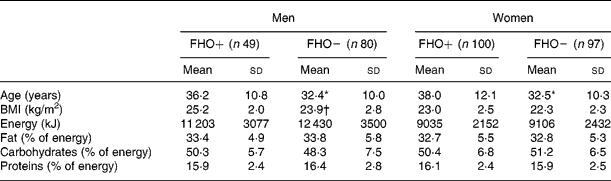
* Mean value was significantly different from that of FHO+ (P < 0·05).
† Mean value was significantly different from that of FHO+, data adjusted for age (P < 0·05).
Although subjects of the present study were non-obese, associations between BMI and eating behaviours were examined (data not shown). In men, significant positive relationships were observed between BMI and cognitive dietary restraint (r 0·20; P = 0·03), rigid restrain (r 0·21; P = 0·03) and disinhibition (r 0·28; P = 0·001), whereas in women positive associations were observed with disinhibition (r 0·21; P = 0·003).
Age- and BMI-adjusted ANOVA were performed to compare scores of eating behaviours in men and women according to FHO − (Table 2). The results indicate that men with FHO+ had higher scores of cognitive dietary restraint and flexible restraint than men with FHO − (P < 0·05). In women, those with FHO+ had a higher score of disinhibition (P < 0·05).
(Mean values and standard deviations)

* Mean value was significantly different from that of FHO+, data adjusted for age and BMI (P < 0·05).
Scores of eating behaviours were subsequently examined according to the number of obese family members. In both men and women, similar scores of cognitive dietary restraint, disinhibition, susceptibility to hunger and their subscales were observed for individuals having only one, two or more than two obese family members (results remained unchanged after adjustment for the number of family members; data not shown). After stratification of individuals with FHO+ on the basis of the obesity status of their mother, significant differences in cognitive dietary restraint, flexible restraint and rigid restraint were observed in women (P < 0·05) (Table 3). No significant difference was observed in men with and without an obese mother. Stratification according to the obesity status of the father was also performed. Individuals with an obese father had similar scores of cognitive dietary restraint, disinhibition, susceptibility to hunger and their subscales than those with a non-obese father (data not shown).
(Mean values and standard deviations)

* Mean value was significantly different from that of those with an obese mother, data adjusted for age and BMI (P < 0·05).
Discussion
The main purpose of the present study was to examine whether eating behaviours (cognitive dietary restraint, disinhibition and susceptibility to hunger) and their subscales are associated with FHO. Since there is extensive evidence that parenting practices influence offspring's eating behaviour(Reference Cutting, Fisher, Grimm-Thomas and Birch23–Reference Francis, Hofer and Birch29), it is likely that the presence of obese family members or obese parents could affect eating behaviours of the offspring.
To our knowledge, this is the first study to report associations between eating behaviours and FHO. Men with FHO+ had higher scores of cognitive dietary restraint and flexible restraint than men with FHO − . Although subjects in the present study had obese relatives, they were still non-obese. These individuals, with FHO+, could have a certain awakening possibly translated by a higher flexible restraint behaviour, a phenomenon not observed in individuals with FHO − . Knowing that flexible restraint is associated with more appropriate weight-controlling behaviours(Reference McGuire, Jeffery, French and Hannan39), and with a more successful long-term management of healthy body weight(Reference Westenhoefer40), flexible restraint could represent an important ally to maintain a normal range of BMI despite the presence of an unfavourable genetic background and familial environment. In women, a higher score of disinhibition was observed in those with FHO+. It is particularly striking to observe that women with FHO+, who already have a higher risk to develop obesity(Reference Lake, Power and Cole1, Reference Katzmarzyk, Perusse, Rao and Bouchard4–Reference Williams8), also had a higher score of disinhibition which is a strong predictor of weight gain(Reference Hays, Bathalon, McCrory, Roubenoff, Lipman and Roberts13). Weight concerns and dieting behaviours are more prevalent among women than men(Reference Neumark-Sztainer, Sherwood, French and Jeffery41) and the results of the present study showed that strategies to maintain weight seem to differ between men and women. Indeed, in men, those with FHO+ seems to have a higher flexible restraint behaviour than men with FHO − while women with FHO+ seem to have a higher rigid restraint behaviour than women with FHO+. Since eating behaviours are related to obesity, some studies have examined relationships between eating behaviours and dietary intakes(Reference Borg, Fogelholm and Kukkonen-Harjula42–Reference Rideout, McLean and Barr45). In the present study, cognitive dietary restraint was associated with a healthier food pattern and more frequent uses of reduced-energy and reduced-fat foods (data not shown), which is consistent with previously reported results(Reference Goulet, Provencher, Piche, Lapointe, John, Nadeau, Bergeron and Lemieux43, Reference Moreira, de Almeida and Sampaio44).
It is well known that parents create environments for their offspring that may promote the development of healthy eating behaviours and weight, or that may encourage overweight and disordered eating behaviours. Indeed, some studies have shown that parents' eating behaviours are related to food intake and to the development of obesity in their children; this link is particularly true between mothers and their children(Reference Cutting, Fisher, Grimm-Thomas and Birch23, Reference Birch and Fisher28, Reference Birch and Fisher46, Reference Birch, Fisher and Davison47). Indeed, it was shown that mothers with the highest BMI values had higher levels of weight concerns(Reference Francis, Hofer and Birch29). Also, mothers who are preoccupied with their own weight and eating also make more attempts to influence their children's weight and eating(Reference Birch and Fisher28, Reference Francis, Hofer and Birch29, Reference Francis and Birch48). Moreover, overweight mothers reported higher levels of restricting daughters' intake and may place their daughters at risk for developing problematic eating behaviours(Reference Francis and Birch48). In this regard, eating behaviours of individuals were first examined according to the number of obese family members and then according to the presence or the absence of an obese mother. The present results show that individuals with only one, two or more than two obese family members had similar scores of eating behaviours (results remain non-significant even after adjustment for the number of family members). However, the presence of an obese mother seems to have an impact on the score of restraint in women. Indeed, those with an obese mother had a higher score of cognitive dietary restraint, flexible restraint and rigid restraint than those with a non-obese mother. Similar analyses were performed with the presence or not of an obese father and no significant difference was observed in both men and women.
Previously, a significant familial component to eating behavioural traits was observed in family studies(Reference Provencher, Pérusse, Bouchard, Drapeau, Bouchard, Rice, Rao, Tremblay, Després and Lemieux31, Reference Steinle, Hsueh, Snitker, Pollin, Sakul, St Jean, Bell, Mitchell and Shuldiner33) and in a cohort of identical and fraternal twins(Reference de Castro and Lilenfeld32), suggesting that genetics is involved in the development of eating behaviours. Although the aim of the present study was not to examine the heritability of eating behaviours, the results of the present study reinforce these findings in showing that eating behaviours differ among individuals having or not a FHO, a crude indicator of genetic susceptibility.
The present study has some limitations. The study design cannot determine whether eating behaviour constructs are causes or consequences of the actual weight. Longitudinal studies are needed to elucidate this phenomenon. Moreover, information on reported FHO concerns the current obesity among family members and does not necessarily reflect the presence or the absence of obesity during the time interval when subjects would probably be living at home and when eating behaviours would have been shaped.
In conclusion, our findings make a contribution in showing that eating behaviours of non-obese individuals are different according to the presence or not of obese family members. Moreover, the present study suggests that having a FHO+ could be associated with eating behaviours. Participants from the present study were non-obese and the present results may reflect strategies adopted by individuals to maintain their body weight, particularly in men. Even though the number of obese family members did not influence the score of eating behaviours, the results of the present study corroborate those previously reported(Reference Birch and Fisher28, Reference Francis, Hofer and Birch29, Reference Francis and Birch48) suggesting that mothers are likely to be involved in shaping the eating behaviours of their children. However, further investigations using longitudinal study designs are needed to establish causal relationships between aspects of the family environment and the development of eating behaviours in offspring.
Acknowledgements
The authors would like to express their gratitude to the subjects involved in the study for their excellent collaboration. We would like to thank Marie-Eve Bouchard, Steve Amireault, Diane Drolet and Dominique Beaulieu for their collaboration on the recruitment of the subjects, the study coordination and the data collection. A.-M. P. is supported by a doctoral research award from the Canadian Institutes of Health Research (CIHR) and the Fonds de la Recherche en Santé du Québec (FRSQ). G. G. is a Tier 1 Canada Research Chair in Health Related Behaviour, Laval University. The present study was supported by a grant from CIHR – New Emerging Teams Programs (NET) (no. OHN 63 276). A.-M. P. performed the statistical analysis of the data and took the primary role in drafting the manuscript. G. G., S. L., L. P. and M.-C. V. guided the strategy of the data analysis, assisted with the interpretation of the results and provided critical review of the manuscript. L. P. and M.-C. V. conceived the study. All authors read and approved the final manuscript. No conflict of interest was declared.



