Introduction
Linguistic landscape (LL), a concept which first emerged in the field of language planning, refers to ‘[t]he language of public road signs, advertising billboards, street names, place names, commercial shop signs, and public signs on government buildings' (Landry & Bourhis, Reference Landry and Bourhis1997: 25). There are two functions attached to the linguistic landscape of a given territory: an informational function and a symbolic function. The informational function serves to inform people of ‘the linguistic characteristics, territorial limits and language boundaries' of a specific region; whereas the symbolic function serves as an indicator of the status, power relations, and cultural identity of the inhabitants, affecting how individuals feel about their community (Landry & Bourhis, Reference Landry and Bourhis1997).
The symbolic function of a linguistic landscape entails its ability to reveal how ideological and cultural factors express themselves in a given territory. As Alastair Pennycook (Reference Pennycook, Shohamy and Gorter2010: 67) argues, linguistic landscapes ‘are spaces that are imagined and invented’; the styles and locations of signs ‘are statements of place, belonging, group membership, and style’. Due to the impact of internationalisation and the global hegemony of Anglophone culture, English is widely used in the linguistic landscape of many regions around the world and has been observed to play an important symbolic function in those linguistic landscapes. According to Peter Backhaus (Reference Backhaus2006), English is the most popular foreign language in non-official signs in Tokyo, which he interpreted as a symbolic expression of Tokyo's place within the English language community. Slobodanka Dimova (Reference Dimova2007) finds that English is frequently used on signs in Macedonia and has been associated with globalisation, modernity, and prestige. Dilia Hasanova (Reference Hasanova2010) notes that English has been used as an indicator of advanced education, modernity, elitism, and prestige. Joseph R. Weyers (Reference Weyers2015) reports that in Colombia, sign writers use English in shop signs to appeal to the readers' desires for higher social status.
Since 2005, there has been an increasing scholarly interest in the role of translation within linguistic landscapes in China, partially due to the translation needs which arose from two major international events, namely the Beijing Olympic Games in 2008 and the World Expo in Shanghai in 2010 (Leong, Reference Leong2012). While some studies focus on the translation quality of public signs (Leong, Reference Leong2012; Zhang & Xu, Reference Zhang and Xu2015), others explore the issue from a more descriptive, socio-cultural perspective, analysing how internationalisation and globalisation have impacted the linguistic landscape in China. Jingjing Wang (Reference Wang2013) investigated the commercial signs in Wangfujing Street, Beijing, noting that more than half of the signs were translated into English, which the author attributes to China's growing need for national modernisation and development. Songqing Li (Reference Li2015) analysed English in the linguistic landscape of Suzhou, highlighting how the use of English in shop signage deviates from commonly accepted linguistic rules and breaks the boundary between the Chinese and English languages and cultures. As Li sees it, the exploitation and manipulation of English symbolises the city's effort to join the global community and to express its regional identity.
Background of the study
This study investigates the use of English in the linguistic landscapes of two adjoining, culturally homogeneous cities in eastern Guangdong: Chaozhou and Shantou, which are commonly referred to as Chaoshan. First established during the Sui Dynasty, Chaozhou enjoys a long history and has developed into a cultural centre of the eastern Guangdong region, with its unique food and tea culture and its traditional opera, music, dance, and embroidery. Shantou plays a more significant role in modern Chinese history. It was opened to free foreign trade as a treaty port in 1860. In 1981, as part of the open door policy of China, Shantou was listed as a Special Economic Zone (SEZ) and was again brought under the spotlight of globalisation. The rich history of the region, its interaction with colonial powers in the past, and its current status as a SEZ make the area a perfect case to investigate how social, cultural, and economic factors influence translation in the global era.
For this study, digital cameras were used to collect photographic evidence between 2015 and 2017 in different areas of Chaoshan. The data were collected along several main streets in four administrative districts in Chaoshan: Xiangqiao, Fengxi, Longhu, and Jinping. These districts were chosen because they cover busy commercial areas, small local businesses as well as cultural heritage sites, representing the dynamics and complexity of the linguistic landscape. Samples were collected from shop fronts, shop windows, posters, billboards, public facilities, and public notice boards, with the majority of the examples consisting of names of stores, cafes, restaurants, hotels, salons, pharmacies, hospitals, banks, museums, and parks. The main corpus contains bilingual signs of Chinese and English. In order to have a fuller understanding of the linguistic diversity in Chaoshan, signs in foreign languages other than English were also collected. International brands such as Walmart, H&M, Pizza Hut, Starbucks, and Burger King were excluded from the study. The final corpus contains 308 photographic images, which were then grouped into public signs (which were collected from public hospitals, public healthcare centres, national banks, and other public facilities and institutions) and private signs (which were collected from non-governmental commercial buildings).
Findings and discussion
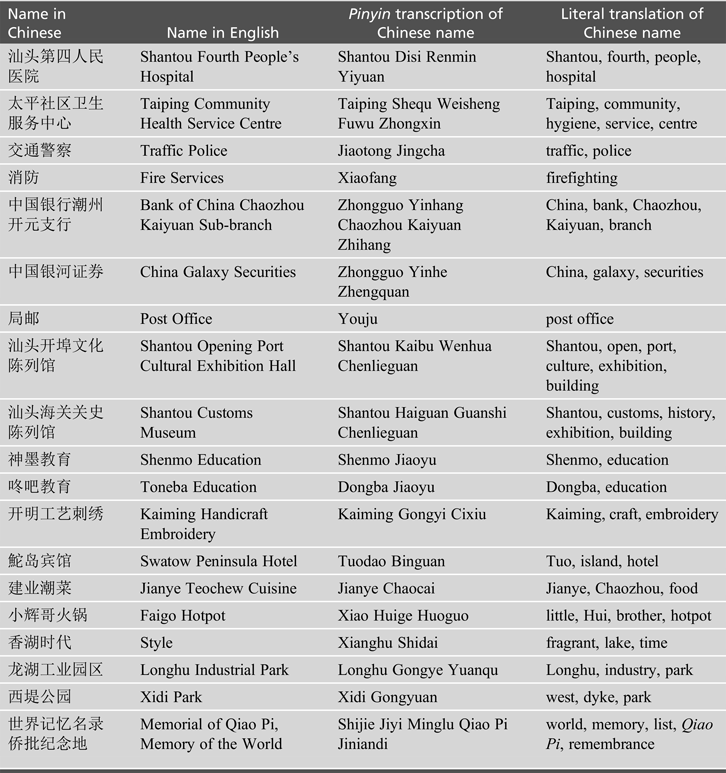
In the 308 photos collected, the most frequently used language other than Mandarin is English. Other Chinese dialects (Chaoshanese and Cantonese) and foreign languages (Korean and Japanese) are occasionally observed. Most of the signs that are accompanied with English translations are private signs of shops, restaurants, hotels, salons, fitness centres, private education organisations, private financial institutions, companies, and industrial parks. Some healthcare organisations, national banks, museums, tourist attractions, and fire and traffic services also provide English translations. Table 1 below presents some examples of public and private signs, found in various locations, for different types of organisations and businesses.
Public and private signs in Chaoshan

In China, language usage in public is regulated by state-level language planning authorities. According to the Chinese Constitution, Mandarin (Putonghua) is the common tongue and the preferred language. The Law of the People's Republic of China on the Standard Spoken and Written Chinese (Law of Chinese) requires Mandarin and standard Chinese characters to be used on public signs, commercial billboards, and shop signs. This law also states that for the sake of providing public service, foreign languages can be used on public signs, provided that they are accompanied by standard Chinese characters. This explains why English is more frequently observed on private signs in Chaoshan. It also explains why English is used on the signs of organisations providing public services, such as fire, healthcare, traffic and police services. Different percentages of English usage are also observed in the linguistic landscapes of other cities. For instance, Backhaus (Reference Backhaus2006) reports that, in Tokyo, English is far less frequently used on public signs than on private signs. Backhaus attributes the difference to regulations that assert more power for the national language, which affects public signs more than private signs. Likewise, public signs in Chaoshan are also more sensitive to language regulations compared to private signs.
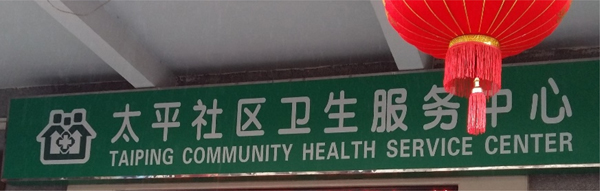
A couple of translation strategies are repetitively used in signage translation in Chaoshan. The first is transliteration, which is realised by phonetically transcribing the source text with pinyin (the Chinese Phonetic Alphabet), the standard Romanisation of Chinese according to the Law of Chinese. The second strategy is semantic translation, which aims to render the meaning of the source text in the target language. In practice, these two strategies are often combined to render different elements from the source text. For instance, in the sign in Figure 1, the proper name in the source text, 太平 (Taiping) is transliterated with pinyin, whereas the descriptive part of the name (which specifies the nature of the organisation), 社区卫生服务中心 (Shequ Weisheng Fuwu Zhongxin, lit. ‘community, hygiene, service, centre’) is rendered semantically as ‘Community Health Service Center’.
Name of a healthcare centre

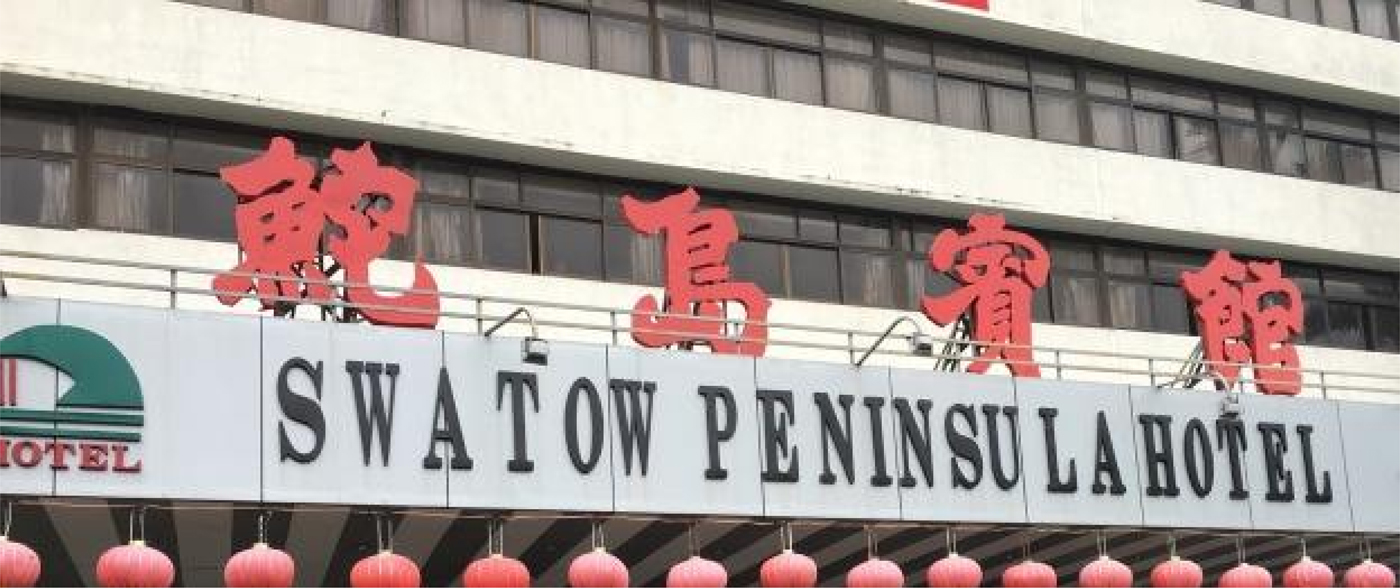
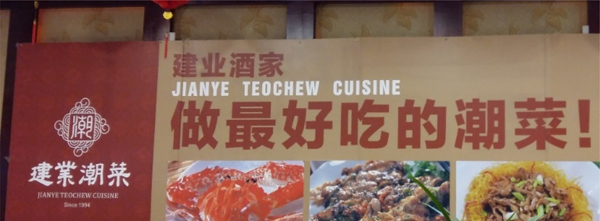
The influence of the local Chaoshan dialect can also be observed on shop signs. Although the practice runs contrary to the Law of Chinese, signs are occasionally not transliterated with pinyin, but with Postal Romanisation, a transliterating system for Chinese place names partially based on the Wade-Giles system and partially on local pronunciation, which was initially used by the Chinese Imperial Post Office in the early 1900s. Figure 2 shows the front view of Swatow Peninsula Hotel, the first international hotel in Shantou. Rather than using a pinyin transliteration, the sign uses Postal Romanisation (Swatow), which is based on the pronunciation of 汕头 (Shantou) in Chaoshanese. Similarly, in Figure 3, a sign found in a restaurant specialising in local food, 建业潮菜 (Jianye Chaocai, lit. ‘Jianye, Chaozhou, dish’), is translated as Jianye Teochew Cuisine, Teochew being the Postal Romanisation of Chaozhou based on the Chaoshanese pronunciation.
Sign of the Swatow Peninsula Hotel

Sign inside a restaurant

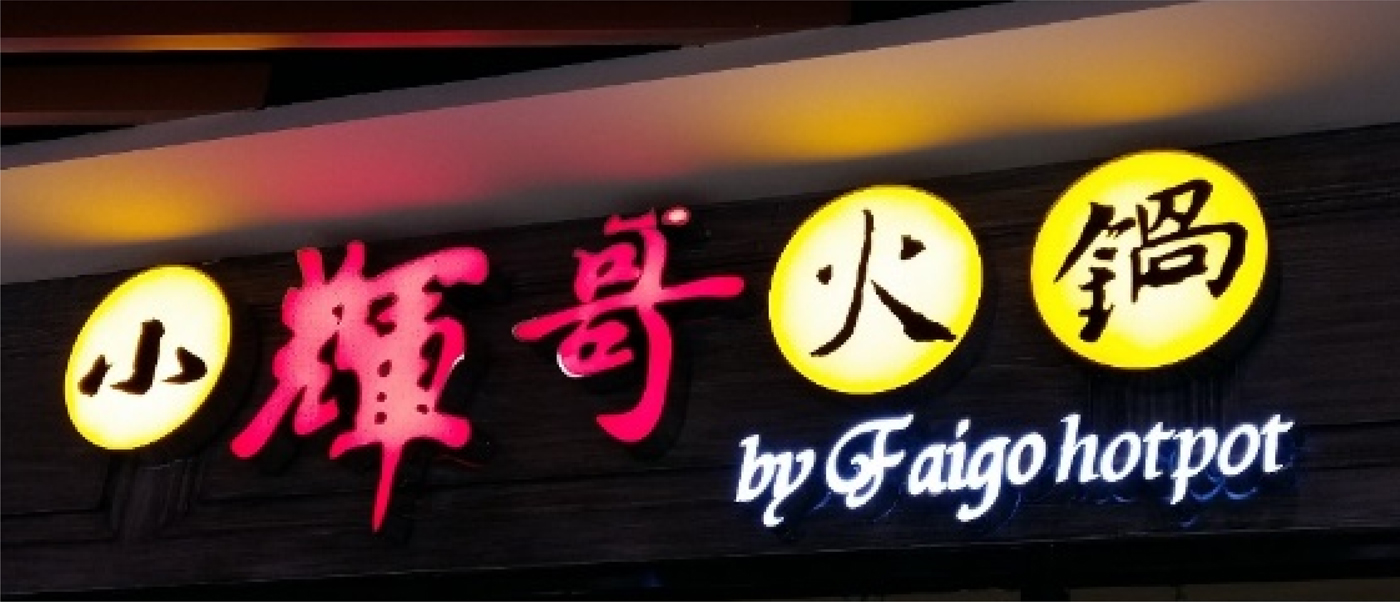
Apart from Mandarin and Chaoshanese, the other Chinese dialect that can sometimes be observed on private signage is Cantonese. Figure 4 shows the shop name of a hot pot restaurant in a shopping plaza. The source text reads 小辉哥火锅 (Xiao Huige Huoguo, lit. ‘little, Hui, brother, hotpot’). When the personal name 辉哥 (Huige, lit. ‘Hui, brother’) was transliterated into English, rather than using a pinyin transliteration based on Mandarin, a different transliteration, Faigo, was used, imitating the pronunciation of the word in Cantonese.
Name of a hotpot restaurant

The transliteration methods of public and private signage in Chaoshan suggest that although state-level language planning exerts a crucial influence on public signs, regional influences can also be observed, especially on private commercial signs. As Chaoshan is situated in Guangdong, not far from the Pearl River Delta Area, Cantonese culture sometimes finds its own expression in the local linguistic landscape, as manifested by the use of Cantonese Romanisation instead of standard pinyin. Naturally, the unique local culture, in particular, the Chaoshanese dialect, also helps to shape the region's linguistic landscape, as is suggested by the use of Chaoshanese-based transliteration in the names of hotels and restaurants.
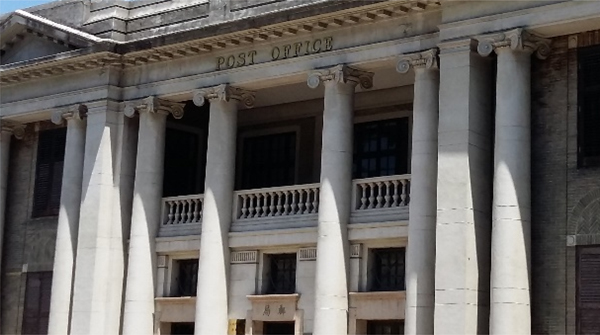
The region's colonial history is also visible in its linguistic landscape. The old city centre used to be the heart of Shantou's ‘colonial glory’, with many foreign embassies, foreign banks, hotels, restaurants, and shopping malls. Quite a few of these buildings still remain largely intact. Figure 5 shows the front view of a building that used to be Shantou's central post office in the early 20th century. Since 2017, the building has been open to the public as a historical museum. The original sign on the building is still preserved. As is shown in Figure 5, the English sign (‘post office’) is engraved on the roof beam in large capital letters. Beneath the English sign, on a much smaller door head and in a moderate size, is the Chinese sign, 邮局 (youju, ‘post office’), which reads from right to left, reflecting the writing order of Chinese in the early 20th century. As discussed previously, the linguistic landscape of a region can indicate the status and power relation of different linguistic communities (Landry & Bourhis, Reference Landry and Bourhis1997). The presentation of the English and Chinese signs of the old post office offers a symbol of Shantou's colonial past and a subtle reminder of its history of submission.
The old central post office in Shantou

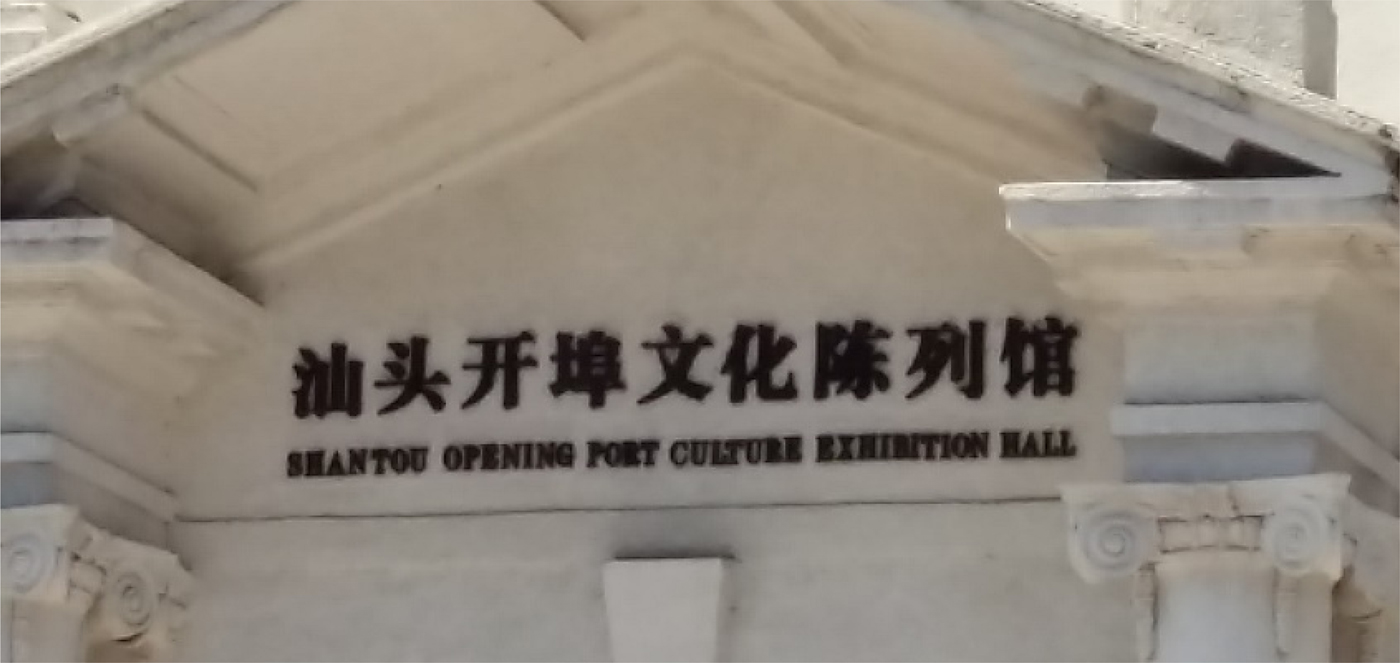
Figure 6 shows the sign on another old building, which used to be the Shantou branch of the Bank of Taiwan, a Japanese-chartered bank first established in Taipei in 1899 after the Japanese occupation of Taiwan. The Shantou branch was set up in 1907 and closed after the end of the Sino-Japanese War in 1945. The building has been open to the public as an exhibition centre since 2010. Unlike the old post office, the original sign on the building is no longer visible. The current sign reads 汕头开埠文化陈列馆 (Shantou Kaibu Wenhua Chenlieguan, lit. ‘Shantou, open, port, culture, exhibition, building’), which is translated semantically as ‘Shantou Opening Port Cultural Exhibition Hall’. The word 开埠 (kaibu, lit. ‘open, port’) in the Chinese sign is intricately related to the colonisation of Shantou. After the first and the second Opium Wars in the mid-19th century, China signed a series of treaties with Western imperialist powers, promising, among other things, the concession of several Chinese coastal cities as foreign trading ports, with Shantou being one of them. This process has been historically referred to as 开埠 (kaibu) in Chinese. For a Chinese reader, the word serves as a mild reminder of Shantou's colonial past, stressing the city's historical role as a free trading port, while toning down associations with imperialism and oppression. For English-speaking readers, unfamiliar with the local history of Shantou, whatever imperialist interpretation ‘opening port’ may invite is even vaguer. While the sign does serve as a reminder of the colonial history of the city, it also expresses a mixed attitude towards imperialism. The economic aspect of colonisation is highlighted by focusing on the city's past role as a trading port, whereas the political aspect is selectively underrepresented, avoiding explicit associations with imperialist oppression and submission.
Shantou Opening Port Culture Exhibition Hall

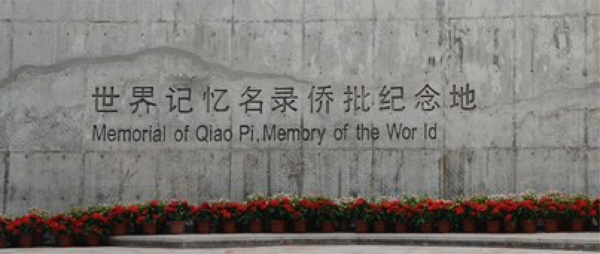
Apart from being a treaty port, Chaoshan was also home to millions of overseas Chinese emigrants to Southeast Asia, who used to send money to their relatives at home. Their correspondence and remittance receipts are referred to as 侨批 (Qiao Pi) in Chinese, a term which was inscribed in the Memory of the World Regional Register of UNESCO in 2013. In 2016, the local government built a park (Xidi Park) to commemorate Chaoshan's emigrant history. Figure 7 shows a sign found in the park engraved on a large headstone. The Chinese text, 世界记忆名录侨批纪念地 (Shijie Jiyi Minglu Qiao Pi Jiniandi), roughly means ‘remembrance of Qiao Pi, Memory of the World’. In the English translation, rather than offering a semantic translation of 侨批 (Qiao Pi), a phonetic translation is provided, preserving 侨批 (Qiao Pi) in its original pinyin form. Apparently, this is not due to the sign writer's inability to translate the term, since, not far from the headstone, UNESCO'S explanation of 侨批 (Qiao Pi) as ‘remittance documents’ is engraved on the pavement of the park. The translation choice expresses an effort to preserve the Chaoshan culture in translation (preserving the original pronunciation, the connection to local history, the cultural nuance that would be lost in translation, etc.). In his discussion of the political agenda of translation, Lawrence Venuti (Reference Venuti1995: 20) calls for translators to produce translations that deviate from native norms and provide ‘an alien reading experience’, in an effort to preserve cultural distinctiveness and to resist the global hegemony of English. In the example discussed above, the sign writer's choice to preserve Qiao Pi in its original pinyin form can be viewed as a form of resistance against the linguistic imperialism of English.
Headstone in Xidi Park

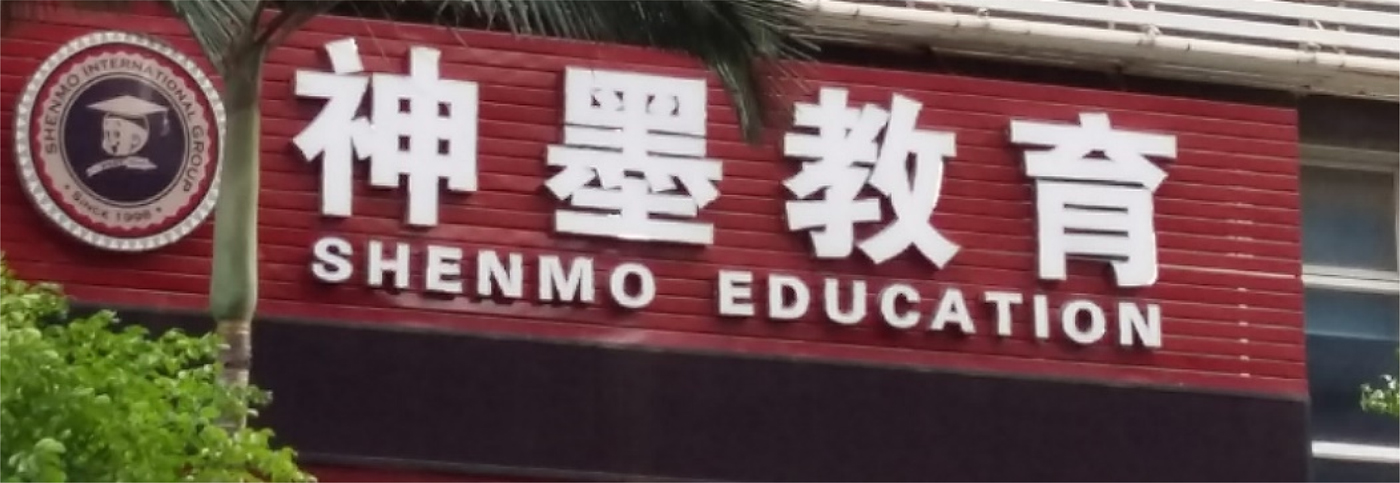
With private commercial signs, though, the hegemony of English still exerts a significant influence in Chaoshan's linguistic landscape. In accordance with the trends in other regions, as reported in previous research (Dimova, Reference Dimova2007; Hasanova, Reference Hasanova2010; Weyers, Reference Weyers2015), English in Chaoshan has also been associated with modernity, globalisation, and elitism. Many restaurants (especially those offering Western food), hotels, training centres, clothing and footwear stores, hair dressers, and fitness centres provide English translations of their names, in an effort to appeal to people's desires for higher social status. For instance, a private training centre, 神墨教育 (Shenmo Jiaoyu, lit. ‘magic, ink, education’), accompanies its Chinese name with an English translation, ‘Shenmo education’ (Figure 8), appealing to parents' need for education with an international outlook. The international image of the training centre is further enhanced by its logo, which shows a child with a mortarboard, surrounded by the English text ‘Shenmo International Group, since 1998’. By using an English logo, the sign writer invites potential customers to associate the training centre with globalisation, prestige, and high-class international education.
Shop name of a training centre

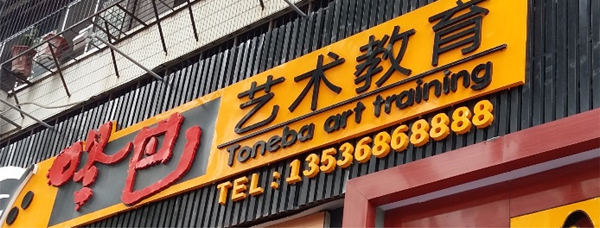
Apart from being a symbol of internationalism and elitism, English has also been manipulated for textual creativity. The name of a music and art training centre (Figure 9), for instance, explores the limits of existing linguistic boundaries, creating a sign that cannot be simply considered as English or Chinese. In the Chinese part of the sign, the first two characters, 咚巴 (dongba), offer an onomatopoeia mimicking the sound of musical instruments. In the ‘English’ part of the sign, 咚 (dong) is translated as ‘tone’; 巴 (ba) is transliterated with pinyin. The translation is innovative in many ways. First, the pronunciation of the Chinese word 咚 (dong) and the English word ‘tone’ are similar. Meaning-wise, 咚 (dong) imitates the sound of music, whereas ‘tone’ refers to the acoustic characteristics of musical instruments. Finally, by combining the English word ‘tone’ with the Chinese word 巴 (ba), a new blend-word is formed, providing multiple layers of meaning transcending and transgressing the boundaries of Chinese and English.
Shop name of a music and art training centre

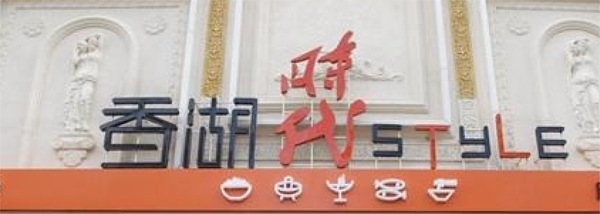
The use of blend-words of English and Chinese in shop names has also been observed by Li (Reference Li2015) in the linguistic landscape of Suzhou, which he also interprets as evidence of the fluid and transgressive capacity of language practice, reflecting the postcolonial use of English in China. The shop name of a local morning tea restaurant (Figure 10) provides another example of the exploitation of linguistic fluidity in Chaoshan's linguistic landscape. The Chinese text in the sign, 香湖时代 (Xianghu Shidai, lit. ‘fragrant, lake, time’), is followed by the English word ‘style’. Put together, the sign could be interpreted as an example of code-switching between Chinese and English. On the other hand, since the pronunciation of the Chinese word 时代 (shidai, lit. ‘time’) is similar to the pronunciation of ‘style,’ it could also be interpreted as a partial translation, with ‘style’ being the transliteration of 时代 (shidai). The sign writer exploited the phonetic similarity between 时代 (shidai) and ‘style’. Beyond this, the Chinese part of the sign creates an impression that the restaurant is starting a new era, or a new fashion, of dining, which is echoed in the English part of the sign. In this sense, the sign constitutes a bilingual pun, exploiting the creative use of language to negotiate the postcolonial use of English and to resist linguistic imperialism.
Shop name of a restaurant

Conclusion
This analysis of the linguistic landscape in Chaoshan finds that the English translation of public and private signage is determined by a negotiation between submission and subversion in multiple facets. On a national/regional level, while most of the signs conform to the Law of Chinese and use pinyin for transliteration, regional identities also find their expressions on private shop signs. The selective use of Chaoshanese- and Cantonese-based transliteration is a reflection of the sign writers' intentions to showcase regional cultures and to build solidarity with local customers. On a historical level, while the political aspect of colonisation is tactfully veiled in some signs, the economic aspect, concerning Shantou's historical role as a free trading port, is highlighted. On an international level, due to the influence of the global hegemony of English, English enjoys high prestige as a foreign language and is often viewed as a symbol of modernity and advanced social status. At the same time, English is also exploited and manipulated, resulting in signs that challenge traditional linguistic rules and transcend established language boundaries. The use of English in signage translation in Chaoshan expresses mixed attitudes towards imperialism and English hegemony. There is, on one hand, a tendency to submit to the cultural and economic power represented by English. On the other hand, there is also an effort to resist English hegemony by becoming an active consumer of the language and using it to negotiate local identity in a postcolonial context.
Acknowledgements
The research is financed by Guangdong Province Grant for Research in Liberal Arts (GD16XWW29) and Shantou University Research Grant (SR15002).
 MINGMING YUAN is currently a Lecturer at the English Language Centre of Shantou University, China. She received her PhD in translation and interpreting from Monash University, Australia. Her research interests include translation and identity, linguistic landscape in translation and Global Englishes. Email: mmyuan@stu.edu.cn