Introduction
Usnic acid is a dibenzofuran derivative known to occur in several epiphytic and terrestrial lichen species. The compound, which has a strong yellow colour, is a product of the secondary metabolism of the fungal partner in lichen symbiosis, and it is deposited mainly at the fungal cell wall (Reference Elix and NashElix 1996). Usnic acid has been identified in many genera of lichens, but it is particularly common in the genera Usnea (Elix et al. Reference Elix, Wirtz and Lumbsch2007) and Cladonia (Huovinen & Ahti Reference Huovinen and Ahti1986). The Northern reindeer lichen, Cladonia stellaris, is a common and ecologically important lichen species forming thick carpets in boreal coniferous forests (Auclair & Rencz Reference Auclair and Rencz1982). The content of usnic acid in this lichen may be as high as 2·5% of the dry weight (Huovinen Reference Huovinen1985). The biological role and potential commercial applications of usnic acid have not been completely explored. The compound has been shown to possess a wide range of interesting biological properties, and its medical use has a long history(Ingólfsdóttir Reference Ingólfsdóttir2002; Oksanen Reference Oksanen2006). In lichens, the primary role of usnic acid is thought to be protection of the photobiont from radiation (Nybakken & Julkunen-Tiitto Reference Nybakken and Julkunen-Tiitto2006). In addition, usnic acid may act as an antifeedant against insects (Pöykkö et al. Reference Pöykkö, Hyvärinen and Backor2005) and molluscs (Gauslaa Reference Gauslaa2005), or as an antimicrobial protectant against fungal pathogens (Cardarelli et al. Reference Cardarelli, Serino, Campanella, Ercole, De Cicco Nardone, Alesiani and Rossiello1997) or bacteria (Lauterwein et al. Reference Lauterwein, Oethinger, Belsner, Peters and Marre1995). Furthermore, it exhibits antiviral, antiproliferative, antipyretic, anti-inflammatory, antitumour and analgesic activity (reviewed by Ingólfsdóttir Reference Ingólfsdóttir2002; Cocchietto et al. Reference Cocchietto, Skert, Nimis and Sava2002; Guo et al. Reference Guo, Shi, Fang, Mei, Ali, Lewis, Leakey and Frankos2008).
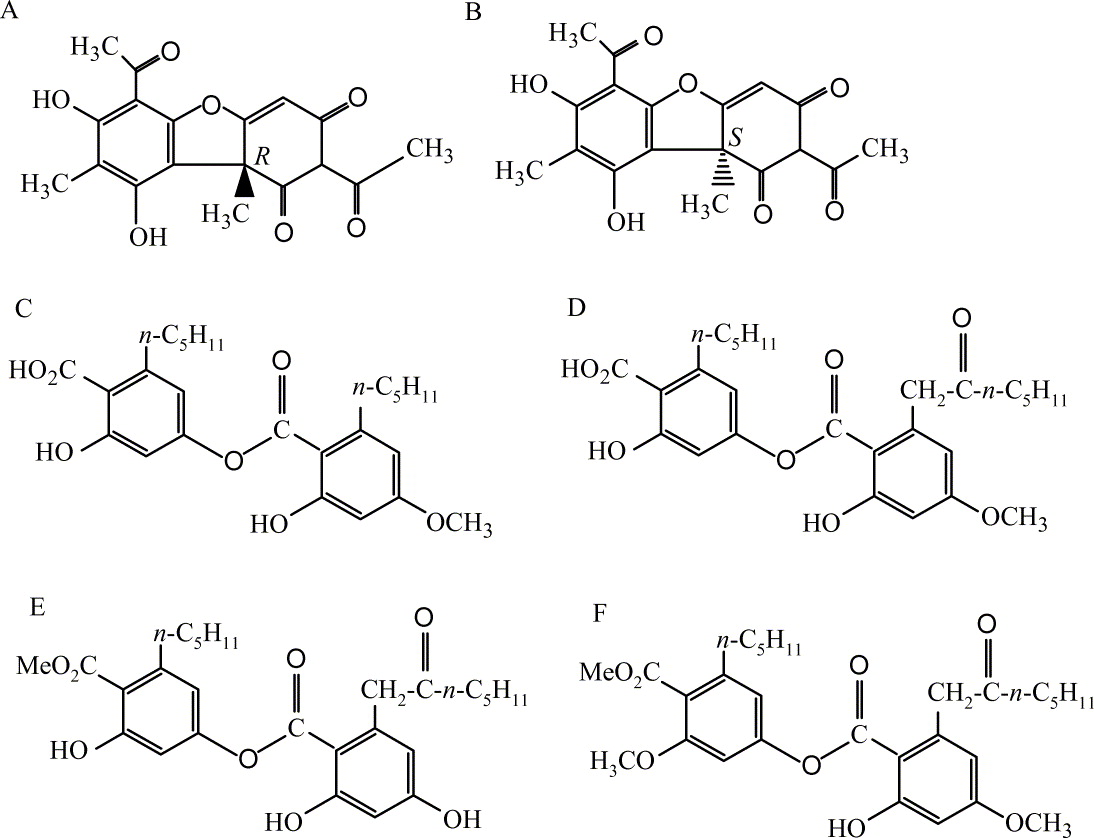
Usnic acid occurs in nature as two enantiomers (i.e., optically active stereoisomers) (Fig. 1A & B). The enantiomeric composition of usnic acid in Cladonia lichens has been determined in one study (Kinoshita et al. Reference Kinoshita, Yamamoto, Yoshimura, Kurokawa and Huneck1997), and C. stellaris was reported to contain only (−)-usnic acid. The biological properties and effects of the two enantiomers of usnic acid have been studied separately in only a few studies, and (−)-usnic acid is much less studied than the (+)-enantiomer. It is evident that the two enantiomers have partly different biological effects. For example, exposure to the (−)-enantiomer, but not to the (+)-enantiomer, reduces chlorophyll content in lettuce (Romagni et al. Reference Romagni, Meazza, Nanayakkara and Dayan2000). (−)-Usnic acid, as opposed to the (+)-enantiomer, shows antifungal effects (Halama & van Haluwin Reference Halama and van Haluwyn2004) and is a selective herbicide due to its ability to inhibit carotenoid biosynthesis (Cocchietto et al. Reference Cocchietto, Skert, Nimis and Sava2002; Ingólfsdóttir Reference Ingólfsdóttir2002). Moreover, (−)-usnic acid shows a more significant antifeedant activity and toxicity towards larvae of the herbivorous insect Spodoptera littoralis than the (+)-form (Emmerich et al. Reference Emmerich, Giez, Lange and Proksch1993). On the other hand, the (+)-enantiomer is reported to have stronger antimicrobial effects than the (−)-enantiomer (Ghione et al. Reference Ghione, Parrello and Grasso1988; Lauterwein et al. Reference Lauterwein, Oethinger, Belsner, Peters and Marre1995).
Perlatolic acid (Fig. 1C), another lichen acid known to occur commonly in C. stellaris, is chemically classified as a depside. The concentrations are usually lower than those of usnic acid (Huovinen Reference Huovinen1985). Also this compound shows high antibacterial (Piovano et al. Reference Piovano, Garbarino, Giannini, Correche, Feresin, Tapia, Zacchino and Enriz2002; Gianini et al. Reference Gianini, Marques, Carvalho and Honda2008) and antifungal activity (Gianini et al. Reference Gianini, Marques, Carvalho and Honda2008) in in vitro studies, and it may cause allergic reactions (Hausen et al. Reference Hausen, Emde and Marks1993). The ecological importance of perlatolic acid has not been investigated in any detail. In contrast to usnic acid, the production of perlatolic acid is not induced by UV-B light (Nybakken & Julkunen-Tiitto Reference Nybakken and Julkunen-Tiitto2006), which may explain why perlatolic acid is more uniform within the lichen thallus (Nybakken & Julkunen-Tiitto Reference Nybakken and Julkunen-Tiitto2006; Stark et al. Reference Stark, Kytöviita and Neumann2007) than usnic acid, which mainly occurs in the light-exposed upper parts in C. stellaris.
High-performance liquid chromatography (HPLC) with UV detection is the most commonly used analytical method for the determination of lichen acids. By using HPLC-UV, micellar electrokinetic chromatography, or isolation using preparative TLC and spectral analysis, some lichen acids other than usnic and perlatolic acid have been identified in C. stellaris, including the depsidones psoromic acid and demethylpsoromic acid (Huovinen & Ahti Reference Huovinen and Ahti1986), the depsides atranorin (Falk et al. Reference Falk, Green and Barboza2008) and evernic and olivetoric acids (Wang & Yang Reference Wang and Yang2004).
Because C. stellaris forms thick carpets on the forest floor, it would be the best source for commercial use of usnic acid with a known enantiomeric composition, and possibly also of pure usnic acid enantiomers. Furthermore, usnic acid produced by this lichen is most likely to have the largest ecological impact in boreal lichen-dominated ecosystems. Therefore, it is important that the distribution of the two enantiomers in C. stellaris is explored, which was the main aim of the present study. The separation of the two enantiomers was improved by optimization of the chromatographic conditions. Moreover, we determined the content of the abundant lichen products usnic and perlatolic acid in C. stellaris collected at different geographical locations, and identified some olivetoric acid-type lichen acids in the extracts. We have also introduced new analytical approaches by using gas chromatography and high-performance liquid chromatography combined with mass spectrometric techniques for quantification and identification of lichen acids.
Materials and Methods
Sampling and sample pretreatment
Altogether, 15 samples were collected from 13 different sampling sites in Finland in 2007 (Table 1). The lichens were rehydrated in a water-saturated atmosphere and gently but carefully cleaned. The top 20 mm of the samples were dried in an oven at 80 °C for 24 h. Approximately 1 g of the dried samples was weighed, immersed in 10 ml acetone and left to stand for 15 minutes. The samples were then filtered through an MN 617 WE (Macherey-Nagel) filter. This extraction was repeated four times, all extracts were pooled into one glass tube and dried at room temperature, taken up in 10 ml acetone and stored at −20 °C until analysis. This stock solution contained approx. 100 mg of the dry lichen sample/ml.
Molecular structures. A, (+)-usnic acid; B, (−)-usnic acid; C, perlatolic acid; D, 4-O-methylolivetoric acid; E, olivetoric acid methyl ester; F, confluentic acid methyl ester.

Determination of usnic acid enantiomers
The acetone extract stock solution (1 ml) was transferred into a 2 ml glass vial, and the solution was evaporated to dryness under a stream of nitrogen gas at 50 °C. A volume of 1 ml of HPLC-grade methanol/0·5% glacial acetic acid 9/1 (v/v) was added, and the solution was kept in an ultrasonic bath at 50 °C for 3 min. The solution (15 µl) was then injected into a chiral HPLC column (Chiralcel OD-R, 250 × 4·6 mm i.d., 10 µm, Daicel Chemical Industries, Ltd.) equipped with a guard column (10 × 4 mm i.d.) using an Agilent 1100 series HPLC (Agilent Technologies, Inc.) system. The HPLC flow rate was 0·4 ml min−1, the column was kept at 20 °C, and the eluent consisted of 0·5% acetic acid in methanol/0·5% acetic acid in water 9/1 (v/v) (isocratic elution). The HPLC was coupled to a Quattro Micro triple quadrupole MS instrument (Micromass Ltd., Manchester, UK) with an electrospray ionization (ESI) source. The analysis data were collected using negative polarity, and detection of the usnic acid enantiomers was performed in the multiple reaction monitoring (MRM) mode. The ions monitored were the [M-H]− ion (m/z 343) in the first MS and the daughter ion [M-CH3]− (m/z 328) in the second MS. The capillary was set at 4·10 kV, the cone at 30 V, and the collision energy at 18 eV. As reference standards, commercially purchased pure (+)-usnic acid and (−)-usnic acid were used (from Aldrich and Pfalz & Bauer, respectively). The retention time of (+)-usnic acid was 57 min and of (−)-usnic acid 61 min.
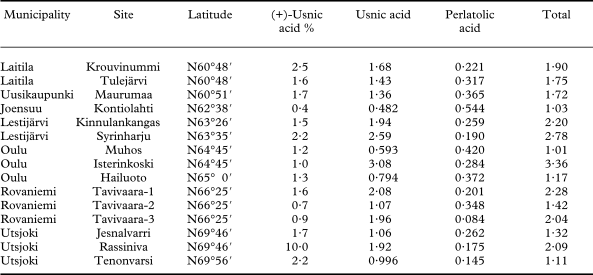
Usnic acid (sum of enantiomers) and perlatolic acid (% of dry weight) and proportion of (+)-usnic acid in Cladonia stellaris samples collected from 13 localities in Finland.

Identification of lichen compounds using HPLC-UV-ion trap-MS
The lichen extract stock solutions were diluted 1:2000 (v/v) with acetonitrile/0·5% acetic acid 40/60 (v/v), and 20 µl was injected into an HPLC-UV-ion trap MS. The column was a Zorbax SB-C8 (100 mm × 2·1 mm i.d., 3·5 µm, Agilent Technologies, Inc.) equipped with a guard column (12·5 × 2·1 mm i.d., 3·5 µm), and the same HPLC system as described above was used, coupled to an ESI interface and an ion trap mass spectrometer (Agilent SL Trap).
The eluents consisted of 0·5% acetic acid in Milli-Q water (A) and 0·5% acetic acid in acetonitrile (B). The gradient was from 40% B, which was held for 2 min, to 95% B in 16 min, which was held for 9 min, and back to 40% B in 1 min, which was held for 6 min. The flow rate was 0·4 ml min−1 and the column was kept at 30 °C. The scan was set at 50–1000 m/z, and the data acquisition (Auto MSn) was set to subject two of the most abundant ions to MS3. The UV detector was set at 254 nm.
Quantification of usnic acid and perlatolic acid
For quantitative analysis of usnic acid, 460 µg of diethylhexyl phthalate (Sigma–Aldrich, Finland, Helsinki) was added to 0·5 ml of the acetone extract stock solution as an internal standard, and the solution was analysed using GC-FID (Perkin Elmer, Autosystem XL). The column used was an HP-1, 25 m × 0·2 mm i.d., film thickness 0·11 µm (J & W Scientific, Agilent Technologies). (±)-Usnic acid (from Aldrich) was used as reference standard.
The oven temperature programme used was from 120 °C, which was held for 1 min, to 320 °C at 6 °C/min, which was held for 15 min. The injector temperature programme was from 160–260 °C, at 8 °C/min, which was held for 15 min. Perlatolic acid was quantified using 101 µg of cholesterol (Sigma–Aldrich, Finland, Helsinki) as an internal standard, which was added to 0·1 ml of the acetone extract stock solution. As a reference standard, pure perlatolic acid was used, kindly provided by Professor John A. Elix at the Australian National University. The solution was evaporated to dryness, and the samples were silylated by adding 20 µl of pyridine, 80 µl of N,O-bis(trimethylsilyl)trifluoroacetamide, and 20 µl of chlorotrimethylsilane, and keeping the solution at 70 °C for 30 min. The samples were analysed by GC-FID as usnic acid.
The peak identity was confirmed by GC-MS (Hewlett-Packard 6890-5973) using a similar column. The GC-MS system was also used for identification of other compounds.
Intra-assay variation of the determined GC concentrations was performed by preparing and analysing two of the lichen extracts in five parallels.
Statistical analyses
The potential effect of collection latitude on usnic acid and perlatolic acid concentration was analysed with regression analysis using the SPSS version 10·0 statistical package.
Results
Both enantiomers of usnic acid were present in all extracts analysed (Table 1). The average proportion of (+)-usnic acid of the total amount of usnic acid was 2·0%; the range was from 0·4% (in the Kontiolahti sample) to 10·0% (in the Rassiniva sample). The variation was small [coefficient of variation (CV) = 2·3%].
The GC-FID intra-assay variation of the usnic acid concentration was 13%, and of perlatolic acid 6%; the variation was approximately the same for both lichen extracts analysed. The concentration of usnic acid ranged from 0·48% (in the Kontiolahti sample) to 3·08% (in the Isterinkoski sample) (Table 1). The average concentration was 1·53%, and the variation was large (CV = 48%). The concentration of perlatolic acid ranged from 0·08% (in the Tavivaara-3 sample) to 0·54% (in the Kontiolahti sample). The average concentration was 0·28%, and the variation was also large for perlatolic acid (CV = 42%).
Usnic acid and perlatolic acids had no statistically significant relationship with the latitude where the samples were collected.
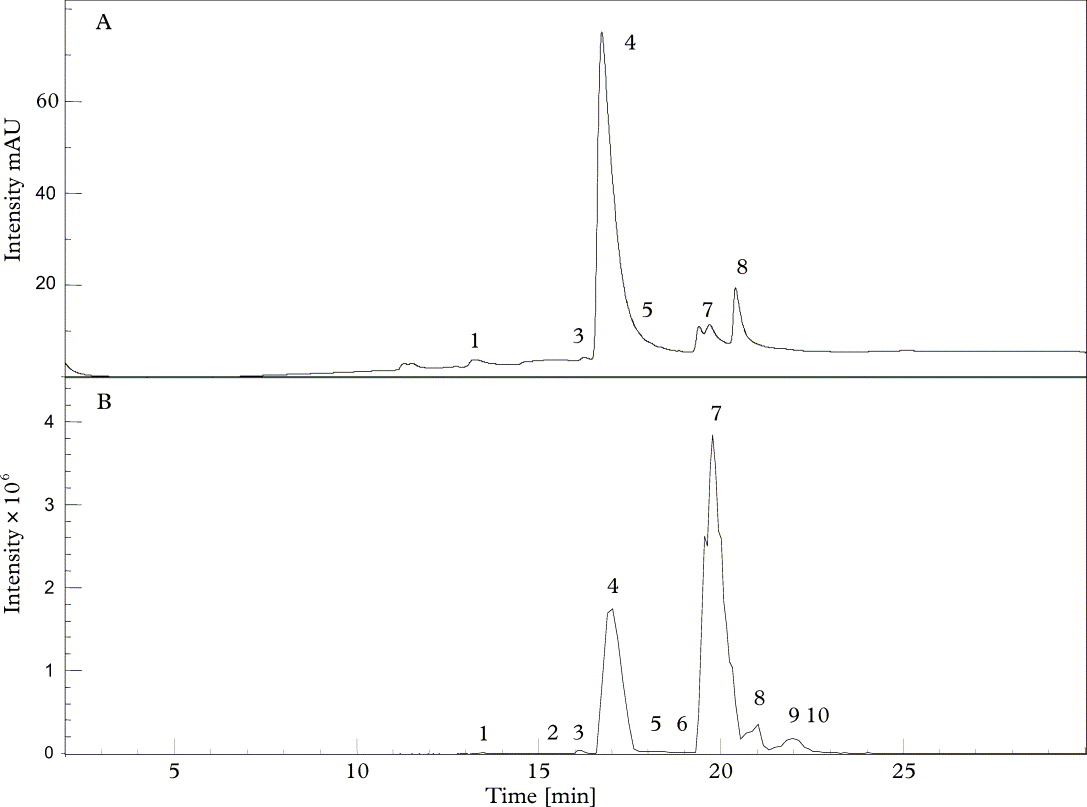
At least seven peaks besides usnic acid (peak 4) and perlatolic acid (peak 7) occurred in the HPLC-MS chromatograms (Fig. 2). One of these was tentatively identified as 4-O-methylolivetoric acid (peak 5) (Fig. 1D). Some of the peaks are not very easily discernible chromatographically, however, they showed clear peaks in the MS spectra.
HPLC-UV-ion trap-MS chromatograms of the lichen extract collected from Krouvinummi. A, UV chromatogram; B, base peak mass chromatogram. Peak 1: retention time 13·2 min, m/z transitions (MS1 → MS2 → MS3) 509 → 446 → 362; peak 2: 15·6 min, 523 → 460 → 397; peak 3: 16·0 min, 517 → 457 → 439; peak 4 = usnic acid: 17·0 min, 343 → 328 → 313; peak 5 = 4-O-methylolivetoric acid (tentatively): 18·2 min, 485 → 223 → 205; peak 6: 18·8 min, 479 → 365 → 321; peak 7 = perlatolic acid: 19·8 min, 443 → 223 → 205; peak 8: 20·7 min, 479 → 365 → 321; peak 9: 22·0 min, 525 → 443 → 223; peak 10, 22·2 min, 445 → 223 → 205.

In the GC-MS chromatograms of silylated extracts, some sugar alcohols were detected as well as perlatolic acid, which was the only lichen acid detected in silylated extracts.
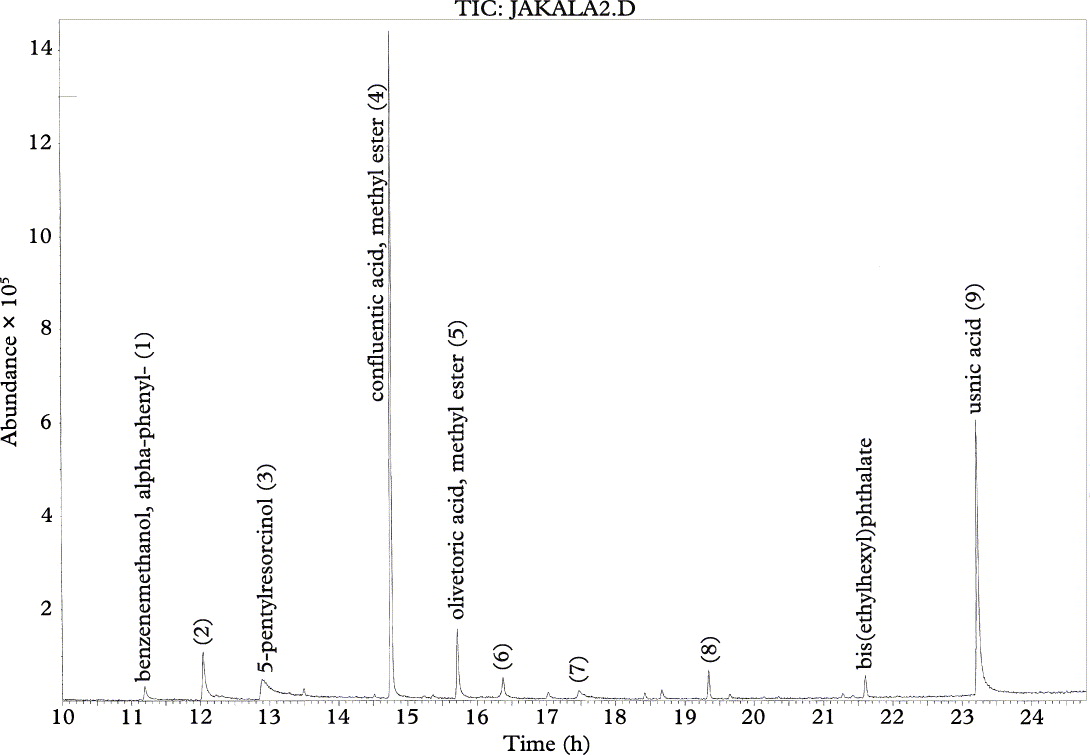
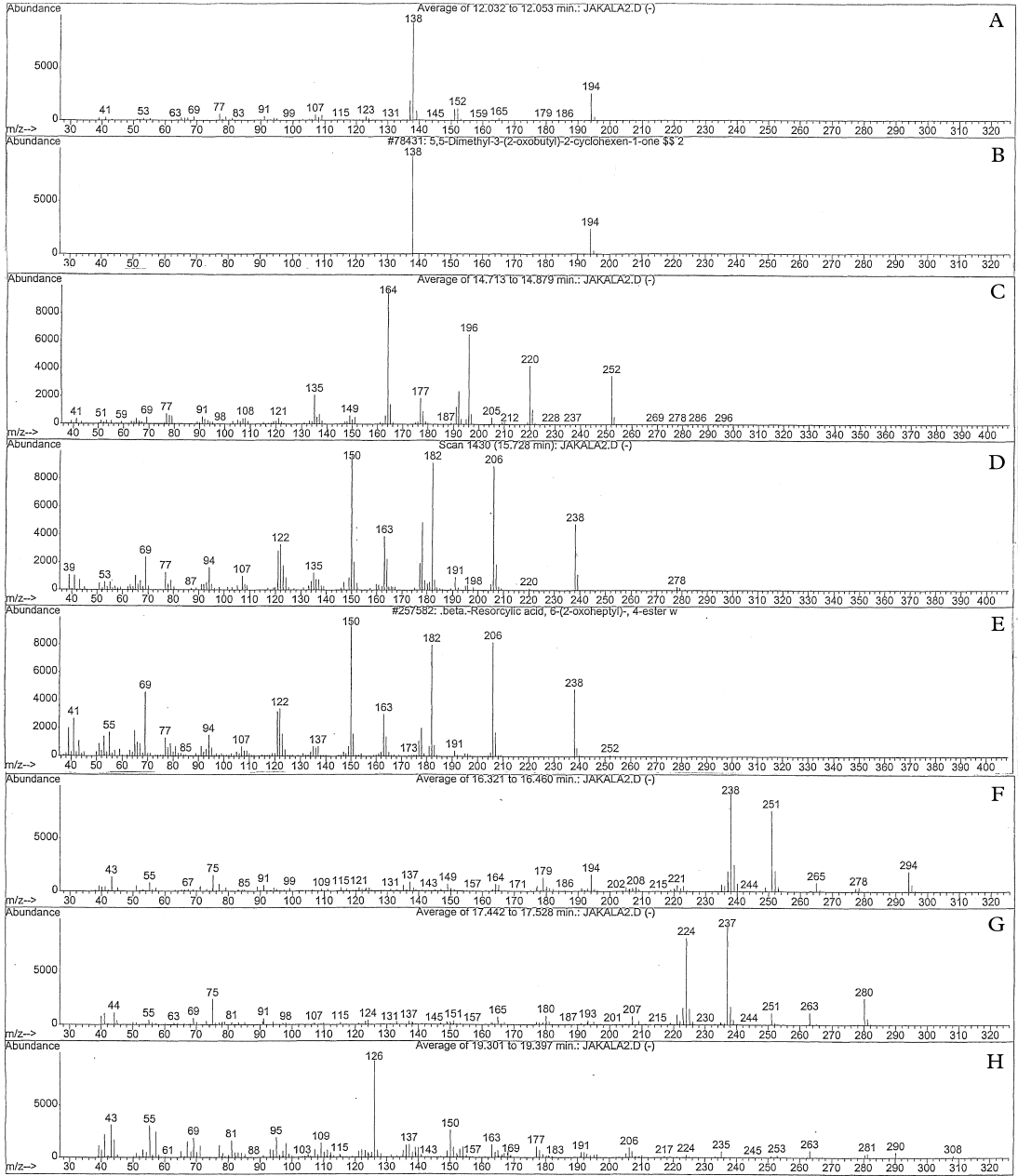
In the GC-MS chromatograms of underivatized extracts, represented by the Krouvinummi lichen extract (Fig. 3), diphenylmethanol, 5-pentylresorcinol, and the depside olivetoric acid methyl ester (Fig. 1E) were identified by comparing on-line with a GC-MS reference library. The bis(ethylhexyl)phthalate peak represents the internal standard. The mass spectrum of olivetoric acid methyl ester (peak 5, Fig. 4) is also very similar to the one published by Huneck et al. (Reference Huneck, Djerassi, Becher, Barber, von Ardenne, Steinfelder and Tümmler1968). The mass spectrum of peak 2 shows similarities with the mass spectrum of 5,5-dimethyl-3-(2-oxobutyl)-2-cyclohex-2-ene-1-one in the spectra library (Fig. 4). The most abundant compound in the GC-MS chromatogram seemed to be another olivetoric acid-type depside, which is tentatively identified as confluentic acid methyl ester (Fig. 1F). The mass spectrum (peak 4, Fig. 4) is almost identical to the mass spectrum of olivetoric acid methyl ester, but with fragments of 14 mass units more. The mass spectrum also resembles a mass spectrum of confluentic acid methyl ester published by Huneck et al. (Reference Huneck, Djerassi, Becher, Barber, von Ardenne, Steinfelder and Tümmler1968).
GC-MS chromatogram of the underivatised Krouvinummi lichen extract.

GC-MS spectra. A, 5,5-dimethyl-3-(oxobutyl)-cyclohex-2-ene-1-one with B, reference spectrum from a spectra library; C, confluentic acid methyl ester; D, olivetoric acid methyl ester with E, reference spectrum from a spectra library; F–H, olivetoric acid-type compounds.

Discussion
Usnic acid enantiomers
We report, for the first time, that Cladonia stellaris may contain both enantiomers of usnic acid. This contrasts with the findings by Kinoshita et al. (Reference Kinoshita, Yamamoto, Yoshimura, Kurokawa and Huneck1997), who reported only the (−)-enantiomer in C. stellaris. The difference in their results compared to our results may be due to analytical differences: Kinoshita et al. (Reference Kinoshita, Yamamoto, Yoshimura, Kurokawa and Huneck1997) used a normal-phase chiral column, while we used a reversed-phase column. Furthermore, we developed an optimal method for separation of the two enantiomers, as the detection of the (+)-enantiomer was difficult because of the much smaller amount of this enantiomer. The chromatographic conditions, i.e., the concentration of the sample, the purity and temperature of the column, and the flow rate, were critical for the separation. However, it cannot be ruled out that the different results might be due to genetic variation of the fungus. The lichen thallus might consist of several genetically different fungal strains (Robertson & Piercey-Normore Reference Robertson and Piercey-Normore2007), and these could produce different enantiomers. Also, the samples in the present work contained the upper parts of several lichen thalli that could have been genetically different. In the study by Kinoshita et al. (Reference Kinoshita, Yamamoto, Yoshimura, Kurokawa and Huneck1997), both enantiomers were found only in two out of 32 lichen species. It remains to be explored how commonly lichen species produce enantiomerically variable secondary metabolites.Although both enantiomers of usnic acid were present in all samples we analysed, the dominant form of usnic acid in C. stellaris was (−)-usnic acid, and the concentration of (+)-usnic acid was at most 10%. The two enantiomers might not have identical biological properties, since in experiments organisms have shown different sensitivity to (+)- and (−)- usnic acid (e.g., Ghione et al. Reference Ghione, Parrello and Grasso1988; Emmerich et al. Reference Emmerich, Giez, Lange and Proksch1993; Lauterwein et al. Reference Lauterwein, Oethinger, Belsner, Peters and Marre1995). Due to the scarcity of experiments investigating the two enantiomers simultaneously, it is not possible to evaluate the biological significance of the production of the two enantiomers.
Content of usnic and perlatolic acid
HPLC-UV has been widely used for analysis of usnic and perlatolic acid in lichen extracts. In one study, the quantification of usnic acid was studied using HPLC-MS (Roach et al. Reference Roach, Musser, Morehouse and Woo2006), but it was discovered that due to matrix effects interfering with the ionization, causing strong ion suppression of usnic acid, this method is not suitable for usnic acid. Usnic acid has also been analysed using solid phase microextraction-headspace GC-MS (De Angelis et al. Reference De Angelis, Di Tullio, Ceci and Quaresima2001); however, to our knowledge, neither usnic acid nor perlatolic acid have been quantified in lichen extracts previously by GC-FID.
The concentration of usnic acid ranged from 0·5–3·1% (mean 1·5%) and the concentration of perlatolic acid from 0·08–0·5% (mean 0·3%), which is very similar to the results of Huovinen (Reference Huovinen1985), who obtained concentrations ranging from 0·4–2·5% of usnic acid (mean 1·4%) and from 0·06–1·5% (mean 0·6%) of perlatolic acid in 53 C. stellaris samples collected in Finland. In our study, the concentration variation was large for both usnic and perlatolic acid (CV 40–50%). Large variation (34%) in usnic acid concentration was also observed by Huovinen (Reference Huovinen1985). As the content of usnic acid is affected by the light environment of the lichen, large variation can be expected, as samples were collected without regard to the openness of the lichen habitat. The concentration of usnic acid should be highest in the upper 20 mm part of the lichen. Huovinen (Reference Huovinen1985) reports an average usnic acid concentration of 0·98% in the upper 25 mm part of the lichen. We have previously obtained an usnic acid concentration of 3% for the upper 10 mm part of the lichen and approximately 1% for the 20–50 mm lower part of the lichen (Stark et al. Reference Stark, Kytöviita and Neumann2007). The acetone extraction method adopted in the present work, as well as in Stark et al. (Reference Stark, Kytöviita and Neumann2007), does not result in complete extraction of the lichen acids, but a small fraction is likely to remain embedded in the cell wall matrix (Solhaug & Gauslaa Reference Solhaug and Gauslaa2001; McEvoy et al. Reference McEvoy, Nybakken, Solhaug and Gauslaa2006). Since all lichen material was extracted similarly, this does not affect the comparison between samples in the present work. Furthermore, there is no a priori reason to suspect that the different usnic acid enantiomers would be extracted differently.
The latitude did not seem to have any influence on the concentrations of usnic or perlatolic acid in the present study. Previously, Huovinen (Reference Huovinen1985) reported that the concentration of perlatolic acid is lower in samples of Northern reindeer lichen collected from more northern latitudes. We could not verify this finding, possibly due to low sample number. The ecological role of perlatolic acid and of the different enantiomers of usnic acid warrant future research, due to the large amounts of C. stellaris in the boreal forests and the considerable amounts of these lichen acids produced.
Identification of lichen compounds
In C. stellaris, besides usnic acid and perlatolic acid, the depsidones psoromic acid and dimethylpsoromic acid (Huovinen & Ahti Reference Huovinen and Ahti1986) and the depsides atranorin (Falk et al. Reference Falk, Green and Barboza2008), evernic acid, and olivetoric acid (Wang & Yang Reference Wang and Yang2004) have been detected. We could not, however, find any indications of the presence of the depsidones, atranorin or evernic acid in the HPLC-MS or GC-MS analyses of our collected lichen samples. Consequently, it seems that the chemical composition of C. stellaris extracts may vary considerably. However, it seems that usnic acid and perlatolic acid are generally the dominant constituents.
The HPLC-UV-ion trap-MS chromatograms of one lichen extract (Krouvinummi) are shown in Fig. 2. All the extracts showed only these peaks, although the relative amounts seemed to vary in different extracts. The fragment at m/z 223 in the MS2 spectrum, detected for perlatolic acid and for peak 5, which is tentatively identified as 4-O-methylolivetoric acid (Fig. 1D), obviously corresponds to the fragment formed by cleavage of the molecule at the carboxyl group, at the carbon-oxygen single bond. Huneck et al. (Reference Huneck, Djerassi, Becher, Barber, von Ardenne, Steinfelder and Tümmler1968) described the fragmentation of a large number of lichen compounds, and showed that depsides are always cleaved at this bond. 4-O-methylolivetoric acid is a known lichen substance (Culberson & Esslinger Reference Culberson and Esslinger1976). It may have remained undetected in previous studies, where reversed-phase HPLC-UV has been used for analysis of C. stellaris extracts, because the peak is so much smaller and it may partly overlap with the usnic acid peak, which was the case at least in our analyses. The other peaks in the LC-UV-ion trap-MS chromatograms remain unidentified. The compounds representing peaks 1 and 2 lose 63 mass units in the MS2 transition, which could correspond to the loss of one methanol and one methoxy group. The compound representing peak 3 seems to lose acetic acid in the MS2 transition, and then water in the MS3 transition. Peaks 6 and 8 seem to be isomers of the same compound, as they have the same molecular ion and most abundant fragment ions in MS2 and MS3. They lose 114 mass units in the MS2 transition, which indicates the 2-oxoheptyl group of the olivetoric acids, and then a carbon dioxide molecule in the MS3 transition. The compounds representing peaks 9 and 10 seem to contain the same substituted benzene ring as perlatolic acid (the fragment at m/z 223) and are, consequently, also olivetoric acid-type compounds. The molecular ion of peak 10, at m/z 445, indicates perlatolic acid with two mass units more; possibly the carboxyl group has been reduced.
The GC-MS chromatogram of the unsilylated Krouvinummi lichen extract shows some unidentified peaks (peaks 6, 7, and 8, Fig. 3). Peaks 6 and 7 seem to represent similar compounds, the mass spectrum of peak 7 showing the same fragments as peak 6, only with 14 mass units (one methyl group) less (Fig. 4). Peak 6 has the fragment at m/z 238 in common with olivetoric acid methyl ester (peak 5), indicating that it contains a similar benzene ring with a methylester group as olivetoric acid methyl ester (Fig. 1E). However, it seems that it contains a butyl group bound to this ring, which would explain the fragment at m/z 294. The butyl group seems to lose an ethyl group and a propyl group, giving fragments at m/z 265 and 251. Consequently, peak 6 could represent the butyl ether of olivetoric acid methyl ester. Peak 7 could represent the butyl ether of olivetoric acid, based on its retention time and fragmentation pattern. Peak 8 also seems to represent an olivetoric acid-type compound, as many fragments are the same as those of olivetoric acid methyl ester. The compound has also some fragments in common with the proposed butyl ether of olivetoric acid (peak 7).
The analytical behaviour of the lichen compounds is somewhat complicated. In the GC analyses, perlatolic acid can be detected only in silylated extracts, whereas the other depsides and usnic acid can be detected only in underivatized extracts. This could possibly be due to the content of the many polar groups in perlatoric acid and olivetoric acid, especially the carboxylic acid group. Consequently, the compounds require silylation in order to be volatile enough for GC analysis. Usnic acid is probably degraded during silylation, and the molecular weights of the other depsides are too high for detection in a silylated form by GC. On the other hand, of the olivetoric acids, the methyl ester forms could not be detected by HPLC-MS. This may be explained by the higher lipophilicity of the methyl esters, i.e., they are not eluted from the reversed-phase column. This might also be the reason why the olivetoric acid-type methyl esters have remained undetected in previous studies of C. stellaris extracts, because GC-MS has, to our knowledge, not been used for these analyses previously.
In addition to the quantified (+)- and (−)-usnic acids and perlatolic acid, olivetoric acid has also been shown to have antifungal and antibacterial effects (Türk et al. Reference Türk, Yilmaz, Tay, Türk and Kivanc2006), and its quantification in lichen tissue and investigation of its ecological role remain future challenges.
In conclusion, this study shows that both enantiomers of usnic acid are present in C. stellaris extracts, and that other lichen acids besides usnic acid and perlatolic acid are commonly occurring in the extracts.
We thank Professor Pia Vuorela (Åbo Akademi University) for valuable advice and for usnic acid reference standards. Markku Reunanen (Åbo Akademi University) is acknowledged for the GC-MS analyses. Saini Heino (Turku University), Tommi Nyman (Joensuu University), Niilo Rankka (Oulu University), and Sari Stark (Finnish Forest Research Institute) are warmly thanked for help in collecting the lichen specimens. This work is part of the activities at the Åbo Akademi Process Chemistry Centre within the Finnish Centre of Excellence Programme by the Academy of Finland.