




No CrossRef data available.
The California Plan: A 21st Century Method for Nominating Presidential Candidates
Published online by Cambridge University Press: 26 February 2004
Abstract
An abstract is not available for this content. As you have access to this content, full HTML content is provided on this page. A PDF of this content is also available in through the ‘Save PDF’ action button.
Information
- Type
- Features
- Information
- Copyright
- © 2004 by the American Political Science Association
Collapse of the Traditional System
The traditional schedule of presidential primaries and caucuses is simply that—a tradition—one which evolved piecemeal over a period of decades, without any systemic architecture. Iowa and New Hampshire always go first because … they are Iowa and New Hampshire. Originally, the other states' primaries and caucuses were spread fairly evenly throughout the spring season, leading up to the nominating conventions in the summer. Whereas now there are only a handful of states that do not hold presidential primaries, prior to the McGovern reforms in the early 1970s, only a third of the states held such primaries. In those pre-reform days, instead of the delegates of a state being chosen in one day as in a primary election, they were usually selected in the course of a long process beginning with precinct caucuses, running through district or county caucuses, and culminating in state conventions. The process of selecting a party's presidential candidate was the aggregation of decisions made in thousands of smokefilled rooms. Such a process did not lend itself to as much media attention nor to a sense of a candidacy building momentum. Rather, there was more the sense that the delegate selection processes in each state were relatively isolated, exerting little influence on each other. In such an environment, there was little perceived advantage in a state choosing its delegates early.
The McGovern reforms changed this process. Over the next two decades, more states switched to primaries, which attracted more media attention. The concept of campaign momentum took shape; with increasing frequency, candidates without sufficient momentum dropped out of the race before the national conventions. Eventually, states realized that they could exert more influence over the process and the candidates, as well as attract more campaign expenditures and media coverage, if they moved their primaries to the beginning of the season. The more the system shifted from caucuses to primaries, the more incentive it created for front-loading. This was the unintended, adverse consequence of the McGovern reforms.
The first significant break with tradition came in 1988, when a bloc of southern states decided to hold their primaries on the same Tuesday March in, calling it “Super Tuesday.” But any state or region of the country can play that game, and in the years since many have. In 1996, California (a region in its own right) moved its presidential primary from the first Tuesday in June to the second Tuesday in March; still not content with that, the most populous state in the union moved its primary to the first Tuesday in March four years later. California was joined by 11 other states, creating a “Mega Tuesday” in which a third of all conventional delegates were awarded. Also in 2000, a bloc of western states moved their primaries to the Saturday between Mega Tuesday and the South's Super Tuesday.
Front-loaded extravaganzas such as Super Tuesday and Mega Tuesday are the weapons of mass destruction in presidential politics. They kill candidacies by the score. Both Bill Bradley and John McCain conceded their parties' nominations on March 8, 2000, the day after Mega Tuesday, before the Western Regional Primary and Super Tuesday even took place. Until 1976, New Hampshire held the first primary of the season on the first Tuesday in March, an event that began the campaign in earnest. In 2000, however, the first Tuesday in March marked not the beginning of the campaign, but the end. Even so, we have yet to see the worst of it. For 2004, the Democratic National Committee “has lifted its window restriction on protecting New Hampshire and Iowa,” meaning that states are now free to schedule primaries and caucuses before these two traditional events.1
Email correspondence with Paul Hegarty, Executive Director, Arizona Democratic Party. January 21, 2003.
The Rise and Fall of the Delaware Plan
While a number of ideas for reforming the presidential nomination process have been put forward, none has come as close to being implemented as the Delaware Plan, developed by Delaware Republican Committee member Richard A. Forsten and state chairman Basil Battaglia (Center for Governmental Studies 2001, 18; Klett 2003). Under the Delaware Plan, the states would be grouped into four “pods” according to population, as determined by the decennial census. The smallest 12 states, plus federal territories, would go first, followed by the next smallest 13 states, then the 13 medium-sized states, and finally the 12 largest states. These four consolidated primaries would occur on the first Tuesday of each month, beginning in March and ending in June.
The advantage of the plan is that it delays costly, high stakes campaigns in large states until later in the season, with the intent of allowing a wide field of candidates to run inexpensive campaigns in small states in early contests. In theory, this should open the political process to more candidates, allowing a fuller debate of the issues and a more competitive nomination process. The plan was adopted on May 4, 2000 by the Advisory Commission on the Presidential Nominating Process, headed by former Republican National Committee (RNC) chairman Bill Brock (Brock 2000, 25–28).
However, a major criticism of the Delaware Plan is that states are locked into the same schedule in every quadrennial cycle. The larger the state, the later it is always scheduled. This is inherently unfair to voters in large states. At the Republican National Convention in July 2000, Haley Barbour (former RNC Chairman, member of the Brock Commission, and advisor to George W. Bush's presidential campaign) said that the Delaware Plan is a “sincere” but “impractical” effort to fix the system. Barbour objected to a system that would allow a candidate to lock up the nomination before being tested in a big state like New York, Pennsylvania, California, Texas, or Florida. Another outspoken critic of the Delaware Plan was Bill Jones, then California secretary of state and member of the Brock Commission. Although recommended by the Brock Commission, the Delaware Plan was subsequently rejected by the RNC Rules Committee at the July 2000 Republican Convention in Philadelphia due to opposition from the Bush campaign and large-population states (Lester 2000; Walsh 2000).
The California Plan
The Graduated Random Presidential Primary System, or California Plan, reflects the basic philosophy of the Delaware Plan, but is entirely different in its implementation of that philosophy. This system features a schedule consisting of 10 two-week intervals, during which randomly selected states may hold their primaries. This 20-week schedule is the approximate length of the traditional presidential primary season. The schedule is weighted as an ascending scale based on each state's number of congressional districts. The actual number of delegates for each state would be set by the political parties themselves, as they always have been. American Samoa, the District of Columbia, Guam, Puerto Rico, and the Virgin Islands, which also send delegates to both national conventions, are each counted as one district in this system, although they in fact have no voting representatives in Congress. When these are added to the 435 congressional districts, the California Plan comprises a total of 440 districts. It happens that this number is equal to:

In the first interval, a randomly determined combination of states with a combined total of eight congressional districts would hold their primaries, caucuses, or conventions. This is approximately equal to the total number of congressional districts in Iowa (5) and New Hampshire (2), thus preserving the doorto-door “retail politicking.” However, these two particular states would not necessarily comprise the first round. Any state or combination of states amounting to a total of eight congressional districts could be in the first round of primaries and caucuses. This could include such ethnically diverse jurisdictions as American Samoa, the District of Columbia, Guam, Puerto Rico, the Virgin Islands, Alaska, Hawaii, New Mexico, Arkansas, Mississippi, Oklahoma, South Carolina, Alabama, Louisiana, Arizona, and Maryland. These jurisdictions have large proportions of people of color such as Asians, Pacific Islanders, Hispanics, Native Americans, and African Americans, and 17 of the 38 first-round eligible jurisdictions have poverty rates above the national average. Opening the first contests to this field of jurisdictions would empower demographic groups that the current system marginalizes.
In the second period—two weeks later—the eligibility number would increase to 16 (8×2). In the baseline design of the Graduated Random System, every two weeks the combined size of the contests would grow by eight congressional districts until a combination of states totaling 80 congressional seats (8×10)—nearly one-fifth of the total—would be up for grabs in the tenth and last interval toward the end of June. As the political stakes increased every two weeks, a steady weeding-out process would occur as less successful campaigns reached the point at which they were no longer competitive in these larger contests. This system would foster the widest possible political debate, commensurate with the need to resolve the debate to one or two viable candidacies at the end of the primary process.
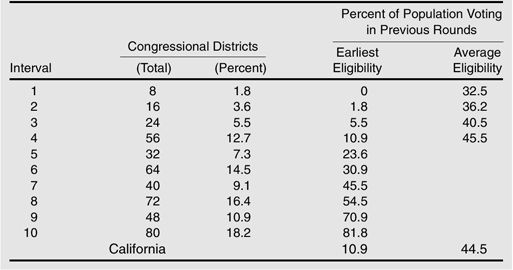
Because California is so much more populous than the other states, this baseline design would allow the Golden State, which has 53 districts, to vote no earlier than the seventh interval, in which the eligibility number is 56 (8×7). This stands in stark contrast to the Graduated Random System's treatment of other states. Texas, the second most populous state, is eligible in the fourth round, as are New York and Florida. The preferred modification (Mod 2A) to the schedule makes two adjustments in order to accommodate California. To begin with, the seventh round is inserted before the fourth, the eighth round is inserted before the fifth, and the ninth round is inserted before the sixth (see Table 1). Finally, the interval between the third round (8×3) and the now much larger fourth (formerly the seventh) round (8×7) is stretched to three weeks to give candidates more time to prepare, while the interval between the eighth (formerly the ninth) round (8×9) and the now much smaller ninth (formerly the sixth) round (8×6) is shortened to one week. Figure 1 shows that these adjustments have only a minor effect on the graceful shape of the graduated random curve.


A handy way to conceptualize how the Graduated Random Presidential Primary System would operate is to compare it to the Parker Brothers board game Risk, a strategy game that lets you conquer the world. In Risk, each player starts out with a small number of armies, so no one gets blown out of the game early. However, every time a player turns in cards, she gets more armies than the previous player did when he turned in his. The winners get stronger, the losers get weaker, and one by one players are swept from the board. The game cannot go on forever, though, because as increasingly massive forces scythe across the continents, it eventually becomes mathematically improbable for two players to remain on the board. The game is designed to produce a winner in about three hours of play. The Graduated Random System would work in much the same way; every two weeks the delegate prize would get larger and larger, until nearly one-fifth of the delegate total would be at stake in the final two weeks of the campaign.
Small states like Iowa and New Hampshire would be eligible for the entire primary season. They might get lucky and be first, get stuck with the last interval, or end up somewhere in the middle. Not every state would have a chance to go first, but every state would have an opportunity to be last. No one region of the country would consistently have an advantage over all the others, while there would be equal advantage in being a large, small, or medium-size state.
The unique and innovative design of the California Plan achieves the goal of preserving “retail politicking” in small, early venues without imposing an unacceptable handicap on large-population states. For instance, Virginia could vote as early as the second of 10 intervals, whereas under the Delaware Plan it would always vote in the very last round. In the California Plan, the four most populous states are eligible to vote in the fourth of 10 rounds. Since only 11% of the American electorate votes in the first three intervals, these large states can figure early enough in the delegate selection process to have as meaningful an input as any state. In fact, the California Plan treats all states with surprising even-handedness; on average, the smallest states are scheduled at random to vote after 32.5% of the country has voted, but for the largest states this figure is no higher than 45.5%, a spread of only 13 points.
Comparison with Historical Data
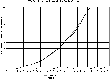
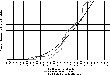
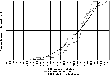
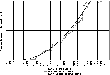
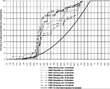
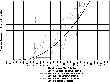
Speaking on the advantages of the Delaware Plan, former chairman of the Republican National Committee's Rules Committee Tom Sansonetti declared that letting the smallest states begin the contest “allows a grassroots campaign to catch fire. The Jimmy Carter example in ‘76, the Gary Hart example from ’84, the Eugene McCarthy example for that matter in 1968 (Center for Governmental Studies 2001, 18).” The fact that the chairman of a Republican committee would refer to the campaigns of three Democrats eloquently bespeaks the bipartisan reach of this issue. Moreover, an interesting question is, if the Graduated Random System had been in place in those years would it have been conducive to the candidacies of Eugene McCarthy, Jimmy Carter, or Gary Hart? Figures 2 through 4 compare the California Plan with the Democratic and Republican delegate selection schedules for national conventions in 1960, 1968, and 1976 (the profiles for 1964, 1980, and 1984 are similar). Note that the California Plan faithfully reproduces the campaign profiles for these years. Comparing these earlier profiles with frontloaded campaigns since 1988 underscores how much the system has deteriorated (see Figure 5). Could a Eugene McCarthy or a Jimmy Carter have made a successful run in these more recent years?


A Window of Opportunity
The nomination of presidential candidates is an issue that straddles the gaps in our federal system of government. It cuts across party lines and jurisdictional boundaries. No single political institution, either partisan or governmental, either state or federal, has clear authority on this issue, yet there are many competing interests. However, by no means are we stuck with the current mess. A number of mechanisms have been proposed for implementing a national solution to the problem of presidential primaries:
- Coordinated state legislation (NASS 1999; 2000);
- Federal statute (Congressional Quarterly 1972; Gorton 2000; Gorton and Lieberman 1999; Hirsch 2000; Levin 2000; Lieberman 1999; Lieberman 2000; Smith 2000);
- Supreme Court challenge (Parschall and Mattei 2002); and
- National party rules (Brock 2000).
Coordinated state legislation constitutes a monumental collective action problem (more than 50 state and territorial legislatures, most of them bicameral). While many federal bills have been introduced, all have died in committee. Judicial intervention in a political process tends to be unpalatable, yet might provide the needed impetus for a political solution. Of the possible paths to implementation, the most likely would seem to be the one that nearly succeeded in 2000: national party rules.
Conventional wisdom might suggest that instituting such a sweeping reform would be a leap of faith that the two major parties must take together. However, an equally tenable counterargument is that the substantial advantages of such a reform would accrue asymmetrically to the political party that had the vision to implement it first, and that the other party would be forced to quickly follow suit. The historical precedent for this is the McGovern reforms. The Democratic Party leaped first, implementing them for the 1972 campaign, and even though Richard Nixon trounced George McGovern in the general election of that year, the Republican Party adopted many of the same reforms in time for the 1976 presidential primaries.
The period between now and the 2004 national conventions represents a new window of opportunity. As Senator Robert Packwood stated in 1972 in reference to reforming the presidential primary system: “It's like the electoral college. You'll see a flurry of activity while the thing is going on. By next year it's 3 1/2 years from the next election and people say, ‘Let's worry about it later”’ (Congressional Quarterly 1972). Both Senator Packwood's observation and the experience of the Brock Commission strongly support the contention that now is the time to begin the next effort to reform the presidential nominating process, or else wait four more years.
If the Republican Party were to adopt the California Plan at its national convention in 2004, this is what could happen in 2008. The Democrats, operating under the front-loaded schedule, determine their nominee in February. But no race means no news, and he or she immediately drops off the radar screen. Meanwhile, a half-dozen Republican candidates wage vigorous campaigns for months. By June, the contest boils down to two candidates, both of whom have built massive name recognition, while the Democratic nominee has languished in obscurity. Republican issues have been hotly debated and finely honed, and are at the forefront of the electorate's consciousness, while few have any idea of the Democratic nominee's vision for the nation. The Republican nominee has been fully vetted; the Democratic nominee has merely proven to be a masterful fundraiser, but may turn out to be a mediocre campaigner. This is a prescription for Republican victory in November. Of course, were the Democrats to be the first party to adopt this reform, the reverse scenario would apply.
Conclusion
The Vanishing Voter Project at the Joan Shorenstein Center on the Press, Politics, and Public Policy (Harvard University) concluded that reform proposals, when it comes to the nominating process, should be judged on the basis of their ability to foster (Patterson 2000):
- A shorter campaign;
- A nominating process that remains competitive for a longer period of time in order to give the public a greater opportunity to engage the campaign and to become informed about the candidates;
- A briefer interval between the decisive contests and the conventions in order to help people sustain the levels of public engagement and information they had attained when the nominating campaign peaked; and
- A system that increases the likelihood that voters in all states will have an effective voice in the selection of the nominees.
As originally designed, the California Plan satisfies three of these criteria. In order to achieve a shorter campaign schedule, it would only be necessary to redefine the length of the voting intervals.
The Graduated Random System embodies the best features of other proposed systems. Like the Regional Lottery System (Center for Governmental Studies 2001, 22) and the Smith Plan (Hirsch 2000; Smith 2000), it selects the order of states and territories in the schedule via a random process, thus all states are treated fairly. Also, as with the Smith Plan, and to a lesser extent the Regional Lottery System, the Graduated Random System distributes the dates of individual primaries and caucuses so that they are not bunched together on the first Tuesday of each month. Like the Delaware Plan, the Graduated Random System structures the overall primary schedule so that the number of delegates at stake starts out small and gradually increases, allowing a greater number of campaigns to begin at the grass roots level and build momentum (Center for Governmental Studies 2001, 17–22; Smith 2000; Washington Post 1999).
If the quest for the presidency can be compared to climbing a mountain, then the time charts comparing the proposed reforms to the presidential primary schedule clearly show that the Graduated Random System results in an initial slope that is gentle enough for many candidates to ascend at first, but one that becomes steeper over the ensuing weeks, ensuring that only the fittest candidates succeed in scaling the final summit (see Figure 6). The slope of the Graduated Random System is smooth and graceful, not jerky and discontinuous. No other proposed system of reform approaches its mathematical elegance.

The Graduated Random Presidential Primary System, or California Plan, is at the same time both random in composition, yet predictable in structure. The composition of the schedule favors no one state or region. Meanwhile, the structure of the system enables the widest possible political debate in the early stages of the presidential primary schedule, yet provides a gradual winnowing process as the price of staying in the game increases with each successive round. A successful candidate need not start out well-heeled, but will cross the finish line fully vetted. He or she need not hail from any particular region of the country, but must appeal to the whole nation. America deserves such a president, and America deserves a rational, systematic primary process for the 21st century.
The author gratefully acknowledges Richard DeLeon, Professor of Political Science at San Francisco State University, for his many thought-provoking questions, which encouraged the refinement and broader development of the California Plan.
References
Appleman Eric M.
2000
“The Rest of the Primaries”
http://www.gwu.edu/~action/chrnothp.html (December 24, 2002).Google Scholar
Brock William E.
2000
“Nominating Future Presidents: Report of the Advisory Commission on the Presidential Nominating Process”
http://www.rnc.org/media/pdfs/brockreport.pdf (February 13, 2003).Google Scholar
Center for Governmental Studies
2001
“Report of the National Symposium on Presidential Selection”
http://www.centerforpolitics.org/reform/nssreport_entire.pdf (February 1, 2003).Google Scholar
Congressional Quarterly.
1960
“How Delegates to National Conventions are Chosen”
February 12, 225.Google Scholar
Congressional Quarterly.
1960b
“Sixteen Presidential Primaries Scheduled for 1960”
March 4, 348Google Scholar
Congressional Quarterly.
1968c
“GOP Delegates: One-Fifth '64 Returnees, Few Negroes”
July 26,
1978–
2000Google Scholar
Congressional Quarterly.
1968e
“Credential Challenges Set Record at Convention”
August 23,
2245–
2254Google Scholar
Congressional Quarterly.
1976a
“Carter Coasts to Nomination in 30 Primaries”
July 10,
1806–
1807Google Scholar
Congressional Quarterly.
1976b
“Caucuses: Light Turnout, Many Uncommitted”
July 10,
1809–
1811Google Scholar
Congressional Quarterly.
1976c
“A Quick ‘Who's Who’ of GOP Delegations”
August 14,
2188–
2196Google Scholar
Congressional Quarterly.
1988a
“Opening Round Primaries and Caucuses … Fragmented Electorate”
March 5,
570–
571Google Scholar
Congressional Quarterly.
1988d
“1988 Democratic First-Round Caucus Results.”
July 9, 1895.Google Scholar
Congressional Quarterly.
1988f
“1988 Republican First-Round Caucus Results.”
July 9, 1897.Google Scholar
Congressional Quarterly.
1996
“1996 Presidential Primary… and Caucus Calendar.”
January 13,
98–
99.Google Scholar
Gorton Slade, and
Joseph Lieberman.
1999
“Regional Presidential Selection Act of 1. 1999.”
http://thomas.loc.gov/cgi-bin/query/z?c106:s.1789: (April 8, 2003).Google Scholar
Gorton Slade.
2000
“Testimony of Senator Slade Gorton (WA) Before the Committee on Rules and Administration, United States Senate, March 29, 2000.”
http://rules.senate.gov/hearings/2000/032900gorton.htm (January 25, 2003).Google Scholar
Hirsch J. M.
2000
“Smith Releases Plan to Keep New Hampshire's Primary First.”
July 6. http://smith.senate.gov/Releases/Releases/07062000.HTM (January 4, 2003).Google Scholar
Klett Rooney
Lieber, &
Schorling.
2003
“Richard A. Forsten. Biography.”
http://www.klettrooney.com/attorneys/alpha/f/forstenra.html (February 13 2003).Google Scholar
Lester Will.
2000
“GOP Abandons Plan to Overhaul Primary Schedule.”
Associated Press,
July 28. http://archive.nandotimes.com/election2000/story/0,3977,500233467-500339806-501946106-0-nandotimes,00.html (January 4, 2003).Google Scholar
Levin Sander.
2000
“Interregional Presidential Primary and Caucus Act of 2000.”
http://thomas.loc.gov/cgibin/query/z?c106:h.r.4014: (April 8, 2003).Google Scholar
Lieberman Joseph.
1999
“Gorton, Lieberman Call for Presidential Selection Overhaul.”
Press release, October 26. http://www.senate.gov/member/ct/lieberman/general/r102699a.html (January 4, 2003).Google Scholar
Lieberman Joseph.
2000
“Testimony on Regional Presidential Selection Act of 1999.”
http://www.senate.gov/member/ct/lieberman/general/r032900a.html (January 25, 2003).Google Scholar
National Association of Secretaries of State.
1999
“Model Presidential Primary Legislation.”
http://www.gwu.edu/~action/nass.html (April 28, 2003).Google Scholar
National Association of Secretaries of State.
2000
“Presidential Primary Plan.”
http://www.nass.org/issues.html (December 23, 2002).Google Scholar
Parshall Lisa K., and
Franco Mattei.
2002
“Parties and the Presidential Nomination Process: Political and Constitutional Implications of ‘Front-Loading.’”
Presented at the 2002 Conference of the Southern Political Science Association, Savannah, Georgia.Google Scholar
Smith Robert.
2000
“Senator Bob Smith's ‘Fairness in Primaries’ Plan.”
http://www.gwu.edu/~action/smithplan.htm (February 1, 2003).Google Scholar
Patterson Thomas E.
2000
“Public Involvement and the 2000 Nominating Campaign: Implications for Electoral Reform.”
The Vanishing Voter Project, April 27. http://www.vanishingvoter.org/releases/04-27-00prim-4.shtml (February 1, 2003).Google Scholar
Washington Post.
1999
“Regional Primary Plan Approved.”
February 13. http://wwwwp7.washingtonpost.com/wp-srv/politics/campaigns/wh2000/stories/primary021399.htm (April 1, 1999).Google Scholar
Walsh Susan.
2000
“Primary Reform Clears GOP Hurdle.”
CBSNews.com, 26 July. http://www.cbsnews.com/stories/2000/07/27/politics/main219401.shtml (February 13, 2003).Google Scholar
Mod 2A Percent of Population Voting in Previous Rounds
 You have Access