Introduction
Coarctation of aorta accounts for 5–10% of all CHD and is often diagnosed in infancy. Reference Dijkema, Leiner and Grotenhuis1 The adult presentation is usually due to uncontrolled arterial hypertension.
While the surgical risk in simple native coarctation of aorta repair nowadays is <1%, the reported rate of re-coarctation is up to 34%. Reference Gatzoulis, Webb and Daubeney2–Reference Puranik, Tsang and Puranik4 The reported mortality rate of re-do surgery for re-coarctation in adults can be up to 10%, particularly in complex disease. Reference Beckmann and Jassar5 Although the percutaneous intervention is the preferred treatment method, it is not always feasible, especially in the context of hypoplasia or interruption of the arch or when a small interposition graft has been previously employed. There is no consensus on the optimal treatment strategy for these complex patients with coarctation of aorta and re-coarctation, Reference Wang, Sun and Hu6,Reference Massey and Shore7 while traditional approaches through a left thoracotomy may be associated with a higher risk of spinal injury and/or mortality in adults. Reference Beckmann and Jassar5 The intrapericardial ascending-to-descending aortic grafting, first described in 1980s, Reference Edie, Janani, Attai, Malm and Robinson8 allows for a single-stage repair of complex native coarctation of aorta or re-coarctation, as well as repair of concomitant cardiac lesions through a median sternotomy. Reference Vijayanagar, Eckstein, Natarajan, Bognolo and Toole9 This approach reduces the risk of dissecting through a collateralised circulation on a previously repaired aorta via thoracotomy and allows for a full bypass for cooling or concomitant repair. However, the long-term outcome of this approach is unknown. In addition to complex coarctation or re-coarctation of aorta, intrapericardial ascending-to-descending aortic grafting has also been employed in selected patients with infected or dysfunctional thoracic stent grafts. In such scenarios, an extra-anatomic bypass offers a mean of maintaining distal perfusion while allowing removal of the infected graft as well as avoiding reconstruction in a contaminated field. Reference Chakfé, Diener and Lejay10–Reference Cheng, Cheng, Chu, Lee and Chen12
We examined the indications and short and long-term outcome of intrapericardial ascending-to-descending aortic grafting in adult patients with complex coarctation of aorta in our tertiary adult CHD centre.
Materials and methods
The demographic, clinical, surgical, and follow-up data of all adults who underwent intrapericardial ascending-to-descending aortic grafting between September 1994 and November 2016 were obtained from electronical patient recording system, automatically linked with the Office of National Statistics, which registers all deaths in the United Kingdom. Arterial hypertension was defined according to 2024 ESC guidelines as systolic blood pressure of ≥ 140 mmHg or diastolic blood pressure of ≥ 90 mmHg. Blood pressure was measured on the right upper arm during outpatient visit, both pre- and post-procedure.
Ethical statement
Data were retrospectively retrieved from our dedicated electronic hospital database. Mortality data were identified from electronic hospital records, automatically linked to the Office for National Statistics, which registers all United Kingdom deaths and is complete. As this is a retrospective study and original data were collected for routine clinical care and administration purposes, individual informed consent was not required (United Kingdom National Research Ethics Service guidance). The study was performed according to the Declaration of Helsinki.
Surgical technique
All procedures were performed via a median sternotomy with the heart retracted superiorly to allow for the exposure of descending aorta behind the posterior pericardium for creation of the distal anastomosis. The proximal anastomosis was performed by application of a side-biting clamp to the greater curve of the ascending aorta and creating an end-to-side anastomosis, with the body of the graft passing in front of or behind the inferior vena cava.
Statistical analysis
Continuous variables are presented as mean ± standard deviation or median (range), and categorical variables as numbers (percentage). Continuous variables were analysed using paired t-test. All statistical analyses were performed using SPSS version 27.0 software. Values of p < 0.05 were considered statistically significant.
Results
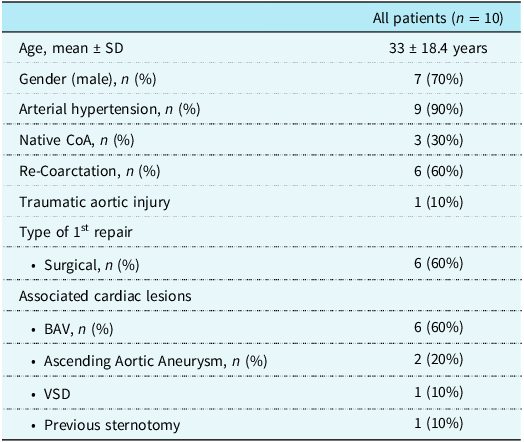
Ten patients after intrapericardial ascending-to-descending aortic grafting were identified, with a mean age at the time of procedure of 33.2 ± 18.4 years; 70% were men (Table 1). Six (60%) patients had a bicuspid aortic valve, and one also had a ventricular septal defect. The mean systolic blood pressure prior to the intrapericardial ascending-to-descending aortic grafting was 154 ± 24 mmHg.
Baseline characteristics

Abbreviations: BAV = bicuspid aortic valve; CoA = coarctation of aorta; VSD = ventricular septal defect.
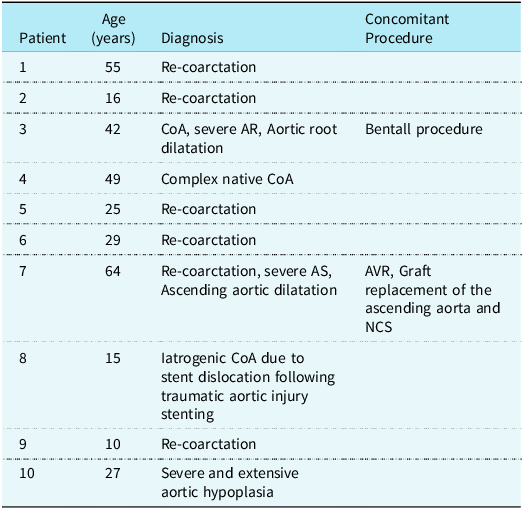
Indications for intrapericardial ascending-to-descending aortic grafting were complex native coarctation of aorta in four patients, re-coarctation in five patients, and acquired coarctation in one patient due to migration of a covered aortic stent used to treat traumatic isthmus transection (Figure 1 and Table 2).
CT angiography of aorta in patient with iatrogenic CoA due to stent dislocation. Abbreviations: CT = computed tomography; CoA = coarctation of aorta.

Preoperative diagnosis and operative data

Abbreviations: AR = aortic regurgitation; AS = aortic stenosis; CoA = coarctation of aorta; NCS = non-coronary sinus.
Nine patients had surgery on cardiopulmonary bypass using moderate hypothermia, while one patient had the procedure performed off pump with the use of stabilisers because systemic heparinisation was contraindicated. Two patients had aortic valve and root replacement at the time of intrapericardial ascending-to-descending aortic grafting.
There were no peri-operative deaths, paraplegia, or stroke in our cohort. The two patients who underwent concomitant aortic root surgery had postoperative permanent pacemaker implantation on 8th and 11th post-operative day due to development of high-degree heart block. One patient with long-standing chronic obstructive pulmonary disease required transient tracheostomy due to prolonged intubation post-operatively. Median hospital stay was 18 (5–142) days.
At a mean follow-up of 13.6 ± 9.4 years, there was one late death, 11 years after surgery, due to terminal heart failure unrelated to intrapericardial ascending-to-descending aortic grafting. Of the nine remaining patients, seven were in NYHA class I and 2 were in NYHA class II at the latest follow-up. All grafts remained patent, with no pseudo-aneurysm formation observed at the most recent follow-up (Figure 2).
Panel A. CT angiography of a patient after CoA repair with interposition graft showing small and kinked graft causing significant re-CoA. Panel B. Post-operative CT angiography of the same patient showing patent IADA graft. Abbreviations: CT = computed tomography; CoA = coarctation of aorta; IADA = intrapericardial ascending-to-descending aortic graft.

The mean number of antihypertensive medications required decreased from 2.8 ± 1.5 preoperatively to 1.6 ± 0.6 at the last follow-up, with improvement in systolic blood pressure control (mean systolic blood pressure pre-operatively 154 ± 24 mmHg versus mean systolic blood pressure 134 ± 19 mmHg at last follow-up, p = 0.05).
Discussion
We present herewith a unique population of adults treated for complex coarctation of aorta or re-coarctation with intrapericardial ascending-to-descending aortic grafting, which was safe and associated with good long-term outcome and improved blood pressure control. In the last decade, technological progress has enabled all adult patients with aortic coarctation to be treated percutaneously. However, intrapericardial ascending-to-descending aortic grafting remains a valuable option when complications arise during a percutaneous procedure or when such a procedure is not feasible. This approach can still ensure surgical success and long-term blood pressure control.
There were no peri-operative deaths in our population. The only late death occurred 11 years after surgery due to terminal heart failure, unrelated to intrapericardial ascending-to-descending aortic grafting. None of the patients experienced paraplegia post-operatively. The operation could also be performed off-bypass.
Contemporary management of adults with native coarctation of aorta or re-coarctation is percutaneous in the first instance, but in selected adults with complex coarctation of aorta or concomitant cardiac lesions requiring simultaneous repair, intrapericardial ascending-to-descending aortic grafting may be preferable. Reference Connolly, Schaff, Izhar, Dearani, Warnes and Orszulak13 With this approach, re-coarctation and concomitant cardiac lesions can be addressed in a one-stage approach via a single incision. An important variant of the described technique is extrapericardial ascending-to-descending aortic grafting, which eliminates the need for cardiopulmonary bypass. This may represent an advantage in particular situations—for example, in cases of multiple trauma or when minimising bleeding risk is critical. Reference Arakelyan, Spiridonov and Bockeria14
Arterial hypertension is one of the most common long-term complications in patients with coarctation of aorta, even after successful repair. Reference Lee, Babu-Narayan and Kempny15,Reference Remmele, Willinger, Oberhoffer-Fritz, Ewert and Müller16 Uncontrolled hypertension is common after coarctation of aorta repair, affecting 47 to 58% of patients, depending on whether 24-hour blood pressure monitoring is performed alongside standard blood pressure monitoring. Reference Panzer, Bové, Vandekerckhove and De Wolf17 No significant difference in the occurrence of arterial hypertension has been observed between conventional surgical and percutaneous coarctation of aorta repair. Reference Panzer, Bové, Vandekerckhove and De Wolf17,Reference Martins, Zachariah and Selamet Tierney18
It has also been shown that arterial hypertension has a progressive character with the incidence increasing over time. Reference Bambul Heck, Pabst von Ohain, Kaemmerer, Ewert and Hager19 This is an important risk factor in these patients for increased mortality as well as morbidity, including stroke, heart failure, and myocardial infarction. Reference Meijs, Minderhoud and Muller20 Therefore, careful monitoring for potential re-coarctation, which may need addressing and timely treatment with antihypertensive medications, is necessary.
In our cohort, all patients except one with a history of traumatic aortic injury had previous arterial hypertension. Blood pressure control improved post-operatively and remained well controlled with lower number of antihypertensive medications required at the long-term follow-up.
Although the surgical risk of simple native coarctation of aorta repair in children is low, the risk increases significantly in adults. Reference Ungerleider, Pasquali and Welke21 The current European Society of Cardiology guidelines for Adult Congenital Heart Disease recommend percutaneous stenting as the first-choice treatment for both native coarctation of aorta and re-coarctation. Reference Baumgartner, de Backer and Babu-Narayan22 This method is effective in relieving obstruction with a reduction in the number of patients requiring antihypertensive therapy. Reference Holzer, Gauvreau, McEnaney, Watanabe and Ringel23–Reference Eriksson, Pihkala and Jensen25 Nevertheless, both surgical and percutaneous approaches are associated with long-term complications, including aortic wall injury (aneurysm, dissection, and intimal tear) and re-coarctation. Reference Schneider, Uebing and Shore26
When percutaneous stenting is not feasible, surgery is the fallback option. Surgical management of the adult with re-coarctation, in turn, represents a surgical challenge with reported surgical risk in these patients being significantly higher compared to surgical risk of native coarctation of aorta repair. Reference Beckmann and Jassar5 Approach through a left lateral thoracotomy may be challenging due to prior surgery, altered anatomy, true or false aneurysm formation at the site of previous coarctation repair, and abnormalities of the vessel walls. Reference Massey and Shore7 Paraplegia remains the most devastating complication after coarctation of aorta operation in adults, where the risk is elevated and not completely prevented by using left heart bypass. Reference Ungerleider, Pasquali and Welke21,Reference Grinda, Macé, Dervanian, Folliguet and Neveux27
Intrapericardial ascending-to-descending aortic grafting proved to be a safe surgical option with good short- and long-term results in patients with complex native or re-coarctation, and it also allows for the repair of concomitant cardiac lesions. Reference Levy Praschker, Mordant, Barreda, Gandjbakhch and Pavie28–Reference Curran, Schaff and Connolly32
Despite the small number of adults with complex coarctation of aorta managed by intrapericardial ascending-to-descending aortic grafting in the present study, the mortality and morbidity results are similar to previous reports. Our study, however, had a longer mean follow-up period. Reference Arakelyan, Spiridonov and Bockeria14,Reference Levy Praschker, Mordant, Barreda, Gandjbakhch and Pavie28–Reference Said, Burkhart, Dearani, Connolly and Schaff30 Similar to our experience, Said et al. Reference Said, Burkhart, Dearani, Connolly and Schaff30 and Levy Praschker et al. Reference Levy Praschker, Mordant, Barreda, Gandjbakhch and Pavie28 reported series of patients who underwent intrapericardial ascending-to-descending aortic grafting with no perioperative deaths and no graft-related complications over the medium-term follow up. These reports highlighted high rates of post-operative arrhythmia and some transient neurological deficit, albeit with significant improvement in systolic blood pressure control at last follow-up, as in our study.
We acknowledge the limitations of our retrospective study that included a historical cohort of intention-to-treat patients. The number is small, but nevertheless, the message from our and previous studies is positive for such a highly selected cohort of patients with complex coarctation of aorta or re-coarctation.
Conclusion
Intrapericardial ascending-to-descending aortic grafting is a safe and effective approach for adults with complex coarctation of aorta or re-coarctation not suitable for a percutaneous or conventional surgical approach with no complications short and long-term in our experience. Intrapericardial ascending-to-descending aortic grafting was associated with improved blood pressure control and a tendency towards less anti-hypertensive medication use in the long-term.
This approach also allows for the concomitant management of intra-cardiac lesions and, if necessary, can be performed without the use of cardiopulmonary bypass and thus may be considered for the management of the adult with complex coarctation of aorta or re-coarctation.
Financial support
This research received no specific grant from any funding agency, commercial, or not-for-profit sectors.
Competing interests
None.