FOCUS POINTS
• Desvenlafaxine (administered as desvenlafaxine succinate), the major active metabolite of venlafaxine, is a serotonin-norepinephrine reuptake inhibitor approved by the U.S. Food and Drug Administration for the treatment of major depressive disorder and is currently in clinical development for other indications.
• In multiple clinical trials, short-term therapy with desvenlafaxine has been shown to be safe and effective in treating depression in adult outpatients with major depressive disorder.
• Long-term therapy with desvenlafaxine is safe and effective.
Introduction
Depression is a prevalent and chronic illness, and it is one of the leading causes of disability worldwide.1 Major depressive disorder (MDD) is defined as having 1 or more major depressive episodes lasting at least 2 weeks, during which the patient experiences at least 5 symptoms, at least 1 of which is depressed mood or anhedonia.2 Additional symptoms include insomnia or hypersomnia, decreased or increased appetite, significant weight change, fatigue, psychomotor agitation or retardation, feelings of worthlessness or excessive guilt, diminished cognitive functioning, and/or recurrent thoughts of death or suicide.2
The chronic and recurrent nature of MDD necessitates long-term treatment. Published treatment guidelines for MDD recommend that patients who respond to acute-phase therapy with antidepressant medication receive a 4- to 5-month regimen of continuation therapy to prevent relapse after symptom remission, and patients with a history of multiple depressive episodes receive maintenance therapy to prevent recurrence.3 In the clinical setting, these guidelines are often overlooked. Indeed, MDD is frequently underdiagnosed and undertreated. Antidepressant medications are often prescribed in inadequate doses for inappropriate lengths of time, making symptom relapse fairly common.Reference Kessler, Berglund and Demler4, Reference Sheehan5 Numerous studies have shown that adherence to the prescribed dose of antidepressant medication is often poor, which can cause a return of symptoms.Reference Lingam and Scott6–Reference Demyttenaere, Enzlin and Dewe8 Recurrent and partially treated depression are correlated with decreased quality of life, reduced workplace productivity, and poor overall clinical outcomes.Reference Sheehan5
Desvenlafaxine (administered as desvenlafaxine succinate), the major active metabolite of venlafaxine, is a serotonin-norepinephrine reuptake inhibitor (SNRI) approved by the U.S. Food and Drug Administration for MDD. Desvenlafaxine is metabolized to a minor extent by the cytochrome P450 pathway with minimal inhibition of cytochrome P450 enzymes.Reference Oganesian, Shilling and Young-Sciame9
Short-term studies have shown that desvenlafaxine is a safe and effective treatment for MDD at doses ranging from 50 mg/d to 400 mg/d.Reference Boyer, Montgomery and Lepola10–Reference Thase, Kornstein and Germain14 In this clinical trial, the long-term safety of high-dose desvenlafaxine (200–400 mg/d) in adult outpatients with MDD was evaluated. The long-term efficacy of desvenlafaxine treatment in relieving symptoms of depression was also examined as a secondary objective. Importantly, at the time the current study was initiated, the therapeutic dose was believed to be in the range of 200–400 mg/d. However, subsequent clinical trialsReference Boyer, Montgomery and Lepola10, Reference Liebowitz, Manley and Padmanabhan12 demonstrated that the optimal dose was considerably lower, and 50 mg/d is now the approved recommended therapeutic dose for MDD in the United States.
Methods
Study design
This was an open-label, phase 3, multicenter, flexible-dose, long-term study. This study was conducted from January 2004 to May 2005 in accordance with the U.S. Food and Drug Administration Code of Federal Regulations (21 CFR, Part 50) and the ethical principles of the Declaration of Helsinki, and was consistent with Good Clinical Practice and applicable regulatory requirements. The study protocol received independent ethics or institutional review board approval before the study began, and written informed consent was obtained from all subjects before their enrollment.
After a screening period of 10 ± 4 days, eligible patients were treated with desvenlafaxine for up to 12 months, plus 1 or 2 weeks for dose tapering as needed. Study visits were conducted on days 7, 14, 30, and every 30 days thereafter until day 360; study visits were then conducted on days 367, 374, and 384 to check for taper/poststudy-emergent adverse events (AEs). Between visits (i.e., on study days 45, 75, 105, 135, 165, 195, 225, 255, 285, 315, 345, 363, 370, and 377), patients were contacted by telephone to assess treatment tolerability and efficacy. There was also a follow-up visit 7 days after the last dose of desvenlafaxine (approximately study day 370 for a 1-week taper period and study day 384 for a 2-week taper period).
Patient selection
Outpatients aged 18–75 years with a primary clinical diagnosis of a single or recurrent episode of MDD without psychotic features,2 which was confirmed by the investigator using a modified Mini International Neuropsychiatric Interview (MINI),Reference Sheehan, Lecrubier and Sheehan15 were eligible for the study. To be eligible to participate in the study, patients must have experienced depressive symptoms for at least 30 days before the screening visit and, in the investigator's opinion, these symptoms should have required treatment for 6 months or longer with an antidepressant drug.
Patients were excluded if they had been treated with venlafaxine within 90 days prior to randomization, had a known sensitivity to the drug, had been previously treated with desvenlafaxine, or if they posed a potential suicide risk. Women who were pregnant, breastfeeding, or planning to become pregnant during the study were excluded. Additional exclusion criteria included current (within 12 months before baseline) psychoactive substance abuse or dependence (including alcohol), manic episodes, posttraumatic stress disorder, obsessive-compulsive disorder, lifetime diagnosis of bipolar or psychotic disorder, generalized anxiety disorder, panic disorder, or social anxiety disorder that the investigator considered primary based on a modified MINI assessment or clinical judgment. Clinically important personality disorders; a mental disorder due to a general medical condition or a neurologic disorder; a history of a seizure disorder; gastrointestinal disease or surgery known to interfere with the absorption or excretion of drugs; neoplastic disorder (except basal or squamous cell carcinoma of the skin) within 2 years; a history of narrow angle glaucoma; major acute illness within 90 days before screening; myocardial infarction within 180 days before screening; clinically important abnormalities on screening physical examinations, electrocardiogram (ECG), or laboratory analyses; and use of prohibited treatments were also exclusionary.
Treatment
The study drug was administered as 100-mg (during post-treatment taper only) or 200-mg tablets. Patients received 200 mg/d (1 tablet) on study days 1 through 7. Beginning on study day 7 and at all subsequent visits, patients were evaluated to determine if the dose should be maintained or adjusted to 400 mg/d (2 tablets) to improve efficacy or tolerance; the dose could also be decreased from 400 to 200 mg/d for safety issues. This flexible-dose regimen was continued for up to 360 days, with up to 2 additional weeks for tapering the medication at the end of the treatment period. During the tapering period, patients who had received 400 mg/d were decreased to 200 mg/d for 7 days and then 100 mg/d for 7 days. Patients who had discontinued while taking 200 mg/d were decreased to 100 mg/d for 7 days.
Safety measures
Safety evaluations included the following assessments: monitoring of AEs, patient discontinuations due to AEs, 12-lead ECGs, physical examinations, vital signs, and laboratory determinations (hematology, blood chemistry, and urinalysis). Laboratory determinations were performed at screening and study days 90, 180, 270, and 360, or at early withdrawal; ECGs were conducted at screening and study days 90, 180, 270, and 360, or at early withdrawal; and vital signs were measured at screening, baseline, and on study days 7, 14, and 30, and every 30 days thereafter until study completion, or at early withdrawal.
Standard Medical Dictionary for Regulatory Activities (MedDRA) dictionary terminology was used to categorize the reported AEs. Treatment-emergent adverse events (TEAEs) were defined as AEs not seen before the first dose of desvenlafaxine was taken, or events that worsened in frequency and/or intensity during the treatment period. Taper and poststudy-emergent AEs were also reported; these were defined as spontaneously reported AEs that were not present during the last 7 days of the treatment period (i.e., before the taper began), or events that were present but became more severe after this 7-day period. A serious adverse event (SAE) was defined as an AE that met any of the following criteria: one that resulted in death, was life-threatening, required inpatient hospitalization or prolongation of an existing hospitalization, resulted in a persistent or significant disability/incapacity, resulted in a congenital anomaly or birth defect, resulted in cancer, or was medically important or required intervention.
Efficacy assessments
The primary efficacy assessment was the 17-item Hamilton Rating Scale for Depression [HAM-D(17)]Reference Hamilton16 total score. The HAM-D(17) was administered at screening; baseline; on study days 7, 14, and 30; and every 30 days thereafter until study completion. The secondary efficacy assessments included the Clinical Global Impressions–Severity (CGI-S) Scale, administered at baseline and study days 7, 14, and 30, and every 30 days thereafter until study completion, and the Clinical Global Impressions–Improvement (CGI-I) Scale, administered on study days 7, 14, and 30, and every 15 days thereafter until study completion. The Montgomery-Åsberg Depression Rating Scale (MADRS),Reference Montgomery and Asberg17 the Visual Analog Scale–Pain Intensity (VAS-PI; overall and individual components),Reference DeLoach, Higgins, Caplan and Stiff18 the Sheehan Disability Score (SDS; total and subcomponent scores),Reference Sheehan19 and the 5-item World Health Organization–Well-Being Index (WHO-5) total score20 were administered at baseline, study day 90, and every 90 days thereafter until study completion.
Statistical analyses
The primary study objective was to evaluate the safety of long-term treatment with desvenlafaxine. The secondary objective was to assess the efficacy of long-term desvenlafaxine treatment. The safety analyses were based on all patients who took at least 1 dose of desvenlafaxine. Efficacy analyses were based on the intent-to-treat (ITT) population, which included all patients who had a primary efficacy evaluation at baseline, took at least 1 dose of desvenlafaxine, and had at least 1 primary efficacy evaluation after the first dose of desvenlafaxine.
AEs and patient discontinuation data were summarized. Vital signs, laboratory measures, and ECG data were summarized, and mean changes from baseline were analyzed using paired t-tests to determine statistical significance. The nominal 5% significance level without adjustment for multiple testing was used.
The primary efficacy endpoint was the mean change from baseline in HAM-D(17) total score at the final on-therapy evaluation. Remission was defined as a HAM-D(17) total score ≤ 7. Mean changes in HAM-D(17) scores and rates of remission were summarized without statistical analysis and presented as last-observation-carried-forward (LOCF) and observed-cases (OC) data. Mean changes from baseline over time in MADRS, CGI-S, Visual Analog Scale–Pain Intensity (VAS-PI), SDS, and WHO-5 scores (LOCF) were also summarized.
Results
Patient demographics and baseline characteristics
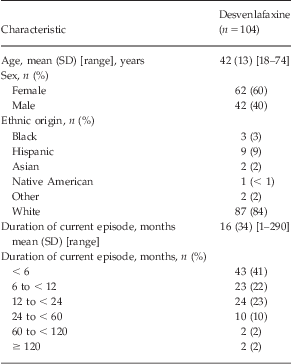
Out of the 138 patients who were screened, 108 patients were enrolled in the study (Figure 1). Of the enrolled patients, 4 had no postbaseline data, and only the remaining 104 patients, who had taken at least 1 dose of desvenlafaxine, were included in the safety population. The patient demographics and baseline characteristics for the safety population are presented in Table 1. The ITT population included 99 patients (5 patients from the safety population were excluded because they did not have a primary efficacy evaluation while on therapy). The ITT and safety populations had similar patient demographics and baseline characteristics. Thirty-six patients completed at least 357 days of the study.
Flow chart of patient enrollment and completion of the study.

Patient demographics and baseline characteristics: safety population
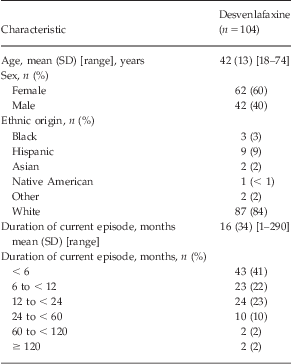
Abbreviation: SD, standard deviation.
Extent of exposure: summary of mean daily dose
The mean dose of desvenlafaxine ranged from 267 mg/d to 356 mg/d in the safety population after the initial dose of 200 mg/d on days 1 through 7.
Safety
Treatment-emergent adverse events
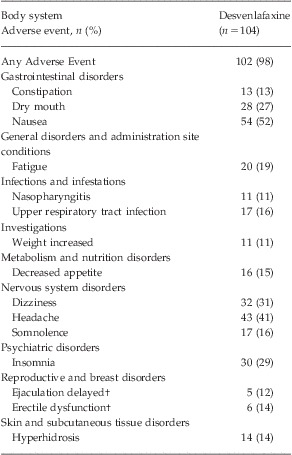
Ninety-eight percent (n = 102) of study patients experienced 1 or more TEAEs during the year-long study period (Table 2). TEAEs were generally mild or moderate in severity. The most frequently occurring TEAEs were nausea (n = 54, 52%), headache (n = 43, 41%), dizziness (n = 32, 31%), insomnia (n = 30, 29%), and dry mouth (n = 28, 27%).
Treatment-emergent adverse eventsFootnote *: safety population

* Events reported by at least 10% of subjects, excluding dose taper phase.
† Males only, n = 42.
Taper/poststudy-emergent adverse events
One or more taper-/poststudy-emergent AEs were reported by 54 patients (52%). Dizziness (n = 18, 17%), nausea (n = 14, 14%), and headache (n = 11, 11%) were the most frequently reported taper-/poststudy-emergent AEs. Fifty patients from the safety population (48%) had modifications to the taper period, including 18 who, at the discretion of the investigator, had the taper period omitted due to AEs, as was permitted in the protocol.
Safety-related discontinuations
Thirty-four (33%) patients in the safety population discontinued from the study due to TEAEs (Figure 1). Nausea (n = 12, 12%) and dizziness (n = 9, 9%) were the TEAEs most frequently cited by patients as primary or secondary reasons for study discontinuation. Other TEAEs cited by ⩾ 3% of patients as primary or secondary reasons for discontinuing from the study were as follows: headache (n = 4, 4%), insomnia (n = 3, 3%), fatigue (n = 3, 3%), anxiety (n = 3, 3%), hyperhidrosis (n = 3, 3%), vomiting (n = 3, 3%), and disturbance in attention (n = 3, 3%).
Serious adverse events
Two patients had SAEs during the study. One patient had irregular menses for 5 months and was found to have a pituitary adenoma; this patient was withdrawn from the study after receiving 187 days of desvenlafaxine treatment. Another patient experienced an acute asthmatic attack but completed the study. These SAEs were assessed by the investigators as not related to desvenlafaxine treatment.
Laboratory evaluations
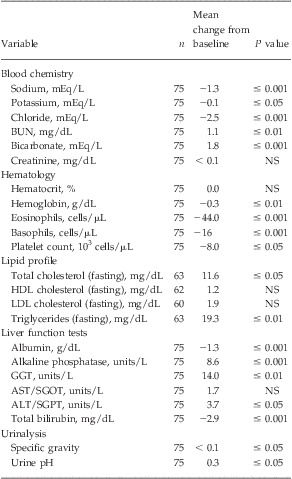
The mean changes from baseline to the final on-therapy evaluation for selected laboratory evaluations are shown in Table 3. Statistically significant increases were found for alkaline phosphatase, bicarbonate, blood urea nitrogen, gamma-glutamyl transpeptidase (GGT), alanine aminotransferase/serum glutamic pyruvic transaminase (ALT/SGPT), fasting total cholesterol, fasting triglycerides, and urine specific gravity and pH (Table 3). Statistically significant decreases from baseline were observed for albumin, chloride, sodium, total bilirubin, basophils, eosinophils, hemoglobin, platelet count, and potassium.
Laboratory measures: final on-therapy evaluation

Abbreviations: AST/SGOT, aspartate aminotransferase/serum glutamic oxaloacetic transaminase; ALT/SGPT, alanine aminotransferase/serum glutamic pyruvic transaminase; BUN, blood urea nitrogen; HDL, high density lipoprotein; GGT, gamma-glutamyl transpeptidase; LDL, low density lipoprotein.
Potentially clinically important (PCI) changes in laboratory evaluations, defined by predetermined criteria, were seen in 63% of patients. Three patients had clinically important laboratory results, which included either changes from baseline or out-of-range measurements. One patient had liver enzymes that had increased more than 3 times from baseline at month 3 [alanine aminotransferase/serum glutamic pyruvic transaminase (ALT/SGPT): 93 units/L; aspartate aminotransferase/serum glutamic oxaloacetic transaminase (AST/SGOT): 69 units/L; gamma-glutamyl transpeptidase (GGT): 325 units/L; alkaline phosphatase: 178 units/L], which resulted in the patient being withdrawn from the study; a second patient had elevated total cholesterol [286.6 mg/dL (reference range 154.8–264.6 mg/dL), a change of 96.5 mg/dL] and low-density lipoprotein [195.7 mg/dL (reference range 73.9–173.7 mg/dL), a change of 68.7 mg/dL] at month 9; and a third patient had persistent proteinuria.
Vital signs
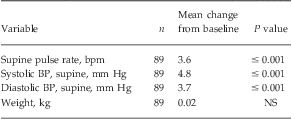
The mean changes from baseline to the final on-therapy evaluation in vital signs and weight are shown in Table 4. Statistically significant changes compared with baseline were observed in systolic and diastolic blood pressure (BP) and pulse rate.
Vital signs and weight: final on-therapy evaluation
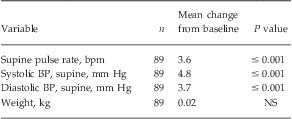
Abbreviation: BP, blood pressure.
Two patients (2%) had potentially clinically important increases in BP (sustained, treatment-emergent increases in supine diastolic BP ⩾10 mm Hg from baseline to an on-therapy value ⩾ 90 mm Hg for at least 3 visits). Five patients were determined by the medical monitor to have clinically important hypertension. One patient had preexisting hypertension that worsened during the study; 1 withdrew because of treatment-emergent hypertension; 1 who had increased blood pressure during the study withdrew because of headaches; 1 had treatment-emergent increased BP that resolved while continuing desvenlafaxine treatment; and 1 had treatment-emergent hypertension that was treated, but persisted. Four patients had postural BP changes (i.e., decrease ⩾ 30 mm Hg in systolic BP from last supine to first standing, or decrease ⩾ 15 mm Hg in diastolic BP from last supine to first standing), and 2 of these patients were determined by the medical monitor to have clinically important postural hypotension.
The mean change in weight from baseline to the final on-therapy evaluation was not statistically significant. However, 9 patients experienced weight decreases of ⩾ 7% from baseline; 3 of these patients experienced weight decreases of ⩾ 10% from baseline, which was considered by the medical monitor to be clinically important. Twelve patients experienced weight increases ⩾ 7% from baseline; 2 of these patients experienced 14% weight increases from baseline, which were considered to be clinically important.
ECG results
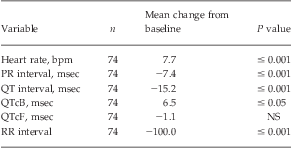
Cardiovascular effects were measured by comparing ECG tracings at final on-therapy or LOCF evaluation with baseline readings. Mean changes in ECG results from baseline to the final on-therapy evaluation are presented in Table 5. Statistically significant increases were observed in heart rate and Bazett-corrected QT intervals (QTcB), while significant decreases were seen in RR intervals, PR intervals, and QT intervals.
Electrocardiogram variables: final on-therapy evaluation
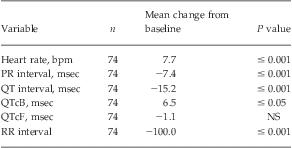
Abbreviations: QTcB, Bazett-corrected QT intervals; QTcF, Fridericia-corrected QT intervals.
Two (3%) patients had on-therapy PR intervals of ⩾ 200 msec, and 1 patient (1%) had an on-therapy QRS interval of ⩾ 120 msec. One patient developed a QTcB prolongation (> 500 msec) at the month 5 visit, which the medical monitor determined was clinically important; the patient was withdrawn from the study at that time for a non-ECG-related AE.
Efficacy
Primary efficacy end point: mean HAM-D(17) total score
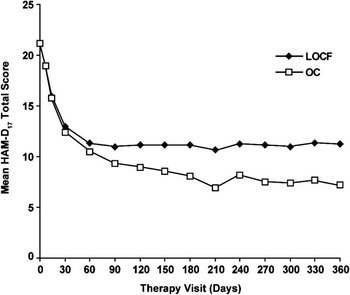
The mean baseline HAM-D(17) total score was 21.2. The mean HAM-D(17) total score steadily decreased during the first 2 months of desvenlafaxine treatment (Figure 2). At day 60, the mean change in HAM-D(17) total score from baseline was −9.8 (LOCF; n = 99); analysis of OC data (n = 79) showed a change from baseline of –10.8 at this time point. This treatment improvement was sustained throughout the study, but there was no further improvement; the final LOCF (n = 99) mean change in HAM-D(17) total score from baseline was −9.9, and the month 12 OC (n = 40) mean change was −14.0.
Mean HAM-D(17) total scores in the intent-to-treat population. Abbreviations: HAM-D(17), 17-item Hamilton Rating Scale for Depression; LOCF, last observation carried forward; OC, observed cases.

Secondary efficacy end points: HAM-D(17) remission rates
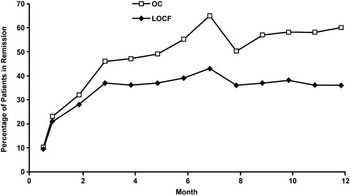
LOCF rates of HAM-D(17) remission increased from 9% at week 2 of desvenlafaxine treatment to 37% at month 3, after which remission rates were sustained until the end of the study (Figure 3). The OC rate of remission increased from 10% at week 2 to 65% at month 7, and was sustained at approximately this level until the end of the study.
HAM-D(17) remission* rates in the intent-to-treat population. Abbreviations: HAM-D(17), 17-item Hamilton Rating Scale for Depression; LOCF, last observation carried forward; OC, observed cases. *Defined as HAM-D(17) total score ≤ 7.

Other secondary efficacy end points
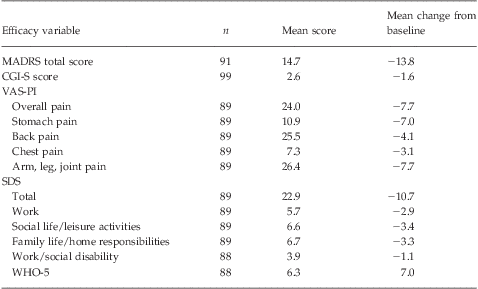
Mean changes from baseline to the final on-therapy evaluation for secondary efficacy variables and health-related quality-of-life measures are presented in Table 6. The temporal pattern of clinical improvement in all secondary efficacy variables was similar to what was observed for the primary efficacy endpoint. The MADRS, CGI-S, and VAS-PI showed a reduction from baseline at endpoint, with the greatest amount of decrease seen in the first 90 days (data not shown). This decrease was then sustained for the remainder of the study. Improvements in the SDS total and subscale scores, as well in the WHO-5 score, were seen at study endpoint.
Secondary efficacy end points: final on-therapy evaluation, LOCF analysis
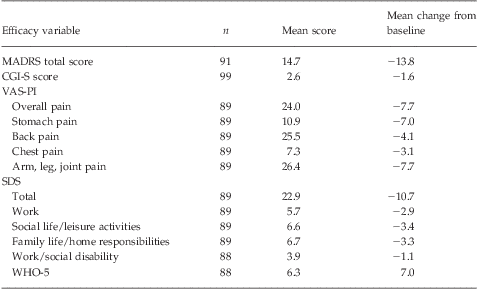
Abbreviations: CGI-S, Clinical Global Impressions–Severity; LOCF, last observation carried forward; MADRS, Montgomery Åsberg Depression Rating Scale; SDS, Sheehan Disability Scale; VAS-PI, Visual Analog Scale–Pain Intensity; WHO-5, 5-item World Health Organization Well-Being Index.
Discussion
This open-label study of high-dose desvenlafaxine treatment for up to 1 year in adult outpatients with MDD found that desvenlafaxine was generally safe and effective in relieving depression. However, the results of this study, particularly those related to safety, must be evaluated in context of the dose range that was used. The mean daily dose of desvenlafaxine ranged from 267 mg to 356 mg, after the initial titration period of 7 days. Short-term studies with desvenlafaxine 50 mg/d,Reference Boyer, Montgomery and Lepola10, Reference Liebowitz, Manley and Padmanabhan12 which were designed and conducted subsequent to the current study, have demonstrated efficacy at the lower dose in patients with MDD. Moreover, a daily dose of 50 mg was comparably efficacious,Reference Thase, Kornstein and Germain14 and was associated with more favorable tolerabilityReference Clayton, Kornstein, Rosas, Guico-Pabia and Tourian21 compared with the doses used in this study. As such, 50 mg/d is now the approved recommended therapeutic dose for treatment of MDD.22
In general, the safety profile demonstrated in this study with high-dose desvenlafaxine was consistent with the previous overall experience with the drug in placebo-controlled studiesReference Clayton, Kornstein, Rosas, Guico-Pabia and Tourian21 and with other antidepressant drugs in the selective serotonin reuptake inhibitor (SSRI) and SNRI antidepressant drug classes.23–28 The most frequently occurring TEAEs were nausea, headache, dizziness, insomnia, and dry mouth, all of which were mild or moderate in severity. As expected with the higher dosages that were studied, the incidence of TEAEs and the discontinuation due to AEs were higher than what has been subsequently observed with the recommended therapeutic dose of 50 mg/d. In the current study, 33% of patients withdrew because of AEs across the 12-month study period. In contrast, the discontinuation rate due to AEs in short-term studies of 50 mg/d was 4%.Reference Clayton, Kornstein, Rosas, Guico-Pabia and Tourian21 Similarly, while more than half of patients in the current study reported nausea, the rate with 50 mg/d is 22% (compared with 10% in the placebo group).Reference Clayton, Kornstein, Rosas, Guico-Pabia and Tourian21
Consistent with the known safety profile of desvenlafaxine, statistically significant increases were observed in the current high-dose study for supine systolic and diastolic BP (mean change from baseline 5 and 4 mm Hg, respectively; P ≤ 0.001) and supine pulse rate (mean change from baseline 4 bpm; P ≤ 0.001). Only 5 patients were determined to have clinically important hypertension. Statistically significant (P ≤ 0.05) mean increases in BP have been previously found with short-term desvenlafaxine treatment. For example, an 8-week study found increases of 4 mm Hg and 3 mm Hg in systolic and diastolic BP, respectively, with 200 mg/d desvenlafaxine treatment, and increases of 4 and 3 mm Hg, respectively, with 400 mg/d treatment and a significant increase in mean heart rate with 400 mg/d treatment (5 bpm, P ≤ 0.05).Reference DeMartinis, Yeung, Entsuah and Manley11 The increases in BP or heart rate appear to be dose-related.Reference Clayton, Kornstein, Rosas, Guico-Pabia and Tourian21 An integrated safety analysis of short-term studies in MDD found increases in systolic and diastolic BP of 1.2 and 0.7 mm Hg, respectively; these differences were significantly different from placebo, but were of a smaller magnitude than the differences observed with higher doses of 200 mg and 400 mg.Reference Clayton, Kornstein, Rosas, Guico-Pabia and Tourian21 Increases in BP have also been observed with long-term treatment with the SNRIs venlafaxine and duloxetine. A pooled analysis of original patient data from venlafaxine studies including doses up to 375 mg/dReference Thase29 showed a clear dose-dependent effect on diastolic BP. The rate of sustained elevation in diastolic BP was 9% in the group of patients receiving the higher doses of venlafaxine (>300 mg/d), which was 3 to 4 times greater than the rates observed in patients in the lower dose groups (≤ 100 mg/d and > 100–200 mg/d). A long-term maintenance study of the extended-release formulation of venlafaxine at doses of 75–300 mg/d found small mean changes in supine systolic and diastolic BP (mean change from baseline 3 and 2 mm Hg, respectively), as well as a mean heart rate increase of 5 bpm over a 12-month period.Reference Kocsis, Thase and Trivedi30 Increases in supine systolic and diastolic BP (mean changes from baseline of 2 mm Hg and 1 mm Hg, respectively), observed at the end of a 6-month treatment period with 120 mg/d duloxetine, did not reach statistical significance.Reference Detke, Wiltse and Mallinckrodt31
Although there was no statistically significant change in weight from baseline at the final on-therapy evaluation (mean change + 0.02 kg), there was a tendency for patients to lose weight during the initial 2 months of desvenlafaxine treatment, after which they regained weight to approximately their baseline level at the final on-therapy measurement. This could make desvenlafaxine an attractive treatment option for patients with MDD who are concerned about the possible side effect of weight gain, particularly if long-term treatment is needed. Weight gain associated with the use of antidepressant treatment is a significant factor in treatment nonadherence.Reference Fava32
ECG abnormalities have also been associated with antidepressant treatment, including SSRIs and SNRIs.Reference Al-Khatib, LaPointe, Kramer and Califf33–Reference Stahl, Grady, Moret and Briley35 Despite the high doses used in the current study, only one patient experienced changes in ECG results (QTcB prolongation) that were considered to be clinically important. Of note, QTcB overcorrects in the presence of increased heart rate,Reference Davey36 which desvenlafaxine has been shown to produce.
There were clinically significant improvements from baseline in standard measures of depression as well as measures of global improvement. Improvement was greatest during the first 2 to 3 months of desvenlafaxine treatment; this improvement was sustained until treatment was discontinued. Additional improvement in HAM-D(17) total score, albeit small (i.e., 4 points), was observed among patients who remained in the study for 12 months; likewise, rates of remission in those patients remaining in the study increased from 46% at month 3 to 60% at month 12. These results support the utility of long-term desvenlafaxine treatment in patients with depression.
Desvenlafaxine treatment was also associated with improvements in overall functioning, as evidenced by improvement from baseline measurements in WHO-5 mean scores at the final on-therapy evaluation. Improvements in SDS mean scores at the final on-therapy evaluation indicated that patients experienced less interference in their work, social life, family, and home activities. A recent study with the current recommended therapeutic dose of 50 mg/dReference Dunlop, Reddy and Yang37 demonstrated similar beneficial effects on functional outcomes in a population of gainfully employed adults with MDD.
Conclusions
High-dose desvenlafaxine was generally safe and effective in relieving depression with long-term use in adult outpatients with MDD. The improvement in depression symptoms in patients who received long-term desvenlafaxine therapy appears to be sustained for up to a year.
Disclosures
James Ferguson's current disclosure information: Within the past 12 months, James Ferguson has had stocks in Novartis, Orexigen, Pfizer, Targacept, Cubits Pharma, Momentum Pharma, and Myriad Genetics. Dr. Rosas is an employee of Pfizer, who also has stock and stock options in Pfizer. Dr. Tourian is an employee of Pfizer, and she also has stock and stock options in Pfizer.