Introduction
Waterfowl are widespread and clearly linked to aquatic environments, where each species shows a preference for a certain kind of habitat (Delacour, Reference Delacour1975; Carboneras, Reference Carboneras, del Hoyo and Elliott1992). In particular, members of the family Anatidae make up an important element of both freshwater and marine aquatic ecosystems, and have varied diets and feeding methods (Carboneras, Reference Carboneras, del Hoyo and Elliott1992; Baldassarre & Bolen, Reference Baldassarre and Bolen2006). Hence, they have the greatest chance of contact with invasive forms of parasitic worms.
Although the helminth community of wild ducks has been well studied in North American, European and Asian species (McDonald, Reference McDonald1974; Kavetska, Reference Kavetska2005; Atkinson et al., Reference Atkinson, Thomas and Hunter2008; Kavetska et al., Reference Kavetska, Królaczyk, Pilarczyk and Kalisinska2012), little is known about the helminth communities of ducks in other parts of the world. In particular, the knowledge of nematodes from anatids in South America is very scarce. Most investigations have been carried out in Chile, Mexico (González et al., Reference González, Skewes, Candia, Palma and Moreno2005; Mercado Reyes et al., Reference Mercado Reyes, Angulo Castillo, Clemente Sánchez, Hernández Llamas, González Rojas, López Torres and Tavizón García2010; Martínez Haro et al., Reference Martínez Haro, Sánchez Nava, Salgado Maldonado and Rodríguez Romero2012) and Brazil (Vicente et al., Reference Vicente, Rodriguez, Gomez and Pinto1996; Vianna Mohr, Reference Vianna Mohr2001), while information about Argentina is still lacking (da Silveira et al., Reference da Silveira, Amato and Amato2006; Agüero & Diaz, Reference Agüero and Diaz2013).
Patagonia harbours about 23 anatid species, with about 30% of them being residents (i.e. present in the area throughout the year with null or local movements), while others are considered partial migrants with both resident and migrant populations (Coconier & Blanco, Reference Coconier and Blanco2005). Of the species studied here, two are residents: the Chubut steamer duck, Tachyeres leucocephalus (Humphrey and Thompson, 1981), and the crested duck, Lophonetta specularioides (King, 1828), while the black-necked swan, Cygnus melancoryphus (Molina, 1782) is a partial neotropical migrant. Tachyeres leucocephalus is a flightless marine endemic bird that lives along a small section of the Patagonian coastline in Argentina (Agüero et al., Reference Agüero, García Borboroglu and Esler2012), and it breeds in syntopy with L. specularioides on the northern San Jorge Gulf, Chubut. On the other hand, C. melancoryphus dwells in freshwater and brackish-water marshes. After breeding, some of the southern Patagonia populations migrate northward along the eastern, central and western Patagonian routes. Opportunistic movements were also recorded in relation to drought conditions (Blanco et al., Reference Blanco, Baigún and López-Lanús2008).
The aim of this study was to record new data of nematodes in these three sympatric anatid bird species from the central Patagonian coast in Argentina, and to provide information about the diet of their hosts.
Materials and methods
Thirteen anatids – four T. leucocephalus, five L. specularioides and four C. melancoryphus – were examined for stomach nematodes. All specimens were observed dying on the coast and were found dead some days later and collected. Tachyeres leucocephalus specimens were found during the summers of 2007/2010/2012 and L. specularioides during the summer of 2008 and 2014, all of them in the northern San Jorge Gulf, Chubut Province (45°02′S; 65°52′W). Cygnus melancoryphus specimens were collected in the Nuevo Gulf, Chubut Province (42°02′S; 65°52′W) during the summers of 2004/2009/2012; and also on the Bahía Engaño coast (43°20′S; 65°02′W) during the summer of 2014. Birds were necropsied to dissect the entire alimentary tract, isolating the proventriculus and gizzard for parasitological inspection. Nematodes found were counted and preserved in 70% ethanol, and studied in temporary mounts of either lactophenol or 25% glycerine–alcohol. Drawings were made with the aid of a camera lucida. Several specimens were dried using the critical point method, examined by scanning electron microscopy (SEM) (Philips SEM 505®; Philips, Amsterdam, The Netherlands), and photographed. Voucher specimens were deposited in the Helminthological Collection of the Museo de La Plata (MLP He 6661, 7021, 7022, 7023 and 7024), La Plata, Argentina, and the Parasitological Collection of the Centro Nacional Patagónico (CNP-Par-60, 93, 94 and 95), Puerto Madryn, Argentina. Also, the stomach contents were examined under 8 × to 64 × magnification, and fragments of invertebrates resistant to digestion were identified using published guides (Boschi et al., Reference Boschi, Fischbach and Iorio1992), reference collections hosted at the Centro Nacional Patagónico and by consulting taxonomy specialists. Prevalence (P) and mean intensity (MI) were calculated following Bush et al. (Reference Bush, Lafferty, Lotz and Shostak1997).
Results
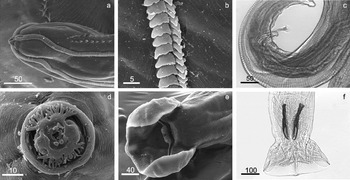
Five nematode species, including four spirurids and one strongylid, were found in the proventriculus and under the koilin lining of the gizzard in 10 of the 13 ducks examined. The spirurid Echinuria uncinata (Rudolphi, 1819), belonging to the family Acuariidae and sub-family Acuariinae, was found in the lumen of the proventriculus of two L. specularioides (P = 40%; MI = 11.5). This species is recognized by the length of cordons, position of the minute deirids, lateral rows of spines, and by the morphology of the terminal male genitalia (fig. 1a–c). Tetrameres (Petrowimeres) fissispina (Diesing, 1861), belonging to the family Tetrameriidae, was found in the proventricular glands of two L. specularioides (P = 40%; MI = 9.5). The species was identified by the features of the cephalic extremity and morphology of the male spiculae. Streptocara formosensis (Sugimoto, 1930), belonging to the family Acuariidae and sub-family Seuratiinae, parasitized the gizzard of three T. leucocephalus (P = 75%; MI = 7). This species is recognized on the basis of the anterior extremity morphology, buccal capsule length, deirids, distribution of papillae, features of the male spiculae and the vulva position of females. Streptocara formosensis is easily distinguished from other species in the genus by the absence of the cephalic collar. Sciadiocara legendrei (Petter, 1967), belonging to the family Acuariidae and sub-family Schistorophiinae, was found in only one of the steamer ducks (P = 25%; MI = 3), and could be identified by the morphology of the ptilinae in the anterior extremity, number of papillae and features of the spiculae of males, and the vulva position of females. The strongylid Epomidiostomum vogelsangi (Travassos, 1937), belonging to the family Amidostomatidae, parasitized all C. melancoryphus examined (P = 100%; MI = 18.5). The species is identified and easily distinguished from other strongylid species by the morphology of the male caudal bursa, and by the presence of four ‘epaulette-like’ structures in the anterior end, deeply incised into 3–4 lobes and carrying 2–3 teeth each (fig. 1d–f).
(a–c) Morphology of Echinuria uncinata, showing: (a) the anterior end with cordons; (b) detail of cordons and (c) lateral view of male showing spiculae. (d–f) Morphology of Epomidiostomum vogelsangi, showing: (d) the anterior end, apical view showing the ‘epaulette-like’ structures, and (e) and (f) posterior extremity of male showing papillae and spiculae, ventral views. All scale bar values are given in micrometres.

The gizzard and proventriculus were not occupied simultaneously in any duck. Co-infection was observed only in the proventriculus of one crested duck (i.e. T. fissispina and E. uncinata).
Examination of stomach contents showed that Chubut steamer ducks feed on crustaceans (Cyrtograpsus spp. and isopods), molluscs of the Mytilidae family and polychaetes of the Nereiididae family. Crested ducks mainly foraged on crustaceans such as anfipods, cladocerans and crabs of the genus Cyrtograpsus. Only one bird fed on polychaetes of the Nereiididae family. Interestingly, the stomachs of black-necked swans were empty and we could not identify any organic matter.
Discussion
Echinuria uncinata is a very common and widely distributed helminth of waterfowl, and has been found associated with granulomas (nodules) in the gizzard wall, the proventriculus and, rarely, in the oesophagus. This nematode species has been reported in several species of Anseriformes (Anatidae) and Charadriiformes in Europe, Asia, Africa and North America (McDonald, Reference McDonald1969, Reference McDonald1974). The first record of this parasite from South America, and particularly in northern Argentina, was recorded by da Silveira et al. (Reference da Silveira, Amato and Amato2006) in the rosy-billed pochard (Netta peposaca). Although, E. uncinata was recovered from L. specularioides in the northern hemisphere (McDonald, Reference McDonald1969), our findings represent the first record of this nematode in this bird species in southern Argentina. Echinuria uncinata has an indirect life cycle, as crustaceans of the genus Daphnia and Ceriodaphnia (Cladocera) are the first intermediate hosts (Anderson, Reference Anderson2000). Although we did not find this type of prey in the stomachs examined, it is probable that the ducks in the present study became infected by cladocerans. The absence of small crustaceans in the examined hosts may be due to the fact that they are quickly and almost completely digested, so they would be under-represented in stomach contents (Swanson & Bartonek, Reference Swanson and Bartonek1970).
Streptocara formosensis appears to be a common parasite of anatids. It has been registered in a large number of Anseriformes, most of which are spread over the northern hemisphere (Gibson, Reference Gibson1968; Delacour, Reference Delacour1975; Carboneras, Reference Carboneras, del Hoyo and Elliott1992; Królaczyk et al., Reference Królaczyk, Kavetska, Stapf and Kalisińska2012). However, Agüero & Diaz (Reference Agüero and Diaz2013) enlarged the host and geographical distribution of this parasite by recording it for the first time in T. leucocephalus from South America. Our findings were consistent with those records and support the hypothesis that Anas platyrhynchos and/or Cairina moschata play a key role in the dispersion of this nematode species on both the Patagonian coast and in the Chubut steamer duck (Agüero & Diaz, Reference Agüero and Diaz2013). Although the life cycle of S. formosensis is still unknown, it is probably similar to that of Streptocara crassicauda (Creplin, 1829) (McDonald, Reference McDonald1969). In that sense, and according to the Chubut steamer ducks’ diet, intermediate hosts could be marine crustaceans, such as crabs (Cyrtograpsus spp.) and isopods, which seem to be the predominant prey items in this bird's diet.
Sciadiocara legendrei has been recovered from waders around Europe, Australia and New Zealand (i.e. Numenius phaeopus, Capella media, Larus novaehollandiae, Calidris canutus, Gelochelidon nilotica and Charadrius leschenaultii) (Wong & Anderson, Reference Wong and Anderson1985; Wong & Lankester, Reference Wong and Lankester1985). Our findings from T. leucocephalus represent the first record of this parasite in America and in an anatid bird. Of the previously recorded hosts, N. phaeopus and C. canutus are migrants from the northern hemisphere and have been recorded from marine coasts of Patagonia, Argentina, during the austral summer (Narosky & Yzurieta, Reference Narosky and Yzurieta2003). Taking into account that T. leucocephalus is an endemic flightless anatid from a small section of the Chubut marine coast, it is likely that N. phaeopus and C. canutus are involved in the transmission of this parasite. Since all hosts inhabit the marine environment, intermediate hosts are likely to be marine invertebrates, although there is no available information on this parasite's life cycle.
Tetrameres fissispina has been recovered from wild and domestic ducks and geese, Podicipediformes, Ciconiiformes, Falconiformes, Galliformes, Gruiformes, Charadriiformes, Columbiformes and Strigiformes, in several parts of the world, including Brazil (McDonald Reference McDonald1969, Reference McDonald1974; Vicente et al., Reference Vicente, Rodriguez, Gomez and Pinto1996). Species of the genus Tetrameres have an indirect life cycle. The first intermediate host of T. fissispina could be aquatic arthropods such as cladocerans and amphipods, with birds becoming infected by consuming these arthropods directly or indirectly using facultative hosts (Anderson, Reference Anderson2000). Taking into account that cladocerans were registered in the stomach contents of the hosts examined here, these invertebrates are probably involved in the transmission of this parasitic species to the definitive bird host. Our findings are the first record for L. specularioides from Argentina, and represent the southernmost record of this nematode species.
Although the genus Epomidiostomum is widely distributed among aquatic birds, mainly anseriforms, E. vogelsangi has been considered to be a rare parasite of waterfowl and has only been recorded twice, in captive C. melancoryphus from Rio Grande do Sul, Brazil (McDonald, Reference McDonald1969, Reference McDonald1974; Fedynich & Thomas, Reference Fedynich, Thomas, Atkins and Hunter2008). The life cycle of E. vogelsangi is unknown, but other species of the genus have a direct life cycle (Fedynich & Thomas, Reference Fedynich, Thomas, Atkins and Hunter2008). This is the first time that this nematode has been recorded in a wild bird and is its southernmost record (in Patagonia, Argentina).
Only one crested duck was co-infected, with T. fissispina and E. uncinata in the proventriculus, which is probably because of the different micro-niche that each parasite species would inhabit in the organ.
Tachyeres leucocephalus and L. specularioides breed in syntopy in the northern San Jorge Gulf, and they apparently feed in the same intertidal areas (M.L.A., pers. obs.) since they partially share invertebrate prey. However, present samples were not infected by the same nematodes. Unlike endemic flightless steamer ducks, crested ducks are considered mostly sedentary with some seasonal movements (Johnsgard, Reference Johnsgard2010). High-latitude breeders commonly disperse following the coast in winter (Carboneras, Reference Carboneras, del Hoyo and Elliott1992). Thus, L. specularioides could be in contact with the natural hosts of both E. uncinata and T. fissispina in low latitudes and could contribute to the geographical dispersion of these nematodes.
More detailed information on the feeding habitats, diet and movements throughout the year are needed to make conclusions about the roles of these birds as definitive hosts of parasites and to elucidate life cycles of nematodes from these latitudes.
In spite of the low number of hosts examined, this work increases our knowledge about the parasites of a conspicuous bird group from Patagonia.
Acknowledgements
The authors wish to thank M. Theiler from the Servicio de Microscopía Electrónica de Barrido from CINDECA (CCT La Plata). We thank S.A.F. Soriano and G. Abril, Province Wildlife Bureau (Dirección de Fauna y Flora Silvestre, Secretaría de Turismo de la Provincia del Chubut), National Park Authorities; and V. Savoya, C. Sueiro and E. Diez for their help in identifying benthic invertebrates.
Financial support
This study was supported partially by N628, N758 (Universidad Nacional de La Plata – UNLP); PIP-698 (Consejo Nacional de Investigaciones Científicas y Tecnológicas – CONICET) and PICT-2012-1399 and 2013-1702 (Agencia Nacional de Promoción Científica y Tecnológica ANPCyT–FONCyT). The authors are members of the Consejo Nacional de Investigaciones Científicas y Tecnológicas – CONICET.
Conflict of interest
None.
Ethical standards
The birds were collected with permission from the National Park Administration (Sample Permission no. 1352; Provincial Sample Permission Disp. no. 51/2014 DFyFS-SSG).