1 Introduction and definitions
The notion of a cardinal algebra, initiated by Tarski in his masterful book [Reference Tarski8], provides a common generalization for a number of important mathematical structures: nonnegative real numbers under addition, sets of nonnegative measurable functions and countably additive measures on a measurable space under pointwise summation, sets of Borel isomorphism types under Borel sum, and so forth.
A cardinal algebra is an algebraic system
 $\langle A,{+},{\sum }\rangle ,$
which satisfies the following postulates I–VII.
-
I (Finite closure postulate): If
 $a,b\in A$
, then
$a+b\in A$
.
-
II (Infinite closure postulate): If
$a_n\in A$
for all
$n\in \omega $
, then
$\sum _{n\in \omega }a_n\in A$
. -
III (Associative postulate): If
$a_n\in A$
for all
$n\in \omega $
, then
$$\begin{align*}\sum_{n\in\omega}a_n=a_0+\sum_{n\in\omega}a_{n+1}. \end{align*}$$
-
IV (Commutative-associative postulate): If
$a_n,b_n\in A$
for all
$n\in \omega $
, then
$$\begin{align*}\sum_{n\in\omega}(a_n+b_n)=\sum_{n\in\omega}a_n+\sum_{n\in\omega}b_n. \end{align*}$$
-
V (Postulate of the zero element): There is an element
$0\in A$
such that
$a+0= 0+a=a$
for all
$a\in A$
. -
VI (Refinement postulate): If
$a,b,c_n\in A$
for all
$n\in \omega $
and
$a+b=\sum _{n\in \omega }c_n$
, then there are elements
$a_n,b_n\in A$
for each
$n\in \omega $
such that
$$\begin{align*}a=\sum_{n\in\omega}a_n,\quad b=\sum_{n\in\omega}b_n,\quad\text{and}\quad c_n=a_n+b_n\text{ for all }n\in\omega. \end{align*}$$
-
VII (Remainder postulate): If
$a_n,b_n\in A$
and
$a_n=a_{n+1}+b_n$
for all
$n\in \omega $
, then there is an element
$c\in A$
such that
$$\begin{align*}a_m=c+\sum_{n\in\omega}b_{m+n}\text{ for all }m\in\omega. \end{align*}$$


It is clear that, assuming the countable axiom of choice
 $\mathsf {AC}_\omega $
, cardinals form a cardinal algebra.
Let
 $\kappa $
be an aleph. Recall the principle of
 $\kappa $
-dependent choices
 $\mathsf {DC}_\kappa $
.
-
DC κ: Let S be a set and let R be a binary relation such that for each
$\alpha <\kappa $
and each
$\alpha $
-sequence
$s=\langle x_\xi \rangle _{\xi <\alpha }$
of elements of
$S,$
there is
$y\in S$
such that
$sRy$
. Then there is a function
$f:\kappa \to S$
such that
$(f{\upharpoonright }\alpha )Rf(\alpha )$
for every
$\alpha <\kappa $
.


It is shown in [Reference Tarski8, Corollary 2.34] that, assuming
 $\mathsf {DC}_\omega $
, in any cardinal algebra
 $\langle A,{+},{\sum }\rangle $
, if
 $a,b\in A$
and
 $m\in \omega \setminus \{0\}$
, then
 $m\cdot a=m\cdot b$
implies
 $a=b$
. This yields a choice-free proof of the celebrated Bernstein division theorem, which states that
 $m\cdot \mathfrak {a}=m\cdot \mathfrak {b}$
implies
 $\mathfrak {a}=\mathfrak {b}$
for all cardinals
 $\mathfrak {a},\mathfrak {b}$
and all nonzero natural numbers m. (Although
 $\mathsf {DC}_\omega $
is needed in the algebraic proof of [Reference Tarski8, Corollary 2.34], as remarked by Tarski [Reference Tarski8, pp. 240–242], in cardinal arithmetic, we can dispense with the use of
 $\mathsf {DC}_\omega $
in the proof of the Bernstein division theorem.)
“Weak cardinal algebras” were introduced by Truss [Reference Truss9] in an attempt to derive as many properties of cardinal algebras as possible using only finitary addition
 $+$
. The infinitary defining postulates of a cardinal algebra were replaced by the following “finite refinement” and “approximate cancellation” postulates.
-
VI’ (Finite refinement postulate): If
$a_1,a_2,b_1,b_2\in A$
and
$a_1+a_2=b_1+b_2$
, then there are elements
$c_1,c_2,c_3,c_4\in A$
such that
$a_1=c_1+c_2$
,
$a_2=c_3+c_4$
,
$b_1=c_1+c_3$
, and
$b_2=c_2+c_4$
. -
VIII (Approximate cancellation postulate): If
$a,b,c\in A$
and
$a+c=b+c$
, then there are elements
$a',b',d\in A$
such that
$a=a'+d$
,
$b=b'+d$
, and
$c=a'+c=b'+c$
.


By [Reference Tarski8, Theorems 2.3 and 2.6], the postulates VI’ and VIII hold in any cardinal algebra
 $\langle A,{+},{\sum }\rangle $
, so every cardinal algebra is a weak cardinal algebra. It is shown in [Reference Truss10, Section 6] that there is a weak cardinal algebra for which the cancellation law “
 $2\cdot a=2\cdot b$
implies
 $a=b$
” fails.
For cardinals
 $\mathfrak {a}$
and
 $\mathfrak {b}$
, we write
 $\mathfrak {a}=^\ast \mathfrak {b}$
if there are sets A and B of cardinalities
 $\mathfrak {a}$
and
 $\mathfrak {b}$
, respectively, such that there are partial surjections from A onto B and from B onto A. A surjective cardinal is an equivalence class of cardinals under
 $=^\ast $
. Since this may be a proper class, we may employ “Scott’s trick” to ensure that the equivalence class is actually a set, namely,
 $$\begin{align*}[\mathfrak{a}]=\{\mathfrak{b}\mid\mathfrak{a}=^\ast\mathfrak{b} \wedge\forall\mathfrak{c}(\mathfrak{a}=^\ast\mathfrak{c}\rightarrow\operatorname{\mathrm{rank}}(\mathfrak{b})\leqslant\operatorname{\mathrm{rank}}(\mathfrak{c}))\}. \end{align*}$$
Surjective cardinals may alternatively be defined as Scott equivalence classes of sets under the relation
 $\approx ^\ast $
:
 $A\approx ^\ast B$
if there are partial surjections from A onto B and from B onto A. It is shown in [Reference Truss10, Theorem 2.7] that surjective cardinals form a weak cardinal algebra, and in [Reference Truss10, Corollary 3.7] that the cancellation law for surjective cardinals holds, that is,
 $m\cdot \mathfrak {a}=^\ast m\cdot \mathfrak {b}$
implies
 $\mathfrak {a}=^\ast \mathfrak {b}$
for all cardinals
 $\mathfrak {a},\mathfrak {b}$
and all nonzero natural numbers m.
It is asked by Truss (see [Reference Truss10, p. 179] or [Reference Truss11, p. 604]) whether surjective cardinals form a cardinal algebra. Of course, if the axiom of choice is assumed, then surjective cardinals are essentially the same as cardinals and hence form a cardinal algebra. So, this question makes sense only in the absence of the axiom of choice. In this article, we give a negative solution to this question by showing that
 $\mathsf {ZF}+\mathsf {DC}_\kappa $
, where
 $\kappa $
is a fixed aleph, cannot prove that surjective cardinals form a cardinal algebra.
Nevertheless, we improve Truss’s result by showing that surjective cardinals form a surjective cardinal algebra, which is by definition an algebraic system
 $\langle A,{+},{\sum }\rangle $
satisfying the postulates I–VII, with VI replaced by VI’. “Surjective cardinal algebras” were introduced simultaneously and independently by K. P. S. Bhaskara Rao and R. M. Shortt on the one hand, and by F. Wehrung on the other hand in [Reference Bhaskara Rao and Shortt1, Reference Wehrung12]. They call such algebras “weak cardinal algebras”. Since the term “weak cardinal algebra” was already used by Truss for a different kind of algebra, we use the term “surjective cardinal algebra” here. Note that, assuming
 $\mathsf {DC}_\omega $
, for surjective cardinal algebras, the cancellation law “
 $m\cdot a=m\cdot b$
implies
 $a=b$
for
 $m\in \omega \setminus \{0\}$
” already holds (see [Reference Bhaskara Rao and Shortt1, p. 157] or [Reference Wehrung12, Proposition 2.9]). So, our result also yields a choice-free proof of the cancellation law for surjective cardinals (by the device discussed in [Reference Tarski8, pp. 240–242] or [Reference Truss10, p. 166]).
The article is organized as follows. In the next section, we show that, assuming
 $\mathsf {AC}_\omega $
, surjective cardinals form a surjective cardinal algebra. In the third section, we show that surjective cardinals may not form a cardinal algebra, even if
 $\mathsf {DC}_\kappa $
is assumed. In the last section, we conclude the article by some remarks.
2 Surjective cardinals form a surjective cardinal algebra
Truss has already shown that surjective cardinals form a weak cardinal algebra (see [Reference Truss10, Theorem 2.7]), and that a weaker version of the remainder postulate holds (see [Reference Truss10, Lemma 3.3]). So, we only need to prove the full remainder postulate. However, for the convenience of the reader, we shall present here a complete proof that surjective cardinals form a surjective cardinal algebra.
To produce choice-free proofs in cardinal arithmetic, we frequently use expressions like “one can explicitly define” in our formulations. For example, when we state the Cantor–Bernstein theorem as “from injections
 $f:A\to B$
and
 $g:B\to A$
, one can explicitly define a bijection
 $h:A\to B$
”, we mean that one can define a class function H without free variables such that, whenever f is an injection from A into B and g is an injection from B into A,
 $H(f,g)$
is defined and is a bijection between A and B.
Lemma 2.1. From a set A and two families
 $\langle B_n\rangle _{n\in \omega }$
and
 $\langle f_n\rangle _{n\in \omega }$
such that
 ${A\cap B_n=\varnothing }$
and
 $f_n:A\to A\cup B_n$
is a partial surjection for all
 $n\in \omega $
, one can explicitly define a partial surjection
 $g:A\to A\cup \bigcup _{n\in \omega }B_n$
.
Proof. Let
 $\pi $
be the Cantor pairing function, that is, the bijection between
 $\omega \times \omega $
and
 $\omega $
defined by
 $$\begin{align*}\pi(m,n)=\frac{(m+n)(m+n+1)}{2}+m. \end{align*}$$
Define by recursion
 $$ \begin{align*} h_0 & =\mathrm{id}_A,\\ h_{\pi(0,n)+1} & =f_n\circ h_{\pi(0,n)},\\ h_{\pi(m+1,n)+1} & =h_{\pi(m,n)+1}\circ h_{\pi(m+1,n)}. \end{align*} $$
An easy induction shows that, for all
 $m,n\in \omega $
,
 $h_{\pi (m,n)+1}$
is a partial surjection from A onto
 $A\cup B_n$
. For all
 $m,n\in \omega $
, let
 $$\begin{align*}C_{m,n}=h_{\pi(m,n)+1}^{-1}[B_n]. \end{align*}$$
An easy induction shows that, for all
 $k,l\in \omega $
with
 $k<l$
,
 $h_l=h\circ h_k$
for some function h with
 $\operatorname {\mathrm {dom}}(h)\subseteq A$
. For all
 $m,n,m',n'$
with
 $\pi (m,n)<\pi (m',n')$
, there is a function h with
 $\operatorname {\mathrm {dom}}(h)\subseteq A$
such that
 $h_{\pi (m',n')+1}=h\circ h_{\pi (m,n)+1}$
, and hence
 $$\begin{align*}C_{m',n'}=h_{\pi(m',n')+1}^{-1}[B_{n'}]=h_{\pi(m,n)+1}^{-1}[h^{-1}[B_{n'}]]\subseteq h_{\pi(m,n)+1}^{-1}[A], \end{align*}$$
which implies
 $C_{m',n'}\cap C_{m,n}=\varnothing $
since
 $A\cap B_n=\varnothing $
. Since for all
 $m,n\in \omega ,$
we have
 $$ \begin{align*} h_{\pi(0,n)+1}[C_{0,n}] & =B_n,\\ h_{\pi(m+1,n)}[C_{m+1,n}] & =h_{\pi(m+1,n)}[h_{\pi(m+1,n)+1}^{-1}[B_n]]=h_{\pi(m,n)+1}^{-1}[B_n]=C_{m,n}, \end{align*} $$
it is sufficient to define
 $$\begin{align*}g=\bigcup_{n\in\omega}\big(h_{\pi(0,n)+1}{\upharpoonright} C_{0,n}\big)\cup\bigcup_{m,n\in\omega}\big(h_{\pi(m+1,n)}{\upharpoonright} C_{m+1,n}\big) \cup\mathrm{id}_{A\setminus\bigcup_{m,n\in\omega}C_{m,n}}.\\[-41pt] \end{align*}$$
Corollary 2.2. From a set A and a function f such that
 $A\subseteq f[A]$
, one can explicitly define a partial surjection
 $g:A\to \bigcup _{n\in \omega }f^n[A]$
.
Proof. Take
 $B_n=f^n[A]\setminus A$
and
 $f_n=f^n{\upharpoonright } A$
in Lemma 2.1.
Lemma 2.3 (Knaster’s fixed point theorem).
Let
 $i:{\mathscr {P}}(A)\to {\mathscr {P}}(A)$
be isotone. Then
 $$\begin{align*}X=\textstyle\bigcup\{D\subseteq A\mid D\subseteq i(D)\} \end{align*}$$
is a fixed point of i.
Proof. For every
 $D\subseteq A$
with
 $D\subseteq i(D)$
, we have
 $D\subseteq X$
, and thus
 $D\subseteq i(D)\subseteq i(X)$
since i is isotone. Hence,
 $X\subseteq i(X)$
, which implies
 $i(X)\subseteq i(i(X))$
since i is isotone, and so
 $i(X)\subseteq X$
by the definition of X. Therefore,
 $i(X)=X$
.
Definition 2.4.
 $\langle f,g\rangle $
is a surjection pair between A and B if
 $f:A\to B$
and
 $g:B\to A$
are partial surjections.
The key step of our proof is the following lemma, which is Lemma 2.3 of [Reference Truss10]. The proof presented here is simpler and more straightforward than, but similar to, the one in [Reference Truss10].
Lemma 2.5. From sets
 $A,B,C$
with
 $A\cap B=\varnothing $
and a surjection pair
 $\langle f,g\rangle $
between
 $A\cup B$
and C, one can explicitly partition
 $A,B,C$
as
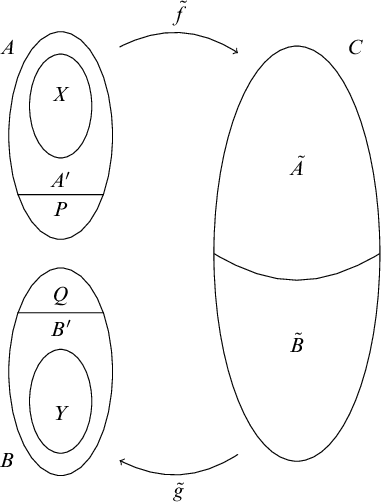
 $$ \begin{align*} A & =A'\cup P\\ B & =B'\cup Q\\ C & =\tilde{A}\cup\tilde{B} \end{align*} $$
and explicitly define partial surjections from
 $A'$
onto
 $A'\cup Q$
and from
 $B'$
onto
 $B'\cup P$
, and surjection pairs between
 $\tilde {A}$
and
 $A'$
and between
 $\tilde {B}$
and
 $B'$
.
Proof. Without loss of generality, suppose that
 $f[A]\cap f[B]=\varnothing $
. Consider the isotone functions
 $i:{\mathscr {P}}(A)\to {\mathscr {P}}(A)$
and
 $j:{\mathscr {P}}(B)\to {\mathscr {P}}(B)$
defined by
 $$ \begin{align*} i(D) & =A\cap g[f[D]],\\ j(E) & =B\cap g[f[E]]. \end{align*} $$
By Lemma 2.3,
 $$ \begin{align*} X & =\textstyle\bigcup\{D\subseteq A\mid D\subseteq i(D)\} \end{align*} $$
and
 $$ \begin{align*} Y & =\textstyle\bigcup\{E\subseteq B\mid E\subseteq j(E)\} \end{align*} $$
are fixed points of i and j, respectively. Let
 $$ \begin{align*} f' & =f\setminus\big(f{\upharpoonright}(f^{-1}[f[X]]\setminus X)\big),\\ g' & =g\setminus\big(g{\upharpoonright}(g^{-1}[X]\setminus f[X])\big). \end{align*} $$
Clearly,
 $\langle f',g'\rangle $
is a surjection pair between
 $A\cup B$
and C. It is also easy to see that
 $X\subseteq g'[f'[X]]$
,
 $Y\subseteq g'[f'[Y]]$
, and
 ${f'}^{-1}[{g'}^{-1}[X]]\subseteq X$
. Let
 $$ \begin{align*} \tilde{f} & =f'\setminus\big(f'{\upharpoonright}({f'}^{-1}[f'[Y]]\setminus Y)\big),\\ \tilde{g} & =g'\setminus\big(g'{\upharpoonright}({g'}^{-1}[Y]\setminus f'[Y])\big). \end{align*} $$
Clearly,
 $\langle \tilde {f},\tilde {g}\rangle $
is a surjection pair between
 $A\cup B$
and C. It is also easy to see that
 $X\subseteq \tilde {g}[\tilde {f}[X]]$
,
 $Y\subseteq \tilde {g}[\tilde {f}[Y]]$
,
 $\tilde {f}^{-1}[\tilde {g}^{-1}[X]]\subseteq X$
, and
 $\tilde {f}^{-1}[\tilde {g}^{-1}[Y]]\subseteq Y$
.
We claim that, for every
 $c\in C$
,
 $$ \begin{align} (A\cup Y)\cap\bigcup_{n\in\omega}(\tilde{g}\circ\tilde{f})^{-n}[\tilde{f}^{-1}[\{c\}]] & \neq\varnothing, \end{align} $$
 $$ \begin{align} (B\cup X)\cap\bigcup_{n\in\omega}(\tilde{g}\circ\tilde{f})^{-n}[\tilde{f}^{-1}[\{c\}]] & \neq\varnothing. \end{align} $$
Assume to the contrary that
 $(A\cup Y)\cap \bigcup _{n\in \omega }(\tilde {g}\circ \tilde {f})^{-n}[\tilde {f}^{-1}[\{c\}]]=\varnothing $
for some
 ${c\in C}$
. Let
 $E=Y\cup \bigcup _{n\in \omega }(\tilde {g}\circ \tilde {f})^{-n}[\tilde {f}^{-1}[\{c\}]]\subseteq B$
. It is easy to see that
 $E\subseteq j(E)$
, so
 $E\subseteq Y$
, a contradiction. This proves (1). The proof of (2) is similar.
Now, we define
 $$ \begin{align*} P & =A\cap\bigcup_{n\in\omega}(\tilde{g}\circ\tilde{f})^n[Y],\\ Q & =B\cap\bigcup_{n\in\omega}(\tilde{g}\circ\tilde{f})^n[X],\\ A' & =A\setminus P,\\ B' & =B\setminus Q. \end{align*} $$
Using
 $\tilde {f}^{-1}[\tilde {g}^{-1}[X]]\subseteq X$
, an easy induction shows that
 $X\cap (\tilde {g}\circ \tilde {f})^n[Y]=\varnothing $
for all
 $n\in \omega $
, so
 $X\cap P=\varnothing $
, which implies
 $X\subseteq A'$
. Since
 $X\subseteq \tilde {g}[\tilde {f}[X]]$
, it follows from Corollary 2.2 that one can explicitly define a partial surjection from X onto
 $\bigcup _{n\in \omega }(\tilde {g}\circ \tilde {f})^n[X]$
, which includes
 $X\cup Q$
. Hence, one can explicitly define a partial surjection from
 $A'$
onto
 $A'\cup Q$
, and similarly a partial surjection from
 $B'$
onto
 $B'\cup P$
.
Finally, we define
 $$ \begin{align*} \tilde{A} & =\big(\tilde{g}^{-1}[A]\setminus\bigcup_{n\in\omega}\tilde{f}[(\tilde{g}\circ\tilde{f})^n[Y]]\big) \cup\bigcup_{n\in\omega}\tilde{f}[(\tilde{g}\circ\tilde{f})^n[X]]\cup\big(\tilde{f}[A']\setminus\operatorname{\mathrm{dom}}(\tilde{g})\big),\\ \tilde{B} & =C\setminus\tilde{A}. \end{align*} $$
The situation is illustrated in Figure 1.
The situation between these sets.

We first note that
 $$ \begin{align} \tilde{g}^{-1}[B]\setminus\bigcup_{n\in\omega}\tilde{f}[(\tilde{g}\circ\tilde{f})^n[X]]\subseteq\tilde{B} \end{align} $$
and
 $$ \begin{align} \tilde{B}\subseteq\big(\tilde{g}^{-1}[B]\setminus\bigcup_{n\in\omega}\tilde{f}[(\tilde{g}\circ\tilde{f})^n[X]]\big) \cup\bigcup_{n\in\omega}\tilde{f}[(\tilde{g}\circ\tilde{f})^n[Y]]\cup\big(\tilde{f}[B']\setminus\operatorname{\mathrm{dom}}(\tilde{g})\big). \end{align} $$
It is also easy to see that
 $$ \begin{align*} \tilde{g}^{-1}[A'] & \subseteq\tilde{g}^{-1}[A]\setminus\bigcup_{n\in\omega}\tilde{f}[(\tilde{g}\circ\tilde{f})^n[Y]],\\ \tilde{g}^{-1}[B'] & \subseteq\tilde{g}^{-1}[B]\setminus\bigcup_{n\in\omega}\tilde{f}[(\tilde{g}\circ\tilde{f})^n[X]]. \end{align*} $$
So,
 $\tilde {g}$
induces partial surjections from
 $\tilde {A}$
onto
 $A'$
and from
 $\tilde {B}$
onto
 $B'$
by (3).
We conclude the proof by explicitly defining partial surjections from
 $A'$
onto
 $\tilde {A}$
and from
 $B'$
onto
 $\tilde {B}$
as follows. Since
 $X\subseteq A'$
, it follows that
 $$ \begin{align} \tilde{g}^{-1}[X]\subseteq\tilde{g}^{-1}[A']\subseteq\tilde{g}^{-1}[A]\setminus\bigcup_{n\in\omega}\tilde{f}[(\tilde{g}\circ\tilde{f})^n[Y]]. \end{align} $$
Since
 $\tilde {f}^{-1}[\tilde {g}^{-1}[X]]\subseteq X$
, we have
 $\tilde {g}^{-1}[X]\subseteq \tilde {f}[X]=\tilde {f}[\tilde {g}[\tilde {g}^{-1}[X]]]$
, so it follows from Corollary 2.2 that one can explicitly define a partial surjection from
 $\tilde {g}^{-1}[X]$
onto
 $\bigcup _{n\in \omega }(\tilde {f}\circ \tilde {g})^n[\tilde {g}^{-1}[X]] =\tilde {g}^{-1}[X]\cup \bigcup _{n\in \omega }\tilde {f}[(\tilde {g}\circ \tilde {f})^n[X]]$
, which implies that, by (5),
 $$ \begin{align} & \text{one can explicitly define a partial surjection from } \tilde{g}^{-1}[A]\setminus\bigcup_{n\in\omega}\tilde{f}[(\tilde{g}\circ\tilde{f})^n[Y]] \nonumber\\& \text{onto } \big(\tilde{g}^{-1}[A]\setminus\bigcup_{n\in\omega}\tilde{f}[(\tilde{g}\circ\tilde{f})^n[Y]]\big) \cup\bigcup_{n\in\omega}\tilde{f}[(\tilde{g}\circ\tilde{f})^n[X]]. \end{align} $$
Let h be the partial function on
 $A'$
defined by
 $$\begin{align*}h(a)= \begin{cases} \tilde{f}((\tilde{g}\circ\tilde{f})^m(a)) & \text{if there exists a least natural number } m \text{ for which}\\ & \tilde{f}((\tilde{g}\circ\tilde{f})^m(a))\in\tilde{g}^{-1}[A]\setminus\bigcup_{n\in\omega}\tilde{f}[(\tilde{g}\circ\tilde{f})^n[Y]],\\ \tilde{f}(a) & \text{if } a\in\operatorname{\mathrm{dom}}(\tilde{f}) \text{ and } \tilde{f}(a)\notin\operatorname{\mathrm{dom}}(\tilde{g}),\\ \text{undefined} & \text{otherwise.} \end{cases} \end{align*}$$
We claim that
 $$ \begin{align} \big(\tilde{g}^{-1}[A]\setminus\bigcup_{n\in\omega}\tilde{f}[(\tilde{g}\circ\tilde{f})^n[Y]]\big) \cup\big(\tilde{f}[A']\setminus\operatorname{\mathrm{dom}}(\tilde{g})\big)\subseteq\operatorname{\mathrm{ran}}(h). \end{align} $$
Clearly,
 $\tilde {f}[A']\setminus \operatorname {\mathrm {dom}}(\tilde {g})\subseteq \operatorname {\mathrm {ran}}(h)$
. Let
 $c\in \tilde {g}^{-1}[A]\setminus \bigcup _{n\in \omega }\tilde {f}[(\tilde {g}\circ \tilde {f})^n[Y]]$
. By (1), it is easy to see that
 $A'\cap \bigcup _{n\in \omega }(\tilde {g}\circ \tilde {f})^{-n}[\tilde {f}^{-1}[\{c\}]]\neq \varnothing $
. Let m be the least natural number for which
 $A'\cap (\tilde {g}\circ \tilde {f})^{-m}[\tilde {f}^{-1}[\{c\}]]\neq \varnothing $
. Let
 $a\in A'\cap (\tilde {g}\circ \tilde {f})^{-m}[\tilde {f}^{-1}[\{c\}]]$
. Then
 $$\begin{align*}\tilde{f}((\tilde{g}\circ\tilde{f})^m(a))=c\in\tilde{g}^{-1}[A]\setminus\bigcup_{n\in\omega}\tilde{f}[(\tilde{g}\circ\tilde{f})^n[Y]]. \end{align*}$$
If there exists an
 $l<m$
such that
 $\tilde {f}((\tilde {g}\circ \tilde {f})^l(a))\in \tilde {g}^{-1}[A]\setminus \bigcup _{n\in \omega }\tilde {f}[(\tilde {g}\circ \tilde {f})^n[Y]]$
, then it is easy to see that
 $(\tilde {g}\circ \tilde {f})^{l+1}(a)\in A'\cap (\tilde {g}\circ \tilde {f})^{-(m-l-1)}[\tilde {f}^{-1}[\{c\}]]$
, contradicting the minimality of m. Hence,
 $c=\tilde {f}((\tilde {g}\circ \tilde {f})^m(a))=h(a)\in \operatorname {\mathrm {ran}}(h)$
.
Now, by (6) and (7), one can explicitly define a partial surjection from
 $A'$
onto
 $\tilde {A}$
. Similarly, by (4), one can explicitly define a partial surjection from
 $B'$
onto
 $\tilde {B}$
.
Lemma 2.6. From pairwise disjoint sets
 $D_1,D_2,Q$
and a partial surjection f from
 $D_1\cup D_2$
onto
 $D_1\cup D_2\cup Q$
, one can explicitly partition Q as
 $Q=Q_1\cup Q_2$
and explicitly define partial surjections from
 $D_1$
onto
 $D_1\cup Q_1$
and from
 $D_2$
onto
 $D_2\cup Q_2$
.
Proof. Let
 $$ \begin{align*} C_1 & =\{c\in D_1\mid f^{-n}[\{c\}]\subseteq D_1\text{ for all }n\in\omega\},\\ C_2 & =\{c\in D_2\mid f^{-n}[\{c\}]\cap C_1=\varnothing\text{ for all }n\in\omega\}. \end{align*} $$
Let
 $g_1$
and
 $g_2$
be the functions on
 $D_1$
and
 $D_2$
, respectively, defined by
 $$ \begin{align*} g_1(c) & = \begin{cases} f(c) & \text{if } c\in C_1 \text{ and } f(c)\in C_1,\\ f^m(c) & \text{if } c\in C_1\setminus f^{-1}[C_1] \text{ and } f^m(c)\in Q \text{ for some least } m>0,\\ c & \text{otherwise,} \end{cases} \end{align*} $$
and
 $$ \begin{align*} g_2(c) & = \begin{cases} f^k(c) & \text{if } c\in C_2 \text{ and } f^k(c)\in C_2 \text{ for some least } k>0,\\ f^l(c) & \text{if } c\in C_2\setminus\bigcup_{n>0}f^{-n}[C_2] \text{ and } f^l(c)\in Q \text{ for some least } l>0,\\ c & \text{otherwise.} \end{cases} \end{align*} $$
It is easy to see that
 $D_i\subseteq \operatorname {\mathrm {ran}}(g_i)$
for
 $i=1,2$
. Let
 $Q_1=Q\cap \operatorname {\mathrm {ran}}(g_1)$
and let
 ${Q_2=Q\setminus Q_1}$
. Then
 $g_1$
is a surjection from
 $D_1$
onto
 $D_1\cup Q_1$
. It suffices to show
 $Q_2\subseteq \operatorname {\mathrm {ran}}(g_2)$
, since then
 $g_2$
will induce a partial surjection from
 $D_2$
onto
 $D_2\cup Q_2$
. Let
 $e\in Q_2$
. Since
 $e\notin \operatorname {\mathrm {ran}}(g_1)$
, it follows that
 $e=f^m(c)$
for no
 $c\in C_1$
and
 $m\in \omega $
, and hence there is a least
 $l>0$
such that
 $e=f^l(d)$
for some
 $d\in C_2$
. By the minimality of l, we have
 $d\notin \bigcup _{n>0}f^{-n}[C_2]$
, so
 $e=f^l(d)=g_2(d)\in \operatorname {\mathrm {ran}}(g_2)$
.
Lemma 2.7. From pairwise disjoint sets
 $A_1,A_2,B_1,B_2$
and a surjection pair
 $\langle f,g\rangle $
between
 $A_1\cup A_2$
and
 $B_1\cup B_2$
, one can explicitly define pairwise disjoint sets
 $C_1,C_2,C_3,C_4$
and surjection pairs between
 $A_1$
and
 $C_1\cup C_2$
, between
 $A_2$
and
 $C_3\cup C_4$
, between
 $B_1$
and
 $C_1\cup C_3$
, and between
 $B_2$
and
 $C_2\cup C_4$
.
Proof. By Lemma 2.5, one can explicitly partition
 $A_1,A_2,B_1\cup B_2$
as
 $$ \begin{align*} A_1 & =A_1'\cup P\\ A_2 & =A_2'\cup Q\\ B_1\cup B_2 & =\tilde{A}_1\cup\tilde{A}_2 \end{align*} $$
and explicitly define partial surjections
 $h_1:A_1'\to A_1'\cup Q$
and
 $h_2:A_2'\to A_2'\cup P$
, a surjection pair
 $\langle f_1,g_1\rangle $
between
 $\tilde {A}_1$
and
 $A_1'$
, and a surjection pair
 $\langle f_2,g_2\rangle $
between
 $\tilde {A}_2$
and
 $A_2'$
. Let
 $$ \begin{align*} D_1 & =\tilde{A}_1\cap B_1,\\ D_2 & =\tilde{A}_1\cap B_2,\\ D_3 & =\tilde{A}_2\cap B_1,\\ D_4 & =\tilde{A}_2\cap B_2. \end{align*} $$
Since
 $(g_1\cup \mathrm {id}_Q)\circ h_1\circ f_1$
and
 $(g_2\cup \mathrm {id}_P)\circ h_2\circ f_2$
are partial surjections from
 ${D_1\cup D_2}$
onto
 $D_1\cup D_2\cup Q$
and from
 $D_3\cup D_4$
onto
 $D_3\cup D_4\cup P$
, respectively, it follows from Lemma 2.6 that one can explicitly partition
 $P,Q$
as
 $$ \begin{align*} P & =P_1\cup P_2\\ Q & =Q_1\cup Q_2 \end{align*} $$
and explicitly define partial surjections
 $s_1:D_1\to D_1\cup Q_1$
,
 $s_2:D_2\to D_2\cup Q_2$
,
 $s_3:D_3\to D_3\cup P_1$
, and
 $s_4:D_4\to D_4\cup P_2$
. Finally, we define
 $$ \begin{align*} C_1 & =D_1\cup P_1,\\ C_2 & =D_2\cup P_2,\\ C_3 & =D_3\cup Q_1,\\ C_4 & =D_4\cup Q_2. \end{align*} $$
Then
 $C_1,C_2,C_3,C_4$
are pairwise disjoint, and
 $\langle g_1\cup \mathrm {id}_P,f_1\cup \mathrm {id}_P\rangle $
,
 $\langle g_2\cup \mathrm {id}_Q, f_2\cup \mathrm {id}_Q\rangle $
,
 $\langle s_1\cup s_3,\mathrm {id}_{D_1}\cup \mathrm {id}_{D_3}\rangle $
, and
 $\langle s_2\cup s_4,\mathrm {id}_{D_2}\cup \mathrm {id}_{D_4}\rangle $
are surjection pairs between
 $A_1$
and
 $C_1\cup C_2$
, between
 $A_2$
and
 $C_3\cup C_4$
, between
 $B_1$
and
 $C_1\cup C_3$
, and between
 $B_2$
and
 $C_2\cup C_4$
, respectively.
The next corollary immediately follows from Lemma 2.7.
Corollary 2.8. The finite refinement postulate holds for surjective cardinals, that is, for all cardinals
 $\mathfrak {a}_1,\mathfrak {a}_2,\mathfrak {b}_1,\mathfrak {b}_2$
, if
 $\mathfrak {a}_1+\mathfrak {a}_2=^\ast \mathfrak {b}_1+\mathfrak {b}_2$
, then there are cardinals
 $\mathfrak {c}_1,\mathfrak {c}_2,\mathfrak {c}_3,\mathfrak {c}_4$
such that
 $\mathfrak {a}_1=^\ast \mathfrak {c}_1+\mathfrak {c}_2$
,
 $\mathfrak {a}_2=^\ast \mathfrak {c}_3+\mathfrak {c}_4$
,
 $\mathfrak {b}_1=^\ast \mathfrak {c}_1+\mathfrak {c}_3$
, and
 $\mathfrak {b}_2=^\ast \mathfrak {c}_2+\mathfrak {c}_4$
.
Lemma 2.9. From pairwise disjoint sets
 $A_n,B_n$
(
 $n\in \omega $
) and surjection pairs
 $\langle f_n,g_n\rangle $
(
 $n\in \omega $
) between
 $A_n$
and
 $A_{n+1}\cup B_n$
, one can explicitly define a set C disjoint from
 $\bigcup _{n\in \omega }B_n$
and a surjection pair between
 $A_m$
and
 $C\cup \bigcup _{n\in \omega }B_{m+n}$
for each
 $m\in \omega $
.
Proof. We define sets
 $\tilde {A}_n,\tilde {B}_n,A_n',B_n',P_n,Q_n$
and functions
 $\tilde {f}_n,\tilde {g}_n,f_n',g_n',p_n,q_n$
as follows. Let
 $\tilde {A}_0=A_0'=A_0$
,
 $P_0=\varnothing $
, and
 $\tilde {f}_0=\tilde {g}_0=\mathrm {id}_{A_0}$
. Assume
 $\tilde {A}_n,A_n',P_n, \tilde {f}_n,\tilde {g}_n$
have been defined so that
 $\tilde {A}_n\cap (P_n\cup \bigcup _{k>n}A_k)=\varnothing $
,
 $A_n'\cap P_n=\varnothing $
,
 $A_n=A_n'\cup P_n$
, and
 $\langle \tilde {f}_n,\tilde {g}_n\rangle $
is a surjection pair between
 $\tilde {A}_n$
and
 $A_n'$
. Since
 $\langle (\tilde {g}_n\cup \mathrm {id}_{P_n})\circ g_n,f_n\circ (\tilde {f}_n\cup \mathrm {id}_{P_n})\rangle $
is a surjection pair between
 $A_{n+1}\cup B_n$
and
 $\tilde {A}_n\cup P_n$
, it follows from Lemma 2.5 that one can explicitly partition
 $A_{n+1},B_n,\tilde {A}_n\cup P_n$
as
 $$ \begin{align*} A_{n+1} & =A_{n+1}'\cup P_{n+1}\\ B_n & =B_n'\cup Q_n\\ \tilde{A}_n\cup P_n & =\tilde{A}_{n+1}\cup\tilde{B}_n \end{align*} $$
and define partial surjections
 $q_n:A_{n+1}'\to A_{n+1}'\cup Q_n$
and
 $p_n:B_n'\to B_n'\cup P_{n+1}$
, a surjection pair
 $\langle \tilde {f}_{n+1},\tilde {g}_{n+1}\rangle $
between
 $\tilde {A}_{n+1}$
and
 $A_{n+1}'$
, and a surjection pair
 $\langle f_n',g_n'\rangle $
between
 $\tilde {B}_n$
and
 $B_n'$
. Clearly,
 $\tilde {A}_{n+1}\cap (P_{n+1}\cup \bigcup _{k>n+1}A_k)=\varnothing $
. An easy induction shows that, for all
 $m,n\in \omega $
,
 $$ \begin{align} \tilde{A}_{m+n+1},\tilde{B}_{m+n}\subseteq\tilde{A}_m\cup\bigcup_{k\leqslant n}P_{m+k}. \end{align} $$
Since
 $\tilde {A}_{n+1}\cap \tilde {B}_n=\varnothing $
for all
 $n\in \omega $
, it follows from (8) that
 $\tilde {B}_n$
(
 $n\in \omega $
) are pairwise disjoint. Also, by (8),
 $\bigcup _{n\in \omega }\tilde {B}_n\subseteq \bigcup _{n\in \omega }A_n$
, and hence
 $\bigcup _{n\in \omega }\tilde {B}_n\cap \bigcup _{n\in \omega }B_n=\varnothing $
.
For each
 $m\in \omega $
, let
 $$\begin{align*}D_m=\tilde{A}_m\cup\bigcup_{n\in\omega}P_{m+n}. \end{align*}$$
Clearly, for every
 $m\in \omega $
,
 $D_{m+1}\cap \tilde {B}_m=\varnothing $
and
 $D_m=D_{m+1}\cup \tilde {B}_m$
. Now, we define
 $$\begin{align*}C=\bigcap_{m\in\omega}D_m. \end{align*}$$
Since
 $C\subseteq D_0\subseteq \bigcup _{n\in \omega }A_{n}$
,
 $C\cap \bigcup _{n\in \omega }B_n=\varnothing $
. Note also that
 $C\cap \bigcup _{n\in \omega }\tilde {B}_n=\varnothing $
, and for every
 $m\in \omega $
,
 $$ \begin{align} D_m=C\cup\bigcup_{n\in\omega}\tilde{B}_{m+n}. \end{align} $$
Let
 $m\in \omega $
. We conclude the proof by explicitly defining a surjection pair between
 $A_m$
and
 $C\cup \bigcup _{n\in \omega }B_{m+n}$
as follows. By (9),
 $$\begin{align*}\mathrm{id}_C\cup\bigcup_{n\in\omega}g_{m+n}':C\cup\bigcup_{n\in\omega}B_{m+n}\to D_m \end{align*}$$
is a partial surjection, so is
 $$\begin{align*}(\tilde{f}_m\cup\mathrm{id}_{P_m})\circ(\mathrm{id}_C\cup\bigcup_{n\in\omega}g_{m+n}'):C\cup\bigcup_{n\in\omega}B_{m+n}\to A_m. \end{align*}$$
Also, by (9),
 $$\begin{align*}\mathrm{id}_C\cup\bigcup_{n\in\omega}f_{m+n}'\cup\bigcup_{n\in\omega}\mathrm{id}_{Q_{m+n}}: D_m\cup\bigcup_{n\in\omega}Q_{m+n}\to C\cup\bigcup_{n\in\omega}B_{m+n} \end{align*}$$
is a partial surjection, so is
 $$ \begin{align*} (\mathrm{id}_C\cup\bigcup_{n\in\omega}f_{m+n}'\cup\bigcup_{n\in\omega}\mathrm{id}_{Q_{m+n}}) & \circ(\tilde{g}_m\cup\bigcup_{n\in\omega}\mathrm{id}_{P_{m+n}}\cup\bigcup_{n\in\omega}\mathrm{id}_{Q_{m+n}}):\\ & A_m\cup\bigcup_{n\in\omega}P_{m+n+1}\cup\bigcup_{n\in\omega}Q_{m+n}\to C\cup\bigcup_{n\in\omega}B_{m+n}. \end{align*} $$
Therefore, it is sufficient to explicitly define a partial surjection from
 $A_m$
onto
 $A_m\cup \bigcup _{n\in \omega }P_{m+n+1}\cup \bigcup _{n\in \omega }Q_{m+n}$
. By Lemma 2.1, it suffices to explicitly define partial surjections from
 $A_m$
onto
 $A_m\cup P_{m+n+1}$
and from
 $A_m$
onto
 $A_m\cup Q_{m+n}$
for each
 $n\in \omega $
.
Let
 $n\in \omega $
. For each
 $l\leqslant n$
, let
 $$ \begin{align*} f_{m+l}" & =f_{m+l}\cup\bigcup_{k<l}\mathrm{id}_{B_{m+k}},\\ g_{m+l}" & =g_{m+l}\cup\bigcup_{k<l}\mathrm{id}_{B_{m+k}}. \end{align*} $$
Then, for each
 $l\leqslant n$
,
 $\langle f_{m+l}",g_{m+l}"\rangle $
is a surjection pair between
 $A_{m+l}\cup \bigcup _{k<l}B_{m+k}$
and
 $A_{m+l+1}\cup \bigcup _{k\leqslant l}B_{m+k}$
, so
 $\langle f_{m+n}"\circ f_{m+n-1}"\circ \dots \circ f_m",g_m"\circ g_{m+1}"\circ \dots \circ g_{m+n}"\rangle $
is a surjection pair between
 $A_m$
and
 $A_{m+n+1}\cup \bigcup _{k\leqslant n}B_{m+k}$
, from which (as well as
 $p_{m+n},q_{m+n}$
) one can explicitly define partial surjections from
 $A_m$
onto
 $A_m\cup P_{m+n+1}$
and from
 $A_m$
onto
 $A_m\cup Q_{m+n}$
.
The next corollary immediately follows from Lemma 2.9, which is a generalization of [Reference Truss10, Lemma 3.3].
Corollary 2.10. (
 $\mathsf {AC}_\omega $
) The remainder postulate holds for surjective cardinals, that is, for all cardinals
 $\mathfrak {a}_n,\mathfrak {b}_n$
(
 $n\in \omega $
), if
 $\mathfrak {a}_n=^\ast \mathfrak {a}_{n+1}+\mathfrak {b}_n$
for all
 $n\in \omega $
, then there is a cardinal
 $\mathfrak {c}$
such that
 $$\begin{align*}\mathfrak{a}_m=^\ast\mathfrak{c}+\sum_{n\in\omega}\mathfrak{b}_{m+n}\text{ for all }m\in\omega. \end{align*}$$
Theorem 2.11. (
 $\mathsf {AC}_\omega $
) Surjective cardinals form a surjective cardinal algebra.
Proof. The postulates I–V hold obviously, and the postulates VI’ and VII hold for surjective cardinals by Corollaries 2.8 and 2.10, respectively.
Corollary 2.12. The cancellation law holds for surjective cardinals, that is, for all cardinals
 $\mathfrak {a},\mathfrak {b}$
and all nonzero natural numbers m, if
 $m\cdot \mathfrak {a}=^\ast m\cdot \mathfrak {b}$
, then
 $\mathfrak {a}=^\ast \mathfrak {b}$
.
Proof. It is noted by Bhaskara Rao and Shortt [Reference Bhaskara Rao and Shortt1, p. 157] and proved by Wehrung [Reference Wehrung12, Proposition 2.9] (even for a more general kind of algebra) that, assuming
 $\mathsf {DC}_\omega $
, the cancellation law holds for any surjective cardinal algebra. Go through the algebraic proof of the cancellation law for surjective cardinals, transfer each intermediate step to the corresponding explicit-definability version using Lemmas 2.7 and 2.9, and finally a choice-free proof of the cancellation law will be obtained.
In the next section, we show that the refinement postulate may fail for surjective cardinals, even if
 $\mathsf {DC}_\kappa $
is assumed, where
 $\kappa $
is a fixed aleph.
3 Surjective cardinals may not form a cardinal algebra
Let
 $\kappa $
be an aleph. We shall prove that it is consistent with
 $\mathsf {ZF}+\mathsf {DC}_\kappa $
that surjective cardinals do not form a cardinal algebra. We shall employ the method of permutation models.
We refer the reader to [Reference Halbeisen2, Chapter 8] or [Reference Jech4, Chapter 4] for an introduction to the theory of permutation models. Permutation models are not models of
 $\mathsf {ZF}$
; they are models of
 $\mathsf {ZFA}$
(the Zermelo–Fraenkel set theory with atoms). We shall construct a permutation model in which
 $\mathsf {DC}_\kappa $
holds but surjective cardinals do not form a cardinal algebra. Then, by a transfer theorem of Pincus [Reference Pincus5, Theorem 4], we conclude that
 $\mathsf {ZF}+\mathsf {DC}_\kappa $
cannot prove that surjective cardinals form a cardinal algebra.
We work in
 $\mathsf {ZFC}$
, and construct the set A of atoms as follows:
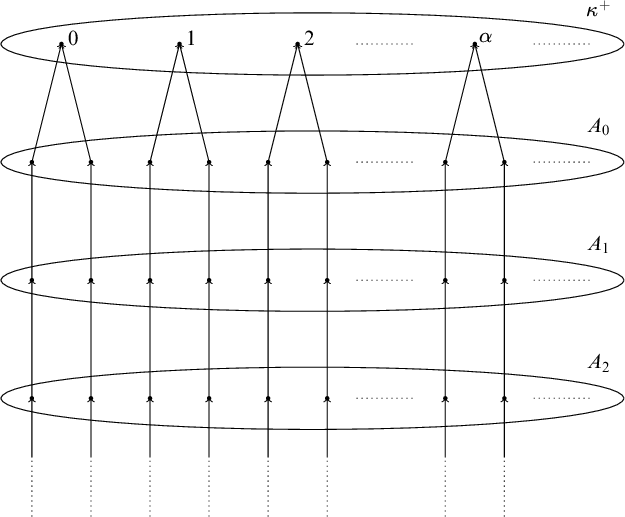
 $$\begin{align*}A=\bigcup_{n\in\omega}A_n, \end{align*}$$
where
 $$\begin{align*}A_n=\{\langle\alpha,i,n\rangle\mid\alpha<\kappa^+\text{ and }i<2\}. \end{align*}$$
Let
 $\mathcal {G}$
be the group of all permutations
 $\tau $
of A such that for each
 $\alpha <\kappa ^+$
, there is a permutation
 $p_\alpha $
of
 $\{0,1\}$
such that
 $\tau (\langle \alpha ,i,n\rangle )=\langle \alpha ,p_\alpha (i),n\rangle $
for all
 $i<2$
and all
 $n\in \omega $
. In other words,
 $\mathcal {G}$
is the group of all permutations of A that preserve the tree structure of
 $A\cup \kappa ^+$
illustrated in Figure 2. Then x belongs to the permutation model
 $\mathcal {V}$
determined by
 $\mathcal {G}$
if and only if
 $x\subseteq \mathcal {V}$
and x has a support of cardinality
 $\leqslant \kappa $
, that is, a subset
 $E\subseteq A$
with
 $|E|\leqslant \kappa $
such that every permutation
 $\tau \in \mathcal {G}$
fixing E pointwise also fixes x. Note that, for every
 $n\in \omega $
,
 $A_n$
is fixed by every permutation in
 $\mathcal {G}$
, so
 $A_n\in \mathcal {V}$
.
The tree structure of
 $A\cup \kappa ^+$
.

Lemma 3.1. For every
 $\beta \leqslant \kappa $
and every function
 $g:\beta \to \mathcal {V}$
, we have
 $g\in \mathcal {V}$
.
Proof. For all
 $\alpha <\beta $
,
 $g(\alpha )\in \mathcal {V}$
has a support
 $E_\alpha $
with
 $|E_\alpha |\leqslant \kappa $
. Let
 $E=\bigcup _{\alpha <\beta }E_\alpha $
. Then
 $|E|\leqslant \kappa $
and E supports each
 $g(\alpha )$
,
 $\alpha <\beta $
. Thus, E supports g, so
 $g\in \mathcal {V}$
.
Lemma 3.2. In
 $\mathcal {V}$
,
 $\mathsf {DC}_\kappa $
holds.
Proof. Let
 $S\in \mathcal {V}$
and let
 $R\in \mathcal {V}$
be a binary relation such that for all
 $\alpha <\kappa $
and all
 $\alpha $
-sequences
 $s\in \mathcal {V}$
of elements of
 $S,$
there is
 $y\in S$
such that
 $sRy$
. By Lemma 3.1, for each
 $\alpha <\kappa $
, every
 $\alpha $
-sequence s of elements of S belongs to
 $\mathcal {V}$
, so
 $sRy$
for some
 $y\in S$
. By the axiom of choice, there is a function
 $f:\kappa \to S$
such that
 $(f{\upharpoonright }\alpha )Rf(\alpha )$
for every
 $\alpha <\kappa $
. By Lemma 3.1 again,
 $f\in \mathcal {V}$
and so
 $\mathsf {DC}_\kappa $
holds in
 $\mathcal {V}$
.
Lemma 3.3. In
 $\mathcal {V}$
, for every
 $m\in \omega $
, there is no surjection from
 $A_m$
onto
 $A_m\cup \kappa ^+$
.
Proof. Let
 $m\in \omega $
. Assume towards a contradiction that there is a surjection
 $f\in \mathcal {V}$
from
 $A_m$
onto
 $A_m\cup \kappa ^+$
. Then f has a support E with
 $|E|\leqslant \kappa $
. Let
 $$\begin{align*}\tilde{E}=E\cup\{\langle\alpha,j,m\rangle\mid j<2\text{ and }\langle\alpha,i,n\rangle\in E\text{ for some }i<2\text{ and }n\in\omega\}. \end{align*}$$
Clearly,
 $|\tilde {E}|{\kern-1pt}\leqslant{\kern-1pt} \kappa $
,
 $\tilde {E}$
is a support of f, and for all
 $j{\kern-1pt}<{\kern-1pt}2$
and all
 $\langle \alpha ,i,n\rangle {\kern-1pt}\in{\kern-1pt} \tilde {E}$
,
 $\langle \alpha ,j,m\rangle {\kern-1pt}\in{\kern-1pt} \tilde {E}$
.
We claim that, for all
 $\alpha <\kappa ^+$
such that
 $\{\langle \alpha ,0,m\rangle ,\langle \alpha ,1,m\rangle \}\nsubseteq \tilde {E}$
,
 $$ \begin{align} f[\{\langle\alpha,0,m\rangle,\langle\alpha,1,m\rangle\}]=\{\langle\alpha,0,m\rangle,\langle\alpha,1,m\rangle\}. \end{align} $$
Let
 $j<2$
be such that
 $\langle \alpha ,j,m\rangle \notin \tilde {E}$
. Then
 $\langle \alpha ,i,n\rangle \notin \tilde {E}$
for all
 $i<2$
and all
 $n\in \omega $
. Let
 $i<2$
. Since f is surjective, it follows that
 $\langle \alpha ,i,m\rangle =f(\langle \alpha ',i',m\rangle )$
for some
 $\alpha '<\kappa ^+$
and
 $i'<2$
. If
 $\alpha '\neq \alpha $
, then there exists a permutation
 $\tau \in \mathcal {G}$
that fixes
 $\tilde {E}\cup \{\langle \alpha ',i',m\rangle \}$
pointwise and swaps
 $\langle \alpha ,i,m\rangle $
with
 $\langle \alpha ,1-i,m\rangle $
, contradicting that
 $\tilde {E}$
is a support of f. So
 $\alpha '=\alpha $
. Hence,
 $$\begin{align*}\{\langle\alpha,0,m\rangle,\langle\alpha,1,m\rangle\}\subseteq f[\{\langle\alpha,0,m\rangle,\langle\alpha,1,m\rangle\}], \end{align*}$$
from which (10) follows.
By (10) and the surjectivity of f, we have
 $\kappa ^+\subseteq f[\tilde {E}]$
, which is a contradiction since
 $|\tilde {E}|\leqslant \kappa $
.
Lemma 3.4. In
 $\mathcal {V}$
, the refinement postulate fails for surjective cardinals. In particular, if
 $\mathfrak {a}=|A|$
,
 $\mathfrak {b}=\kappa ^+$
, and
 $\mathfrak {c}_n=|A_n|$
for all
 $n\in \omega $
, then
 $\mathfrak {a}+\mathfrak {b}=^\ast \sum _{n\in \omega }\mathfrak {c}_n$
but there are no cardinals
 $\mathfrak {a}_n,\mathfrak {b}_n$
(
 $n\in \omega $
) in
 $\mathcal {V}$
such that
 $$\begin{align*}\mathfrak{a}=^\ast\sum_{n\in\omega}\mathfrak{a}_n,\quad\mathfrak{b}=^\ast\sum_{n\in\omega}\mathfrak{b}_n, \quad\text{and}\quad\mathfrak{c}_n=^\ast\mathfrak{a}_n+\mathfrak{b}_n\text{ for all }n\in\omega. \end{align*}$$
Proof. First, the function f on A defined by
 $$\begin{align*}f(\langle\alpha,i,n\rangle)= \begin{cases} \alpha & \text{if } n=0,\\ \langle\alpha,i,n-1\rangle & \text{if } n>0, \end{cases} \end{align*}$$
is a surjection from A onto
 $A\cup \kappa ^+$
. Clearly, f is fixed by every permutation in
 $\mathcal {G}$
, so
 $f\in \mathcal {V}$
. Hence, in
 $\mathcal {V}$
,
 $\mathfrak {a}+\mathfrak {b}=^\ast \sum _{n\in \omega }\mathfrak {c}_n$
.
Assume to the contrary that there are cardinals
 $\mathfrak {a}_n,\mathfrak {b}_n$
(
 $n\in \omega $
) in
 $\mathcal {V}$
such that
 $$\begin{align*}\mathfrak{a}=^\ast\sum_{n\in\omega}\mathfrak{a}_n,\quad\mathfrak{b}=^\ast\sum_{n\in\omega}\mathfrak{b}_n, \quad\text{and}\quad\mathfrak{c}_n=^\ast\mathfrak{a}_n+\mathfrak{b}_n\text{ for all }n\in\omega. \end{align*}$$
Since
 $\sum _{n\in \omega }\mathfrak {b}_n=^\ast \mathfrak {b}=\kappa ^+$
, it follows that
 $\sum _{n\in \omega }\mathfrak {b}_n=\kappa ^+$
, which implies that
 ${\mathfrak {b}_m=\kappa ^+}$
for some
 $m\in \omega $
. Hence,
 $$\begin{align*}\mathfrak{c}_m=^\ast\mathfrak{a}_m+\mathfrak{b}_m=\mathfrak{a}_m+\kappa^+=\mathfrak{a}_m+\kappa^++\kappa^+=^\ast\mathfrak{c}_m+\kappa^+, \end{align*}$$
contradicting Lemma 3.3.
Now, the next theorem immediately follows from Lemmas 3.2 and 3.4, along with a transfer theorem of Pincus [Reference Pincus5, Theorem 4].
Theorem 3.5. It is consistent with
 $\mathsf {ZF}+\mathsf {DC}_\kappa $
that surjective cardinals do not form a cardinal algebra.
4 Concluding remarks
To summarize, the article resolves the open question of whether surjective cardinals form a cardinal algebra, and demonstrates that they indeed form a surjective cardinal algebra. We conclude our article with some suggestions for further study.
In [Reference Tarski7], Tarski gives a combinatorial proof, and in [Reference Schwartz6], Schwartz presents a game-theoretic proof of the Bernstein division theorem. We wonder whether there are similar combinatorial or game-theoretic proofs of the cancellation law for surjective cardinals (Corollary 2.12). We note that Tarski’s combinatorial proof of the Bernstein division theorem relies heavily on the refinement postulate for cardinals, suggesting that a combinatorial proof of the cancellation law for surjective cardinals might be quite complex.
In [Reference Harrison-Trainor and Kulshreshtha3], Harrison-Trainor and Kulshreshtha give a complete axiomatization of the logic of cardinality comparison without the axiom of choice. It is worth replacing “cardinality” with “surjective cardinality” and exploring the corresponding complete axiomatization.