Introduction
Schizophrenia (SZ) is the leading cause of functional disability worldwide. Negative symptoms are the strongest predictor of functional disability. They also predict several other important clinical outcomes associated with poor prognosis, such as liability for illness, reduced subjective well-being, and lower rates of recovery (Pelletier-Baldelli, Strauss, Visser, & Mittal, Reference Pelletier-Baldelli, Strauss, Visser and Mittal2017; Piskulic et al., Reference Piskulic, Addington, Cadenhead, Cannon, Cornblatt, Heinssen and Walker2012; Strauss, Harrow, Grossman, & Rosen, Reference Strauss, Harrow, Grossman and Rosen2010; Strauss, Sandt, Catalano, & Allen, Reference Strauss, Sandt, Catalano and Allen2012). Unfortunately, currently available pharmacological and psychosocial treatments for negative symptoms have proven largely ineffective (Fusar-Poli et al., Reference Fusar-Poli, Papanastasiou, Stahl, Rocchetti, Carpenter, Shergill and McGuire2015).
To develop novel mechanistic targets for the treatment of negative symptoms, several theoretical accounts have been proposed, which focus on reward processing mechanisms resulting from disrupted cortico-striatal circuitry (Barch & Dowd, Reference Barch and Dowd2010; Kring & Barch, Reference Kring and Barch2014). These accounts all have the fundamental assumption of hedonic normality in SZ, and propose that other aspects of reward processing (e.g. value representation, reinforcement learning, effort-cost computation) that rely on cortico-striatal interactions prevent intact hedonic responses from influencing decision-making processes needed to motivate goal-directed behaviors that are deficient in those with negative symptoms (Strauss, Waltz, & Gold, Reference Strauss, Waltz and Gold2014).
Although such conceptual models of negative symptoms have been well-validated in adults with SZ, there is a lack of research on whether models developed for SZ also apply to youth at clinical high-risk (CHR) for psychosis. However, focusing on negative symptoms during this phase of illness may be beneficial, as negative symptoms are highly prevalent in CHR youth and one of the earliest markers of psychosis risk that often lead to initial contact with the treatment system (Addington & Heinssen, Reference Addington and Heinssen2012; Carrión et al., Reference Carrión, Demmin, Auther, McLaughlin, Olsen, Lencz and Cornblatt2016; Häfner, Löffler, Maurer, Hambrecht, & Heiden, Reference Häfner, Löffler, Maurer, Hambrecht and Heiden1999; Piskulic et al., Reference Piskulic, Addington, Cadenhead, Cannon, Cornblatt, Heinssen and Walker2012). Identifying mechanisms underlying negative symptoms in CHR youth may therefore be critical for achieving the goals of identifying individuals in the earliest phase of the prodrome when treatment efforts may be most effective at delaying or preventing illness onset (McGorry, Hickie, Yung, Pantelis, & Jackson, Reference McGorry, Hickie, Yung, Pantelis and Jackson2006; McGorry, Nelson, Goldstone, & Yung, Reference McGorry, Nelson, Goldstone and Yung2010).
The reward processing construct of ‘value representation’ has been proposed to be perhaps the most critical deficit underlying negative symptoms in adults with SZ, suggesting that it is an important domain to be explored in CHR youth. Value representation refers to the ability to generate, update, or maintain mental representations of reward value and use them to guide decision-making. The orbitofrontal cortex plays a critical role in value representation, enabling the calculation of an outcome's value, whether an outcome fulfills motivational needs, and making comparisons of one outcome's value to another's (Wallis, Reference Wallis2007). Individuals with SZ display impairments on tasks where value representations must be updated (e.g. probabilistic reversal learning, intradimensional/extradimensional set-shifting tasks, Iowa Gambling task) (Ceaser et al., Reference Ceaser, Goldberg, Egan, McMahon, Weinberger and Gold2008; Elliott, McKenna, Robbins, & Sahakian, Reference Elliott, McKenna, Robbins and Sahakian1995; Lee et al., Reference Lee, Kim, Seo, Park, Jeong, Kim and Lee2007; Pantelis et al., Reference Pantelis, Barber, Barnes, Nelson, Owen and Robbins1999; Sevy et al., Reference Sevy, Burdick, Visweswaraiah, Abdelmessih, Lukin, Yechiam and Bechara2007; Shurman, Horan, & Nuechterlein, Reference Shurman, Horan and Nuechterlein2005; Tyson, Laws, Roberts, & Mortimer, Reference Tyson, Laws, Roberts and Mortimer2004; Waltz, Frank, Wiecki, & Gold, Reference Waltz, Frank, Wiecki and Gold2011), generated [e.g. delay discounting (DD) and preference judgment tasks (Elliott, Agnew, & Deakin, Reference Elliott, Agnew and Deakin2010; Heerey, Matveeva, & Gold, Reference Heerey, Matveeva and Gold2011; Heerey, Robinson, McMahon, & Gold, Reference Heerey, Robinson, McMahon and Gold2007; Strauss et al., Reference Strauss, Robinson, Waltz, Frank, Kasanova, Herbener and Gold2011], and maintained (e.g. hedonic reactivity and maintenance tasks) (Gard et al., Reference Gard, Cooper, Fisher, Genevsky, Mikels and Vinogradov2011; Kring, Germans Gard, & Gard, Reference Kring, Germans Gard and Gard2011; Ursu et al., Reference Ursu, Kring, Gard, Minzenberg, Yoon, Ragland and Carter2011). Furthermore, impairment on these value representation tasks has been associated with greater severity of negative symptoms in SZ (Strauss et al., Reference Strauss, Waltz and Gold2014). Such findings have led some to propose that value representation may be the most fundamental deficit underlying negative symptoms, preventing intact reward responses from being used to guide decision-making processes needed to initiate approach motivation behaviors (e.g. social, recreational, role) (Barch & Dowd, Reference Barch and Dowd2010; Gold, Waltz, Prentice, Morris, & Heerey, Reference Gold, Waltz, Prentice, Morris and Heerey2008). Whether such deficits also occur in CHR and predict greater severity of negative symptoms has yet to be examined.
One commonly employed measure of value representation is the DD task (Kirby & Marakovic, Reference Kirby and Marakovic1996). DD assesses an individual's preference for hypothetical smaller, temporally proximal rewards over larger, temporally remote rewards. Based on these preferences, a DD function (k-value) is generated to estimate the rate at which an individual discounts reward size based on the delay of reward receipt. Smaller k-values reflect a slower discounting rate, or a preference for larger delayed rewards (LDRs), whereas larger k-values reflect a steeper discounting rate, or a preference for smaller immediate rewards (SIRs). Outside of schizophrenia (SZ), the steeper discounting rate has been associated with lower intelligence (Shamosh & Gray, Reference Shamosh and Gray2008), reduced working memory capacity (Shamosh et al., Reference Shamosh, DeYoung, Green, Reis, Johnson, Conway and Gray2008), obesity (Amlung, Petker, Jackson, Balodis, & MacKillop, Reference Amlung, Petker, Jackson, Balodis and MacKillop2016), and greater impulsivity and addictive behavior (MacKillop et al., Reference MacKillop, Amlung, Few, Ray, Sweet and Munafò2011).
Several studies have examined DD performance in SZ. Most have found that individuals with SZ have steeper discounting rates than healthy controls (Ahn et al., Reference Ahn, Rass, Fridberg, Bishara, Forsyth, Breier and O'donnell2011; Avsar et al., Reference Avsar, Weller, Cox, Reid, White and Lahti2013; Brown, Hart, Snapper, Roffman, & Perlis, Reference Brown, Hart, Snapper, Roffman and Perlis2018; Heerey et al., Reference Heerey, Robinson, McMahon and Gold2007; Weller et al., Reference Weller, Avsar, Cox, Reid, White and Lahti2014; Yu et al., Reference Yu, Lee, Katchmar, Satterthwaite, Kable and Wolf2017); however, findings have not been consistent across all studies (Horan, Johnson, & Green, Reference Horan, Johnson and Green2017; Kirschner et al., Reference Kirschner, Hager, Muff, Bischof, Hartmann-Riemer, Kluge and Kaiser2016; MacKillop & Tidey, Reference MacKillop and Tidey2011; Wang et al., Reference Wang, Jin, He, Chen, Ji, Bai and Wang2018; Wing, Moss, Rabin, & George, Reference Wing, Moss, Rabin and George2012). Neuroimaging studies indicate that steeper discounting is associated with aberrant activation in brain regions associated with executive function (inferior frontal gyri, dorsal anterior cingulate cortex, posterior parietal cortex) and reward processing (ventral striatum and mid-brain) (Avsar et al., Reference Avsar, Weller, Cox, Reid, White and Lahti2013). The steeper discounting rate has been associated with greater severity of cognitive impairment (Ahn et al., Reference Ahn, Rass, Fridberg, Bishara, Forsyth, Breier and O'donnell2011; Brown et al., Reference Brown, Hart, Snapper, Roffman and Perlis2018; Heerey et al., Reference Heerey, Robinson, McMahon and Gold2007; Yu et al., Reference Yu, Lee, Katchmar, Satterthwaite, Kable and Wolf2017) and negative symptoms (Horan et al., Reference Horan, Johnson and Green2017) in some studies; however, other studies have found null or inconsistent results (Heerey et al., Reference Heerey, Robinson, McMahon and Gold2007; Horan et al., Reference Horan, Johnson and Green2017; Weller et al., Reference Weller, Avsar, Cox, Reid, White and Lahti2014). Similar findings have emerged in first-degree relatives (Ho, Barry, & Koeppel, Reference Ho, Barry and Koeppel2018) and individuals with high negative schizotypy traits (Cai et al., Reference Cai, Weigl, Liu, Cheung, Ding and Chan2018) [however, see Wang et al. (Reference Wang, Jin, He, Chen, Ji, Bai and Wang2018) and Yu et al. (Reference Yu, Lee, Katchmar, Satterthwaite, Kable and Wolf2017)]. Collectively, these findings suggest that impairments in value representation exist both in individuals with SZ, as well as first-degree relatives and those with schizotypal traits who are putatively at risk for psychosis. Given these prior findings and that value representation has been proposed to be a core facet of negative symptoms in adults with SZ (Gold et al., Reference Gold, Waltz, Prentice, Morris and Heerey2008), DD may offer insight into the mechanisms underlying negative symptoms in the prodromal phase.
Two studies were conducted to evaluate value representation impairments in adults with SZ (Study 1) and CHR youth (Study 2) using the DD paradigm. These studies had multiple aims. First, to replicate past findings of altered DD in SZ. Based on abundant evidence from previous studies, we hypothesized that individuals with SZ would discount rewards more steeply than controls. Second, to determine whether youth at CHR exhibits altered value representation. We predicted that CHR participants would also discount rewards more steeply than controls. Third, to determine whether DD is related to negative symptoms and cognition across phases of illness. We expected that the steeper discounting rate would be associated with more severe negative symptoms and greater cognitive impairment in both youth at CHR and adults with SZ. Additionally, we predicted that steeper discounting would be associated with higher risk for conversion in CHR participants using a cross-sectional psychosis risk calculator (Zhang et al., Reference Zhang, Xu, Tang, Li, Tang, Cui and Liu2018).
Method
Study 1
Participants
Forty Healthy controls (CN) and 36 outpatients meeting DSM-5 criteria for schizophrenia or schizoaffective disorder (SZ) were included in the study. SZ participants were recruited from local outpatient mental health clinics or online/printed advertisements, and evaluated during periods of clinical stability (defined as no change in medication type of dose within the past 4 weeks). Diagnosis was established via a best-estimate approach based on psychiatric history and the Structured Clinical Interview for DSM-5 [SCID-5: (First, Williams, Karg, & Spitzer, Reference First, Williams, Karg and Spitzer2015)]. All SZ patients had experienced multiple episodes and were generally in the chronic phase of illness.
Healthy control participants (CN) were recruited through printed and online advertisements. CN participants did not meet criteria for any current major psychiatric illnesses (i.e. mood, anxiety, obsessive compulsive disorders, etc.) or SZ-spectrum personality disorders as determined by the SCID-5 (First et al., Reference First, Williams, Karg and Spitzer2015) and SCID-5-PD (First, Williams, Benjamin, & Spitzer, Reference First, Williams, Benjamin and Spitzer2015). CN also had no family history of psychosis and did not meet lifetime criteria for psychotic disorders. Exclusion criteria for all participants included substance dependence in the last 6 months and lifetime history of neurological disorders associated with cognitive impairment (e.g. Traumatic Brain Injury, Epilepsy).
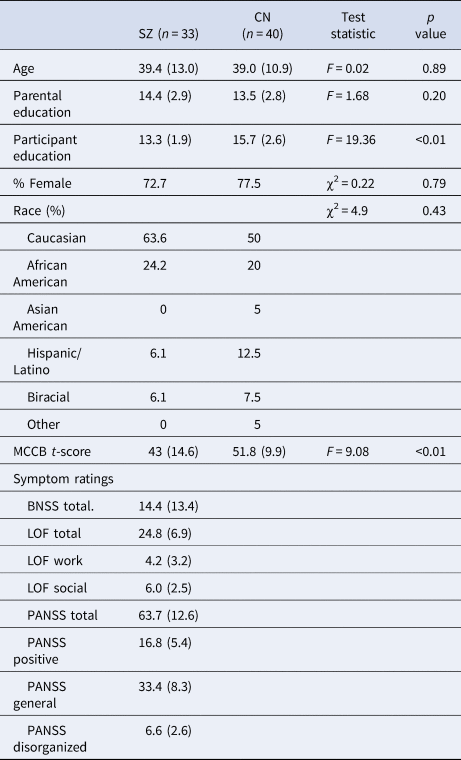
Of the 36 SZ and 40 CN, 3 SZ and 0 CN met criteria for inconsistent responding on the DD task. As it is common to exclude inconsistent responders (Kirby, Reference Kirby2000), these 3 SZ were not included in analyses. The final group included 33 SZ and 40 CN. These final groups did not significantly differ in age, parental education, sex, or ethnicity; however, SZ had lower personal education than CN (see Table 1).
Study 1 demographic and clinical characteristics

SZ, schizophrenia group; CN, control group; MCCB, MATRICS Consensus Cognitive Battery; BNSS, Brief Negative Symptom Scale; LOF, Level of Function Scale; PANSS, Positive and Negative Syndrome Scale.
Note. A total of 19 SZ were prescribed second-generation antipsychotics and 1 was on both first- and second-generation antipsychotics. Thirteen SZ participants were stably unmedicated and not prescribed an antipsychotic at testing.
Procedure
All participants provided written informed consent and received monetary compensation for their participation. Study procedures were approved by the University of Georgia Institutional Review Board. Participants completed a series of clinical interviews conducted by a clinical psychologist (GPS) or examiners trained to reliability standards (>0.80) using gold standard training videos developed by the PI (GPS). In cases of the latter, examiners consulted with the PI for consensus. To establish diagnosis, all participants were rated on SCID-5 criteria (First et al., Reference First, Williams, Karg and Spitzer2015), and SCID-5-PD (First et al., Reference First, Williams, Benjamin and Spitzer2015) SZ-spectrum criteria for CN only. SZ participants were also rated on the Brief Negative Symptom Scale [BNSS: (Kirkpatrick et al., Reference Kirkpatrick, Strauss, Nguyen, Fischer, Daniel, Cienfuegos and Marder2010)], Positive and Negative Syndrome Scale [PANSS: (Kay, Fiszbein, & Opler, Reference Kay, Fiszbein and Opler1987)], and Level of Function Scale [LOF: (Hawk, Carpenter, & Strauss, Reference Hawk, Carpenter and Strauss1975)]. Participants then completed the MATRICS Consensus Cognitive Battery [MCCB: (Nuechterlein et al., Reference Nuechterlein, Green, Kern, Baade, Barch, Cohen and Gold2008)] and the DD task (Kirby, Petry, & Bickel, Reference Kirby, Petry and Bickel1999). The 5-factor model of the PANSS was used to examine symptom associations (Wallwork, Fortgang, Hashimoto, Weinberger, & Dickinson, Reference Wallwork, Fortgang, Hashimoto, Weinberger and Dickinson2012).
Delay discounting task
All participants completed a computerized version of the DD task for hypothetical monetary rewards (Kirby et al., Reference Kirby, Petry and Bickel1999). Over the course of 27 trials, subjects were asked to choose between a SIR and a LDR by responding via left and right button presses on a keyboard. SIRs included rewards of three sizes: small ($11–34), medium ($20–54), and large ($31–80). LDRs also included rewards of three sizes: small ($25–35), medium ($50–60), and large ($75–85). Based on methods from Kirby (Reference Kirby2000), each choice was assigned a k-value, which represents the hyperbolic discount parameter at indifference between choosing LDR and SIR values, and is calculated using the equation by Mazur, Mazur, and Nevin (Reference Mazur, ML., Mazur, Nevin, Commons, Mazur, Nevin and Rachlin1987):

Subjects' k-values were estimated independently for each reward size by calculating the geometric mean of the largest k-value at which they chose the LDR and the smallest k-value at which they chose the SIR. For example, if an individual chose the LDR on a question with a k-value of 0.1 (a choice consistent with k smaller than 0.1), and then chose the SIR at the next smallest k-value of 0.041, the participant's k-value would be determined by taking the geometric mean of the two k-values (0.1 and 0.041). Therefore, a person selecting the aforementioned choices would have an estimated k-value of 0.064. Monitoring response consistency is important for accurately estimating k-values. Inconsistent responding refers to switching between LDR and SIR choices multiple times. k-Values and consistency values were calculated for each individual within each reward size (small, medium, and large) based on procedures by Kirby (Reference Kirby2000). Three participants in the SZ group demonstrated inconsistent response patterns (⩽89% consistent, determined a priori) and were excluded from analysis.
Data analysis
The discounting rate was analyzed using a 2 Group (SZ, CN) x 3 Reward Magnitude (small, medium, and large k values) repeated measures ANOVA. Bivariate correlations were used to determine associations between discounting rate and symptoms, functional outcome, and cognition.
Study 2
Participants
Forty-five healthy controls (CN) and 37 CHR youth were included in the study. CHR participants were recruited from two psychosis risk evaluation programs directed by the PI (GPS), which received referrals from local clinicians (e.g. Psychiatrists, Psychologists, Social Workers, School Psychiatrists) to perform diagnostic assessment and monitoring evaluations for youth displaying psychotic experiences. Additional recruitment methods included online and print advertisements, in-person presentations to community mental health centers, and calls or in-person meetings with members of the local school system (e.g. superintendent, principals). All CHR youth met criteria for a prodromal syndrome on the structured interview for prodromal syndromes [SIPS; (Miller et al., Reference Miller, McGlashan, Rosen, Cadenhead, Cannon, Ventura and Woods2003)]: (1) attenuated positive symptoms (i.e. SIPS score of at least 3–5 on at least one positive symptom item, with worsening symptoms over the past year) (n = 34); (2) genetic risk and deterioration syndrome (i.e. 1st degree relative with a psychotic disorder and decline in global functioning over the past year) (n = 2); and (3) brief intermittent psychosis syndrome (i.e. SIPS score of 6 on at least one positive symptom item, with symptoms present at least several minutes a day at a frequency of at least once per month) (n = 1). None of the CHR participants met lifetime criteria for a DSM-5 psychotic disorder as determined via SCID-5 interview (First et al., Reference First, Williams, Karg and Spitzer2015).
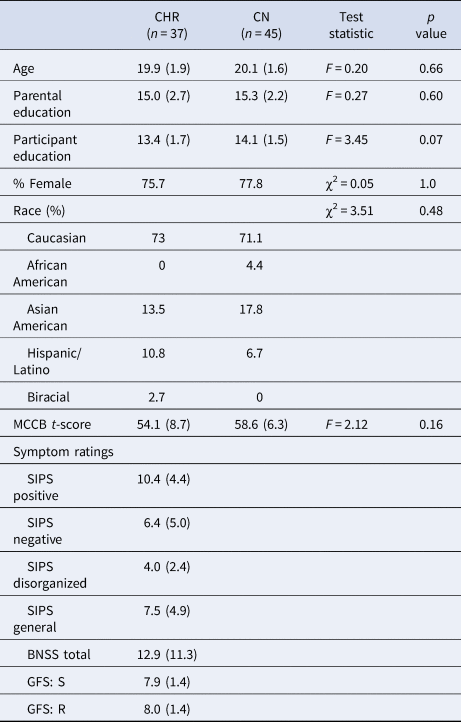
CN participants were recruited from the local community using posted flyers, newspapers advertisements, and electronic advertisements. CN participants had no current major psychiatric disorder diagnoses and no SZ-spectrum personality disorders as established by the SCID-5 (First et al., Reference First, Williams, Karg and Spitzer2015) and SCID-5-PD (First et al., Reference First, Williams, Benjamin and Spitzer2015), no family history of psychosis, and were not taking psychotropic medications. All participants were free from lifetime neurological disease. Groups did not significantly differ on age, ethnicity, sex, personal education, or parental education (see Table 2).
Study 2 demographic and clinical characteristics

CHR, clinical high-risk group; CN, control group; MCCB, MATRICS Consensus Cognitive Battery; SIPS, Structured Interview for Prodromal Syndromes; BNSS, Brief Negative Symptom Scale; GFS: S, Global Functioning Scale: Social; GFS: R, Global Functioning Scale: Role.
Note. Twenty-six CHR participants were not on any psychiatric medication, one CHR participant was prescribed an antipsychotic, seven were prescribed an antidepressant, four were prescribed an anxiolytic, and two were prescribed mood stabilizers.
Procedure
Participants provided written informed consent and received monetary compensation for their participation. Study procedures were approved by the Binghamton University and University of Georgia Institutional Review Boards. Participants completed a structured clinical interview to rate the SCID-5 (First et al., Reference First, Williams, Karg and Spitzer2015) and SCID-5-PD (First et al., Reference First, Williams, Benjamin and Spitzer2015), SIPS (Miller et al., Reference Miller, McGlashan, Rosen, Cadenhead, Cannon, Ventura and Woods2003), BNSS (Strauss & Chapman, Reference Strauss and Chapman2018), Global Functioning Scale: Social [GFS:S (Cornblatt et al., Reference Cornblatt, Auther, Niendam, Smith, Zinberg, Bearden and Cannon2007)], and Global Functioning Scale: Role [GFS:R (Cornblatt et al., Reference Cornblatt, Auther, Niendam, Smith, Zinberg, Bearden and Cannon2007)]. Interviews were conducted by a clinical psychologist (GPS) or examiners trained to reliability standards (>0.80) using gold standard training videos developed by the PI. In cases of the latter, examiners consulted with the PI for consensus. A cross-sectional conversion risk prediction score was calculated for CHR participants using an algorithm by Zhang et al. (Reference Zhang, Xu, Tang, Li, Tang, Cui and Liu2018) that uses functional decline, positive, negative, and general symptom scale items from the SIPS. After the interview, participants completed the MCCB (Nuechterlein et al., Reference Nuechterlein, Green, Kern, Baade, Barch, Cohen and Gold2008) and the DD task.
Delay discounting task
Task procedures were identical to study 1. All participants demonstrated consistent responding and were included in the analysis.
Data analysis
The analytic plan was identical to study 1.
Results
Study 1
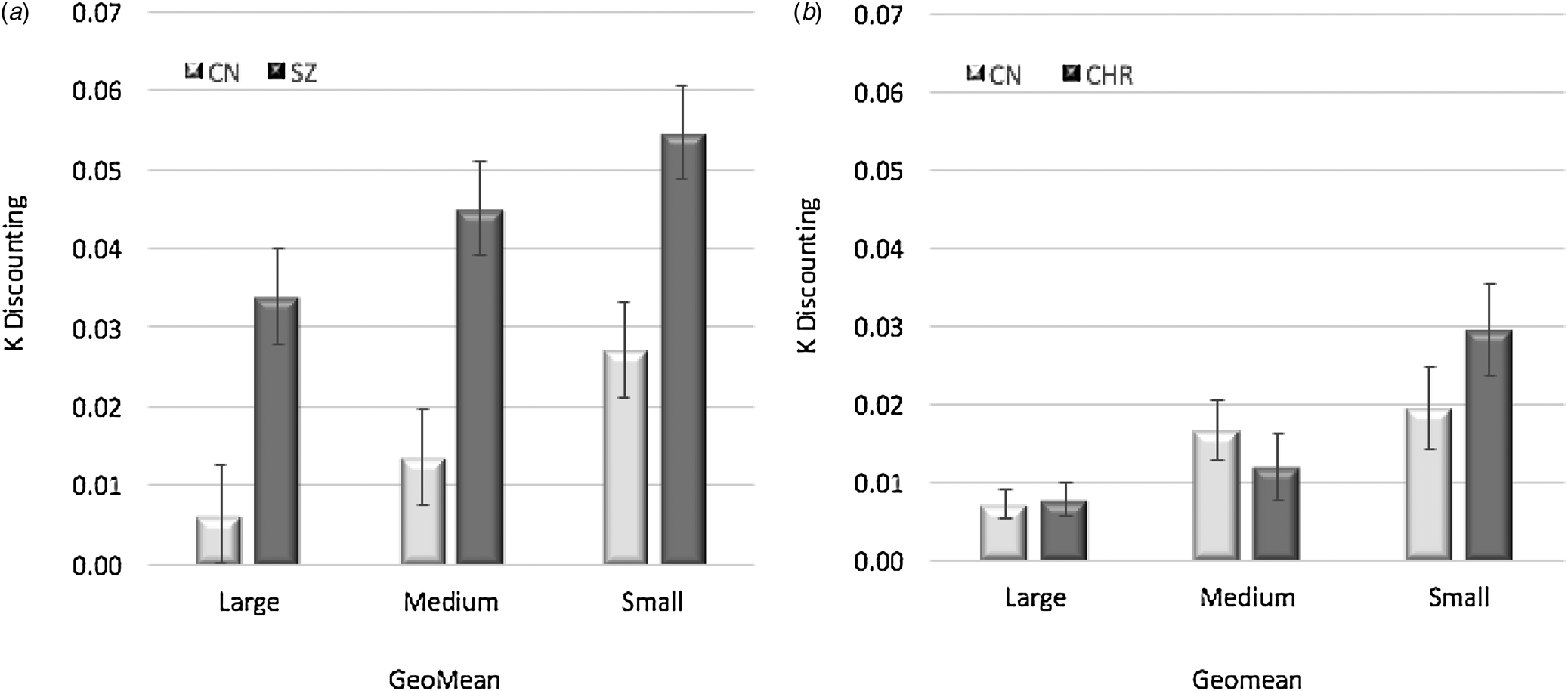
The within-subjects effect of value level, F (2, 71) = 18.61, p < 0.001, η p2 = 0.21, and between-subjects effect of group, F (1, 71) = 6.17, p = 0.02, η p2 = 0.08, were significant. However, the 2 group (SZ, CN) X 3 value level (mall, medium, and large) interaction was nonsignificant, F (2, 142) = 0.40, p = 0.67, η p2 = 0.01. Pairwise contrasts used to follow-up the significant main effect of the value level indicated that discounting was steeper for large than medium, large than small, and medium than small values (p < 0.001 for all). One way ANOVA confirmed that SZ had steeper discounting than CN for large F (1, 71) = 5.51, p = 0.02, η p2 = 0.07, medium F (1, 71) = 6.96, p = 0.01, η p2 = 0.10, and small reward values F (1, 71) = 4.51, p = 0.04, η p2 = 0.06. These findings suggest that value representation is impaired in SZ and characterized by a preference for smaller, immediate rewards (see Fig. 1a).
Delay discounting in SZ and clinical high-risk for psychosis participants.
Note. SZ, schizophrenia group; CN, control group; CHR, clinical high-risk group. A, discounting rate by reward size and group for SZ and CN. B, discounting rate by reward size and group for CHR and CN. Results indicated that SZ had steeper discounting than CN for all 3 value levels (Fig. 1a); however, CHR and CN did not differ for any value level (Fig. 1b).

In SZ, steeper discounting (measured via the average DD geomean score) was associated with poorer working memory (r = −0.56, p < 0.001), poorer global cognition (r = −0.61, p < 0.001), number of cigarettes smoked per day (r = 0.49, p = 0.03), and greater severity of BNSS asociality (r = 0.39, p = 0.03). Partialing out the effects of depression did not attenuate this significant correlation with asociality. The discounting rate was not significantly associated with the other BNSS domains or total score, LOF scores, or other PANSS factors.
Study 2
The within-subjects effect of the reward value was significant, F (2, 80) = 19.78, p < 0.001, η p2 = 0.20. However, the between-subjects effects of group, F (1, 80) = 0.04, p = 0.84, η p2 = 0.001, and the group X reward value interaction, F (2, 80) = 1.48, p = 0.23, η p2 = 0.02, were nonsignificant. Pairwise contrasts used to follow-up the significant main effect of the value level indicated that discounting was steeper for large than medium, large than small, and medium than small values (p < 0.001 for all). The significant differences among value levels indicate that the DD task functioned as expected, but DD performance is unimpaired in CHR participants (see Fig. 1b).
In CHR, steeper discounting was associated with greater severity of BNSS anhedonia (r = 0.34, p = 0.04). Partialing out the effects of depression did not attenuate this significant correlation. The discounting rate was not associated with GFS: S or GFS: R scores, MCCB working memory or MCCB total score, SIPS positive, negative, disorganized, or general scores, or predicted conversion risk. The rate of smoking was too low for correlations with smoking behavior to be conducted in CHR.
Discussion
The primary goal of the current study was to determine whether similar mechanisms underlie negative symptoms across phases of psychotic illness. In particular, we focused on a reward processing deficit thought to be core to negative symptoms of SZ, value representation (Gold et al., Reference Gold, Waltz, Prentice, Morris and Heerey2008), and conducted two studies using the DD paradigm to determine whether value representation was: (1) impaired in adults with SZ (study 1) and CHR youth (study 2) and (2) associated with greater negative symptom severity and more severe cognitive impairment across phases of illness.
The majority of prior studies using DD in SZ have found that patients have steeper discounting rates than CN, consistent with a deficit in value representation (Ahn et al., Reference Ahn, Rass, Fridberg, Bishara, Forsyth, Breier and O'donnell2011; Avsar et al., Reference Avsar, Weller, Cox, Reid, White and Lahti2013; Brown et al., Reference Brown, Hart, Snapper, Roffman and Perlis2018; Heerey et al., Reference Heerey, Robinson, McMahon and Gold2007; Weller et al., Reference Weller, Avsar, Cox, Reid, White and Lahti2014; Yu et al., Reference Yu, Lee, Katchmar, Satterthwaite, Kable and Wolf2017). The current study replicated the significant between group effect observed in most prior studies. Correlations between the discounting rate and clinical outcomes have been inconsistent in past SZ studies. Specifically, steeper discounting has been associated with negative symptoms and working memory impairment in several studies (Ahn et al., Reference Ahn, Rass, Fridberg, Bishara, Forsyth, Breier and O'donnell2011; Brown et al., Reference Brown, Hart, Snapper, Roffman and Perlis2018; Heerey et al., Reference Heerey, Robinson, McMahon and Gold2007; Horan et al., Reference Horan, Johnson and Green2017; Yu et al., Reference Yu, Lee, Katchmar, Satterthwaite, Kable and Wolf2017); however, findings have been nonsignificant or in the opposite direction in other studies (Heerey et al., Reference Heerey, Robinson, McMahon and Gold2007; Horan et al., Reference Horan, Johnson and Green2017; Weller et al., Reference Weller, Avsar, Cox, Reid, White and Lahti2014). In the current study, steeper discounting was associated with greater working memory impairment and more severe negative symptoms, replicating findings of several prior studies (Ahn et al., Reference Ahn, Rass, Fridberg, Bishara, Forsyth, Breier and O'donnell2011; Brown et al., Reference Brown, Hart, Snapper, Roffman and Perlis2018; Heerey et al., Reference Heerey, Robinson, McMahon and Gold2007; Yu et al., Reference Yu, Lee, Katchmar, Satterthwaite, Kable and Wolf2017). Inconsistencies in group effects and negative symptom correlations among past DD studies may reflect methodological differences, such as use of first v. second generation negative symptom scales, whether K-values were normalized or not, and differences in equations used to calculate K, or DD task version.
Contrary to hypotheses, CHR did not differ from CN on the discounting rate. This may suggest that value representation is intact in the CHR population. Alternatively, it is possible that sampling bias led to an over-representation of CHR subjects with clinical and neural profiles that were less likely to show a deficit. Since only ~20% of CHR convert to a full psychotic disorder, it may be that value representation deficits are only pronounced in those who eventually transition. Longitudinal studies are needed to test this possibility. However, as hypothesized, greater severity of negative symptoms was associated with a steeper discounting rate, similar to SZ. Partialing out the effects of depression did not attenuate this significant correlation, suggesting that the increased rates of depression observed in the CHR population (Addington et al., Reference Addington, Piskulic, Liu, Lockwood, Cadenhead, Cannon and Woods2017; Kline et al., Reference Kline, Seidman, Cornblatt, Woodberry, Bryant, Bearden and Addington2018) do not account for this negative symptom effect. These findings suggest that value representation may be a key mechanism of negative symptoms transphasically.
Some have proposed that basic cognitive impairments, particularly in the domain of working memory, may play a role in DD deficits (Collins, Brown, Gold, Waltz, & Frank, Reference Collins, Brown, Gold, Waltz and Frank2014; Gold et al., Reference Gold, Waltz, Prentice, Morris and Heerey2008; Heerey et al., Reference Heerey, Matveeva and Gold2011). This appeared to be true in our SZ sample, but not our CHR sample. Our CHR sample, like many others (Brewer et al., Reference Brewer, Wood, Phillips, Francey, Pantelis, Yung and McGorry2006), did not display cognitive impairments of the same magnitude as SZ. Thus, it is possible that the intact DD performance observed in the CHR sample is a byproduct of relatively preserved working memory performance. As suggested by Collins et al. (Reference Collins, Brown, Gold, Waltz and Frank2014), it may be that reward processing and working memory deficits are intricately inter-related and critical to the etiology of negative symptoms. Future studies are needed to examine this possibility using tasks that manipulate both reward and working memory demands concurrently in both longitudinal CHR and SZ samples.
Certain limitations should be considered. First, although this CHR data is part of a larger longitudinal study, only baseline cross-sectional data were available for this initial report. We were therefore unable to determine whether participants in our sample who will eventually transition to a psychotic disorder display value representation deficits, whereas non-converters do not. Future reports will address this question. Second, although only one CHR subject was prescribed an antipsychotic, we cannot rule out a potential role of antipsychotics in driving DD deficits occur in SZ but not CHR. Third, differences have been observed between DD tasks that manipulate hypothetical v. actual monetary rewards (Horan et al., Reference Horan, Johnson and Green2017). We did not examine this manipulation in the current study, and it is possible that the clinical groups might behave differently in the presence of actual compared to hypothetical rewards that were implemented here. Finally, we conceptualized the DD task as a measure of value representation because it requires participants to generate mental representations related to both time and value, combine them, and use those representations to guide decision-making. However, some have conceptualized this task as a measure of impulsivity (Bickel, Odum, & Madden, Reference Bickel, Odum and Madden1999). We believe our conceptualization of the task as a measure of value representation accurately reflects the construct, as supported by the inclusion of this measure in the ‘Reward Valuation’ domain of the NIMH RDoC matrix. But, other tasks may measure value representation more purely by eliminating the temporal discounting element. Other tasks measuring the value representation construct, such as reversal learning (Culbreth, Gold, Cools, & Barch, Reference Culbreth, Gold, Cools and Barch2016) might yield different results and should be evaluated in future studies
Identifying mechanisms underlying negative symptoms in CHR youth is an urgent need for our field. Negative symptoms are highly prevalent during this phase, one of the key factors that bring CHR youth into contact with the medical system, and a strong predictor of conversion (Demjaha, Valmaggia, Stahl, Byrne, & McGuire, Reference Demjaha, Valmaggia, Stahl, Byrne and McGuire2010; Johnstone, Ebmeier, Miller, Owens, & Lawrie, Reference Johnstone, Ebmeier, Miller, Owens and Lawrie2005; Lencz, Smith, Auther, Correll, & Cornblatt, Reference Lencz, Smith, Auther, Correll and Cornblatt2004; Piskulic et al., Reference Piskulic, Addington, Cadenhead, Cannon, Cornblatt, Heinssen and Walker2012; Schlosser et al., Reference Schlosser, Jacobson, Chen, Sugar, Niendam, Li and Cannon2012; Valmaggia et al., Reference Valmaggia, Stahl, Yung, Nelson, Fusar-Poli, McGorry and McGuire2013; Yung & McGorry, Reference Yung and McGorry1996). The current study is one of a series of studies by our group [see also Strauss, Ruiz, Visser, Crespo, and Dickinson (Reference Strauss, Ruiz, Visser, Crespo and Dickinson2018)] attempting to determine whether reward processing mechanisms related to negative symptoms in SZ are also impaired in CHR and associated with negative symptoms. Value representation may be a key mechanism contributing to negative symptoms transphasically, leading SZ and CHR to be less able to use mental representations of reward value to influence decision-making processes that are needed to initiate approach behaviors (e.g. goal-directed, social, or recreational activities).